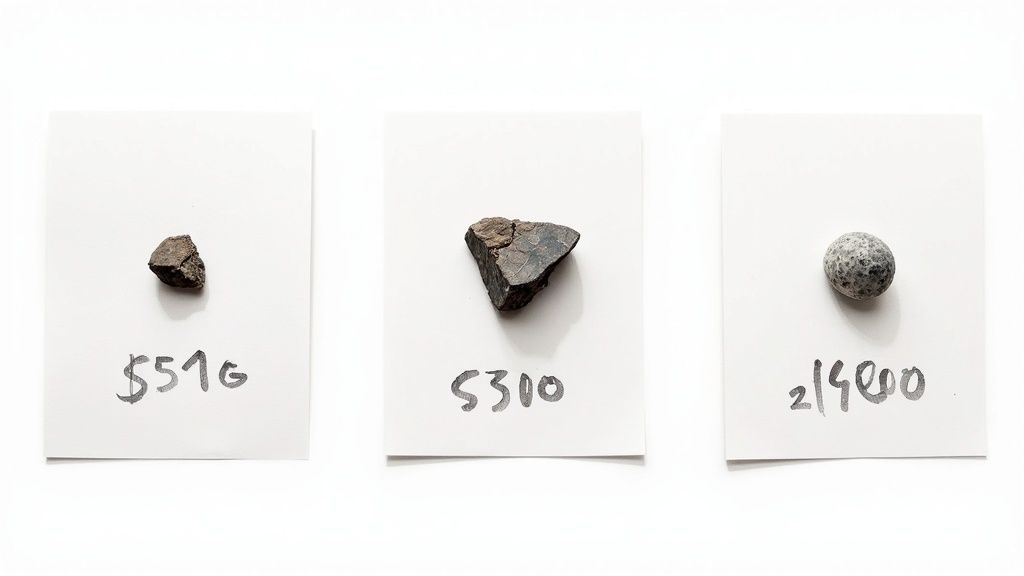
If you're new to the world of meteorites, the first thing you'll notice is the wild range in prices. A piece can cost less than $1 per gram, while another, seemingly similar one, might fetch over $1,000 per gram. This isn't like buying a standard commodity; it's much closer to collecting fine art, where every single piece has its own unique story, rarity, and value.
What Is the True Price of a Meteorite?
You can't determine a meteorite's price by simply putting it on a scale. Its worth is a complex blend of factors that both scientists and collectors get excited about. In this fascinating market, a small, unassuming stone can easily be worth far more than a much larger, more common one.
To really get a feel for this, it helps to think about the idea of understanding intrinsic value. While that term is usually thrown around in the stock market, the core principle is the same here: value comes from unique, inherent qualities. For a meteorite, those qualities are its cosmic origin, its specific composition, and the incredible story of its journey to Earth.
A Spectrum of Cosmic Value
The meteorite market is incredibly diverse. At one end, you have the common types like ordinary chondrites. They're relatively abundant, making them an affordable entry point for new collectors. At the complete other end of the spectrum, you'll find fragments of the Moon or Mars—pieces so extraordinarily rare they command prices on par with precious gems.
Prices can swing dramatically based on where a meteorite came from and what it's made of. For example:
Ordinary chondrites usually go for $2 to $5 per gram.
More exotic stony-iron types like pallasites can jump to $20 to $40 per gram.
The true heavy hitters, lunar and martian meteorites, can sell for $1,000 per gram or more, a price that speaks directly to their unbelievable rarity.
The most valuable meteorites are those that hit the trifecta: rarity, stunning beauty, and a compelling history. A "witnessed fall"—where people actually saw the meteorite streak through the sky and land—can make a specimen significantly more valuable than one that was simply found lying in a desert years later.
A Quick Guide to Meteorite Prices
To give you a clearer picture, here’s a quick-reference table outlining the typical price ranges for some of the main meteorite types. It really highlights how dramatically the value can shift from one classification to another.
Typical Price Ranges of Meteorites by Type
Meteorite Type
Typical Price Per Gram
Key Characteristics
Ordinary Chondrite
$0.50 – $5
The most common type, made up of tiny stony spheres called chondrules.
Iron (e.g., Campo del Cielo)
$1 – $4
Dense and metallic. These are often used for impressive sculptural pieces.
Pallasite
$20 – $100+
Beautiful stony-iron meteorites filled with gem-like olivine crystals.
Lunar (Moon Rock)
$1,000+
Incredibly rare fragments of the Moon's surface, blasted into space by an impact.
As you dive deeper into this hobby, you can explore resources covering historical and current meteorite prices to get a better sense of market trends and what makes certain pieces so desirable.
The Key Factors That Determine Meteorite Value
Figuring out the price of a meteorite isn't a simple price-per-gram formula. It's much more like appraising a rare diamond, where a whole suite of characteristics has to be sized up. It's a fascinating mix of science, history, and pure aesthetics that can make two space rocks of the exact same weight have wildly different values.
Think of it this way: a one-carat, flawed, and cloudy diamond is worth just a fraction of a one-carat, flawless, brilliantly cut stone. The same logic applies here. The factors behind a meteorite's value are what elevate it from a simple rock into a prized cosmic artifact. Let's break down what the experts look at to determine what a piece of the cosmos is truly worth.
Type and Classification
The single biggest factor driving a meteorite's price is its type. Meteorites fall into three main families—stony, iron, and stony-iron—and the differences between them create enormous gaps in value. This is always the first question any serious collector will ask.
Just knowing these basic categories starts to make the market much clearer. If you want to get into the nitty-gritty of their mineral and elemental makeup, you can check out our guide on what meteorites are made of. This knowledge is foundational to understanding why one type is so much more sought-after than another.
Stony Meteorites: This group includes the very common chondrites, which are the most abundant and usually the most affordable meteorites out there. But it also includes the incredibly rare achondrites, like lunar and Martian meteorites, which command the absolute highest prices on the market.
Iron Meteorites: Made mostly of iron and nickel, these are dense, heavy, and often have beautiful, sculptural surfaces. They're more durable and visually striking than most chondrites, which puts them solidly in the mid-tier price range.
Stony-Iron Meteorites: These are the rarest and often the most visually stunning of the main types. Pallasites, which are filled with gem-like olivine crystals suspended in a metallic matrix, are the superstars here. Collectors go crazy for them.
Rarity Is Everything
Right behind type is rarity. In any world of collectibles, scarcity is what drives desire and, ultimately, price. A meteorite from a fall that showered thousands of kilograms of material over the landscape, like the Sikhote-Alin event in Russia, is going to be far more accessible than one from a tiny event where only a few grams were ever recovered.
This is exactly why lunar and Martian meteorites are the undisputed kings of the market. Only a few hundred have ever been found on Earth, making them exponentially rarer than even the most precious earthly gemstones. For many, owning a piece of another world is the ultimate prize.
The core principle is simple supply and demand. If a meteorite type represents less than 1% of all known falls, its value will be significantly higher. For pieces of the Moon or Mars, which represent a tiny fraction of that 1%, the price skyrockets accordingly.
Size and Weight
While rarity and type are the heavy hitters, size still plays a big part in a meteorite’s final price. For the most part, the value is calculated per gram, so a bigger specimen will naturally cost more than a smaller one of the same type. But the math isn't always so linear.
For example, a complete, multi-kilogram iron meteorite might actually have a lower price-per-gram than a small, perfectly formed slice of pallasite. At the same time, a massive, museum-quality specimen often carries a premium that goes far beyond its simple weight. These "hero" pieces are valued for their sheer scale and incredible visual impact.
Condition and Aesthetics
A meteorite’s chaotic journey through our atmosphere and its time spent on Earth take a toll on its condition, which in turn hits its value. Collectors prize specimens that are as close to their landed state as possible, showing minimal weathering or damage from their time on the ground.
Several aesthetic features can dramatically boost a specimen's worth:
Fusion Crust: This is the thin, dark, glassy coating that forms on a meteorite's surface as it burns through the atmosphere. A specimen with a complete or nearly complete fusion crust is a huge plus because it's a direct record of its fiery plunge.
Regmaglypts: These are the classic "thumbprint"-like scoops and indentations you see on many meteorites. They're created as material ablates away during atmospheric entry, and well-defined regmaglypts add both scientific interest and visual appeal.
Orientation: In rare cases, a meteorite will hold a stable orientation as it falls, creating a beautiful cone or shield-like shape. These "oriented" meteorites are exceptionally rare and always command a premium.
Internal Beauty: For types like pallasites, the real magic is on the inside. Slices that reveal a dense and colorful field of olivine crystals are worth far more than those with sparse or fractured gems.
Provenance and Story
Finally, the story behind a meteorite—its provenance—adds a powerful, intangible value. A specimen from a "witnessed fall," where people actually saw it come down and it was documented, is always more valuable than a "find," which is a meteorite discovered long after it landed.
A documented history connects the rock to a specific event and place, removing any doubt about its origin. This is something you see play out in auction markets all the time. For instance, a slice from the famous 1947 witnessed Sikhote-Alin fall can fetch a higher price partly because of its historical significance. Well-preserved stones with documented provenance can see their value multiply by a factor of 2 to 10 times. A compelling story truly elevates a rock from space into a piece of history.
What Different Meteorites Actually Cost
Alright, so we've covered the why behind meteorite pricing. Now let's get down to the fun part: seeing what these celestial visitors actually sell for. The market is all over the place, with everything from common stones a beginner can afford to jaw-droppingly rare specimens that belong in a museum.
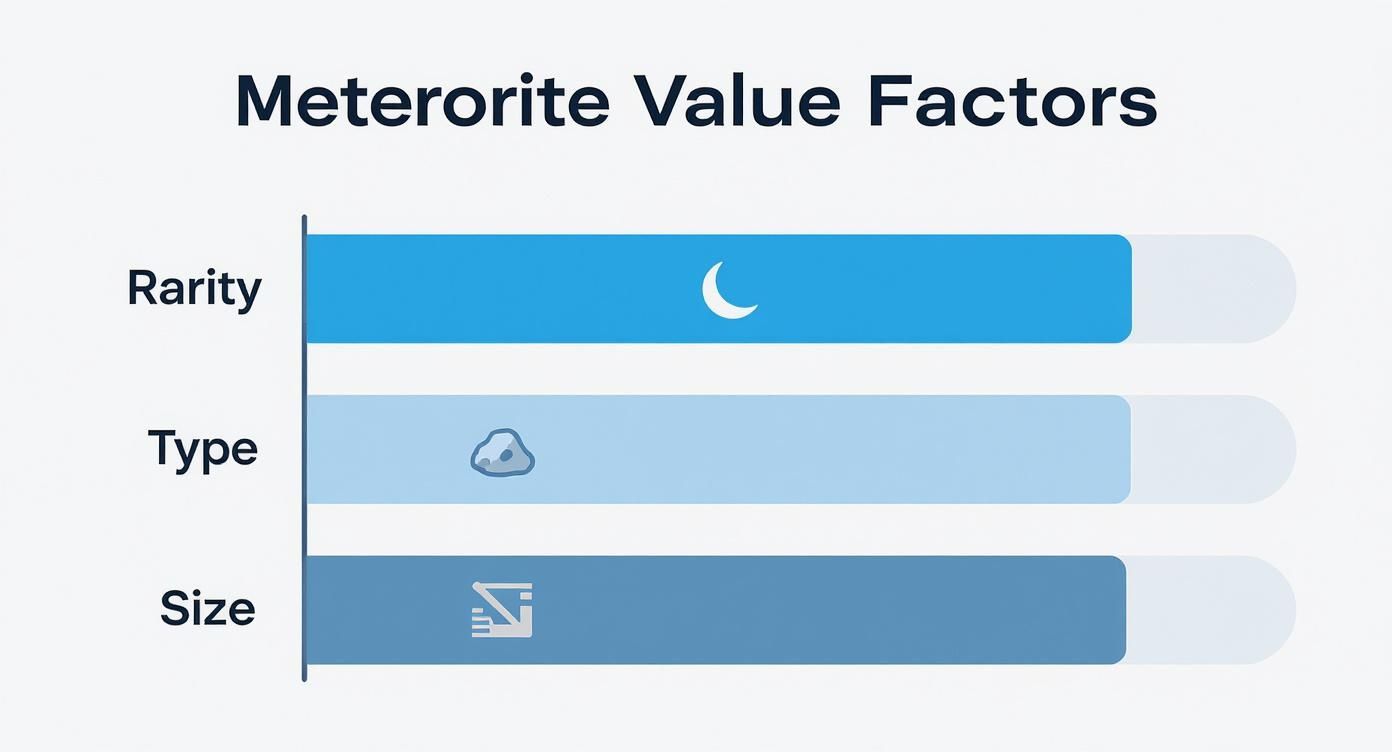
This infographic breaks it down nicely, showing how rarity, type, and size are the big three factors that drive a meteorite's value.
As you can see, rarity is the undisputed king. A tiny speck of a super-rare meteorite can easily out-price a massive chunk of a more common type. Let's dig into what this means for your wallet when you're looking at the most popular meteorites out there.
Common Chondrites: The Perfect Starting Point
For almost every new collector, the journey starts with ordinary chondrites. These stony meteorites are the most common type to fall to Earth, which makes them incredibly affordable and easy to find. They get their name from "chondrules"—tiny, round mineral grains that formed in the solar nebula over 4.5 billion years ago.
Seriously, you're holding the building blocks of planets. Their abundance means you can own a real piece of cosmic history without breaking the bank.
Typical Price: Usually lands between $0.50 and $5 per gram.
Why They're So Popular: They give you an authentic, hands-on connection to the birth of our solar system. It's the best way to get familiar with features like fusion crust and those all-important chondrules.
Real-World Example: A small, whole stone weighing just a few grams can cost less than a cup of coffee. It’s an unbeatable entry point.
A great example is the Allende meteorite, a carbonaceous chondrite that showered over Mexico in 1969. It’s a huge deal scientifically, but because so much of it was recovered, you can find a quality Allende meteorite fragment for sale for a really reasonable price.
Iron Meteorites: Sculptures from Outer Space
Next, we have the iron meteorites. These things are dense, heavy, and made almost entirely of iron and nickel. Their sheer heft and often beautiful, sculptural shapes make them a favorite for anyone wanting a specimen that really makes a statement. They are the shattered cores of ancient, would-be planets.
But the real magic happens when you slice one open and give it a light acid etch. Many irons reveal a breathtaking metallic crystal structure called a Widmanstätten pattern. This intricate, geometric lattice is impossible to create on Earth and is a dead giveaway that you're holding something not from this world.
Typical Price: Generally runs from $1 to $5 per gram, but can climb higher for nicely shaped pieces or those with a truly spectacular pattern.
Why They're So Popular: They're tough, they look incredible, and that unique Widmanstätten pattern makes them perfect for display.
Real-World Example: The Campo del Cielo meteorite from Argentina is a classic. You can grab small fragments for under $50, or go big with a dramatic, multi-kilogram piece that costs thousands.
Pallasites: The Gemstones of the Cosmos
This is where the meteorite world starts to feel like a high-end jewelry store. Pallasites are stony-iron meteorites filled with gem-quality olivine crystals (that's peridot, for the gem lovers) suspended in a solid iron-nickel matrix. When sliced thin and backlit, they absolutely glow with an otherworldly green and gold light.
Pallasites are widely considered the most beautiful meteorites in existence. They are incredibly rare—making up less than 1% of all known meteorites—and their price tag reflects that.
Because all the action is on the inside, pallasites are almost always sold as prepared slices. The quality of that slice—how thin it is, the polish, and the richness of the olivine crystals—is everything. A slice packed with bright, translucent gems will always fetch a much higher price than one with cloudy or sparse crystals.
Typical Price: Slices often start around $20 per gram and can soar past $100 per gram for top-shelf examples.
Why They're So Popular: The aesthetic appeal is off the charts. They are literally cosmic stained glass, offering a peek at the boundary between an ancient protoplanet's core and mantle.
Real-World Example: The Imilac (Chile) and Esquel (Argentina) pallasites are legendary for their stable, gorgeous olivine crystals and are holy grails for many collectors.
Achondrites: The Ultra-Rare Planetary Fragments
Now we’ve arrived at the pinnacle of the market: the achondrites. This class of stony meteorites includes pieces of the Moon and Mars. These rocks were blasted off their home worlds by massive asteroid impacts, wandered through space for millions of years, and eventually ended their journey here on Earth.
For many collectors, owning a piece of another world is the ultimate dream. Their mind-boggling rarity puts them in a league of their own, and the prices follow suit. With only a few hundred authenticated Martian and Lunar meteorites ever found, this is a market driven by pure scarcity.
Typical Price: Expect to start at $1,000 per gram—and there's really no ceiling.
Why They're So Popular: It’s the sheer wonder of it all. You can hold a piece of the Moon or Mars in your hand. That's a feeling—and a collectible—that's hard to beat.
Real-World Example: A well-known lunar meteorite like NWA 13669 can easily command over a thousand dollars for a tiny, one-gram fragment.
Of course, the appeal of meteorites extends beyond raw specimens. Their natural beauty has found its way into luxury goods, too. For instance, you can find a high-end Rolex with a factory meteorite dial, where the famous Widmanstätten pattern creates a finish that is truly one-of-a-kind.
How Market Events Send Meteorite Prices Soaring (or Crashing)
The price of a meteorite isn't some fixed, scientific number. It's a living, breathing figure that gets pushed around by the same forces that drive any other collectible market: supply, demand, and good old-fashioned public fascination. A single, dramatic event can completely rewrite the value of a certain type of meteorite, sometimes overnight.
Think of a big meteorite fall like a sudden, chaotic event on the stock market. The initial news blast creates a frenzy of excitement, but the long-term price really depends on what happens next. The two big questions are always: how much of it was found, and how much did the media run with the story?
These events are fascinating case studies in real-time economics, showing just how powerfully scarcity and availability can dictate value in the collecting world.
The Power of Supply: The Chelyabinsk Example
The 2013 Chelyabinsk superbolide explosion over Russia is one of the most famous meteorite events in modern history. The incredible dashcam footage went viral across the globe, creating an instant, massive demand for pieces of this historic fall. In the beginning, the price for Chelyabinsk meteorites was sky-high, fueled by that intense media storm.
But here's the catch: the sheer scale of the explosion meant a huge amount of material was recovered. Over the next few months and years, literally tons of fragments—from tiny crumbs to massive, multi-kilogram stones—were pulled from the snowy landscape. This absolute flood of material saturated the market.
Once supply caught up with (and then swamped) the initial demand, the basic laws of economics kicked in. The once-lofty price of Chelyabinsk fragments began to drop, and it kept on dropping. Today, it’s one of the most affordable and widely available witnessed falls for collectors—a direct result of its own abundance.
Scarcity in Action: The Osceola Fall
Now, let's flip the script and look at a much smaller, quieter event: the Osceola fall in Florida back in 2016. A bright fireball was spotted, but only a handful of dedicated hunters managed to find a very small number of stones. The total known weight of this entire fall is only about one kilogram. That's a tiny fraction of what came out of Chelyabinsk.
Because so little material was ever found, the supply was extremely tight right from the start. This scarcity has kept the price of the meteorite consistently high among collectors who value its rarity and the story of its tough recovery. It's the perfect illustration of the other side of the market coin.
When a new fall happens, the initial price is often just speculation. It’s the recovery effort that follows that truly sets the long-term value. A massive find can tank prices, while a tiny recovery ensures a specimen stays a prized and expensive collectible.
This dynamic becomes crystal clear when you compare the numbers. The Osceola meteorite started out commanding prices around $150 per gram before settling closer to $100 per gram, a value held up by its extreme rarity. Chelyabinsk, on the other hand, saw its price plummet despite its global fame, all because thousands of kilograms hit the market. This trend holds true even for the most desirable types; a 2022 market analysis from Galactic Stone noted that lunar meteorites were fetching about $1,000 per gram—a price dictated entirely by how little of it we have.
Media Hype and Collector Demand
The final piece of this puzzle is media attention. An event like Chelyabinsk, captured in spectacular videos seen by millions, creates a global audience of potential first-time buyers. This initial spike in demand can temporarily inflate prices, even for what might later become a very common specimen.
Here’s how these factors usually play out:
Initial Event: A witnessed fall creates instant, high-profile interest and speculative, often inflated, pricing.
Recovery Phase: The amount of material found determines the long-term supply. Big recoveries mean lower prices; small finds keep them high.
Market Stabilization: Over time, the price settles to a point that reflects its true rarity and desirability within the established collector community.
Understanding how these market events work is crucial if you want to be a savvy collector. It shows that the price of a meteorite is a moving target, constantly influenced by new discoveries, scientific reports, and the timeless dance between a finite supply and our own endless curiosity.
How to Buy Your First Meteorite Safely
Alright, you've got a solid grasp of what makes a meteorite valuable. Now comes the exciting part: bringing your first piece of the cosmos home. But before you jump in, it's wise to proceed with a bit of caution. While the meteorite world is full of passionate and honest dealers, it also has its share of fakes and wildly overpriced rocks.
Arming yourself with the right knowledge is the absolute best way to ensure your first purchase is a genuine treasure, not a costly mistake. Being a smart, informed buyer makes all the difference.
Finding Reputable Dealers
Honestly, the single most important choice you'll make is who you buy from. A reputable dealer is your greatest ally. They don't just sell you a rock; they provide expertise, provenance, and a guarantee of authenticity. Vetting your source is your first line of defense.
Look for dealers with a long-standing reputation in the community and transparent business practices. The best ones are often members of professional organizations, which hold them to a high ethical standard. Checking reviews and seeing how they engage with other collectors can tell you a lot.
A trustworthy seller will always be happy to answer your questions. If a dealer gets cagey about a specimen's origin, classification, or history, consider it a massive red flag. Just walk away.
Verifying Authenticity
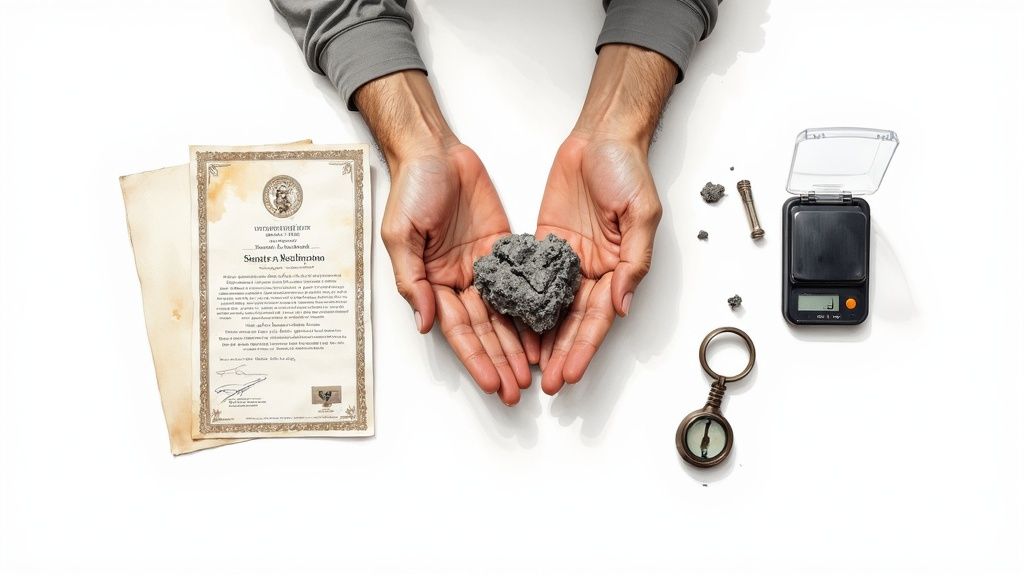
Once a potential specimen has caught your eye, the next step is confirming it's the real deal. Every genuine meteorite should come with documentation that acts as its passport, tracing its identity and history. For any serious purchase, this is non-negotiable.
You should always expect a detailed specimen card or a certificate of authenticity. At a minimum, this document must include:
Name and Classification: The official name (like Campo del Cielo) and its specific type (e.g., Iron, IAB-MG).
Weight: The exact weight of the specimen you're buying, almost always in grams.
Provenance: Information on where and when the meteorite was found.
Seller's Guarantee: A clear statement from the seller guaranteeing the specimen's authenticity.
Without this basic info, you have no real way of knowing what you're buying or if the price is fair. For a deeper dive into trusted sellers and what to look for, check out this excellent guide on where to buy meteorites.
Spotting Fakes and Meteorwrongs
Unfortunately, not every rock advertised as a space rock actually fell from the sky. The market has plenty of terrestrial rocks, charmingly known as "meteorwrongs," as well as outright man-made fakes. Knowing a few tell-tale signs can save you a lot of grief.
Common meteorwrongs include industrial byproducts like slag or naturally dense, iron-rich rocks like hematite and magnetite. To an untrained eye, they can look convincing, but they lack the key features of a genuine meteorite. Always be skeptical of sellers making extraordinary claims without proof to back them up.
Your Buyer's Checklist
To keep your search focused and safe, run through this simple checklist when you're sizing up a potential purchase. It'll help you assess the specimen, the dealer, and the deal itself, so you can buy with confidence.
Evaluate the Source: Is the dealer well-known and respected in the community? Do they have positive reviews and a professional presence?
Inspect the Documentation: Does it come with a certificate listing its name, type, weight, and where it was found?
Check for Key Features: Does the rock itself show authentic characteristics? Look for a fusion crust (if it's a "fall"), regmaglypts, or a Widmanstätten pattern in etched irons.
Compare the Price: Is the asking price in line with market rates for its type, size, and quality? Do a quick search to see what similar specimens are going for.
Trust Your Gut: If a deal feels off or seems way too good to be true, it probably is. Never be afraid to pass on a sale if you have any doubts.
Questions on Every Collector's Mind
Stepping into the world of meteorite collecting is exciting, but it naturally comes with a lot of questions—especially when it comes to price and authenticity. Before you take the leap, it helps to clear up a few common mysteries.
Think of this as your pre-flight checklist. Getting these questions answered will help you navigate the market with confidence and make choices you'll be happy with for years to come.
Are Bigger Meteorites Always More Valuable?
Not at all. This is probably the biggest myth in the meteorite world. While it's true that a larger piece of the same meteorite will cost more than a smaller one, the meteorite's type and rarity are the real drivers of value.
For instance, a tiny, one-gram slice of a Martian meteorite can easily fetch $1,000 or more. At the same time, a huge 10-kilogram iron meteorite might only be worth a few hundred dollars. In this market, rarity and scientific importance almost always win out over sheer size.
A great way to think about it is comparing a small, flawless diamond to a giant quartz crystal. The diamond’s value per carat is exponentially higher because of its rarity and quality, despite its small size. The exact same principle applies to meteorites.
How Can I Be Sure a Meteorite Is Authentic?
Authenticity is everything. Without it, you just have a cool-looking rock. The single best way to protect yourself is to buy from a reputable, well-established dealer who provides documentation and stands behind their specimens.
Here’s what you should always look for:
A Certificate of Authenticity: This is non-negotiable. The certificate should list the meteorite’s official name, its classification, total known weight, and where it was found.
Dealer Reputation: Does the seller have a long history of positive reviews? Are they members of professional organizations? A solid reputation is built on trust and expertise.
Clear Provenance: A good dealer can tell you the story of your specimen—where it came from and how it got to them. This history adds to its legitimacy and its appeal.
If a price seems too good to be true or the seller is vague about the details, trust your gut and walk away.
Is Meteorite Collecting a Good Financial Investment?
Meteorites certainly can be a good investment, but it's not a get-rich-quick scheme. Much like collecting fine art or rare coins, the market has its ebbs and flows. Historically, the value of ultra-rare specimens like lunar and Martian meteorites has steadily climbed because their supply is incredibly finite.
On the other hand, the value of more common types can shift. A large, newly discovered strewnfield can flood the market with a particular type of meteorite, causing its price to dip. That's why most seasoned collectors will tell you to lead with passion. Collect because you love the science, the history, and the wonder of it all. Any financial gain should be seen as a bonus.
After all, the true value is in holding a piece of our solar system's 4.5-billion-year history right in your hand.
Ready to own a piece of the cosmos? Explore a curated collection of authentic, ethically sourced specimens at Astro West. Whether you're a new collector or a seasoned expert, you'll find the perfect celestial treasure backed by decades of expertise. Visit us at https://astrowest.com to start your collection today.