Starting your journey into the world of meteorite collecting is an incredible feeling, but your first big decision is also the most important: knowing where to buy meteorites from a source you can trust. The best places are almost always established online dealers, specialized auction houses, and curated galleries that can guarantee what they're selling is real and can tell you where it came from. Getting this part right is your best defense against fakes and the key to building a genuine, valuable collection.
Your Guide to Finding Authentic Meteorites
The experience of holding a piece of outer space in your hand is like nothing else—it connects you to the vastness of the cosmos. These celestial travelers, some of which are billions of years old, carry the secrets of our solar system's formation. But for newcomers, the market for these incredible artifacts can feel a bit like the Wild West. This guide is your map to navigating it safely.
Your journey begins by understanding the main places authentic meteorites are sold. Each channel offers a completely different experience and caters to different types of collectors, from curious beginners to serious investors. Learning the essentials early on is a lot like learning how to start a collection of rare rocks and minerals—a solid foundation helps you avoid costly mistakes and makes the whole process far more rewarding.
Key Buying Channels at a Glance
To make smart decisions, it helps to compare the main places you’ll find meteorites for sale. Each has its own distinct vibe, benefits, and potential downsides.
Established Online Dealers: These are specialized websites run by experts who often source specimens directly from the field. They are a fantastic starting point for beginners, offering a huge range of authenticated meteorites at just about every price point.
Specialized Auction Houses: Major auction houses handle high-value, incredibly rare, and historically significant meteorites. This is where you’ll find museum-quality giants and true investment-grade specimens.
Curated Galleries: Think of these as art galleries for nature. Whether physical or high-end online shops, they present meteorites as pieces of natural sculpture. Their inventory is highly selective, focusing on stunning aesthetic appeal and exceptional quality for discerning collectors and designers.
To give you a clearer picture, I've put together a quick comparison of these channels to help you figure out which path feels right for you.
Comparing Meteorite Buying Channels
This table breaks down the pros and cons of the most common places to purchase meteorites, so you can match the channel to your goals as a collector.
Requires vetting the dealer's reputation carefully
Specialized Auction Houses
Serious Investors & Museums
Access to rare and historic pieces, verified provenance
High prices, buyer's premiums, competitive bidding
Curated Galleries
Designers & High-End Collectors
Exceptional aesthetic quality, expert curation
Limited selection, premium pricing, focus on display pieces
Ultimately, whether you're buying your first small iron meteorite or bidding on a slice of the moon, understanding these channels is the first step. It empowers you to shop with confidence and find the perfect cosmic treasure for your collection.
Understanding What Makes a Meteorite Valuable
So, what makes one space rock worth pocket change while another fetches a price tag with several zeros? Before you dive into buying, it helps to understand what drives the value of these cosmic visitors. It’s a common myth that size and weight are all that matter. In reality, a small, paper-thin slice of a rare meteorite can easily be worth more than a hefty, common iron chunk.
The first step in figuring out a meteorite's worth is its classification. Just like rocks on Earth, meteorites belong to distinct families, and each one has its own story, rarity, and market value.
Classification and Rarity
At a high level, meteorites fall into three main classes, which form the foundation of their value:
Iron Meteorites: Made mostly of an iron-nickel alloy, these are what most people imagine when they hear the word "meteorite." Some, like the famous Campo del Cielo from Argentina, are relatively common and quite affordable. Others, however, are exceptionally rare and valuable.
Stony Meteorites: This is the biggest group by far, making up over 90% of all known meteorites according to the Natural History Museum in London. They come from the crust and mantle of asteroids. Don't let their abundance fool you, though—the value swings wildly within this group. A common chondrite might be inexpensive, but a piece of the Moon or Mars will cost a small fortune.
Stony-Iron Meteorites: The rarest of the three main types. These are a breathtaking mix of iron-nickel metal and beautiful silicate crystals. Pallasites, with their gem-like olivine crystals glowing within a metallic framework, are especially prized by collectors for their otherworldly beauty.
Simply put, rarity is the biggest driver of value. Take Martian meteorites, for example. They are some of the most sought-after specimens on the planet, often selling for $1,000 per gram or even more. Why? Because they are incredibly scarce and scientifically priceless. The awe-inspiring NWA 16788, the largest known Martian meteorite, recently sold for $5.3 million at Sotheby's—a testament to the fierce demand for these genuine pieces of the Red Planet.
Aesthetics and Provenance
Beyond its classification, a meteorite’s visual appeal and its history are hugely important. Collectors will pay a premium for specimens that tell the story of their violent, fiery journey through our atmosphere.
A well-preserved fusion crust—that dark, glassy skin formed as the rock melted on its way down—or deep, thumbprint-like scoops called regmaglypts can send a specimen's value soaring. These features aren't just for looks; they're the authentic signature of atmospheric entry.
Finally, provenance—the documented history of a specimen—is everything. Solid paperwork, like a specimen card detailing its official name, classification, find location, and the total known weight of the fall, provides the confidence and authenticity every serious collector demands. For a more detailed look, you might be interested in our guide on what a meteorite is worth. It digs deeper into the factors that are crucial for any aspiring collector to understand.
How to Verify Meteorite Authenticity
When you’re figuring out where to buy meteorites, your biggest challenge isn’t finding them—it’s making sure they’re the real deal. The market is full of what collectors call "meteorwrongs," which are just ordinary Earth rocks masquerading as cosmic treasures. Learning a few simple tests can help you spot the difference and build a truly authentic collection.
A genuine meteorite tells the story of its fiery plunge through our atmosphere. That incredible journey leaves behind some tell-tale visual clues you can look for.
Simple Physical Checks
Before you pull the trigger on a purchase, especially from an unverified seller, run through these basic checks. Most authentic meteorites will have at least one of these classic characteristics.
Fusion Crust: This is a thin, dark, and often glassy or eggshell-textured crust on the meteorite's surface. It’s formed when the rock’s exterior literally melts during its high-speed descent.
Regmaglypts: Often described as looking like thumbprints pressed into clay, these are shallow scoops or indentations on the surface. They’re created as material ablates—or burns off—during its flight through the atmosphere.
Magnetic Attraction: The vast majority of meteorites contain a high concentration of iron and nickel. A simple magnet will almost always stick to them, which is a fantastic first test to rule out most common terrestrial rocks. To get into the science of this, you can explore our guide on what a meteorite is made of.
When you’re buying meteorites online, authenticating the pictures is just as crucial as examining the stone itself. This guide offers some great practical tips on how to check if a photo is real, which will definitely sharpen your verification skills.
The Gold Standard of Authenticity
While those physical tests are a great starting point, the most reliable way to guarantee you're getting a real meteorite is to buy from sellers who provide solid documentation and are known in the community. This is your best defense against getting duped.
The single most important factor in verifying a meteorite is its provenance. Reputable dealers will always provide a specimen card or a certificate of authenticity detailing the meteorite’s official name, classification, find location, and total known weight.
The meteorite market has seen a huge shift with the growth of commercial dealers from all over the globe. This has made specimens more available, but it has also opened the door for more fakes to slip through.
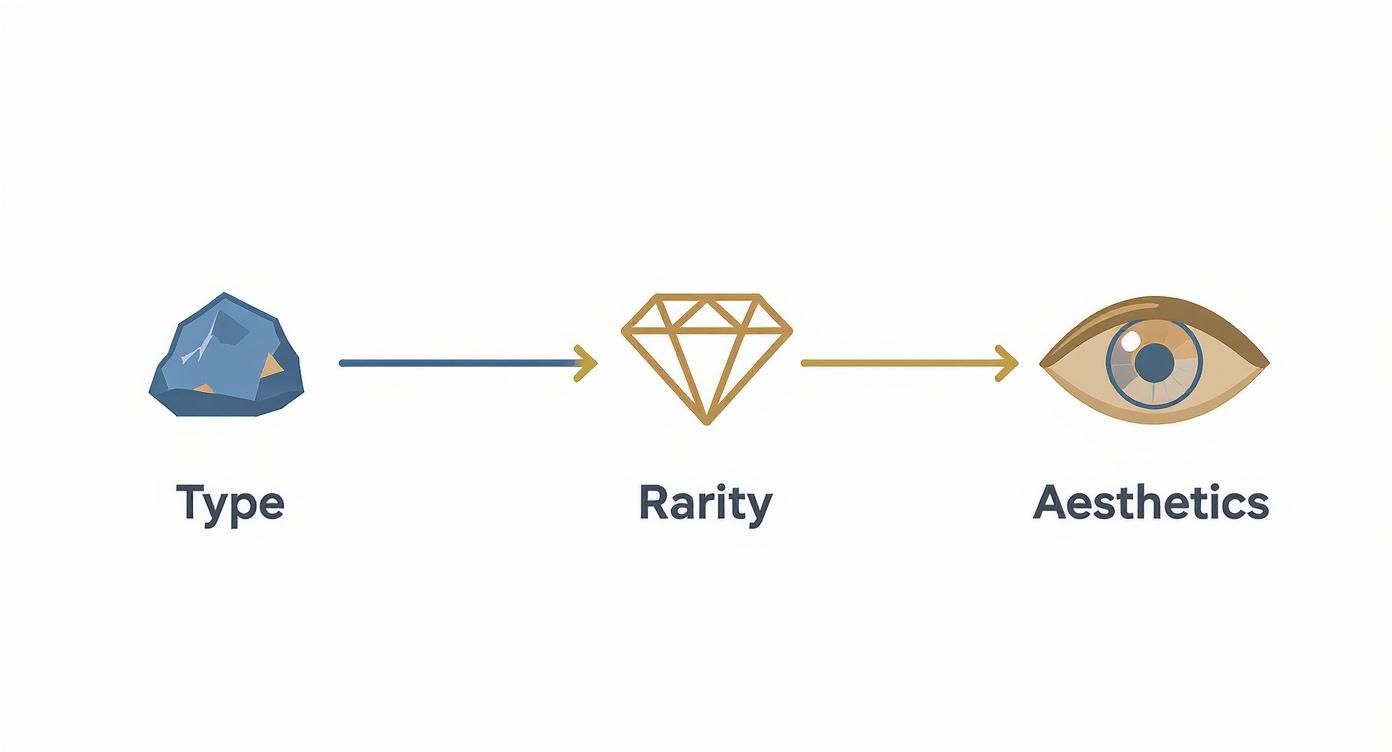
This decision tree shows how a meteorite's type, rarity, and aesthetics all come together to determine its value.
As the infographic makes clear, rarity is the biggest value multiplier, turning what might otherwise be a simple rock into a highly prized collectible.
Buying Meteorites at High-End Auctions
For the collector hunting down investment-grade specimens or pieces with a legendary backstory, prestigious auction houses are the final frontier. This is where you’ll find the absolute top tier of the meteorite market—a world where cosmic rocks are treated like priceless artifacts. Venues like Christie's don't just sell meteorites; they turn the entire experience into a high-stakes event.
These auctions pull in a global crowd of serious collectors, museums, and scientific institutions. They’re all there for one reason: to get their hands on specimens that are simply unavailable anywhere else, from historically significant falls to breathtakingly massive individuals. This is the main stage for the rarest of the rare, including fully authenticated lunar and Martian meteorites.
Understanding the Auction Process
Jumping into a high-end auction requires getting comfortable with its unique rhythm and vocabulary. It’s far more structured than buying from a dealer and has its own set of rules you need to know.
Auction Estimates: Every item, or "lot," has a price range, called an estimate. This is the auction house's expert opinion on what the piece is worth. Bidding usually kicks off near the low end of that range.
Buyer's Premium: This is the big one to remember. The buyer's premium is an extra percentage fee the winning bidder pays on top of the final "hammer price." This fee can run anywhere from 10% to over 25%, so you absolutely have to factor it into your budget.
Provenance and Documentation: Top auction houses stake their reputations on authenticity. Every single specimen comes with a mountain of documentation detailing its history, classification, and scientific analysis, giving buyers a level of confidence you can't get anywhere else.
The results from these major sales often become the new industry standard, setting fresh benchmarks for what truly exceptional meteorites are worth.
High-profile auctions are a powerful barometer for global demand. When you see intense competition push prices far beyond the initial estimates, it’s a clear signal of the strong investment potential of premier meteorites.
A perfect example is Christie's 'Deep Impact' sale, which was a landmark moment for the meteorite market. The auction raked in a staggering $4,351,750, with an unbelievable 100% of the lots selling. Even more telling, 72 of the 75 lots blew past their high estimates, attracting bidders from 23 different countries and proving just how powerful the worldwide appeal for these extraterrestrial treasures really is. You can read more about this record-setting sale on Christie's website.
Ultimately, these events are more than just sales. They are celebrations of natural history, where the most extraordinary travelers from our solar system find new homes.
Navigating Online Shops and Marketplaces
The internet has opened up the world of meteorite collecting like never before, but all that convenience comes with a catch: you have to know who to trust. Think of the online market as a vast digital cosmos filled with both shining stars and barren, worthless rocks. Your job is to learn how to spot the difference and make sure you're bringing home a genuine piece of space history.
This digital landscape is mostly split into two camps: specialized dealer websites and sprawling marketplaces. Specialized dealers are typically experts who have built their entire lives around meteorites, offering curated, authenticated specimens. On the other side, massive marketplaces offer an endless variety but demand far more caution, since literally anyone can post a listing.
Vetting Your Online Seller
Before you even think about adding a meteorite to your cart, you need to do your homework on the seller. A trustworthy vendor will make this easy on you—they’ll be transparent, professional, and more interested in building confidence than making a quick sale. This is a non-negotiable step when figuring out where to buy meteorites online.
Here’s a quick checklist to keep in your back pocket:
Detailed, High-Quality Photos: The seller absolutely must provide clear, well-lit images from every possible angle. You need to be able to see key features like the fusion crust or the Widmanstätten pattern on an etched iron meteorite. Fuzzy, low-res photos are a huge red flag.
Transparent Return Policy: A seller who is confident in their product will always stand behind it. Look for a clear, no-fuss return policy that gives you enough time to get the meteorite independently verified if you want to.
Verifiable Credentials: Does the seller belong to any reputable organizations? Membership in a group like the International Meteorite Collectors Association (IMCA) is a very strong sign of credibility, as its members agree to a strict code of ethics.
The most reliable online dealers don't just sell rocks; they provide education. Look for websites that offer detailed descriptions, classification information, and the story behind each find. That passion for the science and history of meteorites is the hallmark of a source you can trust.
Specialized Dealers Versus General Marketplaces
Deciding between a specialist and a general marketplace often boils down to your tolerance for risk. A specialized dealer has a reputation to protect and almost always offers guarantees of authenticity. Their inventory is carefully selected, much like an art gallery curates paintings or a jeweler selects gemstones. For a similar expert-led approach to other natural wonders, check out our guide on where to buy geodes, which also highlights the importance of expert sourcing.
On the other hand, marketplaces like eBay can be a treasure trove, but they can also be a minefield of fakes. If you decide to shop there, stick to sellers who have extensive, positive feedback specifically for meteorite sales and who meet every single criterion on the checklist above. Your best strategy is to be skeptical first and only trust after you've done your homework.
Common Questions About Buying Meteorites
Even after you've nailed down the basics, pulling the trigger on your first piece of the cosmos can feel like a big step. A few practical questions always pop up, so we’ve put together some straightforward answers to the things new collectors wonder about most.
Is It Legal to Own a Meteorite?
Yes, it’s perfectly legal to own and sell meteorites in most of the world, including the United States. The real question isn't if it's legal, but where it was found.
If a meteorite lands on private property, it belongs to the landowner, who is then free to keep or sell it. The rules change for meteorites found on public or federal land, as they can sometimes be claimed by the government. Any reputable seller will guarantee the legal provenance of their specimens, so you can build your collection without a second thought.
How Much Should I Spend on My First Meteorite?
You absolutely don't need a massive budget to get started. In fact, some of the most fascinating and authentic starter meteorites are surprisingly affordable. You can easily find incredible specimens for between $20 and $50.
A great way to begin is with a classic, like a small Sikhote-Alin iron meteorite or a common NWA chondrite. This lets you hold a real piece of outer space and learn the ropes of collecting before you decide to hunt for rarer, more valuable pieces.
How Do I Care for My Meteorite Collection?
Proper care is key to making sure your cosmic artifacts last for generations. The biggest enemy for many meteorites, especially the iron-rich ones, is rust caused by humidity in the air.
Here are a few simple tips to keep them pristine:
Keep them dry. A display case is your best friend. For extra protection, you can toss in a few descant packets (those little silica gel bags) to soak up any excess moisture.
Handle with care. The natural oils on your skin can speed up oxidation over time. It's always a good idea to handle them with cotton gloves or just by their edges.
Ask the expert. When in doubt, ask your dealer for advice. A knowledgeable seller can give you specific care instructions for more fragile or unique types, ensuring your specimen stays in perfect condition.
Following these simple rules will protect your investment and preserve the incredible story each meteorite has to tell.
Ready to find your first cosmic treasure? At Astro West, we offer a curated collection of ethically sourced and fully authenticated meteorites perfect for every level of collector. Explore our selection and begin your journey today at https://astrowest.com.