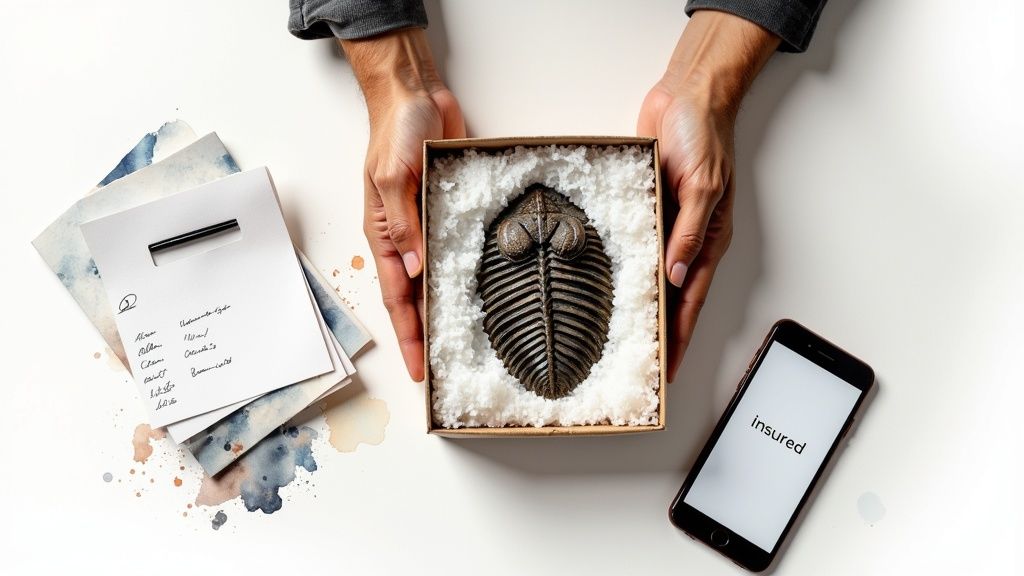
When it comes to buying fossils online, the best place isn't one specific store—it's any reputable, specialized dealer who is transparent about their sourcing, offers clear authenticity guarantees, and has a strong history of happy customers. A huge green flag is a seller who's an active member of paleontological associations. It's a strong signal they're committed to ethical practices and truly know their stuff. While you can find great pieces on big marketplaces, a dedicated dealer's website almost always provides a more secure and informative experience.
Your Guide to Navigating the Online Fossil Market
Going on an online fossil hunt is like taking a journey back in time, connecting you with creatures that roamed the Earth millions of years ago. But the digital marketplace can be as treacherous as it is exciting. Without being able to hold a specimen in your hands, how can you be sure you're making a wise investment?
The key is to stop looking for a single "best" store and instead learn how to spot the qualities of a great dealer. This guide gives you a solid framework for evaluating any online seller, moving beyond guesswork to give you the tools you need to assess authenticity, reputation, and ethical sourcing. A successful purchase really comes down to how well you can vet a dealer before you even think about adding something to your cart.
To get started, just focus on these three core pillars of a trustworthy source:
Verifiable Authenticity: The seller must provide a clear guarantee that their fossils are genuine. This is often backed by a certificate of authenticity or detailed provenance information.
Established Reputation: Look for a long history of positive reviews, professional affiliations, and a transparent "About Us" page that tells you about their expertise and experience.
Ethical Sourcing: A reputable dealer will be open about where and how their fossils were found, ensuring they were collected legally and responsibly.
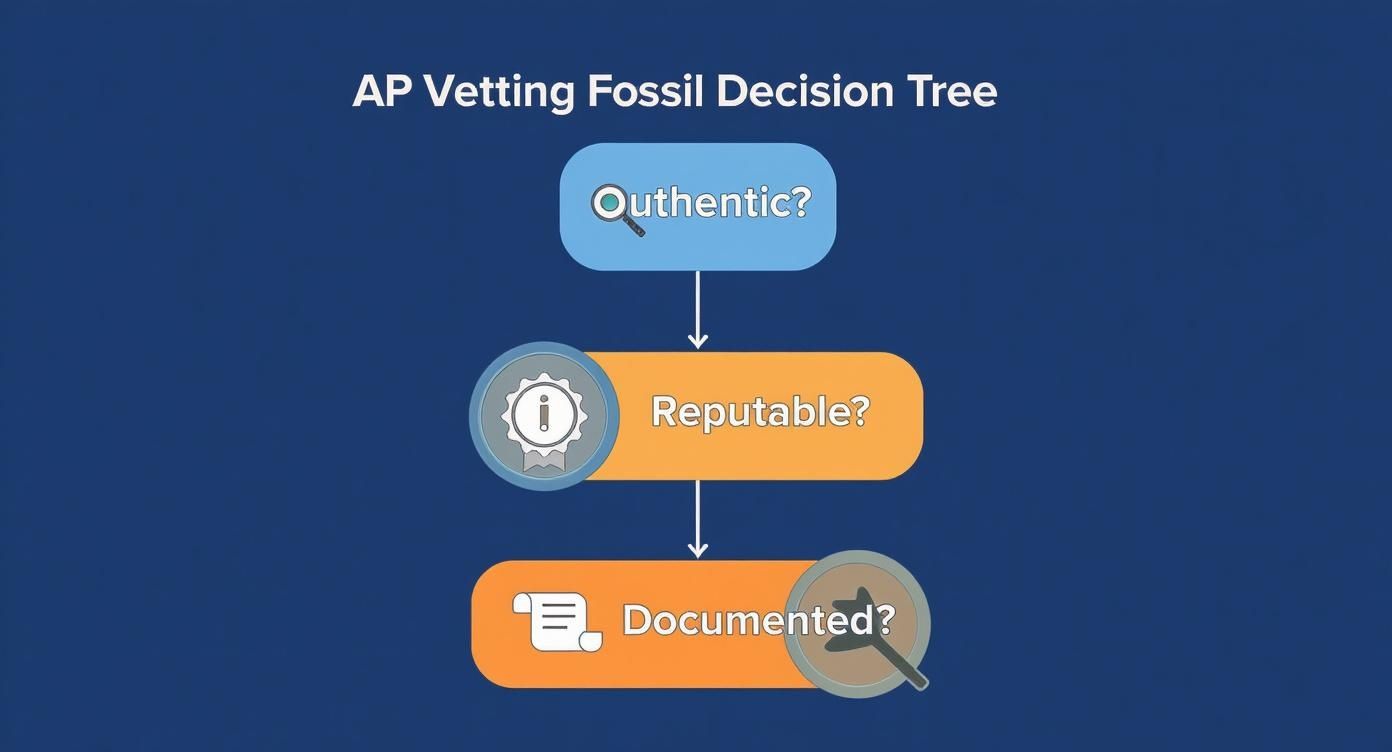
This simple decision tree shows how that initial vetting process works, helping you quickly figure out if a dealer is worth a closer look.
As you can see, your evaluation should always start with authenticity, then move on to the seller's reputation and the specimen's documentation.
What to Look For in a Seller
When you're searching for the best place to buy fossils online, think of yourself as a detective. A great seller leaves a trail of clues that point straight to their credibility. Look for high-resolution images from multiple angles and detailed descriptions that include the fossil's species, age, and location of discovery. The more information they give you, the more confident you can be.
A seller's passion for paleontology often shines through in their content, too. Many of the best dealers run educational blogs or have detailed guides on their websites. For example, knowing the different types of fossils is crucial for any collector, and a good dealer will offer resources to help you build that knowledge.
A trustworthy fossil dealer doesn’t just sell objects; they share stories. Their listings are rich with scientific context, collection history, and a clear passion for the prehistoric world.
Ultimately, a secure transaction comes down to transparency. A clear and fair return policy is completely non-negotiable. It proves the seller stands behind their products and is confident in the authenticity and quality of what they offer. Any seller who hides their policies or makes returns a huge hassle is a major red flag.
Quick Checklist for Vetting Online Fossil Dealers
Before you commit to a purchase, run the seller through this quick checklist. It’s an easy way to spot a trustworthy source and avoid the ones that aren’t.
Evaluation Criterion
What to Look For
Red Flag
Authenticity Guarantee
A clear, written Certificate of Authenticity (COA) is offered with each specimen.
Vague promises of authenticity or no guarantee at all.
High-Quality Photos
Multiple, high-resolution images showing the fossil from all angles, including close-ups.
Blurry, low-quality, or stock photos. Only one picture is provided.
Detailed Descriptions
Includes species name, geological age, formation, and location of discovery. Mentions any repair or restoration.
Missing key information, generic descriptions, or no mention of restoration on a "perfect" fossil.
Seller Reputation
Positive reviews on third-party sites, professional affiliations (e.g., AAPS), and an informative "About Us" page.
No reviews, a brand-new shop with no history, or a complete lack of background information.
Clear Return Policy
A straightforward, easy-to-find return policy with a reasonable timeframe (14-30 days).
No return policy, "all sales final" clauses, or a complicated and restrictive process.
Responsive Communication
The seller answers questions promptly, knowledgeably, and professionally.
Ignores emails, gives evasive answers, or seems unknowledgeable about their own products.
Using this checklist helps take the guesswork out of the equation. A seller who ticks all the right boxes is far more likely to provide you with a genuine, high-quality fossil and a great buying experience.
How to Confidently Identify Authentic Fossils Online
Stepping into the world of online fossil collecting is thrilling, but the foundation of any great collection rests on one thing: authenticity. Without holding a specimen in your hands, how can you be sure it’s the real deal? The secret is to train your eye to recognize the subtle clues that separate a genuine piece of natural history from a clever fake.
Think of a fossil's history—its provenance—like the documented ownership of a famous painting. It tells the specimen's story and helps prove its legitimacy. While not every fossil comes with a detailed paper trail, a reputable seller should be able to tell you where it came from, right down to the geological formation. That context is your first layer of verification.
Authenticity isn't just a simple "real vs. fake" question, either. It’s also about understanding how much a fossil has been altered. Many specimens need some repair to be stable, but it's crucial to know where good preparation ends and excessive modification begins.
Reading the Signs of a Genuine Fossil
Genuine fossils have a certain look and feel that's incredibly difficult to replicate perfectly. When you're browsing online, high-quality images are your best friend. You need to scrutinize those photos for the tell-tale signs of a real specimen.
Texture and Surface Detail: Real fossils almost always have fine, natural textures. A dinosaur tooth, for example, should show faint growth lines or variations in the enamel. A surface that looks too glassy or perfectly smooth might be a red flag for a replica or heavy-handed polishing.
Color and Patina: During fossilization, minerals replace the original organic material. A fossil’s color comes directly from the specific minerals in the surrounding sediment, creating a natural, often uneven, patina. Be suspicious of specimens with perfectly uniform or unnaturally bright colors—they may have been painted.
The Surrounding Matrix: Many fossils are sold with some of the rock they were found in—the matrix—still attached. This is usually a good sign. The matrix's texture and color should match the geological location where the fossil was supposedly found. For instance, fossils from Morocco's famous Kem Kem Beds often have a distinct sandy, reddish-tan matrix.
Learning to spot these details takes a bit of practice, but it's an essential skill for any collector. For more guidance, our guide on things to look for when collecting fossils offers more valuable tips to help sharpen your eye.
Spotting Common Fakes and Alterations
Unfortunately, the fossil market isn't immune to deceptive practices. Knowing what to watch out for is just as important as knowing what indicates authenticity. The most common issues you'll run into are composites, excessive restoration, and outright fakes.
A common trick in the fossil trade is creating a "composite" specimen. This is where unrelated fragments are glued together to create a more complete-looking—and therefore more expensive—piece. A classic example is a single trilobite built from the parts of several different individuals.
Look closely at the joints and seams. Unnatural cracks filled with glue or mismatched textures can expose a composite. Another major issue is restoration. While minor crack-filling is standard, some sellers will reconstruct huge chunks of a fossil with putty or resin, then paint over it to hide their work.
Restoration vs. Repair What's the Difference?
Understanding the line between acceptable preparation and deceptive alteration is absolutely key.
Technique
Description
What It Means for Collectors
Repair
Stabilizing a genuine fossil by gluing its own broken pieces back together. Cracks are often filled with a neutral material.
This is standard and accepted practice. A repaired fossil is still 100% authentic, and sellers should always disclose the work.
Restoration
Reconstructing missing parts of a fossil using synthetic materials like resin or putty and then painting them to match.
This seriously diminishes the fossil's authenticity and value. A seller must disclose the percentage of restoration. A fossil that is 50% restored is only half real.
Composite
Creating a single specimen by combining fragments from multiple different fossils.
This is highly deceptive. The resulting piece is not a single, natural fossil and has very little scientific or monetary value.
A trustworthy seller will always be upfront about any repair or restoration. If a listing for a "perfect" Spinosaurus tooth or a flawless trilobite makes no mention of restoration, be skeptical. Nature is rarely perfect, and millions of years in the ground usually leave a mark.
Don't be afraid to ask a seller directly: "Is there any restoration or repair on this piece?" It’s a perfectly reasonable and necessary question. Their answer—or their silence—will tell you everything you need to know about their credibility.
Vetting Sellers to Find a Reputable Fossil Dealer
The best place to buy fossils online isn't one specific website. It's wherever you find a trustworthy, knowledgeable dealer who lives and breathes this stuff. Your job is to become a bit of a digital detective, sniffing out the clues that separate passionate experts from opportunistic resellers.
Think of it like hiring a guide for a serious expedition. You wouldn't trust someone with no map and zero experience, right? The same goes for buying a million-year-old specimen. A reputable dealer’s website and online presence should be a clear window into their qualifications and their commitment to the science.
This means digging into their professional affiliations, academic background, and how involved they are in the collecting community. These details build a complete picture of a seller you can trust for authentic fossils and solid information for years to come.
Decoding a Dealer's Credentials
The most reliable dealers are almost always deeply embedded in the paleontological community. For them, it’s not just a hobby—it’s a core part of their professional identity. Keep an eye out for specific credentials that show they're serious about the field.
These markers of credibility are a powerful filter, helping you quickly weed out the amateurs. Here’s what to look for:
Professional Affiliations: Membership in an organization like the Association of Applied Paleontological Sciences (AAPS) is a huge green flag. These groups have strict codes of ethics that members must abide by, covering everything from proper labeling to responsible sourcing.
Participation in Major Shows: Legitimate dealers are a common sight at major events like the Tucson Gem and Mineral Show or the Denver Mineral, Fossil, Gem & Jewelry Show. Their presence proves they are respected members of the physical collecting world, not just anonymous online storefronts.
Academic and Field Experience: Does the seller have a background in geology, paleontology, or a related science? Many of the best dealers are active field collectors or researchers themselves, bringing firsthand knowledge to their business.
This level of expertise is just as critical when you're shopping for other rare collectibles. For example, if you're looking to acquire a piece of the cosmos, our guide on where to buy meteorites hammers home this same need for expert verification and a seller you can believe in.
Analyzing Customer Reviews and Online Presence
While credentials lay the groundwork, a seller's public reputation offers real-world proof of their reliability. But you have to learn to read between the lines. A long stream of generic five-star ratings can be just as suspicious as a page full of negative ones.
Look for reviews with substance. Feedback that says, "The Spinosaurus tooth arrived perfectly packaged with an excellent description of its Kem Kem Beds origin," is infinitely more valuable than a simple, "Great seller!" Specific, detailed praise is a sign of a genuinely good experience.
When checking out a seller, pay close attention to how they handle negative feedback. A professional, helpful response to a real issue is often a better sign of a trustworthy business than a flawless but superficial record.
Beyond reviews, take a look at the quality of their website and social media. A dealer who invests in high-quality photography, writes educational blog posts, and engages thoughtfully with their audience is showing a long-term commitment. They aren't just trying to make a quick sale; they're building a community.
This kind of sustained effort builds confidence, which is everything in a niche market. Ultimately, finding the best place to buy fossils online boils down to finding a person or business you can trust. By carefully vetting their credentials and public reputation, you build a relationship that ensures every piece you add to your collection is authentic, ethically sourced, and backed by genuine expertise.
Understanding Fossil Pricing and Ethical Sourcing
Ever wondered why one Megalodon tooth is listed for $100 while another that looks almost identical carries a $1,000 price tag? It’s a common question, and getting to the bottom of it is the first step toward becoming a truly savvy collector.
A fossil's value isn't just a number pulled from thin air. It’s a complex calculation based on a handful of critical factors: rarity, preservation, completeness, and scientific importance. Think of it like a gemstone. The same way a diamond's worth is determined by its cut, clarity, and carat, a fossil's quality is what separates a common find from a museum-worthy treasure.
A small, common ammonite might be wonderfully affordable, but a perfectly preserved dinosaur claw is in a completely different league. Understanding the principles behind value in other collectible markets can be a huge help here. For instance, reading an expert guide on calculating gold value can offer surprising insights into how scarcity and quality drive prices across the board.
Key Factors That Determine a Fossil's Value
When you're browsing online, keep these key factors in your back pocket. They explain why prices can vary so wildly, and a good seller will always provide details touching on each of these points.
Here’s what really drives a fossil’s price:
Rarity and Species: Is the fossil from a common creature, like many trilobites, or something much harder to find, like a Pterosaur? A Great White shark tooth (Carcharodon carcharias) is fairly common, but a tooth from its extinct giant cousin, Otodus megalodon, is far more valuable.
Quality of Preservation: A specimen with crisp, sharp details is worth exponentially more than one that's worn down and eroded. For a Megalodon tooth, this translates to sharp serrations, glossy enamel, and a complete, unbroken root.
Completeness and Size: Is it the whole fossil or just a piece? A complete skeleton is the holy grail, of course, but even with individual fossils like teeth, size definitely matters. To see just how much size can impact price, check out our deep dive into the largest Megalodon shark tooth ever found.
Scientific Significance: Sometimes, a fossil tells a new story. A piece that represents a new species or offers a unique glimpse into prehistoric life carries immense value, both scientifically and for collectors.
The Critical Importance of Ethical Sourcing
Beyond the price tag, a fossil's origin story—its provenance—is everything. Ethical sourcing means ensuring that every specimen was collected legally and responsibly, respecting the laws of its home country. This isn't just about feeling good; it's a legal necessity that protects both scientific resources and the integrity of your collection.
Think of it as the fossil world's version of avoiding "conflict diamonds." An unethically sourced fossil might have been poached from a protected site, illegally exported, or taken without the landowner's permission. Supporting this black market trade does real damage to paleontological sites and the science itself.
The question "Where did this come from?" is the single most important one you can ask a seller. A reputable dealer will have a clear, direct answer and will be proud to share the fossil's collection history.
Navigating Global Fossil Regulations
Fossil laws vary wildly from country to country, which is precisely why a dealer's expertise is so crucial. A fossil legally dug up on private land in the United States is treated very differently from one unearthed in Morocco or China.
For example, many incredible fossils from Morocco are legally excavated and exported, supporting local families and businesses that have been in the trade for generations. On the other hand, countries like China have incredibly strict laws that either heavily restrict or completely ban the export of scientifically important fossils.
A trustworthy dealer navigates this complex legal landscape as part of their job. They work only with sources who operate above board, ensuring every piece they sell has a clean and legal history. Asking about sourcing isn't just for your own peace of mind—it’s how you ensure your collection is built on a foundation of integrity.
What Broader Collectibles Markets Tell Us
To really nail down the best place to buy fossils online, it helps to look beyond the prehistoric world for a moment. The fossil market is unique, sure, but it doesn't exist in a vacuum. It actually shares some surprising parallels with other collecting fields, and picking up on these connections can seriously sharpen your buying strategy.
Looking at trends in nearby markets, like rare watches or fine jewelry, gives you a valuable lens. These fields often have a lot more public data floating around, offering clues about consumer behavior, supply, and demand that you can apply directly to fossils. When you see a surge of interest in one area of tangible, historical collectibles, it often signals a broader appetite for items with a great story.
Lessons from the Watch Market
Take the world of traditional watches. It's a market built on craftsmanship, history, and rarity—sound familiar? It’s a lot like fossils. Research suggests this sector will see steady growth, with a compound annual growth rate of 4.1% expected from 2024 to 2028. This isn’t just about telling time; it shows a growing desire for unique, tangible assets that hold their value, a feeling that absolutely fuels the fossil market.
This increased demand is a double-edged sword for us fossil collectors. On one hand, it brings more passionate, reputable dealers into the online space, which means more high-quality options for everyone. On the other hand, it inspires counterfeiters to get better at their craft, creating more sophisticated fakes to trick buyers who aren't paying close attention.
Thinking Like an Investor
Looking at your collection through an investment lens can also bring a lot of clarity. The principles are the same whether you're evaluating a gemstone or a dinosaur tooth. Grasping the investment potential is key, much like understanding investment value in collectibles like jewelry. It always comes down to the big three: rarity, condition, and provenance.
Just as in other high-value markets, knowledge is your best defense. The more you understand what drives value and how to spot a fake, the more empowered you become as a collector.
Ultimately, by keeping an eye on these parallel markets, you gain a powerful perspective. You learn to recognize the signs of a healthy, growing market and the risks that come along with it. This broader view helps you anticipate shifts, evaluate a fossil's long-term potential, and just plain make smarter buys. It takes you from being a simple buyer to a well-informed collector who can navigate the exciting world of online fossils with real confidence.
The Final Checklist Before You Click Buy
You've done the research, vetted the dealer, and finally found the one. It's the perfect fossil, and the excitement is real. But before you hit that "buy" button, it's time for one last practical check. This isn't about doubting your choice—it's about making sure the journey from their door to yours is as safe as the fossil has been for the last few million years.
Think of it like the final walk-around a pilot does before takeoff. They trust the plane, but they still go through the checklist. Here, we’re just making sure the shipping, insurance, and return policies are buttoned up to protect your investment and ensure a stress-free arrival.
Secure Shipping for Fragile History
A fossil isn't just another widget from an online store; it’s an impossibly fragile piece of natural history. Its trip to your home is likely the most dangerous part of its modern existence. That’s why you need to know exactly how the seller plans to ship it.
A delicate, paper-thin trilobite needs a totally different packing strategy than a chunky Megalodon tooth. A pro dealer gets this and will be happy to explain their methods. Look for specifics: sturdy boxes, tons of cushioning like foam or bubble wrap, and clear, careful labeling. If the shipping details are vague, that’s a red flag. You want someone who packs the fossil with the same respect they showed when preparing it.
Also, for any specimen of value, shipping insurance is non-negotiable. It's usually a small extra cost, but it buys you complete peace of mind.
Think of shipping insurance as your fossil's personal bodyguard. It protects your investment against the rare—but very real—risk of damage or loss in transit, so you're covered no matter what bumps it hits along the way.
If a seller doesn’t offer insured shipping for pricier items, you should seriously think about walking away. It points to a lack of experience or, worse, a lack of concern for your investment.
Fair Returns and Post-Purchase Protection
Even with the best photos and descriptions, sometimes a fossil just looks or feels different in your hands. A fair, collector-friendly return policy is your ultimate safety net. Any dealer who is confident in what they sell will offer a reasonable return window, usually 14 to 30 days. This gives you time to inspect the piece and send it back if it’s not what you expected.
Once that box lands on your doorstep, your job isn't quite over. Taking a moment to document the unboxing is one of the smartest things you can do.
Take photos before you open it: Snap a few pictures of the sealed box, showing its condition right after the mail carrier drops it off.
Record the unboxing: A short, continuous video of you opening the package and revealing the fossil is the best possible proof you can have.
Inspect the fossil right away: Check for any damage that wasn't mentioned in the listing. Compare it closely against the online photos.
This little bit of documentation is priceless if you need to file a shipping claim or if the fossil isn't as described. If something’s wrong, contact the seller immediately with your photos and video. A true professional will work with you to make it right, whether that means a partial refund, an exchange, or a full return. This final check ensures your excitement is matched by a secure and satisfying purchase from start to finish.
Frequently Asked Questions About Buying Fossils
Jumping into the online fossil market can feel a little overwhelming, especially when you're just starting out. It's only natural to have questions. Here are some straightforward answers to the things collectors wonder about most, so you can make your next purchase with total confidence.
Can I Trust Fossils from Marketplaces like eBay or Etsy?
You can definitely find some incredible, authentic fossils on the big marketplaces, but it puts a lot more of the homework on your shoulders. Think of it this way: a specialized dealer stakes their entire reputation on authenticity. On a massive platform, you're dealing with thousands of individual sellers, and their expertise—and integrity—can be all over the map.
If you decide to shop on these sites, you have to vet each seller as if they're a completely separate store. Look for sellers who have a long, consistent history of positive feedback that’s specifically about fossils. I always prioritize sellers who are paleontologists, geologists, or active members of professional groups like the Association of Applied Paleontological Sciences (AAPS).
How Can I Be Sure a Fossil Is Real Without Seeing It?
Nothing can ever fully replace holding a specimen in your hands, but high-quality photos and videos are the next best thing. A seller who is proud of their inventory will have no problem sending you high-resolution images from every angle if you ask. The pictures should be sharp enough for you to see the fine details, the texture of the bone or shell, and the surrounding matrix rock.
The most powerful tool for buying online is a dealer's guarantee. Always confirm they offer an unconditional, money-back guarantee of authenticity. This policy shows they stand behind their expertise and are confident in their inventory.
Another great trick is to check the seller's reputation on independent collector forums. Getting an unbiased opinion from the community is often one of the most reliable ways to gauge a dealer's honesty and the quality of their specimens.
What Is the Biggest Red Flag for an Online Seller?
The single biggest warning sign is a lack of transparency. A truly passionate dealer loves the history behind their pieces and is excited to share what they know. You should be extremely cautious if a seller gets vague about a fossil’s origin (its provenance), only provides blurry or stock photos, or can’t give you straight answers to specific questions.
Along those same lines, a hidden or non-existent return policy is a huge red flag. The best online sellers will always have clear, fair policies that protect you, the buyer. If someone is avoiding transparency, it's usually because they have something to hide.