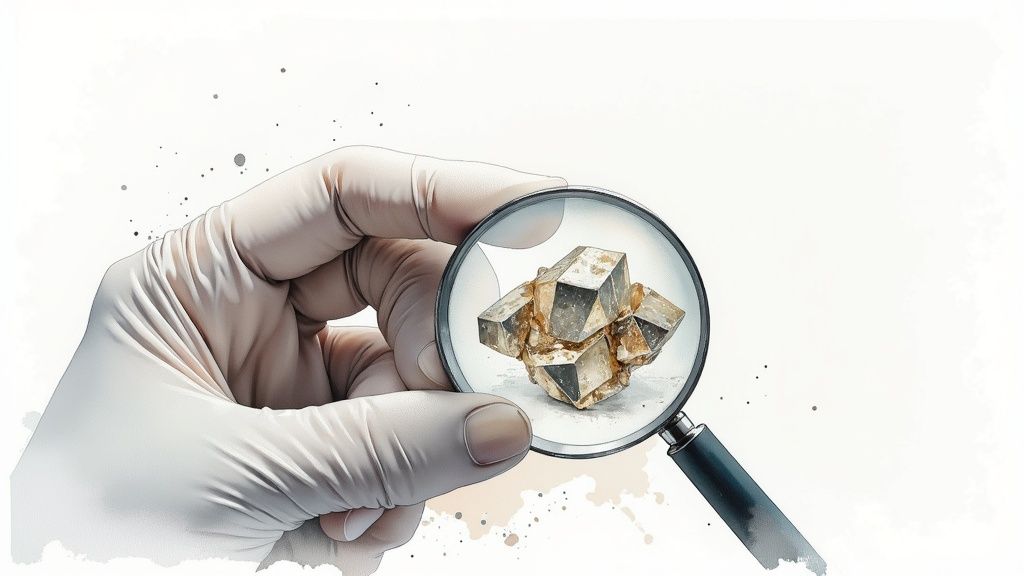
Picture this: a dark, metallic cube, almost perfectly formed, suspended forever inside a crystal-clear or milky-white world. That's the instant magic of galena in quartz. This incredible mineral duo features the lead-gray, mirror-like shine of galena crystals captured within the ethereal body of quartz, creating a stunning piece of natural art forged deep inside the Earth.
The Striking Contrast of Galena and Quartz
What really makes galena in quartz so visually stunning is its dramatic contrast. Galena, a lead sulfide mineral, naturally forms sharp, cubic crystals with a brilliant metallic sheen. When these dark, geometric shapes are frozen inside a matrix of translucent or milky quartz, the result is nothing short of breathtaking.
It’s a beautiful study in opposites: dark versus light, opaque versus transparent, and metallic versus glassy.
This pairing is a huge favorite among collectors, and not just for its looks. Each piece tells a geological story, offering a snapshot of a specific moment in Earth’s history when conditions were just right for these two very different minerals to grow together. For enthusiasts, it’s a chance to own something that showcases two completely distinct mineral habits in one harmonious piece.
Understanding the Key Minerals
To really get why this combination is so special, it helps to know the two players involved. Quartz is one of the most common minerals on the planet, famous for its toughness and stability.
Quartz: This is a silicate mineral made of silicon and oxygen. It forms the clear or whitish crystal structure that acts as the host for the galena. For a deeper dive, you can explore the fundamental properties of quartz.
Galena: As the main ore of lead, galena is known for its perfect cubic crystals, heavy density, and unmistakable metallic luster. It’s what provides those dark, eye-catching inclusions.
This natural partnership creates specimens that are both geologically fascinating and just plain beautiful to look at. For anyone looking to build out their collection, understanding how different quartz formations come to be is a great next step. For an in-depth look, check out this collector's guide to quartz crystal clusters.
How These Minerals Form Together Inside the Earth
The story of how galena and quartz end up together is a geological drama that plays out deep within the Earth's crust. It all starts with something called hydrothermal activity. The easiest way to picture it is as a natural, high-pressure plumbing system where superheated water, loaded with dissolved minerals, gets pushed through cracks and voids in solid rock.
This super-charged water—what geologists call hydrothermal fluid—acts like a delivery service. As it moves through the crust, it dissolves and picks up different elements from the surrounding rock, including silica (the stuff quartz is made of) and lead sulfide (which eventually becomes galena). The journey of these two minerals becoming a single, striking specimen is all about timing and changing conditions.
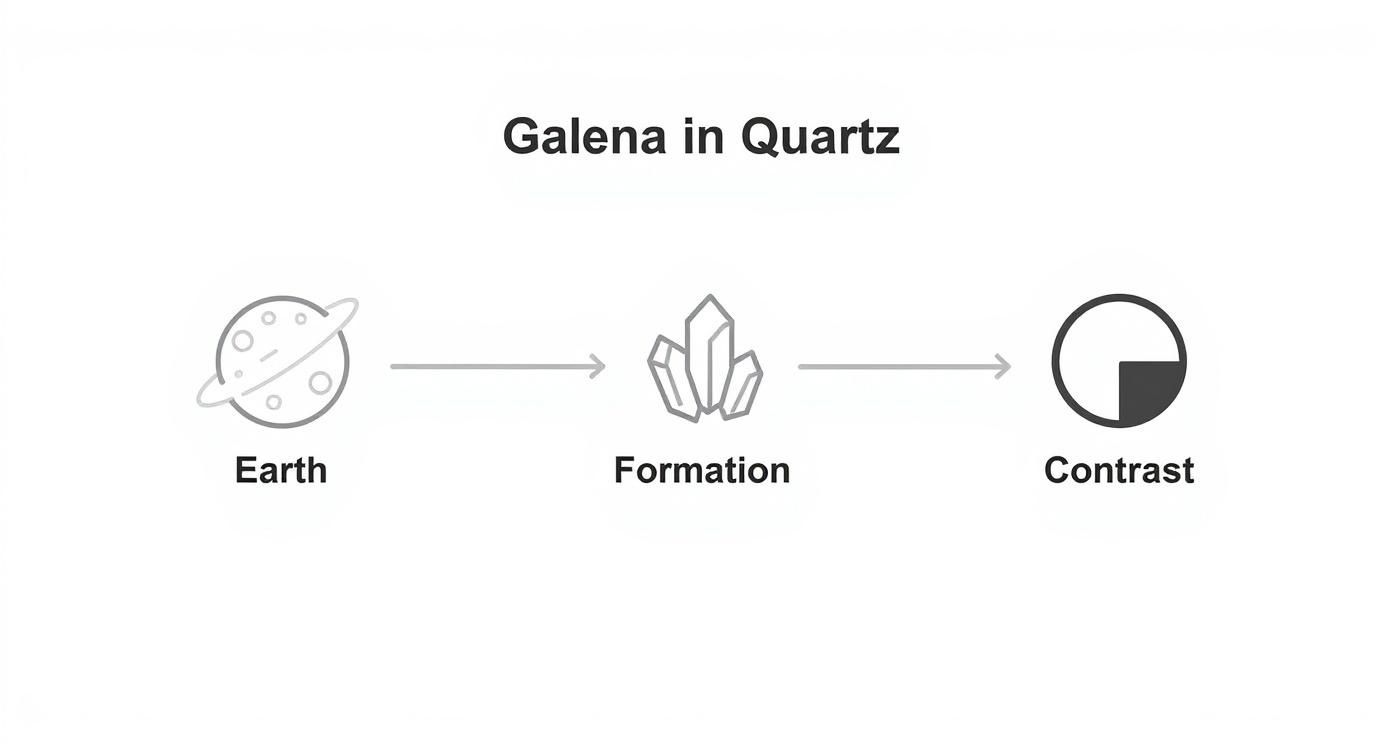
This infographic breaks down that multi-stage geological journey, from deep-earth processes to the final, beautiful mineral pairing.
You can see how separate elements—heat, water, and minerals—have to come together under just the right circumstances to create the unique contrast we see in these pieces.
The Two-Step Formation Process
The crystallization almost always happens in stages. These stages are dictated by shifts in temperature, pressure, and the specific chemical cocktail of the hydrothermal fluid at any given moment.
Quartz Crystallizes First: As the superheated, silica-heavy fluid travels up through rock fissures, it starts to cool down. When it does, the silica can no longer stay dissolved and begins to precipitate out of the solution. This is when the first quartz crystals start to grow, often lining the walls of a fracture to form a vein.
Galena Forms Later: After the initial quartz has formed, something changes. Maybe a new pulse of fluid with a different chemical makeup rushes in, or perhaps the temperature drops even further. This shift allows the lead sulfide to finally crystallize. The galena can form right on top of the quartz, next to it, or even inside tiny cracks within the existing crystals.
This sequential crystallization is the whole secret. The first round of quartz growth creates the perfect host—a stable, crystalline foundation where the later-forming galena can settle in. It’s a geological coincidence that gives us such a visually stunning combination.
This isn't just a tiny, localized event; it's the same process responsible for creating massive mineral deposits all over the globe. Galena found in quartz veins is often tied to major lead-zinc mining districts that have literally shaped regional economies.
Take Wales, in the UK, for example. Galena is a primary lead ore there, and it's commonly found in hydrothermal quartz veins. The Halkyn-Minera district has been mined since Roman times, which tells you just how long these types of mineral formations have been important. You can dig deeper into the mineralogy of Wales to learn more about these historic deposits. This history adds a whole other layer of appreciation for any piece of galena in quartz you might hold.
A Practical Guide to Identifying Galena in Quartz
Spotting galena inside a piece of quartz is one of those thrilling moments for any collector. But how can you be sure it’s the real deal? While its mirror-like shine is often a dead giveaway, a few distinct physical properties make identification surprisingly straightforward once you know what to look for. Think of it like learning a mineral's unique fingerprints.
The first and most obvious clue is its luster. Galena has a brilliant, lead-gray metallic shine that looks just like polished metal. Quartz, on the other hand, has what we call a vitreous (or glassy) luster. This stark contrast is usually the first thing that will catch your eye.
Feel the Weight and Check the Break
Beyond looks, galena has a surprising heft. This is thanks to its high specific gravity, which clocks in between 7.4 and 7.6. It just feels unusually heavy for its size—a characteristic that becomes incredibly noticeable the moment you pick up a specimen.
Next, take a look at how the mineral breaks. Galena has perfect cubic cleavage, which means it breaks along three planes at perfect 90-degree angles. This creates tiny, stairstep-like fractures or even breaks off into complete little cubes. Quartz couldn't be more different, showing a pattern called conchoidal fracture. It breaks in smooth, curved surfaces, much like a piece of chipped glass.
Galena vs Quartz Identification Cheat Sheet
To make things even easier, here's a quick side-by-side comparison to help you tell these two minerals apart at a glance.
Property
Galena
Quartz
Luster
Bright Metallic
Glassy (Vitreous)
Color
Lead-Gray
Colorless, White, or Varied
Specific Gravity
High (7.4–7.6)
Low (2.65)
Fracture/Cleavage
Perfect Cubic Cleavage
Conchoidal Fracture
Hardness
Soft (2.5 on Mohs scale)
Hard (7 on Mohs scale)
Understanding these fundamental differences is a cornerstone of mineralogy. For anyone looking to dive deeper, our comprehensive crystal identification guide offers more advanced techniques for distinguishing all kinds of minerals.
Simple Tests You Can Perform
Sometimes, visual cues aren't quite enough, especially if you're trying to tell galena from a convincing look-alike like pyrite (often called "fool's gold"). A couple of simple, non-destructive tests can give you a definitive answer without harming your specimen.
The Streak Test: This is one of the most reliable field tests out there. Just gently rub the mineral across the back of an unglazed ceramic tile. Galena will always leave a distinct lead-gray to black streak. Pyrite, in contrast, leaves a greenish-black one.
The Hardness Test: Galena is surprisingly soft, with a Mohs hardness of only 2.5. This means you can actually scratch it with a copper penny. Quartz, being much harder at a 7, will easily scratch steel and won't be marked by a penny at all.
A key takeaway for collectors is to always start with the least invasive tests. Observing luster, cleavage, and heft should be your first steps before ever attempting a streak or hardness test on a valuable piece.
By combining these observations—a good visual inspection, feeling its weight, and performing these simple tests—you can confidently identify galena in quartz every time. These hands-on skills transform you from a passive admirer into an informed collector, giving you a much deeper appreciation for every new find.
Galena's Economic and Historical Importance
While a beautiful specimen of galena in quartz is a collector's dream, the real story behind this mineral is its immense industrial power. Long before it was admired on shelves, galena was a cornerstone of human civilization, playing a crucial role for thousands of years. Its journey from ancient Rome to the modern world is a tale of economic might.
First and foremost, galena is the world’s primary ore of lead. This single fact has shaped history in countless ways. Ancient Romans, for instance, were obsessed with it. They used lead from galena to engineer everything from their famous aqueducts and plumbing systems to everyday items like cosmetics and cookware.
Centuries later, its importance skyrocketed again. Lead became an essential ingredient for ammunition, paints, and the first batteries, literally fueling the Industrial Revolution. This massive demand turned galena mining into a global enterprise that built fortunes and entire towns.
From Ore to Economic Engine
But galena had a secret weapon: it's not just a source of lead. It is also a major source of silver. When galena contains enough silver to be worth extracting, it’s known as argentiferous galena. This dual value made certain mining districts incredibly rich.
Think about its key roles throughout history:
Ancient Rome: The go-to source for lead to build their sprawling plumbing networks.
Medieval Period: A critical source of silver for coins and lead for the iconic roofs of cathedrals.
Industrial Revolution: Essential for manufacturing bullets, batteries, and even as an additive in gasoline.
The dual value of lead and silver made galena a "two-for-one" mineral. Mining operations could extract two valuable metals from a single ore, making deposits of argentiferous galena exceptionally profitable and historically significant.
This economic pull triggered mining booms all over the world. As the natural mineral form of lead sulfide (PbS), galena is the most important ore for lead, often found locked in quartz within hydrothermal veins. Historically, some of the most significant deposits were found in the Mississippi Valley. In particular, southeastern Missouri's Lead Belt became—and remains—the largest known galena deposit on the planet.
Mining in this region kicked off in the early 1800s and hit its peak around World War I. Entire communities, like Galena, Illinois, were named for the very mineral that gave them life. You can dig deeper into galena's historical mining impact on Wikipedia.
Famous Mining Districts
A few locations became legendary for their galena production, with local economies rising and falling with the mines' fortunes. These districts aren't just holes in the ground; they're historical landmarks that tell a story of human ambition and geological wealth.
One of the most famous examples is the Lead Belt in Missouri. For over a century, this region was the world's leading producer of lead. Fortunes were built on the silvery-gray galena pulled from its quartz and dolomite-hosted veins.
Knowing this rich industrial past adds a whole new layer of appreciation for any piece of galena in quartz. It connects your personal collection to a powerful global history.
What Determines a Specimen's Value
Ever wonder why one piece of galena in quartz fetches a premium price while another, almost identical one, doesn't? The secret goes way beyond just size. For collectors, a specimen's value is a delicate dance between its aesthetics, the quality of its crystals, and even its geological backstory.
To really appreciate what makes a piece exceptional, you have to look closer. It's not just about how big it is. It's about how sharp the crystals are, how clear the host quartz is, and how the two minerals create a balanced, eye-catching composition. A small, flawless specimen will almost always be more valuable than a large one with noticeable damage.
Key Factors in Valuation
Dealers and seasoned collectors have a keen eye for what makes a specimen stand out. They're looking for that perfect blend of visual drama and mineralogical perfection. Think of a specimen's worth as a story told through its physical traits.
Crystal Quality: This is everything. You want to see sharp, well-defined cubic galena crystals. Anything distorted, dull, or poorly formed just won't make the cut.
Aesthetics and Balance: The overall look is crucial. Is the galena attractively placed within the quartz, or is it awkwardly off to one side? A visually pleasing arrangement that feels balanced can dramatically increase its value.
Quartz Clarity: The host material sets the stage. Galena inclusions pop when they're set against water-clear, highly transparent quartz. If the quartz is milky or cloudy, it can hide the galena and bring the value down.
Condition: Damage is a deal-breaker. Any chips, fractures, or major scratches on either the galena or the quartz will seriously detract from its worth. Pristine, untouched specimens are what everyone is after.
The Importance of Locality and Rarity
Where a specimen was pulled from the earth can have a huge impact on its price. Pieces from classic or historically significant mines—especially ones that are no longer active—often command a premium. This "provenance" adds a layer of rarity and history that collectors are more than willing to pay for.
This principle isn't unique to minerals. It's the same logic that applies to other natural collectibles. For instance, you can see how factors like rarity and origin influence pricing in our guide on what a meteorite is worth. A unique story or a famous origin almost always elevates an object's value.
A specimen's "address" is part of its identity. A galena in quartz from a famous, closed-down mine in Colorado, for instance, is often more valuable than a comparable piece from a currently active, high-production mine.
Sometimes, the value is tied to properties you can't even see. For example, studies on galena from Utah's Burgin Mine revealed that silver content varied wildly depending on crystal size. Coarse-grained galena from this location contained about 0.22% silver by weight, while the finer-grained material had less than 0.04%. You can't see the silver, but this compositional data is critical to the ore's economic value. You can read more about these compositional variations in galena ore in this USGS report.
How to Properly Care for Your Mineral Specimens
Bringing a piece of galena in quartz into your collection is a real treat, but keeping it looking its best for years to come requires a bit of know-how. Galena is surprisingly soft, clocking in at just 2.5 on the Mohs hardness scale, and its metallic luster can tarnish over time. This means a gentle touch is non-negotiable—harsh chemicals and abrasive tools are definitely out.
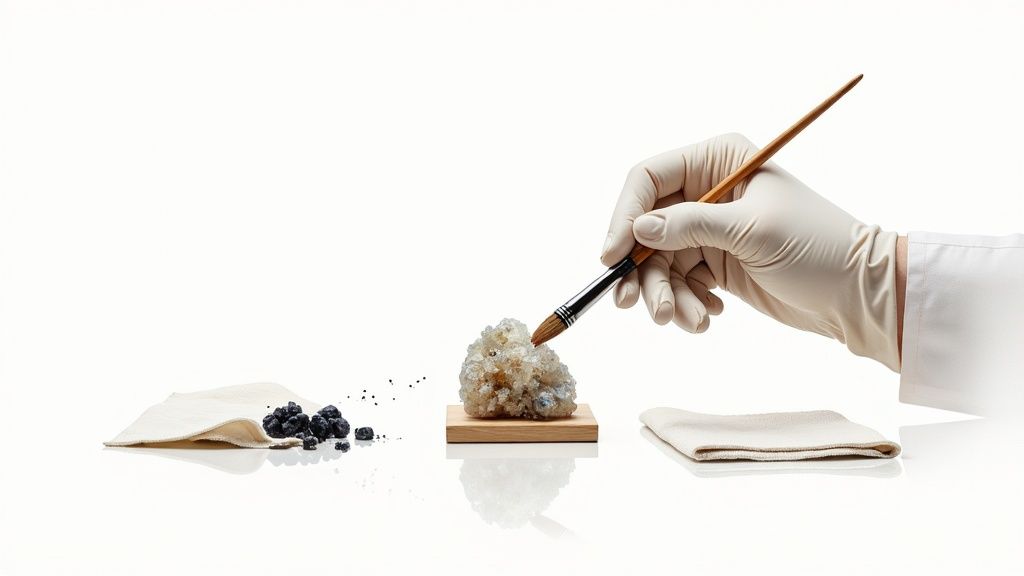
When it comes to cleaning, simpler is almost always better. For a bit of loose dust, a soft-bristled artist's brush or a quick puff of canned air will do the trick. If you’re dealing with more stubborn grime, a soft cloth dampened with a little distilled water is all you need. Just be sure to dry it immediately and completely afterward.
Safe Handling and Display Tips
Since galena is a lead sulfide mineral, handling it safely is key. It's a simple precaution, really: just wash your hands with soap and water after you've touched your specimen. This quick step prevents any mineral dust from being accidentally ingested and makes enjoying your collection perfectly safe.
The whole point of a good display is preservation. You're creating a safe haven for your specimen, protecting it from dust, humidity, and clumsy accidents that can cause damage over time.
To keep your galena in quartz looking pristine, here are a few guidelines to follow:
Avoid Direct Sunlight: Just like a prized photograph, some minerals can fade with prolonged exposure to the sun. Find a spot with plenty of indirect light instead.
Control Humidity: A damp environment is the enemy of galena's metallic shine, as it can speed up tarnishing. A dry, stable room is your best bet.
Use a Protective Case: A closed display case is your specimen's best friend. It keeps dust at bay and shields it from accidental bumps and scratches.
Putting a little thought into your storage solution makes a huge difference. If you're looking for ideas, you can explore options in our guide on choosing the perfect rock collection display case. And while galena in quartz has its own specific needs, it never hurts to understand broader maintenance techniques, like those offered by professional jewellery cleaning services for other valuables in your collection.
Answering Your Top Questions
When you're new to collecting, or even just adding a new type of specimen to your display, a few questions always pop up. It's smart to be curious.
Here are some of the most common things collectors ask about galena in quartz, covering everything from handling it safely to telling it apart from other minerals.
Is Handling Galena in Quartz Safe?
Yes, for the most part, handling a solid, stable specimen of galena in quartz is perfectly safe. The main thing to remember is that galena is lead sulfide. Because of this, you'll want to take a couple of simple, common-sense precautions.
Always wash your hands thoroughly after you've handled your specimen. This is just good practice with any mineral, really. If you want to be extra cautious, keeping it in a sealed display case is a great way to minimize any dust exposure.
Make it a habit to wash your hands with soap and water after touching your minerals.
Avoid grinding, chipping, or breaking the rock, as this can create airborne dust.
It's always best to store these pieces where children can't get to them and in a spot that stays relatively dry.
Does All Galena Contain Silver?
This is a great question, and the answer is no—not all galena is hiding a valuable amount of silver. The specific type you're looking for is called argentiferous galena, which is just a technical way of saying "silver-bearing."
Many galena specimens might have tiny, trace amounts of silver, but you'd need a proper chemical assay to even confirm it's there. In those truly special argentiferous samples, the silver content can climb to over 0.3%, which is when it becomes significant.
How Do I Differentiate Galena from Pyrite?
At a glance, shiny metallic minerals can look alike, but telling galena and pyrite apart is actually quite simple once you know what to look for. A few quick field tests will give you the answer.
The Streak Test: This is a classic. Scrape the mineral on an unglazed ceramic tile. Galena leaves a distinct gray-black streak. Pyrite, on the other hand, will leave a greenish-black line.
Color and Luster: Look closely at its shine. Galena has that classic, bright metallic lead-gray luster. Pyrite, often called "fool's gold," has a much brassier, yellowish glint.
Cleavage: This is a dead giveaway. Galena has perfect cubic cleavage, meaning it breaks along flat planes that create little cube-like shapes. Pyrite's fractures are much more irregular and don't follow a neat pattern.
A good rule of thumb for any collector: always start with the non-destructive tests. Check out the luster, feel the weight, and do a streak test before you even think about anything more invasive.
By keeping these simple tips in mind, you'll be able to confidently identify your galena in quartz specimens and care for them properly. A little know-how goes a long way in building a collection you're proud of.
Keep a dedicated logbook for your collection to jot down each specimen's weight, where it's from, and when you got it.
Take clear photos of your pieces next to a ruler or coin for scale.
Use acid-free paper for your labels to prevent any chemical reactions from damaging the specimen over time.
Rotate your display pieces every so often—it’s a good excuse to admire them up close and check for any dust or damage.
Ready to find your next centerpiece? Explore an online curated selection of fine minerals and expert advice at Astro West today: https://astrowest.com