How to Tell Iron Pyrite from Gold: A Practical Guide
That flash of gold in a stream bed or a rock shop always brings a jolt of excitement. But is it the real deal, or its clever, frustratingly common imposter? For centuries, even seasoned prospectors have been tricked by iron pyrite, a mineral so convincing it earned the permanent nickname "fool's gold."
This isn't a new problem. During the great gold rushes, like the one in California, countless fortunes were lost before they were ever made because miners mistook pyrite’s sharp, brassy crystals for the softer, more rounded glow of genuine gold nuggets. According to the U.S. Geological Survey, this confusion has been a rite of passage for gold seekers for generations.
Learning to spot the difference is a fundamental skill, whether you're a budding geologist, a serious collector, or just someone who loves the thrill of the hunt. Luckily, you don't need a fancy lab. There are a handful of reliable at-home fool's gold tests you can perform to know for sure.
A simple look at the mineral's shape and shine can often be your first big clue. This handy decision tree shows how observing those basic features can quickly set you on the right path.
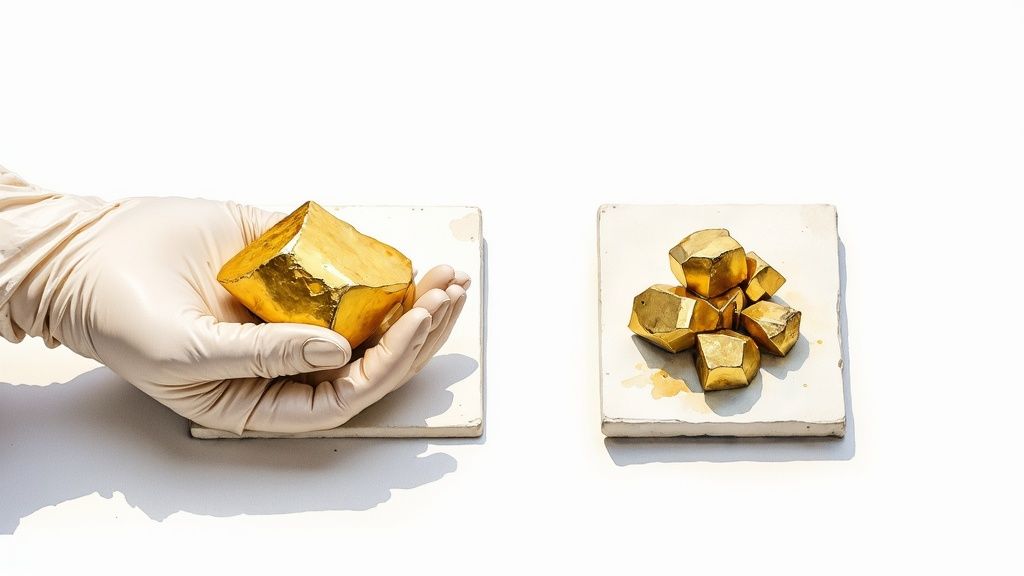
As you can see, gold's natural form is often softer and more irregular. Pyrite, on the other hand, loves to form sharp, almost geometric crystals that look almost too perfect. It's a dead giveaway once you know what to look for.
Gold vs Pyrite At a Glance
For a quick reference, this chart breaks down the key differences between real gold and its most famous lookalike. Keep these points in mind when you're examining a new find.
Characteristic
Real Gold
Iron Pyrite (Fool's Gold)
Hardness
Very soft (2.5-3 Mohs). Dents or bends easily.
Brittle (6-6.5 Mohs). Will crumble or shatter under pressure.
Streak Color
Golden-yellow.
Greenish-black or brownish-black.
Crystal Shape
Irregular nuggets, flakes, and grains. Soft, rounded edges.
Sharp, cubic, or octahedral crystals. Distinct, hard edges.
Weight
Very heavy. Specific gravity is 19.3.
Much lighter. Specific gravity is around 5.0.
Smell
Odorless.
Emits a faint sulfuric smell (like rotten eggs) when struck.
This table serves as a great field guide, but remember that running a couple of simple hands-on tests is the best way to confirm your suspicions.
Of course, pyrite isn't the only thing that gets mistaken for gold. It's also important to know what you're looking at when it comes to jewelry and other man-made items. For a great breakdown, it's worth understanding the differences between solid gold, gold filled, and gold plated jewelry. Having this foundational knowledge is key before we jump into the more detailed physical tests.
Identifying Gold with Simple Visual Checks
Before you start any physical tests, remember that your eyes are the most powerful tools you have. Learning to tell iron pyrite from real gold often just starts with a careful look. The differences can feel subtle at first, but once you know what to watch for, they become surprisingly obvious.
One of the first giveaways is the mineral’s shape. Gold is an incredibly soft and malleable element. In nature, this means it forms as nuggets, flakes, or grains with soft, rounded, and irregular edges. Picture a piece of soft clay tumbled around in a stream—it’s not going to have any sharp angles.
Pyrite, on the other hand, is a crystal. It grows in a highly structured, almost geometric way.
You'll often find pyrite forming into distinct shapes like cubes, octahedrons (eight-sided), or pyritohedrons (twelve-sided). These crystals will have sharp, defined edges and flat, almost polished-looking faces—a stark contrast to gold's lumpy appearance.
For a deeper dive into these characteristics, our crystal identification guide can help you get better at recognizing common mineral forms.
Color and Luster Under Light
Next up, let's talk about the color and shine. Real gold has a deep, rich, buttery yellow color. The crucial part? That color stays consistent whether you’re looking at it in direct sunlight or in the shade. It has a true metallic glow that just doesn't quit.
Pyrite is a whole different story. Its color is a much brasher, more brassy yellow that can sometimes even have a greenish tint to it. The luster is another dead giveaway. In direct light, pyrite can be dazzlingly bright, but as soon as you move it into the shade, that metallic shine can look dull or even darken quite a bit.
Finally, check for any tarnish. As an iron sulfide, pyrite will react with air and moisture over time, which leads to tarnish or even little rust spots on its surface. Gold is one of the least reactive elements on the planet; it will not tarnish or rust. It maintains that brilliant shine forever. If you see any discoloration or rust, you are almost certainly looking at fool’s gold.
Get a Definitive Answer With the Streak Test
When a simple visual check isn’t giving you a clear answer, it’s time to get a little more hands-on. The streak test is a classic, time-tested method geologists use in the field, and it’s one of the most reliable ways to tell iron pyrite from real gold. It’s quick, simple, and reveals a mineral’s true character, which is often hiding beneath a deceptive surface shine.
The whole idea behind the test is to see the color of a mineral’s powder. You'll need an unglazed ceramic plate or a piece of unglazed porcelain tile to do it. Honestly, even the rough, unglazed bottom ring of a coffee mug will work if you're in a pinch. Just scrape your mineral firmly across the surface, enough to leave a powdered streak behind.
What the Streak Tells You
The results you get are immediate and couldn't be more different for these two minerals. There's no ambiguity here. You're looking for one of two things:
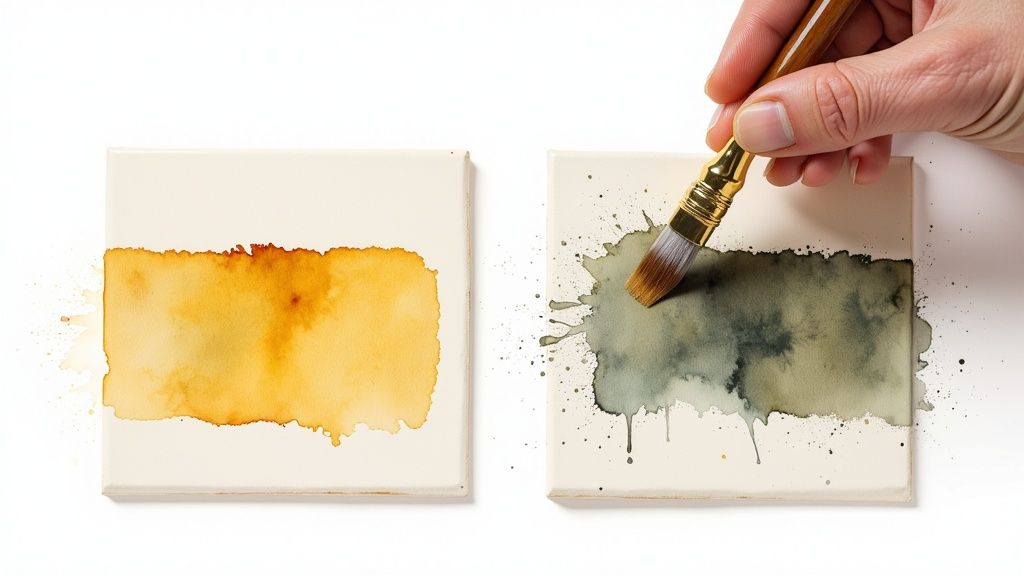
A Golden-Yellow Streak: Real gold is surprisingly soft. When you drag it across a ceramic plate, it leaves behind a beautiful, bright golden-yellow streak. The color of the powder will match the nugget itself. That’s how you know you've got the real deal.
A Greenish-Black Streak: Pyrite might look golden on the outside, but its streak tells a completely different story. Thanks to its iron sulfide composition, it leaves a very distinct greenish-black or nearly black streak. This dark, sooty residue is a dead giveaway that you’re holding fool’s gold.
The streak test cuts right through the visual trickery. Pyrite can absolutely fool the eye with its brassy luster, but it can't fake its fundamental chemical makeup—and that's exactly what the streak test exposes.
This technique is a cornerstone of field geology for a reason: it’s simple and it works. Learning how to identify a mineral using basic, practical tests like this is a fundamental skill for any prospector or collector.
Testing Hardness and Malleability
How a mineral reacts to physical pressure can tell you everything you need to know. Beyond just looking at it, putting your sample through a couple of simple physical tests will give you the clear evidence you need to separate iron pyrite from real gold. These are hands-on, definitive tests, and you probably already have the tools you need.
First up, let's talk about hardness. This classic test uses the Mohs scale, which is just a standard way to measure a mineral's resistance to being scratched. You don't need fancy equipment; a simple steel nail or the tip of a pocketknife blade will do the job perfectly.
Real Gold: Gold is surprisingly soft, ranking only 2.5 to 3 on the Mohs scale. A steel nail, which has a hardness of about 5.5, will easily leave a scratch or even a small gouge on the surface of genuine gold.
Iron Pyrite: Pyrite, on the other hand, is much tougher. It comes in at 6 to 6.5 on the Mohs scale. If you try scratching pyrite with that same steel nail, the exact opposite happens—the pyrite will actually scratch the steel, leaving a silvery mark from the nail on its surface.
This massive difference in hardness is a fundamental tell, much like the one between other common minerals. If you want to get a better feel for why hardness tests are so reliable in the field, understanding the properties of minerals like calcite and quartz provides some great context.
The Hammer Test: Malleability vs. Brittleness
Next, we'll look at malleability—a mineral’s ability to bend or deform under pressure without breaking. This test is where the difference between a soft metal and a brittle crystal becomes incredibly obvious. Just place a tiny fragment of your sample on a hard surface, like an anvil or even a concrete garage floor.
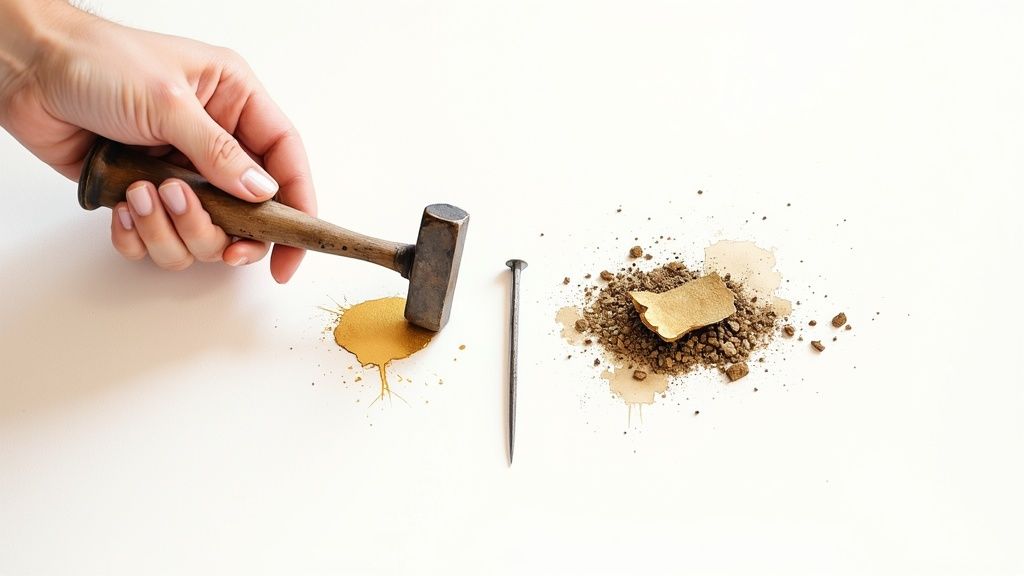
Gently tap the fragment with a small hammer. A piece of real gold is highly malleable, so it will simply flatten out, bend, or deform, almost like a piece of soft lead. In stark contrast, brittle iron pyrite will shatter instantly, breaking into smaller pieces or crumbling into a fine, dark-colored dust.
This simple action gives you an unmistakable result. Gold bends, pyrite breaks.
When you combine the results from the hardness test with this malleability test, you have a powerful, two-pronged approach to confidently identify your find. You'll never be fooled by pyrite's convincing golden shine again.
When You Need to Be Absolutely Sure: Advanced Methods
Okay, so the simple field tests are done, but you're still not 100% convinced. Maybe the results were a little ambiguous, or maybe the potential value is just too high to leave to chance. This is when you bring in the heavy hitters—the scientific methods that give you a definitive answer.
These techniques go beyond simple observation and dig into the core physical and elemental properties of your find. No more guesswork.
The Weight Test: Specific Gravity
One of the most telling differences between gold and pyrite is just how dense they are. This is a property we call specific gravity.
Gold is unbelievably heavy for its size, with a specific gravity of 19.3 g/cm³. Pyrite, on the other hand, comes in at around 5.0 g/cm³. That's a massive difference. In fact, gold is nearly four times denser.
If you were to hold a piece of real gold in one palm and a chunk of pyrite of the exact same size in the other, the difference would be immediately obvious. The gold would feel almost unnaturally heavy, a dead giveaway that you're holding something special.
Getting a Professional Analysis
For geologists, prospectors, and refiners, the go-to tool for a final verdict is a portable X-ray fluorescence (XRF) analyzer. This is the real deal.
An XRF gun shoots X-rays at a sample and reads the energy that bounces back, giving a precise, instant breakdown of its elemental makeup. It's completely non-destructive and provides what's essentially an elemental fingerprint.
For Pyrite (FeS₂): The analyzer will show strong peaks for iron and sulfur.
For Gold (Au): It will confirm the presence of pure gold.
There’s no hiding from an XRF analyzer.
While most of us don't have an XRF gun in our garage, just knowing these tools exist is important. It highlights that the differences between fool's gold and real gold aren't just superficial—they're baked into their fundamental chemistry.
Understanding how to verify valuable finds is a skill that applies to more than just minerals. You can check out some expert tips on identifying valuable items to see how similar principles of careful inspection and verification are used across all kinds of collectibles.
Common Questions About Identifying Gold
Even with all the right tests in your back pocket, a few questions always seem to pop up in the field. Let's dig into some of the most common ones to clear up any confusion you might have when you're trying to tell real gold from its most famous imposter.
Gold and Pyrite: Can They Be Found Together?
This is probably the number one question I get, and the answer is a big yes. It's actually quite common to find gold and pyrite in the same spot, which is exactly why knowing how to tell them apart is so crucial. They often form in similar geological settings, like quartz veins, making them frequent, and sometimes frustrating, neighbors.
The Easiest At-Home Tests
So, what’s the quickest, simplest test you can run without any fancy equipment? Hands down, it's the hardness and malleability check. You don't need much—a basic steel nail will do the trick.
Here’s the rundown:
If the nail scratches your mineral, it could very well be gold.
If the mineral easily scratches the nail, you're almost certainly looking at pyrite.
Another great clue that people often overlook is the smell. I know, it sounds a bit strange, but it works. If you strike pyrite against steel, it can give off a faint sulfuric odor, kind of like a lit match. That’s because it's an iron sulfide. Gold, on the other hand, is completely odorless because it doesn't react with much of anything.
Why does pyrite look so much like gold in the first place? It's all about that convincing brassy-yellow color and metallic shine that earned it the name "fool's gold." But once you know to look for the fundamental differences in crystal shape (cubic for pyrite vs. irregular for gold), hardness, and streak color, you can see right through the disguise.
It’s also worth mentioning that some pyrite, known as auriferous pyrite, actually contains microscopic flecks of real gold. The catch? This gold is chemically locked inside the pyrite's crystal structure. You can't see it, and you certainly can't get it out without some serious industrial processing. So, while your piece of pyrite might technically contain gold, it’s not accessible to the average prospector.
At Astro West, we believe every mineral tells a fascinating story. Whether you're a seasoned collector or just starting your journey into the world of natural treasures, we offer a curated selection of authentic, ethically sourced specimens. Explore our collection of fine minerals, fossils, and more to find your next conversation piece. Visit us at https://astrowest.com to discover a piece of natural history.