Explore the 9ft dinosaur skeleton: Fossils, Replicas, and Care Tips
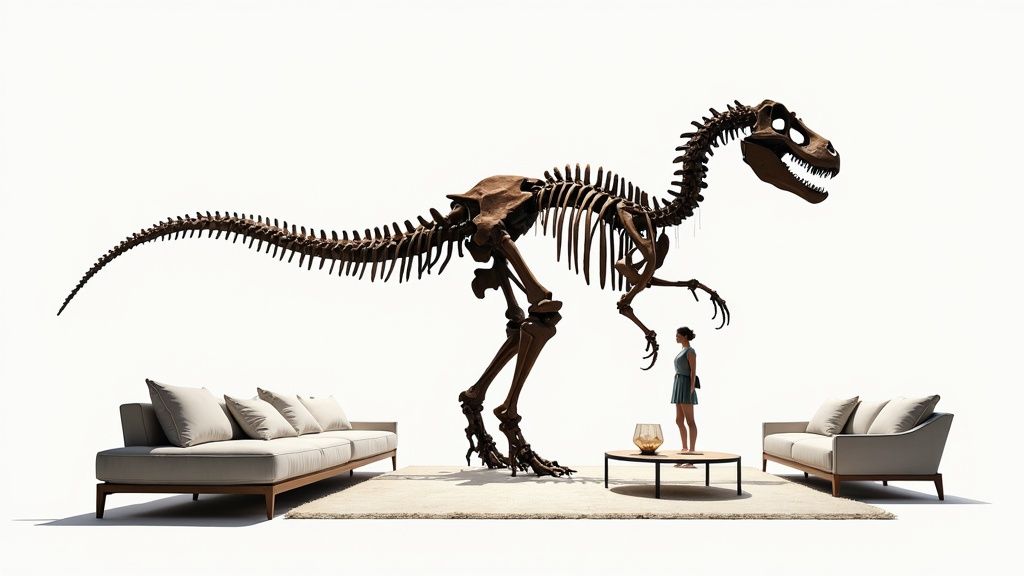
Picture this: a 9ft dinosaur skeleton, standing right in your living room. It's more than just a collectible—it's a genuine piece of natural history, an echo from a world millions of years gone. Something this epic doesn't just decorate a room; it commands attention and sparks a sense of wonder.
Bringing a Prehistoric Giant into Your Home
If you're seriously considering owning a large-scale fossil, whether as a dedicated collector or for a truly one-of-a-kind interior design statement, you've come to the right place. We’re going to walk through the fascinating world of owning these specimens, covering both the science and the artistry behind them. This is all about helping you understand what it truly means to bring a piece of prehistoric life home.
A 9ft dinosaur skeleton can completely transform a space, turning a private study or a grand entryway into your own personal museum. It’s a constant, tangible reminder of Earth's deep history and the incredible creatures that once walked this planet. Forget small talk; this is a true conversation starter and an educational marvel, all in one.
What to Expect on This Journey
Think of this guide as your field manual. We'll cover everything from figuring out the right species for your space to understanding the critical differences between an authentic fossil and a museum-quality replica. My goal is to give you the confidence to make a smart, informed decision.
Here are a few of the key things we’ll explore together:
Species and Scale: What does a 9-foot skeleton actually represent? We'll look at whether you're getting a juvenile giant or a full-grown, smaller dinosaur.
Authenticity vs. Replicas: It’s a big decision. We’ll weigh the pros and cons of owning a genuine piece of history against a durable, finely detailed cast.
Logistics and Display: Let's get practical. We’ll cover the real-world considerations of transport, installation, and the long-term care needed to protect your investment.
When you're planning for a centerpiece this magnificent, don't forget the logistics. Getting a handle on the costs and complexities of professional help for moving substantial items is invaluable. Building a natural history collection is an adventure, whether you're starting with stunning minerals like malachite and labradorite or ancient fossil plates.
Let's get started on adding a prehistoric titan to yours.
What a 9ft Dinosaur Skeleton Actually Represents
When you hear "9ft dinosaur skeleton," don't just think of a measurement. Think of a story frozen in time, a scientific snapshot of a creature that lived millions of years ago. It can be hard to visualize, but picture something about the length of a large motorcycle or a touring kayak—a size that makes a serious statement in any room.
That 9-foot span tells us a lot, giving us clues about the dinosaur's species, its age, and even its place in the prehistoric food chain. It usually points to one of two fascinating possibilities: we're either looking at a young giant in the making or a smaller, more agile hunter in its prime.
Juvenile Giant or Full-Grown Hunter
A 9-foot tyrannosaurid skeleton, maybe from a young Gorgosaurus or even a teenage Tyrannosaurus rex, is an incredible find. It offers a rare peek into the awkward growth stages of these apex predators. Studying a juvenile helps scientists figure out how these giants developed, how their hunting styles changed as they got bigger, and just how fast they shot up in size. These in-between skeletons are crucial for piecing together a species' entire life cycle.
On the other hand, a 9ft dinosaur skeleton could belong to a fully mature adult of a smaller species. Think of something like Deinonychus, a whip-smart and speedy predator from the dromaeosaurid family (the "raptors"). In this case, the skeleton isn't a work in progress; it's a finished product. We get to see a creature in its prime, showcasing the complete anatomy of a successful hunter perfectly built for its environment.
A nine-foot skeleton is a paleontological sweet spot. It provides enough mass and detail to be scientifically significant while being a manageable size for private collectors and decorators to display, bridging the gap between museum halls and personal spaces.
Size in Context
While nine feet sounds massive, it's important to remember just how big some of these animals got. This size generally represents either a smaller dinosaur species or the young of a much larger one. For a bit of perspective, the legendary T. rex skeleton known as 'Sue' is about 40 feet long. A nine-foot specimen would be completely dwarfed by her, which shows that these smaller skeletons tell a different, but equally important, part of the dinosaur story.
Ultimately, every bone tells a piece of the puzzle, whether it's from a juvenile just starting out or an adult at the top of its game. To get a better sense of how these incredible remnants are preserved, you can explore the different types of fossils and the processes that turn bone into stone. The story told by a 9-foot skeleton is one of growth, survival, and evolution, making it a profoundly meaningful piece for any collection.
Choosing Between an Authentic Fossil and a Museum Replica
So, you're ready to bring a 9-foot dinosaur skeleton into your world. This is where you hit your first major fork in the road, and it’s the most important decision you'll make: should you go for an authentic, millions-of-years-old fossil, or a flawless, museum-quality replica? Your answer will shape everything from your budget to the long-term care of your incredible new centerpiece.
An authentic fossil is a direct line to a lost world. It’s a literal piece of Earth’s ancient history—something you can actually see and touch. For many collectors, nothing beats the thrill of owning a genuine specimen. It holds real scientific importance, potential investment value, and a story etched into every fracture and mineral deposit.
But that authenticity comes with a heavy price tag and even heavier responsibility. Genuine fossils are exceptionally rare and, as a result, incredibly expensive and fragile. They demand a strictly controlled environment to keep them from degrading and are tangled in a web of legal and ethical considerations. Proving its provenance—that it was legally and ethically unearthed and traded—is non-negotiable.
The Case for Museum-Quality Replicas
This brings us to the other side of the coin: museum-quality replicas. Don't mistake these for simple models or toys. These are high-fidelity casts created directly from the original fossil bones, capturing every last groove, texture, and subtle detail with breathtaking precision.
A replica gives you all the visual punch and educational power of the original, but with far greater durability. Crafted from modern materials like resin and fiberglass, these skeletons aren't nearly as vulnerable to humidity, temperature swings, or an accidental bump. This makes them a perfect fit for a home, office, or public area without the constant anxiety that comes with displaying a priceless, one-of-a-kind artifact.
A high-quality cast is the perfect marriage of scientific accuracy and modern resilience. It allows the beauty and awe of a dinosaur skeleton to be shared widely, preserving the irreplaceable original fossil for scientific study and conservation.
This practical blend of art and science makes replicas a much more accessible and worry-free entry point for most enthusiasts. To get a feel for what’s out there, you can explore the best place to buy fossils online, where reputable dealers offer both genuine specimens and high-quality casts with total transparency.
Genuine Fossil vs. Replica Comparison
To make the choice clearer, here’s a straightforward comparison breaking down the key differences between a genuine fossil and a museum-quality replica. This should help you weigh the pros and cons based on what matters most to you as a collector.
Attribute
Genuine Fossil
Museum-Quality Replica
Material
Natural fossilized bone, rock matrix
Resin, fiberglass, plaster, or other polymers
Rarity
Extremely rare; one-of-a-kind
Can be reproduced; multiple casts exist
Cost
Very high; typically $50,000 to millions
Significantly lower; $5,000 to $50,000+
Durability
Fragile; susceptible to environmental changes
Highly durable and resistant to damage
Maintenance
Requires climate control and professional care
Easy to clean; minimal maintenance
Authenticity
The real, irreplaceable artifact
A perfect, scientifically accurate copy
Legality
Complex; requires clear provenance and permits
Simple; no legal restrictions on ownership
Best For
Serious investors, museums, advanced collectors
Home decor, educational displays, most enthusiasts
Ultimately, this table highlights that neither option is inherently "better"—they just serve different purposes for different people.
Making an Informed Decision
At the end of the day, the right path is a personal one. It hinges on your goals, your budget, and what you want this piece to represent. Do you see yourself as the careful custodian of a rare scientific treasure, or are you looking for a stunning, stress-free piece of natural art?
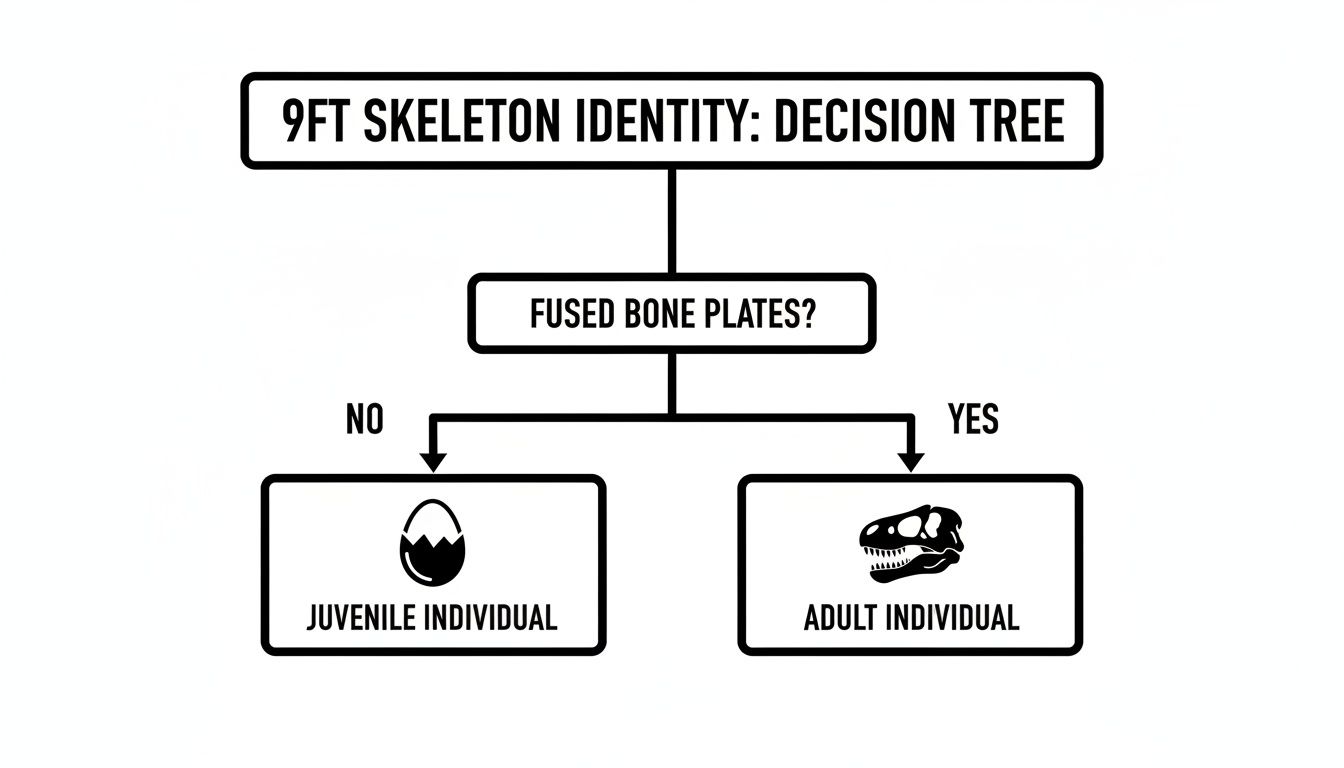
To give you a peek into the world of paleontology, here's one way experts determine a key detail about a skeleton—whether it was a juvenile or a full-grown adult.
As the chart shows, fused bone plates are a tell-tale sign of a mature dinosaur. It's a critical piece of information when assessing any skeleton, whether you're looking at the real deal or a meticulously crafted replica.
Your Smart Buyer's Checklist for Dinosaur Skeletons
Navigating the market for a 9-foot dinosaur skeleton requires more than just an eye for impressive décor. It demands careful research and a healthy dose of skepticism. Whether you’re hunting for an authentic fossil or a museum-grade replica, this checklist will help you make a smart, confident purchase.
Your first step is always to vet the seller. A trustworthy dealer will be transparent, deeply knowledgeable, and more than willing to provide extensive documentation. Look for a long-standing presence in the field, positive feedback from other collectors, and affiliations with reputable paleontological or geological organizations. Never be afraid to ask for references.
Verifying Authenticity and Provenance
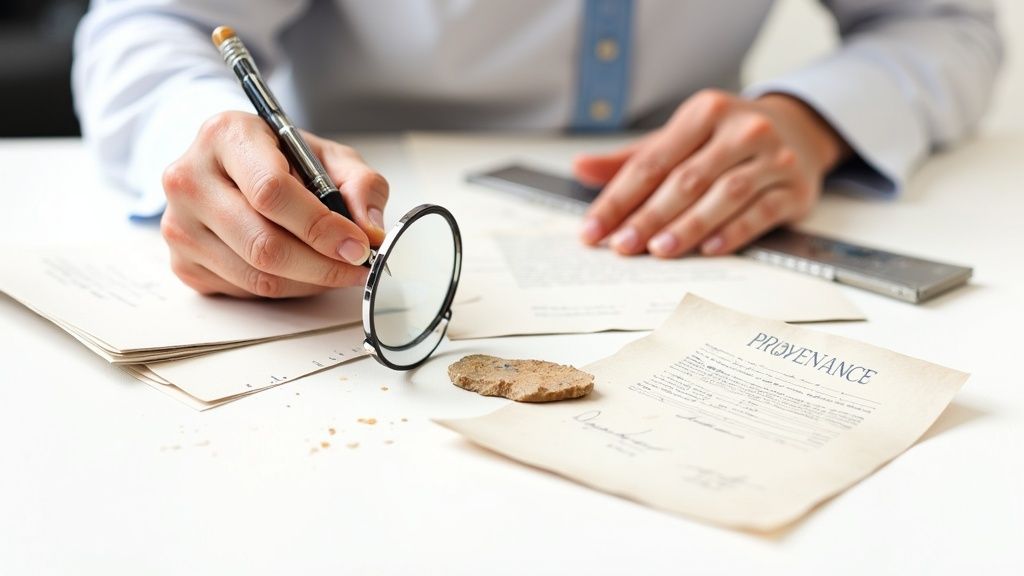
When it comes to a genuine fossil, authenticity and provenance are everything. Think of provenance as the fossil's life story—a documented history tracing its journey from the moment of discovery to the present day. This paperwork is your guarantee that the specimen was legally and ethically sourced.
Here’s what that documentation should include:
Discovery Details: It should clearly state where and when the fossil was found, right down to the specific geological formation.
Land Ownership: This is critical. The paperwork must prove the fossil was excavated from private land with the owner’s full permission. Fossils from public lands are often tangled in legal restrictions.
Chain of Custody: A clear record of everyone who has owned the fossil helps confirm its history and legality.
Preparation Records: Knowing who prepared the fossil—the expert who painstakingly removed it from the rock—tells you a lot about the quality of the work.
A fossil without clear, verifiable provenance is a massive red flag. It could be a forgery, illegally excavated, or unethically sourced, putting you at serious legal and financial risk.
If a replica is on your radar, the standards are different but just as important. Ask about the casting process. The best replicas are molded directly from original fossil bones, which ensures scientific accuracy. The seller should be able to tell you exactly which specimen the cast was made from, including its museum or collection ID number.
Assessing Price and Quality
Several factors drive the price of a 9-foot dinosaur skeleton. Understanding them is key to knowing whether the price tag is fair.
For an authentic fossil, the biggest value drivers are rarity, completeness, and preparation quality. A skeleton from a rare species or one that is over 75% complete will naturally command a much higher price. The skill of the preparator is also a huge factor; a poorly prepared specimen can be damaged beyond repair, losing both its scientific and monetary value.
With replicas, the price is shaped by the quality of the materials (usually resin and fiberglass), the faithfulness of the cast, and the complexity of the custom mount. A dynamic, lifelike pose will almost always cost more than a simple, static one.
For a deeper dive into what makes a fossil a great find, our guide on the essential things to look for when collecting fossils offers even more expert insights. Follow these steps, and you’ll be able to assess any potential acquisition like a seasoned pro.
How To Display and Preserve Your Prehistoric Treasure
Bringing a 9ft dinosaur skeleton home is an incredible feeling, but it’s really just the beginning of the adventure. Now comes the crucial part: proper display and long-term care to protect your investment and make sure this piece of natural history continues to inspire for years to come.
This phase is all about logistics, from specialized shipping to getting it professionally mounted. Don’t worry—most reputable sellers will handle the heavy lifting, coordinating with crating and freight companies who know how to move delicate, high-value items.
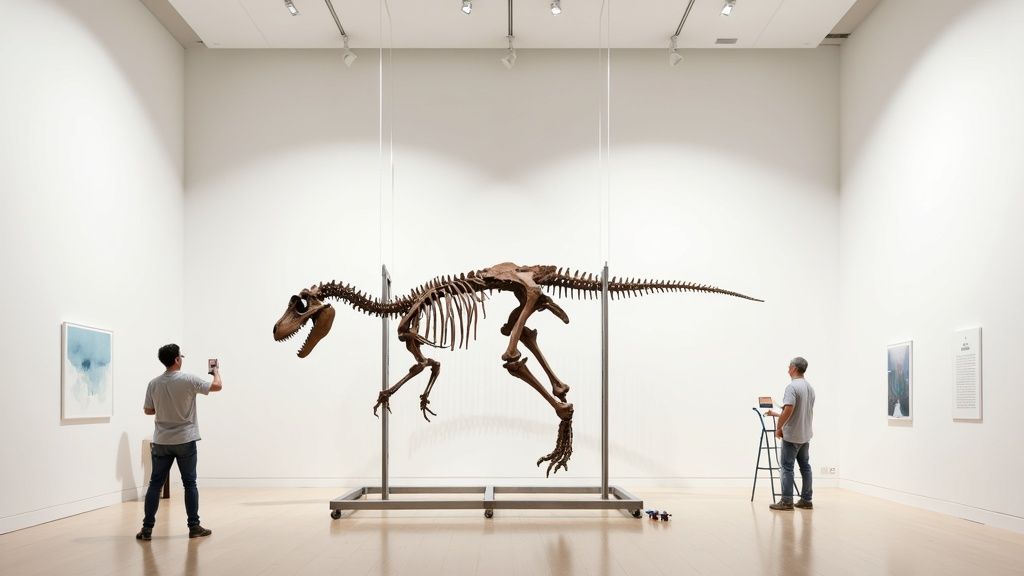
Once it arrives, professional installation is the only way to go. These experts will create custom steel armatures and mounting solutions that are both rock-solid and visually stunning, allowing your skeleton to be posed in a dynamic, lifelike stance. Add some dramatic lighting with a few well-placed spotlights, and you can transform the skeleton from a static object into a show-stopping centerpiece.
Creating the Perfect Environment
When you're dealing with authentic fossils, controlling the environment isn't optional—it's essential. Unlike a durable replica, real fossilized bone is porous and surprisingly sensitive to its surroundings. If the humidity and temperature swing too much, the bone can expand and contract, which leads to cracks and irreversible damage over time.
Think of your display area as a private museum exhibit. Maintaining stable environmental conditions is the single most important factor in long-term fossil preservation. Consistency is everything.
Keeping that environment stable is your top priority. For truly sensitive fossils, it’s worth looking into professional climate-controlled storage solutions to ensure total stability. You'll also want to choose a dedicated space with minimal direct sunlight to prevent fading and deterioration.
A Simple Conservation Checklist
A little routine care goes a long way in keeping your treasure in pristine condition. Here’s a quick checklist that works for both genuine fossils and high-quality replicas:
Regular Dusting: Use a soft-bristle brush or a can of compressed air to gently clear away any dust.
Visual Inspections: Give it a once-over periodically. Look for any new cracks, flaking, or other signs of instability.
Secure Mounting: Double-check that the display stand and all mounting points are still secure and haven't loosened.
Professional Consultation: If you ever notice a change in an authentic fossil, don't hesitate. Call a professional conservator right away.
And as your collection grows, you'll want to give your smaller pieces the same level of care. Consider a high-quality rock collection display case to keep them safe, organized, and beautifully showcased.
Beyond Dinosaurs: Building Your Natural History Collection
A 9ft dinosaur skeleton is an incredible centerpiece, no doubt about it. But its real power isn’t just in its size—it’s in its ability to spark a much wider curiosity for natural history. The best way to think about your skeleton isn't as a standalone trophy, but as the anchor for a captivating collection that tells a much bigger story about our planet.
This approach transforms your space from simply having one impressive fossil into a curated natural history exhibit of your own. The goal is to create a dialogue between different pieces, using other natural wonders to highlight the unique, ancient beauty of your dinosaur.
Complementary Geological Wonders
Imagine setting off the ancient, earthy tones of your fossil with the vibrant, crystalline life of minerals. A large, polished labradorite freeform could sit nearby, its mesmerizing flashes of blue and green echoing the mysteries of a long-lost world. Or picture the deep, banded greens of a malachite specimen adding a touch of rich, organic color, connecting the fossil to the very geological forces that preserved it for millions of years.
These additions do more than just decorate. They create a visual conversation between different eras of Earth’s history, right in your own home.
A well-rounded collection tells a richer story. By pairing a dinosaur skeleton with minerals and other fossils, you create a display that explores not just prehistoric life, but the very formation of the planet itself.
Expanding the Fossil Record
To give your 9ft dinosaur skeleton some real historical context, think about adding other types of fossils to your display. These pieces act as the supporting cast in your prehistoric narrative, showing off the incredible diversity of ancient life.
Here are a few ideas to build out a more comprehensive collection:
Fossil Plates: A large plate crowded with the intricate spirals of ammonites or the segmented bodies of trilobites offers a beautiful window into ancient oceans. It’s a stunning contrast to your land-dwelling dinosaur.
Petrified Wood: A substantial, polished slice of petrified wood tells its own quiet story of time and transformation. Its preserved rings and vibrant mineral colors connect the floral and faunal histories of the planet in one beautiful object.
Meteorites: For a truly out-of-this-world addition, consider a meteorite. Displaying a fragment from space alongside a dinosaur skeleton creates a powerful narrative, linking the fate of the dinosaurs to the cosmic events that shaped our planet’s history.
Each new piece, whether it's a glittering quartz cluster or a delicate fossil plate, adds another chapter to your personal museum. It turns a single purchase into a source of endless discovery and fascination.
Got Questions About Owning a Dinosaur Skeleton?
Stepping into the world of large-scale fossil collecting always brings up a lot of questions. It's a big decision, after all. To help you get a clearer picture, we've put together some straightforward answers to the most common queries we hear about owning a 9-foot dinosaur skeleton.
Think of this as your quick-reference guide. It’s here to tackle those key concerns before you take the exciting leap of bringing a piece of prehistory home.
What Kind of Dinosaur Is a 9-Foot Skeleton Likely To Be?
When you see a 9-foot skeleton, you're usually looking at one of two things. It could be a juvenile of a much bigger predator, like a young Allosaurus or Gorgosaurus, caught in a moment of growth. Or, it might be the fully-grown adult of a smaller, more nimble species—think something like the famously clever Deinonychus.
The specific species is a huge driver of its rarity and, ultimately, its value. A nearly complete juvenile T. rex relative is a whole different ballgame than a common, smaller adult predator.
How Much Does a 9-Foot Dinosaur Skeleton Replica Cost?
For a high-quality, museum-grade 9-foot dinosaur skeleton replica, the price can really vary. You should generally expect to see a range from several thousand to tens of thousands of dollars. The final cost depends on things like the quality of the casting material, how complex the custom mount is, and the level of detail in the finishing work.
Now, an authentic fossil of this size is a whole different level of investment. Genuine specimens often start in the high five figures and can easily climb into six or even seven figures, especially if the skeleton is mostly complete and belongs to a rare species.
Are There Legal Restrictions on Owning a Real Dinosaur Fossil?
Absolutely, and this is a big one. The legality of owning a real fossil comes down to where it was found—specifically, whether it came from public or private land—and the laws of its country of origin. Some countries have incredibly strict laws about fossils leaving their borders.
It is absolutely critical to ensure any authentic fossil comes with clear, legal provenance. This is the paper trail that proves it was sourced, dug up, and sold ethically and legally. A reputable dealer will always provide this documentation without a second thought.
At Astro West, we believe that every fossil, mineral, and meteorite tells a story. As the holiday season approaches, from Black Friday deals to unique Christmas gifts, think beyond the ordinary. A stunning piece of petrified wood or a mesmerizing fluorite tower could be the perfect, timeless present. Whether you are searching for a magnificent centerpiece or the perfect addition to your growing collection, we invite you to explore our ethically sourced and expertly curated specimens. Discover a piece of natural history today at our online gallery.