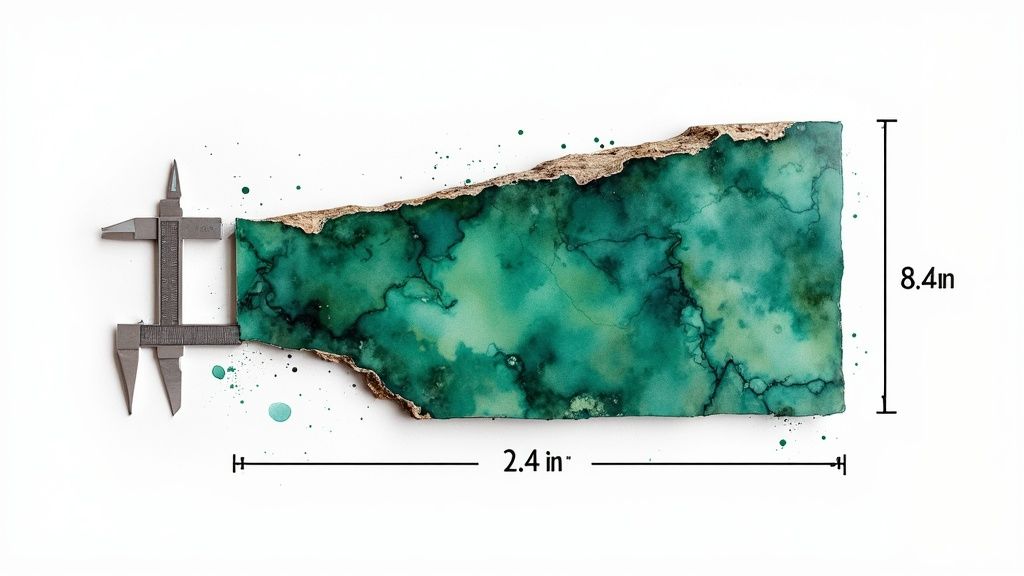
Understanding 8.4 x 6.5 x: How to Read Mineral Dimensions
When you’re browsing a collection of stunning minerals or fossils online, you'll often see a measurement like 8.4 x 6.5 x in the product description. At first glance, these numbers might feel a bit abstract. But they're actually a universal code that tells you the specimen's exact size, usually representing Length x Width x Height in inches.
Learning to read this simple format is the first step to confidently choosing the perfect piece for your collection—one that will fit exactly where you envision it, making your space ready for any season or celebration.
What Do These Numbers Actually Mean?
Navigating the world of online mineral and fossil collecting is exciting, but it requires a clear understanding of size and scale. Since you can't hold a piece in your hands, its dimensions become the most critical piece of information you have.
The "L x W x H" format is designed to give you a complete three-dimensional picture of the specimen before you even click "add to cart."
Think of it like measuring a book to see if it will fit on your shelf. You need to know how long it is, how deep it is, and how tall it stands. The exact same logic applies to a beautiful Malachite slab or a detailed fossil plate.
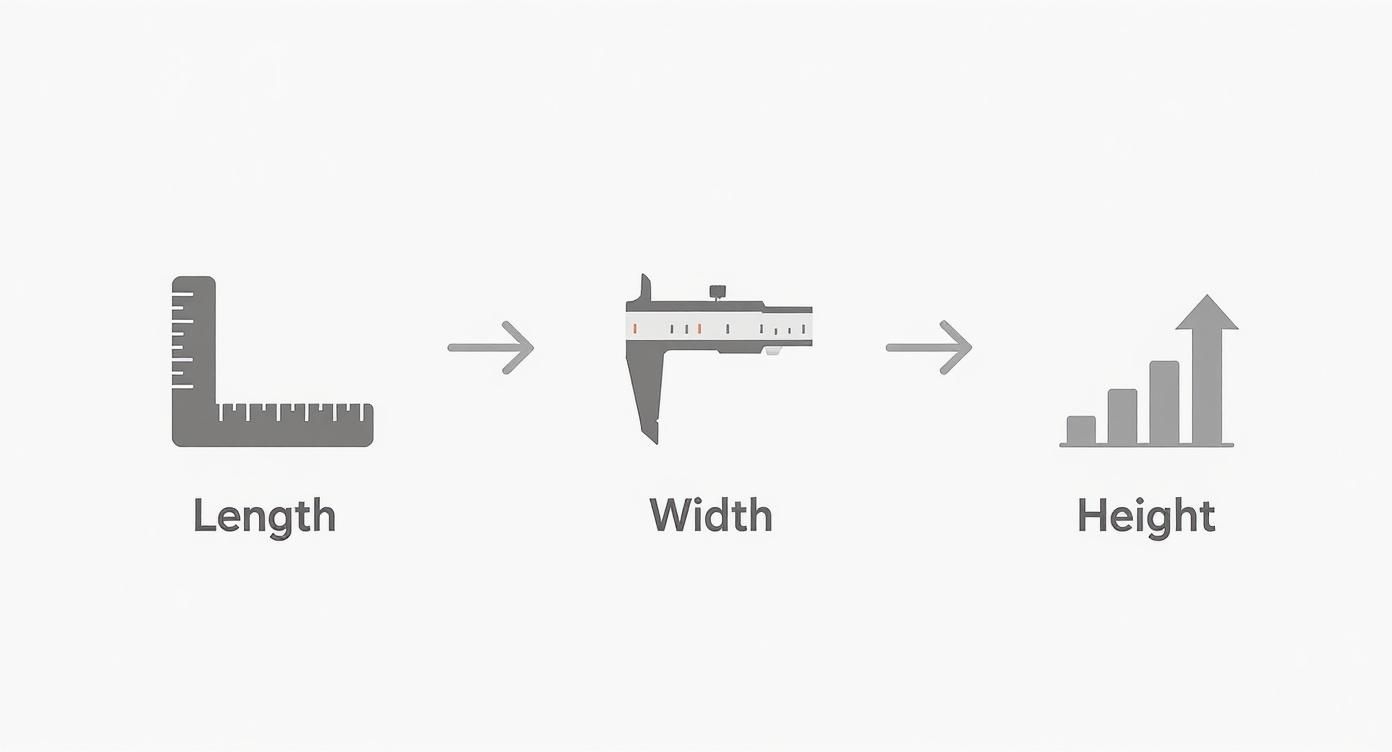
Decoding the L x W x H Format
Each number in the sequence corresponds to a specific measurement, giving you a clear mental model of the item's physical footprint. It’s a standard we use across the industry to keep things consistent and easy to understand.
To help you get the hang of it, here’s a quick reference guide.
Specimen Dimensions at a Glance
Term
What It Represents
Common Units
Length (L)
The first number; the longest side-to-side measurement.
Inches ("), Centimeters (cm)
Width (W)
The second number; the front-to-back measurement (depth).
Inches ("), Centimeters (cm)
Height (H)
The third number; the top-to-bottom measurement (how tall it stands).
Inches ("), Centimeters (cm)
This simple breakdown makes it easy to visualize any piece you're considering.
So, let's put it into practice. Here’s a quick rundown of what each value represents:
Length (L): This is the first number and represents the longest horizontal, side-to-side measurement of the specimen when it's sitting in its natural, stable display position.
Width (W): The second number tells you the depth of the piece, measuring from front to back. This is crucial for knowing how much shelf or desk space it will occupy.
Height (H): The final number is the vertical measurement. It shows you how tall the specimen stands from its base to its highest point.
By mastering this simple L x W x H system, you remove all the guesswork from online shopping. You'll know with certainty whether that captivating Labradorite freeform will be a delicate desktop accent or a commanding centerpiece for your living room. This knowledge empowers you to build a collection where every piece fits perfectly into your intended space, ensuring there are no surprises when your new treasure arrives.
The Universal Language of L x W x H
When you're eyeing a stunning piece of Petrified Wood from one seller and a vibrant Fluorite tower from another, how do you compare them? You need a common language. That's where L x W x H (Length x Width x Height) comes in. It’s the standardized format that lets collectors and sellers across the globe communicate size clearly and effectively. Without it, buying online would be a complete gamble.
This standard isn't just a random set of letters. It’s based on the most logical and stable way a specimen would sit on a surface. Picture a Citrine tower on your desk. Its height is the measurement from the base to its highest point. The length is its longest side-to-side dimension, and the width is the front-to-back depth. This consistency is everything.
This simple, shared approach removes the guesswork, ensuring the piece you fall in love with online is the same one that fits perfectly on your shelf at home. It’s the reason a collector in Tokyo and a seller in New York can make a deal with total confidence, both understanding exactly what they're getting.
Why Consistency in Measurement Matters
The importance of this system isn't unique to collecting; you see it in countless other industries where space and fit are critical. For instance, just as cabinet makers need precise dimensions to design a kitchen, mineral collectors rely on them to plan their displays. If you're curious about how these standards apply elsewhere, this standard cabinet dimensions guide offers a great look into the world of home design.
Whether you need a small accent for a bookshelf or a massive, commanding statement piece for an entryway, accurate dimensions are your best friend. This system ensures that when a listing describes a specimen as 8.4 x 6.5 x 4.2 inches, you know exactly what to expect.
This shared understanding is the bedrock of trust in online collecting. It prevents the disappointment of receiving a specimen that is much smaller or larger than anticipated, ensuring your new treasure meets every expectation.
The Role of Standardization in E-commerce
This level of standardization is a cornerstone of modern e-commerce, making millions of daily transactions possible. The infrastructure behind these sales has become a massive global industry. The point-of-sale (POS) terminal market, which handles these transactions, was valued at a staggering $113.38 billion in 2024 and is projected to hit $181.47 billion by 2030.
This explosive growth underscores just how critical clear, standardized information—like L x W x H measurements—is to building consumer confidence and fueling the digital economy. It's a fascinating look into how the tech that powers retail relies on simple, trustworthy data, as detailed in research from Grand View Research.
Ultimately, this simple set of numbers bridges the gap between the digital and physical worlds. It’s what makes it possible to appreciate and acquire treasures from every corner of the globe without ever leaving your home.
How to Measure Irregularly Shaped Specimens
Minerals and fossils are treasures sculpted by nature, not by a machine. This means they rarely come in perfect cubes or spheres. So, how do you accurately measure a jagged Quartz cluster or a rounded Agate geode? The industry standard relies on a simple yet effective technique known as the "box method."
This approach allows us to assign consistent L × W × H dimensions to even the most complex shapes. By understanding this concept, you can better visualize items online and document your own collection with professional accuracy.
The Imaginary Box Method Explained
The core idea is simple: imagine placing your specimen inside the smallest possible invisible box that could contain its entire form. The length, width, and height of that imaginary box become the official measurements of the piece.
This method ensures that every measurement captures the fullest extent of the specimen, from its widest point to its tallest peak. It provides a standardized framework for describing unique, organic shapes in a way that is universally understood.
Applying the Box Method Step-by-Step
You don't need fancy equipment to use this method at home; a simple ruler or a set of calipers will work perfectly. The key is just to find the maximum dimension along each axis.
Here’s how to do it:
Establish a Stable Base: Place your specimen on a flat surface in its most natural and stable display position. This orientation is crucial because it sets the stage for determining its true height.
Measure Length (L): Looking down from above, identify the two points on the specimen that are furthest apart horizontally. Measure the distance between them—that’s your length.
Measure Width (W): Now, measure the widest points perpendicular to the length you just found. This gives you the front-to-back depth.
Measure Height (H): Finally, measure the distance from the flat surface up to the very highest point of the specimen. This is its height.
For complex pieces like a Labradorite freeform, orienting it to best display its colorful flash, or "schiller," is important before measuring. The goal is to capture the dimensions as it would be viewed. For an in-depth look at a particularly popular and varied mineral, check out our collector's guide to Quartz crystal clusters.
By applying this method, you can confidently determine the overall size of any piece, whether it's a sprawling fossil plate or an intricate crystal formation. A measurement of 8.4 x 6.5 x on our site means we’ve already done this work for you, giving you a reliable snapshot of the specimen’s full presence.
Visualizing Size with Real-World Comparisons
Numbers on a screen, like 8.4 x 6.5 x, can sometimes feel a bit abstract. It’s one thing to read the dimensions, but it’s another to truly grasp how a mineral or fossil will look and feel in your space. The trick is to connect those numbers to everyday objects you already know.
This mental translation is your best friend when shopping online, especially during fast-paced sales events like Black Friday, making the experience far more intuitive and taking the guesswork out of the equation.
This skill is more important than ever as more of us build our collections from online galleries. In fact, the global eCommerce market is expected to grow by 8.4% in 2024, reaching an incredible $6.09 trillion in sales. As this trend continues, having a reliable way to gauge size from a distance builds confidence and ensures you’ll love what you get.
From Numbers on a Screen to a Feel for Size
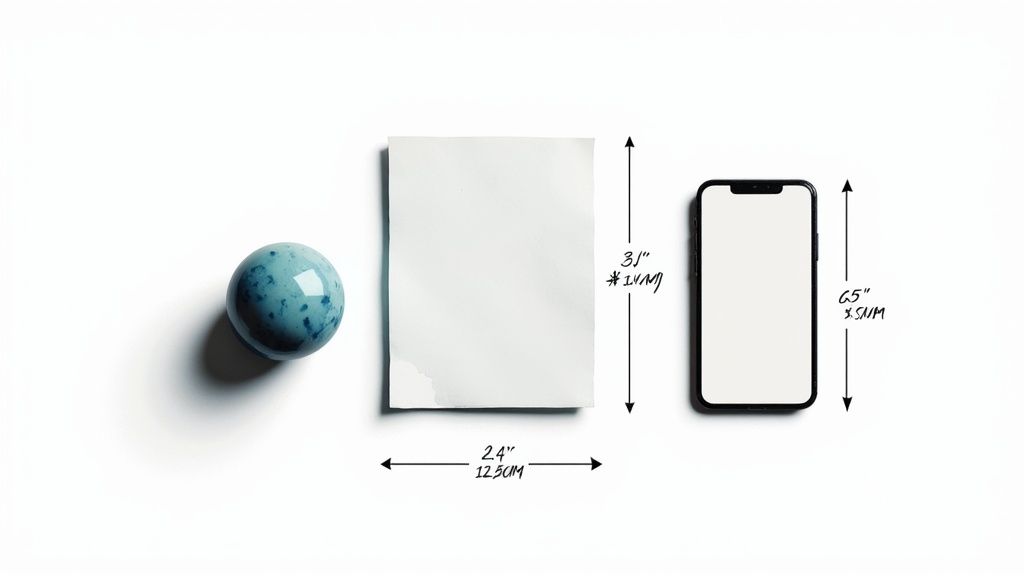
Let’s make those dimensions tangible. An 8.4-inch measurement is just a hair shorter than a standard sheet of US letter paper (which is 8.5 inches long). A 6.5-inch measurement is almost exactly the height of a large modern smartphone, like an iPhone Pro Max.
Suddenly, those abstract numbers start to paint a picture.
8.4 inches (Length): Think of a standard piece of printer paper. That’s a great stand-in for the specimen’s longest side.
6.5 inches (Width): Just picture your phone. This gives you a quick feel for its depth or shorter side.
"x" (Height): The final number is all about vertical presence—how tall it will stand on your shelf.
This simple trick transforms data into a clear visual. You can instantly tell if that stunning Lapis Lazuli sphere will be a perfect accent for your desk or a commanding centerpiece that needs more room to breathe.
Putting It All Together in Your Space
These comparisons empower you to make smarter choices about where a new piece will live in your home. Before you click "buy," grab a ruler and a piece of paper and physically mark out the L x W footprint where you plan to display it—whether that's a bookshelf, a mantel, or a dedicated cabinet.
This practical step removes any doubt and guarantees the specimen you’ve fallen for will fit just right. Of course, knowing how to arrange your pieces is just as important as choosing them. For more ideas on creating stunning displays, check out our guide on how to display crystals.
By using these real-world benchmarks, you can be sure your next acquisition is a perfect match for both your vision and your space.
Choosing the Right Specimen for Your Space
Seeing a measurement like 8.4 x 6.5 x 4.2 inches tells you the size of a specimen, but the real magic happens when you connect those numbers to your life. Understanding how that size will fit into your home, your collection, or your intentions is the secret to choosing a piece that brings you joy every single day.
The world of minerals and fossils is filled with a spectacular range of sizes, and each one has a different role to play. Learning to tell them apart helps you shop with a clear vision, making sure your next treasure feels perfectly at home.
Cabinet Size vs. Decorator Pieces
In the collecting world, we often group specimens by how they’re meant to be displayed. It’s a simple distinction, but knowing the difference can completely change the way you build your collection.
Cabinet Size Specimens: These are the smaller, often intricate pieces made for close-up admiration. They’re right at home inside a curated display case, on a bookshelf, or grouped together on a desk. Think of a beautifully terminated Aquamarine crystal or a detailed fossil plate—they draw you in and invite you to appreciate their finer points.
Decorator Pieces: Larger and more dramatic, these specimens are born to be focal points. A massive Smoky Quartz geode or a tall, polished Fluorite tower can anchor the energy of an entire room, acting as a piece of natural art. Their job is to make a statement from across the room.
The key is to ask yourself one simple question when you see a set of dimensions: "Is this a piece I want to hold and admire up close, or is it one that will define the feeling of a space?" That question alone will point you toward the perfect find. Our guide on selecting a rock collection display case is a great resource for planning the perfect home for your cabinet-sized treasures.
Gifting with Dimensions in Mind
Size is especially critical when you're choosing a gift. After all, you want it to fit seamlessly into someone else's space and life. The occasion itself is often the best guide.
For a romantic gesture, like Valentine's Day, a smaller Rose Quartz heart that can rest on a nightstand feels intimate and thoughtful. Its modest dimensions make it personal.
But for a bigger celebration, like a housewarming or Mother's Day, a larger decorator piece makes an unforgettable statement. Choosing an impressive specimen shows just how significant the moment is, turning your gift into a cherished part of their home’s story.
For those who love to plan with precision, visualizing how a piece will look is crucial. If you're digitally savvy, advanced software like 3ds Max for interior design even allows you to virtually place specimens in a room to see how they fit before you buy. By thinking about the event and the recipient's space, you can choose a gift that's not just beautiful, but a perfect fit for its new home.
How Dimensions Impact Shipping Costs and Safety
When you see dimensions like 8.4 x 6.5 x 4.2 inches on a specimen, it tells you more than just how it will fit on your shelf—it's a critical factor in how we get it to you safely. Understanding the logistics behind shipping a fragile, one-of-a-kind piece from our gallery to your home sheds light on both the cost and the incredible care involved.
The shipping world runs on a concept called dimensional (DIM) weight. Carriers don't just charge based on how heavy a package is; they charge based on how much space it takes up. They calculate a package's volume and compare it to its actual weight, and the shipping fee is based on whichever number is higher.
This is why a large but relatively light fossil plate often costs more to ship than a small, dense meteorite. That fossil plate occupies more physical real estate on a truck or plane, and it's that space that carriers are ultimately selling.
Our Commitment to Safe Arrival
Getting your new treasure to its destination in perfect condition is our absolute top priority. The unique size and shape of every specimen dictates the entire packing process, from the box we choose to the specific type and amount of protective material we use.
Small, Sturdy Items: A durable Jasper palm stone, for example, is straightforward. It needs secure padding to keep it from shifting around, but it's a relatively simple pack.
Large, Fragile Pieces: A large geode or a delicate crystal cluster, on the other hand, demands a much more complex approach. We often use a "box-within-a-box" method, surrounding the inner box with custom-cut foam and layers of cushioning to create a protective cocoon that absorbs any shock during transit.
This meticulous process ensures every piece, big or small, is expertly secured for its journey. For a complete overview of our procedures and policies, you can find all the details in our official shipping policy.
Understanding DIM weight and our packing methods helps clarify the value behind shipping costs. It’s a transparent process designed for one purpose: delivering your specimen safely, whether it's a small gift or a significant addition to your collection.
With the explosion of online shopping—where global sales are expected to rocket past $7.89 trillion by 2028—reliable and secure shipping has become more important than ever. This boom just underscores why professional packing standards are so essential for protecting valuable and irreplaceable items on their way to you. You can discover more insights about these global eCommerce trends at SellersCommerce.
Common Questions About Specimen Dimensions
Even with a good handle on how dimensions work, a few questions always seem to pop up. We get them all the time. Let's walk through some of the most common ones to help you feel even more confident when you're looking at a new piece.
Think of this as the expert FAQ, designed to clear up any lingering confusion and sharpen your collector's eye.
Does the Order of L x W x H Ever Change?
While L x W x H is the industry standard for a reason—consistency—you might occasionally find a seller who lists dimensions in a different order. It can be confusing, which is why we don't do it.
At Astro West, we stick strictly to the Length (longest side) x Width (front-to-back) x Height (top-to-bottom) format. This approach guarantees you have a reliable and predictable way to understand a specimen's size, every single time. No guesswork needed.
What Are the Best Tools for Home Measurement?
For most pieces in your collection, you don't need anything fancy. A simple ruler or a flexible tape measure will do the trick perfectly.
However, if you're dealing with smaller or more intricate specimens where precision really counts—say, a delicate fossil or a tourmaline crystal with sharp, clean terminations—we recommend grabbing a pair of digital calipers. They're an affordable and fantastic tool for getting highly accurate readings.
The most important step, no matter the tool, is to figure out the specimen's most stable, natural display orientation first. All your L x W x H measurements should be based on that position. It’s the only way to accurately reflect how the piece will actually look on your shelf.
Why Do Specimens with Similar Weights Have Different Sizes?
This is a classic point of confusion, and it all comes down to two things: density and shape. A mineral’s chemical makeup determines how much "stuff" is packed into a certain amount of space.
For example, a dense, heavy mineral like Galena will feel surprisingly weighty for its small size. In contrast, a lighter, more expansive specimen like a desert rose selenite of the exact same weight will be much, much larger.
This is exactly why dimensions are often more useful than weight for picturing a piece's true scale and presence. A measurement like 8.4 x 6.5 x 4.1 inches gives you a much better feel for how an item will fit into your space than its weight alone ever could.
At Astro West, we provide precise dimensions for every mineral, fossil, and meteorite to help you shop with complete confidence. Explore our curated collection and find the perfect, ethically sourced treasure for your home or office. Discover enduring natural beauty at https://astrowest.com.