Walk into the world of gemstones, and you’ll find that "jade" is a name that carries a lot of weight—and often, a bit of confusion. While many people picture the almost electric-green jadeite used in fine jewelry, there’s another member of the family worth getting to know: Afghan jade.
Sourced from the mineral-rich mountains of Afghanistan, this material is a specific and incredibly durable type of nephrite jade. It’s not jadeite, but that’s precisely what makes it so interesting. With its unique toughness and a beautiful, earthy color spectrum, it's a captivating choice for collectors and designers alike.
Unveiling the Beauty of Afghan Jade
The world of jade is wonderfully diverse, and Afghan jade offers a character all its own. This gemstone belongs to the nephrite family, a tough and resilient form of jade that has been carved and cherished by cultures for thousands of years. Its story begins deep within the earth.
Born from intense geological pressures, Afghan jade has a unique crystalline structure that’s more fibrous than granular. Think of it like a tightly woven rope instead of a stack of tiny bricks. This structure makes it exceptionally durable—in some respects, it’s even tougher than steel. This incredible resilience has made it a favorite material for intricate carvings that can truly stand the test of time, making it an excellent gift for occasions like Father's Day or as a timeless Christmas present.
A Spectrum of Natural Color
One of the most alluring qualities of Afghan jade is its subtle yet sophisticated color palette. It doesn't shout; it speaks. Unlike the singular intensity often associated with jadeite, Afghan nephrite offers a beautiful range of hues that evoke a sense of natural tranquility, a direct reflection of the varying mineral compositions in its deposits.
You can find this stone in several beautiful variations:
Spinach Green: A deep, rich green with a classic and timeless appeal.
Sage Green: A softer, more muted green with gray undertones, perfect for modern design.
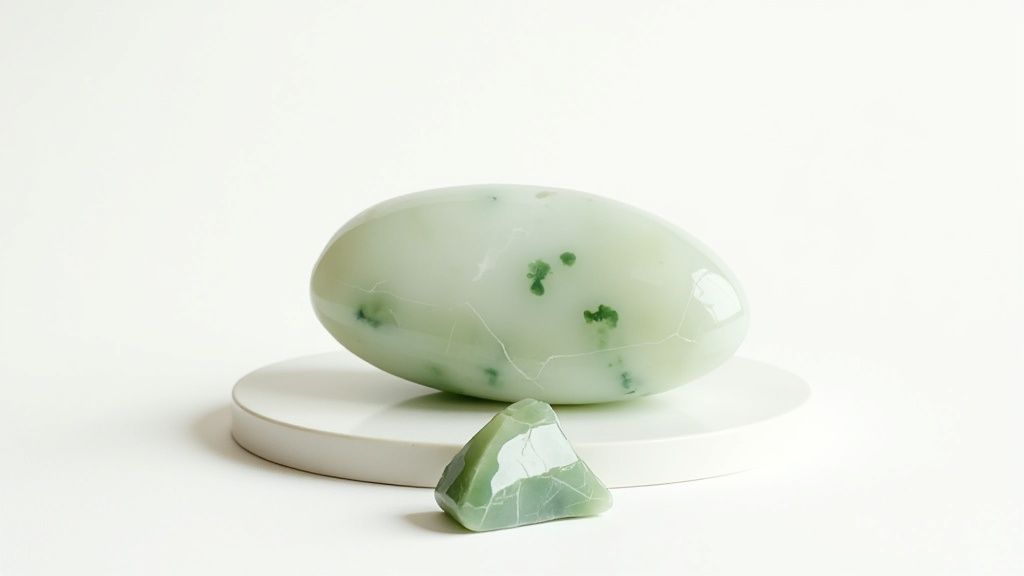
Creamy White: A pale, elegant shade often prized for its purity and smooth texture.
Gray-Green: A sophisticated blend that highlights the stone's earthy origins.
This variety allows designers and collectors to select pieces that resonate with a specific aesthetic, from bold statement carvings to delicate, minimalist jewelry. The stone’s natural beauty doesn't rely on flashy brilliance but on its deep, consistent color and smooth, often waxy luster.
As we dig deeper, we’ll explore the geology that makes Afghan jade so resilient and, just as importantly, how to distinguish it from other stones. Getting this foundational knowledge right is the first step in truly appreciating what makes this particular type of nephrite a remarkable addition to any collection of fine minerals, whether your passion is for aquamarine, lapis lazuli, or quartz.
What Is Afghan Jade, Really? The Geology Behind the Gem
To really get what makes Afghan jade so special, we have to look past its beautiful surface and understand what’s going on inside. Its incredible toughness isn’t just a happy accident; it comes from its specific mineral makeup. Geologically speaking, Afghan jade is nephrite, a variety of jade prized for its remarkable resilience.
The secret to its strength is a structure that’s less like a stack of brittle crystals and more like a tightly woven, matted fabric. Nephrite is made up of an intricate web of interlocking fibrous crystals, which makes it exceptionally resistant to chipping and breaking. It’s this dense, felt-like texture that allowed ancient cultures to carve it into intricate tools and ornaments that have lasted for thousands of years. This durability makes it a thoughtful choice for a New Year's gift, symbolizing strength and longevity.
The Minerals Behind the Magic
Those "fibers" creating this tough-as-nails structure are made of two key minerals from the amphibole group. It's the unique dance between these two that gives every piece of Afghan jade its own distinct personality.
Actinolite: This mineral is rich in iron, and it’s the source of those deeper green shades we love, from a soft sage to the classic spinach green that collectors chase after. The more iron there is, the darker and more saturated the color gets.
Tremolite: On the other side of the spectrum is tremolite, which is rich in magnesium. This mineral is responsible for the lighter colors in Afghan jade, including creamy whites and pale, ethereal grays. A piece with a lot of tremolite will often have a serene, almost milky appearance.
The subtle interplay between actinolite and tremolite doesn't just dictate the stone's color—it also influences its translucency and overall character. This is why you can find such a stunning and diverse palette within Afghan jade specimens, similar to the range found in minerals like fluorite or agate.
Nephrite’s formation is the result of intense geological forces—specifically, the immense heat and pressure found deep within the Earth's crust. This process, known as contact metamorphism, forges the dense, fibrous crystal structure that gives nephrite its signature strength.
Afghanistan's Role in the Global Jade Story
Afghanistan's unique tectonic landscape provided the perfect crucible for this metamorphic process, creating significant and high-quality nephrite deposits. If you want to dive deeper into how these incredible transformations happen, our guide explains what a metamorphic rock is and the powerful forces at play.
Historically, the global jade market has been dominated by jadeite from Myanmar, which supplies over 90% of the world's market. However, Afghan jade is a major player with a deep history. Gemstone mining in the region goes back more than 7,000 years, making Afghanistan one of the most ancient sources of jade on the planet. This gives collectors a chance to acquire a material with both a rich past and its own unique physical properties. For more on this growing market, a great report from the Gemological Institute of America (GIA) offers some fascinating context.
How to Differentiate Afghan Jade from Look-Alikes
Spotting authentic Afghan jade is a skill any collector needs, but it’s easier than you might think once you know the tells. While the word "jade" gets thrown around a lot, true jades are only one of two minerals: nephrite (which is what Afghan jade is) or jadeite. The problem is, several other stones, like serpentine and bowenite, are constantly mislabeled and sold as jade. Knowing the difference is everything.
Developing an eye for these details empowers you to buy with confidence. It's a lot like learning the subtle but critical differences between Moissanite, Cubic Zirconia, and Diamond; that knowledge prevents you from making a costly mistake. The same principle applies here—a little expertise goes a long way.
Visual and Physical Identification Markers
Your own senses are the best tools you have for a first-pass identification. Real Afghan nephrite jade has a distinct look and feel that you won’t find in its common imitators.
Start by looking at the luster, which is just how the surface plays with light.
Afghan Jade (Nephrite): This stone usually has a soft, waxy, or almost greasy sheen. It feels incredibly smooth, sometimes a bit like a bar of soap, but with more density.
Jadeite: Often looks glassier, or "vitreous," especially in top-quality pieces. It has a brighter, more reflective quality.
Serpentine: This look-alike can also seem waxy, but it often feels more slippery to the touch. It's also much softer, meaning it scratches far more easily.
Here's a great hands-on test we use in the business: gently tap two pieces of the same material together. True nephrite gives off a beautiful, resonant "chime." It's a musical sound that's completely different from the dull thud or clink you'd get from a softer stone like serpentine.
This touch-and-feel approach is a fantastic starting point. For more concrete proof, though, we have to look at measurable properties. Our crystal identification guide dives deeper into the techniques mineralogists use to get a positive ID on their specimens.
Afghan Jade (Nephrite) vs. Jadeite Key Differences
To make things simple, this table breaks down the core differences between Afghan jade (nephrite) and its rarer, more expensive cousin, jadeite. It’s a quick reference guide to help you spot the defining traits of each.
Property
Afghan Jade (Nephrite)
Jadeite
Hardness (Mohs)
6.0 – 6.5
6.5 – 7.0
Structure
Interlocking fibrous crystals (extremely tough)
Granular, interlocking crystals
Luster
Waxy to greasy, sometimes vitreous
Vitreous (glassy)
Sound Test
Resonant, musical chime
Higher-pitched, sharp ring
Common Colors
Deep greens, creamy whites, sage, gray-green
Vivid emerald greens, lavender, white, black
By combining a good look, a quick touch test, and an understanding of these fundamental properties, you can build the confidence you need to tell genuine Afghan jade from the sea of look-alikes out there.
Valuing Afghan Jade with Provenance and Ethics in Mind
So, what really gives a piece of Afghan jade its value? While its beauty is what first catches your eye, a specimen's true worth is a mix of its physical quality and the story of its journey from the earth to your hands. Getting a handle on these factors is the key to appreciating what you're really holding.
The big three drivers of quality in Afghan jade are color, clarity, and condition. Collectors are always on the hunt for color uniformity—a rich, even green without any splotches or distracting veins that break up the flow.
Translucency is another huge sign of a top-tier piece. The best specimens aren't flatly opaque; they let a little light pass through, giving the stone a soft, inner glow. Finally, a clean bill of health matters. The absence of fractures or major inclusions ensures the stone is not only structurally sound but also visually pristine.
The Importance of Provenance and Ethical Sourcing
Beyond its physical beauty, the story behind the stone—its provenance—is playing an increasingly vital role in how it's valued today. Afghanistan's mining industry is often small-scale and artisanal, operating within a complex local environment. Knowing a stone's specific origin helps ensure it was sourced responsibly, supporting the communities who mined it and minimizing environmental impact.
This ethical side of the story adds a layer of value you can't see with the naked eye. It forges a connection between the collector, the miners, and the land itself, turning a beautiful object into a piece of heritage and responsible trade. This is where a trusted dealer becomes essential, as they can provide the transparency needed to trace a stone’s journey. The line between precious and semi-precious stones can be blurry, but for materials like Afghan jade, a verified ethical provenance seriously boosts its desirability. You can dive deeper into these classifications in our guide to precious vs. semi-precious stones.
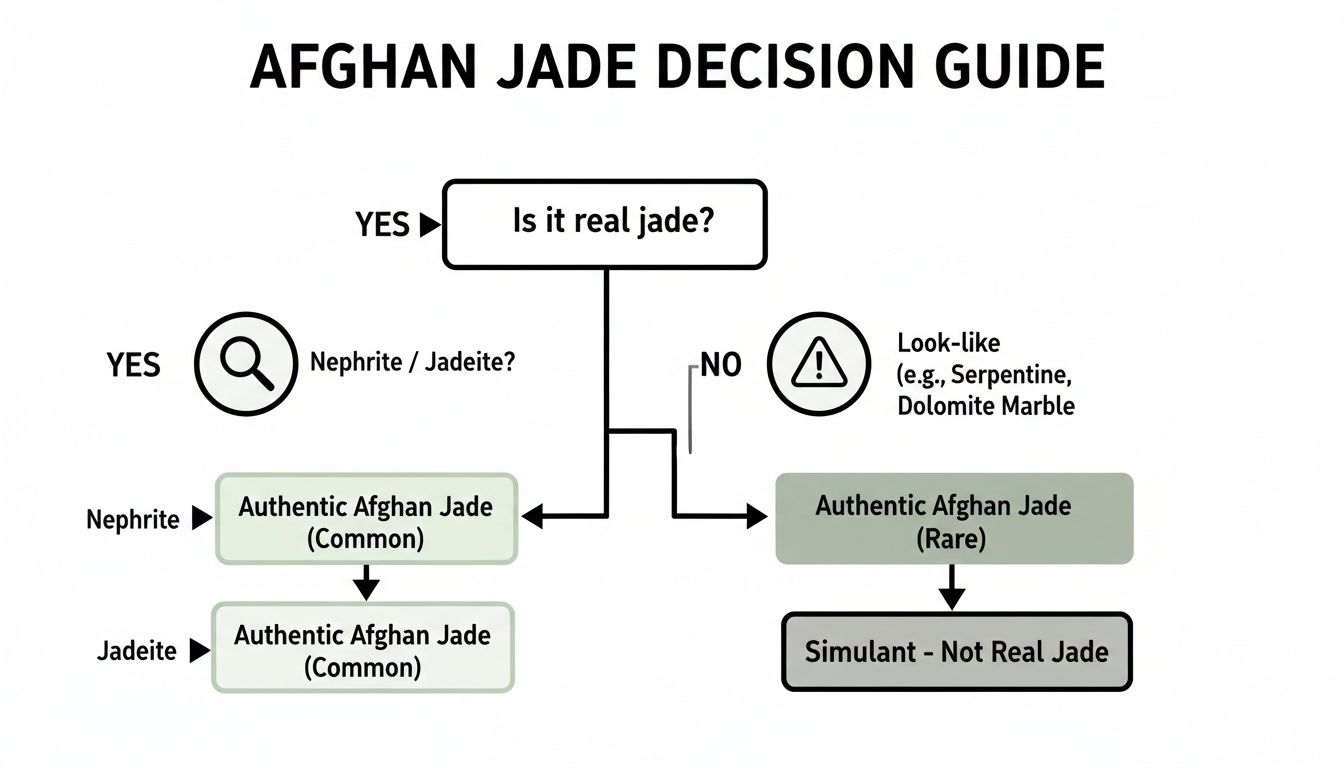
This quick decision guide helps visualize the first steps in identifying real jade and separating it from common look-alikes.
As the chart shows, the first question is always authenticity. It guides a buyer to only start considering nephrite or jadeite after confirming the stone isn't a simulant like serpentine.
A Global Context for a Local Treasure
The global jade market casts a long shadow, heavily influencing emerging sources like Afghanistan, where gemstone mining is a tradition stretching back an incredible 7,000 years. While Myanmar dominates the world's jadeite production with an estimated 20,000 tons per year, generating between $10B to $30B in trade, Afghanistan contributes smaller, artisanal volumes of high-quality nephrite.
This contrast really highlights the unique spot Afghan jade occupies. It’s not about mass production; it's about exceptional quality and a deep-rooted heritage. For a closer look at Afghanistan's role in the global gemstone market, you can review insights from the U.S. Geological Survey.
Ultimately, valuing Afghan jade requires a holistic view. It’s an assessment of the stone’s physical perfection balanced with a deep respect for its origins and the ethical responsibility that comes with collecting natural treasures.
Caring for Your Afghan Jade Collection
Keeping your Afghan jade looking its best is refreshingly simple. This nephrite variety is known for its durability, but a little mindful care goes a long way in preserving its natural beauty for generations to come, whether you have an intricate carving, a polished sphere, or a piece of elegant jewelry.
The best cleaning method is also the easiest. Just grab a soft cloth, some lukewarm water, and a touch of mild, non-abrasive soap. Gently wipe the surface to clear away any dust or oils from handling, then give it a thorough rinse and pat it dry with another clean, soft cloth.
It’s crucial to steer clear of harsh chemicals, ammonia-based cleaners, and especially ultrasonic cleaning machines. These can strip the stone of its signature waxy luster or, in some cases, even mar the surface. A gentle touch is all it takes to bring back its natural glow.
Proper Storage and Handling
While nephrite jade is famously tough, it isn't invincible. It can absolutely be scratched by harder gemstones like diamonds or sapphires. This makes proper storage your first line of defense against accidental damage.
To keep your pieces pristine, just follow a few simple rules:
Store Separately: Always keep your Afghan jade jewelry in its own fabric-lined box or a soft pouch, away from other pieces that could scratch it.
Avoid Impact: For larger carvings and decor, place them on stable surfaces where they aren't likely to get knocked over.
Mind Your Activities: It's a good habit to remove jade rings or bracelets before doing anything strenuous like gardening, working out, or DIY projects to prevent chips.
Showcasing your Afghan jade is all about creating a sense of natural tranquility. The goal is to highlight its subtle translucency and rich, even color without washing it out.
Use soft, diffused lighting rather than harsh, direct spotlights. This allows light to gently penetrate the stone, revealing its inner depth and creating a serene, glowing effect that brings out its best qualities.
Try positioning carvings or spheres where they can be appreciated from multiple angles. Creating a display with complementary natural materials, like petrified wood, or pairing them with other fine minerals such as fluorite can build a stunning, cohesive look in your home or office.
A Smart Buyer's Guide to Acquiring Authentic Pieces
With the right eye and a bit of knowledge, you can navigate the market with confidence and pick out a truly authentic piece of Afghan jade. Think of this as your practical checklist, whether you're buying your first specimen or adding a new treasure to a well-established collection during a Black Friday or summer sales event.
Your first goal is always to verify what you're holding. Remember that "feel test" we talked about? Real nephrite has a distinct, almost waxy smoothness to it. It’s a world away from the glassy coolness of jadeite or the slightly slippery feel of serpentine. You also want to look for deep, consistent color without any strange splotches, which can be a dead giveaway for dye.
Key Quality Indicators and Red Flags
When you’re evaluating a piece, you’re looking for subtle clues. High-quality Afghan jade has a certain presence, while common look-alikes or treated stones often give themselves away if you know what to spot.
What to Look For:
Subtle Translucency: The best nephrite isn't totally opaque. It should let a little light pass through, giving it a soft, inner glow that’s hard to fake.
Even Color: You want to see a rich, uniform color. It could be a deep spinach green or a creamy white, but it should be consistent.
Smooth Finish: A well-polished piece will have a beautiful, even luster. Run your fingers over it—you shouldn’t feel any pits or rough spots.
Red Flags to Avoid:
Mislabeled Stones: Be skeptical of vague names like "new jade" or "Korean jade." These are often just market terms for serpentine or bowenite.
Unnaturally Vivid Color: If the color looks too perfect or almost electric, it’s likely been dyed. A good trick is to check any tiny cracks for concentrated pigment.
Rock-Bottom Price: A large, flawless piece of nephrite for a steal? If a deal seems too good to be true, it almost certainly is.
Partner with a Transparent and Knowledgeable Dealer
Ultimately, the smartest move you can make is to find a dealer you trust. An expert can do more than just a visual check; they can verify a stone's origin, tell you about any treatments, and give you real insight into its quality.
It’s a fascinating market. Afghanistan's nephrite holds its own special place, even when compared to the staggering 20,000 tons of jadeite that Myanmar produces each year. A good seller understands this context—the rich heritage and distinct qualities of afghan jade—and can explain its unique value. For a deeper dive, this corporate jade presentation offers a great overview of the global trade.
Building a collection of fine minerals is a deeply rewarding journey, whether you're drawn to vibrant malachite or dazzling labradorite. Our guide on how to start a collection of rare rocks and minerals is packed with more tips for collectors at every level. Here at Astro West, we invite you to explore our curated selection, where our experts are always ready to share what they know and help you find that perfect piece with absolute confidence.
Your Questions About Afghan Jade, Answered
When people first encounter Afghan jade, a few questions almost always come up. To clear the air, we've put together some straight answers to the things we hear most from collectors, designers, and anyone curious about this beautiful stone.
Is Afghan Jade "Real" Jade?
Yes, absolutely. Afghan jade is a true form of jade, specifically the variety known as nephrite.
It’s a common point of confusion because the term "jade" actually covers two different minerals: nephrite and jadeite. While jadeite gets a lot of attention for being rarer and often pricier, nephrite has its own incredible legacy. It's celebrated for its almost unbelievable toughness and has been carved and revered by cultures around the world for thousands of years. So when you hold a piece of Afghan jade, you're holding an authentic and historically important type of jade.
How Can I Spot a Treated Piece?
The good news is that high-quality Afghan jade is almost always left in its natural, untreated state. Its beauty doesn't need much help. However, some lower-grade material might get a little "boost" with dyes to improve the color or polymer impregnation to make it more stable.
Here are a few things to keep an eye out for:
An unnaturally perfect color. Real stone has subtle variations and flows; if it looks too uniform, almost like paint, be skeptical.
Color pooling in cracks. Get a magnifying glass and look for tiny fractures. If you see pigment concentrated in those little crevices, it’s a red flag for dye.
A plastic-y feel. A polymer coating can give the stone's surface a slightly artificial, overly glossy finish that just doesn't feel right.
The surest way to get the real deal is to buy from a reputable source you trust. An expert dealer will always stand by their pieces, guaranteeing authenticity and disclosing any treatments upfront. That way, you know exactly what you’re getting.
What Is Afghan Jade Best Used For?
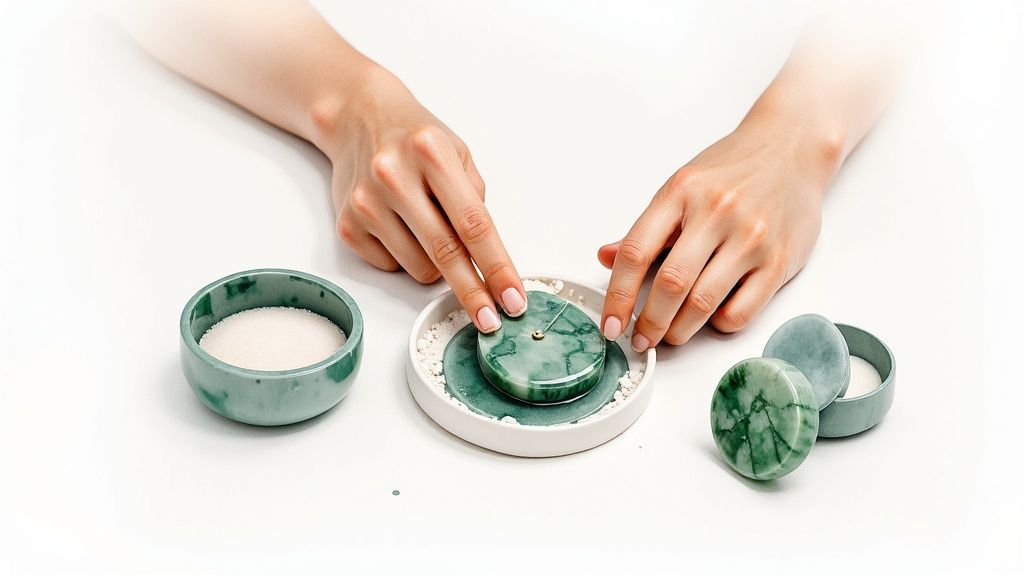
Thanks to its dense, interlocking fibrous structure, Afghan jade is exceptionally tough. This resilience is why it has been the go-to material for centuries for elaborate carvings and sculptures—artists could create incredibly fine, delicate details without worrying about the stone chipping or breaking.
It's also a fantastic choice for jewelry that's meant to be worn, not just admired. Think pendants, beads, and cabochons that can handle the bumps of everyday life, making it a wonderful Valentine's Day or Mother's Day gift. In the world of interior design, you’ll see large polished slabs or spheres of Afghan jade used as stunning statement pieces. They have a grounding, natural elegance that brings a sense of organic tranquility into a room, making them a favorite for adding a touch of nature's artistry to a space.
At Astro West, we believe every mineral tells a story. Our collection of ethically sourced Afghan jade is hand-selected and vetted by experts to ensure you’re investing in a genuine piece of natural history with complete confidence. Explore our curated selection of fine minerals and find the perfect specimen for your collection or design project.