8 of the Rarest Rocks in the World for Elite Collectors in 2026
Embark on a journey to discover the planet's most coveted geological wonders. This guide unveils the 8 rarest rocks in the world, moving beyond common gemstones to explore specimens that define elite collections. We'll delve into their unique origins, the precise factors contributing to their scarcity, and what makes them prized assets for discerning collectors and institutions like the Smithsonian. From minerals rarer than diamonds to stones with extraterrestrial origins, you will learn exactly what it takes to acquire a true piece of natural history.
To truly appreciate what makes a rock specimen exceptional, it often comes down to understanding the concept of elusive rarity and value in collecting. Just as a single coin's minting error can make it priceless, a mineral's unique chemical composition or formation under impossible conditions elevates it from a mere stone to a geological marvel.
This article provides a definitive look into the world of ultra-rare mineralogy, where science, beauty, and investment converge. We will explore the specific characteristics of Painite, Red Beryl, Musgravite, and Grandidierite, as well as other elusive treasures. You will gain practical insights into what makes these specimens so sought-after, from their distinct crystalline structures to the limited locales where they are found.
1. Painite
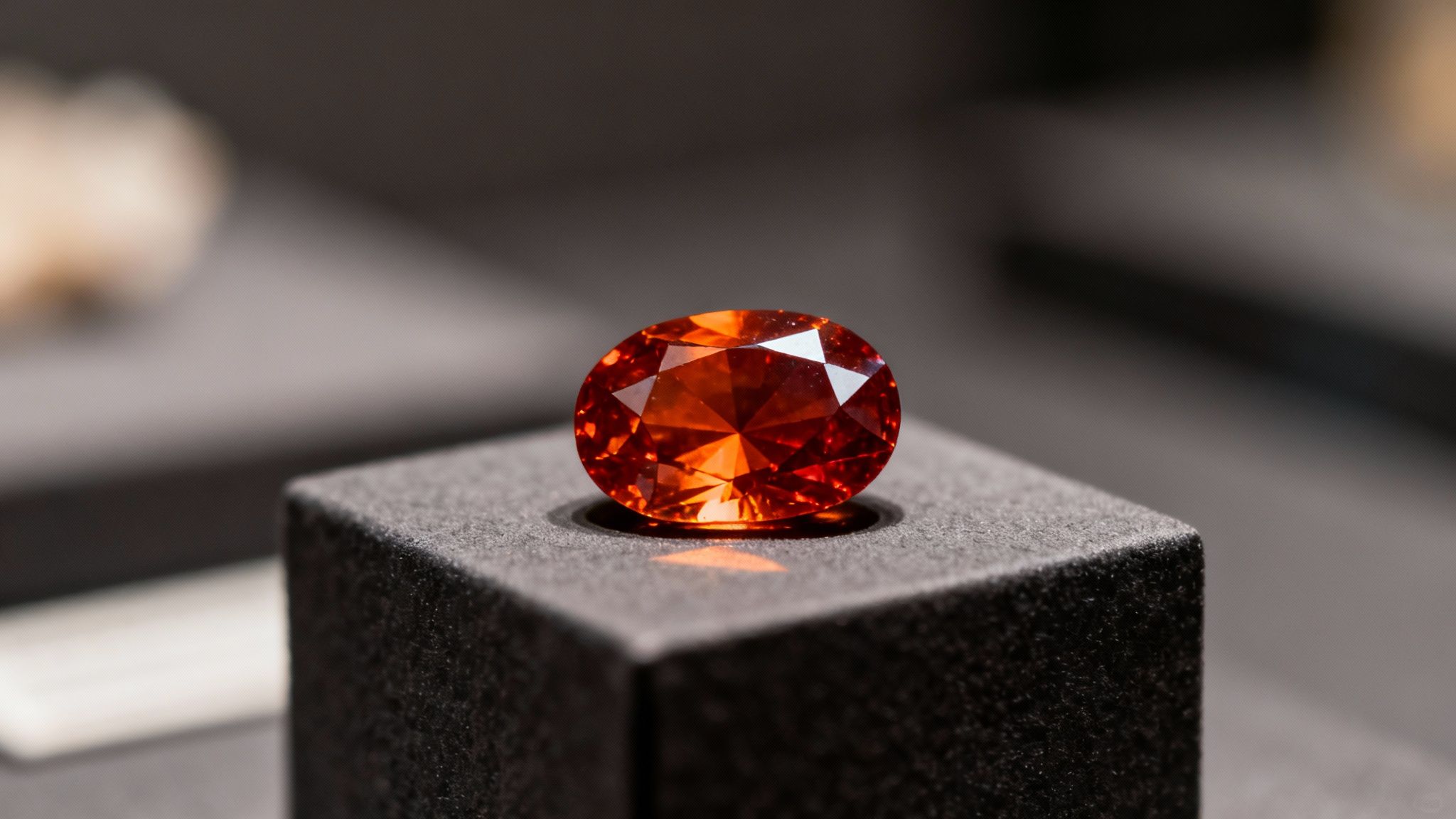
Painite holds a legendary status among gemologists and collectors as one of the rarest rocks in the world. First identified in Myanmar in 1951 by British mineralogist Arthur C.D. Pain, this borate mineral was so scarce that for decades, only two faceted gemstones were known to exist. Its extreme rarity is due to its unique formation conditions, requiring the unlikely combination of boron and zirconium, elements that do not typically interact in nature.
The mineral displays strong pleochroism, appearing ruby-red to brownish-red or orange-red depending on the viewing angle. Although new deposits were found in Myanmar in the early 2000s, increasing the number of known specimens, high-quality, facetable Painite remains exceptionally rare and commands prices exceeding $10,000 per carat, making it a true investment-grade gem.
Why It's a Top Collector's Item
Painite is a "must-have" for serious collectors precisely because of its historic rarity. Owning a specimen connects the collector to a legacy of mineralogical discovery. Its rich, deep red color and exceptional brilliance also make it visually stunning, rivaling more common but still precious stones. Prestigious institutions like the Smithsonian and the Natural History Museum in London house some of the finest examples, cementing its status as a museum-quality treasure. While its value is undeniable, its appeal lies in its story as a once-mythical gem. For those interested in appreciating the unique qualities of rare gemstones, you can explore certified specimens at Astro West.
Actionable Tips for Acquisition
Verify Provenance: Always demand comprehensive documentation tracing the specimen's origin and ownership history.
Seek Authentication: Work with reputable dealers who can provide certification from recognized gemological laboratories like the GIA.
Secure Your Investment: Obtain detailed mineralogical reports and ensure the piece is fully insured and stored securely.
2. Red Beryl (Bixbite)
Red Beryl, often called bixbite, is an exceedingly scarce variety of the beryl mineral family, making it dramatically rarer than its well-known relatives like emerald and aquamarine. This mineral is one of the rarest rocks in the world, with gem-quality crystals found almost exclusively in the Wah Wah Mountains of Utah. Its formation requires a unique geological environment with the right combination of beryllium, aluminum, silicon, oxygen, and trace amounts of manganese, which gives the stone its signature vibrant red hue.
Often referred to as "red emerald," fine red beryl can command prices far exceeding its green cousin, sometimes reaching over $15,000 per carat for high-quality faceted stones. Because most crystals found are small and heavily included, clean, facetable stones over one carat are exceptionally rare and highly coveted. This scarcity, combined with its stunning red-to-pinkish-red color, solidifies its position as a top-tier collectible.
Why It's a Top Collector's Item
Red Beryl’s appeal lies in its extreme rarity within a famous mineral family. Collectors value it as the ultimate beryl specimen, representing the pinnacle of scarcity and beauty. Owning a Red Beryl connects a collector to a unique American locality, as nearly all gem-quality material comes from a single source in Utah. Institutions like the Smithsonian Institution house impressive examples, highlighting its scientific and aesthetic importance. For enthusiasts who appreciate the diversity within mineral groups, owning a red beryl alongside other beryls completes a prestigious collection. To see a stunning example of a different beryl variety, you can view this fine aquamarine specimen.
Actionable Tips for Acquisition
Verify the Origin: Since its value is tied to its Utah source, always request documentation confirming its origin when possible.
Prioritize Color: The most desirable specimens exhibit a saturated, raspberry-red color. Examine the stone under proper lighting to assess its true hue.
Consider Both Forms: While faceted stones are prized, well-formed raw crystals in their rhyolite matrix are also highly collectible and can be a more accessible way to own this rare mineral.
3. Musgravite
Musgravite is a titan among the rarest rocks in the world, an exceedingly scarce oxide mineral first discovered in 1967 in South Australia's Musgrave Ranges. A member of the taaffeite mineral family, its rarity is so profound that for years, only a handful of facetable specimens were confirmed to exist. The mineral's extreme scarcity is due to the very specific geological conditions needed for its formation, requiring a precise combination of beryllium, magnesium, and aluminum.
Often displaying a sophisticated color palette ranging from grayish-green to a deep purplish-gray, musgravite is more subdued than vibrant gems, yet its allure is undeniable. New, small deposits have been found in places like Madagascar, Greenland, and Tanzania, but gem-quality material remains almost mythical. High-quality musgravite can fetch prices well over $35,000 per carat, placing it in an elite category of gemstones sought by only the most serious collectors.
Why It's a Top Collector's Item
Musgravite is a "holy grail" for collectors, representing the pinnacle of mineral rarity. Its subtle yet complex coloration and exceptional hardness make it durable, but its primary appeal is exclusivity; owning one means possessing something few people will ever see. Prestigious institutions like the Smithsonian Institution and the Australian Museum house reference specimens, underscoring its scientific and cultural importance. For advanced collectors, acquiring a musgravite is not just an investment, it is the ultimate testament to their dedication to the world of rare minerals.
Actionable Tips for Acquisition
Work with Specialists: Source musgravite exclusively through highly reputable dealers with established networks and deep expertise in ultra-rare gemstones.
Insist on Lab Reports: Never purchase a specimen without a certificate from a top-tier gemological lab, as distinguishing it from the similar but more common taaffeite requires advanced testing.
Plan for a Long Search: Be prepared for a multi-year wait to find an authenticated specimen for sale, and consider joining elite collector networks to gain access to sourcing opportunities.
4. Grandidierite
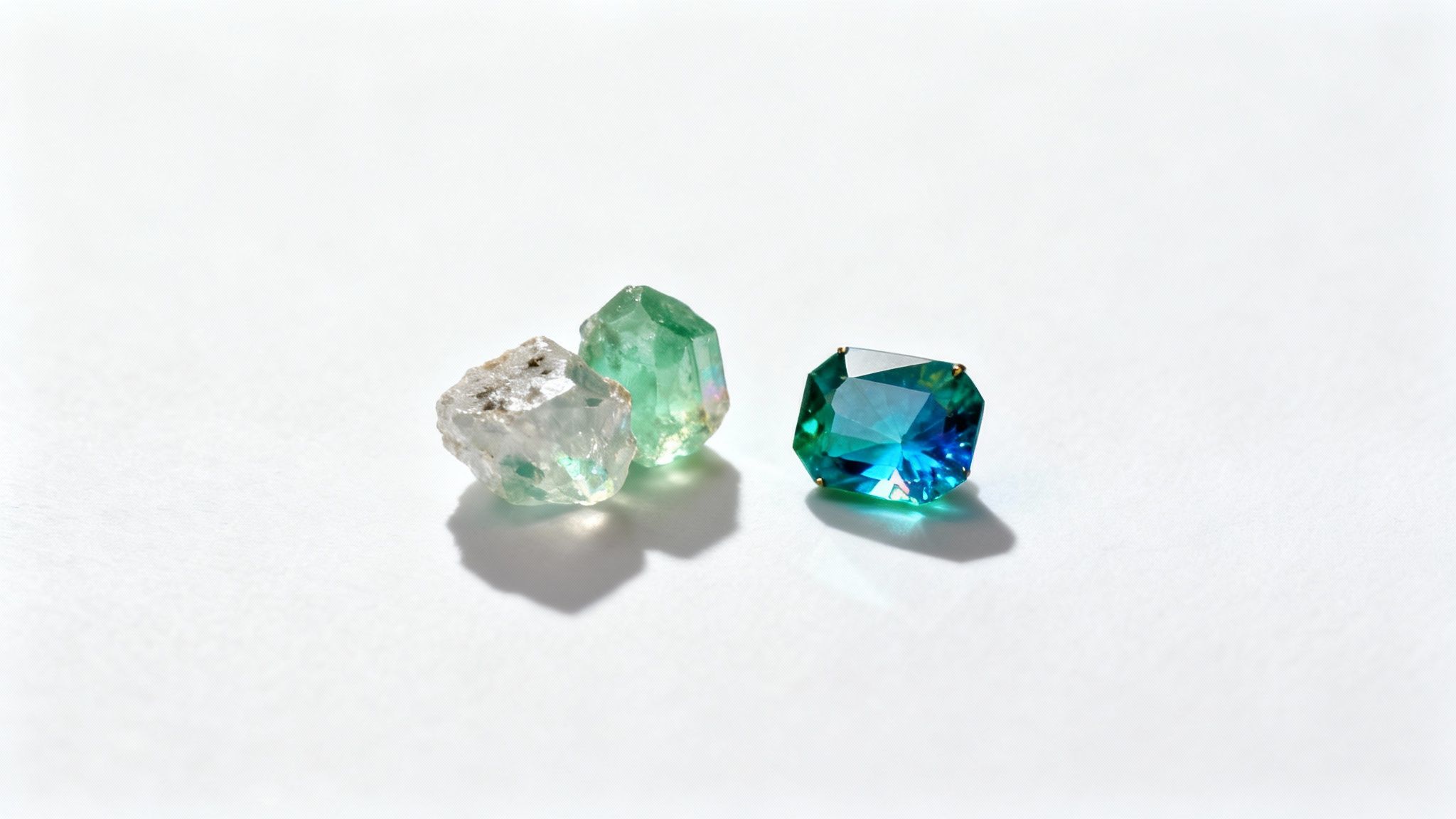
Grandidierite is a stunningly beautiful borosilicate mineral that ranks among the rarest rocks in the world. First discovered in southern Madagascar in 1902 and named after French explorer Alfred Grandidier, this gemstone is celebrated for its distinctive blue-green hue. Its rarity is attributed to its complex chemical composition, requiring a specific combination of magnesium, aluminum, iron, silicon, boron, and oxygen under precise geological conditions. This makes finding transparent, facetable material an exceptionally rare event.
The mineral exhibits strong trichroism, meaning it can show three different colors (dark blue-green, colorless, and dark green) when viewed from different angles. Although the vast majority of grandidierite is opaque to translucent, the truly prized specimens are those with high transparency and a deeply saturated color. With only a few hundred faceted stones known to exist, clean, high-quality grandidierite is one of the most coveted gems for high-end collectors and jewelry designers.
Why It's a Top Collector's Item
Grandidierite’s appeal lies in its mesmerizing color spectrum and its sheer scarcity. For collectors, owning a grandidierite is a mark of a truly sophisticated collection, placing them in an elite group. Its unique trichroic properties make it a fascinating study piece, displaying a different personality with every turn. Prestigious institutions like the Smithsonian showcase fine examples, cementing its status as a world-class geological treasure. Its blend of aesthetic beauty and extreme rarity makes it a holy grail for gemstone enthusiasts, comparable in desirability to other rare colored stones like fine spinel specimens.
Actionable Tips for Acquisition
Prioritize Color and Clarity: Seek specimens with strong, even color saturation and minimal inclusions, as these factors drastically increase value.
Insist on Certification: Due to its rarity, always purchase grandidierite with a report from a reputable gemological lab like GIA to verify its identity and origin.
Verify Provenance: The best specimens originate from Madagascar, so documentation confirming its source is crucial for authenticity and value.
5. Tanzanite
Tanzanite holds a unique position among the world's rarest rocks, not for its overall scarcity, but for the exceptional rarity of its finest, deeply saturated blue variety. Discovered in the Merelani Hills of northern Tanzania in 1967, this blue-violet zoisite mineral is found nowhere else on Earth. Its geological formation is so specific, linked to the tectonic activity of Mount Kilimanjaro, that its supply is inherently finite, making top-grade specimens highly coveted.
The mineral is renowned for its remarkable pleochroism, displaying different colors (typically blue, violet, and burgundy) when viewed from different angles. While most tanzanite is heat-treated to enhance its blue and violet hues, the most valuable specimens are those with a naturally strong, saturated blue coloration. Its meteoric rise in popularity, famously promoted by Tiffany & Co., cemented its status as a contemporary classic and one of the most significant gemstone discoveries of the 20th century.
Why It's a Top Collector's Item
Tanzanite's single-source origin makes it a compelling acquisition for collectors who value geographic rarity. Owning a top-quality blue tanzanite means possessing a gem from a deposit that is expected to be depleted within a generation. Its vibrant color rivals that of fine sapphire, offering a unique visual appeal. Prestigious institutions like the Smithsonian and the American Museum of Natural History feature exceptional tanzanite specimens, highlighting its geological and cultural importance. The stone’s modern discovery and rapid ascent to fame add a fascinating chapter to its story, attracting both gem enthusiasts and investors.
Actionable Tips for Acquisition
Prioritize Color Saturation: Seek specimens with a strong, deeply saturated blue or violet-blue hue, as this is the primary driver of value.
Request Gemological Reports: Always ask for certification confirming treatments. While heat treatment is standard, this should be disclosed.
Consider Raw Crystals: Alongside faceted stones, high-quality raw tanzanite crystals with well-formed terminations are highly prized by mineral collectors.
Ensure Ethical Sourcing: Purchase from dealers who can provide documentation confirming the tanzanite is from an ethical, Tanzanian-certified source.
6. Jeremejevite
Jeremejevite (pronounced ye-rem-yay-ev-ite) is an exceptionally rare borate mineral that stands out as one of the rarest rocks in the world. First discovered in 1883 on Mt. Soktui in Siberia, it was named after Russian mineralogist Pavel Jeremejev. For nearly a century, only tiny, often-included crystals were known, making it a mineralogical curiosity rather than a gemstone. Its scarcity is due to the highly specific geological conditions required for its formation, typically occurring in granite pegmatites.
Newer finds in Namibia and, more recently, Myanmar have produced larger, gem-quality crystals, but these remain incredibly scarce. Jeremejevite is prized for its high clarity and range of colors, from a desirable sky blue to colorless or pale yellow. Well-formed hexagonal crystals are particularly sought after by collectors, and clean, facetable material can command prices comparable to high-quality diamonds, often reaching several thousand dollars per carat.
Why It's a Top Collector's Item
Jeremejevite is coveted by serious collectors for its scientific significance and pristine crystal structure. Its textbook hexagonal prism form makes it a perfect example of crystal morphology. Owning a well-formed Jeremejevite connects a collector to a select group that appreciates both aesthetic beauty and mineralogical perfection. The finest specimens are housed in prestigious institutions like the Smithsonian Institution and the Natural History Museum in London, reinforcing its status as a museum-grade mineral. For collectors, its appeal lies in its combination of rarity, color, and classic crystal habit.
Actionable Tips for Acquisition
Prioritize Crystal Definition: Seek specimens with sharp, well-defined hexagonal crystal faces and strong color, as these are the most desirable traits.
Request Mineralogical Data: Always ask for detailed documentation confirming its origin and any associated mineral analysis.
Join Mineralogical Societies: Network with fellow collectors through societies and forums, as rare specimens are often traded within these communities.
7. Taaffeite
Taaffeite is a true anomaly in the world of gemstones, so rare that it was first identified from an already cut and polished stone. In 1945, Irish gemologist Edward Taaffe discovered the specimen in a jeweler's shop, initially mistaking it for spinel. Closer examination revealed double refraction, a property spinel lacks, confirming it as a new, previously unknown mineral. This serendipitous discovery makes it one of the few gems first identified from a faceted stone rather than a rough crystal.
The mineral's formation requires a unique geological blend of beryllium, magnesium, and aluminum, making it one of the rarest rocks in the world. Found almost exclusively in Sri Lanka and Tanzania, only a handful of specimens have ever been found, with estimates suggesting fewer than 500 exist today. Its colors range from nearly colorless and mauve to a delicate pale lavender, and its exceptional transparency and durability make it suitable for jewelry, though few would risk wearing such an irreplaceable treasure.
Why It's a Top Collector's Item
Taaffeite’s appeal lies in its extraordinary origin story and near-mythical scarcity. For collectors, owning a Taaffeite is like holding a piece of gemological history, a testament to a chance discovery that rewrote mineralogy books. Its subtle, elegant coloration sets it apart from more vibrantly colored gems, offering a sophisticated beauty. Prestigious collections, including the Smithsonian Institution's National Gem Collection, house fine examples, solidifying its status as a world-class collectible. The sheer unlikelihood of ever finding another one makes it an ultimate prize for ultra-high-net-worth enthusiasts.
Actionable Tips for Acquisition
Work with Specialists: Source Taaffeite exclusively through dealers specializing in ultra-rare and investment-grade gemstones who have proven access to such materials.
Insist on Certification: Demand a comprehensive gemological report from a world-renowned laboratory to confirm its identity and rule out similar-looking stones like spinel.
Document Everything: Meticulously document the stone's origin, acquisition details, and any known history to establish clear and unbroken provenance for future valuation.
8. Meteorite Specimens
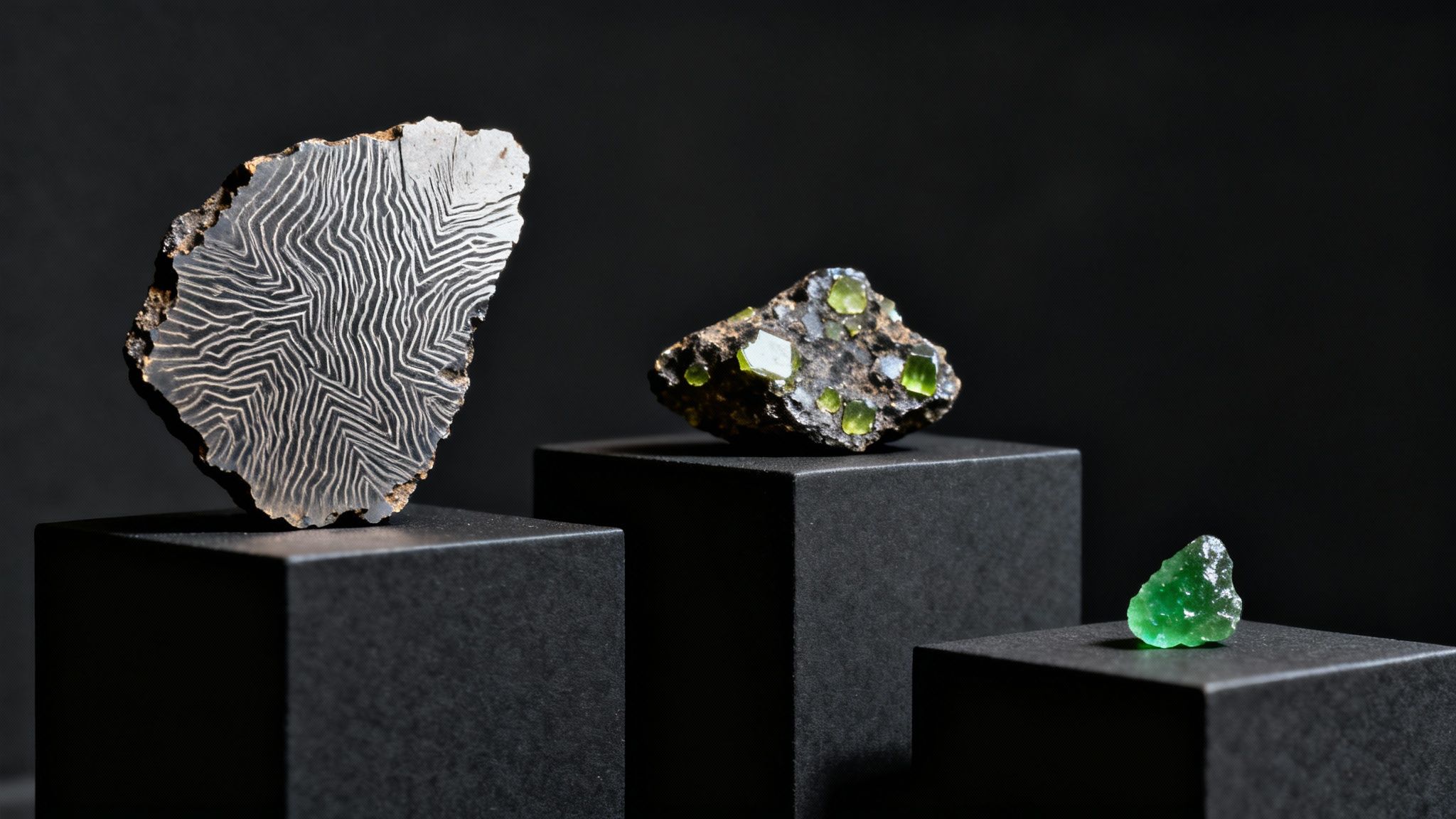
Meteorite specimens are quite literally out of this world, representing some of the rarest rocks found on Earth. These extraterrestrial materials offer unparalleled scientific, aesthetic, and collector value. Varieties like iron meteorites reveal stunning Widmanstätten patterns when etched, while pallasites feature beautiful olivine crystals embedded in a metallic matrix. Their cosmic origins make them prized by collectors and scientific enthusiasts alike, with authenticated pieces commanding premium prices based on their classification, condition, and provenance.
The allure of holding an object that has traveled through space for millions or even billions of years is immense. From the large, sculptural forms of the Campo del Cielo meteorites to the gem-like pallasites, each specimen tells a unique story of cosmic events. Beyond scientific interest, meteorite also finds its way into high-end collectibles. One fascinating example is a Rolex watch featuring a stunning meteorite dial, showcasing how these materials bridge the gap between natural history and luxury craftsmanship.
Why It's a Top Collector's Item
Meteorites are the ultimate collector's item for those fascinated by astronomy and geology. Owning one is a tangible connection to the cosmos. Institutions like the Smithsonian and the American Museum of Natural History house extensive collections, highlighting their scientific importance. Pallasites are particularly sought after for their sheer beauty, combining metal and gem-like crystals. For those seeking large and visually impactful pieces, you can explore a massive Campo del Cielo specimen.
Actionable Tips for Acquisition
Prioritize Authentication: Only purchase from reputable dealers who provide authenticated credentials and meteorite classification codes.
Request Documentation: Insist on paperwork detailing the meteorite’s discovery location, classification, and any previous ownership history.
Choose by Classification: Select iron meteorites for their unique Widmanstätten patterns, pallasites for their aesthetic combination of metal and crystal, and carbonaceous chondrites for their scientific value.
Insure and Store Properly: Protect your investment with proper insurance and store specimens with their documentation in a secure, climate-controlled environment to prevent degradation.
8 Rarest Rocks: Comparative Overview
Item
Acquisition Complexity 🔄
Cost & Rarity ⚡
Quality & Value ⭐
Typical Outcomes / Impact 📊
Collector Tips 💡
Painite
Extremely difficult — very few authenticated specimens; requires expert sourcing
Extremely high ($5,000–$15,000+/ct); <2,000 known
Museum-grade brilliance and proven appreciation
Long‑term investment potential but low liquidity
Verify provenance, insist on mineralogical reports and established dealers
Red Beryl (Bixbite)
High — almost exclusively from Utah; small sizes common
Very high ($1,000–$10,000+/ct); rarer than many gem stones by weight
Wide range ($50–$10,000+ depending on type and rarity)
Scientific authenticity and unique aesthetics; broad appeal
Educational displays, high-end décor, and museum collections; flexible budgets
Purchase only authenticated specimens, request classification codes and documentation
Start Your Legacy Collection with Authenticated Rarity
Our journey through the world's most elusive geological treasures reveals a landscape of breathtaking beauty and incredible scarcity. From the fiery depths that forged Red Beryl to the cosmic odyssey of Pallasite meteorites, each specimen we've explored represents a pinnacle of natural artistry. These are not merely stones; they are tangible pieces of our planet's (and our universe's) deep history. The pursuit of collecting the rarest rocks in the world is more than an acquisition of valuable assets; it's a commitment to preserving and appreciating these irreplaceable wonders.
The common thread connecting a novice collector to a seasoned institution is the unwavering importance of authenticity. As we've seen with gems like Taaffeite and Musgravite, which can be easily misidentified, the value of a specimen is intrinsically linked to its verifiable identity and provenance. This is where expertise becomes your most crucial tool. Building a legacy collection, one that holds its value and its story, begins with a foundation of trust and scientific rigor.
Key Takeaways for Aspiring Collectors
To transform your passion into a meaningful collection, focus on these core principles:
Prioritize Verification: Always seek certification from reputable gemological laboratories. For minerals like Painite or Grandidierite, a lab report is non-negotiable.
Understand the "Why": Rarity is complex. It can stem from a mineral's unique chemical composition (like Jeremejevite), a highly specific geological formation process (like Tanzanite), or an extraterrestrial origin (like a meteorite). Understanding these factors deepens your appreciation and informs your investment.
Value Provenance: A specimen with a documented history, or provenance, is significantly more valuable. Knowing where your rock was discovered and its journey to you adds an essential layer to its story.
Your Next Steps in Curated Collecting
Embarking on this journey can feel intimidating, but it is accessible with the right guidance. Start by focusing on one or two types of rare minerals that truly captivate you. Research their market, study high-quality examples, and connect with established dealers who share your passion for authenticity. A trusted expert will not only provide access to verified specimens but also offer the education needed to make confident decisions. This approach ensures that each piece you acquire is not just an object of beauty but a sound investment in natural history.
Ultimately, collecting the rarest rocks in the world is an extraordinary way to connect with the forces that shape our universe. It's a testament to the patient, powerful, and often chaotic processes that create unparalleled beauty. By focusing on authentication, ethical sourcing, and continuous learning, you can build a collection that will inspire awe and curiosity for generations to come.
Ready to find a certified, museum-quality centerpiece for your collection? Explore the curated selection of fine minerals and authenticated meteorites at Astro West, where scientific integrity and a passion for natural history converge. Find your next extraordinary treasure and invest in verified rarity today at Astro West.