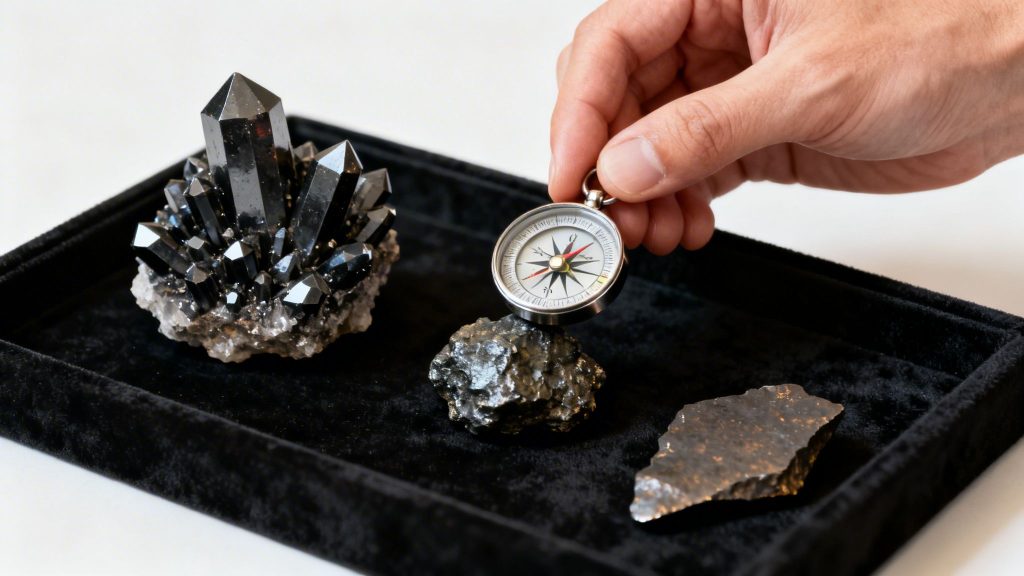
While a few minerals display magnetic properties, magnetite truly commands the market. Its powerful attraction to magnets, a property called ferromagnetism, makes it a legend among collectors. Therefore, this quality is not a novelty; it is a fundamental trait that shapes a specimen’s story, desirability, and long-term value.
Understanding the Value of Magnetic Minerals
The fascination with magnetic minerals extends far beyond simple physical curiosity. For serious collectors and designers, magnetism tells a unique geological story. It offers a direct clue about a mineral's chemical composition and the iron-rich conditions of its formation.
As a result, this natural pull becomes a critical factor in a specimen's valuation. Its worth is not determined solely by magnetic strength. Instead, value emerges from a sophisticated interplay of rarity, provenance, and the tangible beauty of the crystal itself.
Core Factors Driving Value
Rarity and Formation: The specific geological events required to create strongly magnetic minerals are uncommon. This inherent scarcity provides a specimen's foundational value.
Crystal Structure and Aesthetics: A magnetite specimen with sharp, well-defined octahedral crystals will always command a higher price than a massive, undefined form. Factors like luster, size, and association with other minerals dramatically enhance its aesthetic appeal.
Provenance and Integrity: A documented origin from a historically significant locality adds a layer of prestige and verifiable value. For a deeper look into mineral properties, our guide on a variety of mineral facts offers more great insights.
In the world of fine minerals, magnetism connects a specimen's scientific identity to its historical narrative. A piece of lodestone, for example, is not just a magnetic rock; it is a natural compass that guided ancient mariners. That historical weight elevates its value far beyond its physical form.
This intersection of science, history, and aesthetics defines the market for investment-grade magnetic minerals. Each piece tells a story of planetary formation—a story that sophisticated collectors and designers are eager to own. Astro West’s direct relationships with field experts ensure every specimen is selected not just for its magnetic pull, but for its complete narrative and investment potential.
Key Magnetic Minerals and Their Collector Appeal
This table offers a snapshot of primary magnetic minerals, highlighting their properties and the key factors driving their value in the collector market.
Mineral
Magnetic Type
Key Value Drivers
Magnetite
Ferromagnetic
Sharp crystal form (octahedrons), historical significance as "lodestone."
Extremely rare terrestrial and meteoric origins, historical importance.
Maghemite
Ferromagnetic
Often forms as an alteration product, sought for scientific interest.
Titanomagnetite
Ferromagnetic
Combination of titanium and iron, important in geological studies.
Ultimately, whether it's a perfectly formed magnetite crystal or a rare iron meteorite, magnetism imparts a dynamic quality that other minerals lack. It is the invisible force that makes them tangible pieces of our planet's history, appreciating assets whose value is locked in their very atomic structure.
Why Magnetite Is a Cornerstone of Any Serious Collection
When acquiring magnetic minerals, Magnetite is the undisputed cornerstone asset. Its powerful magnetic field and stunning crystal habits make it a true centerpiece specimen. For a collector, however, a premier magnetite is valued for its combination of sharp physical characteristics and deep historical significance.
The most sought-after form for collectors is the octahedron—a razor-sharp, eight-sided crystal resembling two pyramids joined at the base. Specimens exhibiting these perfect geometric forms exist in a completely different price category. A deep, jet-black color and a bright, metallic luster are additional hallmarks of a high-quality, well-preserved piece.
What Separates a Good Magnetite from a Great One?
An investment-grade magnetite specimen is not just a rock that attracts a magnet. Its true market value comes from a synthesis of aesthetic and scientific factors that elevate it far above common examples. Both collectors and designers seek specific qualities that enhance its visual impact and narrative depth.
Here’s what to look for:
Crystal Definition: You must prioritize sharp, distinct octahedral crystals over massive, lumpy forms. The crispness of these crystal faces is the primary indicator of quality.
Size and Luster: Large, well-formed crystals are always rarer. When those crystal faces possess a brilliant, metallic shine, the specimen’s visual appeal—and price—increase dramatically.
Mineral Association: Magnetite found in matrix with other minerals creates a more dynamic composition. For example, a pairing with sparkling quartz or green epidote creates a stunning natural sculpture.
Provenance: A label tracing a specimen to a classic locality, like Russia’s Kola Peninsula or mines in Utah, adds significant value and verifiable authenticity.
Beyond its raw beauty, magnetite holds substantial historical importance. For centuries, the naturally magnetic variety, lodestone, served as humanity’s first compass. This direct link to the age of exploration gives certain specimens a narrative as valuable as their mineralogical properties.
A well-formed lodestone is more than a scientific curiosity—it is a direct connection to the history of discovery. Its ability to point north guided ancient sailors and literally changed the course of global exploration, making it a truly timeless artifact.
This rich history, combined with its industrial importance, gives it a solid market foundation. Magnetite’s intense magnetic pull is essential for modern steel production. Moreover, the global magnetic separation market—which uses this property to purify iron ore—was valued at USD 45.89 billion and is projected to reach USD 74.01 billion by 2033. This real-world relevance provides a sturdy floor for the mineral’s value, ensuring a high-quality magnetite specimen remains a cornerstone asset.
Beyond Magnetite: A Spectrum of Collector-Grade Magnetic Minerals
While magnetite commands the most attention, the world of magnetic minerals is far richer and more diverse. Several other species possess magnetic properties that make them compelling acquisitions for collectors and designers. These minerals offer unique aesthetics and geological narratives, opening new avenues for building a truly distinctive collection.
Pyrrhotite, for example, is a collector favorite due to its unmistakable metallic bronze luster and sharp hexagonal crystals. Its magnetism is directly linked to its iron content. Therefore, not all pyrrhotite specimens are magnetic, which makes strongly magnetic examples that much more desirable for collectors who appreciate such nuances.
Distinguishing Key Magnetic Varieties
Beyond pyrrhotite, a few other minerals offer compelling potential for both investment and design. Each possesses specific traits, from sheer rarity to scientific importance, that drive their value. Their market price is almost always tied to how well these unique characteristics are preserved.
Maghemite: This is a less common but powerfully magnetic iron oxide. It often forms from the alteration of magnetite, making it a scientifically fascinating specimen. Top-grade pieces are prized for their rarity and the geological process they represent.
Titanomagnetite: As its name suggests, this is a blend of titanium and iron oxides. While not always a visual showstopper, its role in paleomagnetic studies—researching Earth's ancient magnetic fields—gives it significant scientific and historical value.
Ilmenite: Similar to titanomagnetite, ilmenite contains titanium and is only weakly magnetic. Its value often stems from its association with other important minerals and its crucial role in geological research, adding intellectual appeal for discerning collectors.
This diagram breaks down the primary factors determining a magnetic mineral's value, using magnetite as a model.
As the chart illustrates, a specimen's true worth is a combination of its physical beauty (crystal quality), documented history (provenance), and the unique story it tells.
Exploring these varied minerals that are magnetic reveals a much deeper market. Value is determined not just by magnetic pull, but by the complete asset profile: rarity, aesthetics, and the incredible scientific story locked within the stone.
At Astro West, our direct relationships with field experts allow us to source not only the finest magnetite but also exceptional examples of these less common magnetic minerals. Our curation focuses on acquiring specimens that satisfy all criteria—crystal quality, provenance, and narrative. This ensures every piece we offer is a sound asset and a stunning object of natural art.
Rare Earths and Meteorites: The Ultimate Magnetic Assets
While most magnetic mineral collections are built on terrestrial specimens, the most exceptional assets often have more exotic origins. These are the specimens tied to the frontiers of modern technology or the vastness of interstellar space. Consequently, they represent the pinnacle of rarity and value, bridging Earth's geology with human innovation and cosmic history.
The Hidden Engines of Modern Technology
Rare earth elements (REEs) are the critical components powering our modern world. Minerals like bastnäsite and monazite are not just geological curiosities; they are the primary sources for elements used to create the planet's most powerful magnets. This direct link to global economic and technological trends transforms them into strategic assets with appreciating value.
The Value of Rare Earth Minerals
Consider neodymium, a key rare earth element. The demand for this single element is a massive market driver, accounting for 45.2% of all global REE consumption. It is the critical component in everything from electric vehicle motors to wind farm turbines.
This industrial appetite has pushed global rare earth oxide production to 390,000 metric tons. This demand, as detailed by Natural Resources Canada, directly underpins the rising value of mineral specimens containing these vital elements. A specimen of bastnäsite, therefore, is more than a crystal. It is a tangible piece of the supply chain that makes green technology possible, a physical investment in the materials shaping our future.
Meteorites: The Ultimate Provenance
Without question, meteorites are among the most coveted magnetic assets an individual can own. Their magnetism, typically from a high concentration of iron and nickel alloys, is a primary identifying feature. However, their true value comes from their extraordinary origin story. These are not merely rocks; they are messengers from the birth of our solar system.
An iron meteorite is a tangible fragment of a shattered planetary core, an object that traveled billions of miles through space before landing on Earth. Its magnetism is a direct link to the cosmic forces that forged our solar system.
Iron meteorites and pallasites are especially sought after by top-tier collectors. When cut and etched, an iron meteorite reveals stunning Widmanstätten patterns—an interlocking metallic crystal structure impossible to form on Earth. Pallasites are even more breathtaking, featuring gem-quality olivine crystals suspended in a solid iron-nickel matrix. To get a better sense of their makeup, you can read our guide on what meteorites are made of.
The value of these extraterrestrial assets is driven by extreme rarity, verifiable cosmic origin, and an aesthetic that cannot be found anywhere else. Each one is a unique artifact of celestial history. This makes it a premier acquisition for any serious collection, an asset class with parallels to fine art and antiquities.
How to Identify and Test Magnetic Minerals
Proper identification is the cornerstone of any serious mineral collection. For magnetic minerals, confirming this property is your first critical step. It is how you separate common look-alikes from authentic, investment-grade specimens and authenticate a key part of their geological story.
Fortunately, you do not need a high-tech laboratory. A few simple, non-destructive tests can be performed safely in the field or at home. These methods protect the physical integrity of your specimen, which is essential for preserving its market value.
Simple Field-Testing Methods
The most direct way to test for magnetism is with a strong magnet; a neodymium magnet provides the best results. Gently bring it near the mineral without touching the surface. A strongly ferromagnetic mineral like magnetite will produce an unmistakable pull.
For weakly magnetic minerals, however, you will need a more sensitive approach. These two methods provide reliable results while keeping the specimen pristine:
The Suspended Magnet Test: Dangle a small magnet from a string so it hangs freely. Slowly bring your mineral specimen toward it. If the mineral is magnetic, it will attract the magnet, causing it to swing.
The Compass Test: Place a simple magnetic compass on a flat, stable surface away from any metal objects. Bring your mineral close to the compass. A magnetic specimen will deflect the needle, pulling it to point directly at the mineral.
A specimen’s response to these tests is a primary data point in its valuation. A strong, immediate reaction indicates high iron content and confirms its identity as a premier magnetic mineral, a quality that directly enhances its desirability.
For those interested in hands-on investigation and discovering magnetic properties, explore this resource on Magnetic Enquiry Exploration.
Verifying Natural Magnetism
Here, an expert’s eye is indispensable. You must distinguish between natural magnetism and an artificially induced field. A true lodestone, for instance, is naturally magnetized magnetite, making it far rarer and more valuable than a standard piece of magnetite treated with a powerful modern magnet.
Confirming natural magnetism often requires assessing a specimen’s provenance and geological context. This is where Astro West's direct relationships with miners and field experts become invaluable. We ensure every piece is sourced with verified authenticity and use these same field tests, backed by deep scientific knowledge, to curate only specimens with unquestionable natural properties.
This expertise protects your investment and guarantees the integrity of your collection. You can build your own identification skills by exploring our detailed guide on how to identify minerals.
Curating and Displaying Your Magnetic Collection
Acquiring a fine magnetic mineral is the first step. The art of proper care and thoughtful presentation protects its long-term value. Curation is an active process of understanding each specimen's unique stability to preserve its beauty and financial worth.
Some minerals, for example, are more demanding. Pyrrhotite, with its beautiful metallic luster, can easily degrade in high humidity, causing it to tarnish and weaken. For such sensitive pieces, a stable, dry environment is essential to prevent your investment from deteriorating.
Preservation and Display Strategies
For stable magnetic minerals like magnetite, the primary goals are protection from dust and physical damage. A high-quality display case is your foundational investment. To elevate your pieces from storage to a genuine design feature, however, you must consider lighting, which makes metallic lusters and crystal forms pop.
With strategic placement, a scientific specimen transforms into a powerful design object.
Create Focal Points: The dark textures of magnetite or the bronze tones of pyrrhotite stand out beautifully against lighter decor. Use them as statement pieces on a mantel or console table to draw the eye.
Group for Impact: A curated cluster of smaller magnetic minerals can tell a powerful geological story. Arrange them by locality or crystal habit to create a cohesive and educational display.
Document and Organize: Proper cataloging is the backbone of any serious collection. Consider using tools like collection management software for tracking provenance records and insurance valuations.
Proper display is more than an aesthetic choice; it is a direct reflection of your respect for the specimen's journey and value. An elegantly presented mineral is not just being shown—it's being honored.
By blending the science of preservation with smart design, you transform your collection into a dynamic and appreciating asset. For those seeking the perfect enclosure, our guide on selecting a rock collection display case offers more detailed advice.
Common Questions on Magnetic Minerals
When acquiring minerals with such a powerful and unusual property, many questions arise. Whether you are a seasoned collector or a designer seeking a unique object, it helps to have direct answers. Here, we address the most common questions we hear at the gallery.
Does Magnetism Increase a Mineral's Value?
Yes, in many cases, magnetism is a significant driver of a specimen's value. This is especially true when the property is central to its identity. For example, a lodestone (magnetite) with a strong, natural magnetic field is far more desirable—and valuable—than a weakly magnetic one.
The same principle applies to meteorites; magnetism is a key diagnostic feature, and that link to its extraterrestrial origin directly impacts its scientific and collectible worth. For rare earth minerals, value is almost entirely tied to their potential use in creating powerful industrial magnets. In these cases, the magnetic potential of their elemental components fuels market demand, directly increasing their price as collector's items.
Are All Black, Metallic-Looking Minerals Magnetic?
No, and this common misconception can lead to misidentification. While magnetite is the quintessential black, metallic, and magnetic mineral, many others share its appearance but lack its magnetic pull. Minerals like hematite, galena, or pyrite can all have a dark, metallic luster but will not react to a magnet.
This is why visual identification alone is insufficient. You must test a specimen's magnetic properties to confirm its identity. A simple, strong magnet is often the best first step to distinguish between these minerals, proving how crucial proper verification is before an acquisition.
How Should I Store My Magnetic Minerals?
Proper storage protects the integrity and value of your collection. For most stable magnetic minerals like well-formed magnetite, the rules are simple. Keep them in a dry, dust-free environment such as a sealed display case to protect them from humidity and physical damage.
However, some specimens are more demanding. A mineral like pyrrhotite is notoriously unstable and can degrade in high humidity. It is also prudent practice to keep strongly magnetic pieces a safe distance from sensitive electronics. At Astro West, we provide specific care instructions for every specimen, ensuring your investment is protected for years to come.
At Astro West, we leverage our deep expertise and direct connections with field experts to source and verify every specimen. Explore our curated collection of fine minerals, meteorites, and fossils, and acquire a genuine piece of natural history with confidence.