Here’s a simple truth: minerals are Earth’s pure ingredients. They're the fundamental, naturally occurring building blocks of our entire planet, and each one has its own unique chemical recipe and internal structure. Think of them less as just pretty rocks and more as the raw elements that make everything else possible.
What Makes a Mineral a Mineral
Ever wondered what really separates a simple rock from a true mineral? It’s not just a casual distinction. Geologists use a specific five-point checklist to decide, turning a simple question into a fascinating piece of science. For any substance to earn the title "mineral," it has to meet all five criteria.
This framework is why some common materials make the cut while others don't. To be a mineral, a substance must be:
Naturally Occurring: It can't be man-made. Steel, for instance, is an alloy created in a factory, so it doesn't qualify.
Inorganic: It can't be formed from living things. This is why coal, which comes from ancient plant matter, isn't a mineral.
Solid: It has to be solid at standard temperatures. This simple rule is why liquid water isn't a mineral, but solid ice actually is.
Definite Chemical Composition: It has a consistent chemical formula. For halite (salt), it’s always NaCl. For quartz, it’s always SiO₂.
Ordered Internal Structure: Its atoms are arranged in a repeating, geometric pattern. This is known as a crystal lattice, and it’s the secret to a mineral's form.
A common mix-up is thinking rocks and minerals are the same thing. Here’s a better way to think about it: a rock is like a cookie, made of different ingredients. Minerals are the pure ingredients themselves—like the sugar, flour, or chocolate chips.
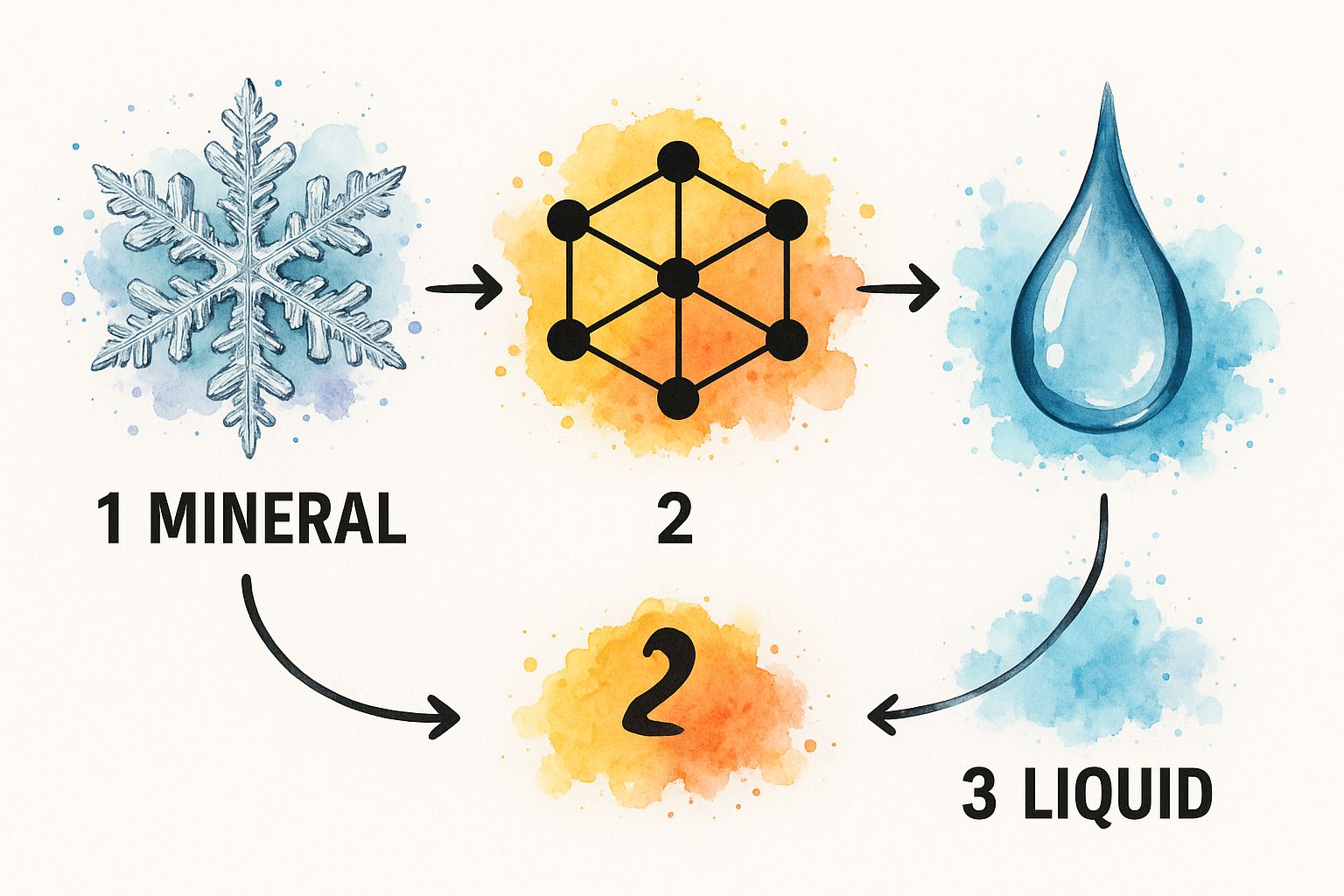
This infographic does a great job of showing the difference between a substance that qualifies as a mineral (ice) and one that doesn't (water), and it all comes down to that critical element of structure.
You can see how the organized, crystalline structure of ice fits the mineral definition perfectly, whereas the freely flowing molecules of water don't have that required order.
This strict definition is what helps geologists classify thousands of different substances. Minerals can even transform from one type to another under intense conditions. You can see how this plays out by exploring what is metamorphic rock and discovering how new minerals are forged deep within the Earth's crust.
How Minerals Are Forged Inside the Earth
Minerals aren’t just found—they’re forged. Deep within our planet, incredible geological forces are constantly at work, turning Earth into a dynamic factory for the crystalline treasures we admire. The story of how minerals come to be is a dramatic one, written over millions of years.
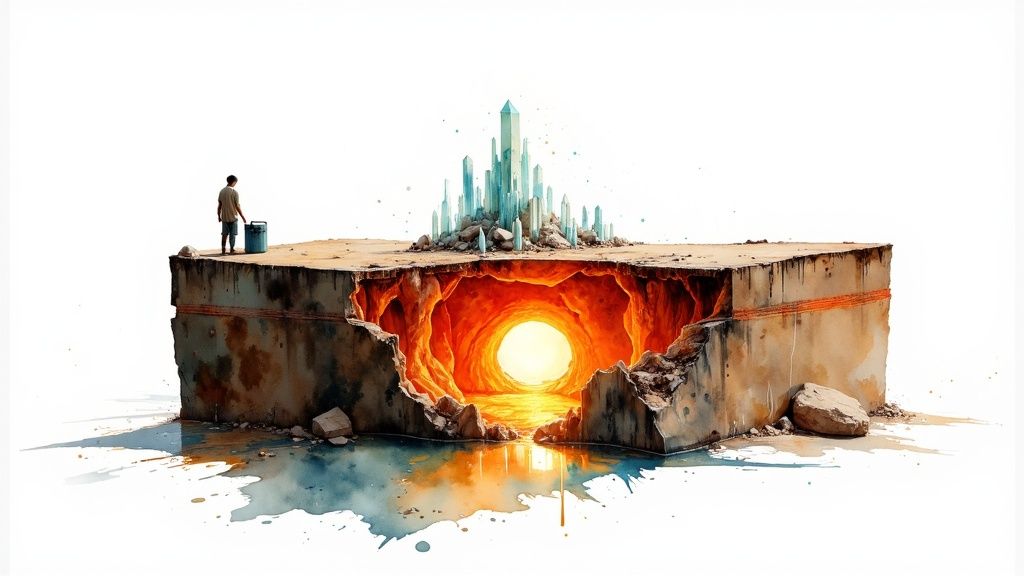
One of the most common ways minerals are born starts with molten rock, or magma. As this intensely hot liquid begins to cool and solidify, its atoms arrange themselves into orderly, repeating patterns, forming crystals. It's a bit like watching water freeze into intricate ice crystals, but on a geological timescale. This is how foundational minerals like quartz, feldspar, and mica come into existence, forming the very backbone of igneous rocks like granite.
Transformation Under Duress
Minerals can also be created when existing ones are put under immense strain. This process, known as metamorphism, subjects a mineral to intense heat and pressure that fundamentally rewires its atomic structure—all without ever melting it. Think of it as the planet’s own natural alchemy, transforming a humble mineral like shale into a completely new one, like garnet.
Another fascinating creation story involves superheated, element-rich water flowing through cracks in the Earth's crust. As this supercharged solution cools, the dissolved elements can no longer stay suspended. They begin to precipitate out, crystallizing into solid mineral deposits.
These deposits often create the rich veins of precious materials we seek out. It’s precisely how many of the world's most valuable gold and silver lodes were formed, solidifying from hot, mineral-packed fluids deep underground.
Surface-Level Creations
Mineral formation isn’t confined to the planet’s depths, either. Right here on the surface, minerals can form from something as simple as evaporating water. When water evaporates from a salt lake, for instance, it leaves behind shimmering deposits of halite (rock salt).
In a similar way, the slow, steady drip of water inside a cave deposits tiny amounts of calcite, gradually building stunning stalactites and stalagmites over centuries. These formations can also hide some beautiful surprises. If you want to learn more, you can explore the question of what is a geode and discover the crystal-lined pockets that form within these rocks. Each process reveals another amazing chapter in the story of how minerals are made.
A Geologist's Guide to Identifying Minerals
With thousands of minerals out there, telling one from another can feel like an impossible puzzle. But geologists have a system. They act like detectives, using a set of key physical properties to uncover a mineral’s true identity. These tests aren't just a simple checklist; they reveal the secrets locked deep inside a mineral's atomic structure.
The first thing most of us notice about a mineral is its color, but ironically, it's often the most misleading clue of all. Tiny impurities can cause a single mineral to show up in a whole rainbow of shades. Quartz is a perfect example—it can be pink (rose quartz), purple (amethyst), or even smoky brown.
That’s why geologists rely more on a mineral's streak. This is the color of its powder when you scrape it across a rough surface, like an unglazed porcelain plate. Hematite, for instance, might look black, gray, or reddish, but its streak is always a distinct reddish-brown. It’s a much more reliable fingerprint.
Hardness, Luster, and Breakage
Another critical property is luster, which is just a fancy word for how a mineral’s surface reflects light. It’s more nuanced than just "shiny" or "dull." Geologists use specific terms like metallic for pyrite (fool's gold), glassy (or vitreous) for quartz, and pearly for talc.
Hardness gives us a much more definitive clue. Measured on the Mohs scale from 1 (the softest) to 10 (the hardest), this test simply checks a mineral's resistance to being scratched. A diamond, scoring a perfect 10, can scratch anything below it. Talc, at a lowly 1, is so soft you can scratch it with your fingernail.
Finally, the way a mineral breaks tells you a lot about its internal crystal structure.
If it splits along smooth, flat surfaces, it has cleavage. This happens along planes of atomic weakness. Halite (table salt) is famous for this, breaking into perfect little cubes.
If it shatters into irregular, jagged, or curved pieces, it has fracture. Think of the curved, glassy fractures you see in a broken piece of quartz.
To see how these properties stack up in the real world, let's compare three common minerals.
Comparing Common Mineral Properties
This table shows how just a few simple tests can easily distinguish between minerals that might look similar at first glance.
Property
Quartz
Halite (Salt)
Pyrite (Fool's Gold)
Color
Variable (clear, white, pink, purple)
Clear to white
Brassy yellow
Luster
Glassy (vitreous)
Glassy
Metallic
Hardness
7 (scratches steel)
2.5 (scratched by a fingernail)
6-6.5 (can scratch glass)
Cleavage
No cleavage; exhibits conchoidal fracture
Perfect cubic cleavage (3 directions)
No cleavage; exhibits conchoidal fracture
Streak
White
White
Greenish-black to brownish-black
As you can see, even if you had a clear piece of Quartz and a clear piece of Halite, a quick hardness test would tell you which is which. The same goes for telling Pyrite apart from real gold—Pyrite’s greenish-black streak is a dead giveaway.
These simple, hands-on tests are the foundation of mineralogy. For a deeper dive into these visual clues, our crystal identification guide is a fantastic starting point.
Of course, some minerals require more specific tests. For example, learning how to tell if diamonds are real often involves checking for thermal conductivity, something you wouldn't do for most common minerals. By combining these observations, geologists can confidently piece together the evidence to name just about any mineral they find in the field.
The Hidden Minerals Powering Your Daily Life
From the moment you wake up, you’re interacting with minerals. They are the unsung heroes of modern life, hidden in plain sight inside the technology you use, the buildings you enter, and even the food you eat. Chances are, you’re holding a few of them right now.
Take your smartphone—it's a veritable treasure trove of geological ingredients. That vibrant screen? It contains indium and tin. The powerful battery that keeps you connected all day relies on lithium and cobalt. These aren't just abstract elements on a chart; they are real minerals pulled from the earth to make our digital lives possible. Even something as simple as a pencil depends on graphite.
From the Earth to Your Home
This deep connection to the mineral world extends far beyond our gadgets. The very walls of your home are likely made from drywall, which is manufactured from the soft mineral gypsum. The salt you sprinkle on your food is simply the mineral halite, harvested from ancient sea beds.
By tracing these materials from the mine to your hands, you gain a new appreciation for how deeply intertwined our lives are with Earth's mineral resources. Every device and structure has a geological story to tell.
The global supply chains that bring us these materials are incredibly complex. For instance, the Democratic Republic of Congo (DRC) produces a significant portion of the world’s cobalt, a mineral absolutely essential for the batteries in electric vehicles and electronics. For a deeper dive into these global dependencies, you can explore these insights on critical mineral supply chains to understand the global mineral economy.
This dependency also makes it fascinating to learn the properties of different minerals, especially how to tell a valuable one from a clever imposter. If you're an aspiring collector, our guide on how to tell gold from pyrite is a great place to start.
Which Countries Are Mineral Superpowers
The Earth’s mineral resources aren’t spread out evenly. Far from it. This geological lottery has created a handful of mineral superpowers—nations whose natural wealth gives them a powerful seat at the table in the global economy. Control over these essential resources is more than just a matter of wealth; it's a source of immense strategic leverage that ties geology directly to international politics.
Some countries are blessed with a staggering diversity of mineral deposits. Australia, for instance, is a true giant in the mining world, with places like The Kimberley region historically famous for its diamonds and other rich finds. Likewise, the sheer size and varied geology of Russia and the United States make them major players on the world stage.
China's Dominant Role
But right now, no country’s influence quite matches China's grip on the global minerals market.
China is one of the world's top mining countries, producing billions of tonnes of minerals every year. It’s not just about bulk, though. China is also a leading producer of the world's rare earth elements and, even more critically, dominates their global processing. These aren't just obscure materials; they are the non-negotiable ingredients for modern electronics, green energy technologies, and advanced defense systems. You can find more details on global leaders in mineral production and how these rankings shift.
This concentration of both mining and processing power in one nation drives home a critical point about minerals: where they come from is just as important as what they become. Access to these resources fundamentally shapes technology, trade, and politics on a global scale.
Meeting the Future Demand for Critical Minerals
As our world hurtles toward a greener future, the hunger for certain minerals is growing faster than ever. These aren't just any rocks; they are critical minerals, the essential building blocks for everything from the batteries in your next electric car to the towering wind turbines and sprawling solar farms powering our cities.
Minerals like lithium, cobalt, and nickel have quickly become the unsung heroes of this energy revolution. This sudden, massive demand is shaking things up, creating both huge challenges and incredible opportunities. On one hand, it’s forcing us to get smarter about mining and recycling, pushing for a circular economy where these finite materials get a second life. On the other hand, it’s sparking new geopolitical rivalries as nations scramble to secure their own supply of these precious resources.
You can see this boom reflected in the sheer scale of global production. In recent years, an estimated 19.2 billion metric tons of minerals were pulled from the earth annually, with Asia leading the charge. For a deeper dive into the numbers, the World Mining Data 2025 report lays out a full, fascinating picture of global production trends.
The choices we make today about sourcing, recycling, and managing these key minerals will directly shape the sustainability and stability of the world tomorrow. How we meet this demand is one of our most pressing global challenges.
Your Questions Answered
When you first get into the world of minerals, a few common questions always seem to pop up. Let's tackle some of the big ones to clear up any confusion and build on what we've learned.
Rock Versus Mineral
It's the classic head-scratcher: what's the real difference between a rock and a mineral? The easiest way to think about it is with a baking analogy.
A mineral is like a single, pure ingredient—think flour, sugar, or salt. It has a very specific chemical recipe and a consistent, orderly internal structure. A rock, on the other hand, is the finished cookie. It's a solid mixture of multiple mineral "ingredients" all bonded together.
For instance, that granite countertop you see everywhere? It's a rock made up of individual crystals of different minerals, most commonly quartz, feldspar, and mica.
The Hardest Mineral
So, which mineral gets the trophy for being the toughest? That title belongs to the diamond.
On the Mohs scale of hardness, which measures how well a mineral resists being scratched, a diamond scores a perfect 10. Its incredible strength comes from the powerful, tightly locked bonds between its carbon atoms. This structure is so durable that a diamond can scratch any other mineral on the planet.
Are Gemstones Minerals?
For the most part, yes! Most of the gemstones we know and love are simply special varieties of common minerals. A fiery ruby is just a red version of the mineral corundum, and a brilliant emerald is the green form of the mineral beryl.
But here's a fun twist: not all gems are minerals. Some of the most beloved gems are actually organic, meaning they came from living things. This category includes pearls (from oysters), amber (fossilized tree resin), and jet (a dense type of coal). Because they have an organic origin, they don't quite fit the strict geological definition of a mineral.
At Astro West, we believe every mineral tells a story millions of years in the making. From museum-quality specimens to stunning natural décor, explore our ethically sourced collection and find a timeless piece of Earth's history to call your own. Discover your next treasure at https://astrowest.com.