Gypsum selenite is one of those minerals that just seems to glow from within. It’s a transparent, often glass-like variety of the gypsum mineral, famous for its ethereal, almost moon-like radiance. Think of it like water, which can take the form of snow or ice. In the same way, the mineral gypsum can form as selenite, satin spar, or alabaster—all are different crystalline expressions of hydrated calcium sulfate.
It’s this natural artistry that makes selenite such a captivating crystal, prized for both its beauty and its unique physical properties.
Exploring the Identity of Gypsum Selenite
So, what exactly makes gypsum selenite so enchanting? Its story starts millions of years ago, deep in ancient seas that have long since vanished. As this mineral-rich water slowly evaporated over countless millennia, it left behind chemical deposits that patiently crystallized into the stunning formations we see today.
The simple chemical makeup, hydrated calcium sulfate (CaSO₄·2H₂O), is the building block for all gypsum varieties. But what gives selenite its signature transparent, blade-like look is all in the crystal structure. You can think of it as nature’s glass, formed not by intense heat but by the slow, quiet process of evaporation.
Core Characteristics
To really get to know selenite, you have to understand its fundamental traits. These qualities don’t just define how it looks; they also dictate how you should handle and care for it.
Luster: Selenite has a pearly to vitreous (glassy) sheen that gives it that famous inner glow.
Transparency: True selenite is colorless and transparent, allowing light to pass right through it in a beautiful, soft way.
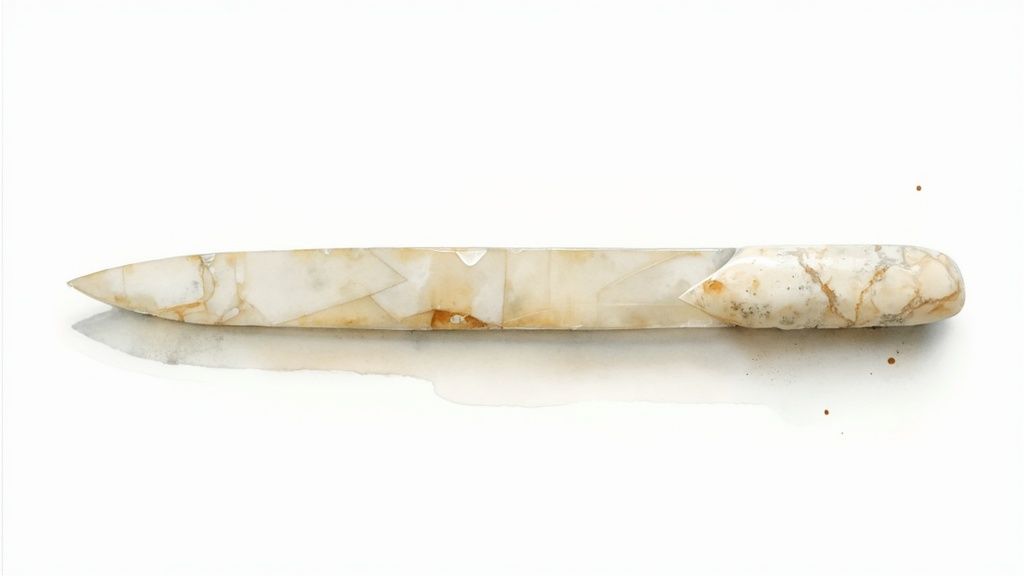
Structure: It often grows in tabular, blade-like, or columnar crystals that have distinct parallel lines running through them.
Softness: This is a big one. As one of the softest minerals around, it ranks only a 2 on the Mohs hardness scale. You can learn more about mineral properties by exploring these 12 amazing facts about minerals you should know.
This incredible softness is a key identifier—you can easily scratch its surface with just a fingernail. It’s a characteristic that quickly sets it apart from many other crystals that might look similar.
For a quick summary of what makes this mineral unique, here's a look at its key attributes.
Evaporation of mineral-rich water in seas or salt flats
These properties are what give selenite its distinct look and feel, making it a favorite among collectors.
The demand for gypsum, including high-purity forms like selenite, continues to climb. The global gypsum market was valued at $36.2 billion in 2025 and is expected to hit $68.6 billion by 2035. The specialty gypsum segment, which selenite is a part of, is valued at roughly $2.1 billion in 2025 alone. You can find more details on the gypsum market forecast on futuremarketinsights.com. This context helps build a deeper appreciation for this truly remarkable mineral.
The Geological Story of Selenite
To really get a feel for gypsum selenite, you have to picture the ancient world where it was born. Its entire existence is a story of patience, beginning in shallow, mineral-rich waters like old seas, salt flats, and enclosed lagoons.
Imagine these massive bodies of water slowly vanishing over millions of years as they evaporated. As the water disappeared, it left behind a soupy, concentrated mix of minerals—mostly calcium sulfate. This incredibly slow, quiet process gave those minerals the time they needed to bond and organize themselves into the stunning, structured crystals we see today.
This is exactly why selenite is found in sedimentary deposits all over the world; those geological environments are the perfect cradle for its growth. To get a better sense of how these layers come together, it helps to understand what sedimentary rock is. The specific conditions during crystallization, like temperature and how pure the minerals are, ultimately decide the final clarity and shape of the gypsum selenite.
Its Defining Physical Properties
Selenite’s geological journey is written all over its most recognizable features. These properties aren't just scientific trivia; they're the secrets behind its famous beauty and delicate nature, telling you exactly how to identify and handle it.
Exceptional Softness: Selenite is famously soft, ranking only a 2 on the Mohs hardness scale. To give you some perspective, it’s softer than a copper penny. You can easily scratch it with just a fingernail, which is a key hands-on test for identifying it.
Perfect Cleavage: Another tell-tale trait is its perfect cleavage. Think of it like a perfectly layered pastry that splits cleanly along straight lines. Selenite naturally breaks along smooth, flat surfaces, which is why it forms into those blade-like wands, tabular sheets, and fibrous columns.
This tendency to split so perfectly is the reason selenite has such a clean, structured look. It’s not cut or polished by people to look that way; its internal crystal lattice dictates these precise, flat planes.
These properties are a direct result of its molecular structure and the way it formed, layer by patient layer. A great example of this is "Glass Mountain" in Utah's Cathedral Valley—a massive mound of crystalline selenite gypsum that has formed over thousands of years, putting these properties on grand display. This natural monument actually crunches underfoot, a testament to the mineral's delicate, crystalline structure.
Understanding these foundational traits connects the science of geology to the crystal's tangible beauty. Its softness and perfect cleavage aren't flaws; they're the very essence of what makes gypsum selenite so unique and captivating.
Understanding the Gypsum Family
Dipping your toes into the world of crystals can get a little confusing, especially when one mineral seems to have a dozen different names. The trick to understanding gypsum selenite is to think of it as part of a family. Each member shares the same chemical DNA—hydrated calcium sulfate—but looks completely different, kind of like siblings with their own unique styles.
What causes these dramatic differences? It all comes down to the environment where they formed. Things like water flow, mineral impurities, and how quickly the crystals grew all played a part in creating their unique textures and shapes. Getting to know these "sister stones" is the key to telling them apart with confidence.
Distinguishing the Four Main Varieties
The most common forms you'll run into are Selenite, Satin Spar, Desert Rose, and Alabaster. Once you know what to look for, each one has a signature look that makes it easy to spot.
Selenite: This is the transparent, glassy version of gypsum. It loves to grow in flat, blade-like sheets and is famous for its incredible clarity and moon-like glow.
Satin Spar: Often mistaken for true selenite, this is the silky, fibrous variety. It’s made of tightly packed, parallel fibers that create a beautiful cat-eye effect and a pearly, satin-like sheen. This is the form most often carved into wands, towers, and spheres.
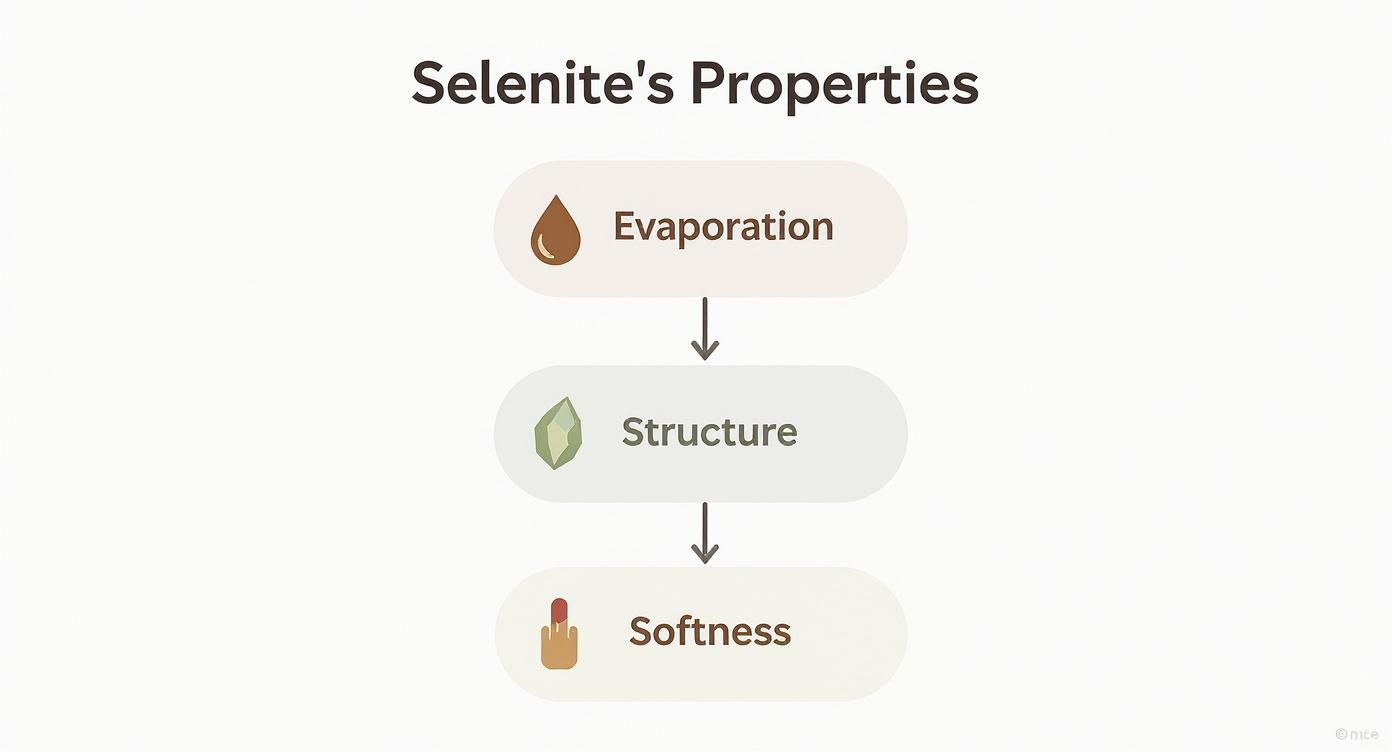
This infographic breaks down the essential properties that define the entire gypsum selenite family, from how it forms to its signature softness.
As you can see, the mineral’s entire life cycle—from evaporation to crystallization—directly shapes its delicate structure and tangible softness.
While Selenite and Satin Spar are the two that get mixed up the most, the other two gypsum siblings have completely different vibes. One is a delicate, floral creation, while the other is a dense, solid material perfect for artists.
Desert Rose: This stunning variety forms when gypsum crystals grow and trap tiny sand particles inside them. The result is a beautiful rosette-like cluster that looks just like a blooming flower, with the sand giving it a unique color and gritty texture.
Alabaster: This is the massive, fine-grained form of gypsum. It’s usually a smooth, opaque white, and its uniform texture has made it a favorite for carving sculptures and decorative pieces for centuries.
To make things even clearer, this handy table breaks down the key differences so you can quickly identify each type of gypsum you encounter.
Comparing Common Gypsum Varieties
Variety
Key Visual Characteristic
Common Forms
Selenite
Transparent, glass-like, and often flat
Tabular sheets, "fishtail" crystals, blades
Satin Spar
Fibrous, silky, with a pearly sheen
Wands, towers, spheres, charging plates
Desert Rose
Rosette-shaped clusters of interlocking blades
Flower-like formations
Alabaster
Massive, opaque, and fine-grained
Carved statues, decorative items, tiles
By understanding these distinctions, you can appreciate the unique beauty of each member of the gypsum family. You'll know exactly what you’re looking at, whether it’s a clear selenite blade or a silky satin spar wand.
How to Identify Authentic Selenite
With so many crystals on the market, learning to spot genuine gypsum selenite is a truly valuable skill. The good news is, you don't need a lab or any fancy equipment. A couple of simple, hands-on tests are all it takes to tell real selenite apart from look-alikes like quartz or calcite.
The single most reliable method is the fingernail scratch test. Selenite is an exceptionally soft mineral, ranking only a 2 on the Mohs hardness scale. Your fingernail, which comes in at around a 2.5, is actually harder.
Go ahead and try it on a small, out-of-the-way spot. If a gentle press of your nail leaves a little white mark, you're almost certainly holding real selenite. Harder stones like quartz, which is a 7 on the scale, won't be fazed in the slightest.
Trust Your Eyes and Hands
Beyond the scratch test, selenite has a few other dead giveaways. Taking a moment to really look at and feel the crystal can tell you everything you need to know.
Pearly Sheen: Real selenite has this incredible pearly or glassy luster that gives it an inner glow. It’s almost as if it has moonlight trapped inside.
Cleavage Planes: Look closely for long, parallel lines or tiny grooves running the length of the crystal. These are its cleavage planes—the natural lines where the crystal wants to split.
Waxy Feel: Pick it up. Selenite often feels slightly waxy or soapy to the touch, a texture that’s completely different from the cold, hard glassiness of a stone like quartz.
One of the biggest red flags to watch for is unnatural perfection. An authentic piece of selenite will almost always have minor imperfections, some internal fractures, or a bit of cloudiness. If it looks perfectly clear and flawless like a piece of manufactured glass, it probably is.
These quick, hands-on tests are essential for any collector. If you want to get even better at spotting the real deal, a comprehensive crystal identification guide can arm you with more advanced techniques and insights.
Your Go-To Checklist for Identifying Selenite
When you're looking at a potential piece of gypsum selenite, just run through this mental checklist. It combines all the key tests into a simple, reliable process.
Do the Fingernail Test: Gently try to scratch the surface. A light mark is a great sign.
Look for the Glow: Check for that soft, moon-like sheen, not a sharp, glassy sparkle.
Find the Lines: Scan for those fine, parallel grooves or fibrous textures running through the piece.
Feel the Surface: Notice if it has a slightly waxy feel that sets it apart from harder, smoother stones.
Proper Care for Your Selenite Crystals
Selenite is undeniably stunning, but its ethereal beauty comes with a catch—it’s incredibly delicate. Keeping it looking pristine is straightforward, but it all comes down to one golden rule: keep it completely dry.
Think of selenite like a sugar cube. It’s a soft, water-soluble mineral, which means any contact with water or other liquids will cause it to break down. Over time, moisture will make the crystal turn cloudy, start to flake apart, or even dissolve, permanently ruining its luminous structure.
For that reason, your usual cleaning methods are off the table. Instead of water, you can safely clear away dust with a few simple, dry techniques. A soft microfiber cloth is perfect for gently wiping down smooth surfaces. For more intricate raw pieces with lots of nooks and crannies, a can of compressed air works wonders.
Storing and Displaying Selenite Safely
Beyond just keeping it dry, where you place your selenite is just as important for its long-term preservation. Its softness makes it extremely susceptible to scratches and chips from harder objects.
To prevent any accidental dings, it’s best to display your selenite in low-traffic areas where it won’t be bumped or handled too often. A dedicated shelf, a glass cabinet, or a quiet corner of a room are all fantastic choices. Just be sure to avoid placing heavier, harder crystals directly on top of it, as they can easily leave a mark.
Prolonged exposure to harsh, direct sunlight can also be a problem. Over months or years, those intense UV rays can cause the crystal to become brittle and lead to fractures. A spot that gets plenty of indirect natural light is perfect for showcasing its glow without risking its integrity.
The key is to treat selenite with a gentle touch. Its fragility is part of its character, reminding us that some of the most beautiful things in nature are also the most delicate.
Following these simple guidelines will ensure your selenite remains a captivating part of your collection for years. To make it even easier, here’s a quick rundown of the essentials.
Selenite Care Dos and Don'ts
DO dust it regularly with a dry, soft cloth or brush.
DON'T ever wash it with water or any liquid cleaner.
DO handle it with clean, dry hands to avoid transferring oils.
DON'T place it in a bathroom or humid environment.
DO store it away from harder crystals that could scratch it.
DON'T leave it in direct sunlight for extended periods.
Decorating Your Home with Selenite
There’s something about bringing selenite into your home that just feels right. It has this clean, almost ethereal quality, and its soft, moon-like glow manages to fit in everywhere, from sleek, minimalist spaces to cozy, eclectic rooms.
It's more than just a pretty mineral, though. Selenite has a knack for introducing a sense of calm and sophistication wherever you place it. Whether it's casting a soft light, serving as a sculptural accent, or simply standing as a piece of natural art, it has a way of completely transforming the atmosphere.
Popular Forms for Home Décor
Selenite comes in all sorts of shapes and sizes, and each one brings a different vibe. Knowing the options can help you nail the exact look you're going for.
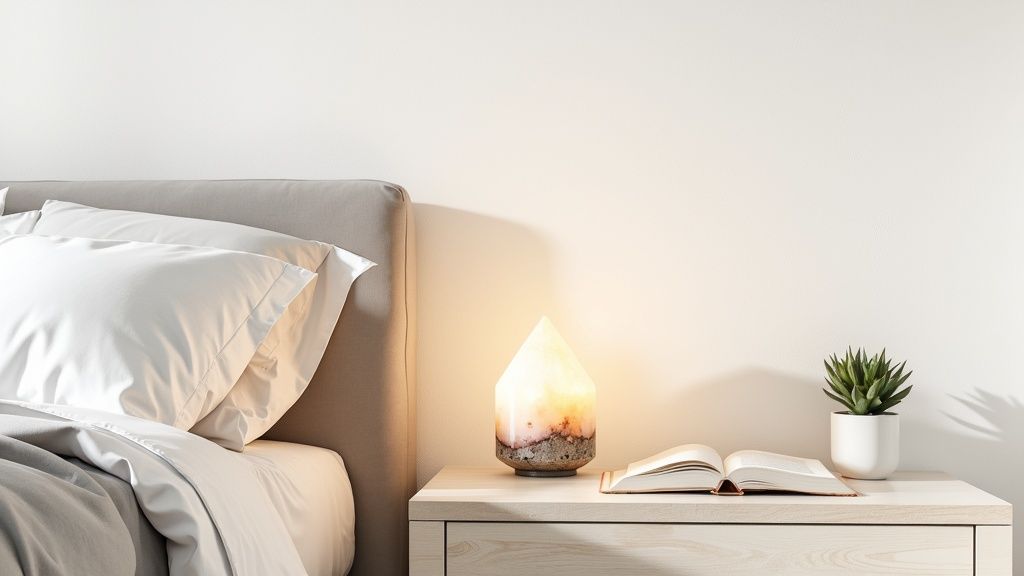
Selenite Lamps: These are probably the most popular way to bring selenite into the home, and for good reason. A hollowed-out tower or sphere with a small bulb inside gives off a warm, tranquil light that's perfect for a bedroom, a quiet meditation corner, or a living room. That soft glow is an instant recipe for relaxation.
Polished Towers and Wands: For a more modern, structured look, polished selenite towers are fantastic. They add a bit of vertical interest to bookshelves, mantels, or side tables. Grouping a few of them in different heights can create a really striking display. We've got more ideas in our guide on how to display crystals effectively.
Raw Specimens: If you're after a more organic, earthy feel, you can't go wrong with a raw piece of gypsum selenite. Its natural texture and form make it a captivating focal point, especially when placed on a coffee table or used as a centerpiece.
You've probably noticed natural décor elements are having a serious moment, and that has really boosted selenite's popularity. Its unique look has caught the eye of collectors and interior designers alike, sparking a steady climb in demand all over the world.
The market data backs this up. The global market for gypsum selenite was valued at roughly $120 million in 2024 and is expected to hit $145 million by 2025. That's a compound annual growth rate of about 6.5% over the last five years.
Design Tips for Any Space
Weaving selenite into your décor is incredibly simple but makes a big impact. In the bedroom, try swapping a harsh traditional lamp for a selenite one on your nightstand. It creates a much more restful environment that's perfect for winding down.
In a living room or office, a polished tower on a desk can add a clean, modern accent without creating clutter. It's also worth thinking about how selenite fits into broader sustainable interior design principles, embracing natural beauty in every element of your space. The best part is that selenite’s neutral tone plays beautifully with just about anything—wood, metal, plants—making it one of the most versatile additions to any design scheme.
Frequently Asked Questions About Gypsum Selenite
As you get more familiar with gypsum selenite, you're bound to have a few questions. It’s a unique mineral, and understanding its quirks is part of the fun. Let’s tackle some of the most common questions that pop up for new and experienced collectors alike.
Is Selenite a Real Crystal?
Absolutely. Selenite is a 100% genuine, naturally occurring crystal.
It’s a specific, often transparent variety of the mineral gypsum, which is a hydrated calcium sulfate (CaSO₄·2H₂O). While it’s incredibly popular in design and metaphysical circles, its origins are firmly rooted in geology. Selenite’s distinct crystalline structure is the result of mineral-rich water slowly evaporating over millions of years.
Why Can't Selenite Get Wet?
This is a big one. You can't get selenite wet simply because it’s a soft mineral that dissolves in water.
Think of it like a sugar cube or a salt block—get it wet, and it will start to degrade, turn cloudy, and lose its structure. Water permanently damages its delicate form. Because of this, always stick to dry cleaning methods. A soft, dry cloth or a quick blast of compressed air is all you need to keep it free of dust.
How Can You Tell Selenite and Quartz Apart?
The easiest way to tell the difference is the scratch test.
Selenite is incredibly soft, ranking at a 2 on the Mohs hardness scale. You can easily scratch it with just a fingernail. Quartz, on the other hand, is much tougher, sitting at a 7 on the Mohs scale. A fingernail or even a steel knife won't leave a mark on it.
Beyond hardness, there's a difference in how they feel. Selenite often has a slightly waxy or soapy texture, while quartz feels more like cold, hard glass to the touch.
Another dead giveaway is selenite’s perfect cleavage. It tends to break along smooth, flat planes, and you can often see fine, parallel lines running the length of the crystal.
At Astro West, we believe in the timeless beauty of natural history. Explore our curated collection of ethically sourced minerals, fossils, and jewelry to find your own authentic piece of gypsum selenite.