A Guide to Rock Pyrite: The Real Story of Fool’s Gold
Rock pyrite is an iron sulfide mineral, but you probably know it by another name: "Fool's Gold." With its flashy metallic luster and pale brass-yellow color, it's easy to see how it got the nickname. For centuries, it has tricked hopeful prospectors into thinking they'd struck it rich.
But pyrite is far more than just a convincing gold look-alike. It's a fascinating mineral with its own story and a unique kind of beauty.
The Real Story of Fool's Gold
The history of pyrite is completely tangled up with the great gold rushes. Picture a prospector in the 19th century, knee-deep in a freezing river, swirling a pan. A glint of yellow catches their eye, and for a heart-stopping moment, they think their fortune is made.
But that excitement quickly fades. The sparkling material isn't soft, pliable gold. Instead, it’s brittle and shatters under the slightest pressure. That’s the classic tale of Fool's Gold.
Real gold is a precious metal, soft enough to be dented or shaped. Pyrite, on the other hand, is an abundant iron sulfide with the chemical formula FeS₂. Think of gold like a piece of soft caramel you can easily squash and mold. Pyrite is more like a rock candy crystal—it has sharp, defined edges and will break into pieces if you press too hard.
More Than Just a Gold Imposter
Even though its nickname comes from deception, rock pyrite is a powerhouse of a mineral in its own right. It forms some of the most stunning and geometrically perfect crystals found anywhere in nature. The most common shape is a perfect cube, often with finely grooved faces that look like tiny, intricate engravings.
It also appears in other incredible shapes, including:
Octahedrons: Eight-sided crystals that look like two pyramids stuck together at the base.
Pyritohedrons: A unique twelve-sided shape with five-sided faces.
Massive formations: Large, dense clusters that don't have a defined crystal shape.
Pyrite actually gets its name from the Greek word pyr, which means "fire." This is because it creates sparks when struck against metal or another hard rock—a trick that was once used to ignite gunpowder.
This natural tendency to form such precise, clean shapes shows just how orderly its iron and sulfur atoms bond together deep inside the Earth. Every single specimen tells a story about the heat, pressure, and chemical soup that created it.
If you're interested in the wild world of minerals, you can explore some amazing facts about minerals you should know to get a sense of their incredible variety. In the end, rock pyrite’s beauty is far more than just skin-deep.
How To Identify Real Pyrite
It’s the classic challenge for every rockhound and treasure hunter: distinguishing real gold from its infamous lookalike, rock pyrite. But you don''t need a fancy lab to solve this age-old puzzle. With just your eyes and a couple of simple tools, you can confidently tell them apart. The secret is to look past that initial golden glimmer and get to know the mineral's true character.
One of the biggest giveaways is the shape of the crystals themselves. Pyrite is famous for forming sharp, almost perfect cubes. You'll see distinct, clean edges and flat faces, often with tiny parallel lines running across them called striations. Gold, on the other hand, is much softer and almost never grows in such a structured way. It typically shows up as nuggets with soft, rounded edges or as irregular, flaky bits.
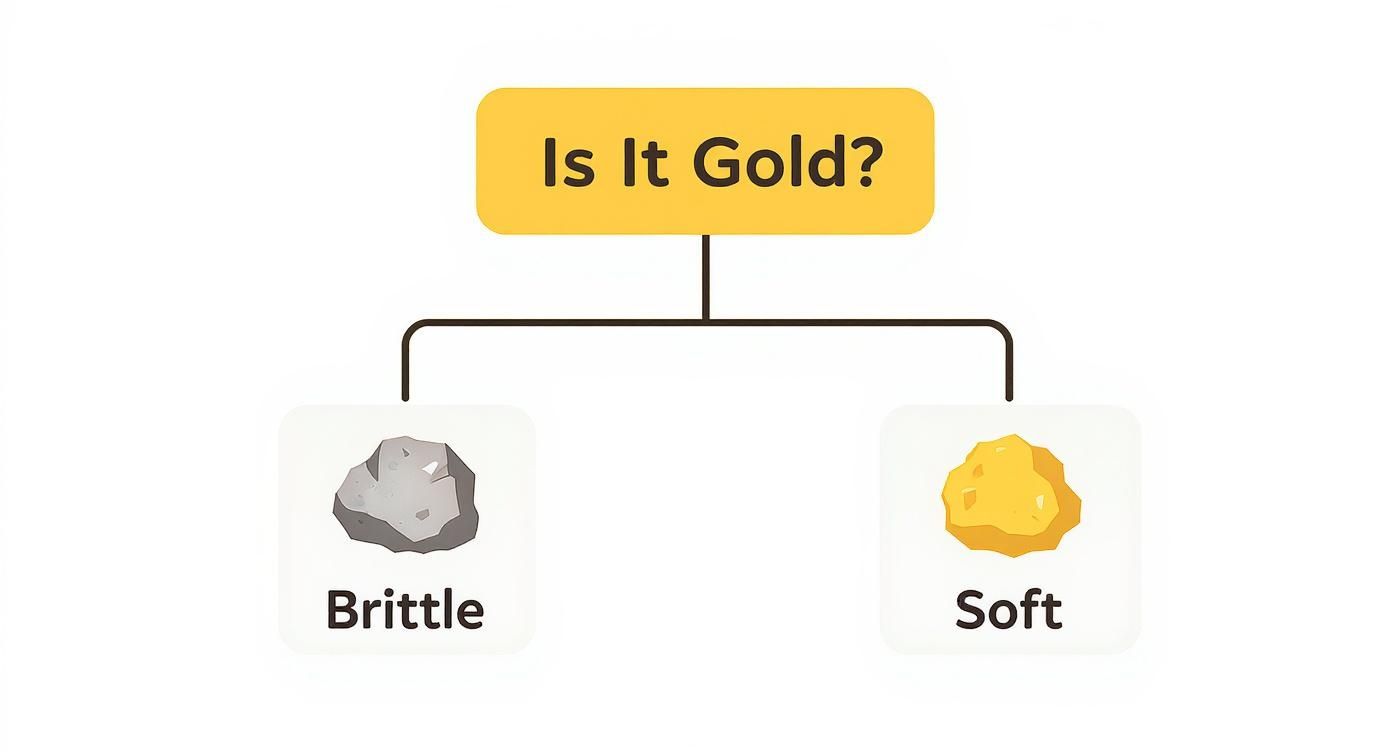
This difference comes down to hardness, which is a major clue. Are you holding something brittle or something soft? This simple question is the first step in identification.
As the infographic shows, the path is clear: gold is soft and will bend, while pyrite is hard and will break or crumble under pressure.
Simple At-Home Identification Tests
Ready to get hands-on? A few simple tests can give you a definitive answer. The most reliable and famous method is the streak test, which reveals a mineral’s true color when it’s in powdered form.
All you need is an unglazed ceramic tile—the back of a bathroom tile works perfectly. Scrape your mineral firmly across the surface.
Rock Pyrite will leave a very distinct greenish-black or brownish-black streak.
Real Gold will leave a true golden-yellow streak, just like its metallic color.
This single test is often enough to settle the debate once and for all.
Another easy test involves nothing more than a steel nail or pocketknife. Pyrite has a hardness of 6 to 6.5 on the Mohs scale, making it harder than steel. You won't be able to scratch it with a nail. Gold, however, is incredibly soft—only about 2.5 to 3 on the Mohs scale—and scratches with ease.
Remember the old prospector’s test: if you can poke it with a pin and it dents or bends, you might have gold. If it flakes or crumbles into dust, you’ve got pyrite.
The table below breaks down these key differences, making it easy to see what sets these two minerals apart.
Pyrite vs Gold Quick Identification Guide
Characteristic
Rock Pyrite (Fool's Gold)
Real Gold
Crystal Shape
Forms sharp, well-defined cubes with flat faces (cubic).
Found as nuggets, flakes, or grains with rounded, soft edges.
Streak Color
Greenish-black or brownish-black.
Bright, golden-yellow.
Hardness (Mohs)
6 to 6.5 (Harder than steel).
2.5 to 3 (Very soft, easily scratched).
Reaction to Pressure
Brittle; shatters or crumbles into powder.
Malleable; dents or bends without breaking.
Smell
May produce a faint sulfurous (rotten egg) smell when struck.
Odorless.
Weight (Specific Gravity)
Heavy, but lighter than gold (~5.0).
Extremely heavy (19.3); noticeably denser than most minerals.
With these simple checks, you'll be able to spot Fool's Gold every time.
Distinguishing Pyrite from Other Lookalikes
While gold is pyrite’s most famous imposter, a couple of other minerals can cause confusion. Chalcopyrite, for instance, has a brassier, more yellowish color than pyrite and is much softer. Marcasite shares the same chemical makeup as pyrite but forms a different crystal structure, often appearing in spear-like or radiating shapes, and it's known to be less stable.
Broadening your knowledge by exploring guides on identifying quality natural stones can give you the context to spot these subtle but important differences.
The Geological Journey of Pyrite
Every piece of pyrite tells an incredible story of heat, pressure, and chemistry deep within the Earth. This mineral isn't something you just find; it's forged in extreme environments where the right ingredients come together in a perfect geological recipe. Pyrite’s creation is a journey that can take millions of years, starting in some of the planet's most dynamic and hidden corners.
Think of the building blocks as simple atoms of iron (Fe) and sulfur (S), floating around in superheated, mineral-rich fluids. These fluids, called hydrothermal solutions, are often bubbling up near volcanic activity. One of the most dramatic settings for pyrite formation is at hydrothermal vents on the deep ocean floor. Here, scalding water erupts from the Earth's crust, carrying dissolved iron and sulfur that instantly crystallize into pyrite the moment they hit the frigid seawater.
Another common birthplace for this mineral is within sedimentary rock layers. This process is a whole lot slower and happens in much calmer conditions.
From Ancient Seabeds to Glistening Cubes
Picture an environment with very little oxygen, like a stagnant swamp or a deep ocean basin. Decaying organic matter on the seabed floor gobbles up all the available oxygen, creating an anoxic (oxygen-free) setting where sulfur-producing bacteria can really thrive. As layers of mud and silt build up, they trap iron-rich minerals. The hydrogen sulfide gas released by the bacteria reacts with this iron, and over millions of years of burial and immense pressure, pyrite crystals begin to grow.
This slow, methodical process gives the iron and sulfur atoms plenty of time to arrange themselves into their signature, highly ordered cubic structure. You can learn more about the fascinating layers where this happens by exploring our guide on what is sedimentary rock.
The iconic, almost perfect cubic shape of many pyrite specimens is a direct result of its internal atomic structure. When conditions are stable and growth is slow, this internal order expresses itself externally as a cube—the most stable form for its crystal lattice.
A Master of Transformation
But pyrite’s geological journey isn't just about creating new crystals from scratch. It’s also a master of replacement. In a process known as pyritization, the mineral can gradually take over other materials, preserving their original shape with a beautiful metallic sheen. This is most famously seen in fossils.
Pyritized Ammonites: Ancient sea creatures with spiral shells are often found perfectly preserved in pyrite, their intricate details captured in glittering gold.
Fossilized Wood: In the right conditions, pyrite can replace the organic fibers of wood, creating stunning specimens that are part fossil, part mineral.
This remarkable ability to replace organic matter highlights just how dynamic pyrite's role in the rock cycle truly is. From erupting out of deep-sea vents to slowly crystallizing in ancient mud and even preserving prehistoric life, the formation of every single pyrite specimen is a testament to the powerful and intricate processes constantly shaping our planet.
Modern Uses for Fool's Gold
While its nickname might suggest it’s worthless, pyrite is actually a surprisingly critical player in modern industry. Its real value has nothing to do with its golden shine and everything to do with its chemical makeup—specifically, its high sulfur content. This makes pyrite the single most important mineral source for producing sulfuric acid, one of the world's most vital industrial chemicals.
The process starts by roasting pyrite ore to release sulfur dioxide gas, which is then converted into the acid we need. This powerful chemical is a fundamental building block for countless products we rely on every single day.
Think of sulfuric acid as a behind-the-scenes workhorse. It’s an essential ingredient in manufacturing processes that touch almost every aspect of modern life, from agriculture to technology.
This indispensable role has created a seriously robust market. The global pyrite market was valued at US$174.2 million in 2022 and is projected to climb to US$249.2 million by 2031. This expansion is driven almost entirely by the rising demand for sulfuric acid. If you dig into the data on this industrial trend, you'll see how regions like Asia Pacific dominate consumption. You can discover more insights about the pyrite market's growth and drivers to get the full picture.
The Industrial Powerhouse
So, where does all this sulfuric acid go? The applications are incredibly diverse. Without it, many of the industries we depend on would simply grind to a halt.
Here are just a few of its most essential uses:
Fertilizer Production: Its biggest job is creating the phosphate fertilizers that are absolutely critical for global food production. Pyrite helps feed billions of people.
Chemical Manufacturing: It’s a key ingredient for producing detergents, dyes, pigments, and even certain pharmaceuticals.
Metal Processing: Sulfuric acid is used for a process called "steel pickling" which cleans and descales steel. It’s also used to extract other metals like copper and zinc from their ores.
Paper and Pulp: The process of turning wood into paper relies on sulfuric acid to break down wood fibers effectively.
Fueling Future Technologies
Beyond these established industrial roles, pyrite is starting to catch the eye of researchers in some really exciting tech fields. Its unique electrical properties have made it a material of interest for scientists looking for sustainable and efficient solutions to our future energy needs.
Scientists are actively exploring pyrite for a few high-tech applications:
Next-Generation Solar Panels: Pyrite is an "earth-abundant" semiconductor, meaning it's common and cheap. Researchers are studying its potential to create low-cost, non-toxic photovoltaic cells that could make solar energy far more accessible and affordable.
Advanced Battery Technology: Its ability to store lithium ions makes it a promising candidate for creating more efficient and powerful lithium-ion batteries—the kind that power everything from our smartphones to electric vehicles.
From the farm field to the high-tech lab, rock pyrite has transformed from a simple gold imposter into a vital global resource. Its true worth isn't in its deceptive looks, but in its powerful contribution to the very foundations of our modern world.
How to Care for Your Pyrite Collection
Owning a piece of pyrite is like having a little piece of geological art, but this stunning mineral needs the right care to keep its metallic shine. The single biggest threat to any pyrite specimen is something collectors call "pyrite decay" or "pyrite disease."
Don't let the name fool you—it's not actually a disease. It's a chemical reaction. When pyrite meets high humidity and oxygen, it can start to oxidize, forming iron sulfates and tiny amounts of sulfuric acid. This reaction shows up as a white, powdery coating and can eventually cause the specimen to crack or even crumble.
The good news? It's pretty straightforward to prevent.
Storing Your Pyrite Correctly
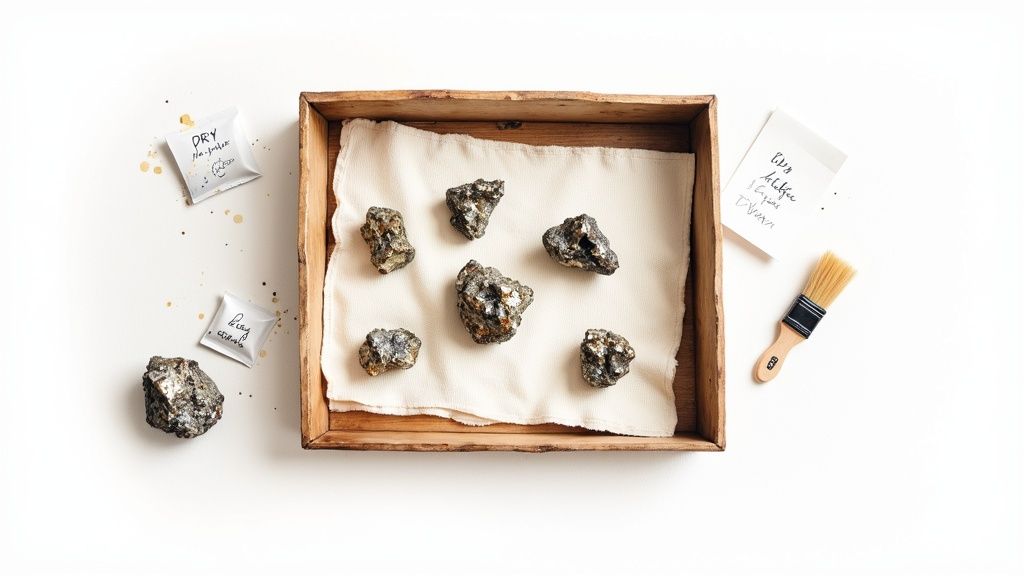
The whole game when preserving pyrite is controlling its environment. Dryness is your number one priority. Keeping your specimen in a stable, low-humidity setting stops oxidation dead in its tracks.
Use an Enclosure: Keep your pyrite inside a closed container. For serious collectors, a specialized rock collection display case is perfect because it seals out ambient moisture.
Add a Desiccant: Toss a silica gel packet inside the container with your pyrite. These little packets are brilliant at soaking up any moisture that gets trapped inside, keeping the air around your specimen perfectly dry.
Avoid Damp Areas: Never, ever store your pyrite collection in a basement, bathroom, or any other part of your home that gets damp. A bookshelf in a climate-controlled room is a much safer bet.
Cleaning and Handling Tips
When it comes to cleaning, less is definitely more. The golden rule is to never use water or liquid chemical cleaners on your pyrite. Adding moisture is the fastest way to kickstart the very decay you're trying to avoid.
All you need is a soft, completely dry brush—a paintbrush or a clean makeup brush works great—to gently dust off your specimens. That's usually all it takes to keep them looking sharp.
If you have pyrite jewelry, store the pieces separately in a soft cloth or a lined jewelry box. This prevents the relatively hard pyrite from scratching up any of your softer gemstones.
By following these simple steps, you can ensure your rock pyrite remains a stunning and stable part of your collection for years, preserving the natural beauty that took millions of years to form.
A Smart Buyer's Guide to Pyrite
So, you're ready to add some pyrite to your collection? Fantastic. Shopping for this mineral is a ton of fun, but knowing a few key things will ensure you bring home a piece you'll love for years. The best specimens are the ones that really show off pyrite's signature geometric personality.
What you want to look for are sharp, well-defined crystal shapes—whether that's a perfect cube, a complex octahedron, or an intricate cluster of interlocking crystals. A bright, brassy metallic shine is another telltale sign of a quality piece. And of course, check for damage. While a few minor nicks are expected with natural minerals, try to find a specimen with crisp edges and clean faces.
Evaluating Different Forms and Sellers
Pyrite shows up in all sorts of forms, each with its own vibe. You might find a raw, natural cluster bristling with crystals, a single smooth and polished tumbled stone, or even a faceted piece sparkling in a piece of jewelry. Think about what style speaks to you and how you plan to display or use it.
When you're ready to make a purchase, always look for reputable sellers. This could be your local mineral shop, a weekend gem and mineral show, or a trusted online dealer. Don't be shy—ask them questions to get a feel for the specimen’s quality and where it came from.
A good seller should be able to tell you where their pyrite was mined. This little bit of information adds to the specimen's story and is often a good indicator of its authenticity and overall quality.
It also helps to have a little context about the global market. Trade data shows which countries are major players in the pyrite game. According to recent market analysis, China, Russia, and Finland are among the top producers. Knowing details like this can give you a better appreciation for the specimens you come across. If you want to dive deeper, you can learn more about the global distribution of pyrite and become an even more informed buyer. With this knowledge in your back pocket, you can confidently pick out the perfect piece of rock pyrite.
Common Questions About Pyrite
Even after getting familiar with pyrite, a few questions almost always pop up for new collectors. Let's tackle some of the most common curiosities to round out your understanding of this incredible mineral.
Is Pyrite Dangerous to Handle?
For the most part, a solid, stable piece of pyrite is perfectly safe to handle. The main thing to be aware of is something called "pyrite decay," which happens when the mineral reacts with moisture and oxygen in the air. This reaction can create a mild sulfuric acid, which is exactly why keeping your specimens dry is so important.
While a quick touch of a stable piece is harmless, it’s always good practice to wash your hands after handling any mineral. And it definitely should never be ingested, so keep it well away from curious pets and small children. If you're planning to cut or grind pyrite for any reason, be sure to use proper ventilation and a respiratory mask to avoid breathing in any dust.
Can Pyrite Actually Create Sparks?
Yes, it absolutely can! This is actually how it got its name. The word pyrite comes from the Greek word pyr, which means "fire." When you strike a piece of pyrite firmly against a hard material like steel, you’ll see visible sparks fly.
This unique trait was famously used to ignite gunpowder in early firearms like wheellock rifles. While your specimen isn't going to spontaneously combust on your shelf, its ability to generate sparks is one of its most defining and historically significant features.
Does Pyrite Have Metaphysical Properties?
In many spiritual and metaphysical circles, pyrite is a big deal. It’s often seen as a powerful stone for protection, willpower, and attracting abundance. Many practitioners call it a stone of manifestation, believing it helps ground your energy and turn ambitious ideas into concrete reality.
Pyrite is frequently linked to the solar plexus chakra, connecting it to personal power, confidence, vitality, and assertiveness. These properties aren't scientifically proven, of course, but they are a huge part of pyrite's cultural appeal and what draws many collectors to it.
Why Do Some Pyrite Specimens Tarnish or Crumble?
This unfortunate process is often called "pyrite disease" or decay. It happens when a specimen is kept in a place with high humidity, triggering an oxidation reaction. This chemical breakdown creates iron sulfates and sulfuric acid, which often show up as a white or yellowish powder. Over time, this can cause the entire mineral to crack and fall apart.
The best defense is good storage. Always keep your pyrite in a dry, stable environment to prevent this from happening. Using a sealed display case with a desiccant packet, like silica gel, is a fantastic way to absorb any moisture in the air and protect your collection for years to come.
At Astro West, we believe every mineral tells a story. From perfectly formed pyrite cubes to ancient fossils, our collection is curated to inspire wonder and help you build a collection you'll treasure for a lifetime. Explore our ethically sourced specimens and find your own piece of natural history today. Visit us at https://astrowest.com.