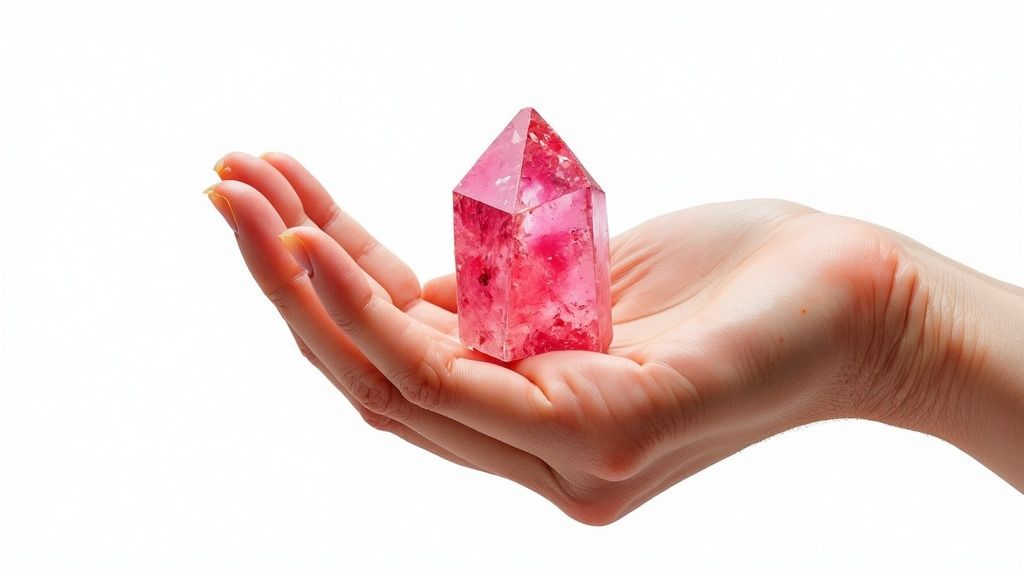
When you hear the name "calcite," you might think of a common, often white or clear mineral. But what happens when nature adds a secret ingredient? You get Manganoan Calcite—a special variety that glows with a soft pink hue and comes alive under UV light.
This unique mineral is essentially standard calcite that has been infused with the element manganese, completely transforming its appearance and properties.
Uncovering the Secrets of Manganoan Calcite
Think of it like this: regular calcite is the plain canvas. It’s made of calcium carbonate (CaCO₃), one of the most abundant minerals on the planet. By itself, it’s a fundamental building block of the Earth's crust. If you're curious about the basics, you can learn more about the foundational properties of calcite here.
But during this mineral's formation, a little bit of atomic magic happens. A small amount of manganese (Mn) gets mixed in, and some of its atoms take the place of calcium atoms within the crystal structure. This simple substitution is all it takes to turn common calcite into the sought-after pink gem we know and love.
The Chemical Recipe for Pink
Chemists and mineralogists write the formula for Manganoan Calcite as (Ca,Mn)CO₃. This little bit of notation tells the whole story: while calcium (Ca) is the main ingredient, manganese (Mn) is right there in the mix, sharing the same spot in the crystal lattice.
The amount of manganese isn't huge, typically ranging from just 1% to 10% by weight. But that small percentage is everything. It’s directly responsible for the depth of the pink color and the intensity of its fluorescent glow. While standard calcite has countless industrial uses, Manganoan Calcite is prized almost exclusively for its stunning looks.
Key Characteristics at a Glance
So, what are the defining features this manganese infusion creates? It boils down to a few key traits that make it easy to spot.
Signature Pink Color: The shade can be anything from a pale, baby pink to a deep, vibrant rose, all depending on how much manganese is present.
Strong Fluorescence: This is its party trick. Under a longwave ultraviolet (UV) light, most specimens light up with a brilliant pinkish-red glow. It's an unmistakable tell.
Rhombohedral Cleavage: Like all calcite, it breaks along smooth, flat planes, creating distinctive rhombus or "diamond-like" shapes when it fractures.
This unique combination of soft pink hues by day and a hidden fiery glow by night makes Manganoan Calcite a true standout in any mineral collection. It’s a perfect example of how a tiny chemical tweak in nature can create something extraordinary.
Getting a handle on these basics is the first step for any collector. It sets the stage for understanding how this mineral forms, how to identify it with confidence, and ultimately, what makes one piece more valuable than another.
How This Pink Gem Forms Inside the Earth
The story of Manganoan Calcite begins deep inside our planet, a process driven by intense heat, immense pressure, and mineral-packed water. This gorgeous pink gem doesn’t just pop into existence; it’s the product of a fascinating geological recipe called hydrothermal formation, the very same process responsible for many of the world's most incredible mineral specimens.
It all starts with superheated water, a potent brew rich with dissolved minerals like calcium and manganese. This isn't your everyday tap water. Think of it as a high-temperature, high-pressure delivery system, forcing its way through cracks and voids in existing rock formations. As this mineral-rich solution travels and finds open space, it begins to cool.
That cooling is the magic trigger. To picture it, just think about making rock candy at home. You dissolve a ton of sugar in hot water, creating what's called a supersaturated solution. As that water cools, it can no longer hold all the sugar, which starts to crystallize onto a string. The birth of Manganoan Calcite works on a very similar principle.
The Hydrothermal Vein Recipe
Those mineral-rich fluids are the sugar water, and the walls of the rock fractures act as the string. As the superheated liquid cools, the dissolved calcium, carbonate, and manganese ions fall out of the solution, slowly but surely building up layer after layer of crystalline Manganoan Calcite.
This isn’t a quick process—it can take thousands, or even millions, of years. The final look of the crystal comes down to a few key ingredients:
Temperature and Pressure: The specific conditions deep underground control how fast the crystals grow and how big they can get.
Manganese Concentration: The amount of manganese in that hydrothermal soup directly determines how deep and vibrant the final pink color will be.
Host Rock Composition: The type of rock the fluids are flowing through can also tweak the final mineral's chemistry and appearance.
You’ll most often find these crystals growing in veins that cut through various rock types. For a more detailed look at the geological processes involved, academic resources like Mindat.org provide in-depth information on mineral formation environments.
Global Hotspots for Manganoan Calcite
While calcite itself is pretty common, the unique conditions needed to cook up top-tier Manganoan Calcite are much rarer. This is why certain places around the globe have become legendary among collectors for producing truly spectacular pieces. Each location has its own geological fingerprint that shapes the crystal's color, clarity, and form.
The specific origin, or "provenance," of a Manganoan Calcite specimen tells a story about its formation, connecting it to a unique set of geological events that happened millions of years ago.
For instance, mines in Peru are famous for churning out some of the most sought-after specimens on the market, often showing off a deep, luscious pink and perfectly formed rhombohedral crystals. In the same way, deposits in China and Mexico are known for yielding stunning clusters with incredible luster and a powerful fluorescent glow. These world-class spots are the perfect storm of the right chemistry and geology, making them true hotbeds for this captivating pink gem. Knowing this backstory adds a whole new level of appreciation for every single piece.
Identifying Manganoan Calcite with Confidence
Ready to sharpen your identification skills? Telling authentic manganoan calcite from its look-alikes can feel tricky, but its true identity is revealed through a few key characteristics. By learning to recognize its signature traits, you can confidently spot this beautiful mineral, whether you're browsing a rock show or eyeing a new addition to your collection.
The whole process is much simpler than you might think. It really just comes down to looking for three big clues: its unmistakable pink color, the way it breaks, and its secret glowing superpower.
The Three Telltale Signs of Manganoan Calcite
Mastering identification is all about training your eye to spot a specific combo of features. Sure, other minerals might share one or two of these traits, but it's the full package that confirms you're holding the real deal.
Signature Pink Color: The most obvious clue is its beautiful pink hue, which can run anywhere from a very pale, almost white-pink to a rich, deep rose. This color is a direct result of the manganese content laced into its crystal structure.
Perfect Rhombohedral Cleavage: Like all its calcite cousins, it has what’s known as perfect rhombohedral cleavage. This just means it breaks along smooth, flat planes that are angled to form rhombus shapes—think of a tilted square. You can often spot these clean, angular fractures even on a raw, unpolished specimen.
Brilliant Fluorescence: This is the showstopper and the definitive test. When you put it under a longwave ultraviolet (UV) light, most manganoan calcite will fluoresce, throwing off a stunning, vibrant pinkish-red glow. This awesome reaction is caused by the manganese atoms absorbing UV energy and re-emitting it as visible light.
This visual guide breaks down the typical conditions required for this unique mineral to form, highlighting just how crucial both hydrothermal fluids and manganese are to the process.
As the infographic shows, you simply can't get manganoan calcite to crystallize without both of those elements in the mix.
Avoiding Common Mix-Ups
Because of its pink color, manganoan calcite is often confused with other popular minerals like Rhodochrosite and Rose Quartz. While they might look similar at first glance, a closer look reveals clear differences that are easy to spot once you know what to look for. For anyone new to collecting, learning to tell different minerals apart is a fundamental skill—for instance, you can dive into a helpful comparison in our guide on the differences between calcite and quartz.
To make it even easier, here’s a quick rundown of what sets these three pink look-alikes apart.
Manganoan Calcite vs Similar Pink Minerals
This table is a handy cheat sheet for telling Manganoan Calcite from two of its most common doppelgängers, Rhodochrosite and Rose Quartz. Focus on these key properties, and you'll be able to tell them apart in no time.
Property
Manganoan Calcite
Rhodochrosite
Rose Quartz
Color
Pale to deep pink, often uniform or banded.
Bright pink to red, often with white bands.
Soft, gentle pink, can be slightly hazy or cloudy.
Cleavage
Perfect rhombohedral (breaks in rhombus shapes).
Perfect rhombohedral, similar to calcite.
None (conchoidal fracture, breaks like glass).
Fluorescence
Strong pink-red under longwave UV light.
Does not typically fluoresce.
May show a very faint, pale pink fluorescence.
Hardness
Soft (Mohs scale: 3). Can be scratched by a copper coin.
Relatively soft (Mohs scale: 3.5–4).
Hard (Mohs scale: 7). Will easily scratch steel.
Reaction to Acid
Fizzes vigorously in dilute acid (like vinegar).
Fizzes in warm acid.
No reaction to acid.
The most reliable, and totally non-destructive, way to distinguish manganoan calcite is with a UV light. That intense, almost neon-pink glow is its undeniable signature, setting it apart from nearly all its common look-alikes.
By using this table and focusing on fluorescence and hardness, you can quickly and accurately identify your specimens. A simple hardness test (seeing if it can be scratched by a steel knife) or a quick check with a UV lamp can instantly solve most cases of mistaken identity. This kind of practical knowledge is what lets you build a collection with confidence, knowing exactly what treasures you have.
Understanding the Value of Your Specimens
Unlike minerals that get scooped up for both industrial and aesthetic reasons, manganoan calcite’s value is all about its looks. Its worth in the collector's market is driven almost entirely by its beauty and how rare it is. This means its value isn't tied to manufacturing or tech—it's determined by how much it captivates the human eye. Valuing a specimen is as much an art as it is a science, focused on a specific set of visual traits that collectors go wild for.
Several key factors come together to determine a specimen's market price. Think of it like grading a diamond; collectors are looking for that perfect storm of exceptional qualities. A piece that knocks it out of the park in just one area might be nice, but a specimen that checks all the boxes becomes truly special and valuable.
The Four Pillars of Value
When you're sizing up a piece of manganoan calcite, experts and collectors are zeroing in on four main things. Getting a handle on these will give you a solid framework for evaluating any specimen you come across, whether it's a small tumbled stone or a huge, museum-worthy cluster.
Color Richness: The single biggest driver of value is color. While any shade of pink is lovely, the specimens that really turn heads boast a deep, saturated rose-pink hue. Lighter pinks are more common and generally less pricey, but that vibrant, intense coloration is what really commands a premium.
Crystal Quality and Form: Sharp, well-defined crystals are way more valuable than indistinct, massive forms. Collectors are on the hunt for those textbook rhombohedral shapes with clean edges and smooth faces. The closer to a perfect crystal structure you get, the higher the price tag.
Clarity and Luster: Clarity is all about how transparent the crystals are. Manganoan calcite is rarely perfectly clear, but specimens with good translucence that let light shine through are highly prized. A bright, glassy luster also adds a major boost to a piece's appeal.
Fluorescence Intensity: You can't overstate the "wow" factor of its UV-reactive glow. Specimens that light up with a brilliant, uniform, and intense pinkish-red fluorescence under longwave UV light are considered top-tier. A weak or spotty glow will definitely knock the value down a few pegs.
These four pillars work together, creating a specimen's overall appeal and what it’s ultimately worth on the market.
Provenance: The Story Behind the Stone
Beyond its physical traits, a specimen's origin—its provenance—can play a massive role in its value. It’s just like a rare vintage wine from a famous vineyard; a manganoan calcite from a classic or depleted mine is often worth more. Mines in places like Peru, which are known for producing absolutely exceptional quality, carry a certain prestige among collectors.
A specimen's label isn't just a location; it's a piece of its history. Collectors often pay more for minerals from well-documented localities, especially those that are no longer producing, as it guarantees a finite supply.
This bit of history adds a layer of rarity and desirability that can elevate a piece far beyond just its good looks.
Navigating Market Prices
The market for fine minerals is always shifting, with prices that can be all over the map. Small, tumbled pieces or minor specimens can be super affordable, while large, high-quality clusters with stunning color and crystal form can fetch thousands of dollars. The demand for manganoan calcite has been growing steadily, particularly in the United States and Europe. The average price for high-quality specimens can range from $100 to $800 per kilogram, depending on crystal size, color intensity, and where it came from. In fact, some market analyses report that since 2018, online sales of manganoan calcite specimens have been growing by about 15% annually. You can discover more insights about the calcite market to see how these trends are shaping what collectors are looking for. By understanding these value factors, you can make smarter decisions when you’re buying, selling, or just admiring the treasures in your collection.
Owning a piece of manganoan calcite is like holding a delicate slice of natural art. While its cotton-candy pink glow is mesmerizing, this mineral is also quite soft and fragile. Taking care of it properly isn't just a good idea—it's essential to protect your investment and keep it looking pristine for years.
The first step is simply understanding its delicate nature. Manganoan calcite sits at a soft 3 on the Mohs scale, which means everyday objects like a steel knife or even a copper penny can easily scratch it. It also has what’s called perfect rhombohedral cleavage. In simple terms, it's prone to splitting along its natural internal planes if it's dropped or knocked, so always handle it with care.
Safe and Simple Cleaning Steps
You don’t need any harsh chemicals or fancy equipment to clean your manganoan calcite. In fact, the gentler you are, the better. Dust and fingerprints can easily dull its beautiful luster, but a quick, dry clean is usually all it takes to bring back that shine.
Just follow these easy steps:
Grab a Soft Brush: Start by gently whisking away any loose dust with a soft-bristled brush. Something like a clean makeup brush or a small paintbrush works perfectly.
Use a Dry Cloth: For fingerprints or minor smudges, a dry, lint-free microfiber cloth is your best friend. Just a gentle wipe is all you need.
Spot Clean with Caution: If you absolutely must use water, dampen a tiny corner of the cloth, wring it out completely, and very lightly dab the spot. Follow up immediately with a dry cloth to remove any moisture.
It's absolutely critical to avoid soaking your specimen in water. As a carbonate mineral, calcite reacts to prolonged water exposure. The surface can become dull, etched, or even start to dissolve over time, causing permanent damage.
On that same note, stay far away from ultrasonic cleaners and harsh chemicals. Soaps, detergents, and anything acidic (like vinegar) will react with the calcite and ruin its surface. When it comes to cleaning, less is definitely more.
Best Practices for Storage and Display
How you store and show off your manganoan calcite is just as important as how you clean it. The right environment protects it from physical damage and other factors that can cause it to fade or degrade.
Keep these key tips in mind when finding a home for your specimens:
Separate and Protect: Never store manganoan calcite next to harder minerals like quartz or fluorite—they will scratch it without a second thought. It's best to keep each piece in its own soft-lined box or wrapped in a soft cloth.
Avoid Direct Sunlight: Just like a prized photograph, the vibrant pink color of manganoan calcite can fade with long-term exposure to direct sunlight. Display your collection in a spot that gets indirect light to keep that beautiful hue alive.
Maintain Stable Conditions: Drastic temperature swings or high humidity can stress the crystal's structure. Find a spot in your home with a stable, dry environment.
For long-term storage or transport, you might even consider using protective films like shrink wrap or stretch wrap on individual pieces to keep dust off and prevent minor bumps. A few simple habits are all it takes to ensure your cherished collection remains as stunning as the day you got it.
Displaying Manganoan Calcite in Your Home
Your manganoan calcite collection is more than just a box of rocks; it's a trove of natural art just waiting to be shown off. Moving your specimens from a dusty drawer to a thoughtful display can transform any room, adding a touch of geological wonder and organic beauty. The trick is to treat each piece not as just a mineral, but as a one-of-a-kind sculpture carved by the Earth itself.
When you go beyond simply lining them up on a shelf, the unique character of each specimen really starts to shine. With a little creativity, you can turn your collection into a captivating focal point that highlights the mineral's delicate pink hue and incredible crystal structures.
Creating an Elegant Mineral Showcase
First things first: think like a curator. Instead of scattering your pieces around the house, group them together to create a cohesive and visually striking arrangement. A dedicated mineral shelf or a well-lit curio cabinet provides the perfect stage for your manganoan calcite.
Here are a few foundational ideas to create an impactful display:
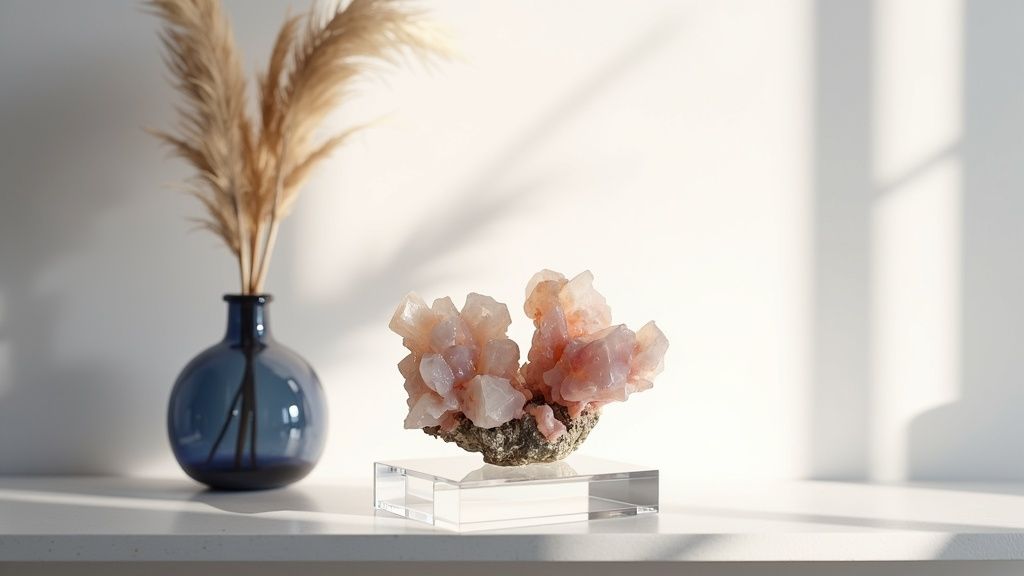
Elevate with Stands: A simple, clear acrylic stand or a minimalist metal holder can make a world of difference. Elevating a specimen gives it a sense of importance and allows light to pass through any translucent areas, making its color even richer.
Play with Contrast: Place your soft pink calcite against a dark background, like a deep gray or navy blue wall. The contrast makes that delicate color pop, immediately drawing the eye to your prized pieces.
Feature a Statement Piece: Got a particularly large or beautifully formed cluster? Don't let it get lost in the crowd. Position it as a standalone natural sculpture on a mantle, side table, or pedestal where it can be admired from all angles.
By thoughtfully arranging your collection, you’re creating a visual narrative that tells the story of your passion for natural history. For more inspiration on stylishly integrating minerals into your space, check out these creative tips on how to display crystals.
To add a professional touch, consider labeling your best specimens. This not only educates curious guests but also documents the piece's origin and significance for your own records. To really elevate your showcase, you can add custom laser engraved plaques that offer detailed information.
Unveiling the Hidden Glow
The most magical thing about manganoan calcite is its brilliant fluorescence. Honestly, no display is complete without revealing this hidden feature. Setting up a UV display is surprisingly easy and creates a dramatic effect that will mesmerize anyone who sees it.
The secret is using the right kind of light. Manganoan calcite puts on its best show under longwave UV light, often labeled as UV-A. You don't need expensive, lab-grade equipment for this—affordable handheld longwave UV flashlights or small UV light bars designed for displays are easy to find online.
To create an unforgettable fluorescent display:
Choose a Dark Location: The glow is most dramatic in a dimly lit or completely dark spot. A cabinet with its own internal lighting or a dedicated shelf away from bright windows is perfect.
Position the Light Source: Install a UV light bar above or in front of your specimens. If you're using a handheld light, you can create a fun "reveal" moment for guests, shining it on the collection to activate its fiery glow.
Ensure Safety: While longwave UV is generally safer than shortwave, you should still avoid shining the light directly into anyone's eyes.
By adding a UV light, you transform your collection from a static display into an interactive experience. It’s the final touch that truly celebrates the dual personality of manganoan calcite—beautiful by day, and absolutely breathtaking by night.
Your Manganoan Calcite Questions, Answered
As you get more familiar with manganoan calcite, a few questions tend to bubble up. Let's tackle some of the most common ones to clear up any lingering confusion about this gorgeous pink stone.
Is Manganoan Calcite Just Another Name for Pink Calcite?
This is a great question and a frequent point of mix-up. The short answer is no, but it's a bit more nuanced than that.
Think of it this way: while all Manganoan Calcite is a type of Pink Calcite, not all Pink Calcite is manganoan. "Pink Calcite" is a broad, catch-all term for any calcite with a pinkish tone. That color can come from different things, like tiny specks of hematite mixed in.
True Manganoan Calcite, on the other hand, gets its signature cotton-candy pink and its fantastic fluorescence specifically from manganese atoms woven into its crystal structure. The real giveaway is the UV test—if it glows with a brilliant pinkish-red light, you've got the real deal.
Can You Wear Manganoan Calcite as Jewelry?
It's not a good idea for anything you'd wear daily. Manganoan Calcite is a very soft mineral, ranking only a 3 on the Mohs hardness scale. That means it's incredibly easy to scratch, scuff, or chip just from normal activity.
Beyond its softness, it has what’s called "perfect cleavage," meaning it can split cleanly along its internal crystal planes if it gets a sharp knock. While you might see it in a very protected pendant, it’s far too delicate for rings or bracelets. Those pieces take too much of a beating, and you'd risk irreversible damage.
When it comes to jewelry, durability is everything. Manganoan Calcite’s softness and tendency to cleave make it an absolutely stunning display piece but a risky choice for accessories meant to handle the bumps of everyday life.
My Manganoan Calcite Doesn't Glow Under UV Light. What's Wrong?
Don't panic! If your piece isn't lighting up under a blacklight, there are a couple of likely culprits. First off, the intensity of the glow in Manganoan Calcite can vary wildly from one specimen to the next.
The fluorescence is triggered by manganese atoms (the "activator"), but other elements—especially iron—can crash the party. Iron acts as a "quencher," which basically dampens or completely shuts down the fluorescent effect. So, your specimen might have enough manganese to look pink but also too much iron to properly glow.
It’s also really important to make sure you're using the right kind of UV light. Manganoan Calcite puts on its best show under longwave UV radiation (UV-A). If you’re using a shortwave UV light, you just won't see that famous brilliant glow you're looking for.
At Astro West, we believe every mineral has a story to tell. From its creation deep within the Earth to the spot it will hold in your home, Manganoan Calcite is a perfect example of nature's artistry. We invite you to explore our carefully chosen collection of authentic, high-quality specimens, each selected for its own unique beauty and personality. Discover your next treasure with us.