calcite calcite: Your Essential Guide to This Common Mineral
At its core, calcite is one of Earth's most common and vital minerals—a simple compound called calcium carbonate (CaCO₃). This is the very same stuff that makes up everyday materials like chalk, the tough shells of sea creatures, and even shimmering pearls. You can think of it as nature’s go-to building block, responsible for creating the vast geological formations that literally shape our world.
The Foundation of Our Planet
Calcite is far more than just another rock. It’s a cornerstone of geology and a hidden ingredient in countless parts of our daily lives. From the majestic marble halls of ancient buildings to the towering limestone cliffs lining our coasts, calcite’s presence is both powerful and everywhere.
To really get a feel for calcite, it helps to picture its unique internal structure. Imagine stacking countless microscopic boxes, each one perfectly slanted. This shape, known as a rhombohedron, is one of the most recognizable features of calcite crystals. This specific atomic layout isn’t just a visual quirk; it’s what gives the mineral so many of its distinct physical and optical properties, which we’ll get into later. For more cool tidbits, you can explore some general facts about minerals.
A Tale of Two Crystals
One of the most fascinating things about calcite is its relationship with another mineral: aragonite. Both are made of the exact same chemical formula—calcium carbonate—but they have completely different crystal structures. This phenomenon is called polymorphism, which makes them “polymorphs” of one another.
A simple way to think about this is to compare graphite and diamond. Both are made purely of carbon, but how those atoms are arranged makes one soft and gray (graphite) and the other incredibly hard and brilliant (diamond). In the same way, calcite and aragonite are chemical twins with totally different personalities, each formed under unique geological conditions of temperature and pressure.
Calcite's Economic Importance
Beyond its natural beauty and role in geology, calcite is an absolute workhorse in the industrial world. Its uses are incredibly widespread, from construction to manufacturing, and its economic impact is massive.
According to market research, the coarse calcite segment, which includes limestone and ground calcium carbonate products, is a major economic driver. Its market valuation has grown from approximately USD 8.66 billion to an expected USD 9.11 billion, reflecting a steady growth rate. This segment is essential for industries producing paints, plastics, and especially cement and concrete.
This growth is directly tied to construction happening all over the globe, especially in major markets across Asia, North America, and Europe. As new buildings, roads, and infrastructure go up, the demand for calcite continues to climb, cementing its place as a critical industrial material.
Identifying Calcite in the Real World
Spotting calcite among other minerals might seem tricky at first, but a few distinctive traits make it surprisingly easy to identify, even without any fancy lab equipment. Once you know what to look for, you'll be able to confidently pick it out of a lineup. We’ll walk through three simple, hands-on tests that reveal calcite’s true identity.
These tests key in on calcite's unique physical and optical properties. We're talking about its predictable breakage pattern, its relative softness, and a fascinating optical trick it performs with light. Master these identification methods, and you’ll have the practical skills to recognize calcite wherever you find it.
The Unmistakable Cleavage of Calcite
One of the most reliable giveaways for calcite is its perfect rhombohedral cleavage. In simple terms, this means that when calcite breaks, it splits along smooth, flat planes that aren't squared up like a cube. Instead, they form a slanted, rhombus-like shape, often just called a "rhomb."
Think of it like trying to break a perfectly layered pastry—it will always want to split along those layers. Calcite does the same thing on a crystalline level, breaking cleanly along its internal planes of weakness. This property is so consistent that even tiny, shattered fragments of calcite will often show this classic shape.
Testing for Softness
Another key trait is its softness. Geologists rank minerals on the Mohs hardness scale, which runs from 1 (the softest) to 10 (the hardest). Calcite lands squarely at a 3 on this scale, making it a relatively soft mineral.
This softness gives us a simple way to test it against common look-alikes. For example, a copper penny has a hardness of about 3.5, which means it will easily leave a scratch on a piece of calcite. On the other hand, quartz—which is often confused with calcite—has a hardness of 7 and will effortlessly scratch a penny or even glass. For a deeper dive into telling these two apart, check out our guide comparing calcite and quartz.
Here's a quick rundown of simple field tests for hardness:
Fingernail: Your fingernail is about a 2.5 on the hardness scale, so it will not scratch calcite.
Copper Penny: A penny (hardness ~3.5) will scratch calcite.
Steel Nail: A steel nail (hardness ~5.5) will easily scratch calcite.
This quick check is often one of the first things mineral collectors do to narrow down the possibilities. If a mineral gets scratched by a penny but not by your fingernail, calcite becomes a very strong suspect.
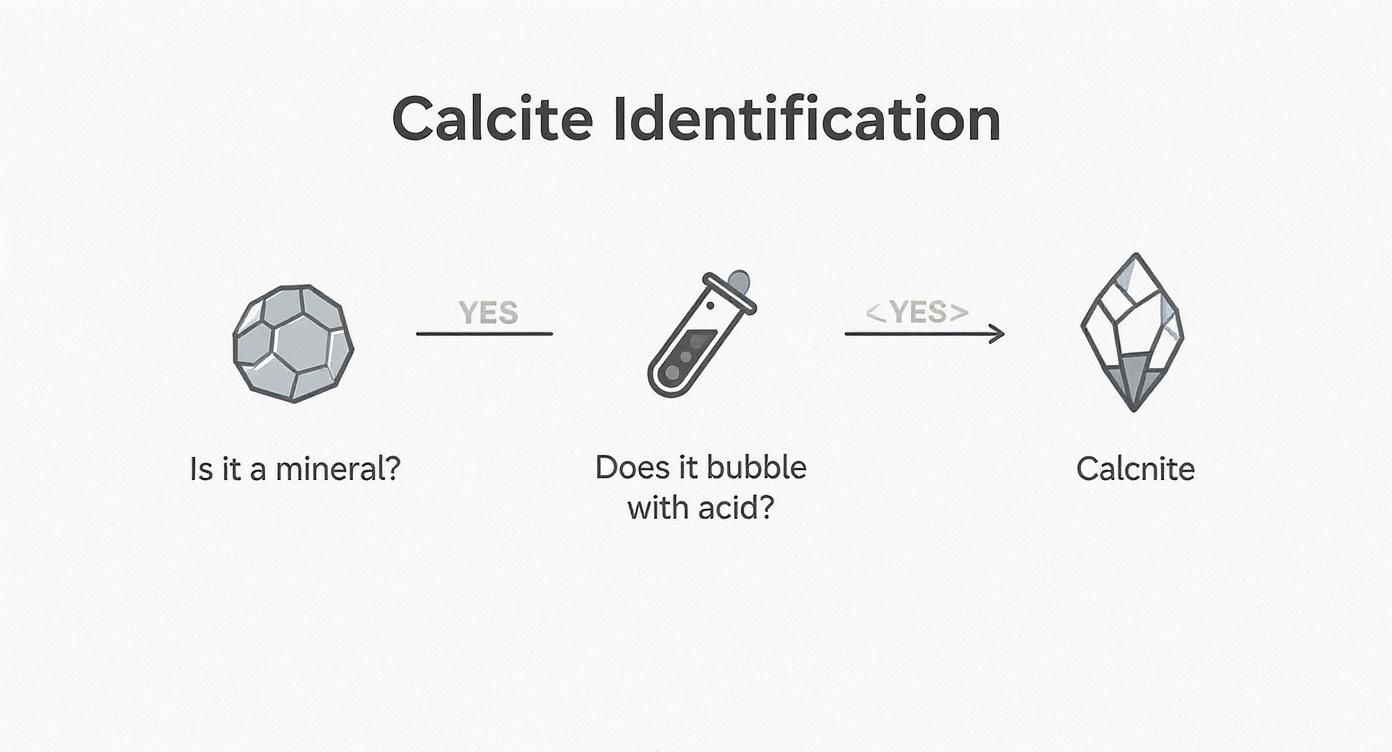
The chart below shows a simple decision tree for identification, highlighting another key test—its reaction to acid.
As the visual guide shows, the acid test is a dead giveaway. Calcite will visibly bubble or fizz when it comes into contact with a mild acid, making it a definitive way to confirm you’ve found the real deal.
The Magic of Double Refraction
Perhaps the most fascinating property of calcite is double refraction, also known as birefringence. This cool optical phenomenon is most famously seen in the clear, glassy variety of calcite called Iceland Spar.
When you place a clear piece of Iceland Spar over some text, something amazing happens: the light passing through the crystal splits into two separate rays. This split makes you see a double image of whatever is underneath it.
This isn't just a neat visual trick; it's a fundamental property rooted in calcite's crystal structure. The way light is forced to travel through its rhombohedral lattice makes it divide, creating two distinct images that are perfectly offset from one another.
This property was incredibly important historically, playing a role in the development of scientific tools like early polarizing microscopes. For collectors today, it remains one of the most exciting and definitive tests for transparent calcite. If you can see double through it, you're almost certainly looking at calcite.
Exploring the Diverse Family of Calcite
While "calcite" might sound like a single mineral, it's really the head of a large and incredibly varied family. Think of it less as one specific stone and more as a basic recipe that nature tweaks to create a stunning spectrum of colors and forms. These variations aren't random—they're the direct result of tiny amounts of other elements that get mixed into the crystal structure as it grows.
It’s a bit like a baker adding different ingredients to the same dough to create everything from a plain loaf to a cinnamon roll. A little bit of iron or manganese in the fundamental calcium carbonate recipe can completely change the final product. The result is a dazzling lineup of calcite specimens, each with its own look and personality.
Optical Calcite: The Master of Light
Perhaps the most famous member of the calcite family is Optical Calcite, known historically as Iceland Spar. This variety is prized for its exceptional transparency and glass-like clarity, which really lets its unique optical properties shine.
This is the calcite that most vividly shows off the phenomenon of double refraction we talked about earlier. Its wild ability to split a beam of light into two made it scientifically priceless for centuries, playing a key role in early optical instruments. Today, it remains a collector favorite for its water-clear look and the mind-bending visual trick it performs right before your eyes.
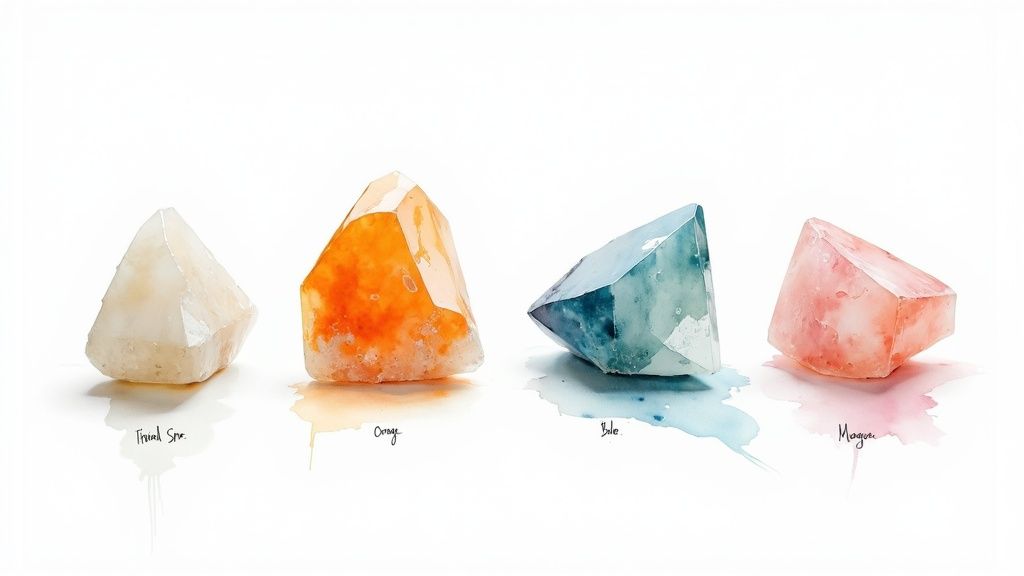
Orange and Blue Calcite: Hues from Within
The world of calcite really comes alive with color, and two of the most popular varieties are orange and blue. These warm and cool tones aren’t from a dye; they’re caused by microscopic inclusions trapped within the crystal as it formed.
Orange Calcite: This vibrant, sunny variety gets its cheerful hue from tiny, scattered particles of hematite (an iron oxide). The more inclusions, the deeper the color, giving us everything from a pale peach to a rich, deep orange. You'll often find it in massive, waxy forms that are perfect for carving.
Blue Calcite: Known for its gentle, calming shades of sky or sea, this variety is a go-to for home décor. Its tranquil color is usually caused by trace mineral impurities, often creating soft, beautiful bands and patterns.
Mangano Calcite: A Hidden Glow
At first glance, Mangano Calcite (sometimes called Manganocalcite) looks like a soft, unassuming pink mineral. It has a gentle, milky appearance that's beautiful in its own right, but its real magic is hidden.
Flip on an ultraviolet (UV) light, and Mangano Calcite erupts in a brilliant, hot-pink fluorescence. This incredible glow is caused by manganese, which acts as an "activator" inside the crystal. The UV energy excites the manganese ions, and they release that energy back as visible light, creating a stunning surprise. This hidden feature makes it a must-have for any collector who loves fluorescent minerals.
These distinct varieties often pop up alongside other minerals. If you're curious about telling them apart, you can learn more about how to identify calcite on quartz in our related guide.
The calcite family is a fantastic example of how tiny changes at the molecular level can produce dramatically different results. From the crystal-clear perfection of Iceland Spar to the secret glow of Mangano Calcite, each variety shows off another facet of this incredible mineral.
A Quick Guide to Common Calcite Varieties
To help you keep track, here's a simple table breaking down the key features of the calcite varieties we've just covered. It's a handy cheat sheet for quickly identifying what you might be looking at.
Variety Name
Primary Color
Key Identifying Feature
Common Association
Optical Calcite (Iceland Spar)
Colorless, Transparent
Extreme double refraction; water-clear clarity
Scientific instruments, optical demonstrations
Orange Calcite
Pale peach to deep orange
Waxy luster, often in massive form
Hematite inclusions, decorative carvings
Blue Calcite
Light to medium blue
Soft, banded patterns; calming appearance
Home décor, soothing aesthetics
Mangano Calcite
Opaque, light pink
Strong pink fluorescence under UV light
Manganese content, fluorescent mineral collections
This table just scratches the surface, but it's a great starting point for appreciating the sheer diversity packed into the calcite name.
How Calcite Powers Modern Industry
While collectors prize calcite for its breathtaking natural beauty, it's also one of the unsung heroes of the modern world. This humble mineral is an indispensable raw material that quietly powers dozens of industries. Thanks to its unique chemical and physical properties, calcite is a versatile and incredibly cost-effective ingredient in countless products we depend on every single day.
From the foundations of our cities to the paper in our notebooks, this abundant mineral plays a critical, often invisible, role in our lives. The sheer scale of its industrial use is staggering and shows just how important it is to the global economy.
In fact, credible sources estimate the global calcite market was valued at around USD 14.6 billion and is expected to climb to USD 21.2 billion by 2032. That's a steady growth rate of about 5.5% per year, driven by its endless applications in construction, paper, plastics, and paints.
The Foundation of Modern Construction
By far, the most significant use for calcite is in the construction industry, where it forms the literal backbone of our infrastructure. Calcite is the main mineral component of limestone, which is the essential ingredient for making cement.
The process is straightforward but transformative. When limestone is heated in a massive kiln, it undergoes a chemical change to create something called "clinker." This clinker is then ground into the fine powder we all recognize as cement. Add some water, sand, and gravel, and you've got concrete—the most widely used building material on Earth.
Every skyscraper, bridge, dam, and highway owes its strength and existence to the fundamental properties of calcite. Modern construction as we know it would be completely unimaginable without it.
Improving Everyday Products
Away from the construction site, finely ground calcite—often called ground calcium carbonate (GCC)—is a crucial additive in all sorts of manufacturing processes. It acts as a "functional filler," which is a fancy way of saying it enhances the properties of many consumer goods.
Here are just a few ways calcite makes everyday products better:
Paper Manufacturing: In the paper industry, GCC is used as a filler to make paper brighter, smoother, and more opaque. This not only results in a higher quality finish but also reduces the need for more expensive wood pulp.
Plastics and Polymers: Calcite adds rigidity, impact strength, and a smoother surface to plastics like PVC pipes, vinyl siding, and car parts. It also helps cut production costs by replacing pricier polymer resins.
Paints and Coatings: As an "extender" in paints, calcite improves the texture, controls the sheen, and boosts durability. Its natural brightness also means manufacturers can use less of the expensive white pigments, like titanium dioxide.
From Agriculture to Environmental Protection
Calcite's usefulness doesn't stop there. Its applications stretch into agriculture and environmental science, where its chemical makeup—calcium carbonate—provides some essential benefits. At its core, calcite is a natural base, which means it's excellent at neutralizing acids.
For centuries, farmers have used crushed limestone (calcite) to treat acidic soils in a practice known as liming. This simple process raises the soil's pH, which in turn unlocks critical nutrients for plants and improves crop yields. The calcite not only fixes the acidity but also gives plants a vital source of calcium.
In environmental work, calcite is a key player in remediation. It helps neutralize acidic wastewater from industrial sites and mines. It's also used in a process called flue-gas desulfurization to capture sulfur dioxide from power plant emissions, which helps reduce acid rain.
On top of all that, purified calcite is also used as a safe, natural dietary calcium supplement for both people and animals.
The journey of calcite from a simple mineral to an industrial powerhouse is a testament to its incredible utility. From massive limestone quarries, you can learn more about how this sedimentary rock is formed and used in our detailed guide.
Caring for Your Calcite Collection
Bringing calcite into your collection is like curating your own private gallery of natural art. As you start out, it helps to know what to look for so you can choose quality pieces that you'll be happy to display for years.
When you're picking out a new specimen, really take a moment to look at its unique character. For transparent varieties, you want good crystal clarity. In pieces like orange or blue calcite, look for a deep, vibrant color. And of course, check for damage. A few natural imperfections are part of the story, but try to steer clear of specimens with major chips or fractures that could threaten their stability.
Handling with Care
If there's one thing to remember about calcite, it's how soft it is. It's only a 3 on the Mohs hardness scale, which makes it a delicate mineral that can be scratched by just about anything harder than a fingernail.
Always handle your specimens gently to avoid accidents. Use two hands for larger pieces and keep them away from harder minerals in your collection, like quartz, which will easily leave a mark. It's also worth remembering that calcite has perfect cleavage—it loves to split cleanly along certain planes. A sharp knock from the wrong direction can cause a piece to break, so mindful handling is everything.
A good rule of thumb for any collector is to treat calcite with the same care you would give fine glassware. Its delicate nature is part of its charm, but it requires mindful handling to preserve its natural beauty and form.
Proper Cleaning Techniques
Keeping your calcite looking its best is surprisingly simple. You don't need harsh chemicals or complicated routines; in fact, the gentler you are, the better.
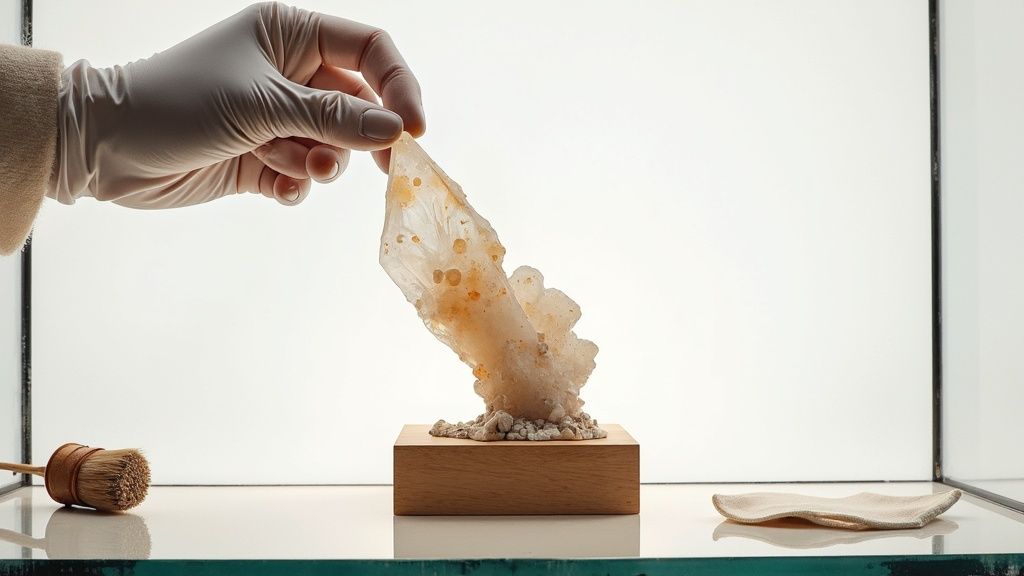
Most of the time, all your calcite will need is a light dusting with a soft, dry brush or a quick blast from a can of compressed air. If you find a piece needs a more thorough cleaning, just follow these simple steps:
Use Lukewarm Water: Grab a bowl and fill it with lukewarm water. Sudden temperature changes from hot or cold water can shock the crystal and cause it to fracture.
Add a Mild Soap: If necessary, a tiny drop of a very mild, non-abrasive soap will do the trick. A simple dish soap is a safe bet.
Wipe Gently: Use a soft cloth to gently wipe the surface. Don't scrub, as you risk damaging the delicate crystal faces.
Rinse and Dry Thoroughly: Run the specimen under lukewarm water to wash off any soap. Then, immediately pat it dry with a soft, lint-free cloth. Never let calcite air dry, or you'll be left with distracting water spots.
Creating the Perfect Display
This is the fun part—showing off your collection. A well-lit cabinet is a fantastic choice, protecting your pieces from dust while keeping them visible. But you'll want to be strategic about where that light comes from.
Many colored calcite varieties can fade if they sit in direct sunlight for too long. The sun's UV rays can bleach the trace elements that give specimens like blue or green calcite their gorgeous hues. To prevent this, keep your display away from windows or invest in a cabinet with UV-protective glass. It’s a simple step that will keep the colors of your calcite collection just as brilliant as the day you brought them home.
A Few Common Questions About Calcite
As you get more familiar with calcite, you’re bound to have a few questions pop up. It’s a mineral with some interesting cousins in the rock world and a few tricks up its sleeve. Let’s clear up some of the most common points of curiosity.
We'll tackle a few key comparisons and dive deeper into some of calcite’s more intriguing properties. Think of this as your quick-reference guide for those lingering "I wonder why…" moments.
How Can I Tell the Difference Between Calcite and Quartz?
This is a classic identification challenge! They can sometimes look alike, especially the clear varieties, but telling them apart is actually pretty easy once you know what to look for. A few simple hands-on tests will give you a confident answer in minutes.
The most reliable check is the hardness test. Quartz is tough stuff, ranking a 7 on the Mohs scale, which means it has no problem scratching glass. Calcite, on the other hand, is much softer with a hardness of only 3. A copper penny can easily leave a scratch on calcite, but it won't make a mark on quartz.
Next, look at how they break. Calcite has what's called perfect rhombohedral cleavage, which is a fancy way of saying it breaks along smooth, flat planes that form distinct rhombus shapes. Quartz is different; it has a conchoidal fracture, breaking with curved, shell-like surfaces just like a piece of chipped glass.
And for the definitive test? A drop of weak acid, even just household vinegar, will make calcite bubble and fizz as it releases carbon dioxide gas. Quartz is completely inert and won’t react at all.
Is Calcite the Same as Limestone and Marble?
Great question! This gets right to the heart of how minerals become rocks. They're all directly related, but they aren't the same. The short answer is that calcite is the mineral, while limestone and marble are the rocks built from that mineral.
Limestone: This is a sedimentary rock made almost entirely of calcite. It typically forms in marine environments from the compacted shells, coral, and other calcium carbonate-rich debris of ancient sea life.
Marble: This is what happens when limestone gets a major geological makeover. As a metamorphic rock, marble starts out as limestone. When it's subjected to intense heat and pressure deep in the Earth's crust, the calcite crystals inside it recrystallize and grow, creating that classic interlocking, often sparkly texture that defines marble.
You can think of calcite as the fundamental building block. Limestone is a large structure built from those blocks, and marble is what happens when that structure is intensely heated and squeezed into a new, more crystalline form.
So, while marble and limestone are made of calcite, they represent different chapters in the geological rock cycle.
Why Does Some Calcite Glow Under a UV Light?
That amazing glow is a phenomenon called fluorescence. It’s not something all calcite does, but when it happens, it's because of tiny impurities—geologists call them "activators"—tucked inside the mineral's crystal structure.
The most common activator in calcite is manganese. When ultraviolet (UV) light, which our eyes can't see, hits the mineral, it excites the electrons in these manganese atoms, bumping them to a higher energy level.
As the electrons immediately fall back to their normal, stable state, they have to release that extra energy. They do so by emitting visible light, which is the beautiful glow we get to see. The color of that glow—often a vibrant pink or red in calcite—depends on the type and amount of the activator present. Without those specific impurities, there's no hidden light to unlock.
Can Calcite Change Color or Fade Over Time?
Unfortunately, yes. Some colored varieties of calcite can lose their vibrancy if they're left in direct sunlight for too long. The beautiful colors in many specimens come from impurities or natural radiation exposure deep underground, and this coloration can be surprisingly sensitive to light.
The ultraviolet rays from the sun are highly energetic and can actually alter the chemical structure of these color centers in the calcite. Over time, this can cause a noticeable fade or, in some cases, make the color disappear entirely. Pink, green, and some blue calcites are especially known for being susceptible to this.
To keep your calcite collection looking its best, it's smart to display it away from windows that get a lot of direct sun. For any pieces you particularly cherish, a display cabinet with UV-protective glass is the best way to preserve their beautiful, natural colors for years to come.
At Astro West, we believe every mineral tells a unique story about our planet's history. Whether you are just starting your journey or are an experienced collector, we invite you to explore our carefully curated selection of calcite and other fine minerals. Discover your next natural treasure at https://astrowest.com.