A Rockhounder’s Guide to Finding Agates in Washington State
If you’re a rockhound, you already know Washington State is a world-class destination for finding agates. Its dramatic coastlines and volcanic interior serve up some of the best hunting grounds in the entire country. Thanks to its wild geologic past, you can find everything from wave-tumbled carnelians on Pacific beaches to intricate fortification agates deep in the mountains. This is where your next great adventure begins.
Why Washington Is an Agate Hunter's Paradise
The Evergreen State's reputation as a top-tier spot for agate hunting isn’t an accident; it’s written in the land itself. Millions of years of volcanic activity created the perfect storm for these beautiful stones to form.
Ancient lava flows left behind countless gas bubbles and cavities in the cooling basalt rock. Over millennia, silica-rich groundwater seeped into these empty pockets, slowly depositing microscopic quartz crystals, one delicate layer at a time. This patient process created the agates we find today, each one a unique snapshot of geological history.
The Thrill of the Hunt
What makes hunting for agates so addictive is the sheer variety of places you can look for them. It’s a hobby that gets you outside and connects you with nature in a truly hands-on way. You aren’t just hiking; you’re scanning the ground, training your eyes to spot the telltale waxy luster of a hidden gem among millions of ordinary rocks.
The real prize in rockhounding isn’t just the stone you pocket. It’s the story of how you found it—the rain-soaked beach walk, the sunny riverbank search, and that jolt of pure excitement when your eyes land on the perfect agate.
This guide will walk you through everything you need to start your own Washington agate adventure. We’ll cover the best locations, the tools you actually need, and tips for identifying your finds. We’ll also touch on the ethical practices that ensure this hobby is around for generations to come.
For those who appreciate seeing these raw stones transformed into art, you can see how master artisans shape them into stunning display pieces, like this hand-carved agate bowl from Madagascar.
From the rugged coastlines battered by winter storms to the forested riverbeds inland, Washington offers a dynamic and rewarding experience for every rockhound. Every tide and every rainstorm can reveal new treasures, meaning no two trips are ever the same. Get ready to explore the geological wonders waiting just beneath your feet.
Discovering Washington's Top Agate Hunting Hotspots
Washington State is a rockhound's paradise, a sprawling treasure map of agate locations, each with its own unique personality and geological story. Knowing where to look—and just as importantly, what to look for—is the secret to a successful hunt, whether you're scanning the wave-battered Pacific coastline or digging into the forested slopes of the Cascades.
The sheer diversity is your greatest advantage. The agates you'll find tumbled smooth on a coastal beach look completely different from the ones you might pry from a mountain quarry. Washington’s coast, especially the stretch from Cape Disappointment up to Shi Shi Beach, is legendary for producing some of the finest agates in the entire country.
It's no exaggeration. A comprehensive survey has documented more than 50 distinct agate collecting sites across the state, with well-known localities like Saddle Mountain and Walker Valley offering up agates alongside beautiful quartz and jasper. You can dive deeper into the state's mineral wealth through a detailed guide to mineral collecting in the Evergreen State.
To help you get started, here's a quick look at some of the best spots in the state.
Top Agate Hunting Locations in Washington State
Location
Region
Common Agate Types
Best Hunting Season
Damon Point
Coastal (Ocean Shores)
Carnelians, Clear Agates
Fall & Winter, after storms
Shi Shi Beach
Coastal (Olympic Peninsula)
Beach Agates, Jasper, Orbicular Agates
Fall & Winter, during low tides
Cape Disappointment
Coastal (SW Washington)
Carnelians, Fortification Agates
Fall & Winter, after storms
Walker Valley
Inland (Skagit County)
Thundereggs, Geodes, Amethyst
Spring & Fall, when ground is soft
Saddle Mountain
Inland (Mattawa Area)
Blue Agates, Petrified Wood
Spring & Fall, avoid summer heat
This table is just a starting point, of course. The real thrill comes from exploring these areas and discovering your own favorite corners of Washington's incredible landscape.
The Wild Pacific Coastline
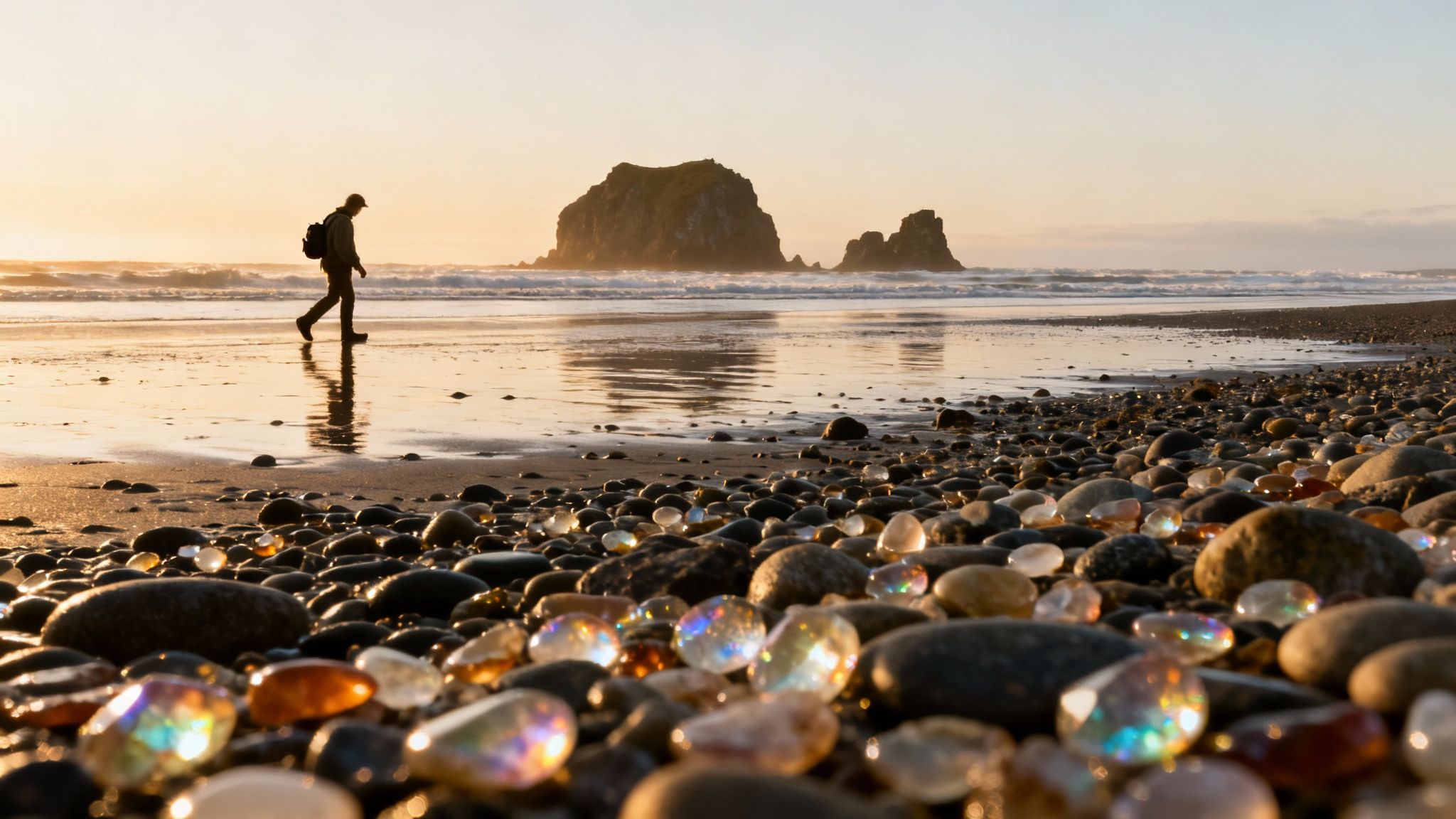
There's nothing quite like hunting on Washington's coast. It’s a dynamic, ever-changing environment, making it a prime destination for finding wave-tumbled agates. The best places to look are the gravel bars and pebble beds that appear at low tide, especially right after a big winter storm. Those storms are nature's rock tumbler, churning up the seafloor and depositing fresh material on the beach for you to find.
The coastline from Cape Disappointment, at the mouth of the Columbia River, north to the rugged shores of Shi Shi Beach is particularly famous. This whole area is a hotspot for classic beach agates, including fiery orange carnelians and delicate clear agates with subtle, beautiful banding.
When you're out there, keep an eye on these specific features:
Gravel Bars at River Mouths: Rivers carry rocks from miles inland and dump them right where they meet the ocean. Agates often get concentrated here.
Pebble Beds Below Bluffs: Erosion is your friend. As coastal cliffs wear away, they release agates that were trapped in the host rock.
Low Tide Lines: Walk the line where the tide has just receded. Heavier stones, like agates, tend to settle out in these freshly exposed areas.
Here's a pro tip from years of beachcombing: walk with the sun behind you. This angle makes the agates light up from within, helping their waxy luster and translucency pop against all the dull, wet rocks. Time your hunt for the hours right after a storm passes and during a negative tide—it will seriously increase your chances.
Inland Treasures: The Mountains and Valleys
If you head away from the coast, you'll find a completely different world of agate hunting. Washington's inland spots are usually tied to ancient volcanic flows where agates formed inside gas bubbles in the lava. This means you’ll need a different approach, often involving a bit of digging and a sharp eye for geological clues.
Walker Valley, a well-known public collecting area managed by the Department of Natural Resources, is a fantastic place for both beginners and experienced hounds. The prize here are thundereggs—rough, spherical rocks that hide incredible treasures. When you cut one open, you might find stunning agate, crystalline quartz, or even opal inside. The fun is in the mystery of what's waiting for you.
Another top inland spot is Saddle Mountain, famous for its petrified wood and striking blue agates. The geology is all ancient basalt flows where silica-rich water seeped into gas pockets, creating the perfect conditions for high-quality agate. You'll often find pieces here with intricate fortification banding—sharp, angular patterns that look like the walls of a tiny fortress.
The key to inland hunting is patience. Unlike beachcombing, where treasures are often lying in plain sight, inland agates may be hidden in clay, attached to host rock, or buried just beneath the surface. A good rock hammer and a small shovel are your best friends.
When exploring these inland areas, look for exposed basalt flows or places where erosion has cut through layers of volcanic ash. These are the zones where agate-bearing material is most likely to be found. And always, always make sure you're on public land designated for collecting and follow any posted rules.
Whether you love the rhythmic sound of waves on a pebble beach or the quiet solitude of a mountain forest, the opportunities for finding agates in Washington State are practically endless. Each location offers a unique adventure and the chance to hold a natural work of art millions of years in the making.
Gearing Up for a Successful Rockhounding Trip
Having the right gear is what separates a casual walk on the beach from a truly successful agate hunt. The good news is, you don’t need a ton of expensive or complicated equipment to get started. A few smart choices, however, can make the difference between a frustrating day and a backpack full of treasure.
I like to think of my kit in three parts: what I need to get the agates, what I need to carry them, and what I need to stay safe and comfortable while I'm out there. A little prep before you leave the house goes a long way, especially when you’re dealing with Washington’s famously unpredictable terrain.
Extraction Essentials
On many of Washington’s beaches, the best "tool" you have is your own two eyes and a willingness to bend over. But when you head inland, you'll often find agates still locked inside their host rock, and that requires a bit more persuasion.
Geologist's Pick or Rock Hammer: This is the classic rockhounding tool for good reason. The pointy end is perfect for poking into cracks and prying things loose, while the flat end helps you carefully chip away the surrounding rock.
Pry Bar and Chisels: For those stubborn agates really embedded in basalt, a small pry bar and a good set of cold chisels give you the leverage to work them free without shattering your prize. I always tell people to start gently and work their way around the stone.
Small Shovel or Trowel: If you’re heading somewhere like Walker Valley to hunt for thundereggs, you’ll be digging in clay and soft earth. A sturdy garden trowel is often all you need to uncover something amazing just below the surface.
As you get your gear together, checking out a beginner's field guide to searching for geological finds can offer some great tips on field techniques that apply to more than just fossils.
Hauling Your Finds Securely
So, you found a perfect agate. Now what? The last thing you want is to get it home and discover it's been chipped and scratched by all the other rocks bouncing around in your bag. Protection is everything.
Start with a durable backpack—something with strong straps that won't dig into your shoulders. A pack with a few different compartments is a huge help for keeping your tools, lunch, and your precious finds separate and organized.
A trick I learned years ago is to wrap each decent find in newspaper, a paper towel, or even an old sock. It’s a simple step, but it stops your agates from grinding against each other on the hike back. For a truly special piece, I'll bring a small, hard-sided container for maximum protection.
Safety and Comfort in the Field
Anyone who has spent time in Washington knows the weather can turn on a dime. Your safety and comfort should always be the top priority—it’s hard to focus on finding agates if you’re cold, wet, or miserable.
Layering your clothes is non-negotiable. I always start with a moisture-wicking base, add an insulating fleece, and top it with a waterproof shell. This setup has saved me from sudden downpours and chilly winds more times than I can count, both on the coast and in the mountains.
Footwear is just as critical.
On the coast, you need waterproof boots with fantastic grip. Those seaweed-covered rocks are no joke.
Inland, I always go for sturdy hiking boots with good ankle support to save me from twists on uneven, rocky ground.
Finally, a few items are must-haves in my pack no matter where I'm going: a basic first-aid kit, a fully charged phone or GPS, extra water, and some high-energy snacks. And if you’re planning on swinging a rock hammer, a good pair of safety glasses is a smart move. Being properly equipped doesn't just keep you safe; it makes the whole experience more enjoyable and lets you stay out longer. For those looking to upgrade their kit, you can browse a great selection of rockhounding tools and accessories.
How to Identify Washington Agates in the Wild
Spotting an agate among a million other beach stones is a skill that takes a bit of practice. At first, everything can look the same. But once you train your eye, agates start to stand out from the crowd. The key is knowing which subtle clues to look for.
Forget searching for bright, obvious stripes. Most raw agates in Washington State are more modest in their natural state. Their real beauty is often hidden under a dull, chalky exterior or a layer of beach grime. Your first clue isn't color; it's texture and light.
Look for Luster and Translucency
Agates are a type of microcrystalline quartz, which gives them a unique look and feel. One of their most telling features is a distinct waxy luster. While other rocks might be grainy, dull, or sparkly, an agate has a smooth, almost greasy sheen to its surface—like a piece of old wax.
This waxy feel is often paired with translucency. This is probably the most reliable field indicator you have. An agate isn’t transparent like glass, nor is it completely opaque like jasper. Instead, it allows some light to pass through, creating a soft, internal glow.
Hold a promising-looking stone up to the sun or a flashlight. If the edges light up and you can see a hint of light penetrating the stone's body, you're likely holding an agate. This simple light test is the fastest way to confirm your suspicions, even on a cloudy Washington day.
This inner glow is what makes hunting on sunny days so effective. As you walk with the sun at your back, it will illuminate any agates in your path, making them pop against the duller, opaque stones around them.
The Spray Bottle Trick
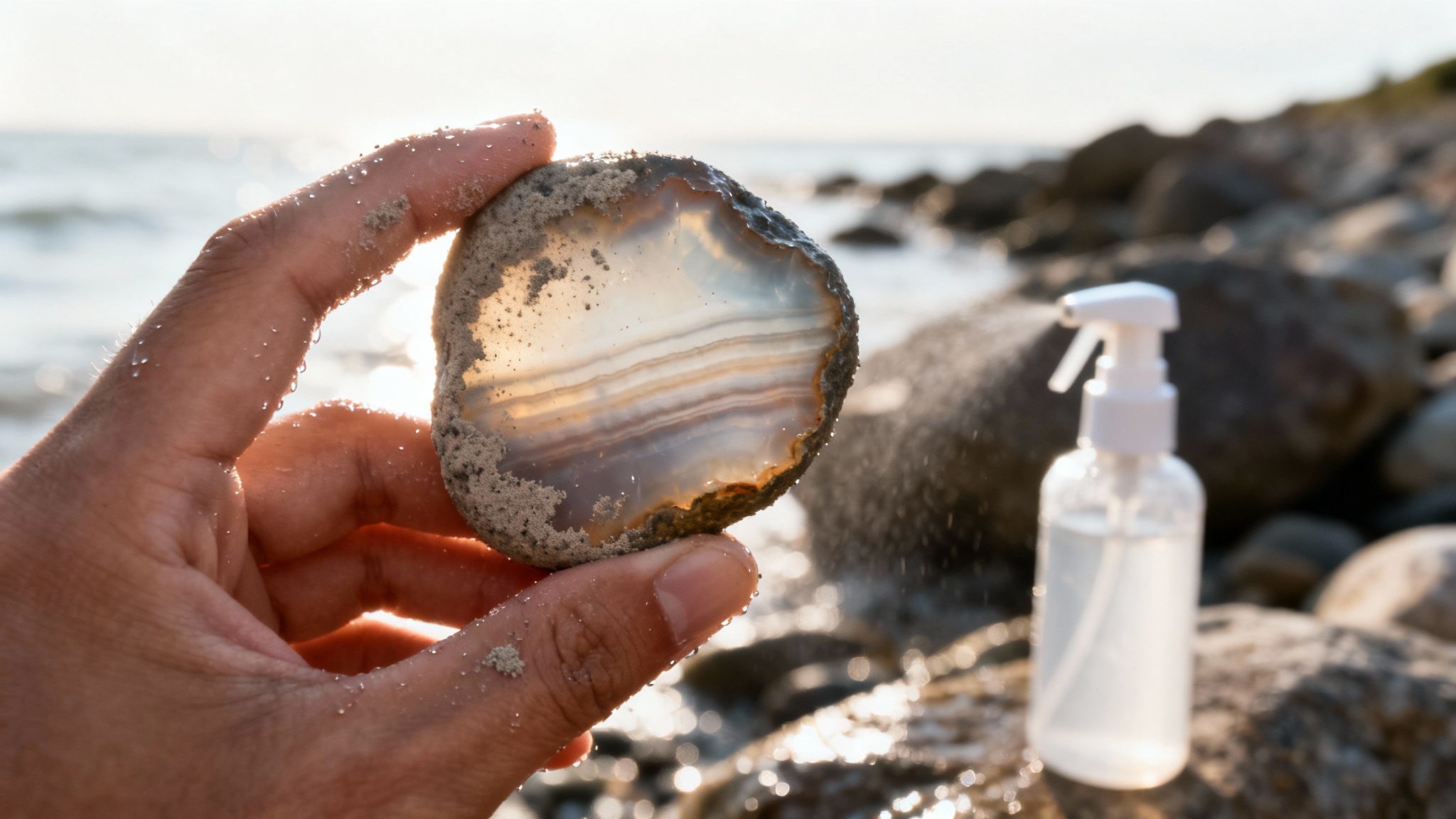
Here’s a field-tested technique that instantly separates the agates from the ordinary rocks. Always carry a small spray bottle filled with water. A dry, dusty stone can look like any other gray rock, completely hiding its potential.
A quick spritz of water works magic. It instantly washes away the dust and mimics the look of a polished stone, revealing any hidden banding, color, or fortifications that were invisible just seconds before. This is especially useful for inland hunting, where stones aren't constantly being washed by waves.
Distinguishing Agates From Their Cousins
It’s easy to confuse agates with their close relatives in the chalcedony family, like common chalcedony or jasper. They are all made of the same mineral, but with a few key differences. Understanding these will sharpen your identification skills.
Agate vs. Jasper: The main difference here is translucency. Agates are translucent, while jasper is opaque due to mineral impurities (often iron). This gives jasper solid, earthy colors like red, yellow, or brown. If you can’t see any light passing through it, it’s probably jasper.
Agate vs. Common Chalcedony: This one is trickier. Agate is technically a variety of chalcedony defined by its banding. If your translucent, waxy stone has visible layers, stripes, or concentric rings, it’s an agate. If it's a solid, uniform color without any banding, it’s simply common chalcedony.
Recognizing Agate Features in the Field
When you find a potential agate, look for these specific characteristics. They often appear in combination, building a stronger case for a positive ID.
Feature
What to Look For
Banding
Fine, concentric lines, stripes, or "fortification" patterns that look like castle walls.
Conchoidal Fractures
Smooth, curved, scoop-like breaks on the surface, similar to chipped glass.
Pitting or "Pockmarks"
Small, irregular dimples on the surface, a common texture for weathered agates.
Waxy Luster
A non-glossy, soft sheen that looks and feels slightly greasy or waxy.
Translucency
Light passes through the stone, especially around the thinner edges, giving it an inner glow.
Learning to spot these signs will transform your rockhounding trips. You'll spend less time guessing and more time discovering. While finding a raw stone is a thrill, seeing its bands revealed after it’s been cut and polished is another level of excitement. For a glimpse of how these stones transform, you can explore beautiful examples of a finished agate slice to appreciate the hidden art within. With practice, you'll be identifying agates in Washington State like a seasoned pro.
Bringing Out the Beauty in Your Raw Agates
The thrill of pulling a perfect agate from the gravel doesn't stop when you get home—in fact, that’s where the next phase of the adventure begins. Your raw finds, often caked in clay or stained by minerals, are hiding some incredible beauty. With a bit of patience and the right approach, you can turn those rough stones into display-worthy gems.
The first order of business is always a good, thorough cleaning. For agates found on coastal beaches, this might just mean a quick rinse under the tap. But if you’ve been digging at an inland spot like Walker Valley, you’ll be dealing with a thick, sticky clay that needs a bit more persuasion.
Start with the basics: grab a bucket of warm water, a little dish soap, and a stiff-bristled brush. Let your agates soak for a few hours to loosen up the grime, then get to work. An old toothbrush is your best friend here, perfect for digging into all the tiny nooks and crannies.
Dealing With Tough Stains
Sometimes, soap and water just don't cut it. You might notice stubborn orange or brown stains clinging to your agates, which is usually a sign of iron oxide. These stains don't actually harm the stone, but getting rid of them can make a world of difference in its appearance.
A popular and highly effective solution for iron stains is a cleaner containing oxalic acid, like Iron Out. Whenever you're working with chemicals, though, safety has to come first.
Work in a well-ventilated space, ideally outdoors.
Always wear protective gear, including gloves and safety glasses.
Follow the manufacturer's directions to the letter, mixing the powder with water to create your solution.
Submerge your agates and let them soak. This could take a few hours or even a couple of days, depending on how deep the stains are.
Once the soak is done, give your stones a final, thorough rinse with clean water to neutralize any leftover cleaner. You'll be amazed at how much brighter and cleaner they look.
The Art of Rock Tumbling
If you’re after that classic, glass-like polish, rock tumbling is the way to go. A rock tumbler essentially mimics the natural smoothing process of a riverbed or the ocean, using grit and water to polish stones over several weeks. It’s a multi-step process that demands patience but delivers absolutely stunning results.
The first—and most critical—step is sorting your rocks. You should only ever tumble stones of similar hardness together. Agates have a Mohs hardness of around 7, so they play well with other tough materials like jasper or quartz. If you toss them in with softer stones, the softer material will just get ground away too quickly.
The tumbling process is a journey of transformation. It’s not just about making a rock shiny; it’s about revealing the intricate patterns and hidden depths that nature spent millions of years creating.
The whole process usually involves four different stages of grit, moving from coarse to a fine polish.
Stage 1 Coarse Grit: This is the shaping stage. It aggressively grinds down rough edges and any imperfections. Expect this to run for about a week.
Stage 2 Medium Grit: After a complete cleaning, the rocks move to the next stage with a finer grit. This step smooths the surfaces shaped by the coarse grit and typically takes another week.
Stage 3 Pre-Polish: This stage is all about preparing the stones for their final polish by creating a smooth, matte finish. It's a crucial step for getting that high-gloss shine.
Stage 4 Polish: Finally, a special polishing compound does the heavy lifting. After another week in the tumbler with this compound, your agates will emerge with a brilliant, glossy shine.
Patience is truly the secret to great tumbling. Rushing the process or skimping on the cleaning between stages can easily ruin your final polish. Of course, if you appreciate the beauty of a finished stone but would rather skip the polishing work, you can find incredible inspiration in professionally finished pieces like this hand-polished chalcedony slice, which shows off the amazing patterns hiding inside.
Rockhounding Ethics and Washington State Regulations
Bringing home a pocketful of beautiful agates is an amazing feeling, but it comes with a real responsibility. Being a good steward of the land is just as important as knowing where to look. Before you even think about grabbing your rock hammer, let's go over the rules of the road—the ethics and regulations that keep this hobby alive for everyone.
The absolute first thing you have to know is whose land you're on. Washington is a wild mix of public and private property, and the rules for collecting change dramatically from one to the next. Never, ever assume that a promising-looking gravel bar or hillside is fair game.
Public Lands vs. Private Property
For the most part, you’ll be hunting on public lands managed by agencies like the U.S. Forest Service (USFS) or the Bureau of Land Management (BLM). On these lands, casual, non-commercial rockhounding is usually allowed. But that doesn't mean it's a free-for-all.
There are limits. Typically, you can collect a "reasonable amount" for your personal use. This often works out to about 25 pounds per day, plus one larger piece. This isn’t a hard and fast rule everywhere, so always check the specific regulations for the area you plan to visit.
The golden rule of rockhounding is simple: leave the area better than you found it. Pack out your trash, fill in your holes, and don't tear up the landscape. This one principle protects our access to these incredible places.
Private property is a completely different ballgame. You must have direct, explicit permission from the landowner before you even step foot on their land. Trespassing is illegal, plain and simple. It also gives the rest of us a bad name and can get incredible collecting spots closed off for good.
Leave No Trace Principles
True rockhounds live by the "Leave No Trace" philosophy. These aren't just suggestions; they're the core of responsible collecting and help preserve Washington’s stunning landscapes.
Plan Ahead and Prepare: Know the rules for your specific spot before you leave the house.
Travel on Durable Surfaces: Stick to established trails and gravel bars. Avoid trampling delicate plants and ecosystems.
Dispose of Waste Properly: If you packed it in, you pack it out. No exceptions. That means everything from granola bar wrappers to a broken bucket handle.
Leave What You Find: This one can be tough for a collector, but it means respecting the environment as a whole. Leave historical artifacts where they are and give wildlife their space.
Minimize Campfire Impacts: If you have a fire, use an existing fire ring. Make absolutely certain it's cold and dead out before you leave.
Respect Wildlife: You're a visitor in their home. Watch animals from a distance and never, ever feed them.
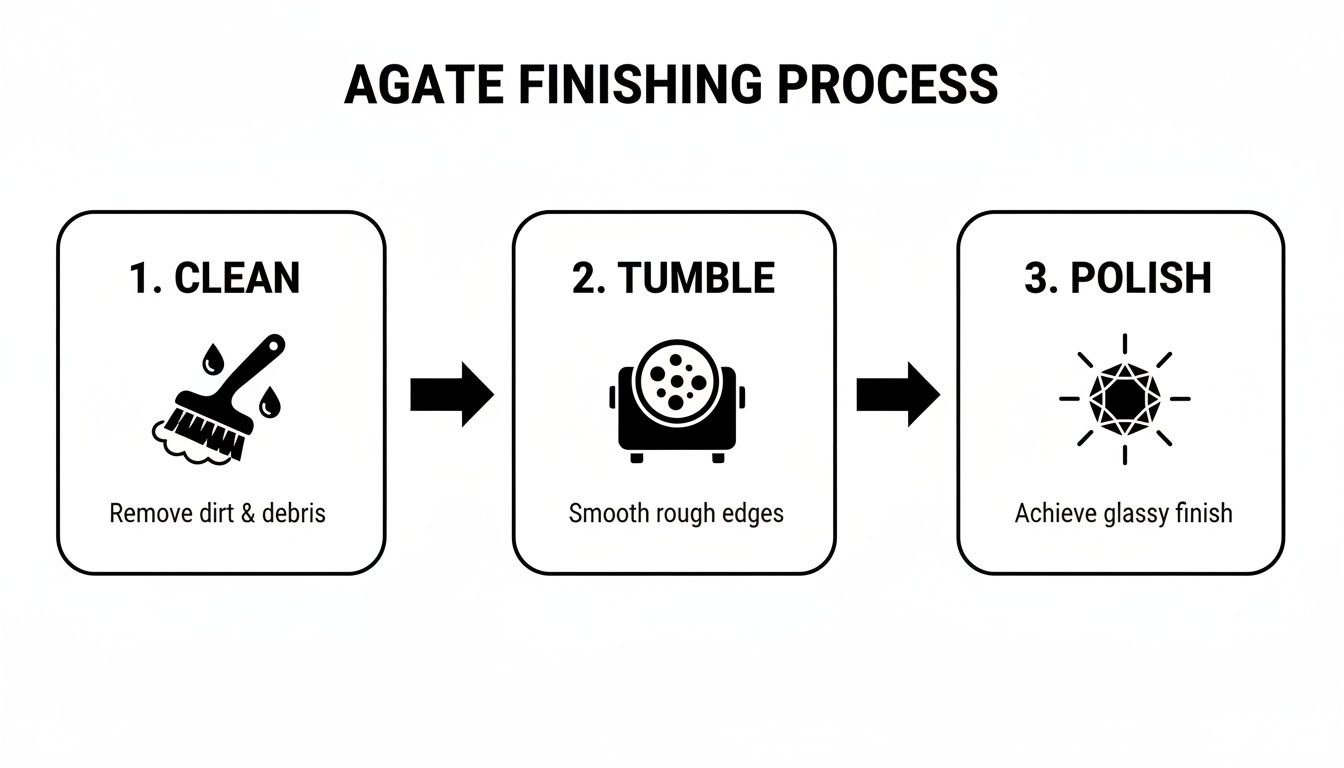
This simple process of cleaning, tumbling, and polishing is how you'll unlock the hidden beauty inside your rough finds. It's this potential that makes Washington a rockhounding hotspot, fueling a recreational economy estimated at $5-10 million annually.
By following these ethical guidelines, you’re doing your part to ensure that hunting for agates in Washington State remains a fantastic adventure for generations to come. For a deeper dive into the state's incredible mineral wealth, you can discover more insights about Washington's mineral wealth on Mindat.org.
A Few Common Questions About Washington Agate Hunting
Even the most seasoned rockhound has questions when exploring a new area. Here are some of the things people often ask before heading out to hunt for agates in the Evergreen State.
When Is the Best Time of Year to Hunt on the Beaches?
The absolute prime season for beachcombing is from fall through early spring. Forget sunny summer days; winter storms are your best friend out here. They have an incredible power to churn up the seafloor and chew away at coastal bluffs, depositing entirely new layers of gravel—and hopefully, fresh agates—right on the beach for you to find.
I always tell people to plan their trips around major storm systems and the lowest tides of the month. Heading out on an outgoing tide right after a big storm creates the perfect scenario for finding treasures that were buried deep underwater just hours before.
Do I Need a Permit to Go Rockhounding?
For the most part, if you're just collecting for your personal display and not for resale, you do not need a special permit. This generally applies to public lands managed by the U.S. Forest Service or the Bureau of Land Management (BLM).
However, collecting is a strict no-go in Washington's State and National Parks. It’s absolutely forbidden.
A word of advice from experience: Always, always verify the specific rules for the exact location you plan to visit. A quick search on the managing agency's website before you pack the car can save you from an accidental misstep. It also helps protect these amazing resources for everyone else.
Are My Agates Worth Anything?
That's the million-dollar question, isn't it? The truth is, the value of an agate is incredibly subjective. It really boils down to a few key things:
Size and Weight: Bigger is almost always rarer and more desirable.
Color and Clarity: Agates with vivid, deep colors and high translucency will catch a collector's eye much faster than a cloudy, plain stone.
Banding and Pattern: This is where things get really exciting. Intricate fortification lines, delicate plumes, or mossy inclusions are what collectors go wild for.
While most of the agates you find will be modest in monetary terms, their real worth is in their natural beauty and the story of how you found them. That said, an exceptionally rare or massive specimen can be quite valuable to lapidary artists and serious collectors. The thrill of finding unique agates in Washington state is truly a reward in itself.
At Astro West, we celebrate the natural artistry of stones from around the globe. While you hunt for your own treasures, explore our curated collection of fine minerals and fossils to inspire your next adventure. Discover a piece of natural history at https://astrowest.com.