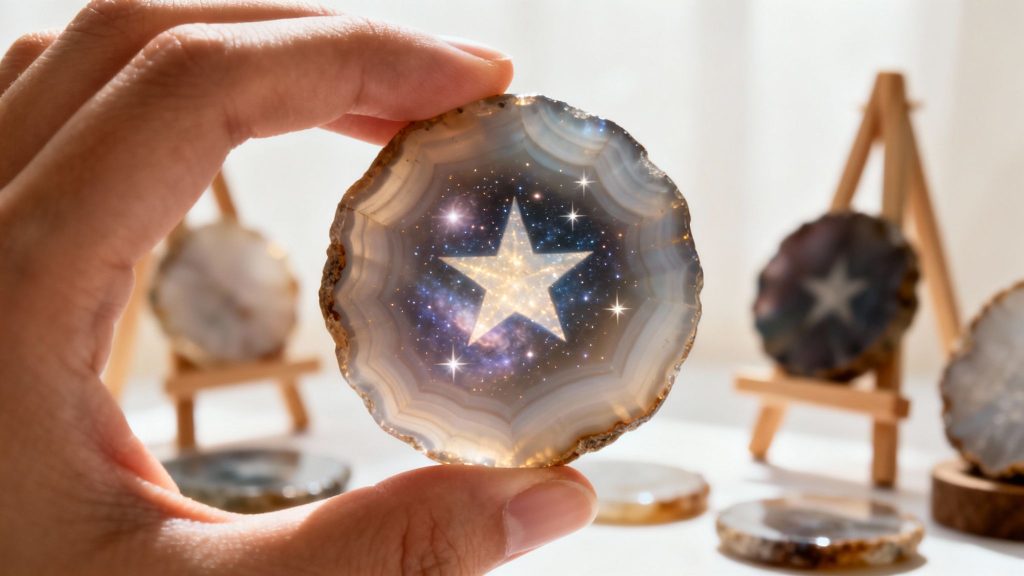
Imagine holding a stone that contains a galaxy frozen in time. That’s the feeling a star agate evokes—it’s a rare and captivating variety of chalcedony, prized for the unique, star-like patterns scattered within it.
These intricate designs, formed by mineral inclusions, create a kind of cosmic fingerprint inside the stone. It’s a guarantee that no two pieces will ever be exactly alike.
The Allure of the Agate Star
At its heart, a star agate is a testament to nature's quiet, patient artistry. It's a world away from the more common banded agates, which form in predictable, familiar layers. Instead, the star variety tells a much more specific story of unique geological events.
These captivating formations aren't carved or enhanced by human hands. They are completely natural patterns created by mineral inclusions, like goethite, radiating outward from a central point. Think of it as a slow-motion firework display, captured forever within translucent stone over millions of years.
This rarity and profound beauty are what capture the imagination of collectors and designers. Every star agate is a one-of-a-kind masterpiece, a miniature abstract painting created by the Earth itself. This inherent individuality makes it a true standout in any collection.
Why Is This Gemstone So Prized?
The value of a star agate goes far beyond just its good looks. Several key factors make it a genuine collector's treasure and set it apart from other gemstones:
Natural Uniqueness: That radiating starburst pattern is entirely natural. This means every specimen has a distinct personality, a world apart from mass-produced or standardized gems.
Geological Rarity: The specific conditions needed for these star-like inclusions to form are far less common than those for simple banding. This scarcity alone elevates its status among agate enthusiasts.
Artistic Form: From delicate, feathery bursts to bold, symmetrical stars, the variety in the patterns is just immense. Collectors often hunt for specimens with particularly well-defined or aesthetically pleasing formations, much like someone appreciating a piece of fine art.
A true star agate is more than just a mineral—it’s a snapshot of a precise geological moment. Its pattern is a signature, a 'cosmic fingerprint' that makes each stone an exclusive artifact of our planet's history.
Whether you are just starting your mineral collection or are a seasoned gemologist, star agate offers a unique blend of natural science and abstract beauty. Exploring a polished agate slice can reveal these incredible, starry depths. It is this combination of rarity, individuality, and raw natural artistry that makes the star agate such a special and sought-after gemstone.
How Star Agate Forms in Nature
The story of a star agate begins deep within the Earth, a tale of immense pressure and incredible patience. Like most agates, they are born inside the empty pockets and cavities of ancient volcanic rock. Over millions of years, these empty voids become the perfect cradle for a new gemstone to grow.
Silica-rich fluids, carrying all sorts of dissolved minerals, slowly seep into these cavities. This isn't a quick or violent event; it's a gradual percolation, drop by drop, over millennia. As this mineral-rich solution fills the space, it begins a slow, meticulous process of depositing microscopic quartz crystals in layers, creating the stone we know as chalcedony.
This process isn't so different from how rock candy forms in a sugar solution, just stretched across a geological timescale. For most agates, this layering creates the familiar, beautiful concentric bands of color. But for a true agate star to emerge, a much rarer set of circumstances has to fall into place.
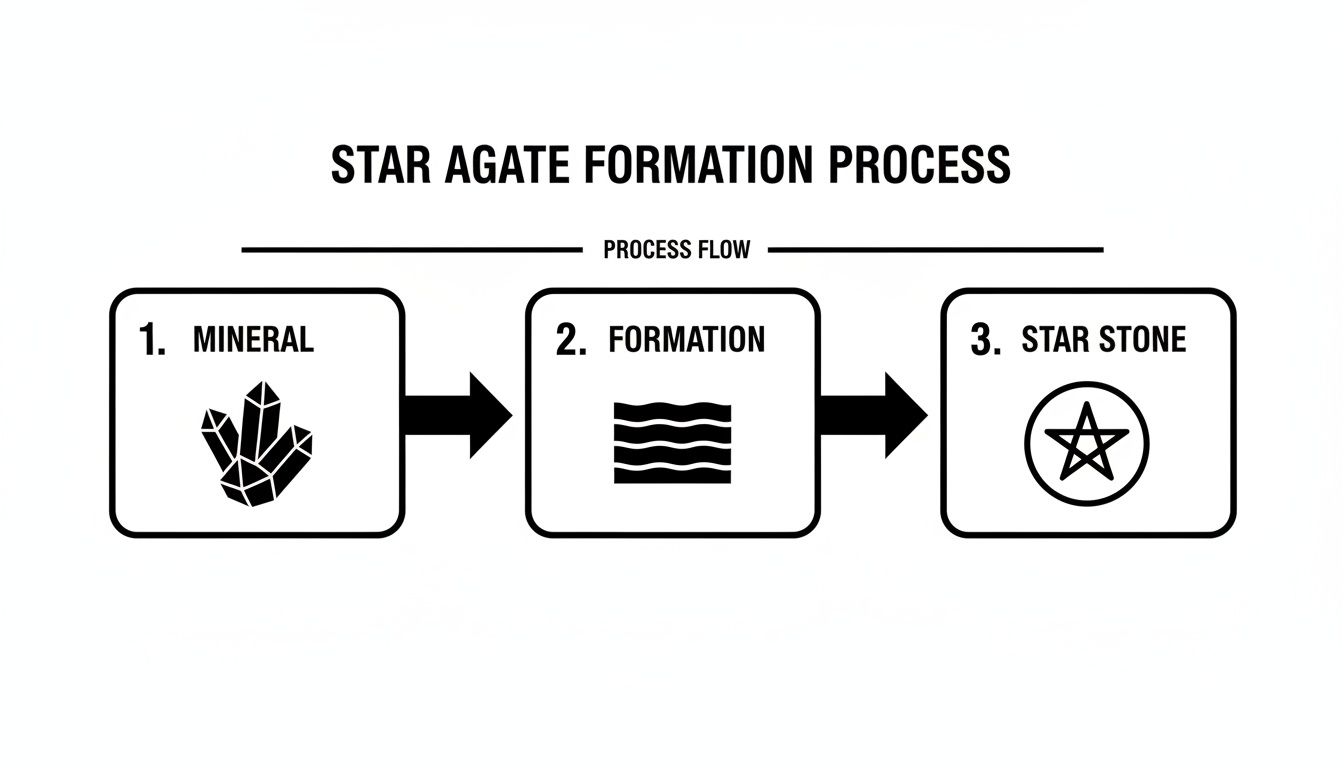
This diagram helps visualize the three-step journey from raw mineral soup to a finished star agate.
As you can see, it takes a very specific combination of mineral ingredients and layered growth to create that celebrated star pattern.
The Spark of Creation
That iconic "star" pattern isn't a trick of the light or some kind of optical illusion; it's a real, physical structure frozen inside the stone. The magic happens when certain mineral inclusions, often needle-like crystals of minerals like goethite, are floating in the silica solution at just the right moment. These inclusions start to grow from a central point, radiating outwards in every direction.
As the chalcedony continues its slow, patient layering process, it entombs these radiating needles. It's like a slow-motion firework display, perfectly preserved in stone. The translucent agate freezes that explosive burst of mineral growth in time, creating the stunning stellar pattern we see in the finished gem.
The formation of a star agate is a geological lottery. The right volcanic host rock, the perfect silica-rich solution, and the timely introduction of specific radiating minerals must all align perfectly.
This delicate balance of conditions is precisely why a true star agate is so much more uncommon than its banded cousins. While you can find gorgeous chalcedony in many forms, like in this hand-polished chalcedony slice, the natural artistry of the star requires a perfect storm of geological events. Each specimen is a testament to a unique, fleeting moment in Earth's deep history, making it a genuine prize for any collector.
A Global Treasure Through History
The allure of star agate isn’t some modern obsession. It’s a story stretching back thousands of years, linking us to the very dawn of civilization. More than just a pretty stone, agate is a cultural artifact with a profound legacy, cherished by ancient cultures for both its beauty and its perceived power.
This incredible story kicks off on the shores of ancient Sicily. Picture stumbling upon a shimmering, patterned stone by a riverbank—that’s exactly how agate got its name between 400-300 BCE. The Greek philosopher Theophrastus is credited with identifying it near the Achates River, which we now know as the Dirillo. That discovery started agate's celebrated journey, turning it into a global icon.
But the real story goes back even further. Archaeological finds, like agate beads from the Middle East dating back 9,000 years and Babylonian axe heads from 3,000 BC, prove this stone has captivated humans for an incredibly long time.
A Symbol of Power and Protection
In the ancient world, intricately patterned stones were never just geological curiosities. They were seen as gifts from the gods or vessels of protective energy, and the mesmerizing patterns inside an agate—especially a rare star formation—were particularly revered. These weren't just rocks; they were mystical talismans believed to ward off evil and bring good fortune.
Babylonian warriors, for instance, carved agates into seals and amulets, convinced they offered strength and protection in the heat of battle. In ancient Rome and Greece, it was shaped into intricate cameos and intaglios, valued not just for its beauty but for the status it gave the wearer. The star agate, with its celestial pattern, was likely seen as an object of immense spiritual significance—a tiny piece of the cosmos you could hold in your hand.
Throughout history, the most captivating agates were more than just ornaments. They were considered powerful tools, symbols of divine favor, and shields against unseen dangers, transforming them from minerals into essential cultural artifacts.
This deep historical context adds another layer of appreciation for star agate. To get a feel for the broader history of how gemstones were used, you can explore the evolution of personal adornment in the Jewelry Through Time: A Complete History Guide.
When you own a star agate today, you're not just acquiring a beautiful gem. You’re holding a fragment of a story that has captivated humanity for thousands of years, a direct link to the artisans and believers of the ancient world.
How to Identify Authentic Star Agate
Spotting a genuine star agate from a look-alike takes a bit of a trained eye, but once you know what to look for, you can learn to see the stone's natural origin story. The first thing to remember? Forget perfection. Nature's artistry is almost always beautifully imperfect, and that's exactly what you want to see.
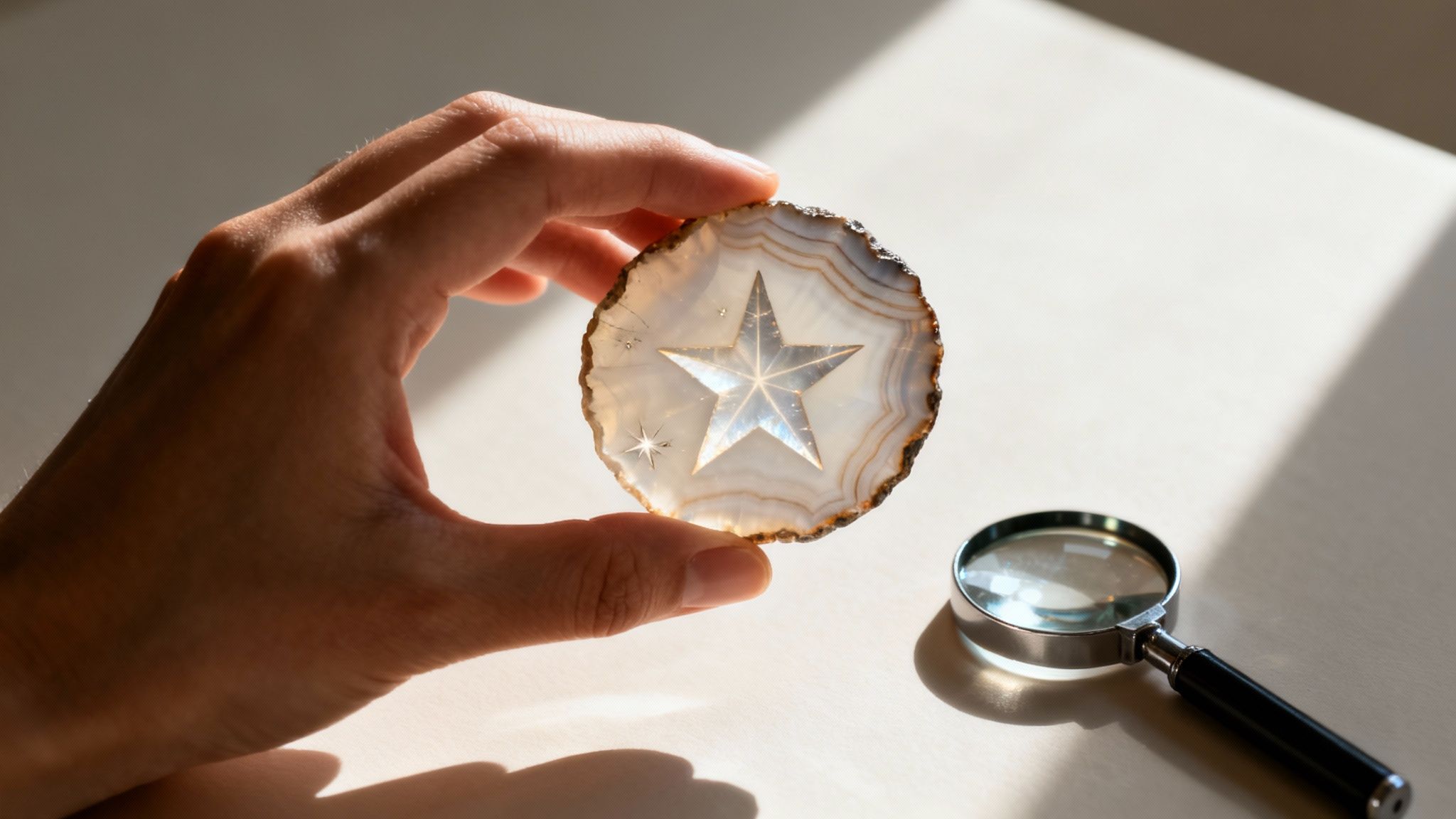
The most important feature is the star pattern itself. In an authentic specimen, the "rays" you see are actually mineral inclusions, like goethite, that grew right inside the chalcedony. They should look like they are truly part of the stone, not something painted on the surface. These inclusions will have a natural, almost fluid feel to them, radiating from a central point with rays that vary in thickness and clarity.
Key Visual Cues for Identification
When you're holding a potential star agate, your focus should be on three main things: translucence, pattern integrity, and color. A real star agate will almost always have some degree of translucency, letting light filter through its body. This is a signature trait of the entire agate family.
Next, get a good look at that star. Does it look organic? Natural mineral inclusions rarely form perfect geometric shapes. If you see a pattern that's too crisp, too uniform, or looks like it's just sitting on top of the stone, that's a red flag. It could be a sign of an artificial enhancement or an outright fake.
Finally, check the color. Natural star agates come in a beautiful palette of earthy tones—think soft grays, muted browns, and creamy whites. While it's true that agates can be dyed, any stone with unnaturally bright or electric colors like neon pink or bright blue isn't a natural star agate. The real deal has a much more subtle, grounded appearance.
Distinguishing Star Agate from Look-Alikes
It's pretty easy to confuse other patterned agates with a true star agate. Plume agates, for instance, have gorgeous feathery, smoke-like inclusions. Dendritic agates are known for their delicate, tree-like patterns. While stunning in their own right, these are completely different formations. Looking at a variety of patterns side-by-side, like these unique examples of tumbled moss agate, really helps train your eye to recognize the radial burst of a true star.
The key difference lies in the pattern's origin point. A true star agate features inclusions radiating from a central nucleus, creating a burst effect. Other patterned agates, like plume or dendritic, have inclusions that branch or billow without a clear, singular origin.
To make things even clearer, this quick comparison table can help you tell the difference between an authentic star agate and some of the common imitations you might run into.
Authentic Star Agate vs Common Look-Alikes
Characteristic
Authentic Star Agate
Plume or Dendritic Agate
Artificially Enhanced/Dyed Agate
Pattern
Inclusions radiate from a central point, forming a "star" or "burst." Rays are often imperfect.
Feathery, smoke-like plumes (plume) or tree-like, fern-like branches (dendritic). No central origin point.
Pattern may be too perfect, geometric, or appear painted on the surface.
Color
Natural, earthy tones: grays, browns, creams, muted yellows. Colors are integrated into the stone.
Varies, but colors are natural and part of the mineral inclusions.
Unnaturally vibrant or electric colors (neon pink, bright blue, deep purple). Dye may concentrate in cracks.
Inclusions
Look like they are inside the translucent chalcedony. Can be goethite or other minerals.
Inclusions are suspended within the chalcedony, creating depth and a 3D effect.
Colorant or pattern may sit on the surface or have a flat, printed look.
Translucence
Typically semi-transparent to translucent, allowing light to pass through the main body of the stone.
Usually translucent, which highlights the internal patterns beautifully.
Can vary, but the dye often makes the stone more opaque or unevenly colored.
Using this guide should give you more confidence when you're assessing a stone. Always trust your gut—if something looks too good to be true, it's worth a second, closer look.
What's a Star Agate Worth? Understanding Value and Rarity
So, what makes one star agate catch a collector's eye—and a higher price tag—while another sits on the shelf? It’s a great question. While agate itself is fairly common, the specific kind we call a star agate is a whole different story. These are much, much rarer.
Unlike diamonds or other gems graded on a simple, universal scale, a star agate's value is all about the beauty and character of its natural pattern. It takes a perfect storm of geological conditions to form a crisp, symmetrical star. Because of this, truly high-quality specimens are scarce and have become a holy grail for many collectors, which is the main reason they command their value.
Key Factors in Grading Star Agate
Looking at a star agate is a lot like appreciating a piece of art; it’s all about the visual impact. The best ones—the ones that really stop you in your tracks—are those where the "star" is incredibly sharp and just plain beautiful to look at.
Here’s what collectors and gem experts are looking for:
Clarity of the Star: This is the big one. How sharp and clear are those radiating lines? You want crisp, well-defined rays, not something blurry or muddled.
Symmetry and Form: A balanced, even starburst is always highly prized. The more perfectly the rays shoot out from that central point, the more valuable the stone becomes.
Contrast and Color: You want that pattern to pop. High contrast between the star's delicate inclusions and the chalcedony around it is key. A bright star against a clean, translucent backdrop is the absolute ideal.
Size and Placement: As you might guess, larger stones with a big, centrally located star tend to be more valuable. A pattern that's off-center or cut off by the edge of the stone is less desirable.
These mesmerizing star-like patterns have been admired for thousands of years, with some ancient artifacts featuring them as symbols of divine power. It’s estimated that star agates make up only 10-15% of all agate traded globally, which really speaks to how uncommon they are.
Rarity and Market Value
Where a star agate comes from can also play a role in its value. Sometimes, specimens from famous locations can fetch a higher price, especially among regional collectors. For instance, finding a perfectly formed star inside a classic Lake Superior agate slice would be an incredible find for anyone who loves LSA's.
At the end of the day, a star agate's value is tied to its natural artistry. A piece that perfectly captures that "frozen firework" display is a true geological masterpiece, and its price will reflect that rare blend of beauty and scarcity.
When you're looking to buy one, my best advice is to focus on the quality of the star itself. A smaller stone with a brilliant, perfect star will almost always be worth more than a huge piece with a faint or messy pattern. If you keep these grading cues in mind, you'll be able to make a much more informed choice, whether you're buying your first piece or hunting for a museum-quality showstopper.
How to Care for Your Star Agate
A gorgeous star agate is a pretty tough stone, but it still deserves the right care to keep its natural shine for years to come. With a hardness of 6.5 to 7 on the Mohs scale, it’s strong enough for regular wear but can still get scratched by harder materials like diamonds or sapphires. A few simple steps are all it takes to preserve its cosmic beauty.
The best way to clean your star agate also happens to be the easiest. All you need is a soft brush, a little bit of mild soap, and warm water to gently wipe away any dirt or oils that have built up on the surface.
Cleaning and Storage Best Practices
Proper care is about more than just a quick wash. How you store your star agate is just as crucial for keeping it in great shape for the long haul.
Here are a few essential tips to keep in mind:
Avoid Harsh Chemicals: Never use things like bleach, ammonia, or other aggressive household cleaners. These can eat away at the stone’s polish and might even alter its color over time.
Steer Clear of Ultrasonic Cleaners: While they work wonders for some gems, the intense vibrations from these machines can create tiny fractures in agates, especially if the stone already has natural internal fissures. It's just not worth the risk.
Protect from Sunlight: Leaving your star agate in direct, prolonged sunlight can cause its subtle, earthy colors to fade. It’s best to display your pieces away from a sunny window.
Store It Separately: To prevent scratches from other, harder stones, keep your star agate jewelry or specimens in a soft cloth pouch or in a separate, lined compartment in your jewelry box.
The most important rule of thumb is to treat your star agate with gentle care. Think of it as a piece of natural art—because that’s exactly what it is. Simple, consistent maintenance is the key.
These principles don't just apply to star agate, of course. For more great advice, check out these essential jewelry maintenance tips to keep your whole collection looking pristine. Building these simple habits will ensure every piece stays as captivating as the day you first got it.
Common Questions About Star Agate
As you get deeper into the world of mineral collecting, a few questions always seem to pop up. It's only natural. To help you feel more confident in your knowledge, we've put together answers to some of the most common inquiries we hear about star agate.
Think of this as a quick chat to clear up any lingering curiosities and make sure you're ready to spot a great piece when you see one.
What Is the Difference Between Star Agate and Star Sapphire?
This is a fantastic question, and one that trips up a lot of new collectors. While both gems have a celestial-sounding name, they are completely different in how they create their "star."
A star agate gets its pattern from physical mineral inclusions, like goethite, that are trapped inside the stone as it formed. This creates a fixed, star-like image. It’s essentially a picture within the gem.
On the other hand, a star sapphire displays asterism. This is a cool optical trick caused by light bouncing off tiny, needle-like inclusions inside the crystal. As you move the stone, a shimmering star glides across its surface. So, the key difference is simple: one star is a static pattern, while the other is a dynamic play of light.
Is Star Agate Expensive?
The value of a star agate can be all over the map. While agate itself is a fairly common mineral, the specific conditions needed to form a crisp, well-defined star are anything but.
A small, cloudy specimen with a faint star might be very affordable, perfect for a starter collection. But a large piece with a sharp, symmetrical, and high-contrast star? That can be quite valuable and highly sought after by serious collectors. Ultimately, the price isn't just about size; it’s all about the quality of that cosmic pattern.
Where Is Star Agate Found?
Agate is found all over the globe. Brazil, for instance, is a powerhouse, often exporting over 1,000 tons a year and dominating roughly 40% of the world's supply.
While you won't find star agate in just one place, notable specimens have come from traditional agate-rich regions like parts of the United States, Mexico, and Brazil. You can dive deeper into agate's global journey with these insights on EmbellishedGems.com. Collectors often get excited about star agates from specific localities known for producing exceptionally clear and beautiful formations.
The most important takeaway is that star agate is a testament to nature's artistry. Its value lies not in its mineral composition alone, but in the rare, beautiful, and unique cosmic pattern it holds within.
At Astro West, we celebrate the unique stories told by each mineral. From mesmerizing star agates to museum-quality fossils, our curated collection offers a gateway to Earth's natural history. Explore our treasures and find a piece of the cosmos to call your own at https://astrowest.com.