Agate Madagascar: A Collector’s Guide to Volcanic Gemstones
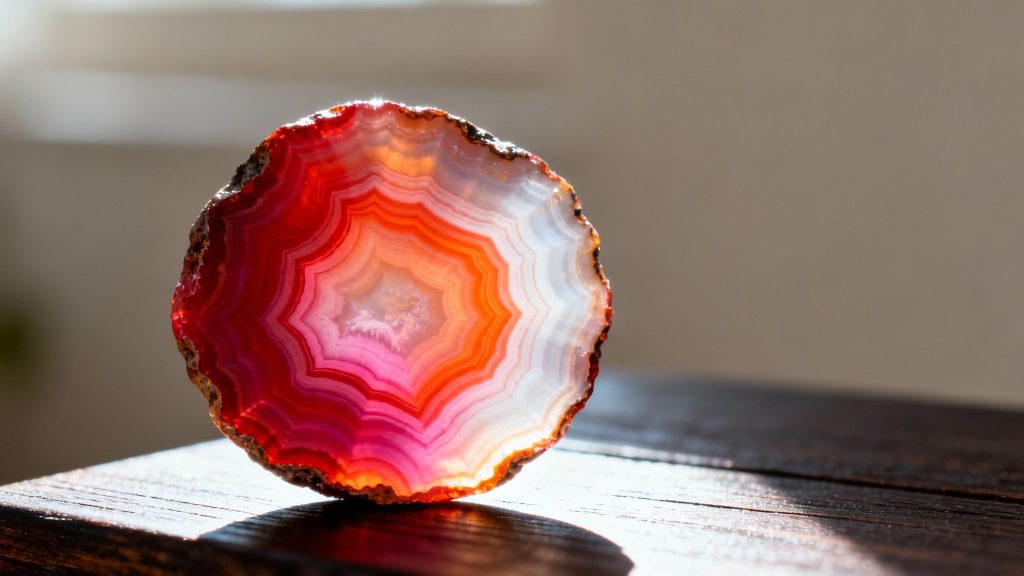
Madagascar agate is one of those stones that just stops you in your tracks. A stunning type of chalcedony, it is famous for the wild, intricate bands of color and unique patterns that formed inside ancient volcanic rock. Every single piece tells its own geological story.
Coming straight from the island nation of Madagascar, this gem is a favorite for both serious collectors and designers who want to capture a bit of natural artistry.
Discover the World of Madagascar Agate
Get ready to dive into the world of Madagascar agate, a gemstone where raw earthly forces create breathtaking, one-of-a-kind art. Known for its fiery colors and story-like patterns, this stone captures the imagination of everyone from seasoned rockhounds to interior designers looking for a touch of organic elegance. Its swirling bands of deep reds, vibrant oranges, and soft pinks make every specimen a true masterpiece.
Madagascar itself is a geological treasure island, known for producing some of the world's most spectacular minerals. This guide is your map to understanding what makes agate from this specific location so special. We'll take a journey from its volcanic origins to its place in modern design, giving you the confidence to appreciate, select, and collect it.
What Makes This Gemstone Unique
Unlike other agates you might see, the material from Madagascar often shows off exceptionally bold and complex patterns. These aren't just for looks—they're a direct record of the island's unique geological past, capturing subtle shifts in mineral content and temperature over millennia. According to the GIA, agates form as silica-rich fluids fill cavities in host rock, with each layer representing a different deposition event. Think of each slice as a cross-section of ancient history, frozen in stone.
This guide will walk you through its most compelling features:
Geological Formation: We'll dig into the volcanic processes that create its signature bands.
Collector Value: You'll learn the factors that determine a specimen's quality and worth.
Artistic Appeal: Discover why it's so celebrated as natural décor, perfect for pieces like a stunning agate dish with druzy.
Madagascar agates are really set apart by their broad, translucent bands and often massive size. This makes them exceptionally well-suited for carving decorative objects and creating striking home décor that puts their internal patterns on full display.
Ultimately, what sets this stone apart is its ability to be both a geological wonder and a piece of natural art. As we explore its formation, varieties, and uses, you'll gain a much deeper appreciation for why Madagascar agate is a cornerstone of any distinguished mineral collection.
The Volcanic Origins of Madagascar Agate
The story of agate madagascar begins with fire and pressure, deep inside the Earth's crust well over 100 million years ago. Picture the island of Madagascar, a landscape dominated by intense volcanic activity. As molten lava flowed and cooled, gas bubbles became trapped within, creating a porous, hollowed-out rock. These countless empty pockets, called vesicles, became the perfect cradles for agate to be born.
The process was slow, almost methodical, like a tree adding new rings year after year. For millennia, these initial cavities sat empty until silica-rich groundwater began its patient work. This mineral-laden water seeped through the volcanic rock, slowly percolating into every last vesicle.
Once inside, the magic began. The silica solution started depositing microscopic quartz crystals, meticulously coating the inner walls of the bubble. This wasn't a one-time flood; it was a cycle that repeated over millions of years, with each pulse of water adding a new, whisper-thin layer.
The Science Behind the Swirls
Those mesmerizing bands and patterns you see in Madagascar agate are a direct result of this layered formation. Each band marks a distinct chapter in the stone's creation, capturing a unique moment in geological time. Subtle shifts in the groundwater's chemistry, temperature, or pressure would change the crystal structure and clarity of each new layer.
You can think of it happening in a few key stages:
Vesicle Creation: Ancient volcanoes erupt, and as the lava cools, it traps gas bubbles, forming empty pockets in the host rock.
Silica Infiltration: Over eons, groundwater loaded with dissolved silica (SiO₂) slowly seeps into these cavities.
Layer-by-Layer Deposition: The silica precipitates out of the water, depositing microcrystalline quartz (chalcedony) layer by microscopic layer, building inward from the outer walls.
Color Infusion: Minerals from the surrounding soil are carried by the water into the forming agate, "staining" the layers with distinct colors.
It's this final stage that gives Madagascar agate its signature fiery palette. The island’s uniquely mineral-rich soil, full of elements like iron and manganese, infused the silica solution. Iron oxides are responsible for the stone’s famous reds, oranges, and yellows, while manganese contributes to the rarer pinks and blacks. Each layer captures a different concentration of these minerals, creating the stunning, high-contrast bands that collectors prize.
While the island is known for many incredible minerals, like the captivating play-of-color in polished labradorite from Madagascar, the agate tells a different story—one of slow, layered creation.
From Ancient Lava to Modern Treasure
This formation process is precisely why no two pieces of agate madagascar are ever identical. Each stone is a unique fossilized record of the specific conditions inside its tiny pocket of ancient lava. Sometimes, the silica solution would run out before the cavity was completely filled, leaving a hollow center lined with sparkling druzy quartz crystals—what we know as a geode.
This incredible natural artistry is deeply tied to the island's broader mineral legacy. Historically, agate has been a cornerstone of Madagascar's mining industry, which saw explosive growth in the modern era. Production surged by 300% in 2010 alone amid a wider sector boom, reflecting a golden age of mineral extraction. For collectors, this means each piece of agate is not just a beautiful object, but a fragment of a dynamic geological and economic history.
The real beauty of Madagascar agate is its story. The fluid, swirling patterns aren't random; they're a direct map of the ancient hydrothermal fluids that flowed through volcanic rock, creating a masterpiece of natural art frozen in time.
Ultimately, every time you hold a piece of Madagascar agate, you're holding a direct connection to the island's violent volcanic past. The stone's journey from a humble gas bubble in cooling lava to a polished gem is a testament to the slow, powerful, and artistic forces of nature.
Identifying the Different Types of Madagascar Agate
While all agate from Madagascar shares the same fiery, volcanic birth, the island's unique geology creates an incredible variety of stones, each with its own character. Learning to tell them apart is a bit like learning to recognize different styles of art—the medium is the same, but the final piece is one-of-a-kind. The secret is in the details: the specific colors, patterns, and inclusions that tell the story of how and where that particular stone formed.
From the warm glow of Carnelian to the tiny landscapes captured inside Moss Agate, each type offers a different peek into Madagascar's mineralogical treasures. Knowing these differences helps you appreciate the subtle features that make each specimen special, turning a simple rock into a geological masterpiece.
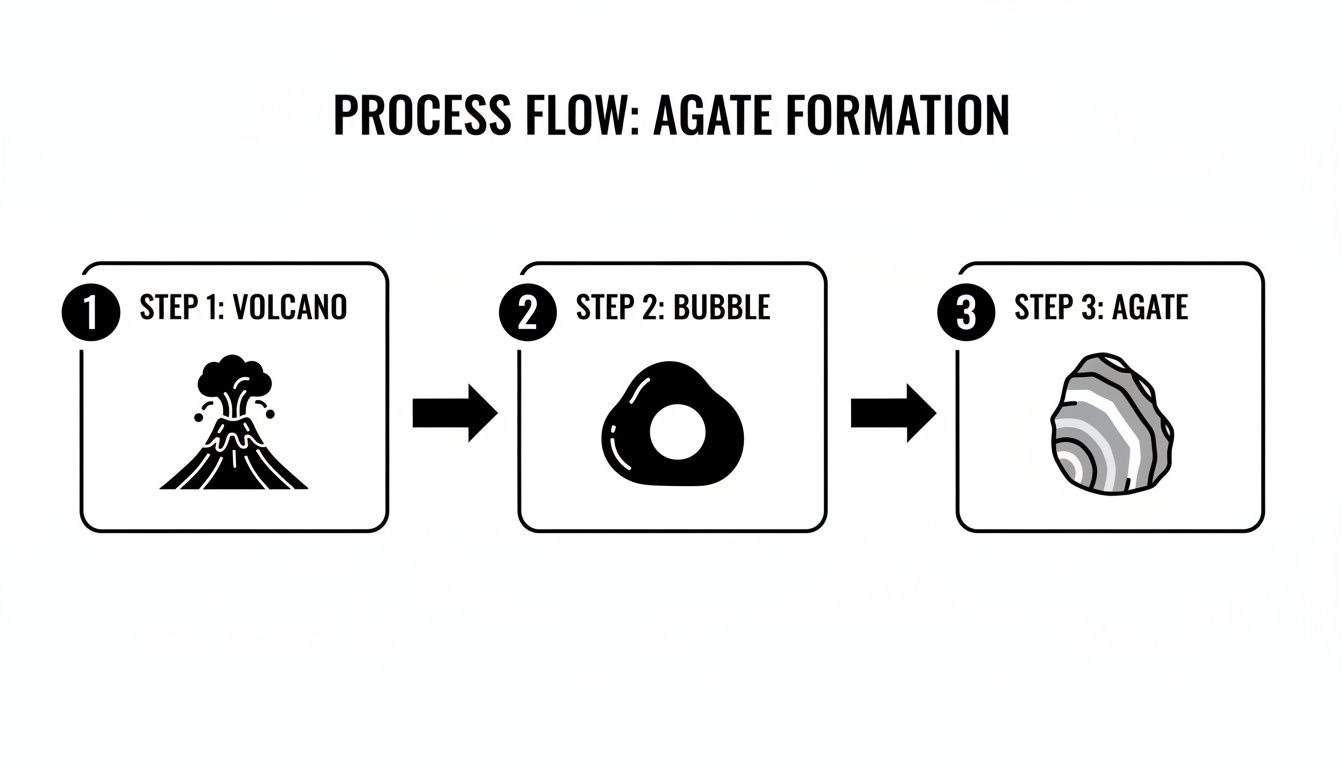
This visual guide breaks down how agate is made, from its volcanic origins to the beautiful, layered crystal we see today.
As the diagram shows, agate doesn't just appear overnight. It's a slow, methodical process where an empty volcanic cavity gets filled, layer by microscopic layer, over millions of years.
The Fiery Heart of Carnelian Agate
One of the most famous varieties to come out of Madagascar is Carnelian Agate, loved for its gorgeous spectrum of red and orange. These warm, fiery colors aren't just for show; they come from iron oxide impurities that were present in the silica-rich water that created the stone. The amount of iron dictates the final color, which can range from a soft, peachy orange to a deep, dramatic blood-red.
Unlike agates known for their sharp, defined bands, Carnelian from Madagascar often has a more uniform or cloudy appearance. Its real beauty is in its rich, translucent depth—it seems to glow from within when you hold it up to a light source. To get a better feel for the subtle differences, it's worth reading up on Carnelian vs. Red Agate.
Its consistent color and solid durability (around 6.5 to 7 on the Mohs scale) make it a go-to choice for cabochons, beads, and polished decorative pieces.
The Captured Landscapes of Moss and Flower Agate
Moving away from solid colors, we find Moss and Flower Agates, which contain entire worlds within them. These aren't your typical banded agates; their patterns are created by mineral inclusions that were trapped as the stone formed.
Moss Agate: This type is filled with dendritic (tree-like) inclusions of manganese or iron oxide. These dark minerals snake through the clear or milky chalcedony, creating patterns that look like tiny sprigs of moss, seaweed, or miniature forests locked in stone. No two pieces are ever alike.
Flower Agate: A relatively new find from Madagascar, Flower Agate is defined by its beautiful plume-like chalcedony inclusions. These formations, usually in soft pinks and whites, look just like blossoms or flower petals suspended inside the stone. These "flowers" aren't a different mineral—they're just a unique growth pattern of the chalcedony itself.
First discovered in 2018, Flower Agate is especially prized for its delicate, almost feminine patterns. The three-dimensional floral plumes create a sense of depth and softness you won't find in any other agate.
These inclusion-rich agates are treasured for their sheer artistry. They are often cut and polished specifically to showcase their internal scenery, making each one a true work of natural art. Looking at a polished agate slice is a great way to see these incredible patterns revealed.
Key Varieties of Agate from Madagascar
To help you quickly identify what you're looking at, this table breaks down the key features of the most popular agate types found in Madagascar. It's a handy reference guide for collectors and enthusiasts alike.
Variety Name
Primary Colors
Distinctive Features
Common Uses
Carnelian Agate
Orange, red, brown
Translucent, uniform, or cloudy color
Cabochons, beads, carvings
Moss Agate
Clear, milky, green
Dendritic (tree-like) mineral inclusions
Slabs, decorative spheres, pendants
Flower Agate
Pink, white, clear
Plume-like "floral" chalcedony inclusions
Palm stones, towers, spheres
Ocean Jasper
Green, pink, yellow, red
Orbs, swirls, and bulls-eye patterns
Spheres, freeforms, jewelry
Each of these varieties tells a different part of Madagascar's geological story. Whether you're drawn to the warmth of Carnelian or the intricate scenes in Moss Agate, you're holding a unique piece of the island's history.
The Orbs and Swirls of Ocean Jasper
While technically an orbicular chalcedony rather than a classic banded agate, Ocean Jasper is a famous and closely related stone found only in Madagascar. It's known for its wild, multi-colored spherical patterns, or "orbs," that pop against a contrasting background. These orbs can be green, pink, red, white, or yellow, often swirling together in combinations that look like an abstract seascape.
Those distinctive orbs are formed through a process called spherulitic crystallization, where silica fibers grow outward from a central point. Each orb is a tiny snapshot of the unique mineral chemistry present at the very moment it formed. The original mining locations have since been depleted, making authentic Ocean Jasper increasingly rare and valuable to collectors who love its whimsical patterns and joyful energy.
How to Buy Authentic Madagascar Agate
Navigating the market for agate madagascar can feel like a treasure hunt. With a little know-how, though, you can learn to spot a genuine piece with confidence. It’s not just about dodging fakes; it's about learning to appreciate the subtle details that make each stone a one-of-a-kind natural wonder.
Your first lesson is learning to "read" the color. Natural Madagascar agate is famous for its warm, earthy palette—think deep reds, fiery oranges, and soft pinks that blend into one another seamlessly. There’s an organic, almost watercolor-like quality to the color transitions that artificial dyes just can't get right.
So, if you spot a stone with screamingly bright, perfectly uniform colors—especially electric blues, intense purples, or neon greens—consider it a major red flag. Dyes create an unnaturally even look and often bleed into tiny cracks, giving themselves away under a close look.
Spotting Natural Features
Beyond the color, the real story of an agate is written inside the stone. Genuine pieces are almost never flawless. They carry the history of their violent volcanic birth and slow, patient formation in the form of inclusions, fractures, and other beautiful imperfections.
Here’s what to look for as signs of a real stone:
Subtle Banding: The bands in natural agate will have slight shifts in their translucency and color depth. They’re rarely perfectly symmetrical, which speaks to the beautifully chaotic way they were formed.
Characteristic Inclusions: Don't be turned off by tiny mineral deposits or internal fractures. These aren't flaws; they're the stone's birthmarks and a hallmark of authenticity.
Translucency Test: Hold the agate up to a light. A genuine piece will usually let some light filter through its layers, revealing a stunning internal depth. Dyed stones, on the other hand, often look flat and opaque.
The key thing to remember is that nature rarely draws in perfectly straight lines or uses unnaturally vibrant colors. It's the subtle imperfections and gentle color shifts that guarantee you’re holding a real piece of Earth’s history.
Getting a feel for these visual cues is your best tool for making a smart purchase and building a collection that’s grounded in genuine natural beauty.
Understanding Quality and Price
Once you’ve confirmed a piece is the real deal, the next step is figuring out its quality. Not all authentic Madagascar agates are created equal, and several factors separate a simple decorative rock from a true collector's gem. Knowing what to look for helps you understand what you're paying for.
The price of Madagascar agate can swing wildly, from just a few dollars for a small tumbled stone to hundreds or even thousands for a large, top-tier sphere or slab. It all boils down to a mix of clarity, color, pattern, and the skill of the person who shaped it. If you're just starting out, browsing a curated selection of minerals is a great way to get a benchmark for quality and price.
Key Quality Factors to Consider:
Clarity and Translucency: The best pieces often have a beautiful translucency that lets light pour in and illuminate the patterns inside. Stones that look opaque or "muddy" are typically less valuable.
Color Saturation and Rarity: Deep, rich, and naturally vivid colors are always in demand. While the classic fiery reds and oranges are beloved, you might find that rarer pastel pinks or multi-hued specimens fetch higher prices.
Pattern Complexity and Sharpness: The most coveted agates show off sharp, intricate, and well-defined bands. "Fortification" patterns (think concentric castle walls) or unique inclusions like those in Moss or Flower Agate can add serious value.
Size and Form: It goes without saying that larger pieces without major fractures are harder to come by. The shape matters, too. A perfectly polished sphere or a masterfully cut freeform sculpture requires more work and skill, which adds to its cost.
Ultimately, the best advice is to buy from someone you trust. A reputable dealer will stand by their specimens' authenticity, give you clear information on the stone's origin, and be upfront about any treatments. That peace of mind is invaluable, letting you invest in a piece of agate madagascar knowing its beauty is as real as its story.
Understanding Ethical Sourcing in the Agate Market
When you hold a piece of agate madagascar, you're connecting with a stone that has traveled from deep within the earth to your hands. But that journey is about more than just geology; it's a human story, too. Understanding that story is what ethical sourcing is all about—ensuring the path from the mine to you is fair, responsible, and sustainable for everyone involved.
The agate trade in Madagascar doesn't look like a massive industrial operation. Instead, it’s mostly driven by artisanal and small-scale mining (ASM), where local miners and small family groups extract stones using simple, hands-on methods. This creates a really unique situation with its own set of challenges and opportunities.
For many rural communities, this work is an absolute economic lifeline, often the only source of income available. At the same time, without the oversight of a big corporation, things like fair pay and environmental care can become real challenges.
The Realities of Artisanal Mining
Artisanal mining is a complex world. It can empower local economies, but it needs a genuine commitment to responsible practices to be truly sustainable. The goal isn't to shut down this vital trade—it's to support and improve it. We want to make sure the people at the very beginning of the supply chain are treated fairly and the land they work is respected.
For collectors, getting a handle on these ethical questions is more important than ever. It ties right into the bigger conversations we're all having about responsible buying and sustainable travel practices. Suddenly, your purchase isn't just a transaction; it's a meaningful vote for a better way of doing business.
In the context of Madagascar agate, true ethical sourcing is all about transparency. It means finding suppliers who build direct, lasting relationships with the miners on the ground—ensuring fair wages, safer conditions, and a real effort to minimize their environmental footprint.
This approach isn't about finding a perfect system, but about striving for positive change within the system that exists. It’s a way to connect your passion for these incredible stones with a tangible, positive impact on the communities that bring them to light.
Why Transparency Is Your Best Tool
As a buyer, you have more power than you think. Your best tool? Asking questions. A good, reputable vendor won't hesitate to talk about their sourcing and their relationships with the communities they partner with. That kind of openness is the hallmark of a business that truly takes its ethical responsibilities seriously.
Try to find suppliers who can give you straight answers about:
Direct Relationships: Do they work directly with the miners or local co-ops, or are there a dozen middlemen in between? Direct relationships usually mean more money stays in the local community.
Community Support: Are they involved in any projects that give back, like supporting local schools or community infrastructure?
Fair Compensation: Can they confidently say they pay fair, living wages for the stones they buy?
The agate market in Madagascar has had its ups and downs, which really shows how fragile this industry can be. According to USGS data, the country's agate output fell by an estimated 33% between 2013 and 2017 as easily accessible surface deposits started to run out. That’s a stark contrast to 2010, when extraction had previously exploded by a staggering 300%.
For serious collectors, this volatility is a reminder of just how valuable it is to find ethically sourced agate madagascar from suppliers who are in it for the long haul and committed to sustainable practices.
Taking Care of Your Madagascar Agate
Your Madagascar agate is a tough piece of natural history, forged in ancient lava flows. Clocking in at a respectable 6.5 to 7 on the Mohs scale, it’s more than capable of handling everyday life. But to keep those incredible colors and patterns looking their best for years to come, a little bit of care goes a long way.
The best part? Keeping your agate madagascar in top shape doesn't require any complicated routines or harsh chemicals. In fact, the simplest methods are usually the safest and most effective.
The Right Way to Clean Your Agate
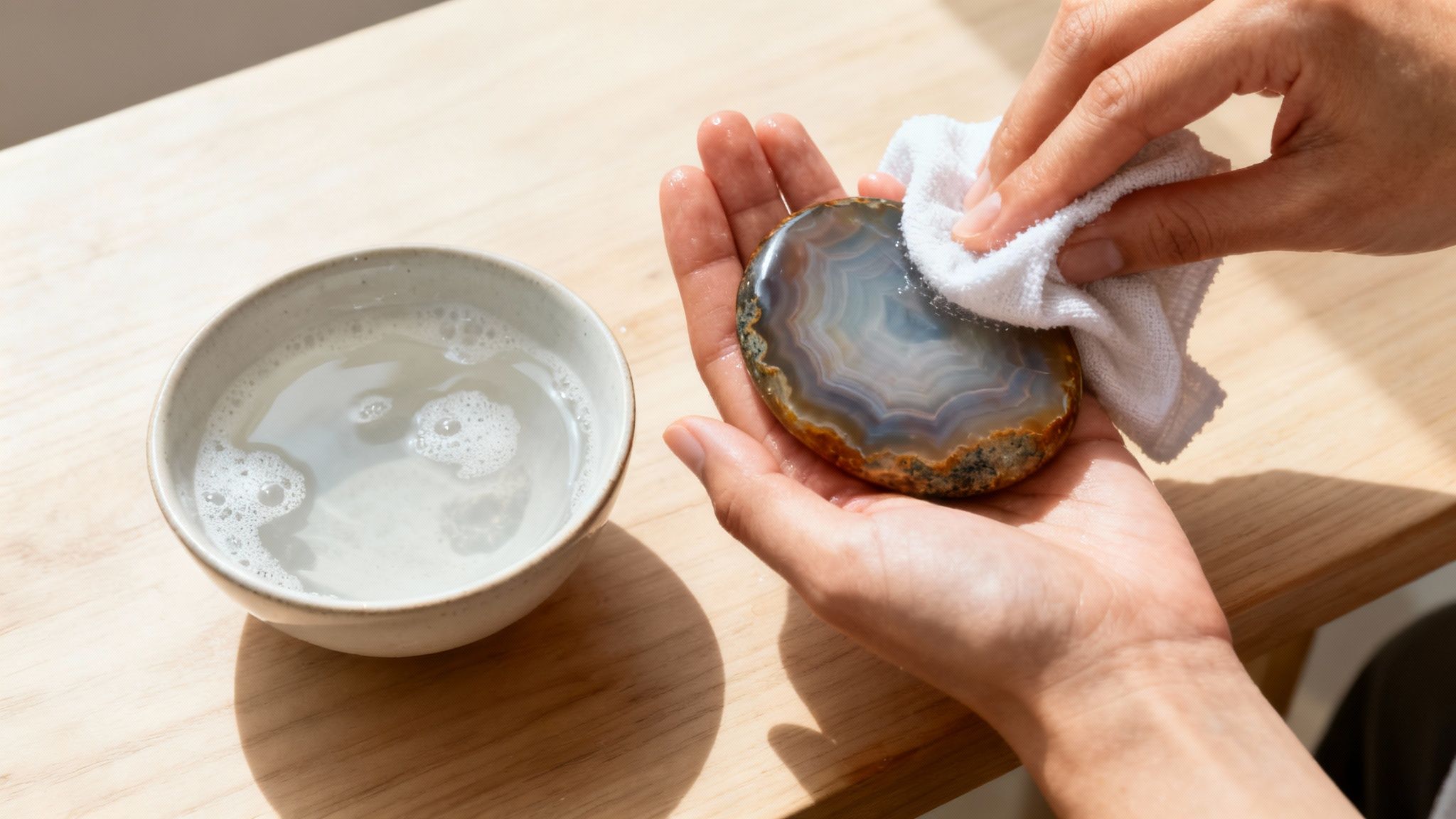
When it comes to cleaning, think gentle. The absolute best way to do it is with a simple solution of mild soap and warm water. It’s tempting to reach for something stronger, but abrasive cleaners, ultrasonic gadgets, and chemical solutions can easily damage the polished surface or creep into tiny, invisible fissures, dulling the stone’s beauty over time.
Just follow these easy steps for a safe and effective clean:
Mix a Gentle Solution: Add a couple of drops of mild dish soap to a bowl of warm water.
Wipe It Down: Dip a soft, lint-free cloth into the soapy water and gently wipe the agate's surface.
Rinse Well: Use a new cloth dampened with plain water to wipe away any leftover soap.
Dry Completely: Pat the stone dry with a clean, soft towel. This prevents water spots from forming on that beautiful polish.
A word of caution: Never use household chemicals like bleach, ammonia, or anything acid-based on your agate. These are far too harsh and can permanently etch the surface or strip away its natural luster.
This simple routine is all you need to clear away dust and fingerprints, bringing back your specimen's natural glow without risking any harm.
Storing and Displaying Your Collection
How you store and display your agate is just as crucial as how you clean it. Agate can be scratched by harder minerals like quartz, topaz, and diamonds, so it’s important to give each piece its own space.
Keep these tips in mind for safekeeping:
Store Individually: Wrap each agate in a soft cloth or tuck it into a padded pouch. This stops it from getting scratched by harder stones in your collection.
Watch the Sunlight: Agate is pretty stable, but some of the more vibrant pieces (especially color-treated ones) can fade with too much direct sunlight. It’s best to display your collection away from windows that get intense, all-day sun.
By following these straightforward tips, you’re ensuring your agate madagascar will continue to be a stunning centerpiece. Its long journey from the earth deserves to be preserved, and with just a bit of attention, its beauty will easily last a lifetime.
Answering Your Top Questions About Madagascar Agate
As you get deeper into the world of Madagascar agate, a few questions are bound to pop up. It's only natural. This last section is all about giving you clear, straightforward answers to the things collectors—both new and experienced—ask most often. Think of it as rounding out your expertise so you can build your collection with confidence.
Is Madagascar Agate a Real Gemstone?
Absolutely. Madagascar agate is a completely natural variety of chalcedony, which is a microcrystalline form of quartz. Each piece is a genuine, one-of-a-kind creation straight from the earth, formed over millions of years inside the gas bubbles of ancient volcanic rock. Those vibrant colors and intricate bands? They're a direct result of the unique mineral cocktail found in Madagascar's soil.
How Can I Tell If My Agate Is Dyed?
Natural Madagascar agate is celebrated for its warm, earthy tones—think rich reds, oranges, and pinks that often blend together subtly. If you see unnaturally bright, electric colors like neon blue, purple, or a shocking green, that’s a major red flag for dye. Dyed stones also tend to have a flat, uniform color, and you might spot dye concentrated in tiny cracks if you look closely.
The thing to remember is that genuine, high-quality agate rarely needs any help. Its subtle imperfections and natural color shifts are what make a piece authentic and valuable in the first place.
What Makes Madagascar Agate Valuable?
Several factors come together to determine its value, creating a huge range from affordable tumbled stones to high-end collector's pieces.
Color and Pattern: Specimens with deep, saturated colors and sharp, complex banding are always the most sought-after.
Clarity and Translucency: The ability of a stone to let light pass through it, revealing its internal depth, adds significant value.
Size and Condition: It’s simple—larger pieces without major fractures are rarer and therefore more valuable.
Origin: Knowing that a piece comes from a specific, reputable source in Madagascar adds to its story and, by extension, its worth.
Why Is Agate from Madagascar So Popular?
The buzz around Madagascar agate is tied to its fairly recent explosion onto the international market. It's a "newer player" on the scene, and collectors prize its agates for their vivid colors—especially the pinks and reds—and striking patterns you just don't see anywhere else. In major markets like the U.S. and Europe, Madagascar agate is grabbing a growing share of the $100+ million annual agate trade, showing up everywhere from handcrafted jewelry to high-end home décor. For a deeper dive into its economic and geological story, the USGS mineral reports are a great resource.
Is It Safe to Put Agate in Water?
Yes, agate is generally safe to clean with water. It’s a durable stone, ranking 6.5 to 7 on the Mohs scale of hardness, so it won’t dissolve or get damaged by a quick wash with mild soap and water. That said, it's best to avoid leaving it to soak for a long time, especially in salt water or water with harsh chemicals, as that could potentially dull its beautiful polish over time.
Here at Astro West, we believe every mineral tells a story. We invite you to explore our carefully curated collection of ethically sourced Madagascar agates and other natural treasures, where each one is a unique piece of geological art. Start your collection today at Astro West