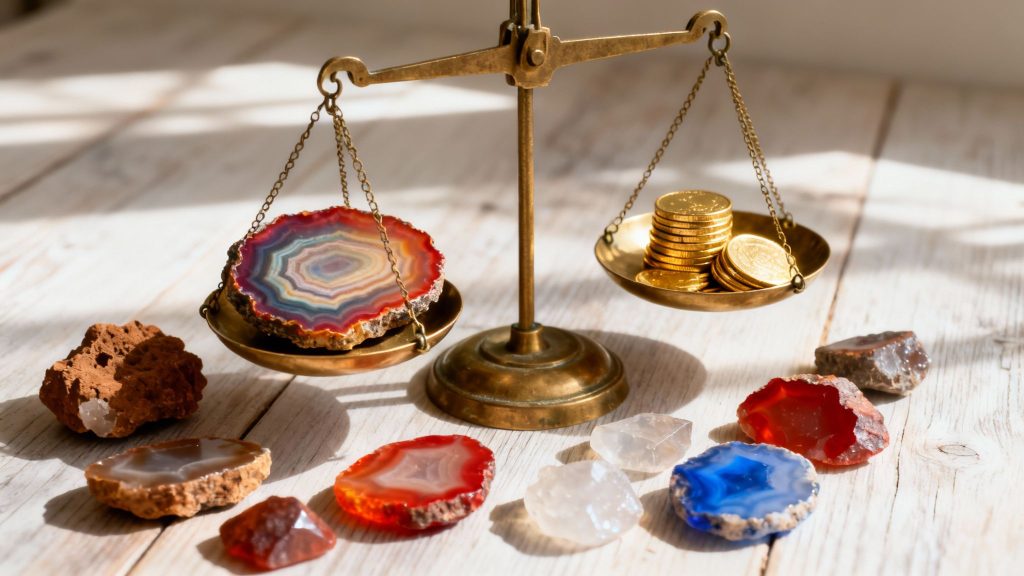
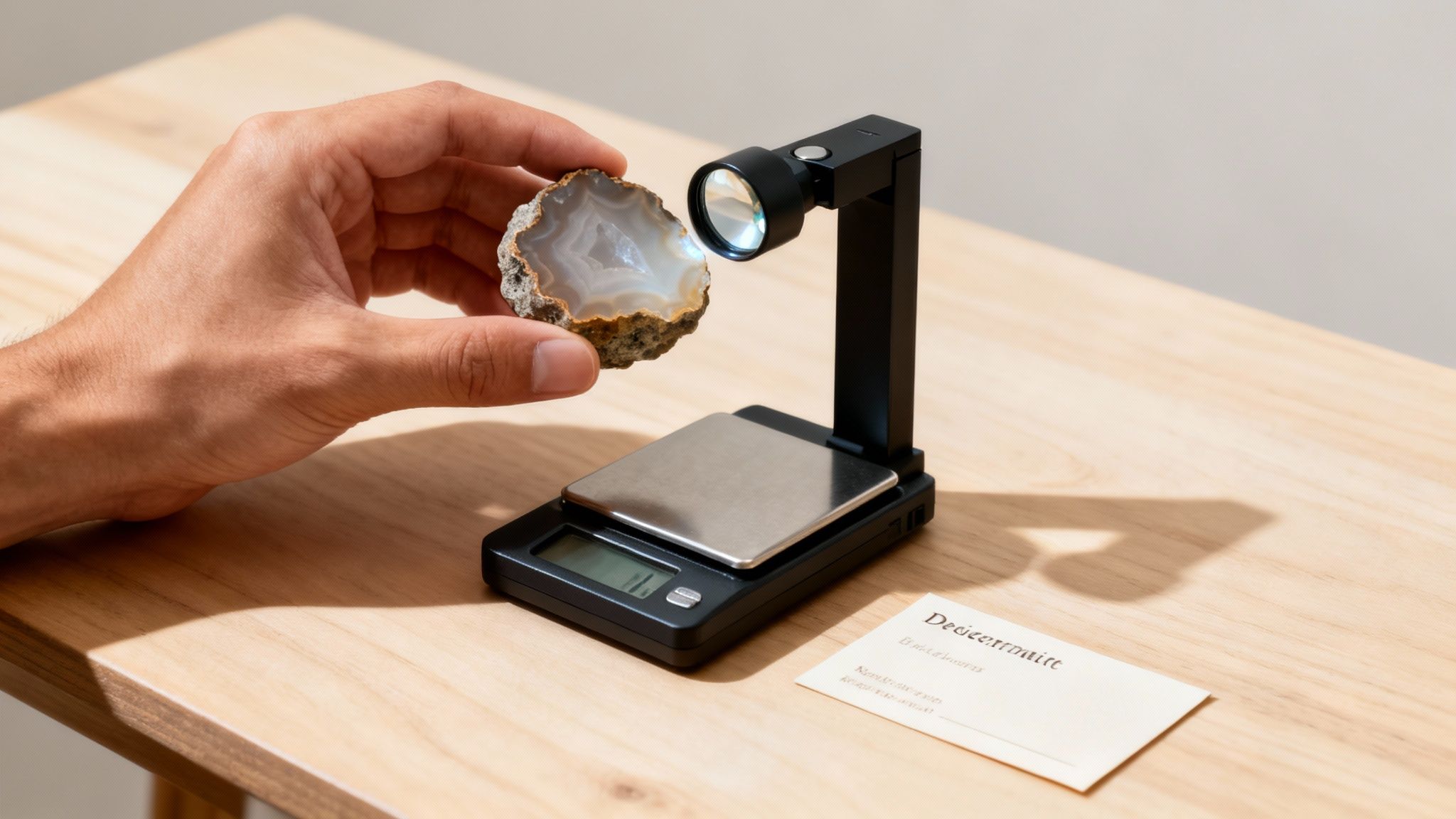
Trying to pin down the price of an agate nodule can feel a lot like pricing a piece of abstract art. A small, seemingly ordinary stone might fetch $10, while another of the exact same size could easily sell for $1,000 or more. It all comes down to a fascinating blend of natural artistry, sheer rarity, and the skill of the human hand that finished the piece.
You're essentially decoding a stone's hidden story, where every single band, color, and inclusion adds a chapter to its unique value.
How Agate Nodules Are Valued
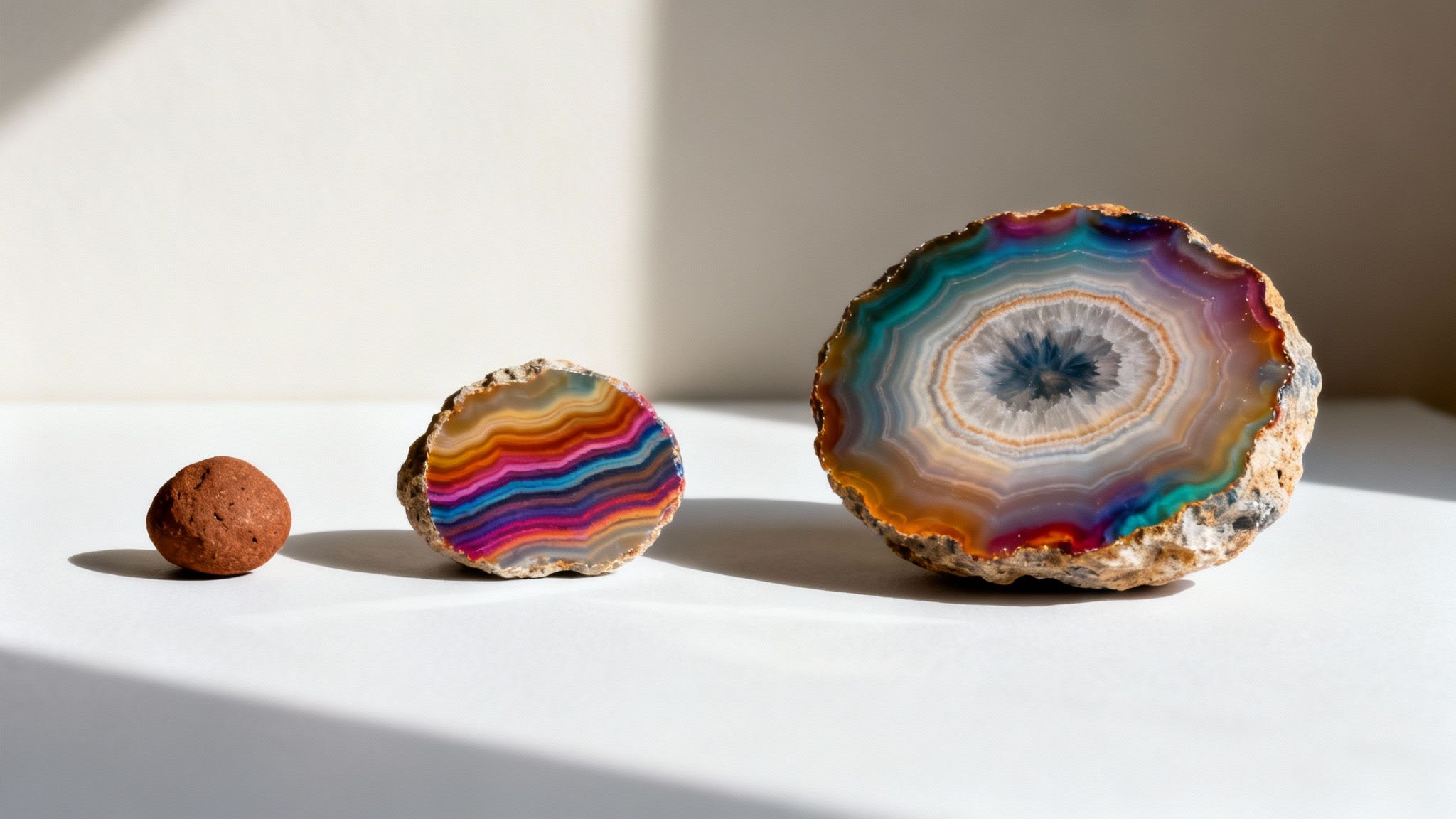
Think of an agate nodule as a natural treasure chest. On the outside, it's often a lumpy, unassuming rock, but inside lies a hidden world of breathtaking patterns. Its journey started millions of years ago in a hollow cavity of volcanic rock, which slowly filled with silica-rich water. Layer by microscopic layer, that process built up the incredible bands and formations that make agates so famous.
Because of this, you can't just weigh an agate on a scale to find its worth. Each nodule is a one-of-a-kind creation, and its price tag is a reflection of that individuality. A keen eye for detail is just as important here as it is with any other collectible, and it's key to understanding what makes collectibles valuable and spotting a true gem.
To give you a starting point, here’s a quick look at what you can generally expect to pay for different grades and sizes of agate nodules.
Agate Nodule Price at a Glance
Nodule Grade
Typical Size/Weight
Estimated Price Range (Uncut)
Estimated Price Range (Cut & Polished)
Collector Grade
3–6 inches
$50 – $300+
$150 – $1,000+
High-Quality Decor
4–8 inches
$20 – $100
$75 – $500
Standard/Tumbling
1–3 inches
$5 – $25
$15 – $60
Of course, these are just ballpark figures. A truly exceptional collector-grade piece with rare features could easily command a price far beyond these estimates.
From Humble Rock to Prized Gem
The journey from a plain-looking rock to a polished masterpiece is where an agate’s value is truly unlocked. A nodule’s potential is just a guess until it’s cut open to reveal the beauty inside. The most important factors driving its price are:
Size and Weight: While bigger can sometimes be better, quality almost always beats sheer size. A massive, plain nodule will often be less valuable than a smaller one with a spectacular, jaw-dropping pattern.
Pattern and Banding: The complexity of the internal patterns is a huge value driver. Think fine, parallel lines, dramatic plumes, or mesmerizing mossy inclusions—these are what collectors hunt for.
Color and Saturation: Vibrant and rare colors like deep reds, blues, and greens will always command higher prices than the more common, earthy tones.
Origin: Nodules from famous or depleted locations, like certain mines in Mexico or Oregon, carry a premium. Their rarity and history add a whole other layer of value.
The transition from humble stone to sought-after art has fueled some serious market growth. The global agate market, currently valued at $10.4 billion, is projected to hit $21.9 billion by 2035, which is a clear sign of its rising star status.
Ultimately, valuing an agate is about appreciating both its raw, natural beauty and the skill it takes to bring it to light. Whether it’s a rough specimen straight from the earth or a perfectly polished agate slice ready for display, each piece tells a unique geological story that earns it a place in a collection.
The Four Core Factors That Determine Price
An agate nodule's final price is a story told by four distinct chapters: its physical presence, its internal color palette, the complexity of its patterns, and the quality of its composition. While it’s tempting to assume that the biggest stone is always the most valuable, the reality is far more nuanced. These four core factors work in tandem, creating a unique valuation for every single specimen.
Understanding how these elements interact is the key to recognizing true value, whether you're admiring a small, intricate piece or a massive, decorative stone. A serious collector might prioritize a rare pattern over sheer size, while an interior designer may be hunting for bold color and scale. Let's break down each of these pillars to see how they build an agate's final price tag.
Size and Weight
The first and most obvious factor is an agate's size and weight. As a general rule, larger nodules are rarer and therefore more valuable, but this relationship isn't a simple straight line. Instead, the value often grows exponentially with size, especially when that size is matched with high quality.
Think of it like this: finding a one-pound, decent-quality agate nodule is relatively common. Finding a ten-pound nodule of the same quality is significantly harder. But unearthing a massive, fifty-pound nodule with exceptional color and pattern? That’s an event of geological rarity. That exponential jump in scarcity creates a similar leap in price.
A key takeaway for buyers is to look for the sweet spot where size meets quality. A hand-sized nodule with a spectacular internal scene can easily be worth more than a boulder-sized one with murky, uninteresting banding.
Color and Saturation
Color is where an agate’s personality truly shines through, and it's a huge driver of its price. The most common agates display earthy tones—shades of brown, gray, and white. While beautiful in their own right, their abundance keeps their prices modest. The real value is found in the rare and unexpected hues.
Vivid, highly saturated colors are prized by collectors and designers alike. Take, for example, the fiery reds and oranges of a classic Fire Agate or the deep, rich blues found in certain regional varieties—these can elevate a nodule’s price significantly.
Here’s how color saturation tends to impact value:
High Value: Intense, naturally occurring reds, blues, purples, and vibrant greens.
Mid Value: Clear, well-defined oranges, yellows, and blacks.
Lower Value: Muted or muddy browns, grays, and faint, washed-out tones.
A word of caution: many brightly colored agates on the market are dyed. According to the Gemological Institute of America (GIA), chalcedony's porous nature makes it easy to enhance with dyes. Reputable dealers will always disclose treatments, but unnaturally uniform and electric colors can be a red flag for artificial enhancement.
Pattern and Banding
Beyond color, the internal pattern—the artistry of the stone—is perhaps the most critical factor in determining an agate nodule price. This is where a simple stone transforms into a natural masterpiece. The complexity, rarity, and aesthetic appeal of its bands and inclusions separate common specimens from investment-grade treasures.
A simple, concentric banded agate is the most common formation you'll see. While classic and attractive, it just doesn't command the high prices of more elaborate patterns. It's the difference between a simple line drawing and an intricate painting.
Exceptional patterns that really drive up value include:
Plume Agates: Featuring delicate, feather-like inclusions that seem to float within the stone.
Dendritic Agates: Displaying tree-like or fern-like branching patterns, often creating miniature black-and-white landscapes.
Lace Agates: Known for their intricate, swirling bands and complex, web-like designs.
Scenic or Picture Agates: The rarest of all, these nodules contain inclusions that form recognizable landscapes, complete with horizons, trees, and lakes.
A nodule with a perfect, museum-quality scenic inclusion is exceptionally rare and can fetch prices thousands of times higher than a simple banded agate of the exact same size.
Clarity and Inclusions
Finally, clarity and the nature of any inclusions play a vital role. In agates, clarity refers to translucence—how well light passes through the stone. A high degree of translucency can make the colors and patterns appear more vibrant and three-dimensional, adding to the stone’s allure and, of course, its value. Opaque or "muddy" agates that obscure the internal patterns are generally less desirable.
Inclusions, which are other minerals trapped within the agate as it formed, can either add or detract from the value. Unattractive, distracting specks or internal fractures will lower the price. But as we saw with plume and dendritic agates, the right kind of inclusions can be the star feature that defines the stone's beauty and rarity, making it a highly sought-after collectible.
Why Origin and Rarity Command Premium Prices
While color and pattern give an agate its personality, origin and rarity give it a pedigree. Think of it like fine wine—the specific place an agate comes from, its "terroir," tells a story that can’t be replicated anywhere else. The unique mix of minerals, temperatures, and pressures in a location creates a signature in the stone.
This history, or provenance, is something collectors and experts get really excited about. An agate from a famous or historically important location automatically carries more weight. That's why nodules from places like Brazil, Mexico, Oregon, and Madagascar are so sought after—it's not just about their beauty, but the legacy of where they were born.
Legendary Locations and Market Scarcity
Certain locations have earned legendary status in the agate world. The mines there produced stones of such incredible and consistent quality that they set the standard for everyone else. But here's the catch: many of these classic spots are now completely mined out or have tight restrictions, making their agates incredibly scarce.
This is the classic recipe for high value: historical importance plus a dwindling supply. When a famous mine closes, the agates already in circulation become finite treasures. It’s no surprise that their prices can skyrocket as collector demand massively outpaces what's available, turning them into appreciating assets.
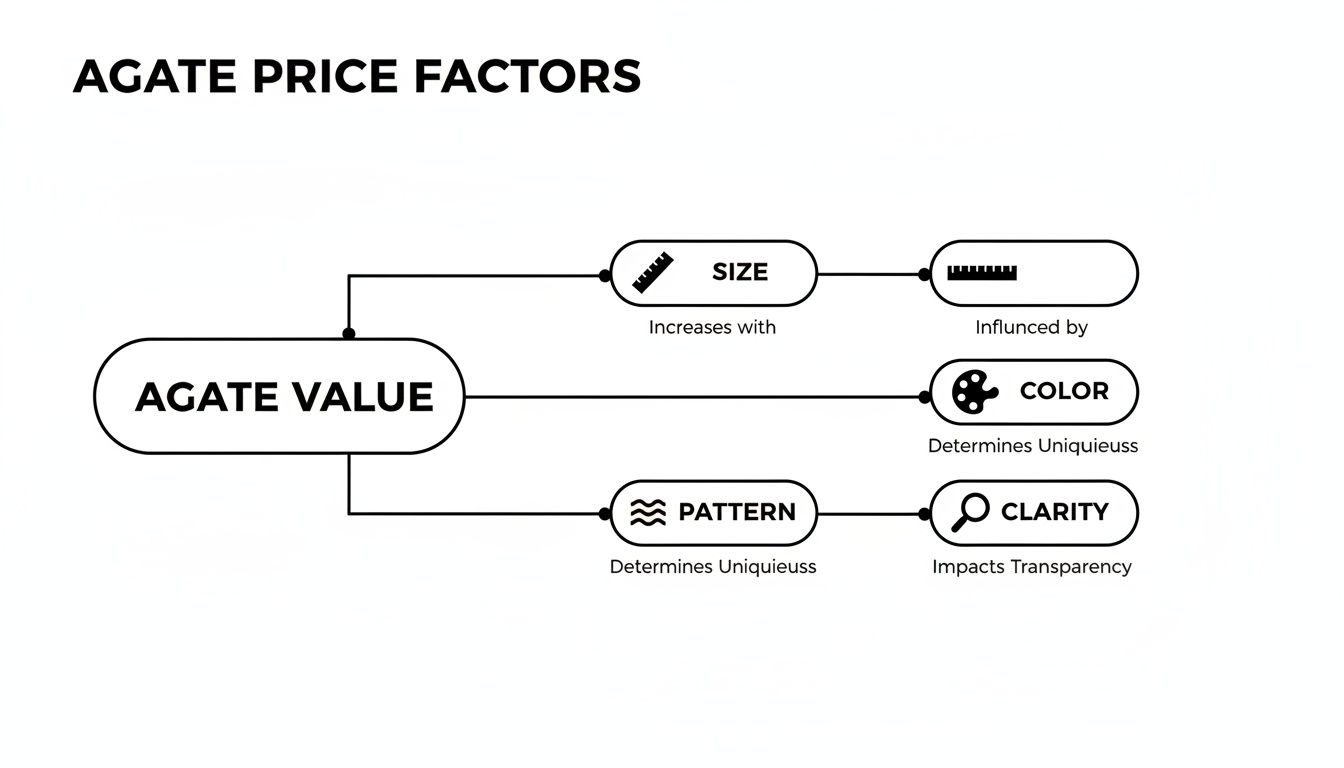
The chart below breaks down the key factors that feed into an agate's price, from its size and color to its pattern and clarity.
As you can see, it's never just one thing. You have to look at all these elements together to really understand a nodule's market worth.
A Case Study in Rarity: The Laguna Agate
If you want a perfect example of how origin and rarity drive price, look no further than the Laguna Agate from Chihuahua, Mexico. Famous for its impossibly tight, vibrant bands and a stunning 3D parallax effect, the Laguna is considered one of the finest agates on the planet. For decades, they were plentiful. Not anymore.
Key mining claims are now closed or heavily restricted, and the supply of top-tier Laguna has slowed to a trickle. This scarcity has sent prices through the roof among collectors who treasure these historic pieces.
The numbers don't lie. A top-quality Laguna Agate that might have gone for $60 per pound a few decades ago can now easily fetch $200-$300 per pound—and sometimes even more for the best rough. It's a fascinating journey from an accessible find to a coveted collectible.
How Provenance Influences Your Purchase
Knowing an agate's backstory is crucial to understanding its full value. When you buy a nodule with a known provenance, you're not just getting a pretty rock; you’re holding a piece of geological history. This is exactly why sellers will make a point of naming the mine or region, especially for high-end specimens.
Here's what to keep in mind when it comes to origin:
Classic vs. New Finds: Agates from classic, depleted locations (like certain old picture agate mines in Oregon) will almost always command a higher price than similar-looking stones from new, active deposits.
Regional Characteristics: Experts can often pinpoint an agate's origin just by its signature look. The tight fortification patterns of a Fairburn Agate from South Dakota, for instance, are unmistakable compared to the wild beauty of a Brazilian Agate.
Ethical Sourcing: Knowing the origin also gives you peace of mind. A reputable dealer can confirm a stone was sourced ethically and legally, which adds another layer of value and trust to your purchase.
Whether you’re eyeing a statement piece for your living room, like a stunning agate dish with druzy from Madagascar, or a small gem for your collection, its origin matters. It connects the stone to a time and a place, turning it from a simple object into a storied artifact. Ultimately, that story is a huge part of the agate nodule price.
How Lapidary Art Unlocks a Nodule's Value
A rough agate nodule is like a geological lottery ticket. Its true value is completely hidden until a skilled lapidary artist makes that first, crucial cut. The transformation from a dull, lumpy rock into a gleaming work of art is where an agate’s potential is finally realized.
This process is far more than just slicing stone; it's an art form that can multiply an agate nodule price by five to ten times.
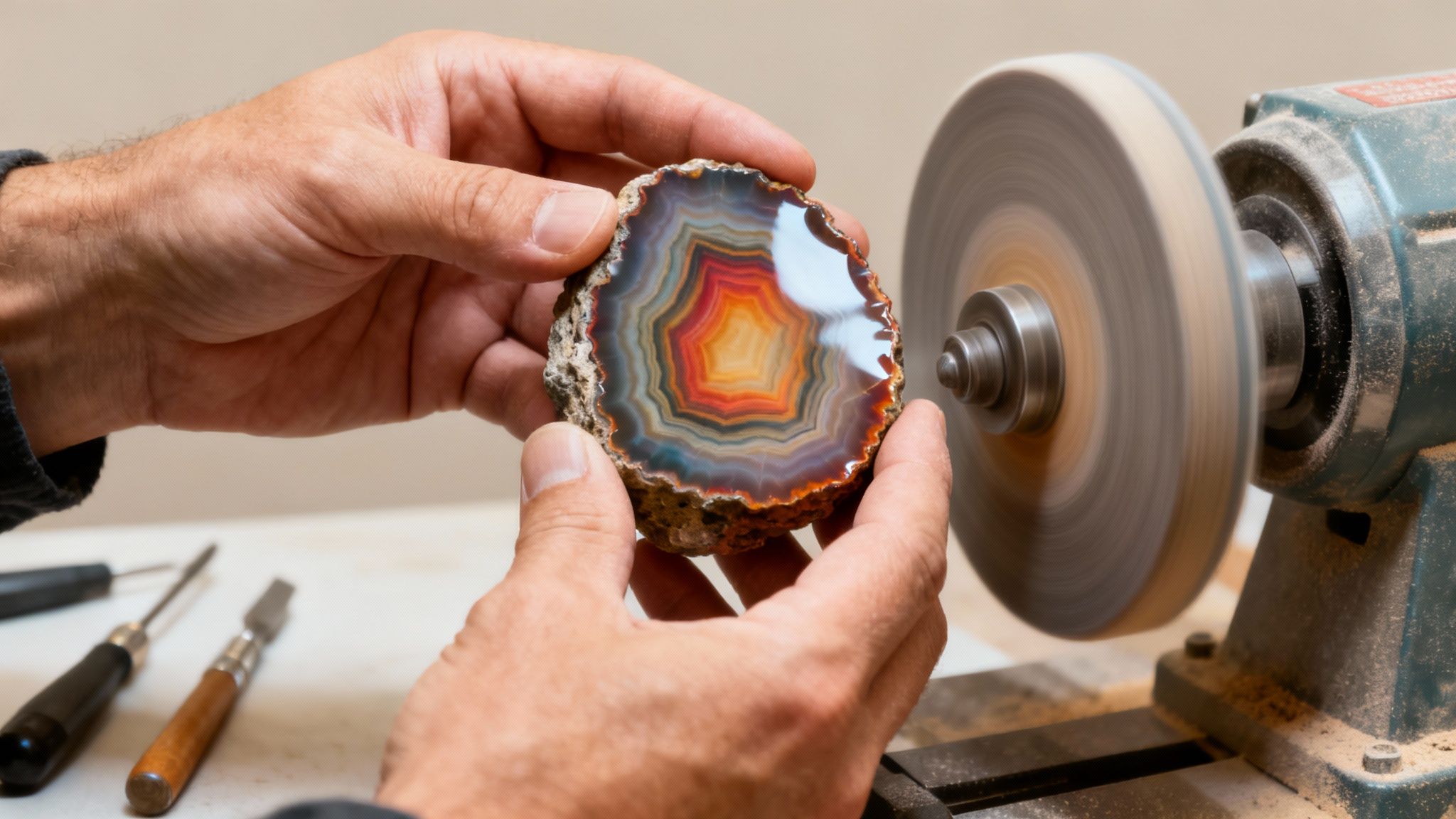
Expert lapidaries don't just put a rock on a saw. They meticulously study its exterior, searching for subtle clues—faint color lines, odd textures, slight bulges—that hint at the pattern's orientation deep inside. Their goal is to "read" the stone and decide on the perfect cut to expose its most breathtaking scene. It's a skill that takes years of practice to master.
That initial decision is everything. A single, well-placed cut can reveal a stunning landscape pattern, while a cut just an inch off might result in much less interesting, common banding. The artistry involved directly translates to market value.
From Rough Stone to Polished Gem
The journey from a raw nodule to a finished piece involves several key stages, and each one adds another layer of value. A lapidary has to navigate these steps with precision, as a mistake at any point can seriously diminish the stone’s final worth.
The fundamental steps are pretty straightforward:
Slab Sawing: The nodule is first cut into slabs of varying thicknesses. This is the big reveal—the first real look inside that helps the artist plan the next shapes.
Trimming and Shaping: Slabs are then trimmed into "pre-forms" for their final shape, whether that's a cabochon for jewelry, a freeform display piece, or a perfect sphere.
Grinding: Using a series of progressively finer diamond wheels, the artist grinds the stone to its exact shape, smoothing out saw marks and refining the contours.
Sanding and Polishing: This final, multi-stage process uses finer and finer abrasives to bring out the stone's natural luster, creating that glass-like finish that makes the colors and patterns pop.
The quality of the polish is a massive price factor. A flawless, high-gloss "wet look" finish that reflects light perfectly is the hallmark of expert craftsmanship. It will always command a much higher price than a piece with a dull or scratched surface.
How Different Cuts Affect Price
The final form of a polished agate has a huge impact on its price, since different shapes require varying levels of skill, time, and material. Some cuts are designed to maximize the raw stone, while others prioritize showcasing a specific pattern, even if it means sacrificing more of the original nodule.
Slabs: Cutting a nodule into polished slabs is one of the most common methods. The value of a slab depends entirely on its size, the pattern it reveals, and the quality of its polish.
Spheres and Eggs: These shapes are surprisingly difficult to create perfectly and result in a ton of material waste, which drives up their cost. A flawlessly round sphere with a beautifully centered pattern is a high-value item for any collector.
Bookends: A nodule cut perfectly in half to create a matching pair of bookends is a classic decorative choice. The symmetry and pattern continuity between the two halves are what make or break their value.
Custom Shapes: Freeform sculptures and intricate carvings, like a hand-carved agate bowl, represent the highest level of lapidary artistry. These unique pieces are priced based on the complexity of the design and the artist's reputation, often fetching premium prices.
A Practical Guide to Buying Agate Nodules
So, you’ve learned what drives an agate nodule price, and now you’re ready to bring one home. Whether you're clicking through an online gallery or standing in a mineral shop with a stone in your hand, the trick is to assess each piece with a sharp, critical eye. This advice comes from years of experience and will help you inspect for quality, set a realistic budget, and feel confident you’re investing in a piece you’ll love for years to come.
First things first: what's your goal? Are you looking for a stunning, oversized nodule to anchor a bookshelf, or are you hunting for a rare, investment-grade specimen for a serious collection? Answering that question will completely change your budget and what features you should be looking for.
Collector Grade vs Decorator Grade Agate Nodules
It’s crucial to understand that not all agates are created equal. Knowing the difference between "decorator" and "collector" quality is the key to buying smart. Decorator-grade pieces are all about visual punch—they’re chosen for their size, attractive colors, and general aesthetic appeal. They are perfect for adding a touch of natural art to a room.
Collector-grade nodules, on the other hand, play in a different league entirely. Here, rarity is king. Factors like a historically significant origin, an exceptionally rare internal pattern, or a flawless, natural composition are what matter most. These are the specimens that become investments, often appreciating over time.
This table breaks down the key differences to help you figure out what's right for you.
Feature
Collector Grade
Decorator Grade
Primary Value Driver
Rarity, provenance, and unique patterns (e.g., plumes, scenes).
Aesthetic appeal, size, and vibrant color.
Color
Natural, nuanced colors from a known locality are prized.
Often features bright, saturated colors, which may be dyed.
Pattern
Complex, well-defined, and rare internal structures.
Bold, simple patterns like concentric bands are common.
Price Point
Can range from hundreds to many thousands of dollars.
Generally more affordable, focusing on visual impact over rarity.
Knowing these distinctions helps you filter your options and pay for the qualities that truly matter to you, whether that's jaw-dropping beauty for your living room or a rare geological treasure for your display case.
What to Look For Before You Buy
When you have a nodule in hand, a careful inspection is your best friend. The little details can tell you everything about a stone’s quality and authenticity, helping you steer clear of expensive mistakes.
Start by checking for hidden fractures. Hold the stone up to a strong light source; hairline cracks that aren't part of the natural pattern can compromise its stability and will definitely lower its value. Next, run your fingers over the surface and pay close attention to the quality of the polish. A top-tier piece should have a flawless, glass-like finish with no dull spots, pits, or scratches.
A critical question for any seller is, "Has this stone been treated?" Any reputable dealer will be upfront about enhancements like dyeing. Unnaturally vivid or uniform colors—especially those shocking pinks or electric blues—are often a dead giveaway for artificial treatment.
Key Questions to Ask the Seller
Talking with the seller is a huge part of the buying process. Their knowledge—or lack thereof—can provide the backstory and context you need to make an informed decision. The more a seller knows about their inventory, the more confidence you can have in what you’re buying.
Here are three questions I always ask:
What is the specific origin of this agate? Knowing the exact mine or region helps confirm its rarity and authenticity. A vague answer like "Brazil" isn't as good as "from the Rio Grande do Sul region."
Are there any repairs or stabilizations? Some fractured stones are stabilized with resin to make them solid. This is an acceptable practice, but it must be disclosed as it absolutely affects the value.
Can you tell me about the lapidary artist? For high-end polished pieces, knowing who cut and polished the stone can add to its story and value, just like knowing the painter of a canvas.
At the end of the day, buying an agate is a personal journey. You might be drawn to the rugged charm of a polished septarian nodule or a classic, finely banded agate. This guidance is here to make sure you choose with both your heart and your head. By inspecting carefully and asking the right questions, you can confidently invest in a piece of natural history.
A Few More Things You Might Be Wondering
To round things out, let's tackle some of the most common questions that pop up when people start collecting agate nodules. Think of this as the practical advice you'd get from a seasoned collector—the kind of stuff that helps you navigate the market with confidence and really appreciate what you're buying.
How Can I Tell If an Agate Nodule Has Been Dyed?
This is a great question, and probably the most important one for a new collector. Natural agates have an earthy, subtle beauty. Their colors are nuanced because they were created by nature, not in a lab. The first red flag is an unnaturally loud or perfectly uniform color—think electric pinks, vibrant teals, or deep, inky purples that just don't look like they came from the ground.
Another dead giveaway? Look closely at any tiny cracks or fractures in the stone. When an agate is dyed, the color often seeps into these crevices and becomes super concentrated, leaving little pools of intense pigment. It’s a tell-tale sign the color was added long after the agate formed. According to the experts at the Gemological Institute of America (GIA), the porous nature of chalcedony makes it a sponge for dyes.
Any reputable seller will be upfront about treatments. If you're ever unsure, just ask. A good dealer is always happy to share a stone's history.
Is a Larger Agate Nodule Always More Expensive?
Not at all. It’s a common misconception that bigger is always better (and pricier). While size definitely plays a role in what an agate nodule costs, it's often the quality and rarity that really drive the value. A small, palm-sized nodule with a jaw-droppingly rare pattern—like a delicate plume agate or a Laguna agate with that perfect, crisp banding—can easily be worth more than a massive, but common, banded agate.
The best analogy is a diamond. A small, flawless gem will always command a higher price than a large one full of imperfections.
The real showstoppers are the agates where everything comes together perfectly. A large nodule that also boasts a rare pattern, vivid natural colors, and comes from a famous, sought-after location? That’s the holy grail for a collector.
So remember, complexity, clarity, and color quality often carry more weight than sheer size.
What Is the Best Way to Care For and Display My Agate?
Good news: agate is a pretty tough stone. It scores a solid 7 on the Mohs hardness scale, which means it holds up well against everyday scratches. Still, it's not indestructible, so you'll want to handle it carefully to avoid any nasty chips or fractures.
Cleaning is simple. All you need is some warm water, a bit of mild soap, and a soft cloth. The most important thing is to avoid harsh chemical cleaners or anything abrasive. Over time, those can strip away the beautiful polish and dull the surface.
When it comes to display, try to keep your agate out of direct, prolonged sunlight. The color is generally stable, but years and years of constant UV exposure could cause some of the more subtle natural hues to fade. A sturdy shelf, a well-lit cabinet, or a dedicated display case is the perfect way to show it off safely.
Are High-Quality Agate Nodules a Good Investment?
For the right pieces, absolutely. Premium agate nodules, especially ones from classic localities or mines that are now closed, have shown a strong history of appreciating in value. Just like any other collectible—from fine art to vintage cars—the investment potential boils down to rarity, quality, and what the market is hungry for. The demand for fine minerals is growing, and top-tier agates are becoming harder and harder to find.
For instance, certain Keweenaw Paint Agates or the coveted Copper-Replacement Agates from Michigan's Upper Peninsula are fiercely sought after by collectors who specialize in that region. These unique local varieties command serious premiums because they're so distinctive and scarce.
The key is to buy from a trusted expert who can vet the piece. That way, you know you're getting an authentic nodule with real potential for long-term value. At the end of the day, though, the best strategy is always to invest in what you truly love.
What Makes an Agate Nodule Feel Waxy or Greasy?
That distinctive waxy or almost greasy feel is one of the classic hallmarks of agate! It all comes down to its microscopic crystal structure. Agate is what's known as a cryptocrystalline quartz, which is a fancy way of saying its individual crystals are so tiny you can't see them without a powerful microscope.
This structure scatters light in a completely different way than a mineral with large, visible crystals (like amethyst, for example). Instead of a glassy, sharp reflection, you get that soft, satiny sheen. It's a key identifying feature for all types of chalcedony and a big part of what makes holding a polished agate so satisfying.
Can I Find Agate Nodules Myself?
You sure can! Rockhounding for agates is a fantastic hobby, and people do it all over the world. The best places to look are usually areas with a history of volcanic activity. In the United States, some of the most famous hunting grounds are the shores of Lake Superior, the deserts of Oregon, and various spots throughout the Southwest.
Before you grab your bucket and head out, make sure to do a little homework on the local rules. Public lands often have limits on what you can collect—for example, Michigan has a 25-pound annual limit per person for collecting on state land. Always respect private property, and stick to responsible collecting practices to ensure these natural treasures are around for future generations to enjoy.
At Astro West, we believe every stone tells a story millions of years in the making. For over 60 years, our family has shared a passion for authentic, high-quality minerals, from stunning decorator pieces to rare, investment-grade specimens. Explore our curated collection of ethically sourced agate nodules and other natural treasures, and find a piece of geological history to call your own.