As a major winter storm rolls in this Sunday, the 25th, it’s the perfect time to settle in and appreciate the power of the natural world from the comfort of home. While the storm offers a temporary show of nature’s force, our collection is filled with timeless treasures forged over millions of years.
Ride Out the Storm With Timeless Natural Art
This weekend, as you prepare for the weather, Astro West invites you to explore Earth’s enduring artistry with a special Winter Storm Sale, starting Saturday, the 24th, with up to 50% off on select items. It’s a great opportunity for collectors and designers to acquire a piece of geological history, whether it's a sculptural Muonionalusta meteorite that traveled through space or a fossil fish plate that captures a moment frozen in time.
Connect with our planet’s deeper stories while you wait for the storm to pass. You can discover a stunning piece to enrich your space, from the mesmerizing spiral patterns of an ancient ammonite fossil to the otherworldly allure of a rare mineral specimen.
The Science Behind a Winter Storm
Ever wonder how a calm winter day can suddenly explode into a swirling, snowy tempest? It’s not just random chaos. The formation of a powerful winter storm comes down to a precise, natural recipe requiring three key atmospheric ingredients. When they come together in just the right way, the results are incredible.
Think of the atmosphere as a giant stage. For the show to begin, you first need a source of frigid air. We're talking air that's at or below freezing (32°F or 0°C). This is non-negotiable; without it, any storm will just produce cold rain. It’s the deep cold that ensures precipitation falls as snow, sleet, or freezing rain.
The Essential Ingredients for a Storm
Next, the storm needs fuel, and that fuel is abundant moisture. This moisture is usually pulled from large bodies of water, like the oceans or even the Great Lakes. Warm, moist air is like a sponge, holding all the potential for the heavy precipitation that defines a major winter storm.
The final piece of the puzzle is a lifting mechanism to get the whole process started. This "lift" is most often created by a weather front—that invisible boundary where a cold, dense air mass slams into a warmer, lighter one. The heavier cold air acts like a wedge, forcing the warm, moist air to shoot upwards into the atmosphere.
As this moisture-packed air rises into colder altitudes, it cools down. The water vapor inside condenses, first into clouds and then into tiny ice crystals. This process releases a surprising amount of energy called latent heat, which acts like a turbocharger, fueling the storm's growth and creating a self-sustaining cycle of rising air and intensifying snow.
This whole drama plays out within a low-pressure system, an area where the air is lighter than its surroundings. Like water flowing downhill, air from high-pressure zones rushes toward this low-pressure center. That movement is what generates the powerful, cyclonic winds we associate with the biggest winter storms.
The immense pressures and sudden transformation that create a storm are mirrored in the geological world. Take the cataclysmic impact that formed the K-T boundary layer—an event of unimaginable force. You can hold a real piece of that history with a K-T Gubbio Specimen, a tangible link to one of Earth’s most dramatic and transformative moments.
Decoding the Types of Winter Storms
While every winter storm shares the same basic recipe, the final results are incredibly diverse. Not all winter storms are created equal; they show up in vastly different forms, each with its own unique personality and set of threats. Understanding these differences is the first step to truly appreciating their power and knowing how to prepare.
Think of it like geological specimens. A violent, sudden impact created the jagged, metallic beauty of a Sikhote-Alin meteorite, while the delicate, slow-forming crystals of an Apophyllite cluster reflect a gentle, aqueous process. The difference between a blizzard and an ice storm is just as profound, shaped by the specific atmospheric conditions at play.
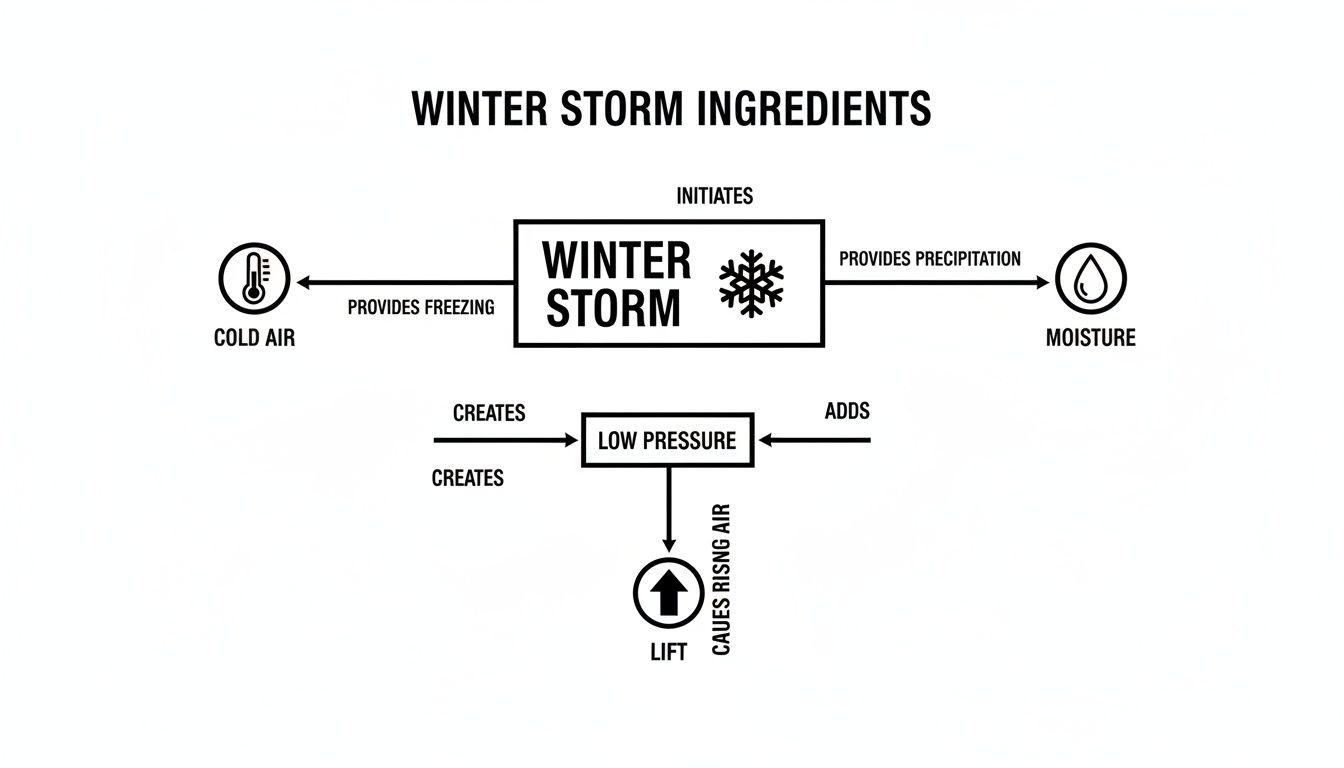
At the heart of it all are three essential ingredients—cold air, moisture, and lift—that combine to form these powerful weather events.
This simple diagram shows how the interplay of these three core elements kicks off every major winter storm, from howling blizzards to coastal nor'easters.
To make sense of the different storm types you might encounter, this quick-reference table breaks down their defining features.
Winter Storms At a Glance
Storm Type
Primary Precipitation
Key Feature
Typical Geographic Area
Blizzard
Snow, blowing snow
Sustained high winds (35+ mph) and low visibility
Plains states, Upper Midwest, mountainous regions
Ice Storm
Freezing rain
Significant ice accumulation on surfaces
Widespread, often in the Midwest and Northeast
Lake-Effect Snow
Heavy snow
Intense, narrow bands of snowfall
Downwind of large bodies of water (e.g., Great Lakes)
Nor'easter
Snow, rain, sleet
Powerful coastal cyclone with northeasterly winds
U.S. East Coast
Each of these storms brings its own brand of chaos, shaped by how and where it forms. Let's dig into what makes each one tick.
Blizzards vs. Ice Storms: Wind vs. Weight
A blizzard isn’t just about the snow; it’s about the sheer ferocity of the storm. The National Weather Service officially defines a blizzard by its brutal conditions: a storm packing winds of at least 35 mph with falling or blowing snow that reduces visibility to less than a quarter-mile for at least three hours. It's a full-on sensory assault of wind and whiteout conditions.
An ice storm, on the other hand, is far more subtle but can be just as destructive. This happens when rain falls through a shallow layer of freezing air right near the surface. The supercooled water doesn't freeze until it hits something—a tree branch, a road, a power line—coating everything in a heavy, treacherous glaze of ice.
It doesn’t take much to cause chaos. Just a half-inch of ice accumulation can add an astonishing 500 pounds of extra weight to a single span of powerline, leading to snapped lines and widespread outages that can last for days.
The Regional Weather Giants
Some winter storms are powerful regional phenomena, famous for terrorizing specific parts of the country.
Lake-effect snow is legendary in areas downwind of the Great Lakes. The recipe is simple: frigid, dry air from the arctic blows over the relatively warmer lake waters. The air acts like a sponge, soaking up immense amounts of moisture and then dumping it as incredibly heavy snow in very narrow, concentrated bands. Some towns can get buried in feet of snow while neighbors just a few miles away see only flurries.
Then there are the Nor'easters, the coastal giants of the Eastern Seaboard. These are intense cyclones that form over the Atlantic, drawing strength and moisture from the warm waters of the Gulf Stream. Named for the powerful northeasterly winds they drive ashore, nor'easters are responsible for some of the most historic and crippling winter storms in U.S. history.
Legendary Blizzards That Shaped History
Some winter storms are so powerful they become legends, leaving a permanent mark on history. They're more than just meteorological events; they are turning points that reshape landscapes, force innovation, and change how societies function. They serve as a raw reminder that nature, at its most intense, is a profound agent of change.
These epic blizzards are the atmospheric equivalent of a cataclysmic impact event—the kind that delivers rare meteorites to Earth. Both forces arrive with overwhelming power, altering the world they touch and leaving behind stories of destruction and, eventually, adaptation. The chaos they create often becomes the very thing that sparks progress.
The Great White Hurricane of 1888
One of the most transformative winter storms in American history was the ‘Great White Hurricane’ of 1888. This was no ordinary snowstorm; it was a complete societal shutdown. Striking from March 11–14, this nor'easter paralyzed the East Coast from Chesapeake Bay to Maine with up to 58 inches of snow.
Winds gusting over 45 mph sculpted snowdrifts that reached an astonishing 50 feet high, burying trains and homes alike. The blizzard exposed the extreme vulnerability of 19th-century infrastructure, severing telegraph lines and completely isolating major cities for days. To really grasp the scale of this event, you can explore the detailed history of this unprecedented storm event.
The fallout from this storm became a catalyst for monumental change. In its wake, New York City and other urban centers made the historic decision to bury their critical infrastructure. Telegraph, telephone, and electrical lines were moved underground—a costly but essential move to storm-proof the modern city. This single event spurred the creation of the resilient urban grid we rely on today.
Echoes of Ancient Cataclysms
This powerful example of nature forcing human innovation echoes events from deep time. The great winter storms of history are, in a way, modern examples of the planet-shaping forces we see throughout the fossil record. The mass extinctions and abrupt climate shifts that paleontologists study were driven by natural disruptions on an even grander scale.
The abrupt changes brought by the Ice Age, for instance, forced countless species to adapt or perish. This era of intense cold and massive glacial movements created the very conditions that preserved many of the incredible fossils we can now study and admire.
These events, whether a colossal blizzard or a sudden ice age, highlight a fundamental truth: history is often written by nature's most dramatic moments. They reveal our weaknesses but also inspire resilience, leaving behind a legacy that shapes the future. For collectors, understanding this context adds another layer of meaning to pieces like an authentic dire wolf skull, a relic from an apex predator that thrived during one of Earth's most extreme winter periods.
How to Prepare for a Modern Winter Storm
While we can't stop a winter storm, modern forecasting gives us something just as valuable: time to prepare.
Staying ahead of the weather is a principle every collector understands instinctively. Just as you'd carefully control the environment to protect a delicate tourmaline specimen from humidity, preparing your home for a storm is about protecting what’s most valuable.
It all starts with understanding the language of the forecast. A Winter Storm Watch is your cue to get ready; it means conditions are favorable for a storm to develop. Think of it as the early heads-up. A Winter Storm Warning is the main event. It’s more urgent and means a dangerous storm is imminent or already happening. That's your signal to take immediate action and stay put.
Essential Home Preparations
Your goal is to create a safe, self-sufficient bubble to ride out whatever the storm throws at you. The priorities are simple: warmth, food, and light, especially if the power grid fails.
Backup Heat Source: A fireplace or a properly ventilated generator can be a lifesaver. Just be smart about it—never, ever use outdoor grills or propane heaters indoors. The risk of carbon monoxide poisoning is just too high.
Emergency Supplies: Get a kit together with at least a three-day supply of non-perishable food that requires zero cooking. Don't forget plenty of bottled water for every person and pet in the house.
Lighting and Communication: Stock up on flashlights, headlamps, and piles of extra batteries. A hand-crank or battery-powered weather radio is also a fantastic tool for staying in the loop when the internet and power are down.
Need a reminder of why this matters? Look no further than the Blizzard of '78. From February 3-5, 1978, this monster storm absolutely hammered the Northeast, burying Boston under a record-shattering 27.1 inches of snow. Its hurricane-force winds and coastal flooding claimed around 100 lives, stranded thousands, and caused billions in damages. That storm became a benchmark, completely reshaping how we approach emergency preparedness.
Vehicle and Travel Safety
During a major winter storm, the safest place you can be is off the roads. Full stop. But having your vehicle ready for an emergency is still a critical part of any solid plan.
You need to think of your car as a potential shelter. If you absolutely must travel, or if you just want to be ready for the worst-case scenario, it needs to be properly equipped.
This means assembling a dedicated winter survival kit. Don't skimp here. Include essentials like a shovel, sand or cat litter for traction, jumper cables, warm blankets, extra clothing (hats, gloves, boots), and a first-aid kit. One more pro tip: always keep your gas tank at least half full. This simple habit can prevent your fuel lines from freezing solid when you need them most.
How Winter Weather Affects Natural Treasures
For anyone who collects natural art, a winter storm is more than just an inconvenience. It’s a powerful force that both reveals and threatens the geological treasures we love. The annual cycle of freezing and thawing is a master sculptor, working its way into tiny rock fissures and slowly, relentlessly, prying them apart. This natural process can be just what’s needed to expose new fossil layers or mineral veins that have been locked away for eons.
This is exactly why so many field collectors and paleontologists make their most incredible finds in the spring, right after the winter has done its work. As the snow melts, the runoff washes away loose dirt and sediment, unveiling specimens that were buried just a season before. In a strange paradox, the destructive force of a storm can be an act of creation for the dedicated hunter.
Protecting Your Collection Indoors
While winter storms are busy unearthing treasures out in the wild, they can create a hidden risk for the specimens you keep inside your home. The biggest threat? A drastic drop in indoor humidity. As our heating systems work overtime to fight the cold, they often strip moisture from the air, creating an environment that’s far too dry for certain sensitive pieces.
This can be especially damaging to materials that hold water within their molecular structure or those preserved in a delicate matrix.
Fossils: A prized specimen like a woolly mammoth molar can be surprisingly vulnerable. If the fossilized material dries out too quickly, it can lead to cracking or flaking, which compromises its structural integrity forever.
Minerals: Certain minerals, like opals, contain a significant percentage of water. Excessively dry air can cause them to craze or crack. Even porous minerals can be negatively affected by rapid shifts in humidity.
Maintaining a Stable Environment
The key to protecting your collection is stability. Think of your display room as a miniature museum—an environment where consistency is king. A simple digital hygrometer will help you keep an eye on the relative humidity, which should ideally be kept as steady as possible. If you notice the air is getting too dry, a humidifier can be a collection-saver.
The raw power of winter is a force to be respected. Just imagine standing at the base of Mount Shasta in California between February 13–19, 1959, as a single, relentless storm dumped a staggering 189 inches—that's 15.75 feet—of snow. It’s still the world’s greatest single-storm snowfall ever recorded. This blizzard redefined nature’s fury, much like the immense geological pressures that forged the minerals deep inside that same volcanic core over millennia. You can learn more about record-breaking snowfalls and the awesome forces they represent.
By managing your indoor climate, you’re protecting these timeless pieces from the less dramatic, but equally damaging, effects of a dry winter interior.
Answering Your Winter Storm Questions
When the skies turn grey and the temperature drops, a lot of specific terms start getting thrown around. Understanding what they all mean is the best way to keep yourself and your family safe when a winter storm is on the horizon.
What’s the Difference Between a Winter Storm Watch and a Warning?
This is one of the most important distinctions to know, as it tells you exactly how you should be reacting to the forecast. It’s all about timing.
A Winter Storm Watch is an early heads-up. It means the conditions are ripe for a significant winter storm to form and hit the area within the next 24 to 48 hours. Think of it as your signal to get ready: check your emergency supplies, fill up the gas tank, and review your family's plan.
A Winter Storm Warning is much more urgent. This means a dangerous, potentially life-threatening storm is already happening or is about to begin. This is not the time to prepare; it’s the time to act. When a warning is issued, you should be taking shelter and staying off the roads entirely.
How Can I Tell the Difference Between Sleet and Freezing Rain?
Both are icy, but they form very differently and create completely separate kinds of hazards on the ground.
Sleet is basically frozen raindrops. It starts as snow high up, melts into rain as it falls through a warm layer of air, and then refreezes into tiny ice pellets before it ever hits the ground. You'll hear it ticking against your window, and it tends to bounce off surfaces.
Freezing rain is the more dangerous of the two. It falls all the way to the ground as liquid rain but freezes the instant it makes contact with any surface that's at or below 32°F. This process creates a smooth, heavy, and incredibly slick glaze of ice that can snap tree branches and bring down power lines under its weight.
What Should I Keep in a Car Emergency Kit for Winter?
Getting stranded in your vehicle during a winter storm can be a life-threatening situation, so a dedicated emergency kit is a must-have. You can't just rely on having a charged phone.
Your kit should be stocked with essentials to keep you warm, safe, and visible until help arrives:
Warm blankets, plus extra hats, gloves, and socks
A flashlight with a fresh set of extra batteries
Non-perishable, high-energy food (like granola bars) and bottles of water
A sturdy ice scraper and a small shovel
A bag of sand or cat litter to give your tires traction if you get stuck
A fully charged phone and a portable power bank to keep it running
As you prepare for the incoming storm, take a moment to explore the timeless beauty of the natural world from the warmth of home. This weekend, Astro West is having a special sale with up to 50% off on select natural treasures. Discover a piece of Earth's history at https://astrowest.com.