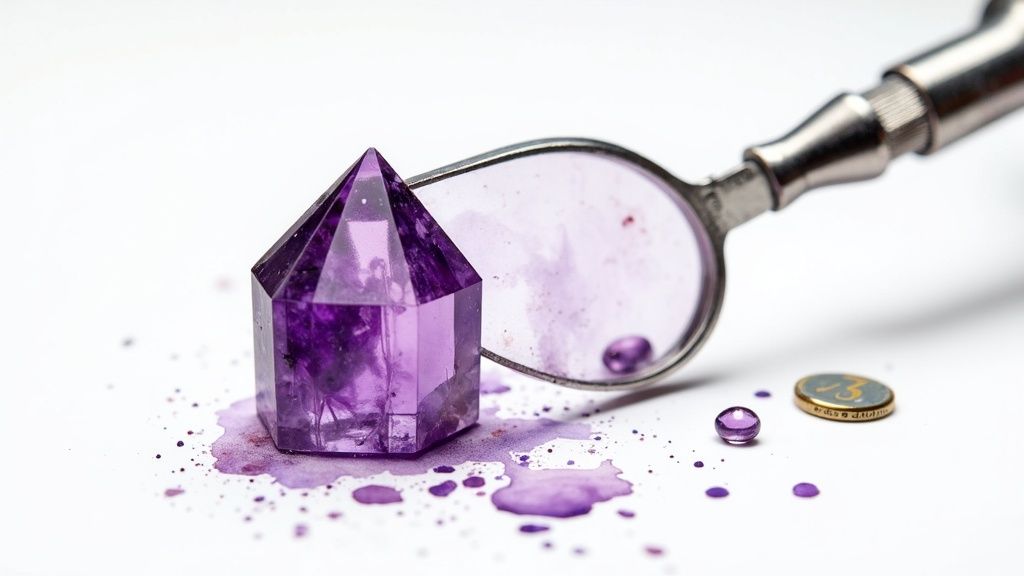
So, where can you find amethyst? The short answer is all over the world, but the best place really depends on what you're looking for. If you're after those massive, deep purple geodes that make stunning display pieces, your search will probably lead you to the commercial giants of Brazil and Uruguay.
For collectors hunting down rare clarity and unique raspberry tones, the mines of Zambia and Russia are legendary. And if you're a hands-on hobbyist who loves the thrill of the hunt, North America has dozens of spots where you can actually dig for your own crystals.
Your Quick Guide to Finding Amethyst
Whether you're just starting your collection, searching for the perfect piece of jewelry, or gearing up for a rockhounding adventure, finding amethyst starts with knowing where to look. This beautiful purple quartz shows up in all sorts of forms, from towering geodes pulled from South American mines to the small, tumbled stones you find in local crystal shops.
The global amethyst market is surprisingly diverse. Some regions are famous for churning out enormous quantities, making amethyst accessible to everyone. Others are prized for crystals with unusual colors, exceptional clarity, or fascinating inclusions. Your approach will change completely depending on whether you want to buy a polished gem, a raw display piece, or feel the excitement of unearthing one yourself.
Where Does Most Amethyst Come From?
Believe it or not, amethyst was once as rare and expensive as rubies and emeralds. Before the 1800s, the main source for high-quality amethyst in Europe was Russia's Ural Mountains, which kept royal families draped in purple for centuries.
That all changed when massive deposits were discovered in Brazil. Suddenly, this once-exclusive gem became available to people all over the world. You can learn more about this major shift in the amethyst trade and its history over at the Crystal Gemstone Shop.
Amethyst's journey from a symbol of royalty to a beloved, accessible crystal is a direct result of geographical discovery. The shift from Russian exclusivity to Brazilian abundance fundamentally changed its place in the world.
Think of this as your starting point for your own amethyst adventure. We’ll dig into the world’s most important deposits, give you some tips for finding it closer to home, and show you how to buy quality amethyst with confidence.
Here’s a quick rundown of what makes each major source special:
Brazil & Uruguay: These South American titans are the source of those iconic deep-purple geodes you see everywhere. They're perfect for home décor and anyone wanting a large, impressive specimen.
Zambia: African mines here produce amethyst with incredible clarity and a rich, raspberry-like undertone. This material is highly sought after by jewelers for its vibrant color.
North America: From Arizona to Ontario, locations across the United States and Canada offer fantastic opportunities for rockhounds to find their own crystals, often with unique local characteristics.
To make it even clearer, here’s a quick summary of the world's top amethyst-producing regions and what makes each one stand out.
Top Amethyst Sources at a Glance
Region
Known For
Best For
Brazil
Massive geodes, deep purple color, commercial abundance
Large display pieces, decorative items
Uruguay
Intense, dark purple crystals, often in smaller geodes
Four Peaks (Arizona) red-flash amethyst, various finds
Rockhounding, unique collector specimens
Each source offers something a little different, catering to everyone from the casual buyer to the serious gem connoisseur. Knowing the difference is the first step to finding the perfect amethyst for your collection.
Exploring the World's Amethyst Giants
To really get a feel for amethyst, you have to go to the source—the places where it forms in breathtaking amounts. While you can find small deposits all over the world, a handful of locations are the undisputed titans of the amethyst industry. These are the places supplying the vast majority of crystals you see in shops, museums, and jewelry.
And what's fascinating is that each of these giants produces amethyst with its own unique signature, almost like a geological fingerprint that tells the story of where it came from.
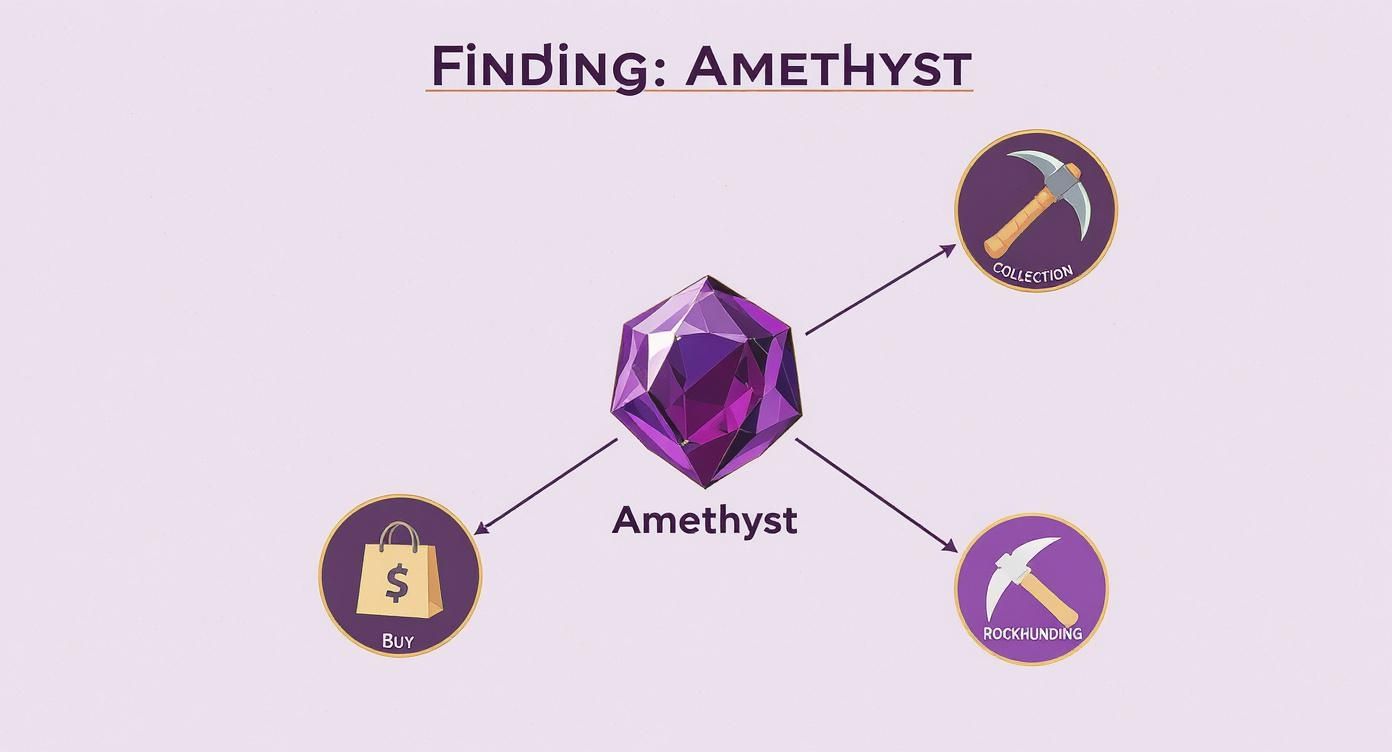
This infographic breaks down the main ways you can get your hands on amethyst, from buying a polished piece to cracking open your own raw geode.
As you can see, the right path really depends on what you're looking for. Do you want a curated, ready-to-display specimen, or are you after the thrill of a hands-on discovery?
The South American Powerhouses
When it comes to sheer volume, nobody beats Brazil. It completely dominates the global market, with some estimates suggesting it has accounted for a massive portion of the world's amethyst supply in recent history. The famous Ametista do Sul mines pull enormous crystals from deep within ancient volcanic basalt flows.
This volcanic activity created the perfect recipe for geodes—those hollow, unassuming rocks that hide a sparkling city of crystals inside. The geodes unearthed in Brazil are legendary, sometimes large enough for a person to stand in. If you want to learn more about these incredible natural formations, check out our guide on what a geode is.
Just next door, Uruguay has made a name for itself not with quantity, but with exceptional quality. Uruguayan amethyst is famous for its intensely saturated, deep purple hue that commands a premium. The crystals are often smaller than their Brazilian cousins, but collectors prize them for their unmatched vibrancy.
The easiest way to think about it is scale versus saturation. Brazil gives you magnificent size and abundance, while Uruguay delivers a concentrated, luxurious depth of color.
Zambia's High-Clarity Wonders
Shifting over to Africa, Zambia has become a major player for high-end, gem-quality amethyst. The mines in the Kariba region are known for producing crystals with stunning clarity and a distinct, vibrant reddish or raspberry undertone.
This unique color profile makes Zambian amethyst a favorite among jewelers. They cut the rough stone into faceted gems perfect for rings, pendants, and earrings. Its clarity and brilliance really set it apart from the material typically used for decorative geodes.
The Legendary Siberian Deposits
You can't talk about top-tier amethyst without mentioning Russia. For a long time, the historic Siberian deposits in the Ural Mountains were the source for the world's finest amethyst. This material set the gold standard for quality with its deep purple color that flashes with brilliant reds and blues.
This legendary color is now famously known as “Siberian” purple.
While commercial mining in these original locations has mostly stopped, the legacy of Siberian amethyst lives on. The term is now used as a grade to describe any top-quality amethyst, regardless of origin, that shows off that coveted rich purple color with secondary flashes of red and blue. These historic mines literally defined what makes an amethyst truly exceptional.
Rockhounding for Amethyst in North America
While industrial giants in Brazil and Zambia pull amethyst from the earth on a massive scale, North America offers a far more personal—and thrilling—way to find it: digging it up yourself. The continent is sprinkled with rich deposits, turning a simple gem hunt into a real adventure for hobbyists and collectors, a practice fondly known as rockhounding.
This hands-on approach connects you to the stone in a way buying a polished gem never could. You're not just acquiring a crystal; you're pulling it from the ground with your own two hands, feeling the same rush miners have for centuries. It’s an incredible way to build a collection where every piece comes with its own story.
From the arid deserts of the Southwest to the dense forests of the Northeast, you’ll find plenty of public and private sites that welcome enthusiasts. All you need is a little know-how, a few basic tools, and a sense of adventure.
Prominent US Amethyst Locations
The United States is home to several fantastic amethyst hotspots, each offering crystals with their own unique character. Perhaps the most famous is the Four Peaks Mine in Arizona. Tucked away in the rugged Mazatzal Mountains, this mine is legendary for producing amethyst with a deep, coveted purple hue and distinct reddish flashes—a quality often compared to prized "Siberian" gems.
But Arizona isn't the only game in town. Other states offer incredible opportunities for rockhounds.
Georgia: The Jackson Crossroads Amethyst Mine is a well-known pay-to-dig site where you have a great chance of finding dark purple amethyst clusters. It's an excellent spot for beginners since the area is famously productive.
North Carolina: In the Appalachian Mountains, areas around Franklin and Hiddenite have drawn gem hunters for generations. Amethyst here comes in a whole spectrum of shades, from the palest lilac to deep, rich violet.
Maine: The western mountains of Maine, especially near towns like Stow, have yielded beautiful amethyst crystals, often found tucked away in granite pegmatites.
While these states are popular destinations, amethyst deposits are scattered across the country. For those exploring the Rockies, it’s worth checking out the opportunities for gemstone mining in Colorado, another prime region for collectors.
Heading North to Canada
Don't forget about our neighbor to the north. Canada boasts a world-class amethyst location, especially in Ontario. The area around Thunder Bay is so renowned for its deposits that amethyst was officially named the provincial mineral of Ontario.
The amethyst from this region is truly special, known for its rich color and frequent hematite inclusions. These tiny red mineral flecks create a stunning contrast against the purple quartz, making Thunder Bay specimens a must-have for serious collectors. Best of all, several mines in the area are open to the public, letting you dig for your own treasures.
Rockhounding is less about finding a perfect, flawless gem and more about the experience of discovery. Each crystal, with its unique shape and inclusions, tells a story of its geological journey.
Gearing Up for Your Hunt
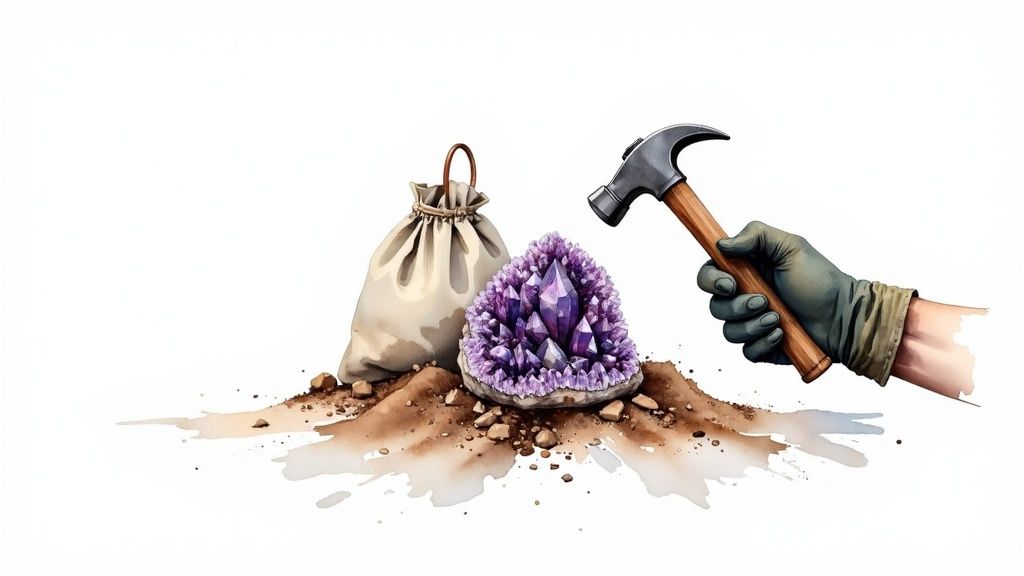
Before you head out, gathering the right tools is key. A successful rockhounding trip doesn’t require a truckload of expensive equipment—just a few basics will make your hunt much easier and safer.
Safety First: Always wear sturdy, closed-toe shoes to protect your feet. A good pair of gloves will save your hands, and safety glasses are essential to shield your eyes from flying rock chips.
Digging Tools: A rock hammer or pick is your best friend for breaking open host rock. A small shovel or trowel comes in handy for clearing away loose dirt and gravel.
Collection and Transport: Bring a durable bucket or a sturdy canvas bag to carry your finds. It's also a smart idea to pack some newspaper or old cloth to wrap delicate crystals and keep them from getting chipped on the ride home.
With the right gear and a promising location, you're all set to start your own crystal-hunting adventure.
Walking into the amethyst market can feel a bit like visiting a massive farmer's market. You'll see vendors with perfectly polished gems and others with rustic, raw crystals pulled straight from the earth. To get the best piece, you need to know what separates the good from the truly exceptional.
Knowing what to look for transforms you from a casual browser into a confident buyer. Whether you’re drawn to a massive geode, a smooth tumbled stone, or a sparkling faceted gem, the principles of quality are surprisingly consistent. Understanding them is the key to finding a piece you’ll love for years to come—and making sure you get what you pay for.
Decoding the Four Cs of Amethyst
Just like with diamonds, the pros use a time-tested system to grade amethyst: the "4 Cs." This framework stands for Color, Clarity, Cut, and Carat Weight, and it’s your best tool for making a smart purchase.
It all boils down to these four factors, which work together to determine a stone's overall quality and value. Let's break down what to look for in each.
Evaluating Amethyst Quality The 4 Cs
Here's a closer look at the four main factors that determine the quality and value of an amethyst. Think of this as your personal checklist when you're shopping.
Quality Factor
Description
What to Look For
Color
The single most important factor for amethyst. It refers to the richness, depth, and evenness of the purple hue.
Look for a deep, vibrant, and uniform purple. The most prized stones have secondary flashes of red or blue. Paler lilac shades are more common and less valuable.
Clarity
The absence of internal flaws, fractures, or mineral inclusions.
The best gems are "eye-clean," meaning you can't see any imperfections without magnification. For raw crystals, this means well-formed, clear points.
Cut
How well the stone's facets are angled and proportioned to reflect light and show off its color.
A good cut will make the gem sparkle brilliantly from every angle. A poor cut can make even a high-quality stone look dull or lifeless. This is most critical for jewelry.
Carat Weight
The physical weight of the gemstone, with one carat equaling 200 milligrams.
Larger stones are rarer, but size alone isn't enough. The price per carat only jumps significantly when the color, clarity, and cut are also exceptional.
Essentially, Color is the star of the show, Clarity is the quality of the stage, and the Cut is the lighting that makes it all shine. Carat Weight just tells you how big the performance is.
Choosing the Right Form for Your Needs
Amethyst comes in all shapes and sizes, and each form has a different purpose. A huge, dramatic geode that makes a stunning statement in a living room isn't exactly practical for a ring, and a tiny faceted gem won’t have the same raw, natural presence as a rough crystal cluster.
If you’re drawn to those big, impressive display pieces, learning where to buy geodes is a fantastic starting point. It opens up a whole different side of the market focused on raw, untouched beauty.
Tips for Spotting Quality and Fakes
When you're shopping, especially from a new vendor or an online store you're not familiar with, a little healthy skepticism goes a long way. Believe it or not, synthetic amethyst and even expertly colored purple glass are sometimes passed off as the real deal.
Keep a sharp eye out for anything that looks too perfect. Unnaturally uniform color with absolutely zero internal flaws can actually be a red flag. Real stones have character.
Don't be shy—ask the seller questions. Inquire about the stone's origin, ask if it has been heat-treated (a common and accepted practice to enhance color), and ask to see it under a few different lights. A reputable seller will be happy to share this information and will want you to feel confident in your choice.
How to Identify Real Amethyst
So, you've got your hands on a gorgeous purple stone, but the big question lingers: is it the real deal? Figuring out how to identify real amethyst can feel a bit like a detective game, but you don't need a forensics lab to spot the most common fakes.
With a few simple at-home checks, you can feel much more confident about your crystal's authenticity.
The most straightforward test comes down to hardness. Amethyst is a type of quartz, which means it scores a solid 7 on the Mohs scale of hardness. In simple terms, it's tougher than common materials like steel and glass. A regular steel nail or knife blade, which has a hardness of around 5.5, shouldn't be able to scratch a true amethyst. If your stone scratches easily, you might just be holding a pretty piece of purple glass.
Looking Closer for Natural Clues
Once it's passed the scratch test, it’s time to get up close and personal. Grab a magnifying glass or a jeweler's loupe and inspect your stone for the subtle imperfections that are the true signatures of a natural gem.
Think of it like spotting the difference between handmade pottery and a mass-produced plate; the natural item is going to have its own unique character.
Here are a few tell-tale signs of authenticity to look for:
Color Zoning: Real amethyst rarely has perfectly uniform color. You'll often see subtle shifts in its hue, with some areas appearing darker or lighter. This uneven distribution, known as color zoning, is a fantastic indicator of a genuine stone.
Inclusions: Tiny internal fractures, wisps of other minerals, or other little flaws are common in genuine amethyst. A stone that looks absolutely perfect—flawlessly clear and evenly colored—might actually be synthetic or glass. Nature is rarely perfect.
The principles here aren't just for gemstones. Once you learn the basics of authentication, you can apply them to all sorts of collectibles. In fact, learning how to spot fake antiques can be surprisingly helpful for training your eye to notice the tiny details that separate the genuine from the imitation.
Understanding Treatments and When to Call in an Expert
It's also important to know that many real amethysts are heat-treated. This is a common and widely accepted practice in the gem world to lighten, darken, or even change the stone’s color—for instance, turning some amethyst into what is sold as citrine. A trustworthy seller will always disclose any treatments.
While at-home tests are great for a first pass, a definitive appraisal really requires professional equipment and a trained eye. If you have a piece that's particularly valuable, consulting a certified gemologist is always your best bet.
They can confirm its origin and identify any treatments with total certainty. If you're building a collection and want to dive deeper, our comprehensive https://astrowest.com/crystal-identification-guide/ is an excellent resource to expand your knowledge.
Ultimately, combining these simple home tests with a bit of research will give you the skills to tell a genuine treasure from a convincing fake.
Your Amethyst Questions Answered
Jumping into the world of amethyst, whether you're digging for it yourself or choosing a piece in a shop, always sparks a few questions. To help you feel more confident in your search, we’ve put together some clear, straightforward answers to the queries we hear most often.
Think of this as your quick guide for those lingering curiosities, clearing up the confusion so you can focus on finding a piece you love.
Can I Find Amethyst in My Backyard?
Wouldn't it be great to stumble upon a sparkling crystal cluster while gardening? While it's a lovely thought, it's highly unlikely for most of us. Amethyst forms under very specific conditions, usually deep inside volcanic or metamorphic rocks and often near quartz veins.
Unless you happen to live in a known geological hotspot with that kind of rock formation, your backyard probably isn't the place to look. For a much better chance of success, your best bet is to visit a dedicated rockhounding site or a region famous for its amethyst deposits. A targeted approach is always more rewarding than a random search.
How Can I Tell Real Amethyst from Purple Glass?
Distinguishing genuine amethyst from a convincing glass fake is actually easier than you might think. The biggest clue is hardness. Real amethyst is harder than glass, which means an amethyst crystal can easily scratch a piece of glass, but glass can't scratch amethyst. It's a simple, reliable test.
You should also look closely for nature's little signatures.
Imperfections: Natural amethyst nearly always has slight variations in color, known as zoning, or tiny internal flaws. You might see faint stripes or feathery inclusions.
Uniformity: Glass, on the other hand, is usually perfectly uniform in its color and clarity. That flawless look can be a dead giveaway.
Temperature: A real amethyst will feel cool to the touch, while glass tends to warm up pretty quickly in your hand.
The small, unique imperfections in a natural stone are like its fingerprint. They aren't signs of poor quality—they're proof of its authentic origin, setting it apart from mass-produced imitations.
What Is the Easiest Way for a Beginner to Find Amethyst?
For anyone just starting out, the most accessible and enjoyable way to find your own amethyst is to visit a public pay-to-dig mine. These spots, like the ones you can find in Georgia or North Carolina, are located on well-known amethyst deposits and provide everything you need to get started.
They'll often rent you the necessary tools and have staff on hand to offer guidance and help you identify what you've found. This approach takes the guesswork out of the hunt and almost guarantees you’ll go home with something beautiful, making it the perfect introduction to the world of rockhounding.
Is Darker Amethyst Always More Valuable?
Generally, yes—a deep, rich color is highly desirable, but there's an important catch. The most prized amethysts show off a vibrant, royal purple hue, sometimes with secondary flashes of red or blue. This intense, saturated color, often called "Siberian" purple, is a key driver of its value.
However, if an amethyst is so dark that it looks nearly black in normal lighting, its value drops quite a bit. The sweet spot is a stone with a deep, vivid color that still allows light to pass through, showing off its natural brilliance and sparkle.
Ready to find the perfect amethyst for your collection or home? Astro West offers a curated selection of ethically sourced amethyst specimens, from breathtaking geodes to exquisite jewelry. With over 60 years of expertise, we ensure every piece is authentic and of the highest quality. Explore our collection and discover a natural treasure that will last a lifetime at https://astrowest.com.