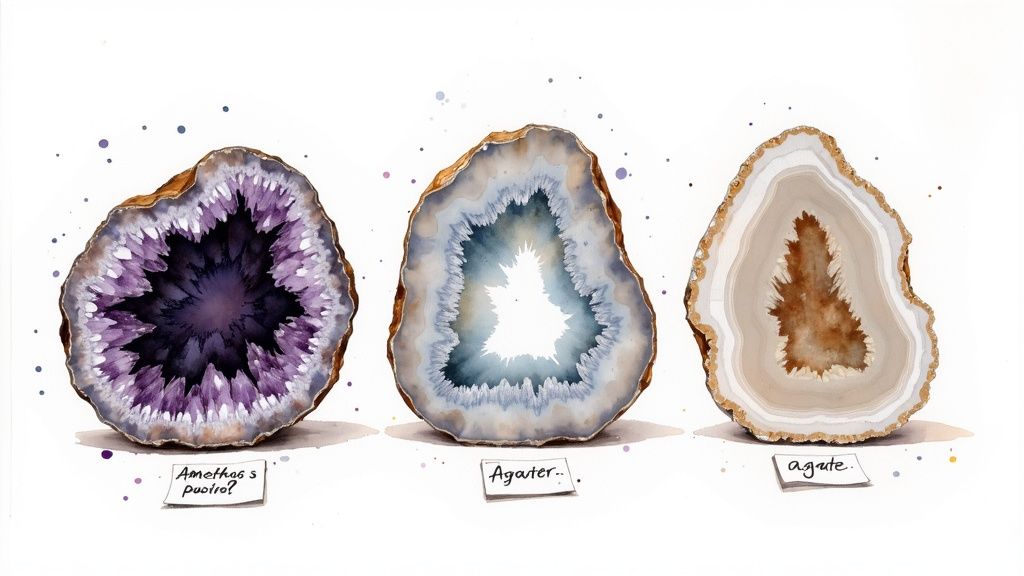
So, you’re ready to find your very own geode. Good choice. These plain-looking rocks with dazzling crystal interiors are a fantastic way to bring a piece of natural art into your home. The thrill of the hunt is part of the fun, but knowing where to start your search is key.
You’ve got a few great paths to take: you can browse endless selections on online marketplaces, feel the energy of a bustling gem and mineral show, or get expert advice at a specialized local crystal shop. Each route offers a totally different experience.
Your Guide to Finding the Perfect Geode
Finding that perfect geode is a treasure hunt, pure and simple. These geological wonders are favorites for a reason—they hide a secret world of breathtaking crystals inside an unassuming rocky shell. But to snag a quality piece, you need to know where the real treasures are found.
Before you dive in, it helps to know what you’re looking for. If this is all new to you, taking a moment to understand what a geode is can make all the difference. It’ll give you the confidence to spot the subtle details in color, crystal structure, and formation that make each geode one-of-a-kind.
Comparing Your Buying Options
Choosing where to buy your geode really boils down to what you value most. Are you after convenience? The best price? Or do you need to hold it in your hands before you buy? Each option—online, a show, or a local shop—is tailored to a different kind of buyer.
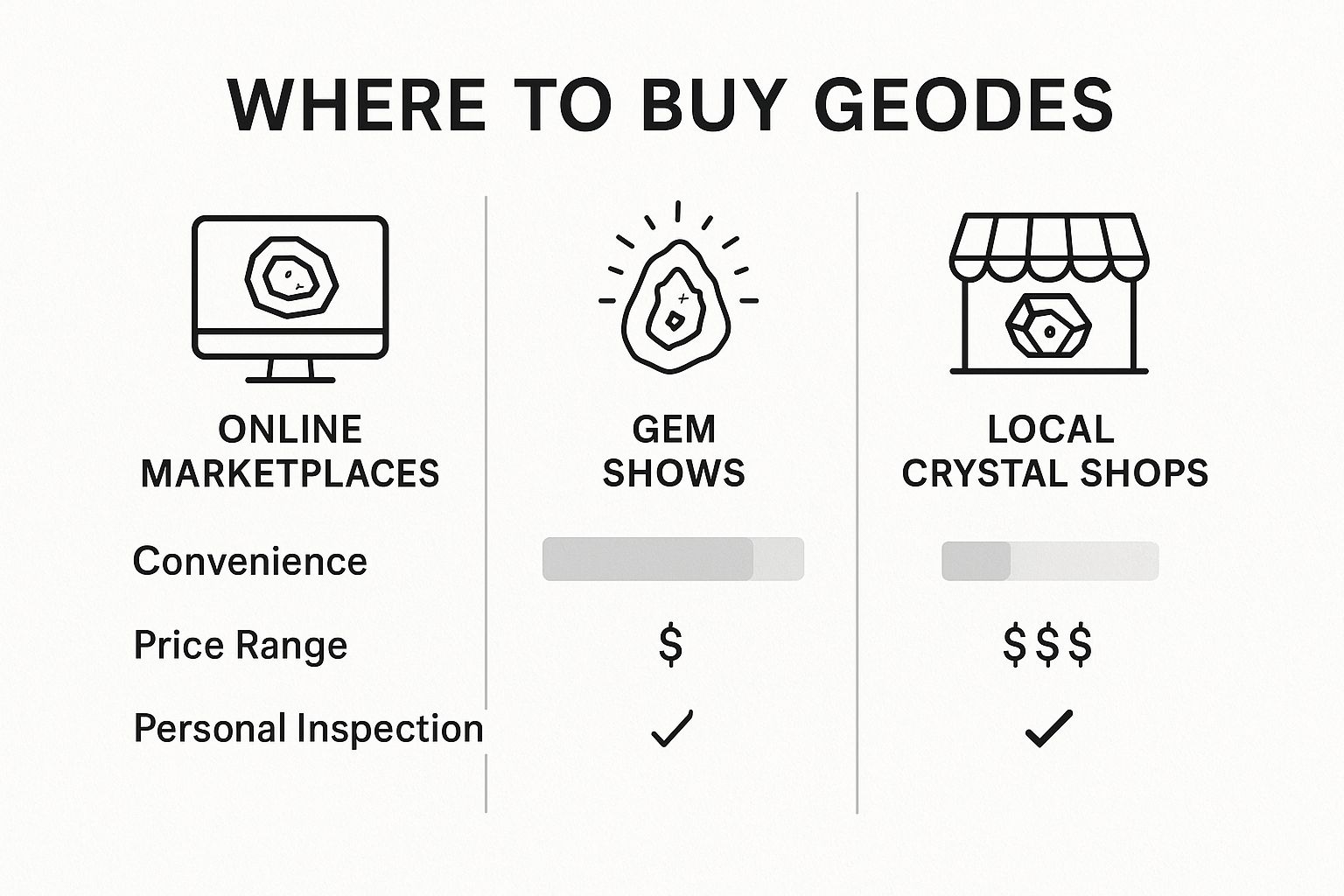
This infographic breaks down the three main channels, giving you a quick look at how they stack up on convenience, price, and the ability to inspect them yourself.
As you can see, online shopping wins for ease, but you lose that critical hands-on inspection. Gem shows, on the other hand, are the best place to physically examine a piece, with prices that can be all over the map. Local shops offer a nice middle ground.
To make things even clearer, let’s break down the pros and cons of each channel.
Quick Guide to Geode Buying Channels
This table summarizes the best places to buy geodes, helping you quickly decide which option is the right fit for your treasure hunt.
Buying Channel
Best For
Pros
Cons
Online Marketplaces
Variety & Convenience. Shoppers who want the largest possible selection and don’t mind buying sight-unseen.
Huge inventory from global sellers. Competitive pricing. Shop anytime, from anywhere.
Can’t physically inspect the geode. Risk of damage in shipping. Photos can be misleading.
Gem & Mineral Shows
Hands-On Inspection. Collectors who want to see, touch, and compare many geodes in one place.
Direct interaction with sellers. Opportunity for great deals. The thrill of discovery.
Can be overwhelming. Shows are periodic and may require travel. Prices vary widely.
Local Crystal Shops
Expert Guidance. Beginners or buyers looking for a curated collection and personalized advice.
Expert staff can answer questions. Support a small business. Hand-picked, quality inventory.
Smaller selection than online. Prices may be higher to cover overhead.
Ultimately, there’s no single “best” place—it all depends on what you’re looking for in your buying experience.
The best place to buy a geode truly depends on your goals. Are you seeking the thrill of a live event, the curated selection of a local expert, or the endless variety available online? Answering this question will point you in the right direction.
Whether you’re a seasoned collector hunting for a rare Uruguayan amethyst or a newcomer just captivated by their inner sparkle, knowing the landscape is the first step. Let’s walk through each of these options so you can buy with total confidence.
Navigating Online Geode Marketplaces
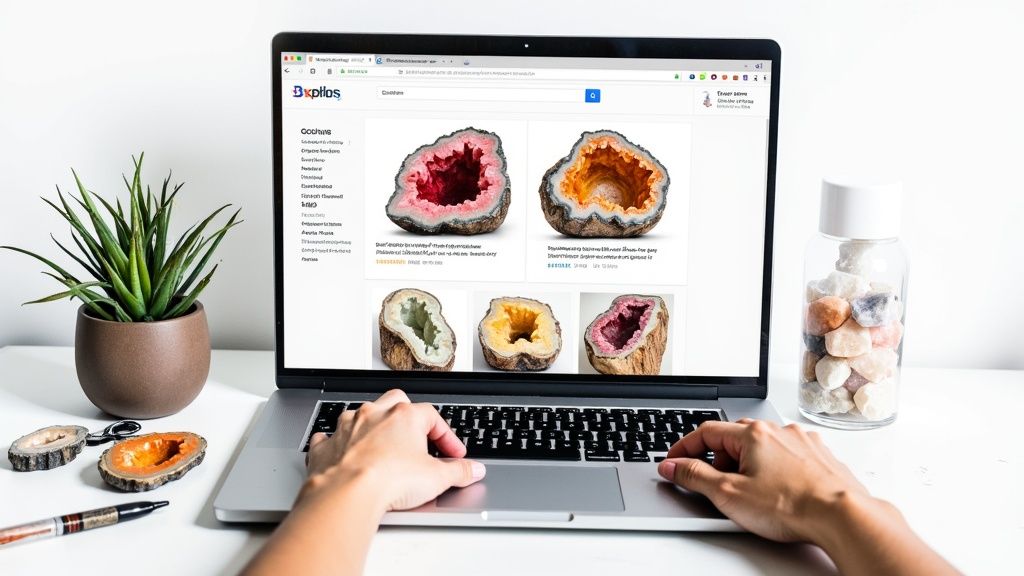
The internet has thrown open the doors to a global treasure chest, giving you access to stunning geodes from Brazil to Africa without ever leaving home. Marketplaces like Etsy and eBay, alongside specialized online crystal shops, offer a selection that feels practically endless. It’s like having a worldwide gem show open 24/7, right on your screen.
But this convenience comes with a catch. Since you can’t physically hold or inspect the geode, you’re putting a lot of trust in the seller’s photos and descriptions. This makes knowing how to spot a reputable vendor absolutely critical.
Identifying Trustworthy Online Sellers
Finding a great online seller is a bit like being a detective—the clues are all there if you know what you’re looking for. A seller’s reputation is your first stop. A long history of positive, detailed reviews is a fantastic sign of reliability. Don’t just look at the star rating; read what people are saying about the item’s quality, shipping speed, and how well it was packed.
Next, dive into the product listings themselves. High-quality photos taken from multiple angles are non-negotiable. Look for shots in natural light and, ideally, one with a ruler or coin to give you a true sense of scale. A single blurry photo or a vague, copy-pasted description is a major red flag. Good sellers are proud of their inventory and want you to see exactly what you’re buying.
Finally, think about ethical sourcing. More and more buyers care where their crystals come from, and for good reason. Look for sellers who are transparent about the origin of their geodes. While not every shop will have a complete mine-to-market history, those who are open about their supply chain show a real commitment to responsible practices.
Maximizing Your Online Search
To really make the most of online shopping, it helps to understand the market. These platforms are the main way people buy geodes globally, serving everyone from casual hobbyists to professional interior decorators. The market for amethyst geodes, for instance, is projected to grow by 6–8% annually, largely driven by their popularity in home decor. Some wholesalers even list large amethyst cathedral sets for $13–$20 per kilogram, making these incredible pieces more attainable than ever. Reputable sources like Accio.com provide further data on amethyst geode market trends on Accio.com.
One of the biggest perks of shopping online is the ability to compare prices and specimens from hundreds of sellers worldwide. Use the platform’s filters to narrow your search by origin, mineral type, or price to find exactly what you’re looking for without the endless scrolling.
To get the best results, get specific with your search terms. Instead of just “geode,” try “Moroccan quartz geode” or “Brazilian amethyst cathedral.” And don’t be shy about reaching out to sellers with questions or requests for more photos. A passionate, trustworthy seller will be more than happy to help you make an informed decision, ensuring the geode that arrives at your door is just as spectacular as you hoped.
The Hands-On Thrill of Gem and Mineral Shows
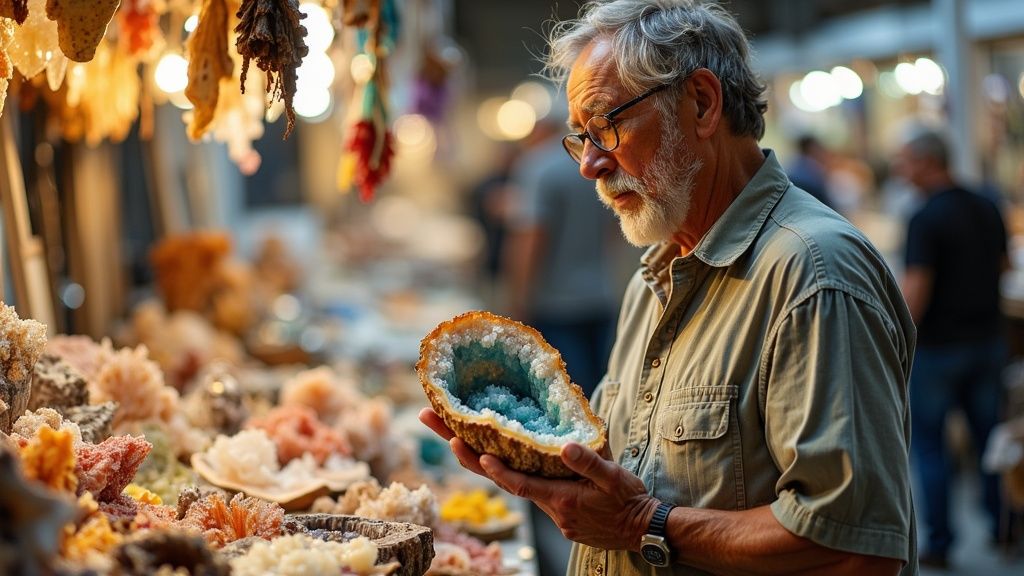
Sure, online stores are convenient, but nothing beats the buzzing, hands-on energy of a gem and mineral show. Picture this: you’re walking through packed aisles, completely surrounded by treasures pulled from every corner of the globe. This is where you get to truly connect with a geode, moving beyond a flat picture to a real, tactile experience.
At a show, you can actually pick up a geode, feel its surprising heft, and peer into its crystal formations. It’s the only way to see the subtle sparkle and true depth of color that a camera just can’t replicate. It’s a completely immersive environment that pulls in all your senses.
Connecting with the Source
One of the best parts of going to these events is getting direct access to the people behind the stones. You can chat with the actual miners, dealers, and artisans who dug up, prepped, or polished the geodes. They almost always have incredible stories about where a specific piece came from, adding a layer of history and personality you’ll never find online.
That personal connection is priceless. You can ask super-specific questions about a geode’s mineral inclusions, its journey from the mine, or the best way to show it off at home. It turns a simple purchase into a rich, educational experience and plugs you into a passionate community of fellow collectors.
How to Prepare for a Gem Show
To really make the most of your visit, a little prep work goes a long way. If you know what to bring and how to navigate the show, you’ll be in a much better position to find incredible pieces at fair prices.
Bring Cash: While more vendors are taking cards these days, cash is still king at these shows. It often gives you a little more wiggle room when it’s time to negotiate.
Carry a Small Flashlight: A simple penlight is a must-have. It’s the best tool for inspecting the inside of geodes, helping you see the crystal clarity and any cool hidden details.
Wear Comfortable Shoes: Don’t underestimate this one. These events can be massive, with what feels like miles of tables to explore. You’ll be on your feet for hours.
Have a Budget in Mind: It’s incredibly easy to get swept up in all the excitement. Setting a budget beforehand helps keep you focused and prevents any surprise sticker shock later on.
Remember that prices at gem shows are often flexible. Don’t be shy about politely negotiating with a vendor, especially if you’re buying a few things. The worst they can say is no, and you might just walk away with a fantastic deal.
Finding these events is easier than you might think. Credible organizations like the American Federation of Mineralogical Societies keep updated calendars of shows happening all over the country. A quick search for “gem and mineral show near me” will also lead you to local clubs and annual events, opening the door to your next great find.
Finding Treasures in Local Crystal Shops
While online markets offer a seemingly endless scroll of options, there’s a certain magic that only happens when you discover a geode in a local crystal shop. These aren’t just retail stores; they’re more like curated galleries, run by passionate owners who hand-pick high-quality and often ethically sourced specimens. It’s an experience a simple click can never quite capture.
Walking into a local shop lets you physically connect with the geodes. You get to hold them, feel their surprising weight and rough texture, and see for yourself how the crystals sparkle under the lights. For many collectors, this hands-on interaction is everything—it ensures the geode you choose really speaks to you.
Building Relationships with Experts
One of the biggest perks of shopping locally is the person standing behind the counter. Shop owners are usually enthusiasts themselves, ready to share the unique history and geological story behind each and every piece. This kind of personalized guidance is priceless, especially if you’re just starting your collection.
They can answer your questions on the spot, pointing out subtle details you might have missed or explaining where a particular stone came from. When you build a relationship with a local expert, you’re not just buying a rock; you’re gaining a trusted advisor for your collection. It turns a simple purchase into a meaningful exchange and plugs you into a local community of fellow crystal lovers.
Supporting these local businesses does more than just get you a beautiful geode; it fosters a community centered on a shared passion for natural wonders. You’re investing in both your collection and the local network of enthusiasts.
Once you bring a beautiful geode home from a local shop, it often becomes an instant statement piece. For ideas on how to show it off, check out our guide on decorating with a large geode to make it the centerpiece of any room.
Decoding Geode Quality and Price
Ever seen two geodes that look almost identical, but one costs ten times more than the other? You’re not alone. Figuring out what drives a geode’s value is probably the most important skill you can learn as a buyer. It’s the difference between snagging a true treasure and just overpaying for a pretty rock.
Much like a diamond, a geode’s worth isn’t random. Its value comes down to a specific set of characteristics that seasoned collectors and geologists use to judge quality. Once you learn to spot these signs, you’ll be able to confidently size up any geode you come across, whether it’s online or at a packed gem show.
Key Factors Influencing Geode Value
When you’re deciding where to buy geodes, knowing what makes one special is half the battle. Think of it as a four-part checklist for quality. The most coveted geodes will get top marks in every category.
Color Intensity: This is what usually grabs your eye first. Deeper, more saturated colors are almost always more valuable. A vibrant, royal purple Uruguayan amethyst, for instance, will command a much higher price than a piece with pale, washed-out lavender crystals.
Crystal Size and Clarity: While bigger isn’t automatically better, large, well-formed crystals are highly sought after. You want to see distinct crystal points that are free from distracting cloudiness. Exceptional clarity lets light dance through the interior, creating that incredible sparkle everyone loves.
Mineral Rarity: Common quartz and amethyst are beautiful, but some geodes hide far rarer minerals inside. A geode lined with stunning blue celestite or shimmering calcite formations is a truly special find, and it will be priced accordingly. The presence of these unique inclusions can send its value soaring.
Overall Condition: Lastly, give the whole piece a once-over. Is the outer rock shell intact? Are the crystals inside free from major damage or chipping? A complete, undamaged specimen is always going to be more desirable and hold its value better.
Understanding the Price Range
The price tag on a geode is a direct reflection of these quality factors, and the range can be staggering. For example, amethyst geodes often sell for $57 to $90 per kilogram, while a high-quality quartz druzy geode might be valued at $0.70 to $1.50 per carat.
This huge variation is exactly why knowing what to look for is so crucial. By weight, geodes can range from $15 to over $7,500 per kilogram, all depending on their unique mineral makeup and aesthetic firepower. Well-researched guides explain in more detail how geodes are valued at Rockchasing.com.
Ultimately, think of buying a geode as investing in natural art. A piece with exceptional color, large, clear crystals, and a rare mineral interior is like a masterpiece—it’s a one-of-a-kind creation that will hold its value and beauty for years to come.
By keeping these factors in mind, you can navigate any marketplace like a pro. You’ll be able to spot the true gems, understand why they’re priced the way they are, and walk away with a piece that offers both stunning beauty and fair value.
From Global Mines to Your Collection
Every geode has a story that begins millions of years ago, deep inside the Earth. Long before it lands on a collector’s shelf, it’s part of a specific place, a unique geological history that gives it a distinct personality. When you’re deciding where to buy a geode, you’re not just picking a pretty rock—you’re choosing a tangible connection to a corner of the globe.
Many of the world’s most incredible geodes are unearthed from a handful of famous hotspots. The mineral-rich, volcanic soils of South America are legendary, producing some of the most sought-after specimens on the market. Think of Brazil and Uruguay, renowned for their deep purple amethyst cathedrals—some so massive you could practically stand inside them.
Meanwhile, Mexico is another key player, especially known for the stunning calcite and quartz geodes found in regions like Chihuahua. These are often the classic “break-your-own” geodes that spark a lifelong passion for so many collectors. Each location gives its geodes unique traits, from the crystal colors to the texture of the outer rind.
The Importance of Ethical Sourcing
As you dive deeper into collecting, understanding a geode’s origin story becomes even more important. Ethical and sustainable mining aren’t just buzzwords in the crystal community; they’re crucial. Responsible sourcing ensures that the environment is respected and that the miners unearthing these natural treasures are treated fairly.
This awareness adds a meaningful layer to your collection. Don’t be shy about asking a seller where their geodes come from. A reputable dealer will be able to tell you the country of origin and might even know the specific mine. This kind of transparency is a hallmark of a trustworthy source and helps you build a collection you can feel good about. If you’re just starting, our guide on how to start a collection of rare rocks and minerals has more advice on thoughtful buying.
Global Demand and Mining Hotspots
The world’s appetite for these natural wonders is growing fast. Demand for pink amethyst, for instance, jumped by 32% between 2022 and 2024 alone, prompting new mines to open.
To give you an idea of the scale, major producers like Rio Grande do Sul in Brazil hold amethyst reserves valued at over $140 million. Down in Patagonia, Argentina, the pink amethyst mines are valued at more than $60 million. Industry reports offer more insights on the growing geode market on farmonaut.com.
By learning about a geode’s origin, you’re not just buying a beautiful object—you’re appreciating its entire journey. This knowledge transforms a simple stone into a tangible piece of the Earth’s history, connecting your collection to the incredible natural forces that shaped it.
Common Questions About Buying Geodes
Even with the best game plan for your geode hunt, a few questions always seem to surface. To make sure you’re completely confident when you decide where to buy geodes, this section tackles the most common uncertainties collectors run into, whether they’re just starting out or have been at it for years.
Think of it as your quick-reference guide for solving those practical puzzles, from spotting a fake to choosing between the thrill of a mystery rock and the guarantee of a pre-cracked beauty.
How Can I Tell If a Geode Is Real or Fake?
An authentic geode feels like what it is: a lumpy, irregular rock. It should feel surprisingly heavy for its size. On the inside, look for crystals with sharp, geometric shapes and natural color variations.
Be wary of specimens with unnaturally bright, uniform, or neon colors—that’s a huge red flag for dye. A simple test for quartz or amethyst is to try scratching it with a steel knife blade. A real crystal won’t be marked. Ultimately, your best defense is buying from a reputable, knowledgeable dealer who is happy to talk about their inventory.
Is It Better to Buy a Whole or Pre-Cracked Geode?
This really comes down to what you’re looking for in the experience. Buying a whole, unopened geode is all about the thrill of discovery—it’s like a geological surprise party! But with that comes the risk you might end up with a solid nodule or a geode with very little crystal growth inside.
On the other hand, buying a pre-cracked geode takes all the guesswork out of the equation. You see the exact color, size, and quality of the crystals before you commit. This is the perfect choice for anyone buying a geode for a specific decorative purpose or for collectors who want a guaranteed high-quality piece. For a foolproof, beautiful specimen, pre-cracked is the way to go.
What Tools Do I Need to Open a Geode?
If you opt for the adventure of an unopened geode, you’ll need a few basic tools. The essentials are safety goggles, a hammer, and a good chisel. For a cleaner break, you can place the chisel on your desired crack line and tap it gently, rotating the geode to score a line all the way around before giving it a firmer strike.
For smaller geodes, a simpler method is to place it inside an old sock or towel and tap it firmly on a hard surface like concrete. If you’re after that perfectly smooth, professional cut, a specialized rock saw is the tool of choice. For more detailed instructions, our guide on how to crack geodes gives you a complete step-by-step walkthrough.
At Astro West, we believe every geode is a piece of natural art waiting to be discovered. Whether you’re seeking the surprise of cracking your own or a stunning, pre-opened specimen for your collection, our ethically sourced and expertly curated selection offers treasures for every enthusiast. Explore our collection of fine minerals and find your perfect geode today.