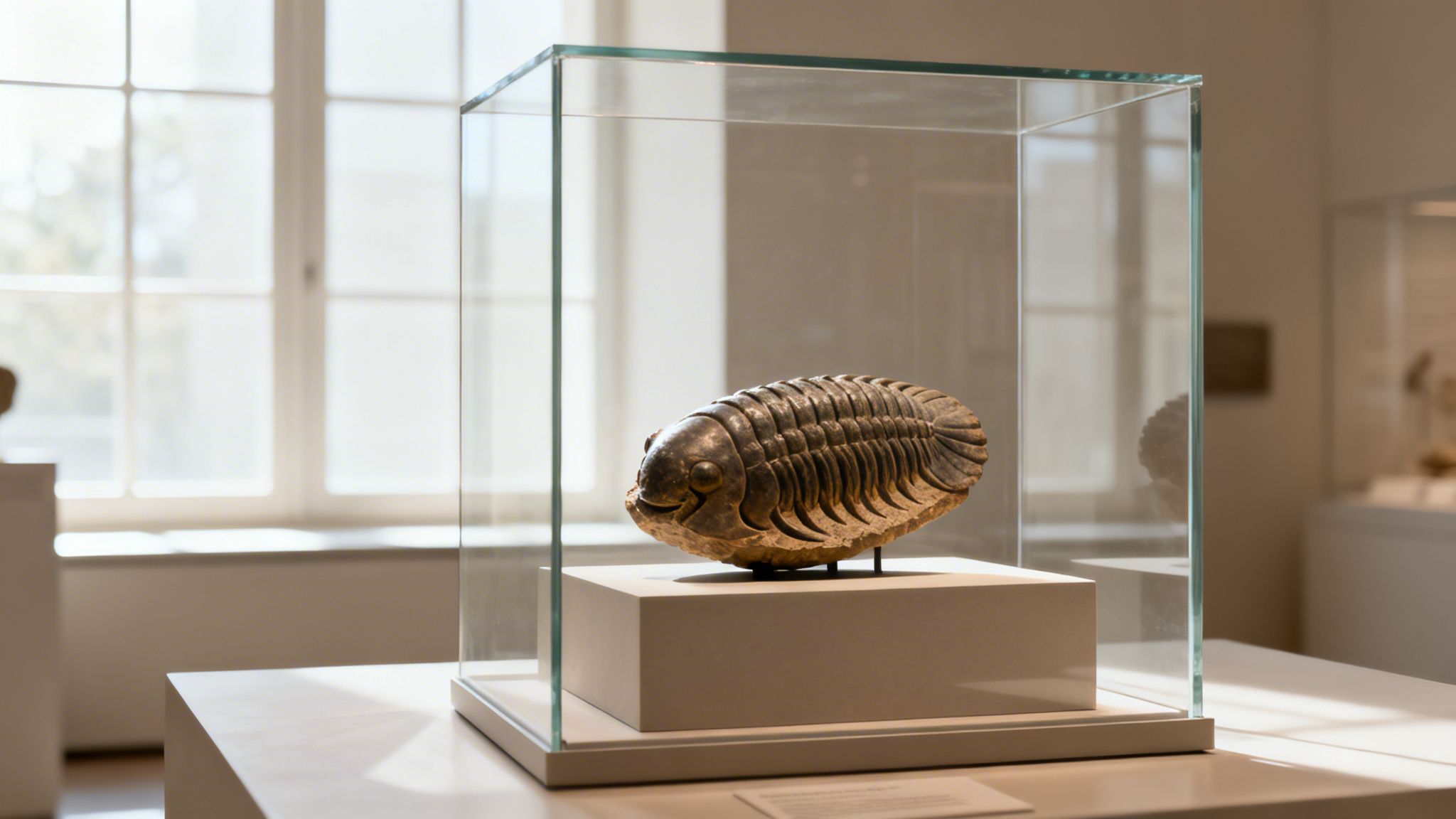
What Is Fossilisation and How Does It Create Investment Value?
Fossilisation is the natural process that transforms life into stone. This transformation requires millions of years and specific geological conditions. Understanding this process is the first step toward appreciating a fossil’s true story, its scientific importance, and its market value.
From Living Organism to Tangible Asset
Every fossil has a unique origin story. This story, the fossilisation process, dictates the quality, detail, and financial worth of the final specimen. The journey from a living creature to a museum-quality showpiece is exceptionally rare; consequently, the vast majority of all life vanishes without a trace.
Only a tiny fraction of organisms ever become fossils. This incredible rarity is a fundamental driver of their value as a collectible asset. For preservation to occur, a series of precise conditions must align perfectly. As a result, each fossil is a survivor against impossible odds.
The Critical First Step: Rapid Burial
The process begins with one crucial event: rapid burial. An organism must be quickly covered by sediment such as sand, mud, or volcanic ash. This protects it from the elements, scavengers, and bacteria that cause decay.
This step is essential to shield the remains from decomposition. It provides the organism a chance to enter the geological record. Once safely buried, the real transformation can begin. The specific minerals in the surrounding sediment, along with immense pressure and temperature, determine the fossilisation pathway. This process leads to the amazing variety we see in fossils. You can learn more about the different types of fossils and how they form, but it all starts here.
A fossil is more than a stone; it is a physical record of a successful battle against decay. Its existence represents an extraordinary alignment of chance and geology, creating an object of immense scientific importance and tangible market value.
Understanding fossilisation is essential for any serious collector. It provides the foundational knowledge needed to assess a specimen’s quality, rarity, and provenance. With this expertise, you can move beyond simply buying fossils and begin building a collection that is both a source of personal fascination and a sound, long-term store of value.
The Blueprints of Prehistoric Preservation
Fossilisation is not a single process. It is a set of different methods for preserving the past. Each of these pathways creates a unique kind of prehistoric treasure, determining a fossil’s final appearance, level of detail, and collector value.
The most common pathway is permineralization. It is responsible for many of the most iconic fossils available on the market today. This process creates durable, three-dimensional specimens that are highly sought after by collectors and institutions.
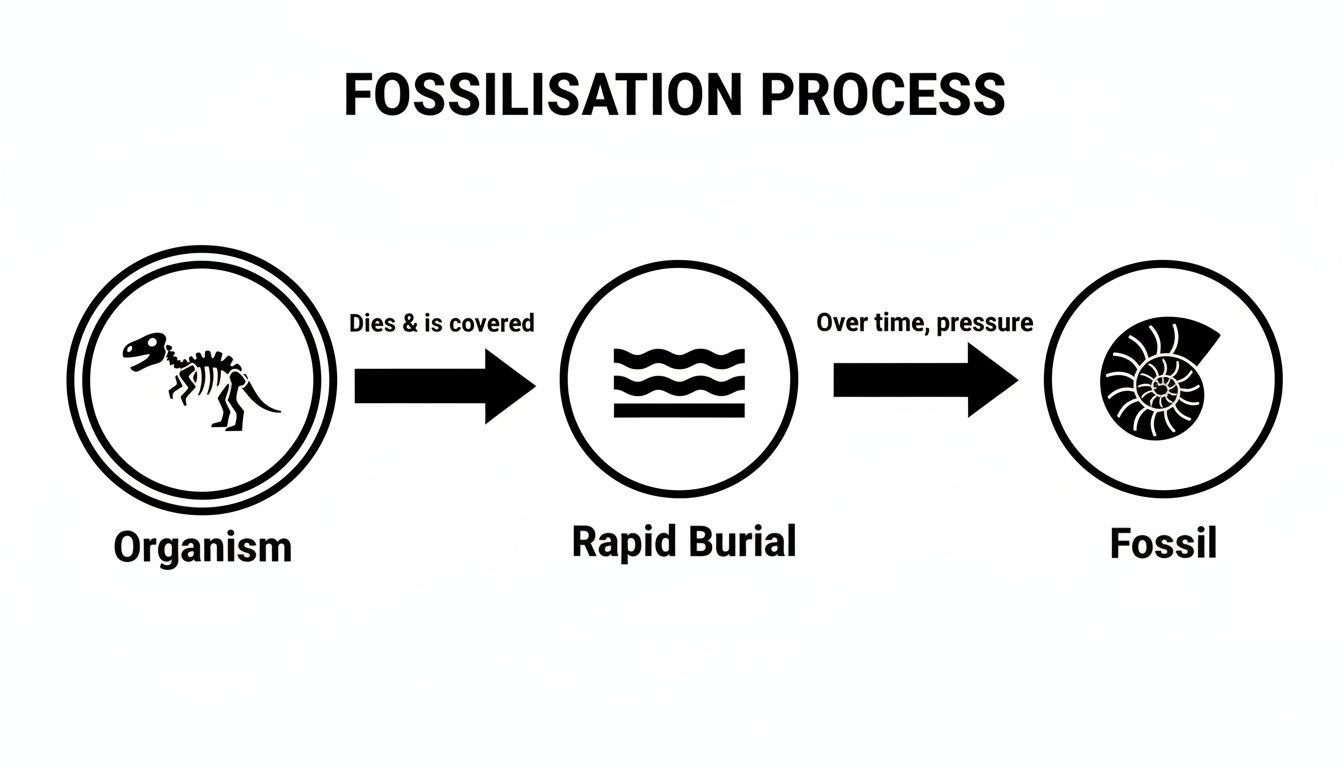
This diagram shows the fundamental journey of fossilisation, from a living organism to a preserved fossil, highlighting the absolute necessity of rapid burial.
As you can see, rapid burial is the critical first step. It protects the remains from scavengers and the elements. This sets the stage for the long, slow transformation into stone, a process that underpins the value of every specimen.
Permineralization: The Art of Mineral Replacement
Permineralization is the remarkable process where organic material slowly turns to stone. It begins when mineral-rich groundwater seeps into the porous parts of bone, shell, or wood. Over immense timescales, these minerals crystallize inside the empty spaces, creating a perfect internal cast.
This meticulous, molecule-by-molecule exchange can take millions of years. It perfectly preserves microscopic details while turning the entire object into a durable mineral replica. The entire process relies on the presence of sedimentary rock, which acts as the ideal host environment for these mineral exchanges.
Permineralization is nature’s best method for creating three-dimensional, high-fidelity fossils. This process is responsible for the stunningly detailed petrified wood and the robust dinosaur bones that form the cornerstones of many world-class collections.
For collectors, permineralized fossils are incredibly desirable. The level of detail can be extraordinary, often capturing cellular structures. This scientific integrity, combined with their sturdy nature and aesthetic appeal, makes them prized assets. A massive, well-preserved dinosaur femur, for instance, owes both its existence and its significant market value to this exact process.
Molds and Casts: Echoes in Stone
Another major pathway creates what are essentially echoes in stone: molds and casts. This process starts when an organism, like a seashell, is buried in sediment that eventually hardens into rock. Over time, groundwater trickles through and dissolves the original shell completely.
What remains is a hollow impression in the surrounding rock. This impression is a mold that perfectly mirrors the organism's external shape. If this empty space is later filled by other minerals that harden, it creates a cast, a three-dimensional stone replica of the original creature.
Many classic ammonite and trilobite fossils are casts. Collectors value them for their sharp detail and iconic appearance. While they contain no original organic material, they provide a perfect stone record of the animal's form.
Carbonization: A Delicate Silhouette
Carbonization occurs when an organism’s volatile compounds, such as hydrogen and oxygen, are driven off by heat and pressure. This process leaves behind a thin film of pure carbon. It is common for plants, insects, and fish that settle in low-oxygen environments like the bottom of a swamp or lake.
The result is a delicate, dark silhouette pressed into rock. The famous fern fossils from the Carboniferous period are perfect examples of this. Their fine, elegant impressions are sought after for their beauty and scientific importance, capturing a fragile moment in geologic time.
To better understand these preservation methods, we can compare them side-by-side. Each pathway produces a fossil with distinct characteristics and its own place in a curated collection.
Comparing Key Fossilisation Processes
Process
Mechanism
Common Fossil Types
Key Value Drivers for Collectors
Permineralization
Mineral-rich water seeps into porous organic material (bone, wood) and deposits minerals, turning it to stone.
Delicate detail, aesthetic beauty, scientific importance of preserving soft-bodied organisms.
As you can see, the specific preservation method directly impacts a fossil's final appearance and value. Whether it's the stony heft of a permineralized bone or the delicate beauty of a carbon film, each fossil is a testament to a different kind of geological miracle. This variation is what creates a diverse and dynamic market for collectors.
Decoding the Market Value of a Fossil
Understanding fossil formation is crucial. However, for a collector, the real question is why one specimen is worth a few dollars while another commands thousands. Here, a fossil’s geological journey meets the principles of supply and demand. You are no longer just looking at natural history; you are evaluating a tangible asset.
The factors that determine a fossil's market price are similar to those for fine art or rare watches. These are the foundational principles of the natural history market. Before diving in, it is helpful to have a grasp of understanding fair market value, as it is the core concept behind any collectible's price.
A fossil's value is a direct reflection of its journey through deep time. Rarity, completeness, and preservation quality are not just scientific descriptors; they are the core drivers of its economic worth and desirability.
These elements combine to tell a story of survival against impossible odds. A common fossil tells a common story. An exceptional one tells a tale so rare it becomes a coveted centerpiece for any serious collection.
Rarity and Scientific Importance
The single biggest driver of a fossil’s value is its rarity. A shark tooth from the Miocene epoch is a fascinating object, but millions exist. In contrast, a feathered dinosaur fossil from the Cretaceous is an object of profound scarcity, capturing a critical evolutionary moment. Its scientific importance elevates it from a mere specimen to a landmark discovery, and its price reflects that global significance.
The species itself also plays a huge role. Fossils from iconic creatures like a Tyrannosaurus rex carry immense cultural weight. That name recognition creates powerful market demand, making these pieces perpetually sought after by museums and private collectors alike.
Completeness and Preservation Quality
The physical integrity of a fossil is paramount. A complete dinosaur skeleton is exponentially more valuable than its individual bones. Therefore, the market places a massive premium on completeness. It offers an uninterrupted view of the prehistoric organism as it was in life.
Just as important is the quality of preservation. How much detail survived? Can you see the fine serrations on a tooth or the impression of skin? A specimen that endured fossilization with minimal distortion and maximum detail is a geological masterpiece, and its price will reflect that perfection.
Exceptional Preservation: A trilobite with its delicate antennae intact or a fish fossil with countable scales will always command a premium.
Structural Integrity: A specimen with little to no repair or restoration is far more valuable. It is an authentic, unaltered piece of natural history.
Articulation: Bones found in their natural, life-like positions (articulated) are much rarer and more desirable than a scattered jumble (disarticulated).
These details are not just for show; they are a direct measure of a fossil's scientific and historical integrity. For collectors looking to find the best places to buy fossils online, understanding these nuances separates a good find from a world-class acquisition.
Size and Aesthetic Appeal
While science is crucial, the raw visual power of a great fossil is undeniable. Size and aesthetic appeal—what collectors call the "wow factor"—are huge drivers of value. This is especially true in the market for natural art and luxury décor. A massive, beautifully prepared ammonite becomes a statement piece.
A specimen's color, symmetry, and quality of preparation all contribute to its desirability. An expertly cleaned and mounted fossil can transcend its scientific origins to become an object of pure aesthetic beauty. This is why a perfectly preserved trilobite, with its elegant form, can fetch a price comparable to contemporary sculpture, attracting interior designers as much as collectors.
Uncovering the World's Premier Fossil Sources
Fossilisation is not uniform across the globe. In a few special locations, a perfect storm of geological conditions produced fossils of breathtaking quality and completeness. These rare sites are known as Lagerstätten, a German term meaning "storage places." For a collector, these are the premier sources for museum-quality specimens.
Fossils from a Lagerstätte are not just preserved; they are three-dimensional snapshots of entire prehistoric ecosystems. They often capture details rarely seen, such as soft tissues, skin texture, and even last meals. This incredible detail provides immense scientific insight and drives significant market value.
What Makes a Lagerstätte Special
The magic of a Lagerstätte lies in its unique environment. These ancient settings—typically quiet lagoons or deep lakes—shared key characteristics that halted decay. Finding this precise combination of factors in the geological record is incredibly rare, which is why specimens from these localities are so prized.
Two conditions were absolutely critical: anoxic waters (water with very little oxygen) and rapid burial in fine-grained sediment. The lack of oxygen stopped the growth of scavenging bacteria that normally devour soft parts. Then, a gentle burial by fine mud or limestone silt encased the organism, protecting it from currents or scavengers.
The unparalleled preservation in a Lagerstätte is the direct result of a low-energy, oxygen-poor environment. These sites effectively mummified organisms before the fossilization process even began, locking in details that are almost always lost to time.
This special setup is why Lagerstätten produce fossils with fully articulated skeletons and carbonized soft tissues. A new discovery of such a site can redefine our understanding of prehistoric life. It also creates a finite and highly coveted source for the world's finest fossil specimens.
The Green River Formation A Prehistoric Lakebed
One of the most famous Lagerstätten is the Green River Formation, a massive deposit spanning parts of Wyoming, Utah, and Colorado. Around 50 million years ago, this area was a network of vast subtropical lakes. The unique chemistry on the lakebeds created a perfect trap for preservation.
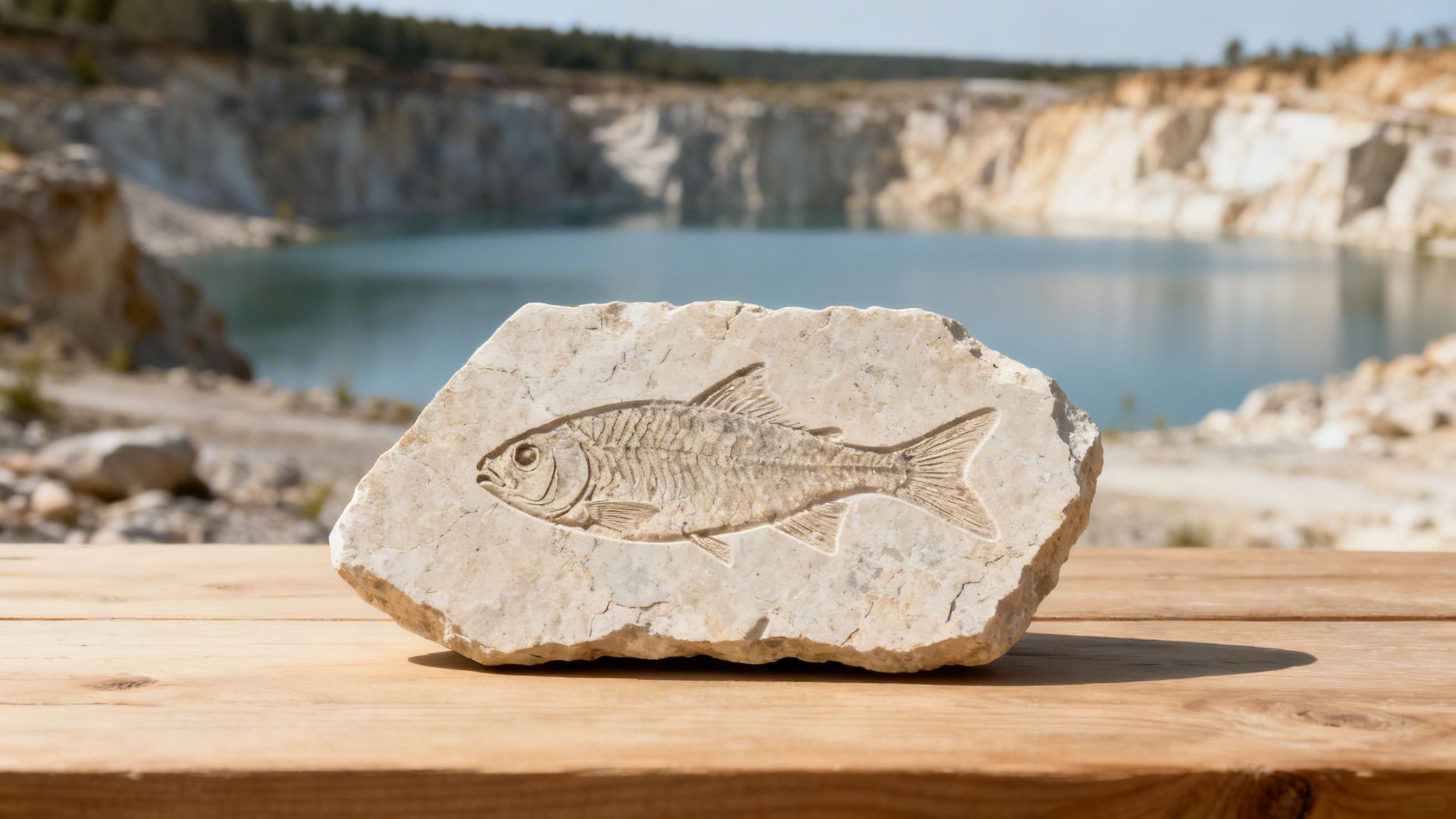
The result is an abundance of exquisitely detailed fish fossils, each a work of natural art. The fine limestone matrix preserved every tiny bone, fin ray, and scale. Specimens from this formation are prized for their aesthetic beauty and flawless condition. Astro West maintains direct relationships with quarry owners in Wyoming, ensuring our clients access the highest-grade specimens from this world-class deposit.
The Solnhofen Limestone The Birthplace of an Icon
Another legendary site is the Solnhofen Limestone in Germany. These 150-million-year-old deposits formed in shallow, stagnant lagoons during the Jurassic period. The fine-grained limestone here is famous for preserving delicate creatures with astonishing clarity.
This site yielded the most famous fossil in the world: the Archaeopteryx. This specimen provided a stunningly clear link between dinosaurs and birds, preserving not just a perfect skeleton but also the impression of its feathers. The extreme rarity of Solnhofen fossils places them at the peak of the market. To acquire a piece from this location is to own a part of paleontological history. For this reason, provenance is everything, and our experts meticulously verify the origin of every specimen.
Building a Collection of Lasting Value
Understanding fossilisation is the single most powerful tool for a collector. It shifts your mindset from simply buying objects to strategically building a portfolio of tangible assets. Every fossil tells the story of its own preservation. That story is directly tied to its quality, rarity, and lasting market value.
This knowledge empowers you to make smarter acquisition decisions. You must train your eye to spot the subtle clues that separate a common specimen from an investment piece. For example, recognizing crystalline structures in a dinosaur bone is proof of excellent permineralization, signaling superior preservation and higher value. Similarly, a trilobite with sharp features indicates a high-fidelity mold and cast, free from the geological distortion that flattens lesser examples.
Starting Your Collection with Confidence
For new collectors, the golden rule is to focus on quality, not quantity. An exceptional example of a common fossil is a better first purchase than a poor-quality specimen of a rare one. It trains your eye for detail and sets a high standard for future acquisitions.
Consider these accessible yet rewarding entry points:
High-Quality Ammonites: Look for specimens with intricate suture patterns and minimal restoration. These beautiful fossils exemplify the mold and cast process and have massive aesthetic appeal.
Detailed Fish Fossils: Pieces from the Green River Formation are an accessible way to own a piece from a Lagerstätte. Seek plates with complete fish showing fine details, like scales and fins.
Exceptional Shark Teeth: While common, a large, perfectly preserved Megalodontooth with sharp serrations is a classic collector’s item that holds its value well.
In each case, you are investing in the quality of the fossilisation. These pieces showcase incredible preservation, making them sound and beautiful additions to any collection. They are foundational assets, not just decorative objects.
An entry-level collector should acquire the best possible example within their budget. A flawless ammonite is a more sophisticated acquisition than a fragmented, heavily repaired dinosaur bone. Quality always precedes rarity in establishing a collection of lasting worth.
Acquiring Museum-Grade Assets
For the serious collector, acquiring top-tier fossils demands a higher level of diligence. The market for high-value specimens operates much like the fine art world. Here, authenticity, provenance, and expert preparation are everything. Every part of a fossil’s history, from discovery to preparation, contributes to its final value.
When considering a significant acquisition, due diligence is non-negotiable. This means verifying the fossil's origin, understanding its scientific context, and assessing any restoration work. This is why partnering with a reputable gallery is so critical. At Astro West, our direct relationships with paleontologists and field experts provide a layer of trust and transparency you cannot find elsewhere. We ensure every piece is ethically sourced, scientifically verified, and expertly prepared, allowing our clients to acquire assets with absolute confidence.
How to Display and Preserve Your Prehistoric Assets
Acquiring a museum-quality fossil is the first step. Next begins a long-term relationship with a genuine piece of natural history. Like any valuable asset, it requires proper care. Proper display and preservation are essential practices that protect your investment and maintain its value.
After surviving millions of years of geological pressure, your fossil now faces new environmental threats. Humidity, sudden temperature shifts, and direct sunlight can cause irreversible damage. More delicate or pyritized specimens are especially vulnerable to these modern environmental factors.
Creating a Stable Environment
Your primary goal is to create a stable environment. Constant swings in humidity are particularly dangerous. Moisture can trigger mineral reactions within the fossil's matrix, leading to cracks or degradation. Fossils containing pyrite, for example, are known for "pyrite disease," a condition where the mineral decays in high humidity.
Understanding the benefits of climate controlled storage is critical for many fossil types. It is the best way to shield them from environmental decay. Additionally, direct sunlight is a hard no. Its UV rays will fade a fossil’s natural coloration and can make the surrounding matrix brittle.
A controlled environment is the most critical factor in long-term fossil preservation. By managing humidity and light, you are actively safeguarding the integrity and market value of your collection for generations to come.
Displaying Your Collection with Purpose
A thoughtful display does more than protect a fossil; it elevates its story and aesthetic power. The right lighting and mounting can draw the eye to incredible details that survived fossilisation. This highlights the specimen’s most compelling features and reinforces its value.
Consider these key principles for an impactful presentation:
Custom Mounting: A professionally crafted stand ensures stability and presents the fossil at the perfect viewing angle, transforming it into natural sculpture.
Strategic Lighting: Use low-UV LED lights to illuminate your specimen without causing damage. Well-placed spotlights can accentuate texture and form.
Minimalist Backgrounds: Let your fossils be the focus by displaying them against neutral, uncluttered backgrounds. This allows their natural form to command full attention.
Finally, remember that proper handling and cleaning are just as important. When moving a specimen, always support its weight from the bottom and use clean hands or gloves. For more in-depth guidance, see our advice on how to clean fossils safely and effectively. By investing in proper care, you ensure your prehistoric asset remains a source of fascination and a sound store of value.
Your Questions Answered: Fossil Collecting FAQs
Entering the world of fossil collecting can feel overwhelming and often raises important questions. From verifying authenticity to understanding long-term value, here are the answers you need, straight from our experts.
How Can I Tell if a Fossil Is Real?
Authenticity is everything. A genuine fossil has a unique mineral composition, a specific matrix texture, and subtle signs of its natural formation. Additionally, professional preparators leave behind very fine tool marks, which are distinct from the crude gouges found on forgeries.
The single most important factor, however, is provenance. A reputable seller will always provide detailed documentation of a fossil’s history. At Astro West, our in-house experts rigorously vet every specimen to guarantee its authenticity. This process protects your investment and ensures you acquire a true piece of natural history.
What Makes One Fossil More Valuable Than Another?
Value comes down to a handful of key factors, with rarity being the most important. A unique species or a specimen from a remote location will always be more valuable. Next are completeness and preservation quality. A fully articulated skeleton with incredible detail is infinitely more desirable than scattered, damaged fragments.
Beyond that, factors like size, aesthetic appeal, and scientific importance play a huge role in market price. A fossil with a great discovery story or one representing a critical evolutionary link holds immense value. These elements transform a fossil from a natural object into a prized historical asset, much like fine art or luxury watches.
Do Fossils Appreciate in Value?
Yes, high-quality and rare fossils have a strong track record of appreciation. This trend is similar to traditional investment markets. It is a simple matter of supply and demand. The supply of exceptional fossils is finite; new, top-tier discoveries are increasingly scarce. Meanwhile, global demand from private collectors, museums, and designers continues to rise.
This imbalance drives long-term value. As the best specimens are acquired by permanent collections, they are taken off the market, increasing the worth of those that remain. Therefore, a carefully chosen fossil is not just a beautiful object; it is a tangible asset with a proven history of holding and growing its value over time.
At Astro West, we provide the expertise and access you need to build a collection of true significance. Explore our curated selection of investment-grade fossils and start your own journey into the incredible world of natural history.