What is a Meteorite Made Of? Discover Its Composition Now
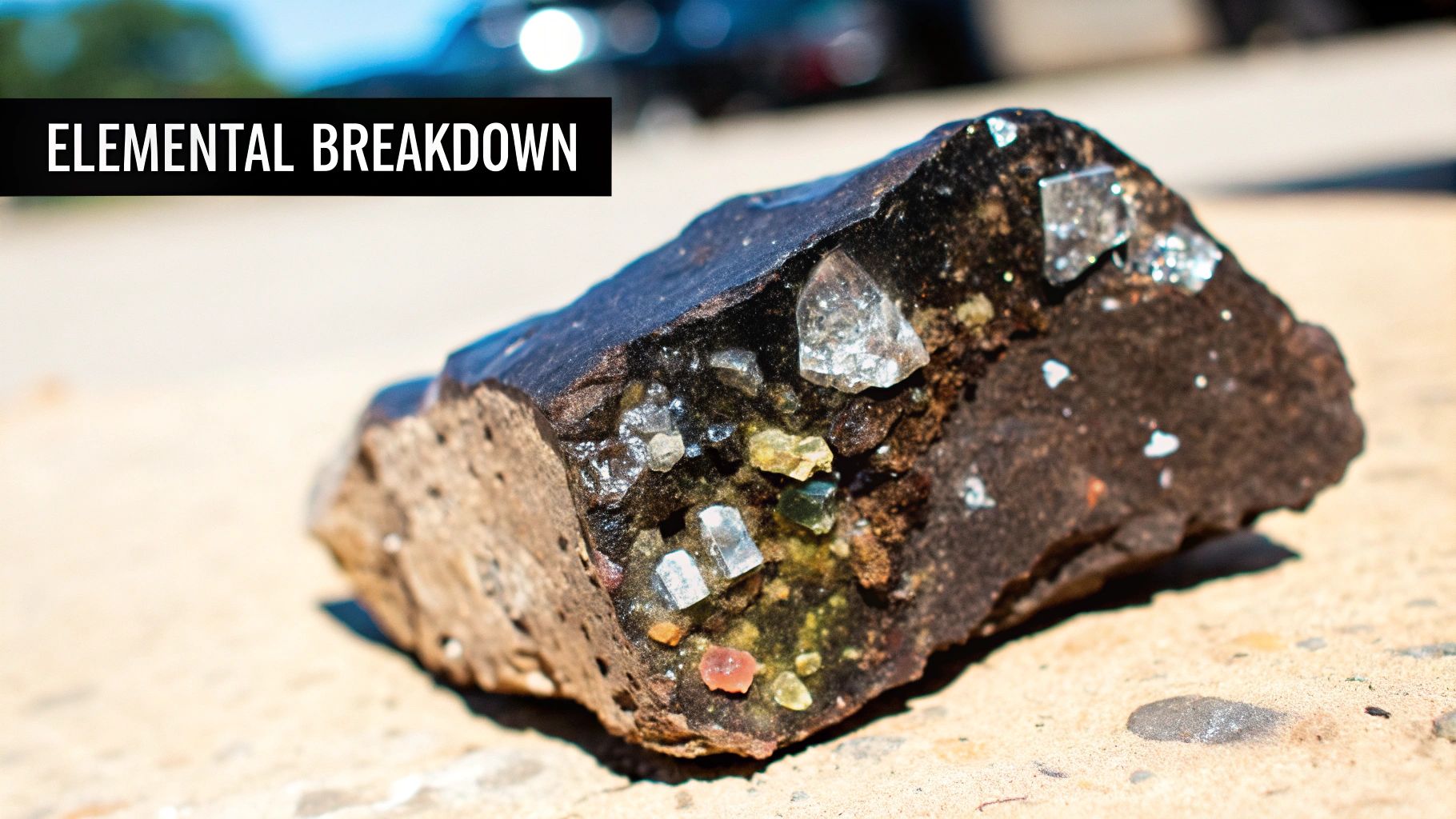
Most meteorites boil down to a pretty simple recipe: iron, nickel, and silicate minerals. Think of them as the leftover building blocks from when our solar system was first coming together. These cosmic travelers are basically time capsules, carrying secrets from planets, asteroids, and the vast space between them.
The Ancient Recipe Inside Every Meteorite
To really get what a meteorite is made of, it helps to imagine a cosmic "recipe book." Just like a baker uses different ingredients for different breads, the universe uses unique combinations of elements to create each type of meteorite. These ancient rocks are remnants from the birth of our solar system, offering us a direct look at the raw materials that built planets like our own.
Every single meteorite tells a story about where it came from—its parent body. It might have been a tiny asteroid that never quite grew up, the shattered core of a small planet, or even a piece of Mars or the Moon that was blasted into space by a massive impact. Its composition is the main clue we have to unlock that incredible history.
The Three Main Meteorite Families
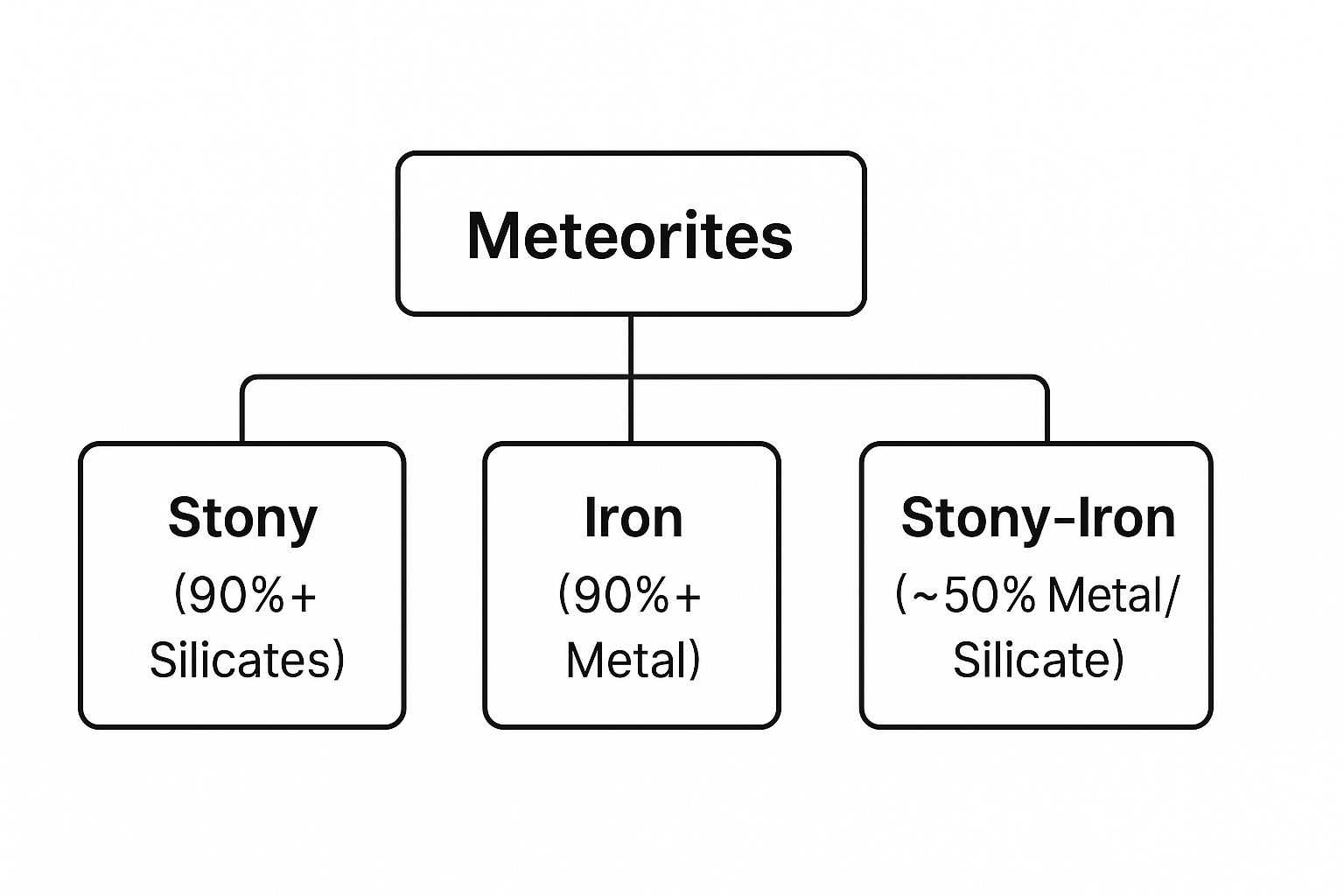
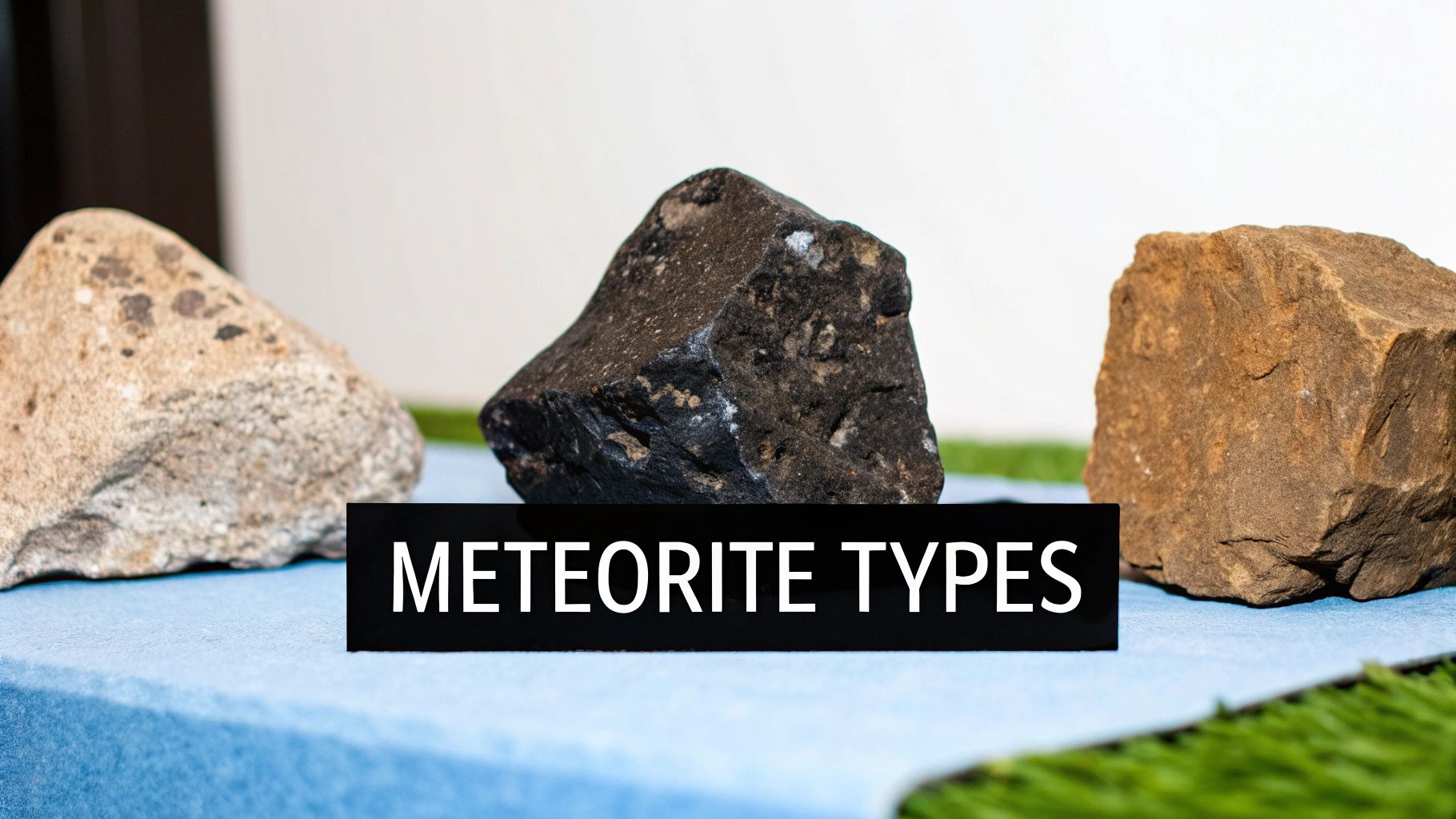
Scientists sort meteorites into three main families based on their internal recipe—specifically, the ratio of metal to rock. This classification helps us figure out where they originated and what they went through over billions of years.
The three primary types are:
Stony Meteorites: Just as the name implies, these are made almost entirely of silicate minerals, the same kind of stuff you find in rocks right here on Earth's crust.
Iron Meteorites: Composed almost purely of an iron-nickel alloy, these dense, heavy meteorites are the remnants of the cores of ancient, shattered worlds.
Stony-Iron Meteorites: The rarest of the three, these are a stunning and dramatic mix of both silicate minerals and shimmering metallic iron-nickel.
This simple breakdown shows how a meteorite’s core ingredients determine its identity.
As the infographic shows, stony meteorites aren't just one type—they're the undisputed champions when it comes to the cosmic visitors found on Earth.
Stony meteorites are, by a huge margin, the most common type to survive the fiery trip through our atmosphere. In fact, stony meteorites make up about 94 percent of all meteorites ever collected on our planet.
The other 6 percent is split between the dense irons and the exceptionally rare stony-irons, which is exactly why those two types are such prized finds for collectors. You can discover more about these meteorite statistics and the science behind why certain types are found more often than others.
To make it even clearer, here's a quick look at the building blocks of each meteorite family.
Quick Guide to Meteorite Composition
This table breaks down the essential materials you'll find in the three main classes of meteorites.
Meteorite Type
Primary Composition
Key Characteristics
Stony
Silicate minerals (olivine, pyroxene)
Similar to Earth rocks; often have a dark fusion crust
Iron
Iron-nickel alloy
Extremely dense and heavy; show a unique Widmanstätten pattern
Stony-Iron
Mix of iron-nickel alloy and silicates
Rare and beautiful; crystals of olivine suspended in a metal matrix
This cheat sheet is a great starting point for understanding what separates one meteorite from another at a fundamental level.
Exploring Stony Meteorites: The Most Common Visitors
When you hear the word "meteorite," you probably picture a heavy chunk of alien metal. The reality is a little different. The vast majority of space rocks that actually survive the trip to Earth are stony meteorites, made up mostly of silicate minerals.
This composition makes them look a lot like regular Earth rocks, which is why countless stony meteorites go completely unnoticed unless a trained eye spots them. But don't let their humble appearance fool you—these common visitors hold some of the deepest secrets of our solar system, with a story told by their internal structure. That story splits them into two incredible sub-groups: chondrites and achondrites.
Chondrites: The Primordial Building Blocks
For scientists, chondrites are arguably the most important meteorites of all. Why? Because they are essentially cosmic time capsules, totally unchanged since they first formed around 4.56 billion years ago.
Their signature feature is the presence of chondrules—tiny, spherical grains of minerals you can see embedded in the rock. Think of chondrules as cosmic hailstones. They started as molten droplets floating in the solar nebula, eventually clumping together with cosmic dust to create the very first asteroids.
Because they’re so ancient and unaltered, chondrites give us a direct snapshot of the raw chemical mix that built our planets. They are the original building blocks of the solar system, frozen in time.
One of the most famous examples is the Allende meteorite, which dramatically fell over Mexico in 1969. It contains calcium-aluminum-rich inclusions (CAIs) that are even older than the chondrules, representing some of the very first solid material to form in our solar system. If you're curious to see one of these ancient travelers up close, you can find stunning examples of the Allende meteorite available for collectors.
Achondrites: Rocks from Other Worlds
If chondrites are the raw ingredients of the solar system, achondrites are the finished product. The "a" in their name means "without chondrules," and for a very good reason. These stony meteorites come from much larger parent bodies—think big asteroids, moons, or even planets—that were large enough to undergo massive geological change.
This process, called differentiation, happens when a parent body gets hot enough to melt. Heavier elements like iron sink to form a core, while lighter silicate materials float to the top and create a crust. Any primordial chondrules are melted away and erased forever.
You can think of achondrites as cosmic volcanic rocks. Much like lava on Earth, they’re formed from material that was melted down, processed, and then cooled into a new type of rock with a far more complex history.
What’s truly mind-blowing is that some achondrites have compositions that perfectly match samples analyzed on other worlds. This has allowed scientists to identify meteorites that were blasted off the surfaces of both the Moon and Mars by ancient impacts, giving us tangible pieces of other planets right here on Earth.
Uncovering Iron Meteorites: Cores of Ancient Worlds
While stony meteorites are the most common visitors from space, iron meteorites are arguably the most dramatic and instantly recognizable. Dense, heavy, and powerfully magnetic, these are the celestial objects most people picture when they hear the word "meteorite." They’re made almost entirely of an iron-nickel alloy, with just trace amounts of other minerals mixed in.
This metallic makeup points to a truly violent origin story. Iron meteorites aren't just random chunks of space metal; they are the literal cores of ancient planetesimals—small, developing planets that were shattered by cosmic collisions billions of years ago. As these little worlds formed, the heaviest elements, iron and nickel, sank to their centers, creating metallic cores much like the one deep inside our own Earth.
When you hold an iron meteorite, you’re holding a tangible piece of a planetary heart—a place we could otherwise never hope to reach.
The Cosmic Fingerprint Inside
The real magic of an iron meteorite is often hidden from plain sight. On the outside, it might just look like a pitted, melted piece of dark metal. But slice it open, polish the surface, and etch it with a mild acid, and an extraordinary secret is revealed: an intricate, crystalline pattern of interlocking metallic bands.
This stunning design is called the Widmanstätten pattern, named after the scientist who documented it in the early 1800s. It’s far more than just a beautiful feature; it is an undeniable certificate of extraterrestrial origin.
This pattern is a form of cosmic fingerprint. It can only form when molten iron-nickel cools at an unbelievably slow rate—no more than a few degrees per million years. This process is impossible to replicate on Earth and only happens deep inside the insulated cores of large asteroids over eons.
This unique structure is definitive proof that the object in your hands is a genuine visitor from deep space.
What the Pattern Tells Us
The specific look of the Widmanstätten pattern—the thickness and arrangement of the metallic bands—is actually a road map. It helps scientists classify iron meteorites into different groups, revealing details about the size of the meteorite's parent body and the conditions under which it formed. For collectors, of course, the pattern is the primary source of an iron meteorite's aesthetic appeal and value.
The different classes of iron meteorites include:
Octahedrites: This is the most common type, proudly displaying the classic Widmanstätten pattern. The bands can be fine, medium, or coarse, all depending on the nickel content.
Hexahedrites: With lower nickel content, these typically don't show a Widmanstätten pattern. Instead, they might reveal fine parallel lines called Neumann lines after being etched.
Ataxites: Packing the highest nickel content, these meteorites are structurally rare and show no visible pattern at all, appearing as a uniform, silvery metallic mass.
Each of these types represents a different chapter in the violent history of a lost world. When you see a beautiful example, like a Muonionalusta meteorite slice with its striking etched pattern, you are looking at the direct result of planetary formation and destruction. Holding one is like holding the very heart of a shattered planet.
The Rare and Beautiful Stony-Iron Meteorites
Sitting at the intersection of stony and iron meteorites are the rarest and, arguably, the most visually striking of all cosmic visitors: the stony-iron meteorites. These incredible specimens make up only about 1% of all known meteorites, making them a true collector's prize.
They're a breathtaking mixture of gleaming iron-nickel metal and colorful silicate minerals, blended together in a way that tells a dramatic story of planetary formation and destruction. These rare objects give us a glimpse into a very specific and turbulent place: the core-mantle boundary of a large asteroid or protoplanet. It's the chaotic zone where the heavy, molten metallic core met the lighter, rocky mantle. When these ancient worlds were shattered by cataclysmic impacts, fragments from this unique boundary were launched into space.
Pallasites: Cosmic Stained Glass
The most famous and sought-after type of stony-iron is the pallasite. These are true celestial marvels, featuring large, often gemstone-quality crystals of a silicate mineral called olivine suspended within a solid iron-nickel matrix.
When sliced thin and polished, light shines through the translucent green and gold olivine crystals, creating an effect that looks just like cosmic stained glass. It's a look that's completely unique in the natural world. Each pallasite is a portrait of planetary differentiation, frozen in time. The dense metal and lighter olivine crystals were in the process of separating when their parent body was violently destroyed, locking them together forever.
For collectors, owning a pallasite is like holding a snapshot from the heart of a shattered world. If you're fascinated by these natural wonders, you can see this incredible structure for yourself in this remarkable Sericho Pallasite meteorite slice.
Mesosiderites: A Chaotic Cosmic Puzzle
The other main group of stony-iron meteorites is the mesosiderite. If pallasites are elegant and orderly, mesosiderites are their chaotic, jumbled-up counterparts. Their name literally means "half iron," and they are a brecciated mix of broken rocky fragments and chunks of iron-nickel metal.
Unlike the uniform structure of pallasites, mesosiderites look like a cosmic construction site, with angular pieces of different rocks cemented together by molten metal. This composition suggests a violent and complex history.
The leading theory is that mesosiderites were born during a massive, low-velocity collision between two different asteroids out in space. Picture the molten metal core of one body splashing over and mixing with the shattered, rocky crust of another. This chaotic event created a jumble of material that eventually cooled into the fascinating and puzzling meteorites we find today, each one a unique relic of a cosmic smash-up.
How Scientists Decode a Meteorite's Story
Figuring out what a meteorite is made of is part detective work, part high-tech science. The process usually starts with simple observations that anyone—including collectors—can do at home. Since the vast majority of meteorites contain iron-nickel metal, the first and easiest test is to see if it’s magnetic.
A simple magnet can often tell you right away if you're holding a potential space rock or just an ordinary terrestrial one. Another big clue is density. Iron-rich meteorites feel surprisingly heavy for their size, far denser than a typical Earth rock. These initial checks are great for weeding out the "meteor-wrongs" and flagging a find that's worth a closer look.
Unlocking Chemical Secrets
Once a promising candidate is identified, the real work begins in the lab. This is where scientists move past physical properties to get a precise chemical breakdown, and it’s where a meteorite’s true story begins to unfold. To do this, they need highly specialized instruments that can map out the exact elements inside and read the history they hold.
One of the most powerful tools for the job is the electron microprobe. This incredible machine fires a highly focused beam of electrons at a tiny, polished slice of the meteorite.
The beam's interaction with the sample causes it to emit X-rays, and the specific energy of these X-rays acts like a unique fingerprint for each element. This allows scientists to build a detailed chemical map, showing not just what the meteorite is made of, but in what exact proportions.
Reading a Cosmic DNA Test
Beyond simply listing the elements, researchers want to uncover a meteorite's age and its journey through space. For this, they turn to isotopic analysis—think of it as a kind of cosmic DNA test. Most elements have isotopes, which are just versions of themselves with slightly different masses, and the ratios of these isotopes can tell an incredible story.
The process uses a mass spectrometer to measure the decay of radioactive elements trapped inside the meteorite's crystals. This analysis reveals two critical pieces of information:
Formation Age: By measuring the decay of long-lived radioactive isotopes, scientists can pinpoint the moment the meteorite first solidified from the cloud of dust and gas that formed our solar system, often dating it back an astonishing 4.56 billion years.
Cosmic Ray Exposure: While hurtling through space, meteorites are constantly bombarded by high-energy cosmic rays. This relentless exposure alters their isotopic makeup, creating a kind of "cosmic tan" that lets scientists calculate how long the rock drifted in space after breaking off its parent asteroid or planet.
By combining all these techniques, scientists can transform a silent, anonymous space rock into a detailed historical document, confirming exactly what it’s made of and revealing the incredible journey it took to get here.
Why Meteorite Composition Matters
When we talk about what's inside a meteorite, we're really talking about the building blocks of our solar system. These aren't just random space rocks; they're physical samples of the raw materials that formed everything around us, from tiny asteroids to planets as complex as our own. Looking at their composition lets us tackle some of the biggest questions about where we all came from.
Think of each meteorite as a time capsule carrying a message from its parent body. An iron meteorite, for instance, gives us a direct glimpse into the core of a shattered protoplanet—a place we could never hope to study otherwise. Then you have stony chondrites, packed with ancient little spheres called chondrules. These are pristine samples of the dust and gas that swirled around our young sun 4.56 billion years ago.
By analyzing the makeup of these cosmic visitors, scientists can essentially reverse-engineer the formation of planets. They reveal the original chemical recipe of our cosmic neighborhood and how those ingredients came together to form the worlds we know today.
Clues to Our Own Origins
The study of meteorite composition—a field known as meteoritics—does more than just tell us about distant asteroids. It reveals critical details about Earth's own story. For example, some carbonaceous chondrites contain water locked right into their mineral structures, alongside complex organic compounds like amino acids.
That's a huge deal. It means these rocks contain the literal building blocks of life. This discovery backs up the powerful theory that meteorites and comets delivered a huge portion of Earth's water and the key ingredients life needed to get started. In a very real sense, studying what a meteorite is made of helps us piece together the puzzle of our own existence.
Planetary Formation: Their chemical makeup shows us the original "recipe" for planets.
Cosmic Impacts: Meteorites provide hard evidence of the solar system's violent and chaotic past.
Delivery of Life's Ingredients: They show how essential elements like water and organic molecules were scattered across space.
These ancient stones offer a profound connection to our cosmic past. It's no wonder their intricate structures and chemical histories have inspired human creativity for generations. This intersection of science and art is perfectly captured in unique creations like meteorite jewelry and streetwear, where cosmic history becomes a personal statement.
From revealing the secrets of planetary cores to hinting at the origins of life on Earth, the stuff meteorites are made of matters deeply. Each one is a chapter in the epic story of our solar system, just waiting for us to read it.
Common Questions About Meteorites
Even after you get a handle on what makes up a meteorite, a few practical questions almost always pop up. Let's tackle some of the most common curiosities people have when they start getting serious about these incredible space rocks.
Are All Meteorites Magnetic?
Most of them are. Nearly every meteorite that lands on Earth contains at least some iron-nickel alloy, which means it will attract a magnet. The pull can be incredibly strong, especially with pure iron meteorites. For stony types like chondrites, the attraction is usually much weaker because the metal is scattered in small flakes throughout the rock.
But here's the catch: a few very rare types, like certain achondrites from the Moon or Mars, might have almost no magnetism at all. So, while reaching for a magnet is a fantastic first test in the field, it isn't the final word.
Can Meteorites Contain Gold or Diamonds?
This is a fun one. While meteorites can contain tiny traces of precious metals like gold, the amounts are microscopic—far, far less than what you'd find in terrestrial ore. They're definitely not a ticket to getting rich.
However, some do contain diamonds! A specific type called ureilites can be packed with tiny nanodiamonds. These aren't the kind you'd put in a ring; instead, they're believed to be formed by the unbelievable shock pressure of cosmic collisions. They’re scientifically priceless, not commercially valuable.
What Is the Difference Between a Meteoroid, Meteor, and Meteorite?
It's easy to get these terms mixed up, but the difference is simple. It all comes down to location.
Meteoroid: This is a chunk of rock or metal just drifting through outer space.
Meteor: When that meteoroid hits Earth's atmosphere and burns up, it creates a brilliant streak of light. That fiery trail is the meteor, what most people call a "shooting star."
Meteorite: If a piece of that object survives the intense journey and actually lands on the ground, it officially becomes a meteorite.
In short: a meteoroid is in space, a meteor is in the sky, and a meteorite is on the ground. Getting this right is key to talking about them like a pro.
At Astro West, we believe everyone should have the chance to hold a piece of the cosmos. Explore our curated collection of authenticated meteorites, from planetary fragments to beautiful pallasite slices, and find your own piece of solar system history at https://astrowest.com.