Ever stumbled upon a lumpy, ordinary-looking rock, only to find it holds a universe of sparkling crystals inside? That’s the magic of a geode. Think of them as nature's ultimate surprise package—a plain, unassuming exterior that hides a breathtaking treasure within.
Unlocking Nature’s Hidden Gems
At first glance, you might walk right past a geode. They often look like any other roundish rock you'd find in a field or desert. But the real story begins when you crack one open. Inside, a hidden world of immense time, pressure, and mineral-rich water is revealed.
These geological wonders are the product of slow, patient processes that can take millions of years. The term geode itself comes from the Greek word “geoides,” meaning 'earth-like.' It's a perfect name for a rock that looks so mundane on the surface but contains something truly spectacular. You can dig deeper into their formation on reputable geology sites like Geology Science.
The Anatomy of a Geode
To really get what makes a geode special, it helps to understand its structure. Each one is built in layers, with every part playing a key role in creating the final masterpiece.
This quick table breaks down the basics:
Geode Characteristics at a Glance
Component
What It Is
Outer Shell
The tough, protective exterior, usually made of a resilient rock like basalt or limestone. This layer acts as a natural vessel.
Middle Layer
A band of chalcedony (a form of microcrystalline quartz) that lines the inside of the shell, creating the perfect base for crystals to grow.
Crystal Interior
This is the star of the show—the glittering, hollow cavity. The types of crystals inside, like amethyst or calcite, depend on the minerals that were present in the water that slowly seeped in.
The simple, layered structure is what allows for such incredible and varied formations.
Let's look a little closer at those layers:
The Outer Shell: This is the hard, protective casing. It's tough enough to withstand the immense pressures of the surrounding earth, preserving the hollow space inside so the magic can happen.
The Middle Layer: Just beneath the shell, you’ll find a layer of chalcedony. This provides a stable, uniform surface that acts as the perfect foundation for the larger, more dramatic crystals to take root and grow inward.
The Crystal Interior: Here’s where the spectacle unfolds. The hollow cavern is filled with crystals that have grown over eons. Their specific color, size, and shape are determined entirely by the unique cocktail of minerals that filtered through the rock millions of years ago.
The real thrill of a geode is the sheer unpredictability. You never truly know what stunning crystal formation you'll find until you look inside. No two are ever the same.
This journey from a simple hollow in a rock to a crystal-lined marvel is what makes every geode a one-of-a-kind piece of natural art. It perfectly sets the stage for understanding the incredible process of how they form.
The Million-Year Journey of Geode Formation
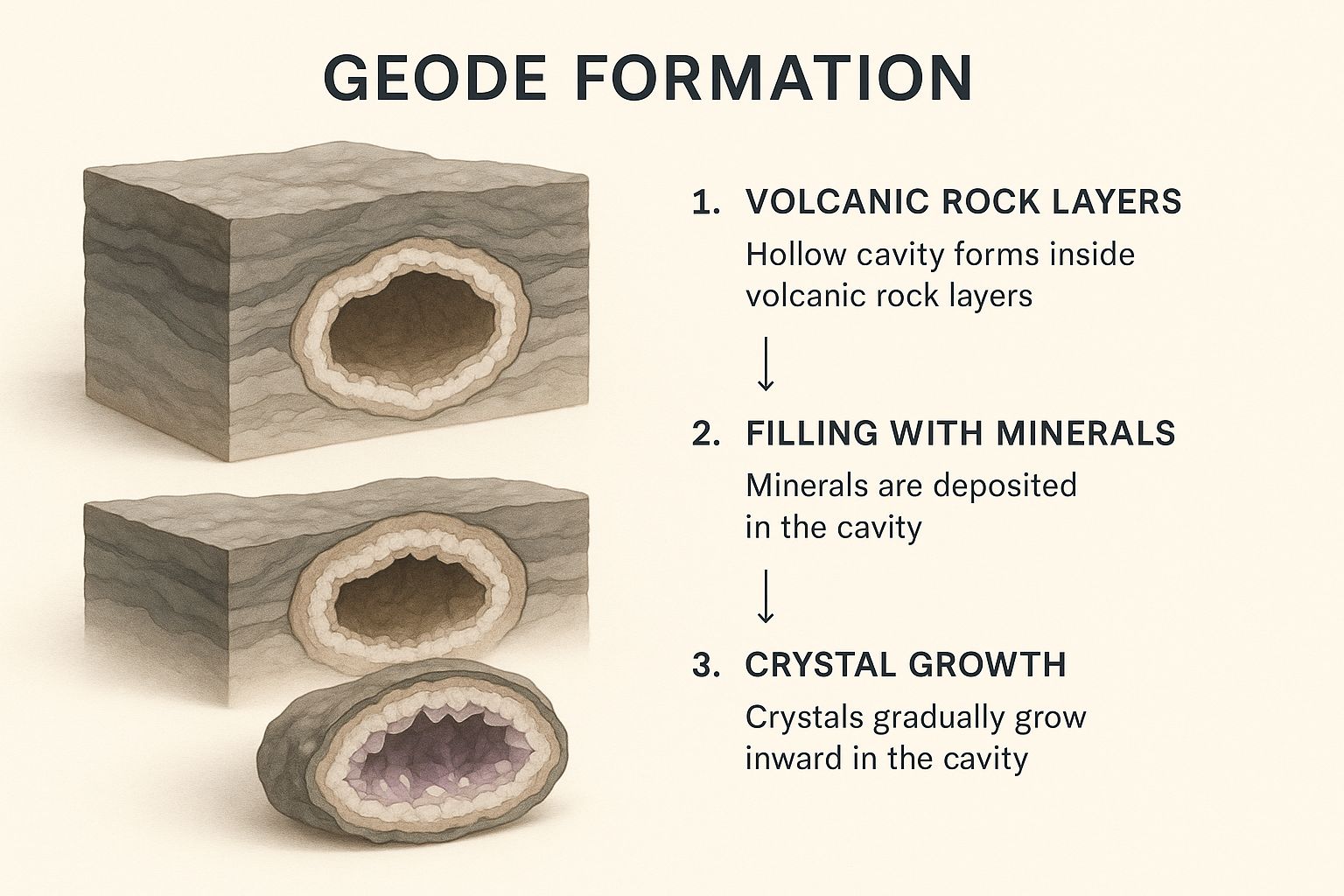
So, how does a seemingly ordinary, hollow rock end up with a sparkling crystal cave inside? The creation of a geode is a story written by fire, water, and an almost unbelievable amount of time. This whole process plays out over millions of years, usually starting in one of two places: a fiery volcanic landscape or a quiet sedimentary bed.
It all starts with an empty space. In volcanic areas, gas bubbles get trapped inside cooling lava, forming perfect little hollow pockets. In sedimentary rock, these voids might be left behind by something as simple as a decaying tree root or an old animal burrow. These empty cavities are the blank canvas for nature's artistry.
From Hollow Rock to Crystal Palace
With the cavity formed, the real magic begins. Over countless centuries, groundwater saturated with dissolved minerals—think silica, calcite, and quartz—slowly seeps through the porous outer shell of the rock. This mineral-rich water trickles into the empty space, filling it up.
Then, as the conditions inside the pocket change, these minerals start to come out of the water solution. They deposit microscopic crystals onto the inner walls. Layer by tiny layer, these crystals grow, building upon one another in a process so slow it’s hard to fathom.
This graphic does a great job of showing how that empty bubble in volcanic rock slowly transforms, with crystals growing from the outside in over geologic time. It’s a patient, deliberate creation.
The Two Paths of Geode Creation
While the basic recipe is the same—a hole, water, minerals, and time—the environment dramatically shapes the final result. Geodes are typically born in one of two ways:
Volcanic Formation: This is the most common origin story. Geodes form inside basaltic lava flows where those gas bubbles I mentioned create the initial voids. Over millions of years, these pockets become the perfect nurseries for mineral-rich fluids to settle in and crystallize.
Sedimentary Formation: These geodes take shape in rocks like limestone, dolomite, and shale. In this case, the hollows are often created when fossils or mineral nodules dissolve away. The process is similar, but the type of rock around it dictates which minerals are on tap for crystal growth.
The specific blend of minerals in the groundwater, along with the precise temperature and pressure, determines exactly what kind of crystals will grow. This is why you might crack one geode open to find brilliant purple amethyst and another to find milky white calcite—each one is a unique snapshot of its own geological history.
If you want to get a better sense of the ancient environments and vast timescales we're talking about, browsing through stock images related to Earth's history can be really eye-opening. It’s a great reminder that every geode is a tangible link to our planet's deep past.
A Visual Guide to Different Geode Types
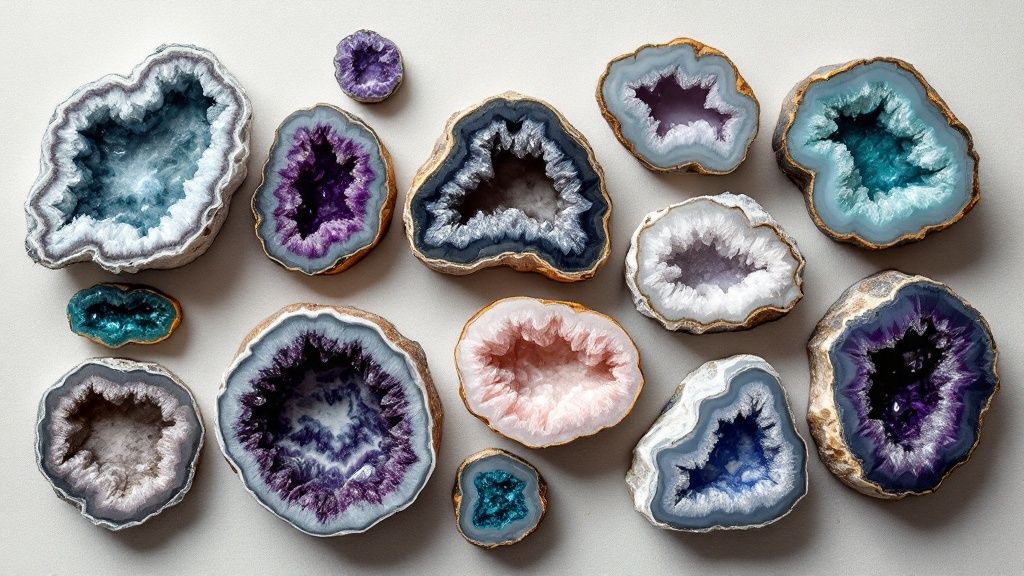
Just like snowflakes, no two geodes are ever exactly alike. This incredible variety is a direct result of the unique geological soup they were cooked in. The specific minerals floating in the groundwater, plus the temperature and pressure during formation, all play a role in the final masterpiece hidden inside.
Think of a geode not just as a pretty rock, but as a time capsule—a direct record of its local environment millions of years ago. By exploring the most common types, you can start to read these natural stories and get better at spotting treasures in the wild.
The Most Common Crystal Cores
While dozens of different minerals can pop up inside a geode, a few are far more common and celebrated by collectors. Each one has its own distinct personality.
Quartz Geodes: This is the quintessential geode, the one most people picture first. They are typically filled with clear or milky white quartz crystals. Their beauty is in their simplicity and the intricate, often large, crystal points that can form. To dive deeper, check out our collector's guide to quartz crystal clusters.
Amethyst Geodes: Easily the most famous and sought-after variety, amethyst is simply purple quartz. That stunning color comes from iron impurities and natural irradiation deep within the Earth, creating every shade from pale lilac to a deep, royal violet.
Calcite Geodes: While quartz is known for its sharp, pointed crystals, calcite tends to form in softer, blocky, or rhombohedral shapes. The crystals can be white, yellow, or even blue, and they have a distinct waxy luster that sets them apart from the glassy shine of quartz.
Here's where it gets really interesting: a single geode can host multiple mineral types. It’s not at all unusual to crack open a geode lined with amethyst points that also has a beautiful calcite formation growing right on top of them.
Getting a feel for these key differences in color, shape, and luster is the first step toward identifying geodes with confidence. Each type tells a different chapter of Earth’s geological story, revealing the unique chemical journey that took place inside that humble, rocky shell.
Why Amethyst Geodes Are So Captivating
When you ask someone to picture a geode, chances are they'll imagine a hollow rock lined with sparkling purple crystals. That iconic image is, of course, amethyst, the undeniable superstar of the geode world. Its deep, royal color has captivated people for centuries, making it one of the most popular and instantly recognizable minerals on the planet.
But where does that gorgeous purple come from? It's all thanks to a bit of geological magic. The story begins with clear quartz that contains tiny amounts of iron impurities. Over millions of years, natural radiation from the surrounding host rock interacts with those iron atoms, causing the crystal to shift from completely clear to a stunning shade of violet.
The Majesty of Cathedral Geodes
Among the most breathtaking examples are the famous cathedral geodes. These are the massive, towering specimens you often see, so named because their arched interiors resemble the vaulted ceilings of a grand cathedral.
They primarily come from Brazil and Uruguay, where they formed inside huge gas bubbles trapped in ancient basaltic lava flows. The sheer scale of these cavities gave the crystals plenty of room to grow to incredible sizes, creating the awe-inspiring formations prized for interior design.
The value of any amethyst geode is really a reflection of its unique geological journey. Everything from the richness of the color and the size of the individual crystal points to the overall shape of the geode plays a role in how desirable it is.
For instance, a geode with deep, evenly colored purple crystals will almost always be more sought-after than one with a washed-out or patchy hue. If you're thinking about bringing one of these natural sculptures into your space, our guide on decorating with a large geode has some great pointers.
Amethyst geodes range in size from small enough to hold in your palm to towering formations taller than a person. The largest pieces with the highest quality crystals are true collector's items and can be worth thousands of dollars. Thanks to its unique geology, Brazil remains one of the world's most important sources for these treasures.
So, How Do You Safely Open a Geode at Home?
That moment of truth—cracking open a geode to see what’s inside—is what it's all about. It's the thrill of discovery, turning what looks like a plain old rock into your own personal treasure. And the best part? You don't need a fancy geology lab. With a couple of common tools and a bit of care, you can do this right in your own backyard.
First things first: safety. Seriously. Tiny, sharp bits of rock can go flying, so always wear safety goggles. I can't stress this enough. A good pair of work gloves is also a smart idea to keep your hands safe from any sharp edges after the geode pops open.
The Classic Sock-and-Hammer Method
This is the go-to technique for most people, especially if you're just starting out. It’s wonderfully simple, requires almost no special equipment, and works great on smaller geodes.
Wrap It Up: Pop your geode into an old, thick sock or wrap it snugly in a towel. This little trick does two things: it catches any small shards that break off and stops the geode from shooting across the floor.
Find a Solid Spot: You'll want to do this on a surface that can take a hit. A concrete patio, a sturdy paving stone, or even a large, flat rock outside are all perfect. Just stay away from your kitchen tiles or hardwood floors!
Tap, Don't Smash: Grab a hammer—a rock hammer is best, but a regular claw hammer will do just fine. Give the geode a solid, sharp tap right in the middle. You're not trying to obliterate it with a single swing; the idea is to create a stress fracture.
Rotate and Repeat: After the first tap, turn the geode a little and give it another firm tap. Keep doing this, working your way around the geode's "equator." Soon enough, you'll hear a satisfying crack, and the stone will split open.
The break you get from this method is often a bit rugged and natural-looking, which I personally love.
There's a real magic in this moment. You are the very first person to ever lay eyes on those crystals, which have been hidden away for millions of years. It’s a feeling that never gets old.
Using a Chisel for a Cleaner Break
If you’re hoping for a cleaner, more controlled split—maybe you want two perfect halves for display—then a chisel is your best friend.
It gives you a ton more precision. Just set your geode on a sturdy surface and place the flat edge of a cold chisel where you want the break to begin. Give the chisel a light, firm tap with your hammer.
Then, just move the chisel along the geode’s circumference, tapping gently as you go to score a line all the way around. Keep tapping along that scored line, and eventually, the geode will split neatly in two. This method is fantastic for getting that perfect, display-ready look.
Your Common Geode Questions Answered
Alright, let's dig into some of the questions I hear all the time from people just starting out. Answering these will help round out your understanding and give you the practical know-how to start your own collection with confidence.
How Can You Tell if a Rock Is a Geode?
Spotting a geode in the wild is a bit of an art, but there are a few tell-tale signs. First, pick it up. A geode will often feel surprisingly light for its size, a dead giveaway that it’s hollow inside.
Look at the shape and texture, too. Most geodes are lumpy and somewhat round or oblong, kind of like a stony potato. Their outer surface is often bumpy and cauliflower-like, which really stands out against the smoother, more uniform rocks you might find nearby.
Are Geodes Valuable?
That's the million-dollar question, isn't it? A geode’s value can swing wildly, from just a few dollars to thousands. It really boils down to what's inside.
The most important factors determining a geode's value are the quality, color, and size of the crystals inside, along with its overall aesthetic appeal. A large geode with deep purple amethyst and perfectly formed points is far more valuable than a small one with pale or cloudy crystals.
Rarity is also a huge factor. If a geode contains a less common mineral, its price tag will definitely reflect that. In the end, it’s all about the unique beauty locked inside.
Where Are the Best Places to Find Geodes?
You can find geodes all over the world, but some places are true hotspots. You want to look for areas with a history of volcanic activity or places with significant limestone deposits—that’s where the magic happens.
Some of the most legendary locations include:
Brazil and Uruguay: These South American giants are famous for producing absolutely enormous, top-tier amethyst geodes.
The Midwestern United States: States like Iowa, Illinois, and Missouri are home to the classic "Keokuk" geodes, which are often filled with gorgeous quartz and calcite crystals.
Mexico: The Chihuahua region is another treasure trove, known for producing incredible specimens, including the popular "coconut" geodes.
But you don't have to book a flight to start hunting. Check out local creek beds, quarries, or any spot where volcanic or sedimentary rocks are exposed. A big part of the fun is figuring out what you’ve found, and our crystal identification guide is a fantastic tool to have in your back pocket as you learn.
At Astro West, we believe every geode tells a unique story millions of years in the making. Whether you're looking for your first specimen or a museum-quality centerpiece, explore our curated collection of ethically sourced minerals and find a piece of natural history to treasure forever at https://astrowest.com.