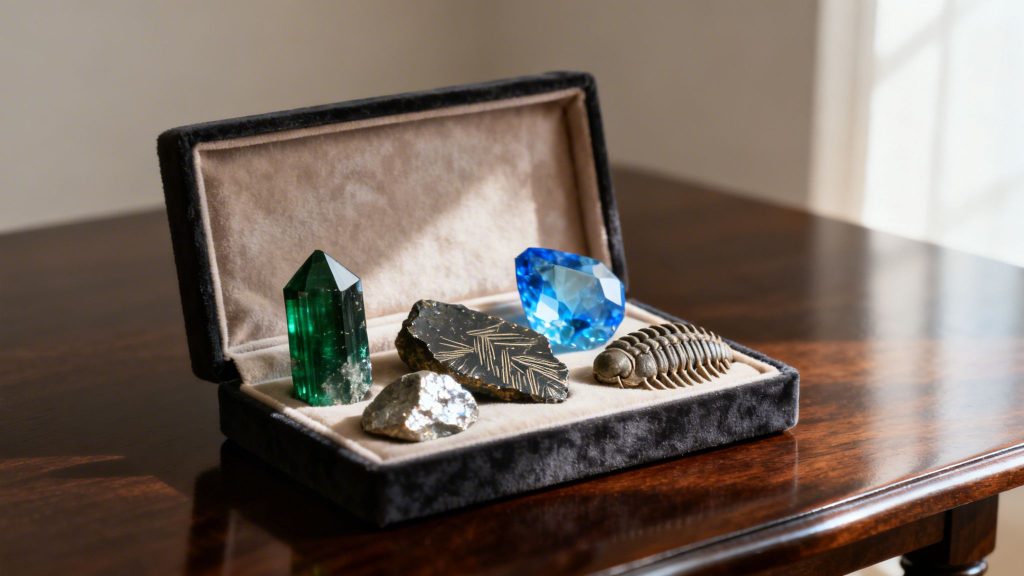
While many stones possess natural beauty, only a small fraction are truly valuable. These specimens—investment-grade gemstones, museum-quality fossils, and meteorites from the Moon or Mars—unite extreme rarity, pristine condition, and stunning aesthetics. Moreover, a documented history often elevates them further. These factors transform a beautiful natural object into a tangible asset with lasting worth.
What Makes Some Rocks More Valuable Than Others
Not all rocks are created equal in a collector's eyes. A common piece of granite and a flawless diamond are both products of geology. However, their values are worlds apart. The difference between a simple stone and a prized collectible comes down to a specific set of criteria. Understanding these factors is the first step toward viewing a specimen not just for its beauty, but as a potential asset.
Valuing these natural objects requires a mindset shift, much like evaluating fine art or a vintage watch. A painting’s worth, for example, is tied to the artist, its preservation, and its visual power. Similarly, a natural history specimen's value is determined by measurable qualities and aesthetic appeal. These are the key drivers that separate a decorative stone from an investment-grade treasure.
Before a detailed analysis, here is a quick overview of the core principles that determine a rock's value.
Quick Guide to Rock Valuation Factors
Valuation Factor
Description
Impact on Value
Rarity
The scarcity of the specimen, considering its geological formation and the depletion of its source.
High: Extremely rare specimens from depleted sources command premium prices.
Condition
The quality of preservation, noting any damage, repairs, or natural imperfections.
High: Pristine, undamaged specimens are always more sought-after.
Aesthetics
The visual appeal of the specimen, including color, clarity, crystal form, and overall balance.
High: Beauty drives demand; a visually stunning piece will always be more valuable.
Provenance
The documented history of the specimen, including its origin, excavation details, and past owners.
High: A rich history adds significance and desirability for collectors.
These four factors work together. They build a complete picture of a specimen's worth. As a result, a simple stone can become a storied artifact.
The Four Pillars of Valuation
At Astro West, every specimen we evaluate is measured against four core principles. This includes everything from a small mineral cluster to a towering dinosaur fossil. These pillars provide a solid framework for understanding why certain rocks command higher prices and tend to appreciate over time.
Rarity: This addresses how difficult it is to find another one like it. Rarity considers not just the mineral type, but also its specific geological scarcity. Additionally, the depletion of its original source and the frequency of new discoveries are critical.
Condition: This pillar assesses how well-preserved the item is. It involves a close look at any damage, repairs, and the quality of its natural formation. For example, a pristine, undamaged crystal will always be more valuable than a fractured one.
Aesthetics: This pillar simply asks, how beautiful is it? It covers everything from color saturation and clarity to crystal structure and overall composition. Beauty creates desire, and desire, in turn, drives market demand.
Provenance: This addresses the specimen’s story. A documented origin from a famous, now-closed mine or a notable past collection can dramatically increase its value. Crucially, it also guarantees its authenticity.
A specimen's journey is a huge part of its value. Knowing a fossil was excavated by a renowned paleontologist or that a mineral came from a historic, now-inaccessible mine adds a layer of significance that serious collectors prize. That history is as tangible as the object itself.
Ultimately, these four pillars work in concert. A rare mineral with dull color and poor form will fetch a lower price than a more common but visually perfect counterpart. By the same token, a fossil with incredible scientific importance but a questionable history will be met with skepticism. The most valuable rocks are always those that score high marks across all four categories, representing the pinnacle of natural art.
The Four Pillars of Specimen Valuation
Determining what makes one rock a simple curiosity and another a valuable asset can feel mysterious. However, it is not just about visual appeal. Much like the worlds of fine art or rare watches, a natural history specimen's value is built on clear principles. At Astro West, we evaluate every piece through the lens of four foundational pillars: Rarity, Condition, Aesthetics, and Provenance.
Grasping these concepts is key to developing a true collector's eye. This knowledge separates a casual admirer from someone who can recognize the subtle qualities that create lasting worth. Therefore, these four pillars provide the logic behind a specimen’s price and its potential to become an appreciating asset.
The Rarity Factor
At its core, value always starts with rarity. This is the simple law of supply and demand. In the world of minerals, however, rarity is about more than a particular mineral's frequency. It is also about how often new discoveries are made. For example, a mineral from a historic, depleted mine instantly becomes a finite, non-renewable treasure.
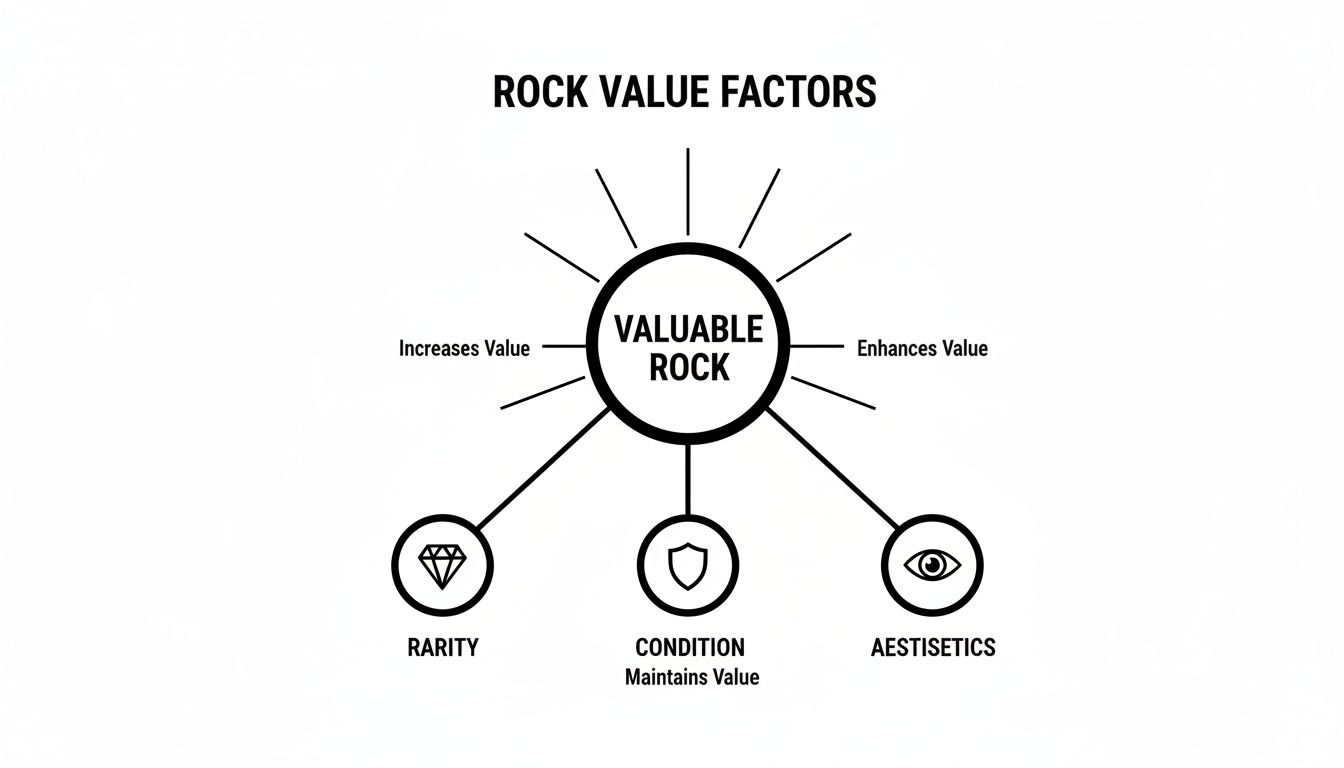
This infographic breaks down the core elements that turn a common rock into a valuable collectible.
As you can see, a specimen’s final value is a blend of its scarcity, its physical state, and its raw visual appeal. These factors work in concert. They create a piece that is both scientifically important and irresistible to collectors.
When a mine is exhausted, any high-quality material already on the market becomes incredibly significant. The supply is permanently capped. Paired with steady or growing demand from collectors and museums, the value of existing specimens naturally appreciates. The best examples become market centerpieces, with prices reflecting their status as irreplaceable assets.
The Importance of Condition
Next is condition, which is the specimen's state of preservation. A perfect, razor-sharp crystal or a fossil with zero repair work will always be more valuable. A similar piece that has been damaged or fixed is worth considerably less. Chips, fractures, and weathering do not just detract from a piece’s beauty; they compromise its scientific and market integrity.
In high-end collecting, condition is everything. A flawless, unrepaired specimen is the gold standard. While some expert restoration is acceptable—and often necessary for massive fossils—that work must be minimal and completely disclosed, as it directly impacts market price and trust.
Assessing condition requires a critical eye. We check for a few key things:
Completeness: Is the crystal or fossil skeleton whole and intact?
Damage: Are there any chips, cracks, or bruises, even minor ones?
Luster and Surface Quality: Does the surface have a fresh, bright appearance, or is it dull and weathered?
Repairs: Has the piece been glued, filled, or polished to conceal damage?
A specimen in pristine shape is a miracle of geological survival. It endured immense natural forces, the violence of extraction, and delicate preparation without serious harm. As a result, collectors will always pay a premium for that level of quality.
The Power of Aesthetics
Aesthetics concern visual impact—the qualities that make a specimen beautiful. While beauty can be subjective, the market has universally agreed-upon attributes that make a piece more desirable and, therefore, more valuable. For many rocks that are valuable, this beauty is what drives the desire to own them.
Key aesthetic drivers include:
Color: The intensity, hue, and evenness of color are hugely important. A ruby with a deep, vibrant "pigeon's blood" red, for example, is in a different league than a pale, pinkish one.
Clarity and Transparency: For most gems and many minerals, a lack of internal flaws or inclusions is crucial.
Crystal Form: Well-defined, sharp, geometric crystals are what discerning collectors seek. We call these "euhedral" crystals.
Composition: The balance and arrangement of crystals on the host rock (the matrix) can create a sculptural quality. This elevates a piece from a specimen to a masterpiece.
A specimen with powerful aesthetics commands attention. It stands out in a display and has a broad appeal that widens its market. Consequently, pieces that hit the perfect sweet spot of rarity, condition, and exceptional beauty are the ones that break auction records.
The Role of Provenance
Finally, there’s provenance: the documented history of a specimen. It answers the crucial questions: Where did this come from, and whose hands has it passed through? A solid provenance can dramatically increase a specimen's value. It adds a compelling story that confirms both its authenticity and its significance.
A specimen with an old label from a famous 19th-century collection carries a unique history. The same is true for one documented as coming from a classic, exhausted mine like Tsumeb in Namibia. For fossils and meteorites, a documented find location is absolutely critical for scientific classification and, by extension, its value.
This is why working with a gallery like Astro West is so crucial. Our direct, long-standing relationships with miners and field experts ensure this vital history is preserved. Therefore, our clients acquire pieces with a story as solid as the stone itself.
From Earth's Treasury: Real-World Examples of Valuable Rocks
It is one thing to discuss value in theory, but another to see it in action. In the world of fine minerals, the principles of rarity, condition, aesthetics, and provenance transform a beautiful crystal into a serious asset. Certain specimens are a class of rocks that are valuable precisely because they are concentrated stores of wealth.
Take Tourmaline, for instance. As a mineral, it is fairly common and found worldwide in nearly every imaginable color. Then there is Paraiba Tourmaline, a specific neon blue-green variety. Its intense, electric color comes from traces of copper—a chemical signature found almost exclusively in its original Brazilian locality.
A Paraiba crystal with top-tier color, fantastic clarity, and documented Brazilian provenance will command an exponentially higher price. Its value is a direct result of extreme rarity (unique chemistry), incredible aesthetics (vivid color), and critical provenance (classic, exhausted origin). Therefore, the market values it like a top-grade sapphire for good reason.
The Power of Scarcity and Beauty
Red Beryl, also known as bixbite, is another fantastic case study. Found only in Utah’s Wah Wah Mountains, this is one of the rarest minerals on the planet. To put it in perspective, for every 150,000 gem-quality diamonds mined, only one gem-quality Red Beryl crystal is found.
Here, a key market principle emerges: absolute rarity creates a high baseline value, even for smaller specimens. Unlike its more common blue cousin Aquamarine, Red Beryl’s worth does not hinge on size. The market for these rocks that are valuable prizes any clean, well-formed crystal simply because the total supply is microscopically small.
A specimen's value is always a story of comparison. A large, pale Aquamarine might be beautiful, but a small, intensely colored Red Beryl crystal is vastly more significant—monetarily and as a collectible—because it is profoundly, geologically scarce.
Why Provenance Can Be the Ultimate Prize
Provenance becomes the deal-maker when a single location produces specimens with qualities found nowhere else. Benitoite, California's official state gem, is the perfect example. This sapphire-blue mineral is found in gem quality at only one place on Earth: the Dallas Gem Mine in San Benito County, a mine that is no longer commercially active.
A specimen's value increases dramatically when a sharp, blue Benitoite crystal remains on its natural white Natrolite matrix. This combination is more than just beautiful. It is an aesthetic signature and an undeniable certificate of origin. Collectors will pay a massive premium for Benitoite on its host rock because it offers irrefutable proof of its unique and significant origin.
Here is a quick breakdown of how these factors create a high-value specimen:
Paraiba Tourmaline: Value is driven by a unique color (aesthetics) from a specific, depleted source (rarity and provenance).
Red Beryl: Value is almost entirely defined by extreme geological scarcity (rarity), making even small, clean crystals incredibly prized.
Benitoite on Matrix: Value is amplified by its natural host rock (aesthetics), which confirms its origin from the only known source (provenance).
At Astro West, our authority is built on direct relationships forged with mine owners and field collectors over decades. This access does more than secure authentic material. It allows us to acquire specimens with confirmed provenance and exceptional quality long before they reach the general market, curating a gallery of assets, not just objects. For those interested in scarcity, our guide to the rarest rocks in the world provides additional context.
Fossils: A Story in Stone That Commands Premium Value
While minerals are prized for their chemistry and crystal structure, fossils are valued for the incredible story they tell. These are not just rocks; they are the tangible remains of ancient life. As a result, their value is deeply tied to the completeness and clarity of that story. The most valuable fossils give us a rare, breathtaking window into a prehistoric world.
This means factors like scientific importance, preservation quality, and anatomical completeness are everything. A complete dinosaur skeleton, for example, is not just a pile of bones. It is a coherent biological statement, and its value is exponentially greater than a few scattered bones from the same species. It provides a full anatomical context that is both visually stunning and scientifically priceless.
The Art of Exceptional Preservation
Some geological formations are legendary for producing fossils with incredible detail. These specimens often cross the line from scientific object to natural art. The Green River Formation in Wyoming, for example, is famous for its 50-million-year-old fossil fish. Specimens from this area often preserve not just bones but also soft tissues, scales, and even the fossilized remnants of their last meals.
Similarly, a perfectly preserved trilobite from a specific Moroccan or Russian site tells a powerful story. If the specimen is complete, uncrushed, and shows intricate details like its compound eyes, its value skyrockets. These are the fossils that truly capture the imagination. They serve as both valuable collectibles and jaw-dropping interior design elements.
A fossil’s worth is often determined by its "life-likeness." A specimen that looks as though it could swim, crawl, or fly away at any moment possesses a unique and powerful aesthetic draw. This quality of suspended animation is what top collectors and designers seek.
Provenance: The Non-Negotiable Factor
In fossil collecting, provenance is non-negotiable. Knowing the exact dig site, the geological layer, and its ownership history is absolutely critical. This information is not a footnote; it is the bedrock of a fossil’s authenticity and, therefore, its market value. A fossil without a documented origin is scientifically compromised and commercially suspect.
This is where true expertise and direct relationships become indispensable. A reputable gallery must provide clear documentation tracing a specimen to its source. This transparency guarantees several key things:
Authenticity: It proves the fossil is genuine and not a composite or a fabrication.
Scientific Context: It allows for accurate identification and study, which adds to its academic importance. You can learn more through our fossil identification guide.
Ethical Sourcing: It confirms the specimen was collected legally and responsibly.
At Astro West, our long-standing connections with paleontologists and field experts ensure every fossil we acquire has a verified and unimpeachable provenance. We believe a specimen's story is just as important as its physical form. This commitment to scientific integrity allows our clients to acquire these irreplaceable pieces of natural history with absolute confidence.
Meteorites: The Ultimate Rarity from Beyond Our World
While rare minerals and fossils are some of our planet's greatest treasures, meteorites are something else entirely. They are literal, tangible pieces of the cosmos, making them some of the most profound rocks that are valuable. These visitors from space represent the ultimate form of rarity, since their supply is limited not by earthly geology, but by the unimaginable distances of space.
The meteorite market is driven almost completely by two factors: classification and scarcity. Not all space rocks are the same. Common types, like stony chondrites, fall to Earth fairly often and have more accessible prices. However, certain classes of meteorites are so scarce their value can easily rival that of investment-grade gemstones.
Classification and Total Known Weight
A meteorite’s identity is everything. Once found, a specimen undergoes rigorous scientific analysis to determine its exact classification. This process establishes its origin story—did it come from an asteroid, the Moon, or even Mars? That classification is the single biggest factor in determining its market value.
From there, collectors and institutions track the Total Known Weight (TKW) for each meteorite type. This figure is the combined mass of every known specimen from a particular fall or classification. A meteorite with a tiny TKW, like a rare achondrite, is automatically more valuable than a common iron meteorite where the TKW is measured in tons.
For instance, a fragment from the Tissint meteorite, a witnessed fall in Morocco in 2011, is incredibly valuable. Scientific testing proved it came from Mars. The TKW of all authenticated Martian meteorites is exceptionally low, making any new piece a major market event. You can learn more about what a meteorite is worth in our detailed guide.
The Power of Extraterrestrial Aesthetics
Beyond pure rarity, a meteorite’s visual beauty plays a huge role in its value. Some meteorites have features so unique they are prized as natural works of art. These specimens move beyond scientific interest and become luxury design objects.
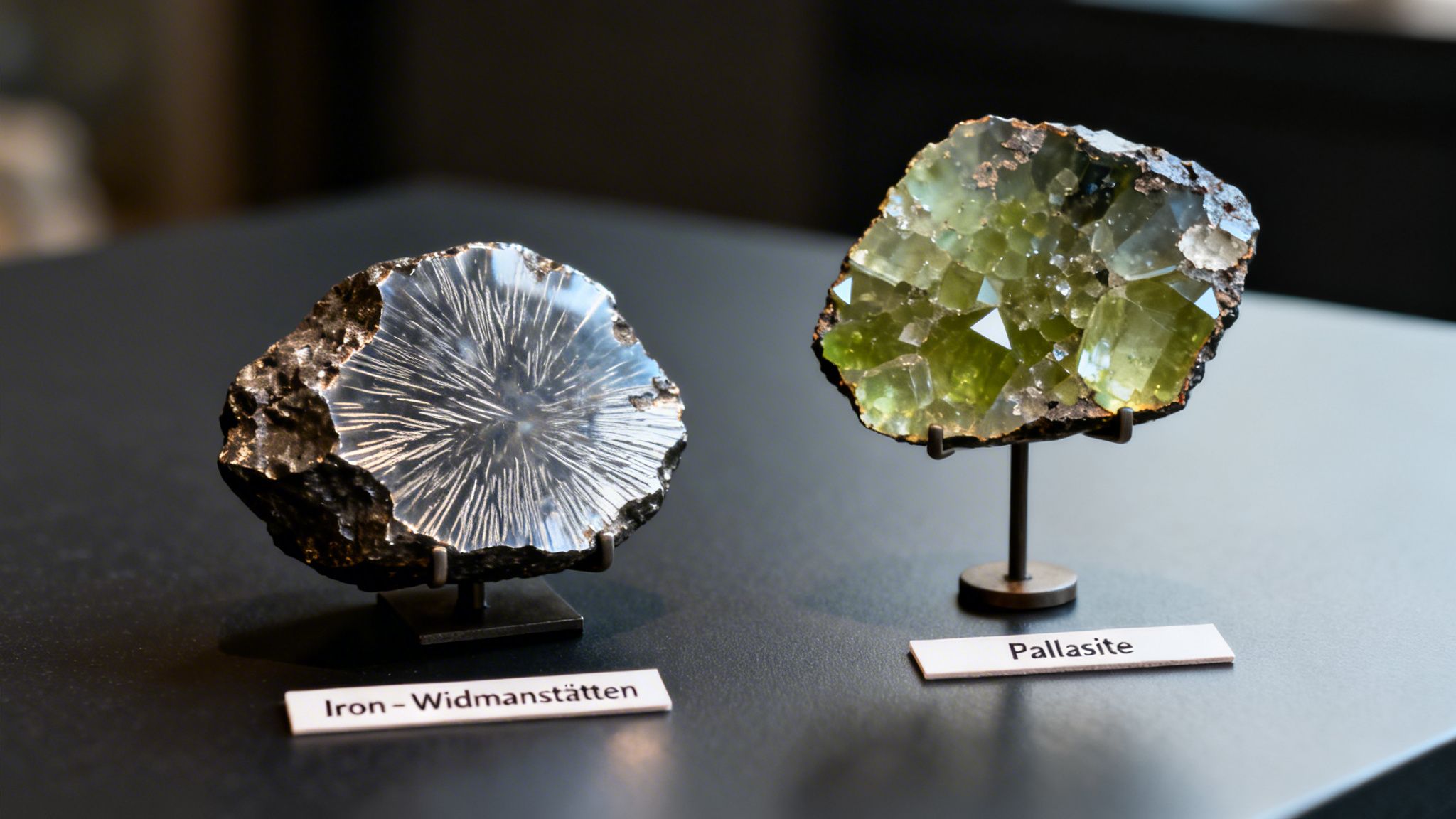
Widmanstätten Patterns: Found only in certain iron-nickel meteorites, these are intricate crystalline patterns. They appear when the meteorite is sliced and etched with a mild acid. These patterns formed over millions of years of slow cooling in the vacuum of space—a process impossible to replicate on Earth.
Olivine Crystals in Pallasites: Pallasites are stony-iron meteorites filled with olivine crystals (the gemstone peridot) suspended in a metallic matrix. When sliced thin and backlit, these specimens glow with a brilliant green and gold light. The clarity, color, and size of those crystals directly drive the meteorite's price.
Owning a meteorite is fundamentally different from owning any object from Earth. It is a direct, physical link to the cosmos—a piece of a world that is not our own. That conceptual power is a huge, if unquantifiable, part of its value.
Acquiring these specimens demands absolute trust in your source. Verifying a rock is a genuine meteorite with a confirmed classification is a highly specialized skill. It requires scientific testing and a deep understanding of the global meteorite market. At Astro West, we provide that certainty, ensuring every extraterrestrial specimen is authenticated and properly classified.
How to Acquire Valuable Specimens with Confidence
Building a collection of fine minerals, fossils, and meteorites is an acquisition of real, tangible assets. Therefore, navigating the market requires a smart approach grounded in trust and verification. The greatest risks for any collector are fakes, undisclosed treatments, and misrepresented histories. All of these can destroy a specimen’s long-term value.
Confidence comes from working with a trusted expert who provides transparent, verifiable information. A premier gallery is not just a shop; it is your curatorial partner. They guide you to pieces that meet both your aesthetic and investment objectives.
The Bedrock of Trust: Direct Relationships
The foundation of Astro West’s expertise is our direct, long-standing relationships at the source. We have spent decades building personal connections with miners, paleontologists, and field experts globally. This network is, without a doubt, our most valuable asset.
These relationships grant us access to the world’s finest natural history specimens, often before they reach the open market. More importantly, they guarantee the authenticity and provenance of every piece we handle. We know the history of our rocks that are valuable because we have a direct line to the people who pulled them from the earth.
When you acquire a specimen from a gallery with deep field connections, you are buying certainty. The piece’s story is intact, its quality is verified, and its value is clear. This turns a simple transaction into a confident investment.
A Partner in Curation, Not Just a Retailer
Our role is not that of a mass retailer; we are your curatorial guide. We are committed to helping you build a collection that is visually stunning and a real store of value. This means providing a complete, honest assessment of every specimen.
We empower you with the knowledge to make smart decisions. We explain each of the value pillars:
Rarity: We explain the specific geological or historical reasons a specimen is so scarce.
Condition: We meticulously detail any natural imperfections or expert preparation work.
Aesthetics: We articulate the unique visual qualities that make a specimen exceptional.
Provenance: We provide documented evidence of the specimen's origin and ownership history.
This commitment to education and transparency ensures you know exactly what makes your acquisition a sound and meaningful asset. By working with Astro West, you gain more than a magnificent specimen. You gain a partner dedicated to helping you build a collection of lasting significance and worth.
Frequently Asked Questions About Valuable Rocks
Entering the world of fine minerals, fossils, and meteorites often brings questions. It is a fascinating field but can feel intimidating at first. Here, we address some of the most common questions from new and seasoned collectors.
Do Valuable Specimens Appreciate Like Fine Art?
Yes, the finest specimens have a track record of appreciation similar to the fine art and luxury watch markets. As iconic mines become depleted and demand grows, the finite supply of top-tier material naturally drives long-term value. This is especially true for assets with solid provenance.
For example, Paraiba tourmaline from the original Brazilian source has seen its value increase dramatically since the mine was exhausted. This appreciation has cemented such specimens as true tangible assets.
A specimen's value is directly tied to its rarity and quality. The finest minerals, fossils, and meteorites only become scarcer over time. This predictable scarcity is a powerful engine for appreciation, making exceptional pieces a reliable store of value.
How Can I Start a Collection Without a Large Budget?
The key is to prioritize quality and education over sheer size. Focus on acquiring a perfect, smaller specimen instead of a large, lower-quality one. You will be much happier in the long run.
For instance, a small but flawless aquamarine crystal can be a fantastic entry point into the market for rocks that are valuable. The same is true for a common but perfectly preserved trilobite fossil. Your most important tool, however, is knowledge. Learning to spot the markers of quality is the first step toward building a collection you can be proud of.
How Can I Be Sure a Specimen Is Authentic?
Authenticity is the absolute cornerstone of value. Verification is not just a good idea; it is a non-negotiable step in any serious acquisition. For this reason, you should always buy from a reputable gallery that provides thorough documentation.
This paperwork should include detailed provenance, scientific classification, and full disclosure of any restoration. An established expert has spent years training their eye to spot the subtle signs of artificial treatments or composites. An amateur would easily miss these details.
At Astro West, our field relationships and rigorous verification process guarantee the authenticity of every piece in our gallery. This allows you to buy with total confidence, knowing your investment is solid.
Discover a curated collection of the world's finest minerals, fossils, and meteorites, each selected for its authenticity, beauty, and enduring value. Visit Astro West to explore investment-grade specimens with verified provenance. Find your next acquisition at https://astrowest.com.