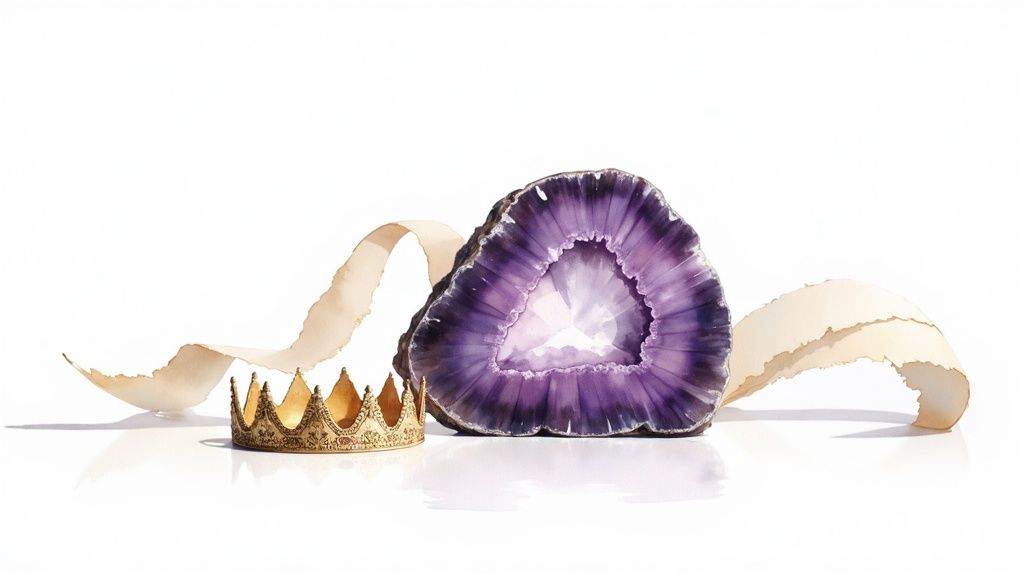
Amethyst is a variety of quartz famous for its incredible violet hues, easily making it one of the most recognizable gemstones on the planet. But it's so much more than just a mineral—it's a symbol of royalty, spirituality, and calm that has fascinated people for centuries. It beautifully marries the tough, crystalline structure of quartz with a stunning natural color palette.
The Enduring Allure of Purple Quartz
Quartz amethyst isn’t just another pretty stone; it's a natural wonder with a rich story woven through history, science, and culture. From its formation deep inside volcanic rocks to its modern role in home décor and wellness, amethyst holds a truly unique position. Unlike fleeting trends, its appeal has stood the test of time, loved by everyone from ancient Greeks to today's top interior designers.
Think of this guide as your complete roadmap to understanding everything about amethyst. We'll take a journey from its geological beginnings—exploring how nature crafts these amazing crystals—all the way to its practical uses in our daily lives. The goal is to give you the full picture of why this purple crystal continues to be so popular and respected.
What Makes Amethyst Stand Out
So, what gives amethyst its magnetic charm? It’s a perfect mix of accessible beauty and deep-rooted symbolism. For many, the stone is a centerpiece in spiritual practices, believed to promote clarity and a sense of peace. For others, a massive amethyst geode is simply a breathtaking statement piece that brings natural artistry right into a living room.
This blend of qualities makes quartz amethyst incredibly versatile. It’s just as at home in a high-end jewelry collection as it is in a quiet meditation space. Its wide availability also makes it a great entry point for new collectors and enthusiasts. While amethyst is the most famous, you can explore a whole range of other purple crystal stones in our detailed guide.
At its core, quartz amethyst represents the perfect marriage of Earth's raw power and delicate beauty. Its journey from a hidden geological marvel to a celebrated cultural icon is a testament to its lasting significance.
Throughout this guide, we'll unpack every facet of amethyst, covering everything you need to know. Key areas we'll explore include:
Geological Formation: The step-by-step process of how amethyst crystals actually grow inside rock cavities.
Physical Properties: What defines its color, hardness, and overall quality.
Cultural and Spiritual Meaning: Its historical uses and modern metaphysical associations.
Practical Applications: How to use it in décor, jewelry, and personal wellness routines.
Buyer’s Guide: Tips for choosing, caring for, and identifying authentic amethyst.
By the end, you'll have a crystal-clear understanding of what makes this gemstone a timeless treasure.
How Nature Creates Amethyst Crystals
The story of how an amethyst crystal comes to be is a geological epic. It’s a process involving volcanic fury, mineral-rich water, and a final touch of natural radiation, all playing out over millions of years. This powerful recipe is what transforms simple cavities in rock into the stunning crystalline treasures we see today, starting deep within the Earth's crust in areas of intense volcanic activity.
This incredible journey begins with hollow pockets forming inside cooling lava flows. Think of it like baking a loaf of bread—as the dough bakes, gas bubbles create air pockets inside. In a similar way, as molten rock cools and solidifies, trapped gases form hollow cavities, creating the perfect cradle for crystals to grow.
These cavities, known as vesicles, are where the real magic is about to happen.
The Mineral-Rich Brew
Once these pockets are formed, they don't stay empty for long. Superheated groundwater, loaded with dissolved silica (silicon dioxide, the building block of quartz), seeps into these empty spaces. This isn’t just ordinary water; it’s a potent hydrothermal fluid that has picked up trace amounts of iron and other elements from the surrounding rock.
This silica-and-iron-infused water completely fills the cavity. With high pressure and a solution saturated with minerals, the conditions are perfect for crystallization. As this mixture slowly cools over immense stretches of time, the crystals begin to form.
The process is unbelievably gradual. It's a lot like making rock candy, where sugar crystals slowly emerge from a supersaturated sugar-water solution. In the Earth, this same principle is magnified over millions of years, allowing large, perfectly formed quartz crystals to grow layer by layer.
These crystal-filled pockets are what we now know as geodes. While they might look like plain, unassuming rocks on the outside, their interiors hide a sparkling world of crystals. To see how these natural wonders come together, you can explore what is a geode in this detailed guide.
The Final Transformation into Amethyst
At this point, the crystals inside the geode are actually clear quartz. The final, critical step—the one that gives quartz amethyst its signature purple hue—is a fascinating twist of natural science. The host rock surrounding the geode contains tiny amounts of radioactive elements, like uranium.
Over eons, this low-level natural radiation bombards the clear quartz crystals. The energy from this irradiation interacts with the iron impurities that were trapped inside the crystal’s structure as it grew. This process excites the iron atoms, causing them to absorb certain wavelengths of light and reflect others.
This is what turns the crystal from clear to a beautiful shade of violet. The exact shade and intensity of the purple depend on a couple of key factors:
Iron Concentration: How much iron was present in the original silica solution.
Radiation Exposure: The intensity of the natural radiation and how long the crystal was exposed to it.
This explains the incredible range of amethyst, from a delicate, pale lilac to a deep, rich royal purple. Every crystal tells the unique story of its geological home.
Global Sources and Their Unique Signatures
The specific geological conditions needed for amethyst to form are only found in certain places around the world, and each location produces crystals with its own distinct personality. The source of an amethyst can often give you clues about its color, size, and the way it formed.
Major Global Amethyst Sources:
Location
Typical Characteristics
Formation Type
Brazil
Produces enormous geodes, often with light to medium purple crystals. The state of Rio Grande do Sul is famous for its massive amethyst deposits.
Volcanic Basalt
Uruguay
Known for producing intensely saturated, deep purple crystals, though often in smaller geodes than those from Brazil.
Volcanic Basalt
Siberia, Russia
Historically the source of the most prized "Siberian" deep purple amethyst with reddish and blue secondary hues.
Hydrothermal Veins
Zambia
A significant African source, producing high-quality amethyst with rich, uniform purple color and excellent clarity.
Hydrothermal Veins
From the sprawling geodes of South America to the coveted deep violet crystals of Siberia, the journey of quartz amethyst is a testament to nature's slow, patient, and breathtaking artistry.
Understanding the Physical Qualities of Amethyst
There’s so much more to amethyst than its captivating color. When you start to understand its physical makeup, you begin to appreciate the stone on a whole new level—not just as something beautiful, but as a unique geological masterpiece. From its surprising toughness to the story told by its internal structure, these traits are your guide to identifying the real deal.
Perhaps the most practical quality of amethyst is its durability. It scores a solid 7 on the Mohs scale, making it a tough, reliable mineral that's perfectly suited for everyday jewelry. That means it’s harder than both steel and glass (and can easily scratch them). But it's not invincible; harder gems like topaz (8), sapphires (9), and diamonds (10) can leave a mark, so store your pieces carefully.
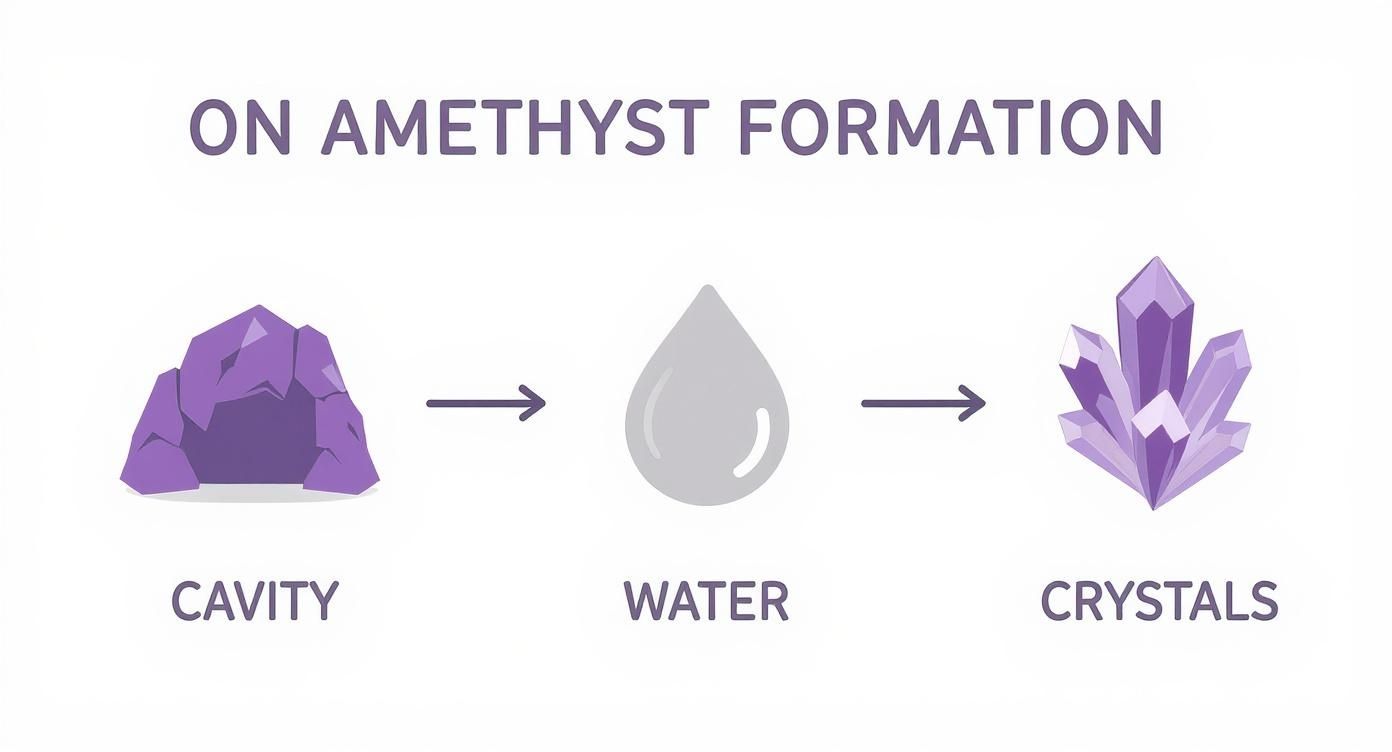
This infographic breaks down amethyst's incredible journey, showing how an ordinary rock cavity transforms into a stunning crystal cluster.
It really boils down to three key stages: a cavity forms, mineral-rich water seeps in, and then, over millennia, the crystals slowly take shape.
The Science Behind Its Purple Hue
The color is what everyone falls in love with, and for good reason. Amethyst’s palette is breathtaking, running from a soft, dreamy lilac to a deep, velvety violet. This isn’t just random chance; it’s the result of a very specific geological recipe that requires just the right amount of iron and a little bit of natural radiation.
The quartz crystal actually starts out clear. As it grows, tiny amounts of iron get mixed into its crystal structure. Then, over millions of years, natural background radiation from the surrounding rock zaps these iron impurities. This process changes the way the crystal absorbs light, causing it to reflect back those gorgeous purple tones we adore. How deep the purple gets depends entirely on how much iron is present and how long the crystal was exposed to radiation.
A key takeaway for collectors is that color saturation is the primary driver of value. The most prized specimens, often called "Siberian" amethyst, exhibit a deep purple with secondary red and blue flashes, making them exceptionally rare and sought-after.
This incredible color is a big part of why amethyst is such a star in the colored gemstone market. Research indicates a steady demand for colored gemstones, with the Asia-Pacific region being a significant market driver.
Amethyst Quality Grading Factors
Trying to figure out what makes one amethyst more valuable than another? It really comes down to a few visual cues. This table simplifies the key differences between a lower-grade stone and a top-tier, gem-quality specimen.
Quality Factor
Low-Grade Characteristics
High-Grade (Gem Quality) Characteristics
Color
Pale lilac or very dark, almost black; uneven color (zoning) is prominent.
Deep, rich purple with flashes of red or blue; color is evenly saturated.
Clarity
Visible internal cracks, fractures, or cloudy areas (inclusions).
"Eye-clean," meaning no inclusions are visible to the naked eye.
Cut
Basic or poorly proportioned cut that doesn't maximize brilliance.
Precision cut that enhances the stone's natural color and sparkle.
Carat Weight
Abundant in all sizes, so large size alone doesn't guarantee high value.
High-quality material is rare in large sizes, significantly increasing value.
Ultimately, a truly exceptional amethyst will have that perfect combination of deep, vibrant color and flawless clarity. While beautiful stones exist at every grade, the gem-quality pieces are in a class of their own.
Spotting Genuine Amethyst
Telling real amethyst from a clever fake can feel a bit daunting, but you don't need to be a geologist. A few simple observations can help you make a confident choice. Natural amethyst almost always has little quirks and imperfections that separate it from imitations like colored glass or lab-grown quartz.
Here’s what to look for:
Color Zoning: Real amethyst often has an uneven color. You might spot lighter or darker patches within the same crystal. This is totally normal and is known as color zoning. A perfectly uniform color can sometimes be a red flag.
Inclusions: Get up close and look for tiny internal flaws or specks. These are like natural birthmarks, common in genuine crystals but usually absent in flawless, man-made versions.
Temperature: Natural quartz often feels cool to the touch. Glass fakes, on the other hand, tend to warm up to room temperature much faster.
Hardness Test: This is a classic. Since amethyst is a type of quartz, it should be able to scratch a piece of glass. On the flip side, a steel knife shouldn't be able to scratch your amethyst.
If you’re ready to go deeper, our comprehensive crystal identification guide offers more advanced techniques to sharpen your skills. By combining these simple checks, you’ll build the confidence to tell a true geological wonder from a simple imitation.
Amethyst in Wellness and Spiritual Practices
Beyond its obvious good looks, amethyst has a long and storied history in wellness traditions and spiritual beliefs. For thousands of years, cultures all over the world have seen this purple gem as a powerful stone for tranquility, mental clarity, and spiritual connection. It’s often thought of as a natural stress reliever—a tool for quieting a racing mind and finding a bit of inner peace.
This reputation comes from the idea that amethyst helps soothe and balance the body’s energy. Crystal healing practitioners often suggest it can help diffuse feelings of anxiety, frustration, and general negativity, replacing them with a sense of calm. That’s exactly why you’ll often find it recommended for creating serene spaces perfect for relaxation or a good night's sleep.
With the growing interest in holistic health, these traditional beliefs have found a new audience, reflecting a broader cultural shift toward wellness and mindful living.
Connecting with Higher Consciousness
In many spiritual practices, amethyst is tied directly to our higher centers of awareness. It’s especially linked to the Third Eye Chakra (Anja) and the Crown Chakra (Sahasrara). Think of these energy centers as gateways to our intuition, inner wisdom, and our sense of connection to the bigger picture.
By working with these chakras, amethyst is believed to help cut through mental fog and sharpen our intuitive senses. It’s like tuning an old radio to a clearer station; the stone is thought to filter out the distracting “static” so you can hear your own inner guidance more clearly. This makes it an incredibly popular companion for meditation and mindfulness.
Holding a piece of amethyst during meditation or just placing it nearby is said to deepen the experience, helping you access a more heightened state of awareness. It’s all about encouraging you to look inward and trust what you find.
Practical Ways to Use Amethyst for Wellness
You don’t need complicated rituals to bring amethyst’s calming energy into your life. It’s easy to weave it into your daily routine in simple, practical ways to support a more balanced lifestyle. The whole point is to create small moments of peace and reflection.
Here are a few popular ways to use amethyst:
Create a Tranquil Space: Place an amethyst cluster or geode in your bedroom, office, or living room. Its presence is thought to help purify the environment and create a more peaceful vibe.
Enhance Your Meditation: Hold a small, tumbled amethyst in your palm or place it in front of you while you meditate. Focusing on its calming energy can help quiet your mind.
Wear Amethyst Jewelry: Keeping the stone close to your skin with a necklace, bracelet, or ring is an easy way to carry its soothing vibrations with you all day long.
Improve Restful Sleep: Try placing a smooth amethyst stone under your pillow or on your nightstand. It’s believed to help ward off nightmares and encourage deep, restorative sleep.
These practices are just one piece of a bigger wellness puzzle. If you’re building a more holistic routine, you might want to explore more about general wellness practices to find what works for you.
A Stone of Sobriety and Clarity
The name "amethyst" actually comes from the Greek word amethystos, which means “not intoxicated.” The ancient Greeks believed the stone could prevent drunkenness and help a person maintain a clear, sober mind. They even studded their drinking cups with amethyst to keep themselves from overindulging.
This ancient idea has evolved into a modern association with mental clarity and breaking free from bad habits or addictive behaviors. Today, it’s seen as a stone of temperance, supporting conscious choices and mental strength. To dive deeper into the stone's symbolism, check out our guide on the amethyst crystal meaning and its uses.
Whether you’re seeking a deeper spiritual connection or just a little more mental calm, amethyst remains a cherished ally for anyone trying to live a more balanced life.
Using Quartz Amethyst in Decor and Jewelry
Amethyst is more than just a pretty mineral; it’s a versatile design element that brings a touch of natural elegance to both personal style and living spaces. Its rich spectrum of purples allows it to be a subtle accent or a commanding centerpiece, making it a favorite for jewelers and interior designers alike.
The key is knowing how to make its unique character shine. Whether polished into a delicate pendant or left raw in a bold statement ring, amethyst offers a style for every taste. For the home, large geodes and clusters serve as breathtaking pieces of natural art, infusing any room with a sense of calm and sophistication. Let's look at some practical ideas for bringing this stunning crystal into your life.
Styling with Amethyst Jewelry
Choosing amethyst jewelry is a personal experience. With options ranging from deeply saturated, faceted gems to raw, organic crystals, the style you pick can dramatically change your look, moving from understated elegance to bohemian chic.
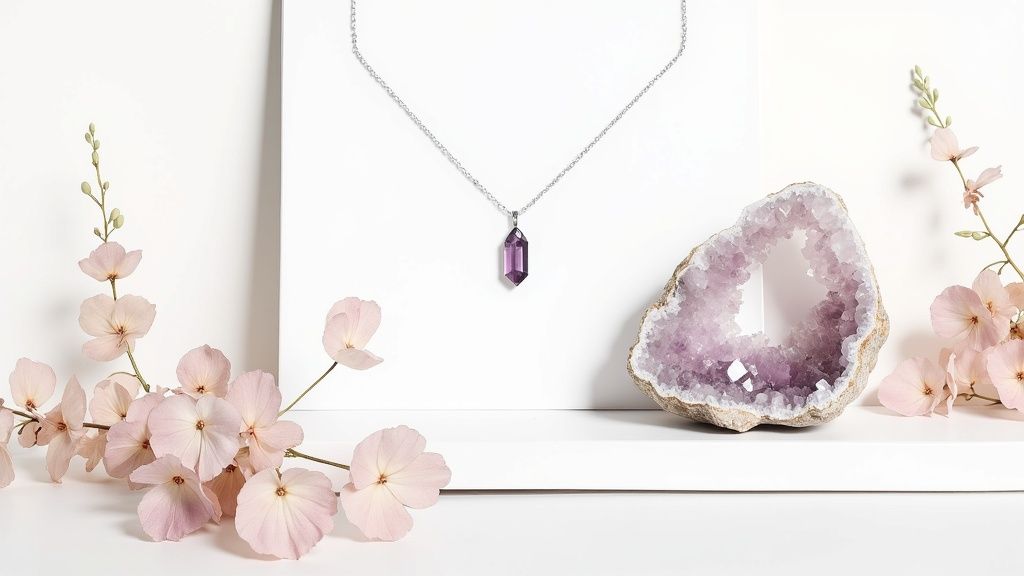
A faceted amethyst pendant, for example, offers a classic, refined touch perfect for formal occasions or daily wear. In contrast, a ring featuring a large, uncut quartz amethyst crystal makes a bold, artistic statement where the crystal’s natural form is the star of the show.
When you're picking a piece, pay attention to the metal it’s paired with.
Yellow Gold: Creates a warm, classic look, beautifully complementing the deep purple tones of a high-quality amethyst.
Silver or White Gold: Offers a cool, modern contrast that really makes the amethyst’s color pop.
Rose Gold: Provides a soft, romantic feel that pairs wonderfully with the lighter, lilac shades of amethyst.
The versatility of quartz amethyst makes it an excellent choice for any jewelry collection. It’s also quite durable, meaning it can handle daily wear while its captivating color ensures it will always stand out.
Designing with Amethyst in Your Home
Bringing amethyst into your home decor is like adding a piece of natural sculpture. Its presence can instantly elevate a room, creating a focal point that is both grounding and visually striking. How you use it can define a room’s entire atmosphere.
A large amethyst geode placed in a living room, for instance, becomes an immediate conversation starter. Its sparkling interior draws the eye, adding a layer of texture and depth that manufactured decor simply can't replicate. On a smaller scale, clusters on a bookshelf or desk can introduce a pop of color and organic form.
The most effective use of amethyst in decor connects the piece to the room's function. By placing it with intention, you can subtly influence the space's energy, aligning its natural properties with the activities that happen there.
Think about the mood you want to create in different areas of your home. Each placement is a unique opportunity to enhance the room's purpose and aesthetic.
Room-by-Room Amethyst Placement Ideas
Placing amethyst strategically can help you cultivate a specific feeling in each part of your home. It’s about more than just filling a space; it’s about creating an environment that feels intentional and harmonious.
Living Room for Calm and Connection: A large amethyst cathedral or cluster near a window or in a main seating area works wonders. It acts as a stunning piece of natural art and is thought to create a peaceful, welcoming atmosphere for guests and family.
Home Office for Focus and Creativity: A smaller, polished amethyst point or a raw cluster on your desk can serve as a beautiful and grounding presence. Many believe it helps clear mental clutter, making it easier to concentrate on complex tasks and creative projects.
Bedroom for Rest and Serenity: Consider placing a smooth, tumbled amethyst on your nightstand. Its calming energy is traditionally associated with promoting restful sleep and preventing nightmares, helping to make your bedroom a more tranquil sanctuary.
How to Choose and Care for Your Amethyst
Navigating the world of amethyst can feel a little overwhelming at first, but knowing just a few key details will help you find the perfect piece. Whether you're drawn to a raw, natural specimen or a polished gemstone for jewelry, the main things that determine its quality are always color, clarity, and cut. Once you get a feel for these, you can choose your next amethyst with total confidence.
When it comes to amethyst, color is king. The most sought-after and valuable stones have a deep, rich purple hue, sometimes with mesmerizing flashes of red or blue. Collectors often call this top-tier color "Siberian." Of course, lighter lilac and lavender shades are gorgeous in their own right and much more common, but it's that intense, saturated purple that really drives up the value.
You'll want to look for even color distribution across the stone. That said, some natural zoning—where the color is a bit uneven—is perfectly normal and often a good sign you're looking at the real deal.
Evaluating Your Quartz Amethyst
Next up is clarity. If you're shopping for faceted gems to be set in a ring or necklace, you'll want a stone that is "eye-clean." This just means it has no internal flaws or fractures that you can see without magnification. For raw clusters and geodes, on the other hand, natural inclusions are part of their unique character. Just keep an eye out for large, distracting cracks that might affect the stone's stability and overall beauty.
For polished stones, the cut is also a huge factor. A skilled gem cutter knows how to shape the amethyst to maximize its brilliance and really show off that incredible purple color.
You’re not alone in your love for this stone—you’re joining a thriving market. Quartz, which includes its famous purple variety, is a major player in the global gem and mineral market. You can read more about the quartz market projections to see just how significant it is.
The most important step in choosing your amethyst is to buy from a reputable and transparent seller. Ethical sourcing and authenticity should be top priorities, so don't hesitate to ask questions about a stone's origin.
Keeping Your Amethyst Vibrant
The good news is that caring for your quartz amethyst is pretty straightforward, which means its beauty can easily last for generations. It’s a relatively hard stone, making it durable enough for regular wear, but it isn't indestructible.
The biggest threat to its color? Prolonged exposure to direct sunlight. Over time, the sun’s rays can cause that beautiful purple to fade.
To keep your amethyst looking its best, just follow these simple tips:
Avoid Sunlight: Store your amethyst jewelry or decor pieces away from windows or any spots that get intense, direct light. A jewelry box or a shelf out of the sun’s path is perfect.
Gentle Cleaning: All you need is warm, soapy water and a soft brush. Stay away from harsh chemicals or ultrasonic cleaners, as they can sometimes damage the stone.
Proper Storage: To prevent harder gems like diamonds or sapphires from scratching it, store your amethyst separately. A soft cloth pouch or a lined jewelry box works wonders.
Follow this advice, and you'll be all set to pick out a stunning piece of amethyst and keep it looking brilliant for years to come.
Common Questions About Quartz Amethyst
Even after diving deep into the world of amethyst, you probably still have a few questions. That's perfectly normal. This section is designed to give you clear, straightforward answers to the most common queries we hear from both new enthusiasts and seasoned collectors.
Think of it as your go-to reference for quick solutions and practical advice.
Can I Leave My Quartz Amethyst in the Sun?
It’s a definite no-go. Leaving your amethyst in direct sunlight for long stretches is one of the fastest ways to ruin its gorgeous color. The sun’s ultraviolet (UV) rays essentially bleach the stone, causing that deep, vibrant purple to fade over time. Unfortunately, this change is irreversible.
To keep your quartz amethyst looking its best, store it away from windows or any spot that gets blasted with direct sun. If you’re cleansing your crystal, try safer methods like placing it in the moonlight overnight, using a singing bowl, or smudging it with sage.
How Can I Tell if My Amethyst Is Real?
Genuine quartz amethyst has a few tell-tale signs that separate it from fakes like colored glass. A great first test is checking its hardness. Amethyst scores a solid 7 on the Mohs scale, meaning it should be able to scratch a piece of glass. A steel knife, on the other hand, shouldn't easily scratch it.
Also, get up close and look for nature's fingerprints—the natural imperfections. Real amethyst often has:
Color Zoning: The color isn't perfectly even. You'll see lighter or darker patches and stripes within the same crystal.
Inclusions: Look for tiny internal fractures or little mineral specks inside the stone.
If a piece looks too perfect—flawless and with completely uniform color—it might be synthetic or just plain glass. The absolute best way to guarantee authenticity, though, is to buy from a trusted, reputable dealer.
What Is the Difference Between Amethyst and Other Purple Stones?
While plenty of minerals come in purple, amethyst is specifically the violet variety of quartz. Its identity comes down to its unique chemical makeup—silicon dioxide with iron impurities—and its trigonal crystal structure. Stones like purple fluorite or charoite might look similar at first glance, but they are entirely different minerals.
You can often tell them apart by their physical properties. Fluorite, for example, is much softer than amethyst and scratches easily. The signature purple in amethyst comes from a specific process where iron impurities are activated by natural radiation. That's the secret sauce that makes amethyst, well, amethyst.
The core distinction is mineral identity. Amethyst is quartz; other purple stones are not. This fundamental difference affects everything from hardness and crystal shape to how the stone gets its color.
What Does It Mean if My Amethyst Changes Color?
If you notice your amethyst’s vibrant purple is starting to fade, the most likely culprit is exposure to sunlight or heat. As we mentioned, UV light breaks down the color centers created by the iron and radiation. In fact, this is how some citrine is made—lighter-colored amethyst is intentionally heat-treated to transform it into its yellow-to-orange quartz cousin. If your stone changes color without any obvious reason, consulting a gemologist is a good idea, but fading from light is almost always the cause.
At Astro West, we believe that every mineral tells a story millions of years in the making. From stunning amethyst geodes to rare fossils and meteorites, our collection is curated with a passion for natural history and a commitment to authenticity. Explore our gallery to find the perfect piece for your collection, home, or jewelry box. Discover your own piece of Earth's artistry at https://astrowest.com.