You might hear "Fool's Gold," but the story behind pyrite price is far more interesting than its old nickname lets on. A small, rough tumble can cost just a few dollars, while a museum-quality specimen with pristine crystal structures might fetch hundreds or even thousands. The value here has nothing to do with its metallic content—it’s all about geological artistry and aesthetic appeal.
The most coveted pieces are those with razor-sharp, well-defined crystals and that classic, brilliant metallic shine.
What Actually Determines the Price of Pyrite
Though it's famously mistaken for gold, pyrite's worth is surprisingly complex and operates completely outside the precious metals market. Instead, the pyrite price is set by factors that speak to collectors, geologists, and even designers.
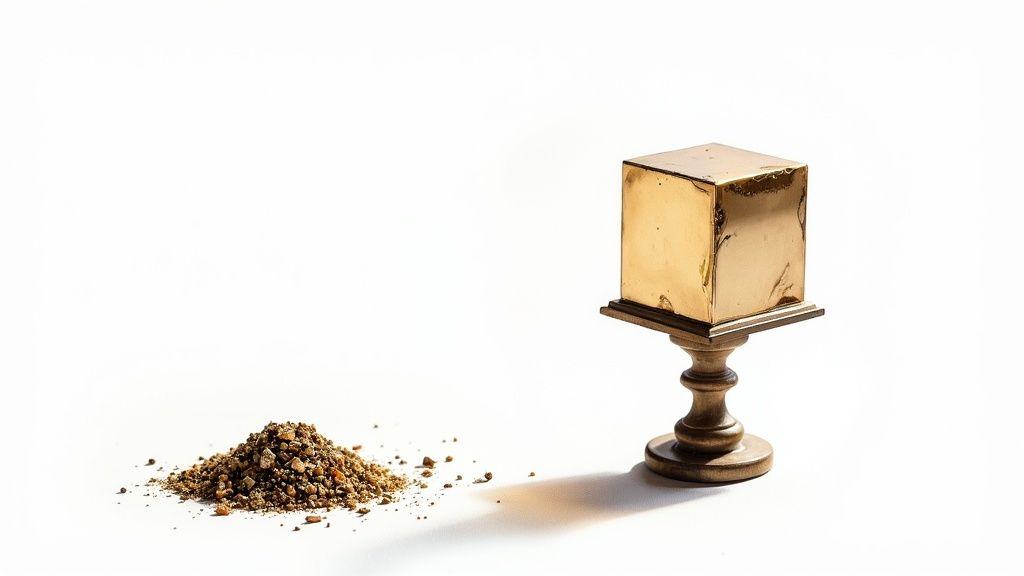
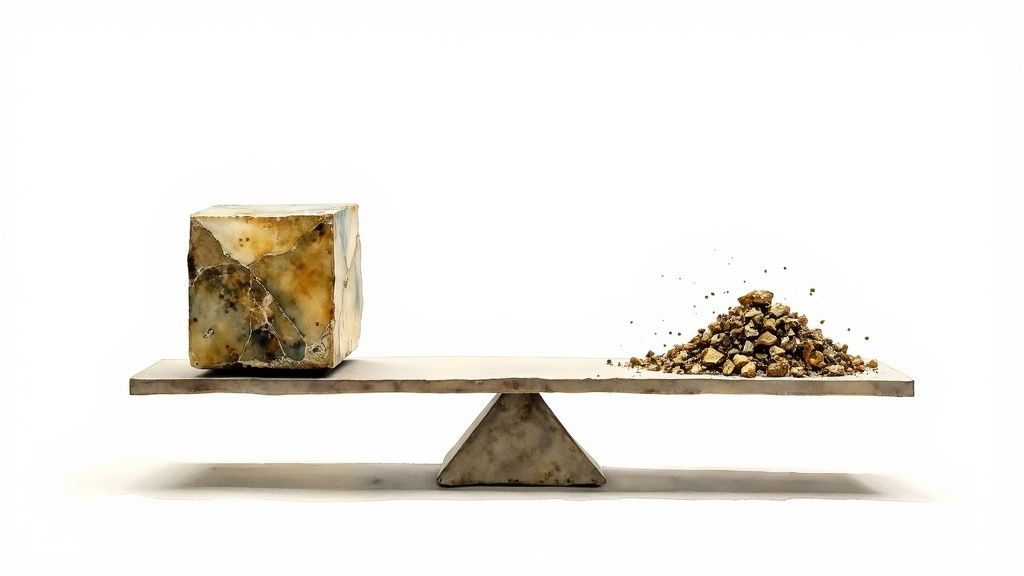
Think of it like this: a pile of ordinary stones doesn't have much value, but a masterfully carved statue made from the same rock can be priceless. The same logic applies to pyrite. A raw, unstructured chunk might be sold for industrial use based on its weight, but a perfectly formed, mirror-faced cube from a famous location is treasured for its natural, sculptural beauty.
That distinction is the key to understanding how it's valued. A few core characteristics separate a common stone from a collector's dream.
Core Value Factors
The valuation of pyrite isn't random. It follows a clear set of traits that determine how desirable a piece is and, ultimately, what it's worth. These elements all work together to define a specimen's overall quality and wow factor.
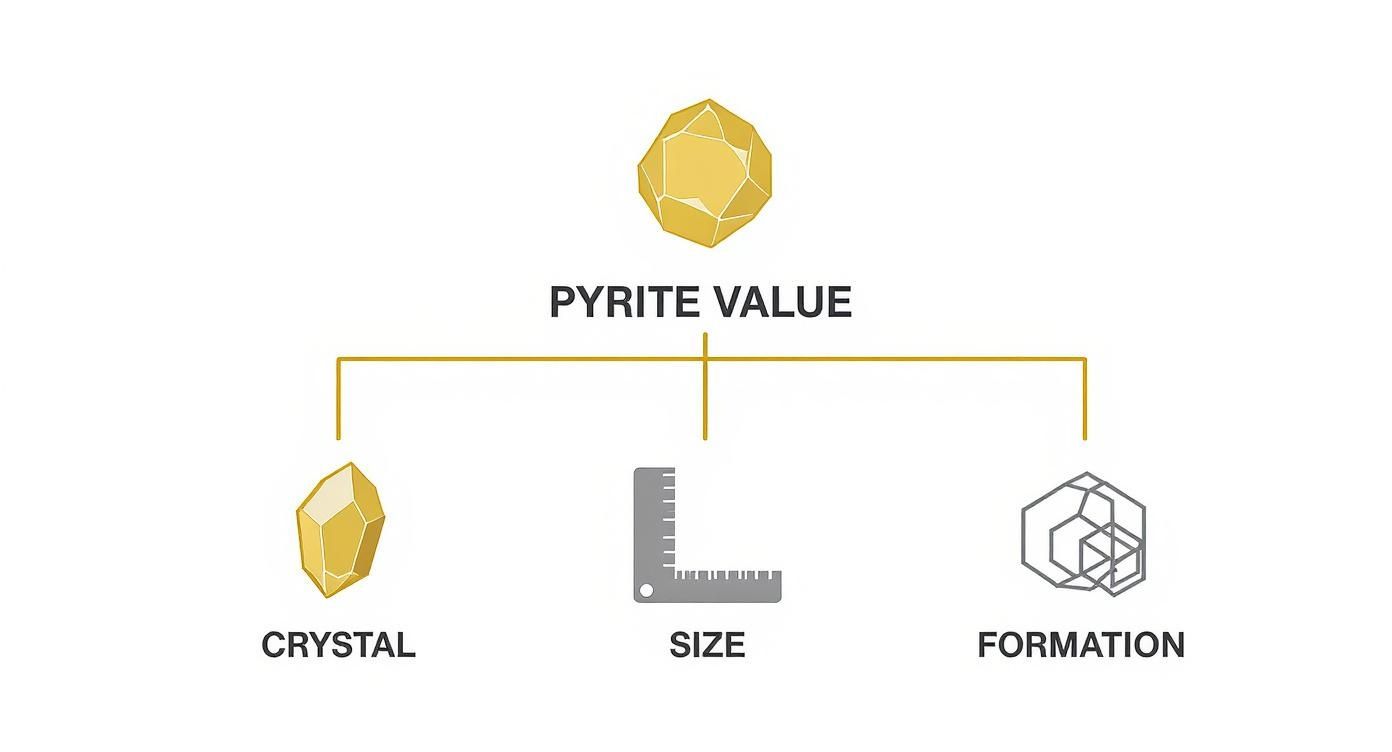
This infographic breaks down the main drivers behind pyrite's value, showing how crystal quality, size, and formation all play a part in its final price.
As you can see, a specimen's value journey starts with its crystal structure. This is then magnified by its size and the uniqueness of its formation, creating a combined value that's much greater than the sum of its parts. This framework is essential for anyone looking to buy or collect.
The most crucial takeaway is that pyrite is valued as a natural sculpture. Its worth is tied to the perfection of its geometric forms—pristine cubes, intricate pyritohedrons, and dazzling clusters are what command premium prices.
Getting a handle on these fundamentals is a lot like learning how other natural treasures are priced. For instance, the principles behind valuing gems or even extraterrestrial rocks often follow similar rules of rarity, quality, and origin. Diving into some gemstone price and quality comparisons can give you a broader sense of how market value works across the board.
For a completely different angle, you might find it interesting to learn about the price of meteorite specimens, which also hinges on rarity and unique features. Next, we’ll dig deeper into these factors—quality, size, and formation—to build a complete picture of what makes pyrite truly valuable.
How Size and Form Impact Pyrite's Value
When it comes to putting a price on pyrite, size definitely matters—but maybe not in the way you’d think. Unlike a simple commodity sold purely by weight, a pyrite specimen’s value is a story of geometry, presentation, and natural artistry. A single, large, perfectly formed crystal is always going to be worth exponentially more than the same weight in small, broken-up pieces.
Think of it like diamonds. A five-carat pile of diamond dust just doesn’t have the same jaw-dropping value as a single, five-carat flawless diamond. It's the exact same principle with pyrite. A museum-quality pyrite cube, with its razor-sharp edges and mirror-like faces, is a piece of natural sculpture that commands a serious price. On the flip side, the same weight in crushed industrial-grade pyrite is sold for pennies on the dollar, valued only for its sulfur content.
This premium is all thanks to collectors and designers who hunt for those impressive, well-defined specimens that put the mineral’s stunning natural geometry on full display.
Why Crystal Form Is King
The shape of the pyrite, known as its crystal habit, is the single most important factor in its value. While the overall mass plays a part, it’s the perfection of the form that truly gets collectors excited. Pyrite naturally grows in several distinct and absolutely beautiful shapes.
Cubes: This is the iconic pyrite shape. Specimens from places like Navajún, Spain, are world-famous for their almost unbelievably perfect cubic structure.
Pyritohedrons: A more complex, 12-faced form that’s a huge hit with collectors who love its intricate, soccer-ball-like appearance.
Octahedrons: An eight-faced crystal that is a bit less common than the cubes but just as prized when it's well-formed.
Clusters: These are intergrown crystals that create a dazzling, multi-faceted specimen. Large, undamaged clusters are especially valuable.
On the complete opposite end of the value spectrum is pyrite's role in industry. In this world, form means nothing. All that matters is the mineral’s chemical makeup—specifically, its sulfur content.
The global pyrite market was estimated at USD 192.39 million in 2023, with forecasts expecting it to grow to nearly USD 268.91 million by 2031, according to research from Straits Research. This isn't driven by collectors, but by industrial demand for things like construction materials, solar panels, and batteries.
Key Takeaway: The value of pyrite splits down two completely different paths. For collectors, it’s all about the perfection of its natural crystal form. For industry, it's a purely chemical game where aesthetics don't even enter the conversation.
Assessing Pyrite Quality Like an Expert
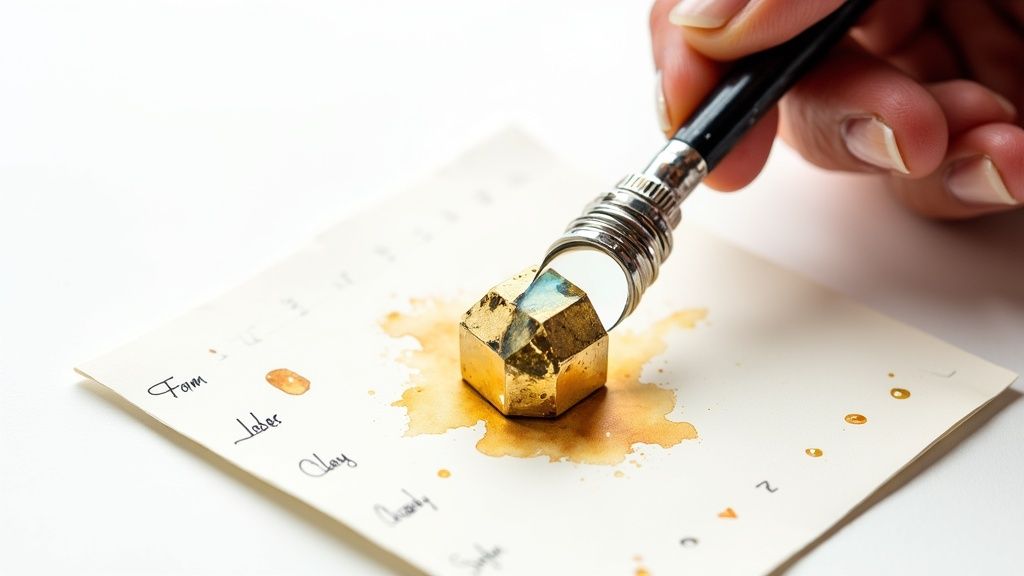
When it comes to the pyrite price, size isn't the only thing that matters. In fact, the single biggest factor driving a specimen's value is its overall quality. To get a handle on this, we can borrow from the diamond world's famous "Four C's" and adapt them for pyrite: Crystal Form, Luster, Clarity, and Character.
This simple framework is all you need to start telling the difference between a run-of-the-mill stone and a true collector's piece. Learning to spot these details is the first step to understanding why two pieces of the same size can have wildly different price tags.
Crystal Form: The Shape of Value
As we touched on earlier, the perfection of a pyrite crystal's shape is everything. Those sharp, well-defined cubes or complex, multi-sided pyritohedrons are what collectors crave—and they'll pay a premium for them. Lumpy, indistinct masses just don't have the same appeal.
Think of it like comparing two sculptures. One is a rough, unshaped block of marble, while the other is a perfectly carved statue with crisp, intentional lines. The statue is more valuable because of its defined form. The same principle applies to pyrite. A piece that showcases that perfect natural geometry without chips or dings is always going to be worth more.
Luster: That All-Important Shine
Luster is just a fancy word for how light bounces off a mineral's surface. With pyrite, what you want to see is a brilliant, brassy-yellow metallic sheen. A top-tier specimen should have an almost mirror-like finish that catches the light from every angle.
Key Quality Indicator: A top-grade pyrite specimen will have a vibrant, untarnished luster across all its crystal faces. Dull, oxidized, or tarnished surfaces can significantly reduce a specimen's value, as they detract from its visual appeal.
That unmistakable metallic gleam is exactly what earned pyrite its "Fool's Gold" nickname. A piece with a weak or cloudy luster will always be priced lower, even if its crystal shape is decent.
Clarity and Matrix: The Setting
In the world of pyrite, "clarity" isn't about being see-through. It’s about the condition of the crystal faces and their relationship with the rock they grew on, which we call the matrix. You're looking for flawless, smooth surfaces free from chips, cracks, or noticeable scratches.
The matrix itself is a huge part of the equation. A small, perfect pyrite cube perched aesthetically on a contrasting white quartz matrix can easily be worth more than a larger, standalone cube. The matrix gives the crystal context and can turn a simple mineral specimen into a natural work of art.
Character: Unique and Rare Formations
Finally, we have "character"—the unique features that make a piece truly one-of-a-kind. These rare formations can send the pyrite price soaring because they're so scarce and fascinating.
Pyrite Suns: Often called pyrite dollars, these are stunning radiating discs of pyrite crystals that form in a distinctive sunburst pattern.
Fossil Replacements: These are the real showstoppers. Pyrite sometimes replaces the organic material of an ancient fossil, like an ammonite, perfectly preserving its shape in shimmering metal.
Pseudomorphs: This happens when pyrite takes on the crystal shape of a completely different mineral. It's a geological curiosity that gets collectors really excited.
These are the kinds of unusual traits that serious collectors hunt for. If you're just starting out, a good crystal identification guide is a great tool for learning how to spot the subtle features that define a stone's quality and rarity.
How Industrial Demand Influences the Market
While collectors are drawn to pyrite for its incredible geometric shapes and metallic sheen, there's a whole other market that couldn't care less about its looks. For them, it’s all about what’s inside.
The pyrite price in the industrial world has nothing to do with aesthetics. Instead, it’s driven purely by the mineral's high sulfur content, which makes it a crucial ingredient for producing sulfuric acid.
This gives pyrite a fascinating dual identity. In one world, it’s a treasured geological specimen. In another, it's a workhorse for global industry. This industrial demand creates a completely separate, parallel market where value is measured in chemical purity and tonnage, not crystal perfection.
The Sulfuric Acid Connection
Sulfuric acid is one of the most widely produced chemicals on the planet, and pyrite is a primary source for making it. This powerful acid is an essential building block for countless products we use every day. To really understand the industrial side of the pyrite market, you have to look at where all that acid goes.
Here are a few of the biggest industrial uses:
Fertilizers: A huge chunk of sulfuric acid goes into producing phosphate fertilizers. This directly ties the price of industrial pyrite to global agricultural trends and food production.
Chemical Manufacturing: It’s a core ingredient for making detergents, dyes, pigments, and a whole host of other industrial chemicals.
Mining and Metallurgy: The acid is used to leach metals like copper and uranium from their ores.
Pharmaceuticals: It also plays a key role in synthesizing a wide range of medicines and pharmaceutical products.
This widespread demand means that economic growth, especially in agriculture and manufacturing, can directly boost the need for industrial-grade pyrite and nudge its price upward. The interplay between these factors can be surprisingly complex; you can explore similar forces in our article covering other facts about minerals and their industrial applications.
Market Growth and Economic Factors
The industrial pyrite market isn't just stable—it's growing. Valued at roughly USD 12.02 billion in 2022, the global pyrite market is projected to hit an estimated USD 19.15 billion by 2032, according to insights from Allied Market Research.
That growth, which works out to a compound annual growth rate (CAGR) of about 4.8% during the forecast period, is almost entirely fueled by its vital role in making sulfuric acid for all those different industries.
In this industrial context, pyrite behaves just like any other global commodity. Its price is swayed by factors like mining operational costs, supply chain stability, geopolitical events, and even swings in energy prices. Any of these can cause significant volatility.
At the end of the day, this reveals the two completely different worlds of pyrite valuation. While one buyer might carefully inspect the luster and form of a single, perfect cube, another is only interested in the chemical analysis of a multi-ton shipment.
This industrial demand provides a foundational, if less glamorous, price floor for pyrite based purely on its utility.
Why a Specimen's Origin Matters
Just like fine wine from a specific valley or coffee from a particular mountain, a pyrite specimen’s place of origin can dramatically influence its price. Not all pyrite is created equal, and where it was mined tells a story of rarity, quality, and the unique geological conditions that collectors are willing to pay a premium for. In many ways, the pyrite price is directly tied to the reputation of the mine that produced it.
This concept of "provenance" is central to the collector's market. A specimen’s origin acts like a brand name, signaling a certain standard of quality and a unique look you just can't find anywhere else. For serious collectors, owning a piece from a world-famous locality is often just as important as the specimen’s own physical traits.
World-Famous Pyrite Localities
Certain locations around the globe are legendary for producing pyrite with distinct, exceptional characteristics. Over time, these mines have built a reputation for yielding "best-in-class" specimens, making their pyrite incredibly sought after.
Two of the most celebrated localities include:
Navajún, Spain: This mine is the undisputed king of pyrite cubes. It's world-renowned for producing specimens with nearly perfect, mirror-like cubic crystals that seem almost too perfect to be natural. A sharp, lustrous cube from Navajún will always command a higher price than a similar-sized cube from a less famous location.
Huanzala, Peru: While Spain is known for cubes, Peru is famous for its dazzling and complex crystal clusters. Mines in this region produce brilliant, intricate specimens featuring multiple crystal forms—like octahedrons and pyritohedrons—often intergrown in spectacular arrangements.
The reputation of a specific mine or region creates a baseline of value. Collectors know that a "Navajún cube" implies a certain level of quality and aesthetic perfection, which justifies a higher market price.
Logistics and Regional Price Variations
Beyond a mine's reputation, practical factors like logistics, tariffs, and local regulations also play a big role in regional price differences. A high-quality pyrite specimen mined in Peru might be more affordable in Lima than it is in London or Tokyo, simply because of the added costs of transportation, import taxes, and distribution.
You can see this reflected in global trade dynamics. According to the Observatory of Economic Complexity (OEC), international trade in iron pyrites hit USD 118 million in 2022, marking an 18% jump from the previous year's USD 100 million. As demand grows in major markets, these logistical costs become even more significant, affecting the final retail price you see.
The bottom line? The exact same specimen can have two very different prices depending on where in the world you buy it.
Your Practical Guide to Buying Pyrite
Alright, now that you're armed with the knowledge of what drives pyrite's price, let's put it into action. Whether you're a budding collector or just looking for a show-stopping decorative piece, this guide will help you navigate the market with confidence. Buying pyrite should be fun, not stressful.
The first step is simply knowing what to look for. It's all about training your eye to appreciate the natural qualities of a specimen while spotting any red flags that might pop up.
The Pre-Purchase Checklist
Before pulling the trigger, run through this quick mental checklist. It works whether you're at a local gem show, a specialty rock shop, or scrolling online. A few moments of sharp observation can save you from a bad buy and make sure you're getting what you pay for.
Inspect for Damage: Get up close and personal with the crystal edges and faces. Are there obvious chips, deep scratches, or fractures? A few minor dings from its journey out of the earth are normal, but significant damage is a definite value-killer.
Check for Sneaky Repairs: Be wary of crystals that look like they’ve been glued back onto their matrix. It's a common trick to salvage broken specimens, and it absolutely tanks their worth. Look for faint, tell-tale signs of adhesive around the base of the crystals.
Assess the Luster: Does the piece have that classic, bright metallic shine? Steer clear of specimens that look dull, tarnished, or have an unnatural, almost plastic-like coating. That can be a sign of an artificial enhancement you don't want.
Questions to Ask the Seller
A good seller will always be happy to talk shop and answer your questions. Their transparency is usually a great indicator that you're getting a quality, ethically sourced piece. Don't be shy—the story behind the stone is part of what makes it special.
Pro Tip: Always ask where the specimen came from. A seller should be able to tell you the country and, ideally, the specific mine. This provenance is a huge factor in the pyrite price, especially for iconic localities like Navajún, Spain.
On top of that, ask about any treatments or repairs. An honest seller will have no problem telling you if a piece has been professionally cleaned, stabilized, or fixed up. This information is critical for figuring out its true value and ensuring the price for your "Fool's Gold" is fair.
Answering Your Questions About Pyrite's Value
When you're new to the world of minerals, the idea of "value" can be a bit tricky. With pyrite, it's not about melting it down—it's about its natural artistry. Let's clear up a few of the most common questions people have when they first encounter this striking mineral.
How Much Is Pyrite Worth Compared to Real Gold?
It’s easy to see why pyrite earned the nickname "Fool's Gold," but when it comes to value, they're in completely different universes. Gold is a precious metal, and its price is driven by global markets, often reaching thousands of dollars per ounce.
Pyrite, on the other hand, is valued as a mineral specimen. Its worth comes from the beauty of its crystal structure—its form, luster, and how well-preserved it is. While a top-tier pyrite piece can fetch hundreds of dollars, it’s being purchased for its aesthetic and geological significance, not its raw material.
Does a Specific Origin Increase Pyrite Price?
Absolutely. In the mineral world, location is everything. The pyrite price can jump significantly if a specimen comes from a famous locality known for producing exceptional crystals.
The undisputed champion here is Navajún, Spain. Pyrite from this mine is legendary for its near-perfect, mirror-like cubic crystals that look like they were carved by hand. They're naturally formed masterpieces, and collectors will pay a premium to own a piece from this iconic source.
Can Pyrite Tarnish and Affect Its Value?
Yes, and it's something every collector needs to be mindful of. Pyrite is an iron sulfide, and when it's exposed to high humidity or moisture, it can oxidize. This process, sometimes called "pyrite disease," can dull its brilliant metallic shine, leaving it looking tarnished and dark.
For a high-end specimen where luster is a huge part of the appeal, this damage can seriously lower its value. The key is prevention: storing your pyrite in a dry, stable environment is the best way to keep it looking brilliant for years to come.
As a general rule, pyrite is best viewed as a collector's mineral rather than a financial investment. While rare, top-quality specimens can appreciate over time, the market is not as liquid as precious metals. It's best purchased for its aesthetic and geological appeal.
At Astro West, we believe every stone tells a story. Explore our curated collection of ethically sourced minerals, fossils, and meteorites to find your own piece of natural history. Discover enduring natural treasures at https://astrowest.com.
Key Takeaways
The real pyrite price varies greatly based on factors like crystal quality, size, and unique formations, rather than its metallic content.
Collectors value pyrite for its aesthetic appeal, with pristine specimens commanding premium prices, while industrial uses focus on its sulfur content.
The influence of provenance is crucial; specimens from renowned locations like Navajún, Spain, command higher prices due to their exceptional quality.
Condition and clarity matter greatly; dull or damaged pieces lose value, while specimens with immaculate luster and shape are more desirable.
Understanding these market dynamics helps buyers navigate and appreciate the complexity of the real pyrite price.