A Guide to Purple Stones and Crystals Beyond Amethyst
From the deep violet of royalty to the soft lavender of twilight, purple has always held a certain mystique. It's a color that feels both elegant and a little bit magical, making it a perfect choice for adding a special touch to your life, whether as a gift for a loved one this holiday season or as a treat for yourself.
When people think of purple stones, their minds usually jump straight to amethyst—and for good reason. But the world of purple minerals is so much bigger and more fascinating than just one stone. It’s a diverse family that includes rare beauties like the swirling patterns of charoite, the rich magenta of sugilite, and the gentle, shimmering lilac of lepidolite. This guide is your map to that world.
Why We're Drawn to Purple Gemstones
For centuries, purple was the color of power and spirituality. Dyes to create purple fabric were incredibly rare and expensive, so the color naturally became a symbol of wealth and status, reserved for emperors, kings, and high priests. That deep-rooted connection still resonates today, pulling us toward the captivating hues found in these natural stones.
But their appeal is more than just color. Each crystal tells a geological story—a dramatic tale of intense pressure, heat, and a precise mix of elements that created its unique shade and structure. Getting to know these natural treasures is a rewarding journey, whether you're a seasoned collector or just looking for a beautiful piece to display in your home. Think of this guide as your practical companion for appreciating, identifying, and caring for these incredible gifts from the Earth.
What You'll Discover Inside
We’re going to move well beyond the beloved amethyst to uncover lesser-known but equally stunning minerals. You'll get a real feel for what makes each one unique, not just in how it looks, but in how it formed.
This is about more than just memorizing names. It’s about understanding the science and artistry behind each crystal. When you learn how natural irradiation gives amethyst its color or how to recognize the silky, fibrous swirls of charoite, you build a much deeper connection to these natural wonders.
I’ve structured this guide to build your knowledge one step at a time. Here’s what we’ll cover:
A Diverse Mineral Family: We'll meet the key players like purple fluorite, charoite, sugilite, lepidolite, and iolite, and discover what makes each one so special.
The Science of Color: Forget dry textbook explanations. We’ll explore the simple geological reasons behind their incredible purple shades and other important physical properties.
Identification and Authenticity: You'll learn practical, hands-on tips to tell genuine gemstones apart from the common fakes and imitations you might encounter.
Value and Quality: We'll break down what really determines the price of a purple stone, from the richness of its color to its rarity on the market.
Proper Care and Maintenance: Get essential advice for cleaning, storing, and displaying your collection so it stays beautiful for years to come.
Meet the Diverse Family of Purple Minerals
When most people think of purple stones, amethyst is the first thing that comes to mind. But while it may be the most famous member of the family, it’s just one part of a much larger, more diverse world. The spectrum of purple crystals is packed with specimens that have wildly different origins, chemical makeups, and visual flair.
Getting to know this variety is like exploring the branches of a fascinating family tree—each one has its own personality and story to tell. You’ll find everything from the silky, fibrous swirls of Charoite to the metallic shimmer of Lepidolite. Some were formed deep inside volcanic rock, while others were born from incredible geological pressure over millions of years. Let’s dive into some of the most captivating purple minerals you can find.
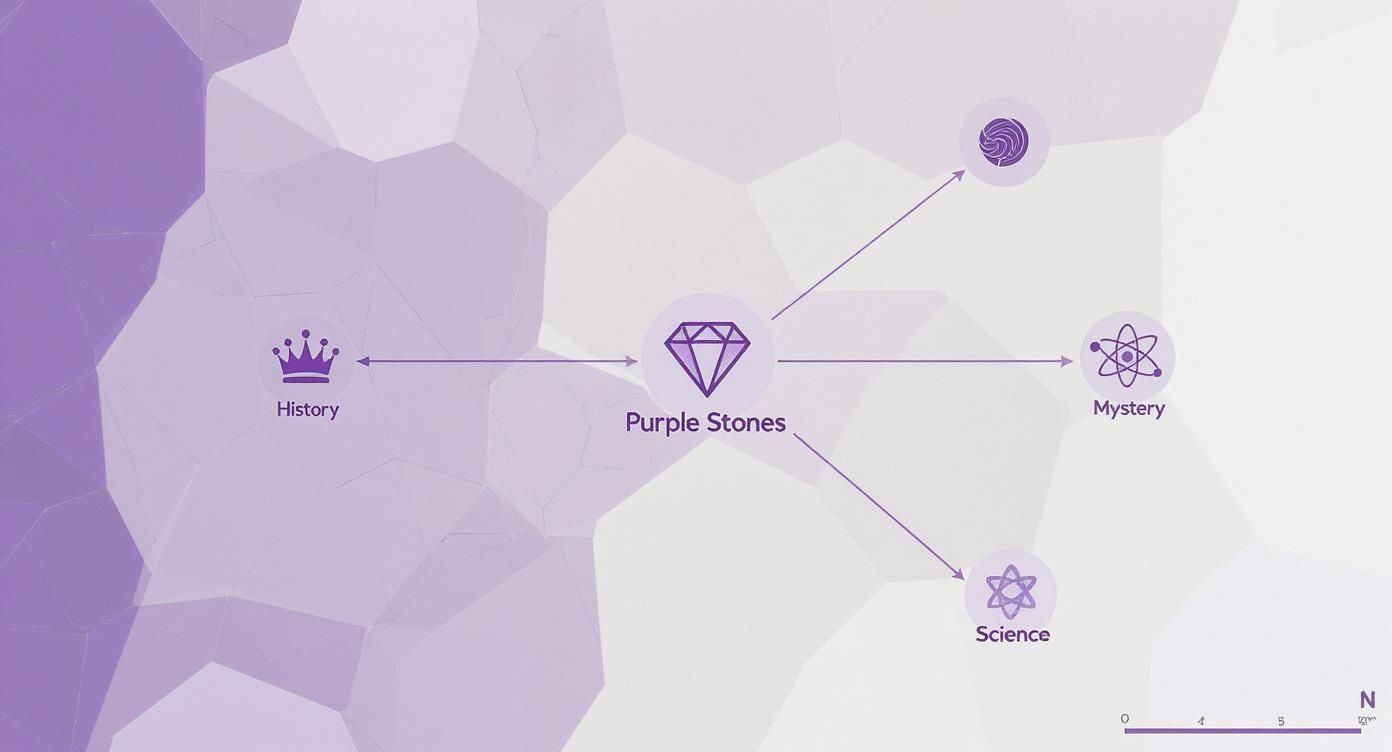
This map gives you a sense of how our fascination with these gems is multifaceted, blending historical reverence with geological wonder and a touch of mystery.
It really highlights how these stones sit at the crossroads of science, history, and our own sense of awe.
Amethyst: The Enduring Classic
Amethyst is the quintessential purple quartz, beloved for its incredible range of hues from a delicate lilac to a deep, royal violet. That gorgeous color comes from natural irradiation of iron impurities tucked inside its quartz crystal structure. It’s a relatively hard stone, clocking in at a 7 on the Mohs scale, which makes it durable enough for just about anything, especially jewelry.
Its name has a great backstory, too—it comes from the Greek word amethystos, meaning "not drunk," as it was once believed to prevent intoxication. Today, the most prized specimens come from major sources like Brazil, Uruguay, and Zambia.
Charoite: The Siberian Swirl
Charoite is one of the most visually distinct—and rare—purple crystal stones you can find. It’s only found in one place on Earth: the Sakha Republic of Siberia. Its appearance is absolutely unmistakable, with mesmerizing lavender-to-violet swirls that have a pearly, almost silky luster that seems to dance as you turn the stone.
This unique look comes from its fibrous, interlocking crystals. Its incredible rarity and singular source make it a holy grail for collectors and artisans alike.
Lepidolite: The Lilac Shimmer
Lepidolite isn't a single mineral but a lilac-gray or rose-colored member of the mica family. Its distinctive purple hue is thanks to its lithium content, and you’ll often find it in granite pegmatites hanging out with other lithium-bearing minerals like tourmaline.
What truly makes Lepidolite special is its signature shimmer. This glittery or sparkly effect is caused by the countless tiny, plate-like mica crystals packed within its structure, catching the light beautifully from every angle.
Lepidolite is a perfect example of how a mineral's composition directly creates its unique beauty. The lithium gives it color, but it’s the mica structure that’s responsible for that captivating sparkle you just don’t see in other purple stones.
Purple Fluorite: The Geometric Wonder
Fluorite is a collector's dream because it comes in nearly every color imaginable, but its purple varieties are particularly stunning. It often forms in perfectly shaped cubic or octahedral (think two pyramids stuck together at the base) crystals, making it a favorite for anyone who appreciates natural geometry.
Purple Fluorite can also display "color zoning," where you can see clear bands of light and dark purple within a single crystal—a little window into its growth history. Just be gentle with it; with a Mohs hardness of only 4, it's a soft stone best suited for a display case rather than everyday jewelry.
Sugilite: The Rich Magenta Rarity
Sugilite is another exceptionally rare mineral, prized for its intense, opaque magenta to purplish-pink color. It was first discovered in Japan in 1944, but the most significant deposits were later found in South Africa's Wessels Mine, which remains the primary source for gem-quality material today.
Its vibrant, electric color is due to the presence of manganese. The best Sugilite has a rich, uniform color and is often found intergrown with other minerals, creating patterns that make each piece unique. Thanks to its striking color and scarcity, top-grade Sugilite is highly valued by collectors.
Iolite: The Viking's Compass
Iolite, also known as cordierite, is a fascinating gem famous for its strong pleochroism. This is an optical phenomenon that causes it to display different colors when viewed from different angles. Look at it one way, and it's a beautiful violet-blue; turn it slightly, and it might look completely clear or even a grayish-yellow.
This unique property was supposedly used by Viking sailors as a primitive navigation tool, as it could help locate the sun's position on overcast days. With a hardness of 7 to 7.5, Iolite is a durable and truly intriguing choice for jewelry.
To give you a clearer picture, here’s a quick rundown of how these beautiful stones stack up against one another.
Quick Comparison of Popular Purple Stones and Crystals
This table offers a simple overview, comparing the key features of the minerals we’ve just explored to help you tell them apart at a glance.
Mineral Name
Mohs Hardness
Primary Sources
Key Identifying Feature
Amethyst
7
Brazil, Uruguay, Zambia
Classic purple quartz, ranges from lilac to deep violet.
Charoite
5 – 6
Siberia, Russia (only)
Distinctive swirling or fibrous patterns with a silky luster.
Lepidolite
2.5 – 3
Brazil, USA, Russia
Shimmering, glittery appearance due to mica inclusions.
Purple Fluorite
4
China, Mexico, USA
Often forms in cubic crystals; can show color banding.
Sugilite
5.5 – 6.5
South Africa, Japan
Opaque, intense magenta to violet-pink color.
Iolite
7 – 7.5
India, Sri Lanka, Brazil
Strong pleochroism—shows different colors from different angles.
Each of these gems brings something special to the table, from Amethyst's timeless elegance to Iolite's hidden optical tricks. As you can see, the world of purple minerals is far richer and more varied than many realize.
Understanding the Science Behind Their Color
The deep, captivating beauty of purple stones can feel like pure magic, but the real story is a fascinating dive into geology and chemistry. That incredible spectrum—from the softest lavender to the richest violet—is the direct result of unique geological processes, the right mix of trace elements, and even the way the crystals themselves are built.
Once you understand the science, you start to see these natural wonders in a whole new light.
Think of a clear quartz crystal as a blank canvas. By itself, it’s colorless. But when nature introduces specific ingredients and conditions during its formation, vibrant color is born. Each purple stone tells a different story of its creation, a story written in the language of chemistry and physics.
The Role of Trace Elements and Irradiation
One of the most common ways purple stones get their color is through a tag-team effort of trace elements and natural radiation. Amethyst is the perfect example of this incredible natural alchemy.
For an ordinary quartz crystal to become amethyst, it needs two key things: tiny amounts of iron impurities tucked inside its crystal lattice and exposure to natural gamma radiation from the surrounding rock over millions of years. This radiation zaps the iron ions, changing them in a way that makes them absorb certain colors of light and reflect others. The color our eyes see? Purple.
It's a bit like a secret recipe where the ingredients must be added in the right order. Without the iron, the radiation would have no effect on the color. Without the radiation, the iron would just sit there, leaving the quartz perfectly clear.
This delicate process is why amethyst's color can vary so dramatically, from a pale, dreamy lilac to a deep, saturated violet. It all depends on how much iron was present and how intense the radiation was.
When Inclusions Are the Artists
In other purple stones, the color doesn't come from an atomic-level change. Instead, it's created by tiny particles of other minerals trapped inside during formation. Imagine adding colorful sprinkles to clear ice cream—the sprinkles themselves are what create the new look.
Sugilite: This rare gem gets its stunning magenta and violet hues from manganese woven into its complex silicate structure. The manganese acts as a powerful pigment, giving Sugilite its signature look.
Lepidolite: The soft, shimmering lavender of lepidolite comes from its lithium content. As a member of the mica family, its structure is made of countless tiny, plate-like crystals, and the lithium inside gives it both its delicate color and that characteristic sparkle.
Charoite: The mesmerizing swirls in charoite are a result of its unique, fibrous crystal structure packed with various impurities. The way these fibers interlock creates its distinctive chatoyancy (a silky luster) alongside those signature violet patterns.
These stones prove there's no single "purple" ingredient in nature. Instead, a whole range of elements and structural quirks can produce these stunning colors.
Hardness, Clarity, and Crystal Structure
Beyond color, other physical properties are key to really understanding and identifying purple stones. The Mohs scale of hardness, which ranks minerals from 1 (softest) to 10 (hardest), is a crucial factor, especially if you're thinking about jewelry. Amethyst is quite durable with a hardness of 7, while Purple Fluorite is much softer at a 4, making it more prone to scratching.
Clarity refers to how transparent a stone is and whether it has internal features, known as inclusions. Some stones, like top-grade amethyst, are prized for being "eye-clean" with no visible flaws. In others, like charoite, the inclusions are the main event, creating the beautiful patterns the stone is famous for.
The internal crystal structure also defines a mineral. For instance, fluorite naturally forms in cubic or octahedral shapes, giving it a distinct geometric look that immediately sets it apart from the hexagonal system of quartz minerals like amethyst.
The Magic of Optical Effects
Some purple stones have an extra trick up their sleeve: special optical properties that create dynamic, eye-catching effects. The most famous of these is pleochroism, where a gemstone shows different colors when you look at it from different angles.
Iolite is the undisputed star of this phenomenon. From one direction, it might appear as a deep violet-blue, but turn it slightly and it can shift to a pale yellow or even become completely colorless. This incredible effect is caused by its crystal structure absorbing light differently along its various axes. It’s a built-in light show, revealing the hidden complexity within the stone and making it a truly captivating gem for those who know to look for it.
How to Identify Authentic Purple Gemstones
Navigating the world of purple gemstones is thrilling, but it's easy to second-guess what's real and what's not. With convincing fakes like dyed glass and altered quartz floating around, how can you be sure you're getting the genuine article? The good news is, you don't need a gemology lab to start spotting the difference.
All it takes is a good eye and a few simple, non-destructive tests you can do right at home. Learning these techniques will help you spot the key traits that separate a true mineral from a clever imitation, giving you the confidence to build a collection you can be proud of.
Start with Visual Inspection
Your most powerful tool is simply your own observation. Natural crystals are almost never perfect—and their "flaws" are often the best proof of their authenticity.
Grab a magnifying glass or a jeweler's loupe and get up close and personal with the stone. You're looking for inclusions, which are tiny internal fractures, bits of other minerals, or little pockets of liquid that got trapped inside as the stone formed millions of years ago. A perfectly flawless, evenly colored stone should make you pause. It's often a sign of synthetic glass or a lab-grown crystal.
Another dead giveaway is how the color is distributed. Natural stones like amethyst and purple fluorite often have color zoning, where the color is stronger in some spots or shows subtle bands. Dyed stones, on the other hand, usually have an unnaturally uniform color that bleeds into tiny cracks and fissures—a telltale sign that the color was added later.
Think of inclusions as a stone's natural birthmarks. While perfectly clear specimens are valuable, the tiny imperfections in most minerals are your guarantee that you’re holding a unique piece of geological history, not a mass-produced imitation.
Simple At-Home Tests for Purple Stones
Beyond just looking, a few easy tests can tell you a lot about a stone's identity. These methods won't harm your crystal and can help you distinguish the real deal from common lookalikes.
One of the simplest is the temperature test. Real crystals, especially quartz like amethyst, are great at conducting heat and will feel distinctly cool to the touch. Glass, a common imposter, is an insulator and will warm up to your skin temperature almost immediately.
Next, try the light test. Hold the stone up to a light source. Does it have a glassy, almost too-perfect shine? Glass fakes often have tiny, perfectly round air bubbles trapped inside, which is a sure sign they're man-made. Genuine crystals will have inclusions, but they'll be irregular in shape. For stones known for cool optical tricks, like the pleochroism in Iolite, turning the stone in the light should make the color shift—a feature that’s nearly impossible to fake well. For a deeper dive, our comprehensive crystal identification guide covers more advanced techniques.
Recognizing Common Imitations and Treatments
Knowing what fakes to look for is half the battle. Many popular purple stones are either treated to enhance their look or are faked outright.
Here are some of the usual suspects:
Dyed Quartz or Agate: Cheaper, porous stones like agate or clear quartz are often soaked in purple dye to mimic high-grade amethyst. Check for color concentrated in the stone's cracks, which is right where the dye tends to pool.
Heat-Treated Amethyst: Some pale amethyst is heated to deepen its color. It's still real amethyst, but this is a treatment that any honest seller should disclose. If you heat it too much, it can even turn into citrine, its yellow-to-orange quartz cousin.
Glass Imitations: If it's brightly colored, perfectly clear, and has those tiny, round air bubbles, you're almost certainly looking at glass. It can be molded into any shape, making it a common substitute for both faceted gems and polished stones.
Synthetic Crystals: These are lab-grown crystals that have the same chemical makeup as the natural version. The giveaway is that they often look too perfect, lacking the natural inclusions and color variations that make real geological specimens so unique.
By combining a careful look with these simple tests, you can dramatically lower your chances of being fooled. The key is to hunt for the subtle imperfections and unique characteristics that could only be created by nature, not a factory.
What Determines the Value of Purple Stones
Ever looked at two seemingly similar purple stones and wondered why their price tags are miles apart? You're not alone. The value of purple stones and crystals isn't random; it's a careful assessment made by gemologists and seasoned collectors. Knowing what they look for demystifies the market and helps you understand what makes one piece a simple tumbled stone and another a true investment.
Much like diamonds, colored gemstones are graded using a framework known as the "Four Cs": Color, Clarity, Cut, and Carat weight. But for most purple stones, one of those "Cs" stands head and shoulders above the rest. Color is king.
The Critical Role of Color
When it comes to purple stones, color is almost always the most important factor driving value. It's not just about a stone being purple—it's about the quality of that purple. Three specific aspects of color make all the difference:
Hue: This is the stone's pure color. Is it a true, straight violet, or does it lean toward blue or red? A pure, vivid purple is almost always the most valuable.
Tone: This is all about the lightness or darkness. If the tone is too dark, the stone can look almost black and lose its vibrancy. Too light, and it appears washed out.
Saturation: Think of this as the intensity of the color. A highly saturated stone pops with a rich, vibrant purple hue, completely free of any dulling gray or brown undertones.
Take amethyst, for example. Specimens with a deep, royal purple—often called "Siberian" grade—fetch the highest prices. For a stone like charoite, the value lies in the mesmerizing beauty of its swirling lavender and violet patterns.
Clarity, Cut, and Carat Weight
While color may be the star of the show, the other Cs play crucial supporting roles in shaping a stone's final price.
Clarity refers to the presence (or absence) of internal features called inclusions. For a transparent stone like amethyst or iolite, the fewer visible inclusions, the higher the value. But for an opaque stone like charoite, those fibrous inclusions are the pattern, so it's their beautiful, artistic arrangement that matters most.
The cut of a gemstone is all about unlocking its beauty. A masterfully executed cut will intensify a stone's color, hide or minimize inclusions, and create that brilliant sparkle everyone loves. A sloppy cut can make even a top-quality stone look dull and lifeless.
Finally, carat weight is simply how much the stone weighs. In general, bigger stones are rarer and more valuable—but only if the other quality factors are excellent. A massive, low-quality amethyst might be worth less than a smaller one with perfect color and clarity. Understanding these subtle distinctions is key, and learning the difference between precious vs. semi-precious stones can provide some really helpful context.
Rarity and Market Demand
Beyond the Four Cs, basic economics—supply and demand—plays a huge part. Amethyst is relatively abundant across the globe, which helps keep it affordable for everyone. On the other hand, minerals like charoite (found only in one remote area of Siberia) and sugilite (with just one major source for gem-quality material) are exceptionally rare.
Rarity is what transforms a beautiful mineral into a coveted collector's item. When a desirable stone can only be found in one remote corner of the world, its value naturally skyrockets, reflecting both its scarcity and the difficulty of bringing it to market.
This dynamic is easy to see in the market data. Amethyst is one of the most economically significant purple stones out there. In 2025, the global amethyst market was valued at around USD 1,161 million, with the iconic purple variety making up 45% of that total. It's projected to grow to about USD 1,652 million by 2034, proving its steady, widespread appeal. You can dig into this research and its projections on MarketGrowthReports.com.
The Growing Importance of Provenance
In recent years, a new factor has entered the conversation: provenance. This refers to a stone's origin and its documented history. Today’s collectors and buyers are more conscious than ever about ethical sourcing. A stone with a clear history, traced back to a mine with responsible practices, can command a premium.
Knowing where your purple stones and crystals come from isn't just about ensuring ethical standards—it adds a rich layer of story and authenticity to your collection.
Caring For Your Purple Gemstone Collection
Once you’ve started building a collection of purple stones and crystals, you'll want to keep them looking their best. The good news is that proper care isn’t complicated, but knowing the personality of each mineral is the key to preserving its natural beauty for years to come. A little consistent care ensures your treasures stay as captivating as the day you brought them home.
For the tougher crystals in your collection, like amethyst and iolite, which are a 7 or higher on the Mohs scale, a simple cleaning is usually all they need.
Gentle Cleaning Techniques
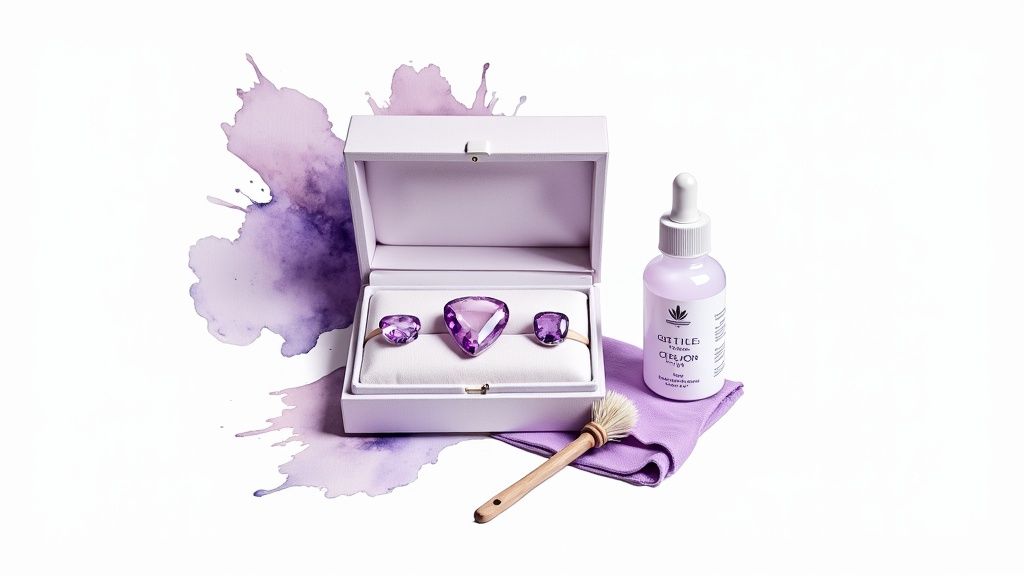
For these more durable stones, a simple bath in warm water with a couple of drops of mild dish soap will do the trick. Grab a soft-bristled brush—an old toothbrush works perfectly—and gently scrub away any dust or oils that have built up. Rinse it well under clean water and pat it dry with a soft, lint-free cloth.
A word of caution: always steer clear of harsh chemicals, abrasive cleaners, and drastic temperature changes. Even for hardy minerals, this can cause thermal shock, leading to tiny internal fractures and doing irreparable damage.
Knowing when not to use certain cleaning methods is just as critical. Ultrasonic cleaners can be a disaster for stones with natural inclusions or those that have been treated. By the same token, steam cleaning is a no-go for most colored gemstones.
Safe Storage and Display
Proper storage is just as vital as cleaning. The golden rule is simple: harder stones will always scratch softer ones. A piece of quartz (hardness 7) will have no problem putting a nasty scratch on a beautiful piece of fluorite, which is only a 4.
Here's how to keep everyone safe:
Separate and Protect: Give each specimen its own space. A soft pouch or a fabric-lined box with dividers is perfect. This one small step prevents countless accidental chips and scratches.
Avoid Direct Sunlight: Many purple stones, especially amethyst, are notorious for fading with too much sun exposure. Keep them away from sunny windowsills to maintain their deep, rich color.
Mind the Humidity: Try to store your collection in a stable, climate-controlled spot. Extreme humidity or dryness can harm certain minerals, particularly the more porous ones.
Of course, you want to show off your collection! Thoughtful display not only keeps your stones safe but also turns them into a stunning part of your home décor. Whether as a gift for Mother's Day or a centerpiece for your own space, a well-displayed crystal can bring joy and beauty to any room.
Common Questions About Purple Stones and Crystals
As you get deeper into the fascinating world of purple minerals, you'll find certain questions pop up again and again. Whether you're just starting your collection or have been at it for years, getting straight answers from people who know their stuff can make all the difference. It helps you appreciate what you have and feel more confident about what you're buying.
Here are a few of the most common queries we hear from collectors.
Which Purple Stone Is Best for Everyday Jewelry?
When it comes to jewelry you're going to wear every day, durability is king. You need something that can handle the occasional bump or scrape without a second thought.
Amethyst is an excellent choice. It has a hardness of 7 on the Mohs scale, which means it’s tough enough to resist scratches and chips from normal wear. Iolite is another fantastic option with very similar resilience.
On the other hand, you'll want to avoid softer stones like Purple Fluorite for pieces like rings or bracelets. With a hardness of just 4, it's far too delicate for daily wear and can get damaged easily. Stones like that are much better suited for pendants or simply as beautiful display specimens where they're safe from harm.
Can the Color of Purple Crystals Fade Over Time?
Yes, unfortunately, some can. Amethyst is the most famous example of this. Its stunning violet hue can slowly lighten if it's left in direct sunlight or exposed to other strong UV sources for too long.
It's a simple fix, though. To keep your amethyst pieces looking as vibrant as the day you got them, just store them away from direct light when you're not wearing or displaying them. A little bit of care goes a long way in preserving their incredible color for years to come.
Are All Purple Stones Different Kinds of Amethyst?
This is a really common misconception, but the answer is a definite no. While amethyst is easily the most well-known purple gem, that beautiful color shows up in a whole range of minerals that are completely unrelated to one another.
Take Charoite, for example—it's a rare silicate mineral found only in one place on Earth: Siberia. Then you have Fluorite, which is a halide mineral. Each purple stone has its own unique chemical makeup, crystal structure, and story of how it was formed.
Honestly, that incredible diversity is what makes collecting purple stones so much fun. It’s a whole world of different histories, textures, and hues waiting to be discovered.
Ready to discover the perfect purple specimen for your collection? With our Black Friday and Cyber Monday sales just around the corner, there’s no better time to explore the diverse and ethically sourced selection of fine minerals and crystals at Astro West. Find your next natural treasure today.