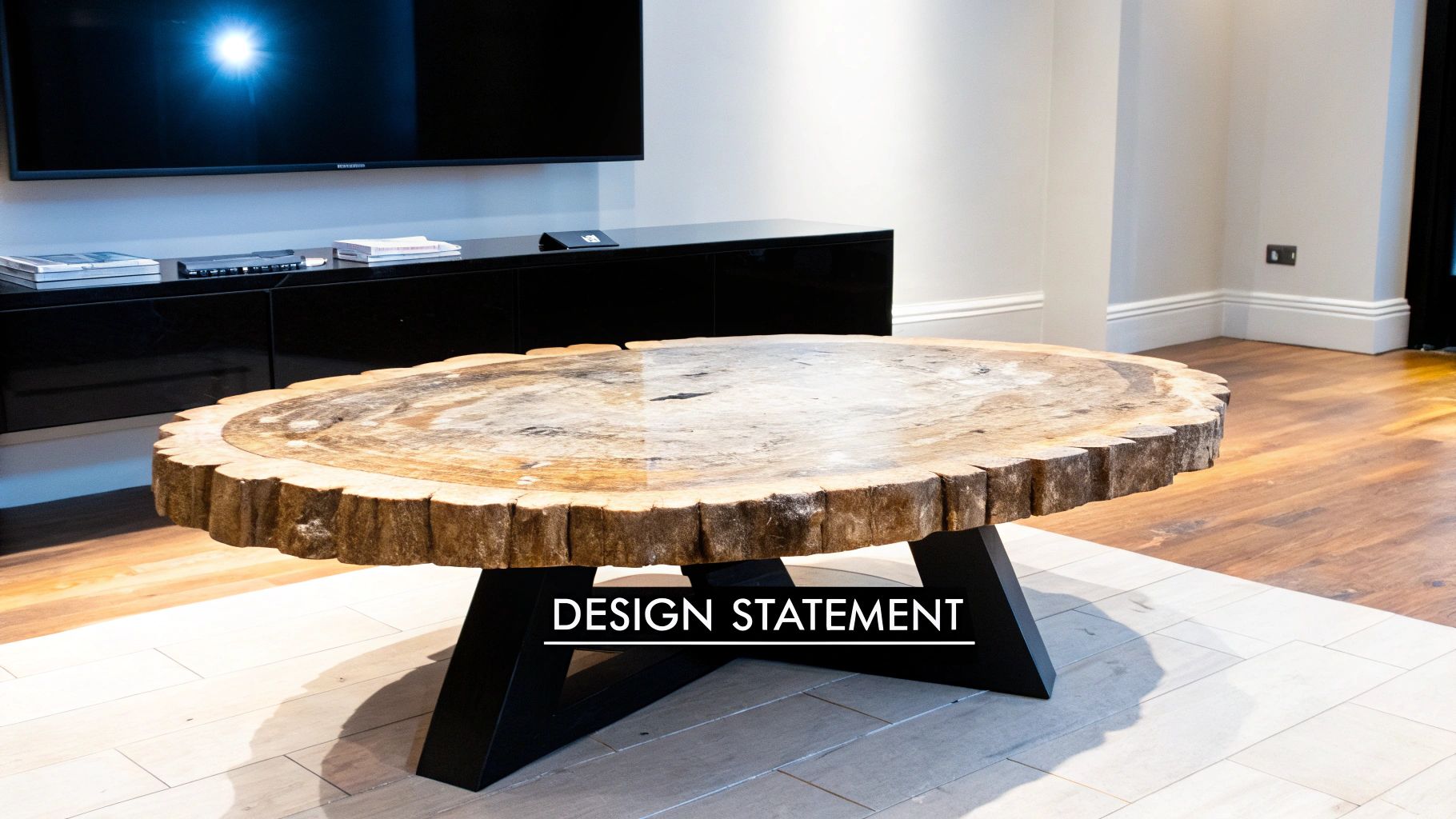
A Collector’s Guide to Luxury Petrified Wood Decor
Imagine holding a slice of a forest that stood millions of years ago, a piece of ancient Earth now polished like a gemstone. That’s the magic of luxury petrified wood. It’s far more than stone; it’s a story of transformation, a tangible link to a world that has long vanished, and a definitive statement piece for collectors and designers alike.
The Stone That Was Once Alive
At its core, petrified wood is fossilized wood that has gone through an incredible metamorphosis. This natural alchemy, called permineralization, is a slow, patient process that unfolds over millions of years. It begins when a tree falls and is rapidly buried by sediment—such as volcanic ash or river mud—which seals it off from the oxygen that would normally cause it to decay.
Over immense stretches of geological time, mineral-rich groundwater begins to flow through the buried log. It seeps into every pore and cell, slowly depositing microscopic crystals of quartz, calcite, or even opal.
This isn't a simple replacement of one material for another. It's a meticulous infusion, where minerals gradually fill the organic structure, solidifying the wood and preserving its form with breathtaking accuracy.
Preserving Ancient Detail
The result is a perfect stone cast of the original tree. The process is so precise that it often captures details right down to the cellular level. When an expert cuts and polishes a piece, it can reveal an entire history:
Growth Rings: You can see the clear lines of the tree's annual growth cycles, telling a story of seasons that passed long before humans walked the Earth.
Bark Texture: The fossilized exterior often keeps the rugged, distinct texture of the original bark.
Cellular Structure: Look closely—sometimes under magnification—and you can spot the microscopic cell walls of the ancient wood.
This incredible preservation is what turns a piece of petrified wood from a simple stone into a true natural artifact. Every slice, like this stunning petrified wood slab from Arizona, is a one-of-a-kind object with a story that can't be duplicated, offering a direct window into Earth's primeval forests.
What you hold is not merely a beautiful object; it is a time capsule. It's a fusion of biology and geology, where the life of an ancient tree is immortalized by the patient work of the Earth itself.
This amazing transformation creates an object that is both ancient and enduring, making it a prized possession for collectors, designers, and anyone with an eye for natural art. The global market for petrified wood is a niche but booming part of the luxury décor world, currently valued at around $850 million and growing. This trend reflects a deep desire for unique pieces that blend prehistoric wonder with modern style. You can read the full research on the petrified wood market to see just how strong its appeal has become. It's a value built on a natural process that turns fleeting life into permanent art.
From Ancient Forest to Fossilized Jewel
The story of luxury petrified wood doesn't start in a mine—it begins in a prehistoric forest. The single most important factor in how a piece looks is the specific environment where the tree lived, died, and fossilized. This geological fingerprint, what we call provenance, is everything. It dictates the wood's color, its patterns, and ultimately, its worth. A specimen's origin tells a unique story, making some locations legendary among collectors.
No two pieces of petrified wood are exactly alike because no two ancient environments were identical. Think about it: the minerals in the groundwater, the type of mud or ash that buried the log, and the immense geological pressures at play all came together to create the final masterpiece. This is why knowing where a specimen came from is so crucial to understanding its rarity and beauty.
In one region, the conditions might have created deep, dramatic blacks. In another, a completely different set of minerals produced a rainbow of fiery reds and oranges. Each deposit is a distinct chapter in Earth’s history, perfectly preserved in stone.
The World's Most Renowned Sources
While you can find petrified wood all over the globe, only a handful of locations produce the exceptional quality that collectors and designers hunt for. The geology in these areas had the perfect recipe for breathtaking preservation, turning entire forests into natural art galleries. These premier sources are the gold standard.
Some of the most celebrated origins include:
Arizona, USA: Home to the famed Chinle Formation, Arizona is where you'll find some of the world's most vibrant and colorful petrified wood. Specimens from this Triassic-era deposit are famous for their intense reds, yellows, and purples, all thanks to a high concentration of iron oxides in the ground.
Indonesia: Indonesian petrified wood, especially from Sumatra and Java, is known for its dramatic dark tones and incredible preservation. These pieces often come from ancient tropical trees buried in volcanic ash, resulting in rich blacks, deep browns, and creamy whites that show off stunning cellular detail.
Pacific Northwest, USA: The states of Washington and Oregon are famous for their dark, dense petrified wood. Also preserved by volcanic activity, these specimens have a bold, dramatic presence. Their deep blacks and grays are highly sought after for modern interior design.
The provenance of a luxury petrified wood specimen is its birth certificate, written by the Earth itself. It tells you not just where it’s from, but what it has been through—a story of volcanic eruptions, ancient riverbeds, and millions of years of patient transformation.
Why Origin Dictates Value
The difference between sources is dramatic. A log pulled from Arizona's silica-rich, mineral-painted deserts tells a completely different story than a piece from the volcanic ash beds of Indonesia. The first is a canvas of fiery, sunset hues; the second is a masterclass in monochromatic elegance and subtle detail. It's this geological diversity that gets collectors so excited.
Understanding these distinctions is the key to appreciating the material's market value. The world of luxury petrified wood is a powerhouse fueled by global trade, with some estimates putting its 2025 value at $500 million and potentially climbing to $700 million by 2033. This growth really highlights its premium status, which is concentrated in key regions like the U.S. Southwest (holding a 50% share), China (25%), and Argentina (15%).
You can discover more insights about these market trends to get a feel for the global appetite for these natural treasures. Each piece, tied to its specific origin, contributes to this thriving market, offering a slice of geological history that is both beautiful and increasingly valuable.
How to Grade Luxury Petrified Wood
What separates a run-of-the-mill decorative piece from a museum-quality masterpiece? It all comes down to a specific set of criteria that seasoned collectors and experts use to grade luxury petrified wood. Learning to see a specimen through this lens is the key to collecting with confidence and distinguishing standard material from a true investment-grade work of natural art.
Not all petrified wood is created equal. Far from it. The value and allure of any given piece are determined by a powerful combination of natural factors and human craftsmanship. These grading elements work together, telling the full story of the specimen's rarity and beauty and painting a complete picture of its journey from an ancient forest to a polished gem.
Color Intensity and Rarity
The first thing that will always catch your eye is the color. The stunning hues you see in petrified wood don't come from the original tree; they're painted by trace minerals present in the groundwater during fossilization. Think of these minerals as nature’s pigments, slowly staining the silica that replaced the wood fibers over millions of years.
Iron Oxides: These are the most common minerals, responsible for the rich reds, deep oranges, and sunny yellows found in many beautiful specimens.
Manganese: This element creates the dramatic blacks and sometimes delicate pinks that provide a stunning, moody contrast.
Copper, Cobalt, or Chromium: These are much rarer, producing the highly sought-after greens and blues that can elevate a piece into the highest echelons of value.
A top-tier specimen will feature colors that are not only rare but also intensely saturated. Washed-out or muddy tones are far less desirable than a vivid, gem-like palette that feels alive.
Clarity and Complexity of Wood Grain
Beyond the color, the next critical element is how well the original wood structure has been preserved. The finest luxury petrified wood holds onto its organic identity, allowing you to see the tree’s entire life story locked in intricate detail. This means high-value pieces will show clear, complex, and beautifully defined patterns.
You should look for sharp growth rings, delicate cellular structures, and even the unique swirls of knots and burls. The less distortion and the more detailed the grain, the higher the quality. It's a direct reflection of a perfect, undisturbed fossilization process.
A truly exceptional piece allows you to trace the growth rings with your finger, connecting you directly to seasons that passed over 200 million years ago. It’s this tangible link to a vanished world, preserved in stone, that defines its ultimate worth.
Completeness and Crystalline Features
The physical integrity of the specimen is also a huge factor. A complete round or a large, unbroken slab is almost always more valuable than a fragmented piece. Collectors look for specimens that have retained their natural shape, especially those that include the fossilized bark or "skin," which adds a wonderful layer of authenticity and rustic beauty.
On top of that, some of the most coveted pieces contain crystalline druzy pockets. These are small cavities within the wood where silica-rich water had room to form thousands of sparkling quartz crystals. These glittering pockets add a stunning textural contrast to the smooth, polished surface, creating a natural geode right inside the fossil.
To see an excellent example of a piece with a beautifully preserved form and a mirror-like finish, take a look at this polished petrified wood slab from Astro West. The quality of the polish is the final touch, turning a remarkable natural artifact into a finished work of art. A flawless, high-gloss polish that reveals the depth of color and detail without distortion is the true hallmark of expert craftsmanship.
To help you visualize these factors, we've broken them down into a simple table.
Key Factors in Grading Luxury Petrified Wood
This table outlines the primary characteristics used to evaluate the quality and ultimate value of a petrified wood specimen.
Grading Factor
Description
What to Look For (High Value)
Color
The hues imparted by trace minerals during fossilization.
Intense, highly saturated colors. Rare blues and greens command the highest prices.
Grain Preservation
The clarity and detail of the original wood structure.
Sharp, well-defined growth rings, cellular detail, and visible knots or burls.
Completeness
The physical integrity and form of the specimen.
Complete rounds or large, unbroken slabs. The presence of fossilized bark is a bonus.
Crystalline Features
The presence of quartz crystals within the wood.
Druzy pockets with well-formed, sparkling crystals that add texture and visual interest.
Polish & Finish
The quality of the surface preparation by a craftsman.
A flawless, high-gloss, mirror-like finish that enhances color and detail without distortion.
Understanding these five pillars of quality is the foundation for building a truly exceptional collection.
The infographic below illustrates the primary global sources that produce the luxury petrified wood graded on these very factors.
As you can see, key regions like the USA, China, and Argentina each contribute geologically distinct specimens to the global market, with each source valued for its unique mineral compositions and quality of preservation.
Integrating Natural History into Modern Design
Beyond the world of pure specimen collecting, luxury petrified wood makes its most powerful statement when it becomes functional art inside the home. This is where a 200-million-year-old fossil transforms from a collectible into a breathtaking dining table, a one-of-a-kind countertop, or a commanding sculptural accent. For interior designers and discerning homeowners, it’s a rare chance to weave a tangible piece of Earth’s deep history directly into a modern living space.
A huge part of its appeal is its formidable durability. Made mostly of quartz, petrified wood clocks in at a Mohs hardness of 7, making it just as tough and scratch-resistant as granite. This practical strength means it can serve as the functional heart of a room—a surface for everyday life that just so happens to be a masterpiece of natural design.
A Grounding Force in Contemporary Spaces
In a world filled with mass-produced furniture and synthetic materials, luxury petrified wood offers something profoundly real. Its organic patterns, earthy tones, and incredible age provide a grounding counterpoint to clean lines and minimalist aesthetics. The story held within its grain introduces a layer of soul that manufactured objects simply can’t fake.
This unique ability to bridge the ancient and the contemporary makes it incredibly versatile. A polished petrified wood table can anchor a minimalist living room, adding warmth and texture without disrupting the calm. In a more maximalist space, a slab with wild colors and bold patterns becomes an electrifying focal point, tying together eclectic design elements with its undeniable presence.
Petrified wood doesn’t just occupy a space; it commands it. Each piece introduces a narrative that spans millennia, inviting conversation and transforming an ordinary room into a gallery of natural history.
This appeal hasn't gone unnoticed. In the luxury décor world, the unique fossilized patterns of petrified wood are turning functional surfaces into art. Market analysts now project this segment's global value will hit roughly $1,053.5 million USD by 2025, a huge leap driven by a historical CAGR of around 8%. This growth reflects a surge in sustainable luxury interiors, where petrified wood is now capturing 12-15% of the high-end natural stone décor market in key regions.
From Statement Furniture to Sculptural Accents
Bringing this material into a design can be as bold or as subtle as you want. The key is to always let the piece’s natural character shine, making it the hero of the room.
Statement Tables: A large dining or coffee table made from a single slab is the ultimate conversation starter, showing off the full splendor of the fossilized grain.
Unique Countertops: In a kitchen or bathroom, a petrified wood countertop introduces a level of luxury and organic beauty that turns a functional area into a stunning feature.
Sculptural Elements: Even smaller pieces have a major impact. Side tables, stools, or decorative objects like this beautiful petrified wood bowl from Indonesia add a touch of ancient elegance to any corner.
Architectural Features: For a truly integrated look, designers are using slabs for wall cladding or fireplace surrounds, creating a seamless connection between the home’s structure and the natural world.
For anyone looking to create a calm, nature-inspired environment, materials like this are essential. To explore more ways of incorporating organic textures, check out these Earthy Apartment Decor Ideas for inspiration. Ultimately, luxury petrified wood offers a way to live with history, infusing modern design with the timeless, grounding energy of the ancient Earth.
How to Care for Your Piece of Prehistory
When you bring a piece of luxury petrified wood into your home, you become the custodian of a natural artifact that has been millions of years in the making. Proper care isn't just about cleaning; it's about preserving its story, its polish, and its structural integrity so it remains a breathtaking centerpiece for generations. The good news? Its quartz composition makes it remarkably durable, and keeping it in pristine condition is actually quite straightforward.
The most important rule is to be gentle. Harsh chemicals, abrasive cleaners, and acidic substances are the primary enemies of that polished surface. They can etch the finish, dull its deep luster, and even stain the stone over time. Simple, non-destructive methods are all you need.
Gentle Cleaning and Maintenance
For routine dusting, a soft, dry microfiber cloth is your best friend. It grabs dust without leaving lint or scratching the surface.
For a more thorough clean, all you need is a little pH-neutral soap and warm water. It's a simple, safe process.
Create a mild solution: Just mix a few drops of gentle, pH-neutral dish soap into a bowl of warm water.
Wipe gently: Dampen a soft cloth with the soapy water, wring it out so it's not dripping, and gently wipe down the surface.
Rinse and dry: Follow up with a second cloth dampened with plain water to remove any soap residue. Then, immediately dry the piece with a clean, soft towel to prevent water spots from forming.
That’s really all it takes to keep your luxury petrified wood looking its best. If you're looking for more general advice, guides on cleaning natural stone can offer some valuable insights that apply here, too.
Think of your petrified wood piece like fine furniture, not an indestructible rock. While its hardness rivals granite, its polished surface deserves mindful protection to maintain that deep, lustrous shine that reveals its inner history.
Protecting Your Investment from Damage
Prevention is always the best strategy for long-term care. Scratches and impacts are the main risks, especially for functional pieces like tabletops or consoles. A few simple habits can make all the difference in preserving that flawless finish.
Always use coasters for drinks, placemats for dishes, and trivets for hot items. This protects the surface from moisture rings, heat, and potential scratches. It's also a smart move to stick felt pads on the bottom of any vases, lamps, or decorative objects you place on the wood. And of course, never drag heavy or sharp items across the surface—that’s a sure way to cause deep scratches that are a real headache to repair.
Displaying for Maximum Impact
How you display your petrified wood can dramatically elevate its natural beauty. The right placement and lighting will draw the eye to its unique colors, crystalline pockets, and intricate grain, turning your specimen into a true work of art.
Try using a focused spotlight or some accent lighting to highlight any druzy quartz formations. This will make them sparkle and catch the light beautifully. Placing a piece near a window where it can catch natural light is also fantastic, as it will bring out subtle color variations throughout the day.
Whether you have a massive tabletop or a small sculptural accent, give your piece room to breathe. Avoid cluttering the surface so its ancient, organic patterns remain the undisputed focal point of the space.
Choosing Your Perfect Petrified Wood Specimen
Any significant purchase, whether it's fine art or a piece of Earth's history, starts with trust. Knowing what to look for and who to buy from is the difference between acquiring a genuine treasure and simply making a transaction.
This guide is designed to help you navigate the final steps of your journey, ensuring the piece of luxury petrified wood you bring home is authentic, ethically sourced, and a perfect fit for your collection.
Evaluating a Dealer's Reputation
A reputable gallery like Astro West doesn't just sell specimens; we curate them. Every piece in our collection has gone through a rigorous vetting process, often involving direct relationships with trusted field experts and miners from around the globe.
Look for dealers who are transparent about their sourcing and can provide clear, verifiable documentation for their pieces.
Verified Provenance: A trustworthy dealer should be able to document a specimen's origin and confirm it was collected legally with landowner consent.
Expert Curation: The best galleries have in-house geologists or highly trained curators who understand the science behind the beauty.
After-Sale Support: A clear return policy and detailed care instructions aren't just good customer service—they signal a dealer's confidence in their inventory.
Questions to Ask Before You Buy
Asking the right questions is what separates a savvy collector from a casual buyer. Don’t be shy about digging into the details.
Always inquire about the specimen’s geological context and the methods used for its extraction. It's also wise to ask if the dealer has any third-party lab reports or expert reviews for the piece you're considering.
"Authenticity is the non-negotiable foundation of every luxury petrified wood purchase."
Ensuring Authenticity and Provenance
Documentation is everything. Certificates from geological labs can confirm a piece’s age and specific mineral composition, giving you scientific proof of what you're buying.
Always request provenance records. These documents show the chain of custody and prove the specimen was collected legally and ethically. It’s this tangible link to Earth’s deep past that gives a piece its unique character and story.
Once you've verified authenticity and are happy with the provenance, it's a good idea to compare pricing for similarly graded specimens. If you’re serious about collecting, joining collector circles or gallery mailing lists can often provide early access to the most exciting new finds.
Most importantly, don't rush the decision. Patience often leads to acquiring a truly outstanding piece that you'll cherish for a lifetime.
Documentation: Keep both digital and physical copies of all certificates and receipts.
Return Policies: Make sure you fully understand the return window and any conditions.
Transportation: For larger or more fragile pieces, insist on professional packing and shipping to protect every edge and surface.
Building Confidence in Your Purchase
Arming yourself with knowledge is the best way to avoid buyer's remorse. The most reputable dealers are educators at heart—they want you to understand and appreciate what you're buying, not just make a sale.
An informed choice ensures your luxury petrified wood becomes a treasured heirloom and a fantastic conversation starter for decades to come.
A Note on Curation and Scientific Rigor
Scientific accuracy is at the heart of every world-class collection. At Astro West, our experts often use microscopy to verify the intact cell structures and identify the specific mineral deposits that give a piece its unique color and pattern.
This meticulous process ensures every specimen meets the highest standards, both aesthetically and scientifically. It's how we can confidently stand behind every piece in our gallery.
Final Thoughts on Your Purchase
When you combine ethical sourcing, expert curation, and rigorous documentation, you can shop with complete confidence. Luxury petrified wood is so much more than decor; it’s a statement piece that embodies planetary time and remarkable human craftsmanship.
Every specimen you select is a conversation waiting to happen and a treasure that will last for generations. You're bringing the story of an ancient forest into your modern space.
Begin your collection today with expert guidance from Astro West. Contact us for personalized consulting or to arrange a private viewing at our Manhattan gallery.
Happy collecting.
Questions We Often Hear About Petrified Wood
As you start or grow your collection, some questions come up time and time again. We've put together this quick guide to give you clear, practical answers about the value, durability, and investment potential of luxury petrified wood.
Does All Petrified Wood Look the Same in Color?
Not in the slightest. The incredible rainbow of colors you see in petrified wood comes from whatever minerals were floating around in the water and sediment while it was fossilizing. Think of it like nature painting the stone with a mineral watercolor palette over millions of years.
Reds, Oranges, and Yellows: These fiery, warm tones are thanks to iron oxides.
Blacks and Pinks: Rich, deep blacks and soft pinks are the work of manganese.
Greens and Blues: Highly sought-after greens and blues are a gift from copper or cobalt.
The rarity and intensity of these colors are huge factors in what makes one piece more valuable and desirable than another.
Can I Really Use a Petrified Wood Slab for a Kitchen Countertop?
Absolutely, and it's an increasingly popular choice for a truly one-of-a-kind luxury countertop. Petrified wood is almost entirely quartz, which gives it a Mohs hardness of 7. That puts it in the same league as granite, making it exceptionally resistant to scratches and heat.
Of course, just like any other natural stone, it needs to be properly sealed. This protects it from staining from acidic things like a splash of wine or lemon juice. Its blend of raw durability and organic artistry makes it a functional masterpiece for any high-end kitchen.
How Can I Tell if My Petrified Wood Is Real?
Authenticity is everything. The first step is a close look at the cellular structure. Even after millions of years, you should still be able to see the wood grain under magnification—proof of its past life as a tree. Reputable galleries like Astro West will always provide documentation on provenance, which tells you the exact geographic spot the specimen came from.
Ethical sourcing is just as important. This ensures the wood was collected legally from private land with permission, not poached from protected places like national parks. The only way to be certain is to buy from a trusted source that guarantees authenticity and can walk you through the history of your specific piece.
Investing in luxury petrified wood is about owning a verifiable piece of Earth's deep history. Authenticity isn't a minor detail; it's the very foundation of the specimen's value and story.
Is High-End Petrified Wood a Good Investment?
Without a doubt. High-quality, visually stunning petrified wood is considered a strong performer in the fine collectibles market. There's a limited supply of top-grade specimens, yet demand from luxury designers and collectors is constantly growing. Because of this, prices for large, rare pieces have shown consistent appreciation over time.
Things like vibrant, unusual colors, perfectly preserved grain, and impressive size all drive its long-term value. A premier specimen is far more than just decor; it's a tangible asset with a proven ability to hold and increase its worth.
At Astro West, we see every specimen as a storyteller, sharing a narrative that began millions of years ago. Our dedication to ethical sourcing, scientific accuracy, and expert curation means you're acquiring not just a beautiful object, but a genuine piece of natural history.
Explore our curated collection and bring a piece of the ancient world into your home. Discover our world-class selection of natural history treasures at Astro West.