Beneath Colorado's iconic mountains lies a hidden world of brilliant gemstones, turning the state into a paradise for rockhounds and collectors alike. The Centennial State is loaded with geological wealth, from its official state gemstone, aquamarine, to world-class rhodochrosite and even diamonds. Consider this guide your treasure map to the most famous gemstones of Colorado.
Why Colorado Is a Gemstone Treasure Chest
Colorado's dramatic landscape isn't just for show; it’s a direct result of the complex geological forces that cooked up the perfect environment for mineral formation. You can think of the Rocky Mountains as a massive geological kitchen where intense heat, immense pressure, and a slow cooling process mixed a rich stew of elements. Over millions of years, this process allowed unique and beautiful crystals to grow.
The state’s mineral wealth is woven into its history, starting with the famous Gold Rush. But the treasure hunters of the past often overlooked the colorful stones they unearthed while searching for precious metals. This laser focus on metals like gold means many incredible gemstone deposits were left behind for modern collectors to discover. In fact, sometimes a glittering find wasn't gold at all. For anyone new to prospecting, it's a good idea to learn how to tell gold from pyrite to avoid a classic case of mistaken identity.
A Legacy Written in Stone
Colorado's gemstone and mineral industry is part of a massive $6 billion mineral production history that kicked off with the 1858 gold rush. Between then and 1957, the state became a powerhouse, known for 445 mineral species—with an incredible 42 of them first discovered right here. This rich mining heritage created the foundation for today’s vibrant rockhounding culture.
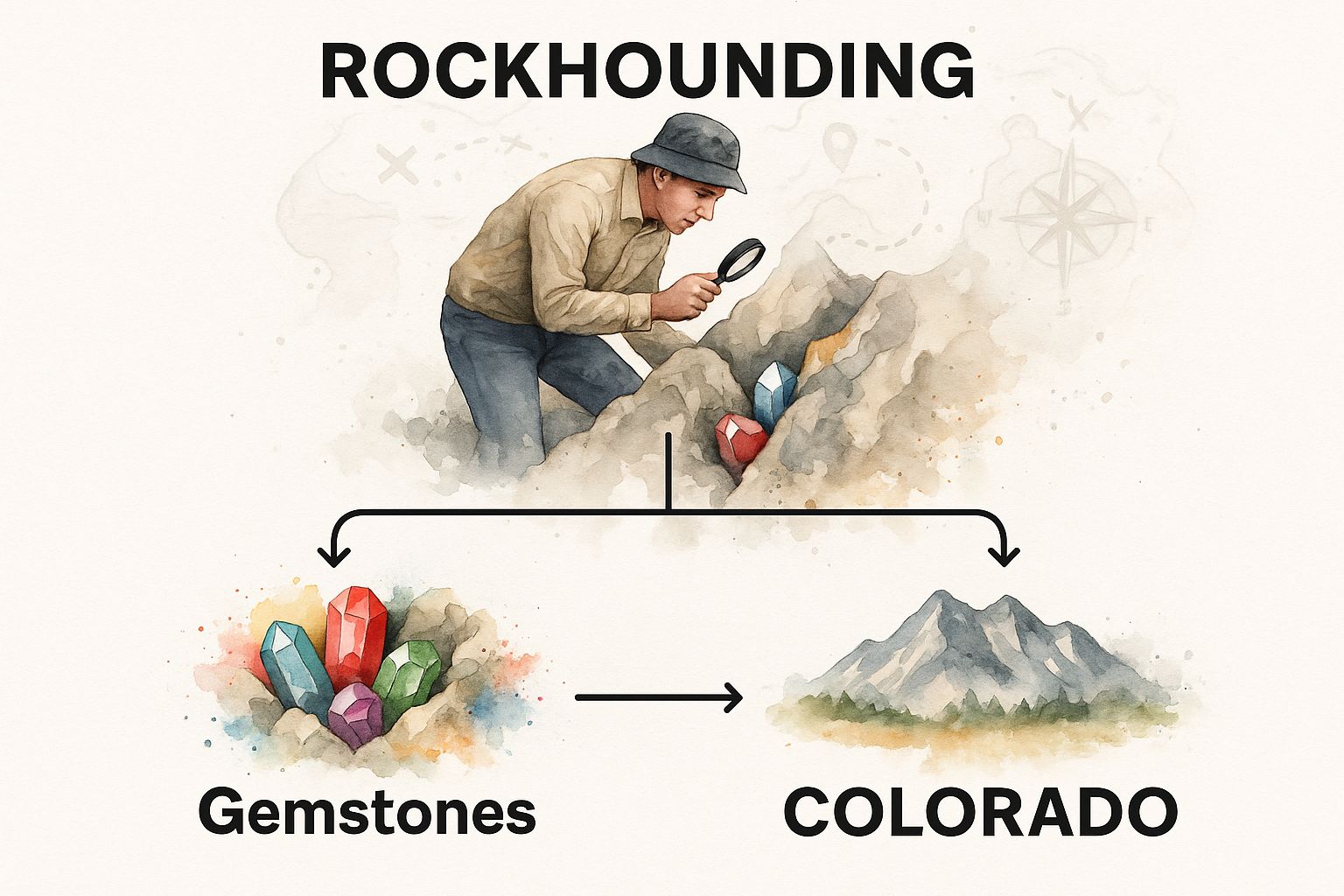
The infographic below really brings to life the key factors that make Colorado a top-tier destination for gemstone enthusiasts.
This illustration neatly shows how the state's powerful geological past, rich mining legacy, and diverse mineral deposits all come together to create a true rockhounding paradise.
What Makes Colorado's Gems Special
The unique geology here doesn't just create a wide variety of gemstones; it also gives them distinct characteristics that are hard to find anywhere else. The state's mineral treasures include:
High-Altitude Aquamarine: Found on Mount Antero, some of the finest deep-blue aquamarine in North America forms in pegmatites at over 13,000 feet.
World-Class Rhodochrosite: The Sweet Home Mine produced the "Alma King," a rhodochrosite crystal widely considered one of the best mineral specimens ever found.
Iconic Amazonite and Smoky Quartz: The Pikes Peak region is famous for producing stunning crystal combinations of deep teal amazonite paired with dark smoky quartz.
Colorado offers a unique opportunity for collectors to find specimens that are not only beautiful but also have a compelling geological story. The state's mineral wealth is a direct window into the powerful forces that shaped the American West.
The Most Famous Gems Hiding in the Rockies
While Colorado offers a dazzling variety of minerals, a few truly stand out as icons of the state. These are the gemstones that pull collectors from all over the world, each with a story tied directly to the dramatic geology of the Rocky Mountains. They aren't just pretty stones; they're tangible pieces of Colorado's natural history.
From the sky-blue hues of the state gem to the fiery red of a world-class treasure, these famous finds are what make Colorado a premier destination for rockhounds. Let's dig into the crown jewels of the Centennial State and see what makes them so special.
To give you a quick overview, here's a look at some of the state's most sought-after gemstones.
Colorado's Signature Gemstones at a Glance
Gemstone
Primary Location(s)
Color(s)
Mohs Hardness
Aquamarine
Mount Antero
Pale to deep blue, blue-green
7.5 – 8
Rhodochrosite
Sweet Home Mine (Alma)
Cherry red, pink, rose
3.5 – 4
Topaz
Tarryall Mountains
Colorless, pale blue, sherry-brown
8
Amazonite
Pikes Peak Region
Teal-blue, green
6 – 6.5
Smoky Quartz
Pikes Peak Region
Dusky brown to near-black
7
This table is just a starting point. Each of these gems has a rich story that goes far beyond its basic stats.
Aquamarine: The Official State Gem
Colorado's official state gemstone, crowned in 1971, is the elegant Aquamarine. This gorgeous blue-green variety of beryl is famously found at extreme altitudes on Mount Antero, one of Colorado's towering "fourteeners"—peaks soaring over 14,000 feet.
Picture a geological pressure cooker deep inside the mountain. Molten rock, called pegmatite, cooled incredibly slowly over millions of years. This unhurried process gave the perfect ingredients—beryllium, aluminum, and silica—time to line up and form large, often flawless, hexagonal crystals. Those crystals are the stunning aquamarines collectors hunt for today.
The conditions on Mount Antero are brutal, but they're exactly what created some of North America's finest specimens. Their color can range from a pale, watery blue to the deep, saturated sky blue that fetches the highest prices. Finding them means navigating treacherous terrain at dizzying heights, making every crystal a hard-won prize.
Rhodochrosite: The Red Treasure of the Sweet Home Mine
While aquamarine may be the state gem, Rhodochrosite is arguably Colorado's most celebrated mineral. The Sweet Home Mine, tucked away near Alma, produced rhodochrosite crystals of such exceptional quality and color that they set the world standard.
Originally a silver mine, the miners in the late 1800s often viewed the vibrant red mineral as a nuisance. It wasn't until the 1960s that collectors recognized its true value. The mine was eventually reopened just for these specimens, ultimately yielding the "Alma King"—a breathtakingly large crystal now on display at the Denver Museum of Nature & Science.
The deep, cherry-red color of Sweet Home Mine rhodochrosite is unparalleled. It forms in sharp, rhombohedral crystals that are often translucent, creating a gem-like quality that is coveted by museums and collectors worldwide.
The mine’s unique geology allowed these incredible crystals to grow in open pockets, or "vugs," right alongside quartz and fluorite, creating stunning and valuable combination pieces. With the Sweet Home Mine now closed, its legendary rhodochrosite specimens are even more rare and desirable. The lines between what's considered precious or semi-precious often blur with rarity and demand; you can explore the differences between precious and semi-precious stones to learn more.
Topaz: The Hardy Gem of the Tarryall Mountains
Another of Colorado’s standout treasures is Topaz, found mainly in the Tarryall Mountains. What’s so fascinating about this gemstone is its incredible hardness—a solid 8 on the Mohs scale—which makes it tough enough for just about any kind of jewelry.
Colorado topaz usually grows in rhyolite, a type of volcanic rock. Gas bubbles trapped in the cooling lava created cavities where, over time, fluorine-rich vapors deposited topaz crystals. These gems can be completely colorless (easy to mistake for quartz), a pale blue, or a beautiful sherry-brown.
While not as famous as aquamarine or rhodochrosite, topaz from this region is prized by collectors for its sharp crystal shape and clarity. Hunting for them is a classic rockhounding adventure, often involving sifting through decomposed granite to find these resilient little crystals.
Amazonite and Smoky Quartz: A Perfect Pairing
The Pikes Peak region is home to one of the most iconic mineral combinations anywhere: Amazonite and Smoky Quartz. This classic pairing is a visual masterpiece born from the Pikes Peak granite batholith.
Amazonite is a vibrant teal-blue to green variety of microcline feldspar. Its striking color comes from tiny amounts of lead and water trapped inside the crystal as it formed.
Smoky quartz is a type of quartz that gets its dusky brown to almost-black color from natural radiation locked within the granite.
These two minerals often grow together in the same pegmatite pockets, creating breathtaking specimens. The cool, vivid blue of the amazonite crystals pops dramatically against the dark, moody smoky quartz. For many collectors in Colorado, finding a perfectly balanced plate of these two minerals is the ultimate goal. The unique geochemistry in the Pikes Peak area created the perfect storm for this stunning duo to form, making it a must-have for any serious collection.
Tracing Colorado's Historic Turquoise Trail
While showstoppers like aquamarine and rhodochrosite often grab the headlines, turquoise holds a special, soulful place in Colorado's story. It’s more than just a pretty stone; it's a cultural artifact, a thread connecting the state’s ancient geology to the people who first called this land home. Turquoise tells a story of trade, artistry, and a deep reverence for the earth itself.
The journey of Colorado turquoise isn't just a geological one—it's a trail that winds through high-altitude mining camps and into the hands of skilled artisans. Its legacy is particularly strong in the central part of the state, where the conditions were just right to cook up this iconic blue-green mineral.
The Heart of Turquoise Country
The epicenter of Colorado's turquoise boom is Lake County, especially around the aptly named Turquoise Lake near Leadville. This area was the heart of the action, with mining operations hitting their peak in the 1940s. During this time, miners pulled significant quantities of high-quality stone from the ground, cementing Colorado's reputation as a key source for American turquoise.
One legendary discovery really shows what these deposits were capable of. In 1941, a single, massive turquoise nugget weighing a staggering 8.75 pounds was found. It was a testament to the incredible mineral wealth hiding in these mountains, and finds like this drew prospectors from all over, putting the region firmly on the turquoise map.
The unique character of Colorado turquoise comes from its specific geological birthplace. The gemstone here usually appears as thin veins and small nodules inside the 1.4 billion-year-old St. Kevin Granite. This ancient host rock provided the perfect recipe of copper and aluminum that, over millions of years, slowly formed into the vibrant turquoise collectors prize. You can dive deeper into the geological details of Colorado's turquoise deposits if you want to get technical.
From Mine to Masterpiece
The story doesn't stop when turquoise comes out of the ground. For centuries, this stone has been deeply valued by Native American tribes of the Southwest, including the Ute, Navajo, and Pueblo peoples. Colorado's turquoise deposits were a vital part of a vast, ancient trade network that moved this sacred stone across the continent.
Turquoise was used for:
Ceremonial Purposes: Believed to hold protective and healing powers, it was a cornerstone of spiritual practices.
Adornment: It was skillfully crafted into intricate jewelry—necklaces, bracelets, and detailed inlay work—often paired with silver.
Trade and Status: The quality and amount of turquoise someone owned could signify their wealth and social standing.
Turquoise is often called the "sky stone," a bridge between the spiritual and physical worlds. Its presence in Colorado is a direct link to the region's deep cultural and geological past, connecting the earth's treasures with human creativity and belief.
Famous Mines and Their Legacy
Several historic mines have shaped Colorado's turquoise legacy, each producing stone with its own distinct personality. Mines like the King Manassa (originally the Lick Skillet) and the Turquoise Chief became famous for their specific colors and matrix patterns—the web-like lines of host rock that give each stone its unique fingerprint.
The King Manassa mine, for example, is known for its beautiful range of green to blue-green turquoise with a striking golden-brown matrix. That signature look makes it instantly recognizable to collectors. While many of these historic mines aren't running on a large scale anymore, their stones live on, treasured in vintage jewelry and private collections.
The turquoise trail in Colorado is a journey through time. It connects the immense geological forces that built the Rockies with the gold-rush-era miners who rediscovered its value, and the ancient cultures that revered it long before. This enduring legacy ensures turquoise remains one of the most significant gemstones of Colorado.
Colorado's Unexpected Diamond Discovery
When you picture the gemstones of Colorado, diamonds probably aren’t the first thing that comes to mind. But the state holds a wild and dramatic chapter in North American diamond history—a story filled with swindlers, hard-won science, and a brilliant, if brief, moment of commercial mining. It's a tale that proves Colorado’s geological treasures are more complex than just its famous colored gems.
The story kicks off not with a real find, but with a legendary scam. In 1872, the "Great Diamond Hoax" hoodwinked the nation after two prospectors salted a remote northwestern Colorado mesa with a stash of low-grade diamonds, rubies, and sapphires. They conned prominent investors and sparked a national frenzy before a sharp-eyed geologist exposed the whole thing, casting a long shadow of doubt over any future diamond claims in the state.
That public embarrassment made it incredibly difficult for anyone to take Colorado diamonds seriously for a very long time. It would take more than a century for legitimate science to finally step out from the shadow of the hoax and reveal the truth hiding just beneath the soil.
From Hoax to Hope: The Rise of Kimberlite Science
The real breakthrough didn't come from a lucky prospector stumbling over a glittery rock. This was a story of patient, geological detective work. Diamonds aren’t formed just anywhere; they’re created under mind-boggling pressure and heat over 90 miles deep in the Earth's mantle.
To get to the surface, they need a special kind of geological elevator—a violent, supersonic volcanic eruption that blasts a column of magma called kimberlite straight up. This "kimberlite pipe" is the primary source rock for diamonds, and finding one is the first, most critical step to any real diamond discovery. For decades, geologists simply believed these pipes didn't exist in Colorado.
The hunt for diamonds is really a hunt for their unique host rock, kimberlite. Locating these ancient volcanic pipes is the geological equivalent of finding a treasure map where X truly marks the spot.
Everything changed in 1975. That's when Professor Malcolm McCallum from Colorado State University officially identified kimberlite pipes in the State Line District, right on the Colorado-Wyoming border. This discovery was a game-changer, flipping the narrative from historical fraud to scientific fact. Finally, there was concrete proof that Colorado had the right geology to host diamonds.
The Kelsey Lake Mine: A North American First
Professor McCallum’s work paved the way for serious exploration. After years of testing and evaluation, the Kelsey Lake Mine opened for open-pit mining in 1996, becoming one of the first commercial diamond mines in North America. The operation proved that the kimberlites in the area could produce gem-quality diamonds at grades on par with some commercial mines in other parts of the world. You can dive deeper into this historic discovery with resources from the Colorado Geological Survey.
The diamonds pulled from Kelsey Lake were impressive and often had unique qualities.
Size: The mine was known for large stones, including the biggest diamond ever found in Colorado—a whopping 28.3-carat yellow gem. Another 14.2-carat gem-quality white diamond from the mine was aptly named the "Colorado Diamond."
Quality: A remarkable percentage of the diamonds found were gem quality, which is a high ratio for any diamond mine.
Appearance: Many were clear, octahedral crystals, the classic "diamond shape" that forms naturally in the earth.
Despite its success producing beautiful gems, the Kelsey Lake Mine had a short and troubled run, closing down in the early 2000s due to a mix of legal and financial problems. The site is now closed to the public, but its legacy is secure. The mine proved that the list of gemstones of Colorado includes one of the world's most coveted jewels, forever changing the state’s mineral story.
Your Practical Guide to Rockhounding in Colorado
Knowing about Colorado's incredible gemstones is one thing; finding them yourself is another adventure entirely. Making the leap from admirer to active rockhound takes the right gear, a solid grasp of the rules, and a deep respect for the rugged landscapes you’ll be exploring.
This is your practical guide to getting started—the real-world advice you need to begin your own treasure hunt safely and responsibly.
Gearing Up for Your Gemstone Adventure
Think of getting ready for a rockhounding trip like preparing for a good day hike, but with a few special tools added to your pack. You don’t need a professional setup right out of the gate, but having the right basics makes the experience so much more productive and fun.
Your toolkit really has three jobs: keeping you safe, helping you dig, and letting you figure out what you’ve found. Every piece of gear is important, especially when you're miles from anywhere.
Here's a quick checklist of the essentials:
Safety First:Safety glasses are an absolute must to protect your eyes from flying rock chips. A sturdy pair of gloves is also non-negotiable for handling sharp rocks and digging in rough terrain.
The Right Tools: A good rock hammer or pick is your best friend for breaking open promising rocks. A small shovel or trowel comes in handy for digging in softer ground or sifting through scree fields.
Navigation and ID: A GPS device or a reliable mapping app is critical, as many of the best spots are pretty remote. A physical field guide to Colorado minerals is great for helping you identify your finds on the spot.
Carrying Your Haul: A sturdy backpack is a given. Also, bring a few durable bags or small boxes—lined with newspaper or bubble wrap—to protect your delicate finds on the hike back.
A successful rockhounding trip isn't just about what you find—it's about how you find it. Respecting the land and following the rules ensures that these natural treasures will be available for future generations of collectors to discover and enjoy.
Understanding the Rules of the Hunt
Before you even think about swinging that rock hammer, you need to know exactly where you are and what rules apply. Collecting gemstones of Colorado isn't a free-for-all; the regulations change completely depending on who owns the land. Getting this wrong can lead to hefty fines and damage to sensitive environments.
The biggest distinction is between public and private land. On most lands managed by the Bureau of Land Management (BLM) and the U.S. Forest Service (USFS), recreational rockhounding for personal use is generally permitted. This means you can collect a reasonable amount of common minerals, as long as you aren’t causing major surface disturbance. However, using mechanized equipment is almost always forbidden, and collecting is off-limits in designated wilderness areas, national parks, and monuments.
Private land is a completely different ballgame. This includes patented mining claims, which are private property even if they're surrounded by public land. You must have explicit, direct permission from the landowner before searching or collecting on any private property or claim. Trespassing is not only illegal but can be dangerous. Always check land ownership maps and keep an eye out for claim markers.
If you want a more structured experience without the guesswork, a fee-dig mine can be a fantastic option. For a deeper dive, our guide to gemstone mining in Colorado offers more details on these opportunities.
To help you get started, here's a quick look at some popular and accessible public locations.
A Rockhounder's Map to Colorado Public Sites
This table gives you a starting point for planning your trip, focusing on public lands where you can legally hunt for some of Colorado's famous gems.
Location / Region
Primary Gemstones Found
Land Type (e.g., National Forest, Fee-Dig Mine)
Difficulty Level
Mount Antero
Aquamarine, Topaz, Phenakite
San Isabel National Forest
High (4WD required)
St. Peter's Dome
Amazonite, Smoky Quartz
Pike National Forest
Moderate
Hartsel Area
"Amethyst" Quartz, Agate
BLM Land / Private Fee-Digs
Easy to Moderate
Devil's Head
Topaz, Smoky Quartz
Pike National Forest
Moderate (Hiking)
Always remember to double-check the specific regulations for any area you plan to visit, as rules can change. This is just a map—the real adventure begins when you get there.
Staying Safe in the High Country
Colorado's mountains are stunning, but they can be incredibly unpredictable. Your safety should always be the number one priority, especially when you're rockhounding at high altitudes where the weather can turn on a dime.
Keep these essential safety tips in mind:
Acclimatize to the Altitude: If you're coming from sea level, give your body a day or two to adjust before tackling a high-altitude site like Mount Antero. Drink way more water than you think you need.
Watch the Weather: Afternoon thunderstorms are a classic feature of a Colorado summer. Get an early start and plan to be off exposed ridges well before noon to avoid lightning danger.
Be Prepared for Anything: Pack layers of clothing, extra food and water, sunscreen, and a basic first-aid kit. Tell someone your plan—where you're going and when you expect to be back. The terrain is often loose and rocky, so wear sturdy hiking boots with solid ankle support.
Answering Your Colorado Gemstone Questions
Stepping into the world of Colorado gemstones brings up a lot of questions, whether you're planning your first rockhounding adventure or are just curious about the state's incredible mineral wealth. To get you started on the right foot, we've put together answers to some of the most common questions we hear from beginners and seasoned collectors alike.
Think of this as your go-to guide for clearing up common uncertainties and building on what you've learned about Colorado's geological treasures.
What Is the Official State Gemstone of Colorado and Where Can I Find It?
Colorado's official state gemstone, designated in 1971, is the gorgeous Aquamarine. This beautiful blue-green variety of beryl is famously found in one of the highest mining locations in North America—the rugged slopes of Mount Antero in the Sawatch Mountain Range.
Here, the crystals grow inside rock cavities called pegmatites, often at elevations pushing past 13,000 feet. While there is public access in parts of the San Isabel National Forest, hunting for aquamarine here is a serious endeavor. The extreme altitude, wildly unpredictable weather, and tough terrain make it a bucket-list trip best saved for experienced and well-prepared rockhounds. It's also critical to know that many of the best spots are on private mining claims, so respecting property lines is an absolute must.
Can I Legally Collect Gemstones on Public Land in Colorado?
Yes, you definitely can, but you have to follow some important rules and ethical guidelines. Recreational rockhounding for your personal, non-commercial collection is generally allowed on most lands managed by the Bureau of Land Management (BLM) and the U.S. Forest Service (USFS).
This amazing privilege lets you collect a reasonable amount of common minerals and rocks. However, it comes with a few key restrictions:
You're typically limited to simple hand tools, like rock hammers and small shovels.
Mechanized equipment, like power sluices or jackhammers, is a definite no-go for recreational collecting.
Collecting is off-limits in certain protected areas, including National Parks, National Monuments, and designated Wilderness Areas.
The golden rule of rockhounding is to "leave no trace." This means packing out everything you bring with you, keeping surface disturbance to a minimum, and respecting the environment so others can enjoy it after you're gone. Always check with the local BLM or USFS field office for the most current rules before you head out.
What Valuable Gemstones Are Found in Colorado Besides Aquamarine?
While aquamarine gets the official title, Colorado is a true mineralogical paradise, packed with a ton of other valuable and highly sought-after gemstones. There's really something for every kind of collector here.
Some of the state's biggest stars include world-famous Rhodochrosite from the now-closed Sweet Home Mine, which is prized by top collectors for its unbeatable cherry-red color. The Pikes Peak region is a legendary spot for finding vibrant teal Amazonite, often in spectacular combinations with dark Smoky Quartz crystals.
Beyond these icons, you can also hunt for beautiful blue Topaz in the Tarryall Mountains and find historic Turquoise deposits near Leadville. And let's not forget the diamonds from the Kelsey Lake Mine, which proved Colorado's geology is full of surprises. Other cool finds include garnet, zircon, fluorite, and amethyst, making the list of gemstones of Colorado a long and exciting one.
How Do I Identify the Gemstones I Find?
Figuring out what you've found is one of the most rewarding parts of rockhounding. It can be a bit tricky at first, since raw crystals often look nothing like their polished, gem-store versions. The key is to look at characteristics like color, crystal shape, hardness, and luster (the way it reflects light). For instance, quartz usually has a glassy luster and a six-sided crystal shape, while feldspar minerals like amazonite often show flat, blocky surfaces where they've cleaved.
A good field guide is your best friend out on the trail. Once you're back home, you can dive deeper with online resources. Our crystal identification guide offers practical tips on what properties to look for when you're trying to put a name to your newfound treasures.
At Astro West, we believe every stone tells a story millions of years in the making. Whether you're a seasoned collector searching for a museum-quality specimen or a newcomer looking for your first piece of natural art, our curated collection of fine minerals, fossils, and jewelry has something to inspire you. Explore our ethically sourced treasures and bring a piece of Earth's history home. https://astrowest.com