The best gifts for kids are the ones that sneak learning into playtime. They cleverly blend fun with discovery, turning an ordinary afternoon into a powerful engine for development. These aren't just toys; they’re the tools that build critical cognitive, social, and emotional skills, sparking a love for learning that lasts long after the playroom is tidied up.
How Playful Learning Shapes Bright Futures
Choosing a gift for a child can feel like navigating a minefield of options, but focusing on educational value really simplifies the search. An educational gift does more than just entertain—it actively hooks a child’s curiosity and supports them right where they are in their developmental journey.
Think of it as providing the raw materials for a child's growing mind. Every block stacked, puzzle solved, or experiment conducted lays a new foundation for future knowledge.
This isn't just a fleeting trend; it reflects a much deeper understanding of how kids' minds work. Parents and gift-givers are now actively looking for toys that offer real, tangible benefits. You can see it in the market numbers: the global educational toys market was valued at USD 19.2 billion in 2020 and is on track to hit USD 31.62 billion by 2026. This growth signals a major shift toward providing tools that build skills, not just offer a few minutes of amusement. If you're curious, you can dig deeper into the educational toy market analysis from Arizton Advisory & Intelligence.
The True Purpose of an Educational Gift
At its heart, an educational gift is designed to teach a specific skill or concept through hands-on interaction. This active participation is what separates a truly developmental toy from a passive one. Instead of just watching a screen, a child is building, creating, and figuring things out on their own.
This guide will give you a clear roadmap for picking the perfect educational gifts by exploring:
The Power of Hands-On Play: We'll get into why "learning by doing" is so incredibly effective for brain development.
Age-Appropriate Gifting: It’s all about matching gifts to a child's specific developmental stage for maximum impact.
Key Gift Categories: We’ll break down the best types of educational toys, from STEM kits to strategy games.
Experiential Gift Ideas: Let's look beyond physical toys to gifts that create lasting memories and skills.
The best toys are often the simplest. They are open-ended tools that let children be the architects of their own play, fostering creativity, critical thinking, and a genuine sense of accomplishment.
By the time you're done here, you’ll be ready to find a gift that not only makes a kid light up but also genuinely contributes to their growth, turning every moment of play into a valuable learning opportunity.
The Science of Learning Through Hands-On Play
Ever watch a kid's eyes light up while they're stacking blocks, mixing paints, or just digging in the dirt? That's not just fun and games—it's the brain's favorite way to learn. Research from institutions like the National Association for the Education of Young Children (NAEYC) consistently shows that active, hands-on play builds stronger, more permanent neural pathways than passively watching a screen.
Think about it like this: you could watch a dozen videos on how to bake a cake, but you won't truly get it until you measure the flour, crack the eggs, and feel the sticky batter on your own hands. That sensory feedback is exactly how a child's brain is wired to make sense of the world.
When kids physically interact with something, they engage multiple senses at once. This multi-sensory flood of information cements concepts in their minds far more effectively than just seeing or hearing about them. The best educational gifts are simply tools that get this powerful learning process started.
From Simple Actions to Complex Skills
It’s incredible how simple play translates directly into high-level skills. Every activity is like a targeted workout for the brain, building the foundational abilities they'll rely on for the rest of their lives. This is the core of learning by doing, and it’s the secret sauce in any great educational toy.
You can see this magic in action everywhere:
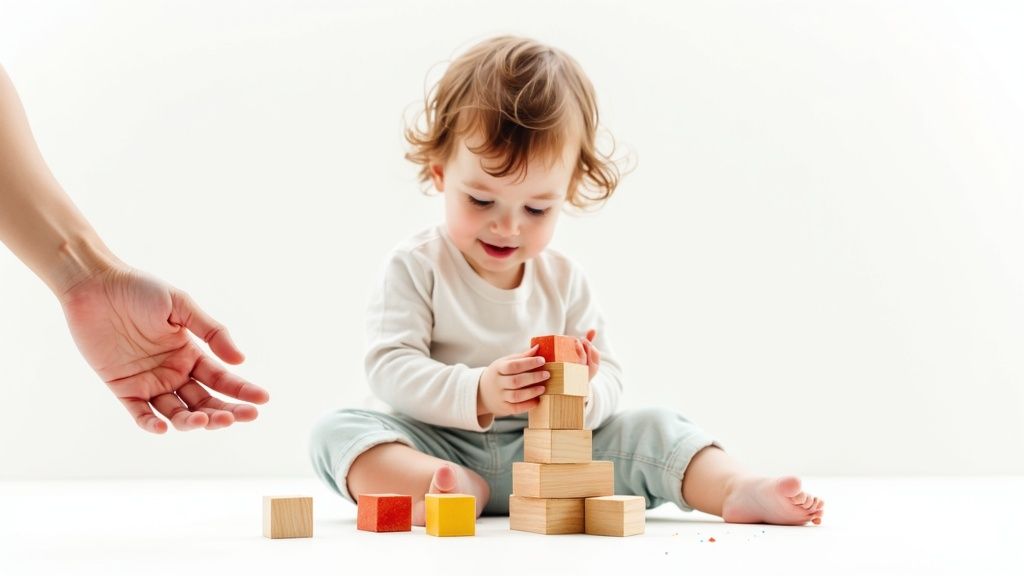
Stacking Blocks: This classic isn't just a toy. It's a hands-on masterclass in spatial reasoning, teaching tangible lessons about balance, gravity, and even basic geometry.
Science Kits: Mixing two substances to see a reaction is more than just a cool fizz. It’s a child's first real taste of the scientific method—forming a hypothesis, running an experiment, and observing the result.
Modeling Clay: Squishing, rolling, and shaping clay is fantastic for building the fine motor skills needed for handwriting. It’s also a sandbox for creative expression and three-dimensional problem-solving.
These aren't just one-and-done lessons. Each time a child plays this way, they’re reinforcing those neural connections, making their brains more flexible and better equipped for whatever challenges come next. A great way to keep this development going is by exploring a variety of hands-on learning activities.
Why Active Engagement Trumps Passive Viewing
In a world overflowing with screens, the distinction between active and passive learning has never been more critical. While digital apps can have their place, they often cast the child as a passive observer. Hands-on play, on the other hand, demands that they jump in, solve problems, and think for themselves.
Imagine the brain as a muscle. Passively watching content is like watching someone else work out—it might be interesting, but you're not building any strength. Hands-on learning is the workout. It forces the brain to make decisions, adapt to mistakes, and create something entirely new.
The trial and error that comes with hands-on play isn't a bug; it's the main feature. It teaches resilience, adaptability, and the crucial lesson that mistakes are a perfectly normal part of getting smarter.
This is exactly why a simple set of wooden blocks can offer more developmental benefits for a young child than a flashy tablet. Open-ended educational gifts don't just entertain; they empower kids to become creators of their own learning journey, not just consumers of content. When you choose gifts that encourage them to build, experiment, and imagine, you’re giving them the raw materials to become smarter, more curious, and more confident people.
Matching the Right Gift to Every Age and Stage
Picking the right educational gift is a lot like telling a good story—you have to know your audience. A toy that mesmerizes a five-year-old might bore a ten-year-old, and what challenges a toddler could just frustrate a preschooler. The secret to a gift that really lands is matching it to the child's specific developmental stage, meeting them exactly where they are on their learning journey.
This isn’t about following rigid rules. It’s about understanding the cognitive and physical milestones that define each phase of childhood, as outlined by organizations like the CDC. A thoughtfully chosen gift works with a child's natural development, making learning feel less like a chore and more like a thrilling adventure. It offers just enough of a challenge to keep them hooked without tipping over into frustration.
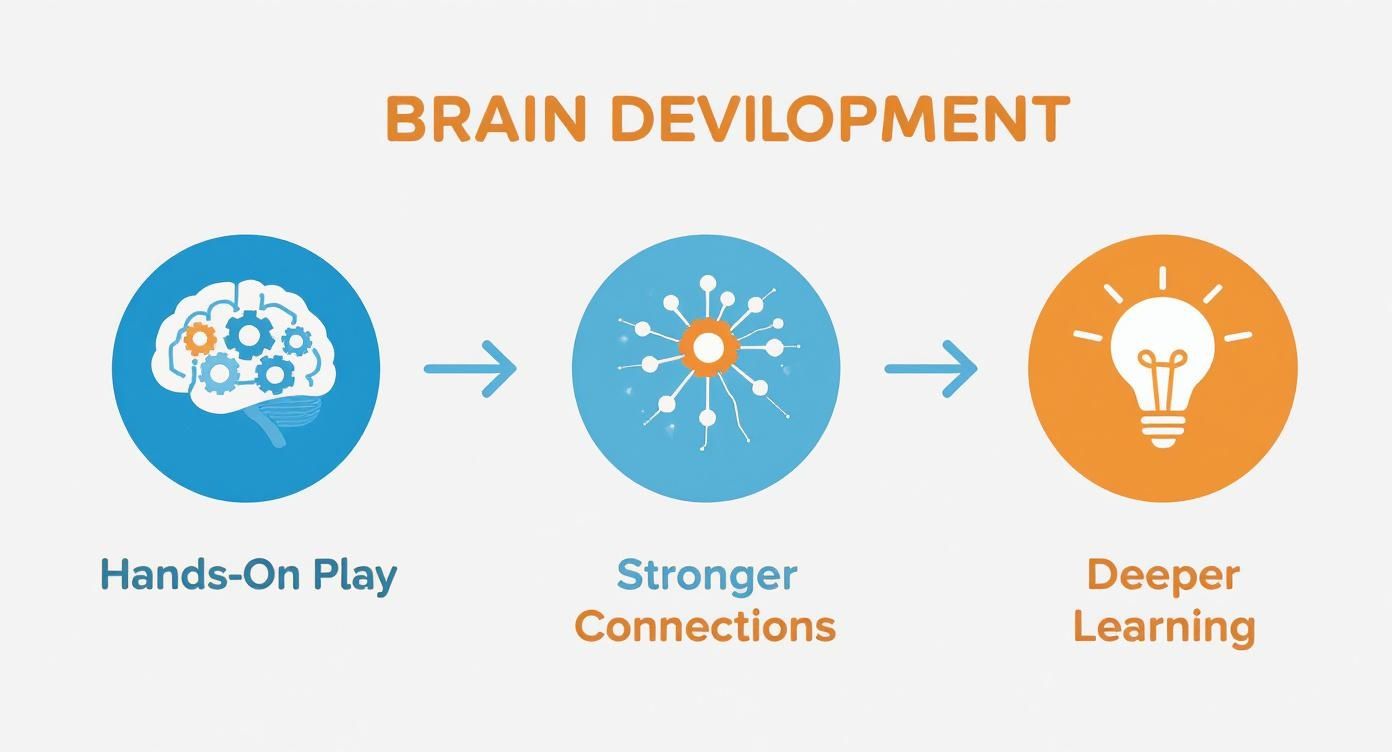
This timeline shows how hands-on play forges stronger neural connections, paving the way for deeper, more effective learning.
As you can see, active engagement is the first, crucial step in a powerful chain reaction that quite literally shapes a child's mind.
To make this easier, we've put together a quick guide that connects age groups with the types of gifts that best support their growth.
Educational Gift Guide by Age Group
Age Group
Developmental Focus
Recommended Gift Categories
Skills Developed
Toddlers (1–3)
Sensory exploration, motor skills
Building blocks, shape sorters, musical toys
Fine/gross motor control, cause-and-effect, object permanence
This table serves as a great starting point, but let’s dive a bit deeper into what makes each stage so unique.
Toddlers (1–3 Years): Building a Sensory World
For toddlers, the world is one giant sensory playground. Their main job is to explore everything through touch, taste, sight, and sound. Educational gifts for this age should zero in on developing fine and gross motor skills, introducing basic concepts like cause-and-effect, and just encouraging that sensory discovery.
Think simple, safe, and durable. Toys that can be stacked, sorted, pushed, or pulled are perfect. This is the age where a set of chunky wooden blocks or a simple shape sorter can provide hours of foundational learning.
A toddler’s play is their work. Every object they handle is a lesson in how the physical world operates, building the essential brain architecture for all future learning.
This early stage is so critical that it drives a huge part of the market. According to recent market analysis, toddlers (ages 1–3) are a major consumer segment, showing just how much parents and educators value this crucial window for cognitive development.
Preschoolers (3–5 Years): Igniting Imagination and Early Skills
Preschoolers are absolutely bursting with creativity. Their play becomes more complex, weaving in storytelling, role-playing, and the beginnings of social interaction. This is the perfect time to introduce gifts that fan those flames.
Look for gifts that support early literacy and numeracy in a fun, pressure-free way. Alphabet puzzles, counting games, and basic building sets like magnetic tiles are all excellent choices. Arts and crafts supplies—like non-toxic crayons, modeling clay, and washable paints—are also fantastic for encouraging self-expression and refining motor control.
Pretend Play Sets: A doctor's kit or a play kitchen lets them act out real-world scenarios, building empathy and language skills along the way.
Simple Board Games: Cooperative games that don’t require reading are great for teaching turn-taking, rule-following, and teamwork.
Lacing Toys: These are perfect for developing the fine motor precision they’ll need for writing down the road.
Early Elementary (6–8 Years): Fostering Foundational STEM and Logic
Once kids hit elementary school, their capacity for logical thinking and problem-solving expands dramatically. They're ready for more structured challenges that build foundational STEM (Science, Technology, Engineering, and Math) skills.
This is the golden age for introductory science kits, simple coding robots, and more complex construction toys. Gifts that involve following instructions to reach a goal—like a beginner's LEGO set—are ideal. They teach patience, precision, and the pure satisfaction of seeing a project through to the end.
Pre-Teens (9–12 Years): Diving into Advanced Concepts
Older kids are ready to tackle much more complex and strategic challenges. Their abstract thinking skills are coming online, allowing them to grasp intricate systems and long-term planning. The best educational gifts for this age group respect their growing intellect and independence.
This is the time to introduce advanced coding kits, sophisticated engineering sets, or detailed chemistry labs. For those special occasions, you can find a wealth of unique birthday gift ideas that cater to curious and intelligent young minds.
When you thoughtfully match a gift to a child's age, you ensure your present is more than just a fleeting distraction. It becomes a valued tool that supports their growth, nurtures their passions, and makes learning an exciting part of everyday life.
Exploring Top Categories of Educational Gifts
Once you’ve zeroed in on the right age range, it's time for the fun part: exploring the different types of educational gifts. Each category is designed to flex a different mental muscle, from scientific curiosity to artistic expression.
Think of it like building a well-rounded library. Just as you’d want books on different subjects, a variety of educational toys helps a child develop a more balanced set of skills. Let’s dive into some of the most impactful categories.
STEM Kits Fueling Future Innovators
Science, Technology, Engineering, and Math (STEM) gifts are brilliant at making complex subjects feel like a game. They take abstract ideas and make them tangible, turning the kitchen table into a science lab or a bedroom floor into a robotics workshop.
These kits are so much more than fun experiments; they’re the building blocks of a scientific mindset. A kid with a volcano-making kit isn't just mixing baking soda and vinegar—they're learning about chemical reactions, cause and effect, and the thrill of seeing a hypothesis play out.
According to market research, STEM toys are one of the fastest-growing segments of the educational toy market, as parents and educators increasingly look for ways to build modern, future-ready skills in children.
STEM gifts are perfect for the child who:
Is always asking "why?" and trying to figure out how things work.
Loves hands-on experiments and isn't afraid to get a little messy.
Shows a spark of interest in nature, technology, or solving puzzles.
Building And Engineering Toys For Young Architects
Building and engineering toys are the champions of spatial reasoning, planning, and good old-fashioned perseverance. From classic wooden blocks to intricate mechanical sets, these gifts empower children to become the architects of their own worlds.
Every time a child connects two pieces, they’re getting a hands-on lesson in gravity, balance, and structural integrity. They're also sharpening fine motor skills and learning patience through the inevitable trial-and-error process of construction.
Building toys teach one of life's most valuable lessons without saying a word: a grand vision is achieved one small, intentional step at a time. The joy is not just in the finished product, but in the process of creating it.
These toys are ideal for the child who:
Enjoys constructing things, whether with blocks, pillows, or cardboard boxes.
Likes to follow instructions but also loves to invent their own designs.
Has a patient and methodical approach to play.
Arts And Crafts Kits Nurturing Creativity
While STEM and engineering focus on logic and structure, arts and crafts gifts are all about celebrating creativity, self-expression, and fine motor control. These kits give kids the tools to bring their wildest imaginations to life.
Working with materials like clay, paint, or beads is a fantastic sensory experience. It also helps children develop the dexterity needed for skills like writing. More importantly, art gives them a powerful outlet to express feelings and ideas they might not have the words for yet. To find the right fit, you can explore a comprehensive list of educational activities for different age groups.
Choose arts and crafts for the child who:
Is a natural storyteller or daydreamer.
Loves drawing, painting, or making things with their hands.
Expresses themselves visually and enjoys playing with colors and textures.
Logic And Strategy Games For Sharpening Minds
Logic puzzles and strategy games are the ultimate brain workout. They challenge kids to think ahead, anticipate consequences, and adapt their plans on the fly—all while having a blast. These games are fantastic for honing critical thinking and sportsmanship.
Whether it’s a classic board game or a single-player puzzle, these gifts teach children to analyze situations and make calculated decisions. Some of the best educational gifts for kids are those that connect thinking skills to real-world concepts, like geology. A fossil dig kit, for instance, builds patience while introducing them to paleontology. You can learn even more by checking out our guide on what are the different types of fossils.
Logic games are a great fit for the child who:
Enjoys puzzles, riddles, and figuring things out.
Is competitive in a healthy way and loves a good challenge.
Can focus on a task for an extended period.
By choosing a gift from a category that clicks with a child’s natural inclinations, you’re not just giving them a toy. You’re giving them a tool that validates their interests and helps them build skills they’ll use for a lifetime.
Giving Experiences Instead of Things
Toys and kits are fantastic for hands-on learning, but let’s be honest—some of the most powerful gifts don't come in a box. When you give an experience, you're shifting the focus from a temporary object to a lasting memory. It creates a space for discovery that a single toy just can't match.
These kinds of gifts connect learning directly to the real world. They show kids that knowledge isn’t just something you find in a classroom or a textbook; it’s everywhere. An experience can ignite a lifelong passion, bring a family closer, and build practical skills in a way that feels like pure fun.
Moving Beyond the Playroom
Think of experiential gifts as investments in a child’s curiosity. They’re a perfect way to nurture an interest that’s already bubbling up or to introduce them to something completely new. The best part? The learning feels totally natural because it’s woven into an exciting outing or activity.
Consider these impactful options that truly keep on giving:
Museum or Zoo Memberships: An annual pass transforms a one-time visit into a year-long adventure. It encourages kids to go back again and again, letting them dive deeper into science, history, or the animal kingdom at their own pace.
Subscription Boxes: A monthly STEM or art box delivers a fresh dose of excitement right to your doorstep. Each delivery is a self-contained project that builds skills over time, whether it's coding fundamentals or a new painting technique.
Classes and Workshops: Signing a child up for a local coding class, a pottery workshop, or music lessons offers structured, expert-led instruction. This is a brilliant way to support a specific passion and help them develop a genuine skill.
The Lasting Value of Shared Discovery
So many of these experiences are meant to be shared, creating priceless time for family connection. A simple afternoon visiting a nature center or a guided stargazing tour becomes a memory you’ll all talk about for years to come.
Experiences are the stories we tell ourselves and each other. Gifting an adventure gives a child a new chapter to add to their personal story—one filled with discovery, connection, and the quiet confidence that comes from trying something new.
Even simple creative activities at home can be turned into a memorable experience. For parents looking for engaging ideas, an ultimate guide to choosing children's coloring books can help transform a quiet afternoon into a focused, artistic session.
Likewise, something as simple as a visit to a local rock and mineral shop can spark a lifelong fascination with geology. Here at Astro West, we offer memorable, hands-on activities that do just that. To get a feel for the excitement, check out our guide on how to crack geodes and see how an ordinary-looking rock can hold a universe of wonder inside.
Ultimately, giving an experience is about gifting growth, memories, and the pure joy of discovery.
Got Questions About Educational Gifts? We've Got Answers.
Picking out the right educational gift can feel like a bit of a balancing act. You want something that will light up a child's face, but you also want it to have real value beyond the initial excitement. It’s completely normal to have a few questions swirling around as you try to find that perfect sweet spot.
Let's clear up some of the most common concerns, so you can feel confident and excited about your choice.
How Do I Find a Gift That’s Actually Fun and Educational?
The trick is to start with what the child already loves. Seriously. A gift that taps into their natural curiosity—whether that's dinosaurs, building forts, or making art—is always going to feel like play, not a homework assignment. The learning part should be baked right into the fun.
Think about it this way: a kid who's always telling stories will see a set of hand puppets as pure entertainment, but they’re also sharpening their language and narrative skills without even realizing it. The child who is obsessed with taking things apart will be totally absorbed by a simple gear set, all while getting a hands-on lesson in basic physics. The best educational gifts for kids don't shout about their benefits; they let the fun do all the talking.
Are Those Expensive Tech Toys Really Worth the Hype?
High-tech toys can definitely have a "wow" factor, but a steep price tag doesn't guarantee a better learning experience. The real question is whether the toy encourages active engagement or just passive consumption. A lot of flashy electronic gadgets are designed to entertain, requiring little more from a child than pushing a button.
On the other hand, simpler, open-ended toys often deliver far more developmental bang for your buck. A good set of magnetic tiles or a basic chemistry kit doesn’t have a script. It invites a child to imagine, experiment, and figure things out on their own terms.
Before you splurge on a pricey gadget, just ask yourself this: "Is the child in control of the play, or is the toy in control of the child?" The most powerful gifts are the ones that empower a kid's imagination, not just distract them with lights and sounds.
What Kinds of Gifts Won't They Outgrow in a Few Months?
For a gift with real staying power, think "open-ended." You want items that can be used in new and more complex ways as a child's skills and imagination expand. These are the classics that stick around for years, not weeks.
A few categories are famous for their longevity:
High-Quality Building Sets: Things like LEGOs, wooden blocks, or magnetic tiles are just as engaging for a four-year-old learning to stack as they are for a ten-year-old engineering elaborate castles.
Art Supplies: A solid set of paints, quality colored pencils, or a block of modeling clay has no age limit. The projects simply grow more sophisticated over time.
Real Tools and Instruments: A sturdy, child-sized gardening set, a beginner’s ukulele, or a durable microscope can easily spark a hobby that lasts a lifetime.
How Can I Pick a Great Gift Without Adding to Screen Time?
The best way to encourage screen-free play is to go for hands-on, tangible gifts. Look for things that engage the senses and require physical interaction. Science kits with things to mix and measure, board games that get everyone talking, or outdoor tools like a compass or magnifying glass all pull a child's focus into the real world.
And don't forget experiential gifts. A pass to a local museum or a planned rock-hounding trip are fantastic screen-free options that build incredible, lasting memories.
Here at Astro West, we believe the most unforgettable educational gifts are the ones that connect kids to the raw wonder of the natural world. From the thrill of cracking open your own geode to the awe of holding a real fossil, our collection is built to spark a curiosity that lasts a lifetime.