Dioptase: A Premier Investment in Natural Green Treasure
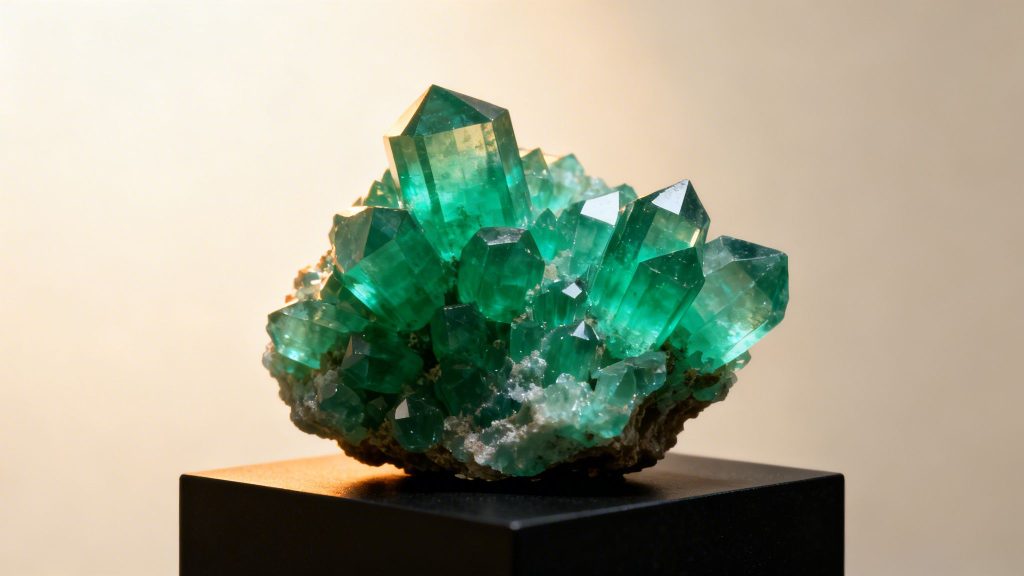
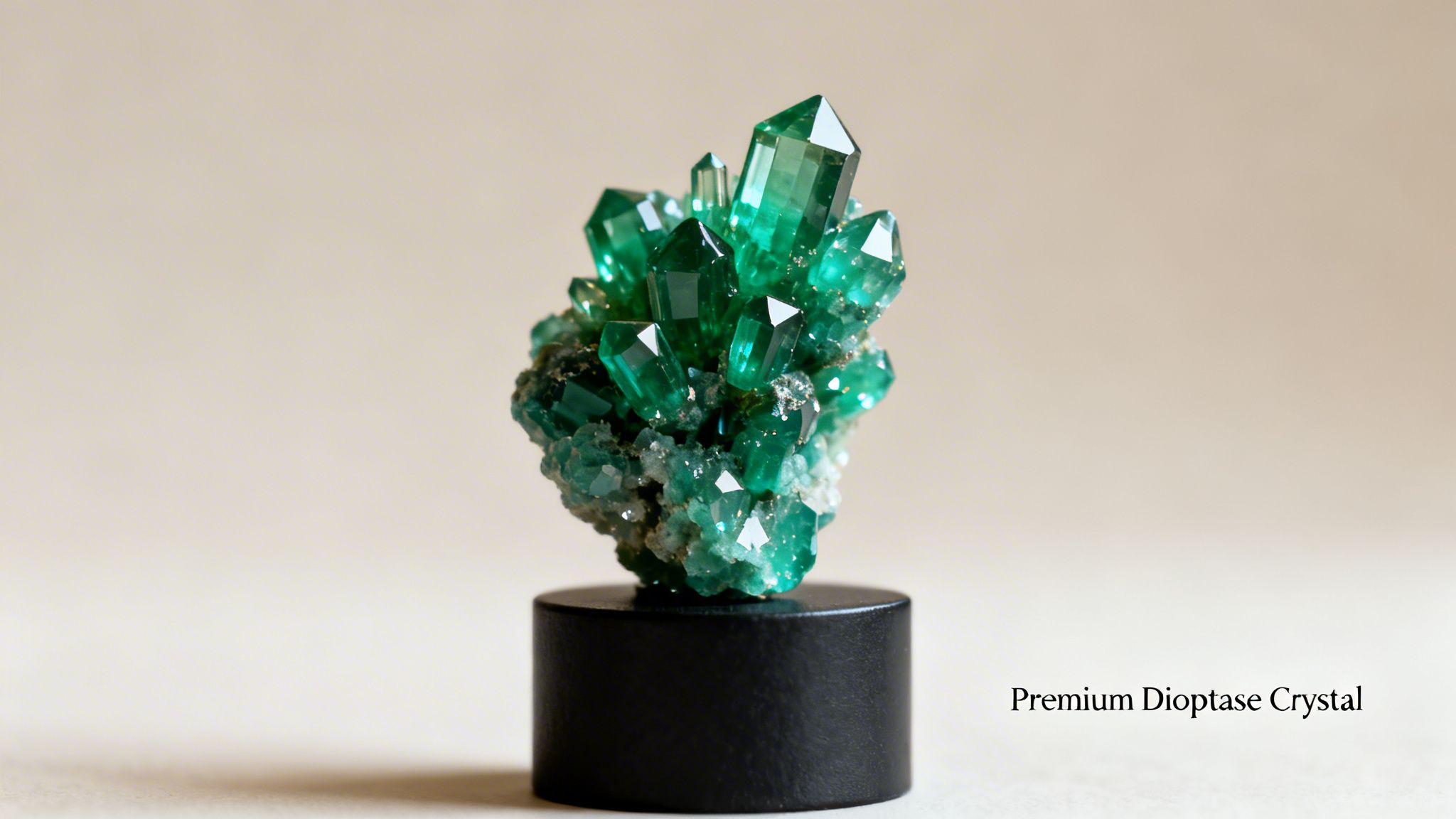
Dioptase possesses an intense, emerald-green color that rivals the finest gemstones. However, its true value extends beyond stunning aesthetics. Dioptase is a top-tier collectible asset, defined by extreme rarity and appreciating market value. This is far more than a beautiful mineral; it is a tangible, investment-grade asset.
Why Dioptase Is a Premier Collectible Asset
Dioptase occupies an elite position in the world of mineral collecting. Its astonishing color, a direct result of its copper content, commands immediate attention. Unlike more common green minerals, however, investment-grade dioptase is exceptionally scarce. This rarity transforms it from a geological curiosity into a significant asset with long-term potential. Indeed, the fine mineral market operates much like the markets for fine art or luxury watches, where rarity and quality drive value.
To understand dioptase, one must look beyond its physical properties. Market dynamics ultimately dictate its price. The story of dioptase is a classic example of finite supply meeting ever-growing demand from discerning collectors. This lesson is essential for anyone looking to start a collection of rare rocks and minerals, moving past simple identification and toward intelligent acquisition.
Scarcity as a Primary Value Driver
The core of dioptase's value is its limited availability. High-quality specimens with deep color and sharp, well-formed crystals originate from only a handful of locations. Moreover, many historically important sources are now depleted, placing a firm cap on the supply of top-tier material. This creates a textbook economic scenario where existing specimens become progressively more valuable over time.
Dioptase is a clear example of how geological rarity translates directly into market value. As new discoveries of fine material become less frequent, legacy specimens from famed localities like Tsumeb, Namibia, are elevated to the status of irreplaceable natural treasures.
Additionally, the conditions required for dioptase formation are highly specific. The mineral forms only in the oxidized zones of copper sulfide deposits. This geological constraint means that large, gem-quality crystals are exceptionally uncommon. In fact, any dioptase crystal that grows beyond 1/2 mm is already considered highly collectible.
Understanding Investment-Grade Quality
Not all dioptase specimens are created equal. The market draws a sharp distinction between standard pieces and investment-grade treasures based on several key factors. These details separate a decorative stone from a serious asset.
Crystal Size and Definition: Larger, sharply defined crystals are exponentially more valuable. A cluster of crisp, distinct points will always command a higher price than a muddled group.
Color and Transparency: The most coveted specimens show a vibrant, saturated emerald green with high transparency. Light should play through the stone.
Matrix Association: Dioptase on a contrasting matrix, such as brilliant white calcite, creates a stunning natural sculpture. This aesthetic appeal dramatically enhances its price.
Condition: Like any collectible, condition is paramount. Specimens with minimal damage and complete, unbroken crystal terminations will always command the highest values.
A special formation known as "grape dioptase," which consists of botryoidal or globular aggregates, is particularly rare and fiercely sought after. At Astro West, our expertise is built on identifying specimens that meet these stringent criteria. Our direct relationships with miners and global suppliers ensure every piece has the authenticity and quality necessary for a premier collection.
The Geological Rarity and Provenance of Dioptase
The staggering value of a top-tier dioptase crystal comes down to one simple fact: it is a geological miracle. This mineral does not form just anywhere. It is the result of a precise sequence of events that has occurred in only a few places on Earth.
For dioptase to form, a specific recipe is required. First, a massive copper deposit must be present. Then, over immense time, silica-rich groundwater must slowly trickle through the weathered, oxygen-rich upper layers of that deposit. This delicate dance between copper, silica, and oxygen coaxes the vibrant green crystals into existence.
Because this formation process is so uncommon, the world's supply of fine dioptase has always been extremely limited. High-quality material is scarce and increasingly difficult to source. As a result of historical mines closing, the available pool of premier specimens is now effectively capped, turning every great piece into a finite, irreplaceable treasure.
The World's Premier Dioptase Localities
A specimen's origin, or provenance, is as critical to its value as a signature on a master painting. Certain mines have become legendary for producing dioptase of a particular character and quality. A crystal’s documented history can therefore dramatically boost its desirability and price.
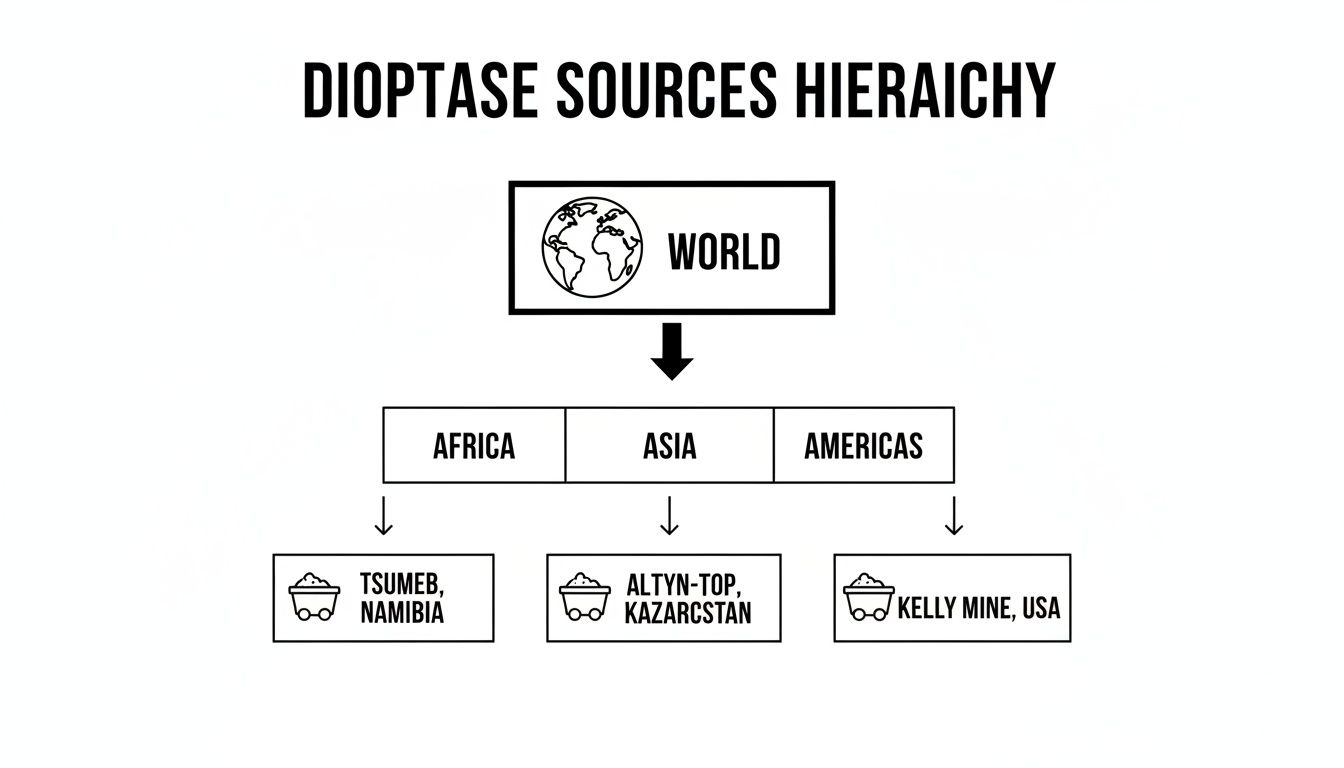
The handful of locations that have produced world-class dioptase are a who's who of famous mineral localities. For example, Namibia's Tsumeb Mine is perhaps the most famous, having produced incredible dioptase for nearly a century, often on a calcite matrix. Tsumeb specimens truly set the standard for crystal quality and are fiercely sought-after today. Elsewhere in Africa, the Democratic Republic of Congo's deposits produced stunningly bright, gemmy crystals, while Namibia's Kaokoveld Plateau is known for dioptase on shattuckite.
The closure of the Tsumeb Mine in 1996 was a landmark event for the mineral market. It instantly transformed every existing Tsumeb dioptase specimen from a collectible into a finite historical artifact, causing a notable appreciation in value that continues today.
This principle of provenance is not unique to dioptase. Collectors recognize the signature traits of specimens from specific regions, as seen with other copper minerals. Our guide on Malachite in Azurite, for instance, shows how origin shapes both aesthetics and price.
Why Supply is Diminishing
The challenge of sourcing high-quality dioptase is only intensifying. Many of the most famous 20th-century mines are now exhausted and permanently sealed. As a result, the market depends on the recirculation of old collections and rare, unpredictable new finds from lesser-known deposits.
This dwindling supply directly and powerfully affects the market. As demand from collectors, investors, and museums continues to grow, the price for superior-grade specimens consistently climbs. The market treats these premier crystals just like any other rare, tangible asset class whose supply is fixed. For example, the extreme rarity of "grape dioptase," a botryoidal form, proves this point. Its unique globular structure makes it one of the most coveted variations of all.
A Collector's Guide to Valuing Dioptase
Valuing a dioptase specimen is similar to appraising a fine emerald. Two pieces of the exact same weight can have wildly different price tags. The difference comes down to a specific set of qualities that separate a decorative green rock from a true, investment-grade treasure.
Learning to see these differences empowers a collector. It requires moving beyond simple admiration of the color and learning to decode the stone's story. This story is told through its crystal size, clarity, and relationship with its host rock.
The Core Pillars of Dioptase Valuation
The price of a dioptase specimen is not random. It is a direct reflection of its rarity and aesthetic power. A sophisticated collector learns to assess a few key factors to understand a specimen's real market position.
For example, a piece with large, but cloudy and dull crystals might be less valuable than a specimen covered in smaller, yet perfectly clear and glassy crystals. It’s this interplay of qualities that creates an exceptional, top-tier piece. Understanding that hierarchy is everything.
As you can see, the world-class dioptase that commands the highest prices comes from only a handful of mines. This extreme geographical rarity is one of the biggest drivers of the mineral's high market value.
From Collectible to Investment Grade
In the world of dioptase, size matters significantly. While even microscopic crystals can be beautiful, the market places a huge premium on well-formed, visible crystals. In fact, any sharp dioptase crystal over just 1/2 mm is already considered a worthy collectible.
However, when crystals reach a centimeter or more in length, their value increases exponentially. Large, sharp, and undamaged crystals are geological miracles. These are the specimens coveted by museums and top-tier collectors, pushing them into a completely different market category.
The biggest leaps in value occur when world-class crystal size meets exceptional color and clarity. A large, gem-quality dioptase crystal on a clean, contrasting white calcite matrix is the absolute pinnacle—a true natural masterpiece.
One of the most sought-after forms is what collectors call “grape dioptase.” This is a botryoidal habit where the mineral grows in globular, grape-like clusters. It is exceptionally scarce and often fetches prices far beyond what standard crystalline specimens of the same weight would.
Judging Quality: A Collector's Tiers
To understand how these factors stack up, it helps to use a clear framework. When evaluating a dioptase specimen, you are essentially determining which tier it belongs to. The following table breaks down the different quality grades you will encounter.
Dioptase Valuation Tiers
Valuation Tier
Crystal Size & Formation
Color & Transparency
Matrix & Aesthetics
Market Focus
Investment Grade
Large (>1 cm), sharp, undamaged crystals. Often in dramatic clusters.
Top-tier, deep "emerald" green. Flawless transparency (gemmy).
Pristine, high-contrast matrix (e.g., white calcite) that enhances the crystals.
High-end collectors, museums, and investors.
Collector Grade
Distinct crystals (2-10 mm). Well-formed, with minor imperfections.
Good, saturated green color with some to good transparency.
Aesthetically pleasing matrix that complements the dioptase.
Serious collectors and mineral enthusiasts.
Entry-Level
Micro-crystals or "druse". Individual crystals are tiny or indistinct.
Paler or less saturated green. Opaque to translucent.
Minimal or unattractive matrix. The focus is on the mineral itself.
Novice collectors, decorative use, and educational purposes.
Ultimately, a specimen's grade is determined by its weakest attribute. Even a piece with giant crystals will be held back by muddy color or a messy matrix. Finding a piece that excels across all these metrics is the true goal. Learning more about what makes certain minerals valuable can provide broader context; for instance, our article on rocks that are valuable offers additional market insights.
Market Dynamics and Long-Term Value
When viewed through an investor's lens, dioptase behaves much like fine art or a vintage timepiece. This market is not driven by speculation. It is governed by timeless principles of scarcity, historical importance, and a passionate collector base. High-quality dioptase has a documented history of appreciation, making it a powerful tangible asset.
The story begins with its finite supply. Exceptional dioptase has always been rare, found in only a few global localities. The market fundamentally changed when legendary mines, especially the iconic Tsumeb Mine in Namibia, closed permanently. That event capped the supply of new, world-class material, instantly turning existing specimens into historical artifacts.
As a result, any top-tier Tsumeb dioptase on the market today is a legacy piece. Auction records and private sales show a steady, undeniable climb in their prices. This is the same pattern seen when a famous artist passes away or a luxury watchmaker discontinues a model. The existing works become irreplaceable, and their value appreciates accordingly.
Collector Behavior and Museum Acquisitions
On the other side of the equation, demand for dioptase only reinforces its value. Discerning collectors and major institutions acquire a piece of natural history, not just a beautiful green stone. This demand is not a fleeting trend. It is rooted in a genuine appreciation for unparalleled rarity and aesthetic perfection.
Museums play a huge role in cementing this market value. When an institution like the Smithsonian acquires a major dioptase, it acts as a powerful stamp of approval. More importantly, it permanently removes that premier piece from private circulation. This tightens the available supply for collectors and pushes up the value of comparable specimens.
High-quality dioptase is increasingly difficult to source. The easy-to-reach deposits were exhausted decades ago, and new finds of significant quality are exceptionally rare. This growing scarcity is the primary engine behind its consistent appreciation in value.
In this market, quality is everything. A small, flawless specimen from a famous location will almost always outperform a larger, imperfect piece from an unknown source. The smartest collectors therefore focus on assets that combine the best traits, knowing these are the pieces that will deliver the strongest long-term performance.
Buying Authentic Dioptase with Confidence
Adding a top-tier dioptase to a collection is a major milestone. This decision goes beyond spotting a beautiful stone; it means committing to a piece of natural art with verified authenticity. For this reason, partnering with a gallery that specializes in fine minerals is critical.
Astro West acts as your personal curator, guiding you to specimens with proven integrity. Our direct lines to miners, field collectors, and global experts give us access to authentic material. We ensure every single piece has a traceable history.
Verifying Authenticity and Provenance
In the world of fine minerals, provenance is everything. A specimen's documented origin is as crucial to its value as the ownership history of a famous painting. For every investment-grade dioptase we offer, we provide detailed locality information. This documentation guarantees its history and cements its value as a tangible asset.
Authenticity, however, is more than just a label. It requires a trained eye to confirm a specimen’s crystal structure, color, and associated minerals match its claimed origin. A seasoned expert, for instance, can recognize the signature look of a Tsumeb dioptase, separating it from material found elsewhere. This rigorous verification process is the foundation for building a confident collection. It turns a purchase into a secure investment, as seen in our guide on where to buy meteorites.
How to Properly Care For and Display Your Dioptase
Dioptase is not only rare; it is also delicate. With a Mohs hardness of only 5, it demands careful handling and thoughtful display to protect its condition and value. A single scratch can dramatically reduce the worth of an otherwise perfect specimen.
A specimen's value is intrinsically linked to its preservation. Proper care is not just maintenance; it is an active strategy for protecting your investment for generations.
This relative softness is precisely why dioptase is not a mainstream gemstone. When first identified in 1793 from Kazakhstan, it was mistaken for emerald. Its lower hardness kept it out of jewelry but solidified its legendary status among elite mineral collectors. To protect your investment, follow these essential guidelines:
Handling: Always hold a specimen by its matrix (the host rock), never by the fragile crystals. Oils from your skin can dull their brilliant luster over time.
Cleaning: Never use ultrasonic cleaners or harsh chemicals. The safest way to remove dust is with a gentle puff of compressed air.
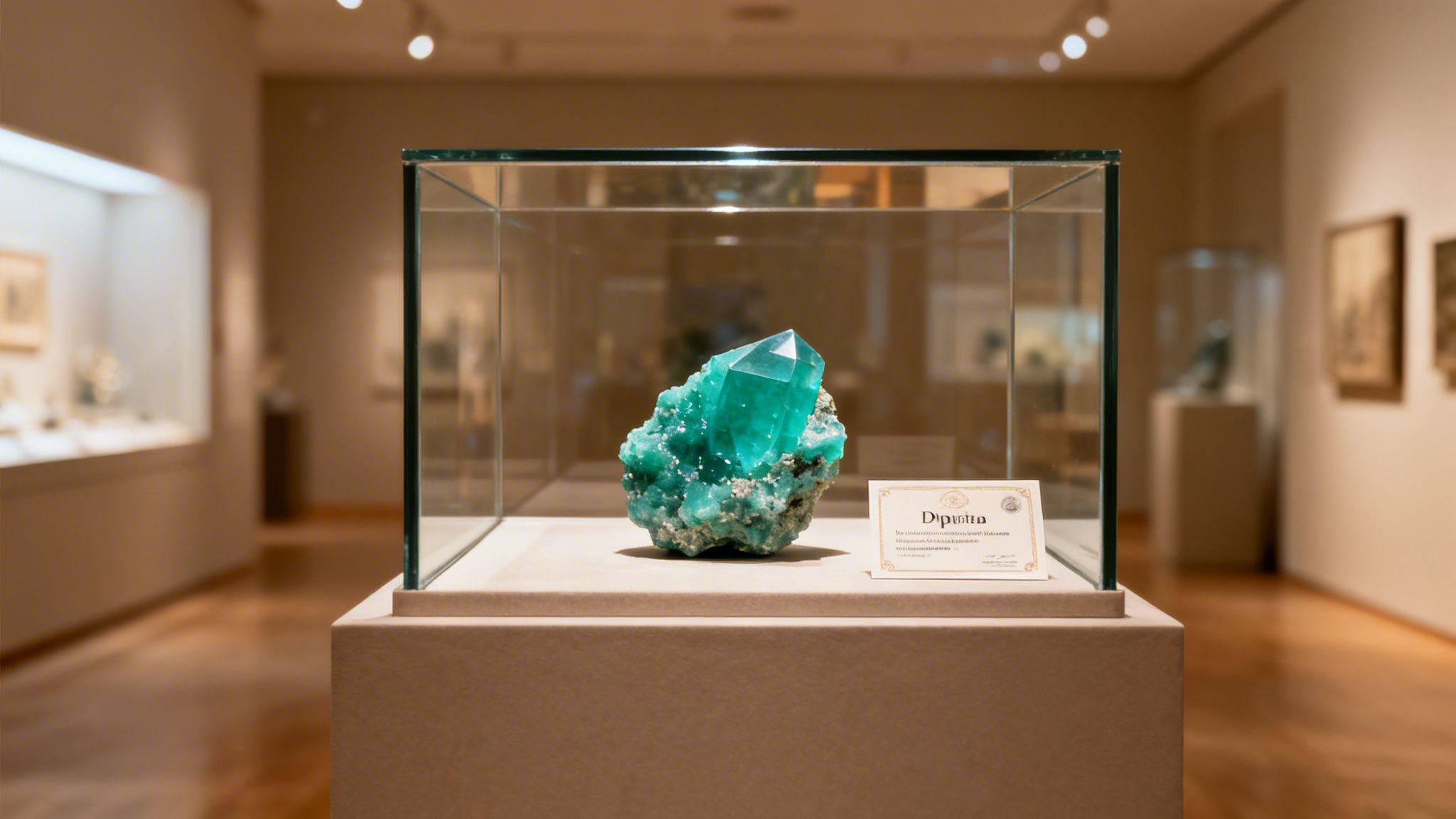
Display: Keep your dioptase out of direct sunlight, as prolonged exposure can cause its magnificent green color to fade. A closed display case offers the best protection from dust and accidents.
By following these simple rules, you ensure your dioptase will remain a pristine centerpiece in your collection. This commitment to preservation is the final, crucial step in securing its lasting value.
Common Questions About Investing in Dioptase
It is natural to have questions when considering a mineral as exceptional as dioptase. You are not just looking at a beautiful stone; you are considering an investment in natural art. This is the practical advice you would receive from a seasoned collector.
Let's tackle some of the most common questions we hear. We provide clear, straightforward answers to help you feel confident about your acquisition.
Why Is Dioptase So Expensive Compared to Other Green Minerals?
The high price of dioptase comes down to two factors: extreme rarity and breathtaking beauty. Unlike common green minerals like malachite, gem-quality dioptase forms only under very specific geological conditions. These natural perfect storms are found in just a handful of places, severely limiting its supply.
Moreover, the closure of legendary mines like Tsumeb in Namibia has made top-tier material even scarcer. That event increased the value of existing specimens almost overnight. Its price reflects its status as a finite natural treasure, making it a true collector's asset.
Can Dioptase Be Used in Jewelry?
You will almost never see dioptase in jewelry, and for good reason. It has a Mohs hardness of only 5, making it very soft and easy to scratch with daily wear. Additionally, its perfect cleavage means it can split cleanly if struck.
For these reasons, dioptase is treasured almost exclusively as a mineral specimen for display. Its true home is safe in a curated collection where its delicate beauty can be preserved for the long term.
How Do I Verify a Dioptase Specimen Is Authentic?
Authenticity is paramount when investing in fine minerals. Your most important step is to buy from a reputable gallery like Astro West that guarantees provenance and provides detailed locality information. This documentation is your best line of defense and a huge part of the specimen's long-term value.
Visually, high-quality dioptase is unmistakable. Look for vibrant, electric emerald-green color, excellent transparency, and sharp, well-formed crystals. The best pieces often have minimal damage and sit on a contrasting matrix, which makes the green crystals pop. We meticulously examine every dioptase we acquire, ensuring it meets our high standards for authenticity and collector-grade quality.
A trusted gallery does more than just sell minerals; it provides verification and stands behind every specimen's history. This assurance is the cornerstone of a confident and valuable acquisition.
Does Dioptase Increase in Value Over Time?
Yes, high-quality dioptase has a strong and well-documented track record of appreciating in value. This upward trend is driven by a simple economic formula: rising demand and a shrinking supply. The finest specimens are becoming harder to find.
As major historical sources like Tsumeb have been depleted, the best specimens have effectively become "heritage" pieces. Their value is consistently backed by auction records and private sales. This history makes an investment in a top-grade dioptase a proven store of value in a tangible, beautiful asset.
At Astro West, we provide the expertise and access necessary to acquire authentic, investment-grade minerals with complete confidence. Explore our curated collection of dioptase and other natural treasures at https://astrowest.com.