Chrysocolla in Quartz The Definitive Gemstone Guide
At its heart, chrysocolla in quartz is a stunning natural partnership. It's what happens when vibrant, soft chrysocolla gets encased and protected by durable, clear quartz.
Think of it like a delicate flower perfectly preserved in crystal-clear resin. The quartz acts as a natural shield for the fragile blue-green mineral inside, transforming it into a gemstone that's actually hard enough to be worn in jewelry. This unique fusion is precisely what makes it so prized by collectors and designers.
The Beautiful Alliance of Two Minerals
The world of gemstones is filled with fascinating combinations, but few are as visually striking—or as geologically significant—as chrysocolla in quartz. This material, often called gem silica, isn’t a single mineral. It's a composite stone, a perfect example of nature creating something far greater than the sum of its parts.
To really get it, you have to imagine chrysocolla on its own. It’s a gorgeous hydrous copper silicate known for its vivid, turquoise-like colors that can range from a soft sky blue to a deep, moody teal. The problem? It's incredibly soft, ranking only 2.5 to 3.5 on the Mohs hardness scale. This makes pure chrysocolla far too fragile for most jewelry; it would scratch or crumble with the slightest knock.
How Quartz Elevates Chrysocolla
This is where quartz makes its grand entrance. During the stone's formation, silica-rich fluids seeped into the porous chrysocolla. This process, known as silicification, filled in all the tiny gaps and enveloped the colorful mineral in a hard, protective layer of microcrystalline quartz (also called chalcedony).
The result is a dramatic transformation:
Enhanced Durability: The quartz matrix skyrockets the gemstone's hardness to nearly 7 on the Mohs scale. Suddenly, it’s tough enough for rings, pendants, and other pieces meant for everyday wear.
Increased Luster: The quartz lends the stone a beautiful vitreous (glass-like) luster and often a glowing translucency that pure chrysocolla could never have.
Amplified Beauty: The clear or translucent quartz acts like a natural magnifying glass, intensifying and enriching the chrysocolla's internal color and patterns.
This rare geological event is what elevates a common copper mineral into a top-tier gemstone. The perfect balance of color from the chrysocolla and fortification from the quartz creates the coveted material known as gem silica.
This protective quality isn't unique to just chrysocolla; it's similar to how quartz can form around other minerals, creating stable and beautiful specimens. For anyone curious about how this host mineral works its magic, our collector's guide to quartz crystal clusters is a great place to start.
To help visualize this incredible upgrade, here’s a quick breakdown of the key differences between the two materials.
Chrysocolla vs. Chrysocolla in Quartz: Key Differences
Property
Pure Chrysocolla
Chrysocolla in Quartz (Gem Silica)
Hardness (Mohs)
2.5 – 3.5 (very soft, like a fingernail)
~7 (hard and durable, like quartz)
Use in Jewelry
Limited to protected settings; very fragile
Excellent for all types of jewelry
Luster
Dull to earthy
Vitreous (glassy) and often translucent
Value
Relatively low, sold as collector specimens
High to very high, prized as a gemstone
Structure
Porous and often crumbly
Solid, stable, and non-porous
As you can see, the addition of quartz completely changes the game.
Essentially, chrysocolla provides the soul—the breathtaking color—while quartz provides the body—the structure, durability, and shine. This geological marriage is what allows us to wear and admire a mineral that would otherwise be confined to collector cabinets. The synergy between them is truly remarkable.
The Geological Journey of Gem Silica
The creation of gem silica, or what we call chrysocolla in quartz, is a story of incredible geological luck. It’s a remarkable two-act play that unfolds deep within the Earth, demanding a precise sequence of events to turn a common copper mineral into a highly sought-after gemstone. This isn't a quick or guaranteed process; it’s a natural alchemy that happens only under the most specific circumstances.
The whole journey starts in a copper ore deposit. Over immense timescales, mineral-rich groundwater begins to trickle through the cracks and pockets in the host rock. As this water mingles with the copper ore, a chemical reaction kicks off, forming an entirely new, secondary mineral: chrysocolla.
Act One: The Birth of Chrysocolla
In this first stage, the newly formed chrysocolla is soft, porous, and honestly, pretty delicate. It grows in botryoidal (grape-like) clusters or as faint veins lining the rock, showing off its classic blue-green colors. While beautiful, this early-stage chrysocolla is extremely fragile, with a hardness of only 2.5 to 3.5 on the Mohs scale. It's far too soft for jewelry or any other durable use.
For this mineral to become the gem we know and love, something else has to happen. The environment must change, introducing a new player to the game.
Act Two: The Silicification Event
The second act is where the real magic happens. This stage, known as silicification, occurs when silica-rich fluids start flowing through the exact same channels where the chrysocolla has already formed. Imagine liquid glass slowly seeping into every nook and cranny of a delicate sponge.
This super-saturated silica solution—basically microscopic quartz particles suspended in water—permeates every tiny pore of the soft chrysocolla. Over eons, this silica hardens and crystallizes into chalcedony, a microcrystalline form of quartz. This process does two critical things: it wraps the fragile chrysocolla in a hard, protective shell and fills it from the inside out, creating a solid, stable, and absolutely stunning gemstone.
The perfect timing of this two-step process is what makes gem silica so incredibly rare. If the silica fluids arrive too early, the chrysocolla won't have formed. If they arrive too late, the chrysocolla may have already eroded away.
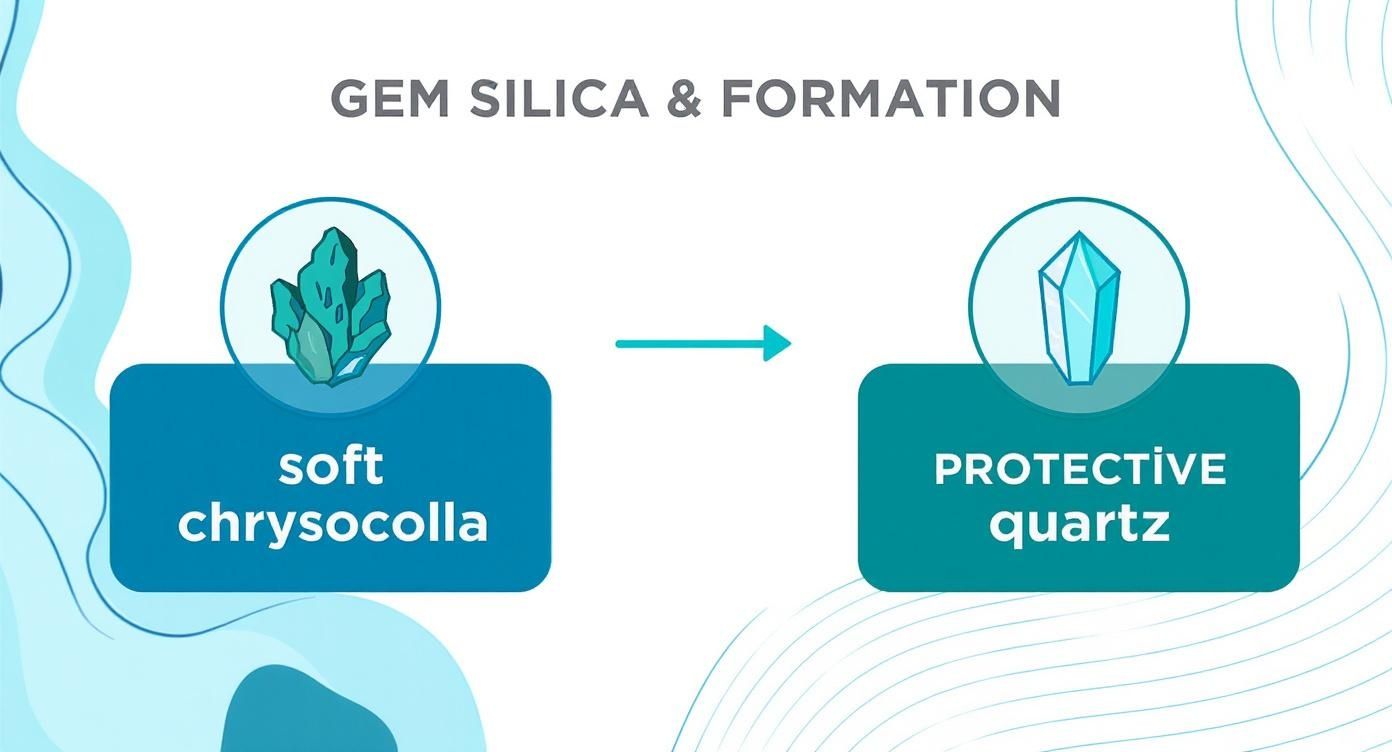
The following infographic breaks down this essential two-stage journey from a soft mineral to a durable gemstone.
As you can see, the infusion of quartz is the key step that transforms the material from a fragile deposit into a gem-quality treasure.
This precise and rare geological sequence is why gem silica is only found in a handful of locations worldwide, with notable deposits in Arizona, Peru, and Indonesia. The conditions have to be just right. This isn’t unlike other mineral inclusions in quartz, where specific environmental factors are needed to create unique specimens. For a different take on this phenomenon, you can explore how other minerals get trapped inside a quartz host in our detailed look at galena in quartz inclusions. The principles of one mineral hosting another are a fascinating part of geology.
Ultimately, every single piece of chrysocolla in quartz is a testament to a fleeting geological window of opportunity—a moment when conditions aligned perfectly to create something truly special.
How to Identify Genuine Gem Silica
Spotting real gem silica—the absolute best grade of chrysocolla in quartz—from clever fakes and other look-alike stones is a skill every serious collector needs to develop. Because it’s so rare and valuable, it’s a constant target for imitation. Luckily, once you know what to look for, you can learn to spot the real deal by focusing on a few key traits that gemologists use every day.
This guide will walk you through the primary identifiers, going beyond just looks to the properties that truly define this incredible gemstone. With a little practice, you can approach any potential specimen with confidence, ensuring you’re investing in authentic, high-quality material.
Analyzing Color and Translucency
The first thing that grabs your eye with gem silica is its color. Top-grade material flashes a vivid, almost electric blue-green that’s both intense and evenly spread throughout the stone. Unlike many other stones, the best pieces have a pure, saturated color without any muddy or gray undertones.
Just as important is its translucency. High-quality gem silica isn't opaque; it has a one-of-a-kind 'glow' as light enters the chalcedony. Imagine looking into a piece of luminous, colored Jell-O. This watery, glowing quality is a hallmark of superior material and is incredibly difficult for fakes to get right.
The Decisive Hardness Test
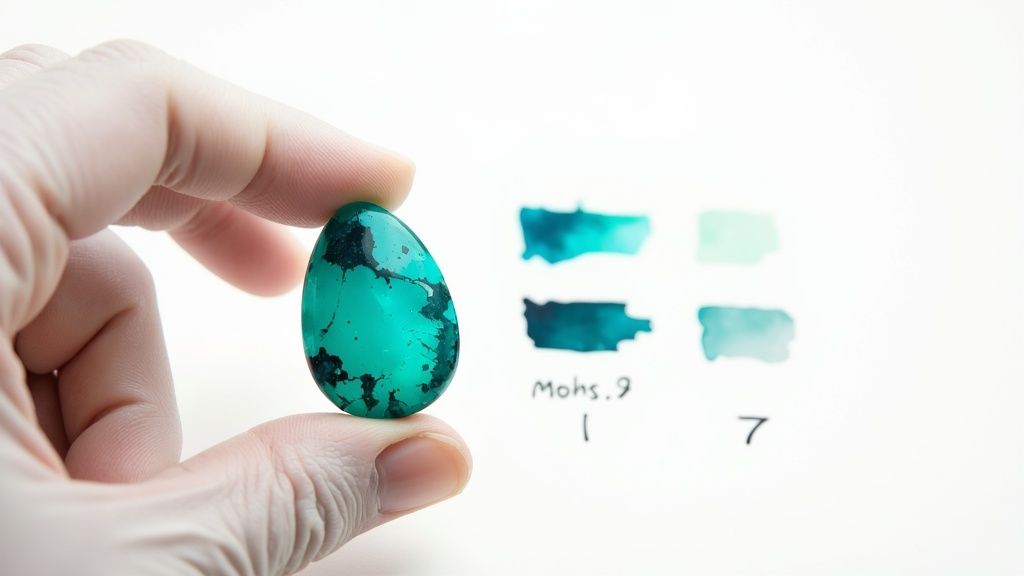
Hardness is one of the most reliable ways to confirm you're looking at genuine chrysocolla in quartz. As we've covered, pure chrysocolla is ridiculously soft, ranking only 2.5 to 3.5 on the Mohs scale. But when it becomes fully saturated with silica, its hardness skyrockets to nearly 7, putting it right up there with solid quartz.
This is a game-changing difference. Many look-alikes or lower-grade pieces are really just chrysocolla with a tiny bit of quartz mixed in, so they scratch easily. A simple scratch test (done carefully on a spot that won't be seen) can instantly separate durable gem silica from its softer, less valuable cousins. This is a fundamental skill in mineral analysis, and you can explore these techniques further in a good crystal identification guide.
Spotting Common Simulants and Look-Alikes
The high price tag on gem silica means the market is flooded with stones trying to pass for it. Being able to spot these simulants is a must for any smart buyer.
The most convincing fakes often involve dyed chalcedony, where a porous, light-colored stone is infused with a blue-green dye to imitate gem silica's prized color. While these can look good initially, the color often appears too uniform and lacks the subtle, natural variations of real chrysocolla.
Here’s a quick rundown of how to tell gem silica apart from its most common impersonators:
Dyed Chalcedony: Under magnification, look for dye that has pooled in tiny cracks or pits. The color might also look unnaturally vibrant or "painted on" compared to the deep, in-body color of true gem silica.
Turquoise: While the color can be similar, turquoise is almost always opaque and has a waxy luster. Gem silica, on the other hand, is translucent with a vitreous (glassy) shine. It's also typically harder than turquoise, which usually sits between 5 and 6 on the Mohs scale.
Variscite: This mineral often leans more toward green and has a chalky or porcelain-like look, completely missing that signature glowing translucency of top-tier gem silica.
By combining these visual cues with a simple hardness test, you can confidently identify true chrysocolla in quartz and avoid the disappointment of a costly mistake.
Grading and Valuing Chrysocolla in Quartz
Figuring out the value of chrysocolla in quartz, or gem silica, is a nuanced art. For collectors and buyers, understanding what makes one stone worth more than another is the key to appreciating both its price and its rarity. It's why two pieces that look similar at first glance can have wildly different price tags.
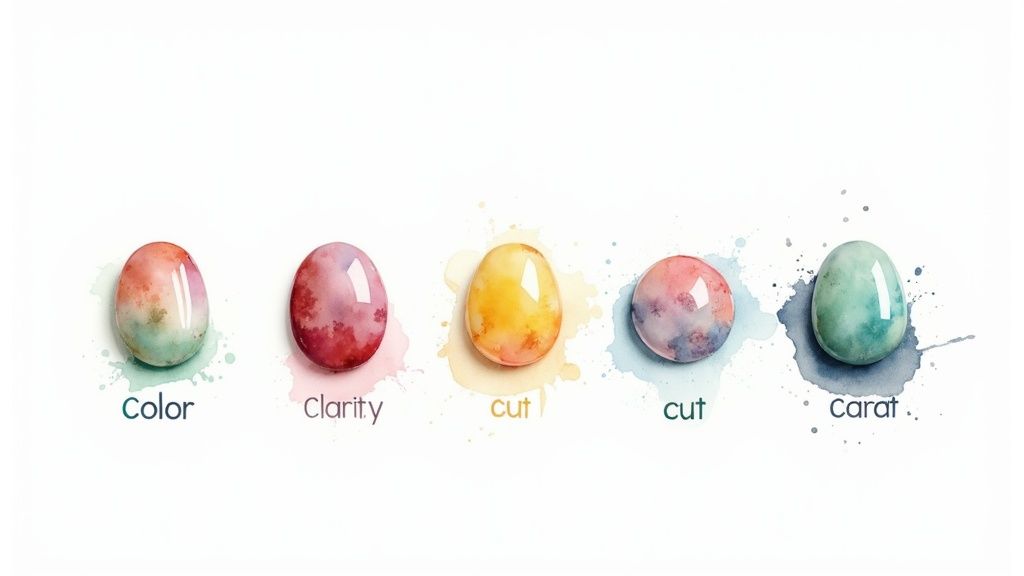
We can break it down using a system inspired by the classic "Four Cs" of diamond grading: Color, Clarity, Cut, and Carat Weight. This framework makes it much easier to see what defines a truly top-tier specimen.
Color: The Most Critical Factor
When it comes to gem silica, color is king. It's the single most important element in determining a stone's value, hands down.
The absolute pinnacle of quality is a pure, intensely saturated blue-green—a color often described as "electric" or "neon" turquoise. This is what collectors dream of. The color should be even and consistent throughout the stone, with no splotches or dull areas to break up the visual flow.
While all shades have their own beauty, the market pays a massive premium for that specific, vibrant blue. Stones that are too green, pale, or grayish will always be less valuable. The ultimate prize is a piece with color so rich it seems to glow from the inside out.
Clarity and Translucency
Clarity in gem silica isn't about being see-through like a diamond. Instead, it’s all about the degree of translucency and the absence of distracting imperfections. The best pieces have a unique, almost gelatinous or "watery" look that lets light penetrate deep inside, creating an incredible internal glow.
Several things can detract from a stone’s clarity and drag down its value:
Opaqueness: Stones that are totally opaque just don't have that luminous depth that collectors are after.
Inclusions: Any visible dark spots, bits of rock matrix, or other mineral specks will disrupt the pure color and lower the price.
Fractures: Internal cracks or fissures that reach the surface are major red flags, as they compromise both the stone's beauty and its structural integrity.
A top-quality chrysocolla in quartz will appear clean to the naked eye, with a smooth, uniform texture and that signature luminous, semi-transparent appearance. This visual purity is a direct indicator of its value.
To make sense of these factors, here’s a quick breakdown of how gem silica is graded.
Gem Silica Quality Grading Factors
Grading Factor
Low Quality
Medium Quality
Top Gem Quality
Color
Pale, grayish, or overly greenish hue. Uneven color distribution.
Decent blue-green color, but lacks intense saturation. May have minor blotches.
Opaque with no light penetration. Numerous visible inclusions or fractures.
Semi-translucent with a slight glow. Some minor, non-distracting inclusions.
Highly translucent with a strong internal glow. Eye-clean with no visible flaws.
Cut
Poorly shaped, asymmetrical, or with a dull, uneven polish.
Decent shape and polish, but may lack perfect symmetry or luster.
Excellent symmetry, a flawless high-gloss polish, and a well-proportioned cabochon.
Overall Appeal
Looks dull, "rocky," and lacks visual depth.
A pretty stone, but doesn't have the "wow" factor of top-tier material.
Appears to glow from within. A vibrant, clean, and expertly finished gemstone.
This table helps illustrate why the finest gem silica is so rare—it has to hit the mark on every single one of these points.
Cut and Carat Weight
The way a stone is shaped is also a huge part of its final value. Lapidaries almost always cut chrysocolla in quartz into cabochons—those smooth, domed shapes with a flat back. This cut is perfect for minimizing waste while maximizing the stone’s color and glow. A well-proportioned cut with a perfect polish is critical; it’s what brings the gem’s natural beauty to life.
Finally, there’s carat weight. Just like with any other gem, bigger is often more expensive. But with gem silica, quality almost always beats size. A small, one-carat stone with jaw-dropping color and clarity can easily be worth more than a clunky, 20-carat piece that's opaque and has a muddy color.
The holy grail for collectors is finding that rare combination of large size and top-tier quality. Those pieces are exceptionally rare and can command prices reaching thousands of dollars per carat. This interplay between beauty and resilience is a key thing to think about when choosing the best gemstones for jewelry, as you need both for a piece that will last.
Caring for Your Gem Silica Jewelry
Having a piece of chrysocolla in quartz jewelry is a real joy, and with just a little care, its incredible beauty will easily last for generations. The good news? Its quartz host gives it a hardness of around 7 on the Mohs scale, making it plenty durable for regular wear.
Still, like any fine gemstone, it needs mindful handling to keep its vibrant color and structural integrity intact. The most important rule is to be gentle. Your gem silica doesn't need aggressive scrubbing or harsh treatments—a few simple habits are all it takes.
The Right Way to Clean Gem Silica
When your jewelry needs a little refresh, always stick to the simplest and safest method. Forget about complex cleaning tools or chemicals; they can do more harm than good, potentially scratching the stone's surface or even causing internal fractures.
Here’s the only cleaning process you'll ever need:
Prepare a Gentle Solution: Grab a small bowl, fill it with lukewarm water, and add a few drops of a mild dish soap. Avoid hot water, as sudden temperature swings can stress the stone.
Soak Briefly: Let your jewelry sit in the soapy water for just a few minutes. This is usually enough to loosen any dirt, dust, or oils that have built up.
Use a Soft Brush: With a very soft brush—an old toothbrush with soft bristles is perfect—gently scrub the gemstone. Pay a little extra attention to the nooks and crannies around the setting where dirt loves to hide.
Rinse Thoroughly: Hold the piece under clean, lukewarm running water until all the soap residue is gone.
Pat Dry: Use a soft, lint-free cloth to gently pat the jewelry dry.
That's it. This simple routine is more than enough to keep your chrysocolla in quartz sparkling without risking any damage to its delicate internal structure.
The most critical takeaway here is what not to use. Never, ever expose your gem silica to harsh chemicals like bleach or ammonia. You also have to steer clear of mechanical cleaners. Both ultrasonic and steam cleaners can cause microscopic fractures to form or expand, leading to irreversible damage.
Smart Storage and Wearing Habits
How you store your jewelry is just as important as how you clean it. The biggest threat is getting scratched, especially by harder gemstones. A diamond, sapphire, or ruby can easily mar the surface of your gem silica if they knock against each other in a jewelry box.
To prevent this, just store your piece separately. A soft fabric pouch or a dedicated compartment in a lined jewelry box is the perfect solution. It's a simple step that prevents accidental damage and keeps that beautiful polish pristine.
Finally, make it a habit to put your jewelry on after you've applied any cosmetics, hairspray, or perfume. The chemicals in these products can build up over time and dull the stone's surface, so making your jewelry the last thing you put on is a great way to protect it.
Common Questions About Chrysocolla in Quartz
Even with a good grasp of the geology and care, some questions always pop up when people get fascinated by chrysocolla in quartz. It’s an unusual gem, and its rarity and unique beauty naturally spark a lot of curiosity. Let's clear up some of the most common points of confusion.
Think of this as the final chat you'd have with a seasoned gem expert, tying up the loose ends. We'll tackle the common mix-ups with other stones, explore what this gem means to people beyond its science, and really nail down why it holds such a special place in the mineral world.
Is Chrysocolla in Quartz the Same as Turquoise?
This is probably the most frequent question I get. It's an easy mistake to make, especially for a new collector. While chrysocolla in quartz can share that beautiful blue-green color with turquoise, they are completely different minerals from the ground up—chemically, structurally, the whole nine yards.
So, no, they are fundamentally distinct. Turquoise is a hydrated phosphate of copper and aluminum. Chrysocolla in quartz, on the other hand, is a copper silicate that got a serious upgrade when it was infused with microcrystalline quartz. This completely different recipe results in very different physical properties, which is how you tell them apart.
The biggest giveaway is hardness. Thanks to its quartz host, top-grade gem silica is tough, clocking in at around a 7 on the Mohs scale. Turquoise is much softer, usually landing between 5 and 6. That difference makes gem silica far more durable and suitable for everyday jewelry.
Visually, here are the subtle clues to look for:
Luster and Translucency: Turquoise is almost always opaque and has a waxy or even dull look. High-quality chrysocolla in quartz is prized for its watery translucence and glassy (vitreous) shine, which gives it a captivating internal "glow."
Color Purity: The very best gem silica displays an intense, almost electric blue that you just don't see in turquoise. While both are beautiful, the color of top-tier gem silica is often described as purer and more vivid.
Look for that signature glow and remember its superior hardness, and you’ll have no trouble telling true gem silica from its famous look-alike.
What Are the Metaphysical Properties of Gem Silica?
Beyond its geological origins, chrysocolla in quartz is a big deal in the world of crystal healing. It's seen as a powerful combination stone, blending the unique energies of its two parts to create something greater. Practitioners believe this fusion makes it a potent tool for emotional and spiritual health.
Chrysocolla on its own is known as a stone of communication, calm, and empowerment. It’s closely tied to the throat and heart chakras, believed to help you speak your mind clearly, wash away negative energy, and find your inner balance. People often call it the "Teaching Stone" for its connection to wisdom.
Quartz, meanwhile, is considered the "master healer" of the crystal world. It's seen as an energy amplifier, able to absorb, store, and regulate energy. Its presence is thought to boost the properties of any stone it’s paired with.
When these two come together as gem silica, the quartz is believed to supercharge the calming and communicative vibes of the chrysocolla. The result is a gemstone seen as a channel for speaking one's truth with clarity, compassion, and confidence.
Its metaphysical attributes are often boiled down to:
Empowered Communication: Helping you articulate your inner wisdom and thoughts.
Emotional Soothing: Calming anxiety and easing emotional stress, especially during big life changes.
Spiritual Amplification: Magnifying your intentions and linking the heart and throat chakras for heartfelt expression.
For those who use crystals in their personal growth journey, chrysocolla in quartz represents a perfect harmony of gentle energy and powerful expression, making it a treasured stone for meditation and healing work.
Why Is High-Quality Gem Silica So Expensive?
The price tag on top-tier chrysocolla in quartz can be a real shocker, but it’s a direct result of its extreme rarity, stunning beauty, and relentless demand. This isn’t an arbitrary price; it’s a classic case of supply and demand where a tiny supply of phenomenal material meets a passionate market of collectors and designers.
The main reason for its cost is the geological lottery it takes to form. The sequence of events—a copper deposit forms, chrysocolla replaces it, and then silica-rich fluids perfectly infuse it at just the right time—is incredibly rare. Even when a deposit is found, the conditions have to be absolutely perfect to produce gem-grade material.
Within those rare finds, only a tiny sliver of the material, often less than 1%, hits the "holy trinity" of qualities that command top dollar:
Top Color: An intense, pure, and evenly saturated blue-green.
High Translucency: A glowing, watery look that lets light penetrate the stone.
Excellent Clarity: Free of distracting matrix, fractures, or dark spots.
This severe shortage of top-grade rough means very little ever makes it to the market. This trickle of supply is met with huge demand from high-end jewelers who adore its unique color and toughness, and from discerning mineral collectors chasing the finest examples of natural art. This intense competition for the best pieces naturally pushes prices into the same league as other precious gems, sometimes hitting thousands of dollars per carat.
Where Is the Best Gem Silica Found?
While chrysocolla deposits exist all over the world, only a handful of places have ever produced the legendary, top-quality gem silica that sets the bar for collectors. Where a specimen comes from can seriously impact its prestige and value, with certain mines achieving an almost mythical status.
Historically, the undisputed champion for the finest chrysocolla in quartz has been Arizona, USA. Two mines there are the stuff of legend:
The Inspiration Mine: Located in Gila County, this mine is famous for producing gem silica with color and translucency that are simply unmatched. Pieces from here are often the benchmark for quality.
The Ray Mine: Down in Pinal County, this mine also yielded extraordinary material celebrated for its vibrant, pure blue hues.
Although major production from these classic Arizona spots has dwindled, they remain the most revered sources. Today, Peru has stepped up as another key supplier of high-quality gem silica, with much of the new material on the market coming from its copper-rich mountains. Other notable, though less consistent, finds have been made in places like Indonesia, Mexico, and Taiwan.
For a seasoned collector, however, provenance is everything. A piece of gem silica with paperwork tracing it back to the Inspiration or Ray mines will almost always command a premium, thanks to its historical weight and the legendary quality tied to those names.
At Astro West, we take pride in sourcing exceptional minerals from around the globe, including beautiful and rare specimens of chrysocolla in quartz. Whether you are a seasoned collector searching for a piece from a classic locality or a new enthusiast captivated by its stunning color, we invite you to explore our carefully curated collection of natural treasures. Visit us online to discover a world of geological art, ethically sourced and expertly vetted for your collection.