Calcite: 2026 Collector’s Guide to Value, Rarity, and Provenance
Calcite is a foundational mineral, simultaneously common in nature and exceptionally rare in its finest forms. As the primary component of limestone and marble, it is a workhorse of global industry. For collectors and designers, however, its value lies in its spectacular diversity of crystal habits, colors, and optical properties that transform simple calcium carbonate into a collectible asset.
Calcite's Enduring Market Value
While calcite's industrial applications are vast, its economic footprint is immense. It is a critical ingredient in cement, steel production, and agriculture. This industrial demand establishes a stable foundational value for the mineral, ensuring it remains a globally sought-after commodity.
For collectors, however, the valuation story begins where industrial use ends. The factors that elevate a calcite specimen to a prized asset are entirely different from its raw material utility. Key value drivers include:
Exceptional Crystal Forms: Perfectly formed scalenohedral "dogtooth" crystals or glassy rhombohedrons command high prices. Complex and pristine structures are always desirable.
Optical Purity: Varieties like Iceland Spar are treasured for their powerful double refraction. This unique physical property adds significant historical and scientific value.
Rare Coloration: Trace elements introduce breathtaking colors. For example, the vibrant pinks of Manganoan calcite dramatically increase a specimen's rarity and market demand.
Size and Condition: Large, undamaged clusters with a brilliant luster are always in high demand. These pieces represent the pinnacle of natural formation and preservation.
A Global Economic Powerhouse
Industrial demand for calcite is staggering. The global market for coarse calcite reached $8.66 billion in 2024. Moreover, it is projected to climb to $11.56 billion by 2029, driven largely by infrastructure development in the Asia-Pacific region.
Beyond Industrial Use
This powerful industrial market provides a stable backdrop for the collector's market. Beyond geological significance, individual calcite varieties carry unique appeal. For example, metaphysical interest in Yellow Calcite's healing properties and benefits adds another layer to its market appeal.
Ultimately, a calcite specimen’s journey from a common mineral to a collectible is a story of transformation. It shifts from a bulk commodity to a singular object of natural artistry. At Astro West, we specialize in curating specimens that capture this transition, where geological perfection and aesthetic beauty create a lasting store of value.
Decoding Calcite Rarity and Specimen Value
While calcite is abundant, collector-quality specimens are not. The vast majority of calcite is industrial grade, valued for its chemical composition. For connoisseurs, however, valuation depends on specific qualities that transform a common mineral into a work of natural art.
A specimen's journey to high-value collectible status is defined by specific aesthetic and structural qualities. These attributes separate the mineral's two primary markets. This chart provides a clear visual breakdown of the split between industrial and collectible applications.
As shown, the path to collectible status is unrelated to industrial utility. Instead, it is determined by factors like crystal form, clarity, and color. These qualities are paramount to a collector but irrelevant to a cement manufacturer.
The Influence of Crystal Habit
The first quality that drives value is crystal habit—the characteristic external shape of a crystal. Calcite is remarkably versatile, known to form over 800 distinct crystal shapes. However, only a select few consistently command premium prices in the collector market.
Scalenohedral 'Dogtooth' Crystals: These sharp, pointed crystals are perhaps the most iconic and desirable form. Their dramatic, dagger-like shape creates a powerful visual impact, especially in pristine, well-developed clusters.
Rhombohedral Crystals: Known for their classic, diamond-like shape, rhombohedrons are prized for their geometric perfection. Specimens with glassy faces and razor-sharp edges are always in high demand.
A specimen’s value increases exponentially when these habits are perfectly defined with complete terminations. Any damage, such as a broken point, significantly diminishes its market worth, much like a tear in a fine art painting.
Clarity and Optical Phenomena
Clarity is another critical value driver. Most calcite is opaque or translucent. Therefore, finding an exceptionally transparent, water-clear specimen is a rare event. The pinnacle of this quality is optical calcite, historically known as Iceland Spar.
Iceland Spar is famous for its strong double refraction. This is an optical property where light passing through the crystal splits into two rays, making any object viewed through it appear doubled. This tangible quality adds immense value and historical weight to a specimen.
This remarkable property transforms a mineral into a piece of natural optical technology. Specimens that demonstrate this effect clearly and are free of internal fractures are true investment-grade treasures.
The Role of Color and Twinning
Color, or its absence, profoundly impacts calcite's value. Perfectly colorless, "water-clear" specimens are highly prized. Additionally, vibrant colors created by trace elements can introduce an entirely new level of rarity. For instance, the presence of manganese creates a stunning pink hue in Manganoan Calcite.
Furthermore, twinning adds another layer of complexity and desirability. This occurs when two or more crystals grow into each other in a specific, symmetrical way. Twinning creates intricate forms that are far less common than single crystals, making them highly prized by collectors.
Calcite Valuation Tiers
Valuation Tier
Key Characteristics
Typical Price Range (Astro West)
Primary Collector Focus
Decorator Grade
Opaque to translucent; common habits; minor damage acceptable; attractive color.
$25 – $250
Aesthetic appeal for home or office display; color and general form.
Collector Grade
Good transparency; well-formed habits like sharp "dogtooths"; minimal damage; important locality.
$250 – $1,500
Quality of crystal form, clarity, and specific origin; building a representative collection.
Investment / Museum Grade
Exceptional clarity (optical or near-optical); rare habits or twinning; vibrant, rare colors; no damage; verified provenance.
$1,500 – $10,000+
Rarity, aesthetic perfection, provenance, and long-term value appreciation.
Ultimately, pricing a calcite specimen is a sophisticated assessment. It requires a combined analysis of its form, clarity, color, and condition. This process mirrors the grading of fine art or gemstones, where provenance and aesthetic appeal determine an object’s market position.
Locality and Provenance: The Collector's Guide
When evaluating a fine mineral, its origin is as important as its composition. A calcite specimen's provenance—the specific mine or region where it was unearthed—is a critical component of its value. A documented history connecting a specimen to a famous or depleted mine can elevate its worth dramatically, much like a fine wine's terroir.
Knowing a calcite’s origin is fundamental to its identity. It is the artist's signature on a natural masterpiece. This knowledge explains why some specimens are merely beautiful, while others are true investment-grade assets.
The Elmwood Mine, Tennessee, USA
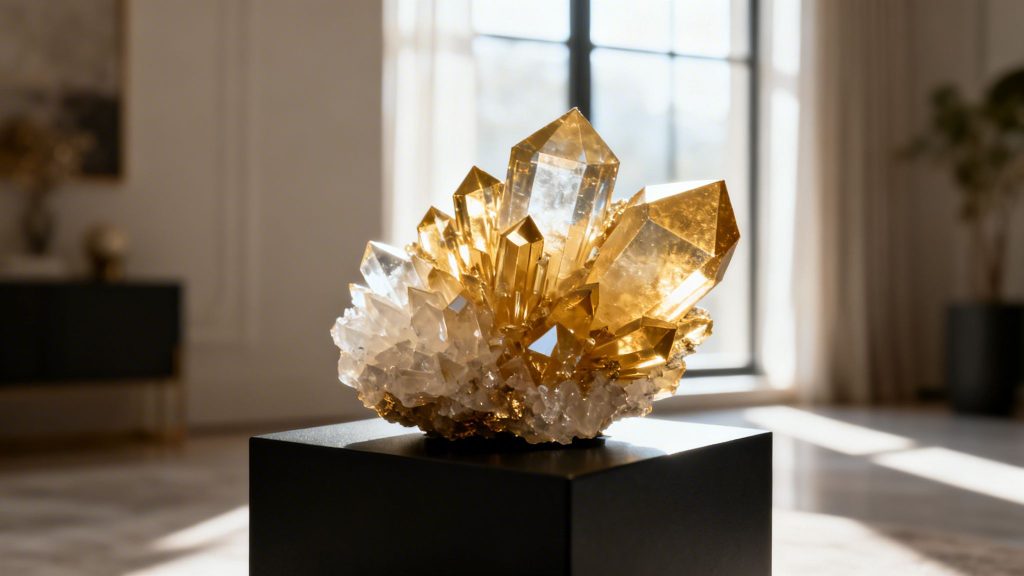
In the world of fine minerals, some locations are legendary. The Elmwood Mine in Tennessee is one such locale. For decades, this mine produced what many consider the world's finest calcite, famous for its stunning honey-gold to rich amber-orange crystals.
These are the iconic "dogtooth" calcites—scalenohedral crystals with razor-sharp points and incredible clarity. They formed slowly in open limestone pockets, often alongside deep purple fluorite and lustrous sphalerite. As a result, these combinations are among the most aesthetic and sought-after pairings in the mineral kingdom.
Now that the mine's primary operations have ceased, top-quality Elmwood specimens have become incredibly scarce. Acquiring one with documented provenance is like obtaining a piece of American mineral history.
Mexico: A Masterclass in Diversity
Mexico is another calcite powerhouse, celebrated for producing an incredible spectrum of colors and forms. The country offers a masterclass in the mineral's versatility. It has yielded everything from the vibrant, fluorescent pinks of Manganoan calcite to optically pure Iceland Spar. You can learn more about this coveted variety by exploring pink calcite in our dedicated guide to Manganoan Calcite.
The country’s complex geology, with its rich history of hydrothermal activity, created the perfect conditions for a stunning variety of calcite formations. As a result, Mexican rosette clusters and intensely colored crystals are mainstays in premier collections worldwide.
The sheer volume and consistent quality of Mexican calcite have made it a major force in the global market. Its specimens consistently set a high bar for what collectors and designers seek in a top-tier piece.
China: A Modern Leader in World-Class Specimens
Over the past few decades, China has emerged as a dominant force in the fine mineral scene. It has produced an astonishing array of calcite specimens that have redefined the market. Chinese calcite is known for its incredible complexity, including intricate twinning and unusual crystal habits not seen elsewhere.
The Asia-Pacific region is now poised to capture over 35% of a global calcite market projected to hit $14.6 billion in 2025. China is central to this growth. The country's integrated supply chains make it a top producer, a fact that elevates the status of its fine mineral specimens among serious collectors.
At Astro West, our direct relationships with field experts in these key localities ensure every calcite specimen has a verified provenance. This commitment to traceability allows our clients to invest with confidence. They acquire a piece of natural history whose value is supported by a unique, documented origin.
A Practical Guide to Identifying Authentic Calcite
Distinguishing genuine calcite from its look-alikes is a core skill for any collector. Thankfully, a few simple, non-destructive tests can confidently verify a specimen. Mastering these techniques protects your investment and deepens your appreciation for calcite's unique properties.
The Hardness Test
One of the most reliable identifiers is calcite’s relative softness. On the Mohs scale of mineral hardness, calcite registers a 3. This makes it much softer than commonly confused minerals like quartz (a hard 7).
You can perform a quick scratch test for verification. A copper penny, with a hardness of about 3.5, will scratch calcite. Conversely, your fingernail, at around 2.5, will not mark the mineral. This simple comparison is an excellent first step in the identification process.
Observing Cleavage and Fracture
Another definitive characteristic of calcite is its perfect rhombohedral cleavage. In simple terms, this means calcite breaks along three distinct planes of weakness. The result is smooth, flat surfaces that form a “rhomb,” a shape resembling a slanted box.
Even on a massive, non-crystalline piece of calcite, these flat, reflective planes are often visible when tilted under light. This property is a key differentiator from a mineral like quartz, which has no cleavage. When quartz breaks, it exhibits a conchoidal fracture—curved, shell-like surfaces similar to broken glass. Our article on distinguishing calcite and quartz explores this difference in greater detail.
The Acid Test: A Safe Approach
Perhaps the most definitive test for calcite involves its reaction to acid. Calcite consists of calcium carbonate, which effervesces, or fizzes, upon contact with a weak acid. This reaction releases harmless carbon dioxide gas, creating visible bubbles.
A single drop of household vinegar is sufficient for a safe, at-home test. Simply apply a tiny amount to an inconspicuous spot on the specimen. If it is genuine calcite, you will see an immediate and noticeable fizz.
Important Safety Note: Always perform this test on a small, hidden area of the specimen. While vinegar is weak, it can still lightly etch the surface. Therefore, using it sparingly is key to preserving the specimen’s aesthetic condition and value.
By combining these three simple tests, you can confidently identify authentic calcite. Learning these hands-on techniques connects you more deeply to the mineral's essential scientific identity. It is this combination of physical properties and stunning beauty that makes calcite such a rewarding mineral to collect.
Calcite as a Collectible Asset and Design Element
Beyond the collector's cabinet, calcite has a powerful presence in luxury interior design. Its diverse forms and colors allow it to function as a statement piece of natural art. A large, well-formed calcite cluster can anchor a room, acting as a focal point that introduces organic texture and geological history into a modern space.
The visual impact is immediate. For instance, a cluster of golden dogtooth calcite from the Elmwood Mine creates a breathtaking contrast with minimalist decor. Similarly, a sphere of soft blue or green calcite can introduce a calming, natural element to a living room. Calcite’s inherent beauty makes it a core part of a room’s narrative.
From Mineral Specimen to Design Centerpiece
Integrating calcite into a design scheme balances its natural artistry with curated elegance. Its versatility is a major strength. For example, massive forms of calcite are the primary component of marble, a material synonymous with luxury for centuries. Its presence in fine furniture, such as an antique side table with a marble top, highlights its long history as a prized design material.
Designers often turn to specific calcite varieties for their unique aesthetic flair:
Optical Calcite (Iceland Spar): Its water-clear transparency creates a sense of light and purity. It is perfect for spaces designed to feel open and bright.
Manganoan Calcite: The soft pink hues of this variety add warmth to a neutral palette. It also fluoresces a brilliant hot pink under UV light.
Cobaltoan Calcite: With its striking magenta colors, this rare variety serves as a vibrant accent piece, much like fine sculpture.
You can learn more in our guide on how to display crystals for maximum visual impact. These principles help transform a raw specimen into an integrated design feature.
Calcite as a Tangible Asset
The appeal of calcite extends beyond aesthetics; it also performs well as a tangible asset. While the industrial market provides a stable economic floor, the collector's market operates on principles similar to fine art or luxury watches. Top-tier specimens from historically important localities, especially those now closed, have shown consistent value appreciation.
The acquisition of a fine calcite specimen is an investment in rarity, beauty, and provenance. As premier examples become scarcer, their market value is driven by both seasoned collectors and high-end designers competing for the best available pieces.
This demand is backed by a robust domestic market. In the United States, calcite demand reflects steady industrial strength. Projections show the market growing from $4.3 billion in 2025 to $7.5 billion by 2035. For Astro West's clients, these figures underscore the mineral's importance.
Ultimately, whether as a focal point in a curated interior or the cornerstone of a serious mineral collection, calcite offers a unique blend of natural artistry and long-term value. Its ability to command attention and hold its worth makes it a smart addition to any portfolio of tangible assets.
Acquiring and Preserving Your Calcite Investment
Acquiring a fine calcite specimen is an act of custodianship for a piece of natural history. To ensure it holds its value, your first step is to confirm its authenticity and origin. Therefore, partnering with a trusted gallery is essential for anyone building a serious collection.
A reputable source provides more than a mineral; they provide its history. At Astro West, our long-standing relationships with miners and field experts mean every piece comes with a traceable provenance. This protects your investment and deepens your appreciation for the specimen's journey.
How to Care for Your Calcite
Once acquired, maintaining your calcite in pristine condition is critical. Calcite ranks a soft 3 on the Mohs hardness scale. This softness requires respectful handling to prevent scratches and damage.
Follow these essential rules for its preservation:
Clean Gently: Use a soft artist's brush and distilled water to remove dust. Avoid all acids, including household vinegar, and harsh chemical cleaners, as they will permanently damage crystal faces.
Handle with Care: Always hold calcite specimens by their solid base or matrix. Its "perfect cleavage" means it can split cleanly along internal planes if dropped or struck.
Display Thoughtfully: Keep calcite out of prolonged, direct sunlight. UV rays can cause the color in some varieties, such as pink Manganoan calcite, to fade over time, diminishing its beauty and market value.
A specimen's value is directly tied to its condition. Proper care ensures the natural luster, sharp crystal points, and vibrant color you invested in remain pristine, protecting its standing as a tangible asset for generations.
Building Your Collection with Confidence
Calcite offers a compelling combination of natural artistry and tangible value. It is both a stunning natural object and a solid asset with a history of appreciation. By focusing on quality, securing provenance, and practicing proper care, you can transform an acquisition into a lasting legacy.
Building a meaningful mineral portfolio requires expertise and a trusted eye. To learn more, see our expert advice on how to start a collection of rare rocks and minerals. This guide helps collectors make informed decisions, ensuring every addition is a confident step toward building a collection of true significance.
Answering Key Questions About Calcite
To conclude, we address common questions that arise when collecting calcite. This practical advice, drawn from seasoned expertise, helps collectors navigate the market with confidence and fully appreciate their acquisitions.
Does Calcite Appreciate in Value Like Gemstones?
Yes, though the high-end calcite market operates more like fine art than traditional gemstones. While industrial-grade calcite is common, investment-grade specimens are exceptionally scarce. Scarcity is the primary driver of their value.
Appreciation is driven by factors like exceptional rarity, provenance from a classic locality, or stunning aesthetic qualities. A vibrant cobalt-pink specimen or a flawless "Iceland Spar" from a closed mine are examples of pieces sought by discerning collectors. As a result, top-tier specimens perform as a reliable tangible asset over time.
What Is the Difference Between Calcite and Quartz?
Although they can appear similar, calcite and quartz are entirely different minerals with clear distinguishing characteristics. The easiest identifier is hardness. Calcite is soft, ranking a 3 on the Mohs scale, and can be scratched by a copper penny. Quartz is much harder at a 7 and resists a scratch from a steel knife.
Their internal structures also differ fundamentally. Calcite has perfect rhombohedral cleavage, meaning it breaks along flat, diamond-shaped planes. In contrast, quartz lacks cleavage and exhibits a conchoidal fracture, breaking with curved surfaces like glass. Finally, a drop of vinegar will cause calcite to fizz, a chemical reaction that quartz does not have.
How Should I Clean and Display My Calcite Specimen?
Proper care is essential to preserving a calcite specimen’s beauty and value. As a soft mineral, it is sensitive to both acids and abrasives. Therefore, it requires gentle handling.
Clean calcite using only a soft brush and distilled water. Avoid all household cleaners, especially vinegar or lemon juice, as they will dissolve the crystal surfaces and cause permanent damage.
For display, avoid long-term, direct sunlight. Constant exposure can fade the color in prized varieties like Manganoan calcite. Finally, place your specimen in a secure location where it will not be bumped or scratched, such as a dedicated shelf or enclosed display cabinet.
At Astro West, we believe a well-informed collector is a confident one. Our gallery provides access to world-class calcite specimens, each with verified provenance and a story to tell. Explore our curated collection online or visit our Manhattan showroom to find the next centerpiece for your collection. Discover more at https://astrowest.com.