Identify Calcite and Quartz Easily — Key Tests & Tips
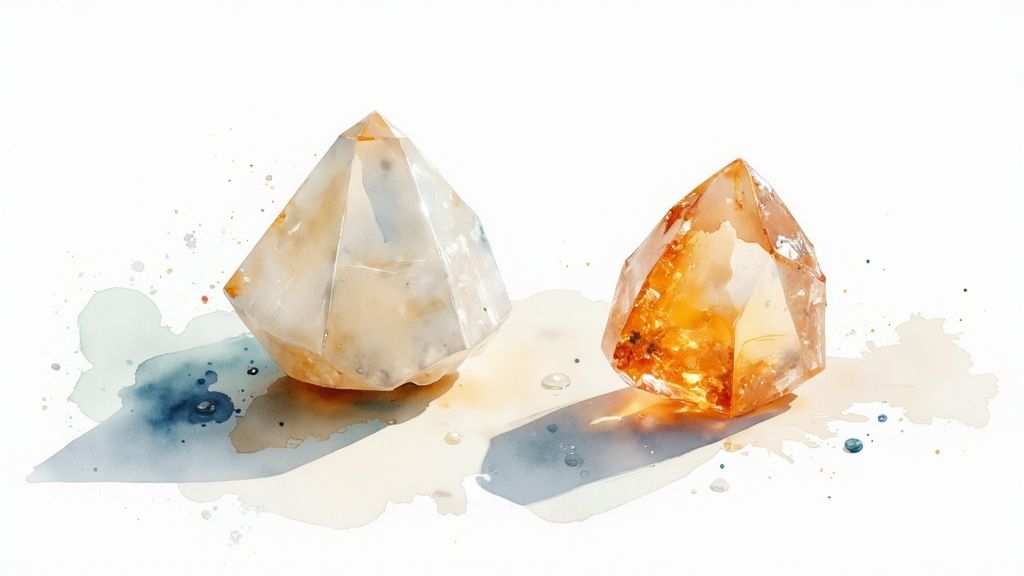
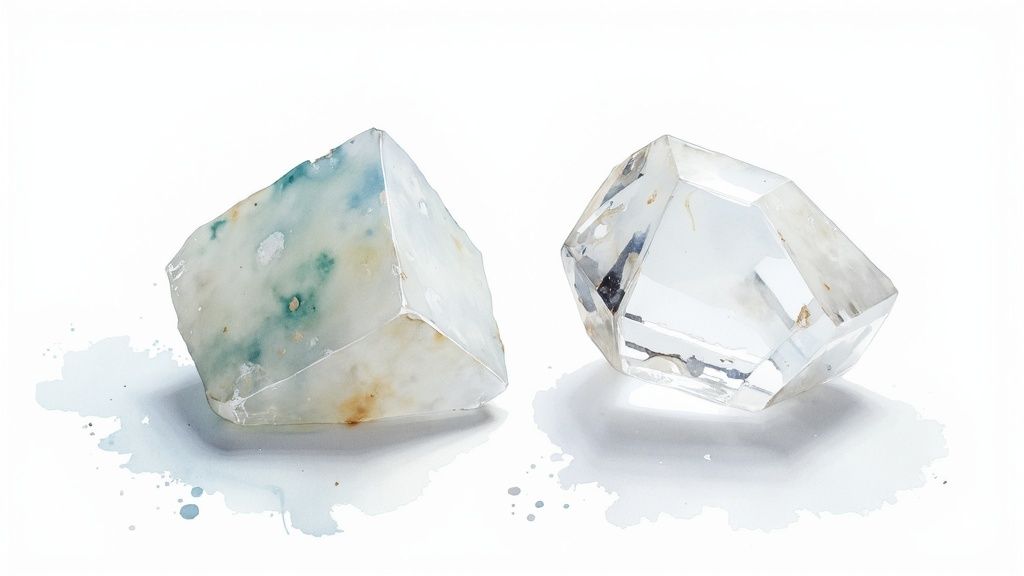
At first glance, telling calcite and quartz apart can be a real head-scratcher. For new collectors, they're probably two of the most commonly confused minerals out there. They can look remarkably similar with that glassy luster and a whole spectrum of colors, but their fundamental properties are worlds apart.
Getting a handle on their key differences is the first step toward identifying them with confidence.
Understanding Two Common but Different Minerals
While calcite and quartz often look like geological twins, they have entirely different chemical "fingerprints." Calcite is a carbonate mineral (calcium carbonate), while quartz is a silicate mineral (silicon dioxide). This core difference in their makeup dictates everything from how hard they are to how they react with common household substances.
Think of it as learning the secret handshake for each mineral. One is relatively soft and reactive, while the other is exceptionally tough and stable. For anyone just starting out, learning to tell these two apart is a foundational skill. We'll soon get into some simple, reliable tests you can do right at home to nail the identification every time.
The ability to differentiate between common minerals like calcite and quartz is essential for building a well-curated collection. It empowers you to accurately label specimens and appreciate their unique geological stories.
For anyone looking to dive into the world of mineral collecting, mastering these basics is a fantastic starting point. If you're getting serious about growing your display, you can learn more about how to start a collection of rare rocks and minerals in our guide. This knowledge ensures you know exactly what treasures you've found.
Exploring the Unique Properties of Calcite
Calcite is one of those minerals you've likely encountered without even realizing it. As one of the most common minerals on the planet, it’s the main ingredient in everyday rocks like limestone and marble. Chemically, it's pretty straightforward: just calcium carbonate (CaCO₃). But that simple formula is the secret to some of its most interesting tricks.
Unlike quartz, which is tough and resilient, calcite is quite soft. It only scores a 3 on the Mohs hardness scale, which is a huge clue for identification. This means you can easily scratch it with a steel knife or even a copper penny—something you could never do to a piece of quartz.
Distinctive Cleavage and Optical Wonders
The single most telling trait of calcite is its perfect rhombohedral cleavage. Think of it like this: no matter how you break a piece of calcite, it will always split along clean, flat planes into smaller, rhombus-shaped fragments. It’s like the mineral has a built-in blueprint for how it wants to break.
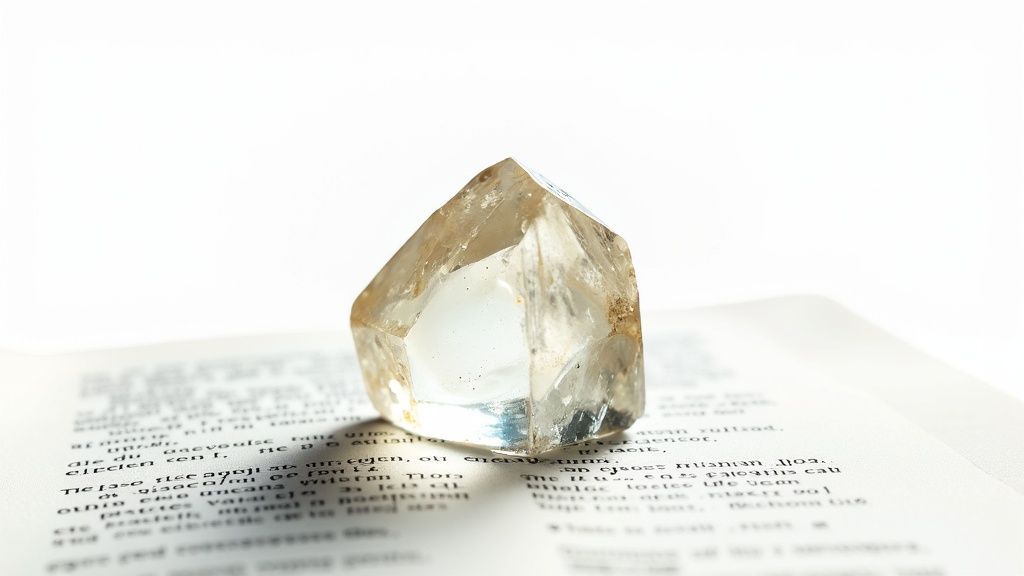
Even more captivating is its strong double refraction. If you get your hands on a clear variety, like Iceland Spar, and place it over some text, something amazing happens. The light passing through the crystal splits into two rays, creating a stunning optical illusion where every word appears doubled.
But the ultimate confirmation? The acid test. A single drop of household vinegar on the surface will make calcite gently fizz as it releases carbon dioxide bubbles. This reaction is a dead giveaway of its calcium carbonate makeup, and it's a test that quartz will fail every single time.
Industrial Importance and Market Growth
Calcite isn't just for collectors; it's a true industrial workhorse. Its versatility makes it an essential ingredient across dozens of sectors, from construction and plastics to paints and paper.
In fact, the global calcite market is projected to swell from USD 12.07 billion to USD 21.41 billion between 2025 and 2035. You can find more details on this trend in recent calcite market growth analyses. This massive growth underscores just how vital this seemingly simple mineral is to our everyday products and infrastructure.
Uncovering the Power of Durable Quartz
Now, let's talk about quartz, the undisputed workhorse of the mineral kingdom. Made of silicon dioxide, it’s one of the most common and toughest minerals you'll find anywhere on Earth. Its defining feature is its sheer hardness.
Clocking in at a 7 on the Mohs scale, quartz can easily scratch glass and even steel—a feat calcite simply can’t match.
This incredible resilience makes quartz a champion in both nature and industry. Unlike calcite, which splits along predictable lines, quartz has a conchoidal fracture. This means it breaks with smooth, curved surfaces, much like a piece of freshly broken glass. For collectors, that distinct pattern is another dead giveaway.
Resilient Structure and Unique Abilities
Beyond its toughness, quartz has a fascinating trick up its sleeve: piezoelectricity. When you put it under mechanical stress, it generates a tiny electric charge. This unique ability is precisely why quartz is essential in electronics, powering everything from watches and radios to the computer you're likely using right now.
Its versatility extends to its looks, too. Quartz shows up in a dazzling array of forms, from the flawless clarity of Rock Crystal to the deep purples of Amethyst and the warm, sunny tones of Citrine. For a deeper dive into all its beautiful variations, be sure to check out our collector's guide to quartz crystal clusters.
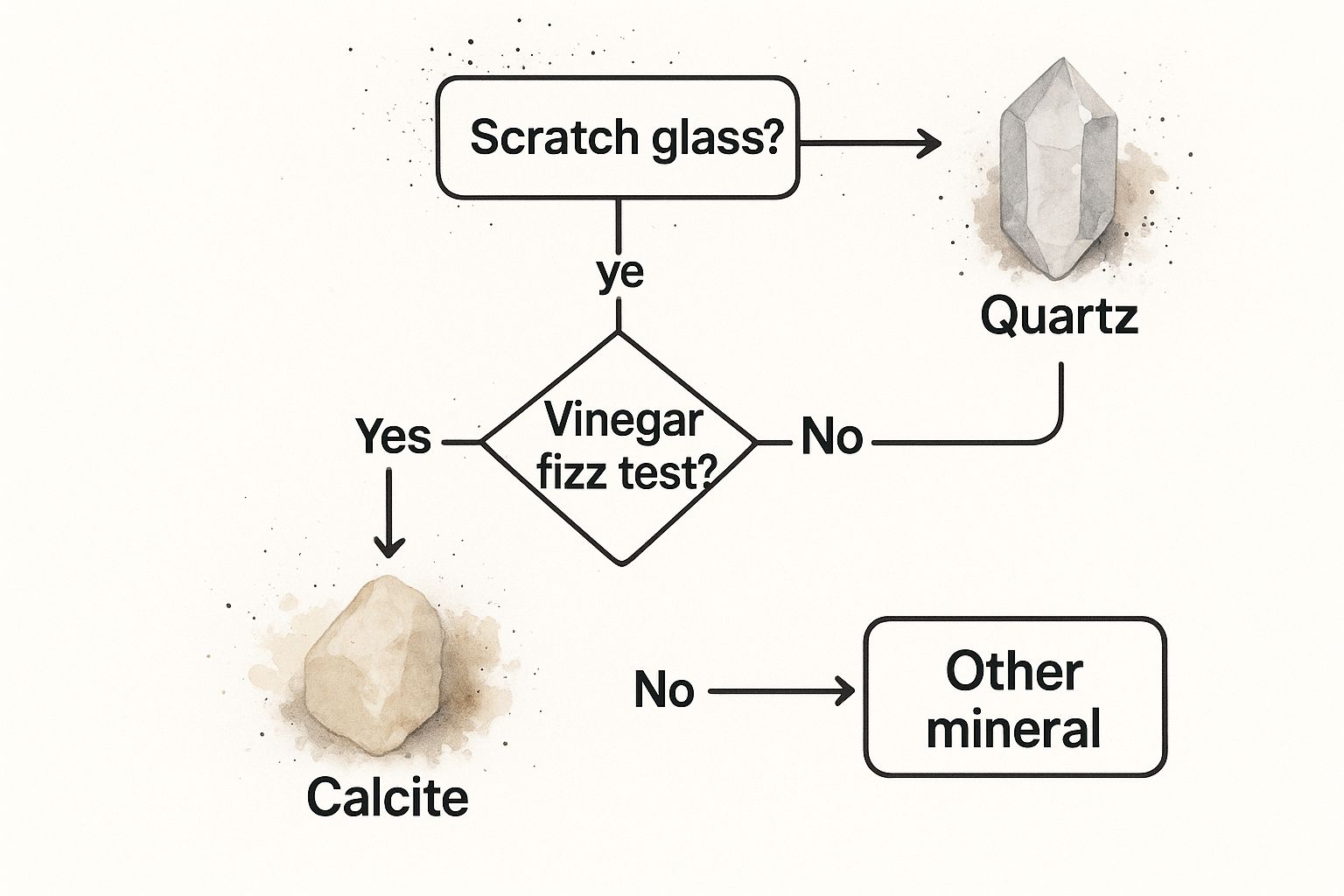
This handy little chart simplifies those first few identification steps.
As you can see, the hardness test is almost always the quickest way to get your answer.
Quartz’s power isn't just limited to its natural state. Engineered quartz—a composite of ground quartz and resins—has become a hugely popular material, driving a market projected to grow from USD 12.8 billion to USD 17.58 billion by 2032. This demand is especially strong in construction and design, where you'll find it in applications like durable quartz countertops that perfectly blend its natural strength and beauty.
Simple Tests to Tell Calcite and Quartz Apart
Telling calcite and quartz apart in the field doesn't require a geology degree—just a few simple tools and a keen eye. These are the kinds of practical, hands-on tests that let you move past the textbook and get a real feel for what makes these minerals unique. You don't need any complex equipment, just a bit of know-how.
Let’s start with the most reliable method: the hardness test. Quartz is a seriously tough mineral, ranking a solid 7 on the Mohs scale. What does that mean in the real world? It’s harder than steel, so it will easily scratch a piece of glass or a steel knife blade without breaking a sweat.
Calcite, on the other hand, is much softer. It comes in at just a 3 on the Mohs scale, making it far more delicate. It absolutely cannot scratch glass. So, if your specimen leaves a distinct mark on a glass surface, you can be almost certain you're holding a piece of quartz.
The Decisive Fizz and Fracture Tests
If the hardness test points toward a softer mineral, your next move is the classic "fizz test." This is a dead giveaway for calcite because it targets the mineral’s unique chemical makeup. Calcite is calcium carbonate, which means it reacts with acid.
Just place a single drop of common household vinegar on your specimen. If it’s calcite, you’ll see little bubbles fizzing up as the acid releases carbon dioxide. It's a simple but definitive reaction. Quartz, being silicon dioxide, won't react at all. Nothing will happen.
Another fantastic clue lies in how the mineral breaks, which reveals its internal crystal structure.
Calcite has what’s called perfect rhombohedral cleavage. It breaks into clean, rhombus-like shapes with flat, angled sides. Think of it like a tilted box.
Quartz doesn’t have cleavage. Instead, it has a conchoidal fracture, breaking with smooth, curved surfaces that look a lot like chipped glass.
A final, quick visual check is for something called double refraction. Just look through a clear piece of the mineral at a line of text on a page. If the words appear doubled, you’re looking through calcite. This cool optical trick doesn’t happen with quartz.
Field Identification Guide: Calcite vs. Quartz
When you're out there with a specimen in hand, it helps to have a quick reference. This table breaks down the key tests into a simple, easy-to-follow format.
Identification Test
Calcite Result
Quartz Result
What You Need
Hardness Test
Will NOT scratch glass or a steel knife.
WILL scratch glass or a steel knife.
Glass, steel knife
Acid "Fizz" Test
Fizzes and bubbles when vinegar is applied.
No reaction to vinegar.
Household vinegar
Breakage Pattern
Breaks into clean, rhombus-like shapes (cleavage).
Breaks with smooth, curved surfaces (fracture).
A hammer (optional)
Double Refraction
Text viewed through the mineral appears doubled.
Text appears normal, not doubled.
A book or paper
With these simple methods, you can confidently tell these two common minerals apart. Mastering these techniques is a huge step for any collector, and our complete crystal identification guide can help you apply these same principles to countless other minerals you might find on your adventures.
Where These Minerals Form and Why It Matters
The geological stories behind calcite and quartz are just as different as their physical traits. Understanding their origins is key to knowing why one is soft and reactive while the other is tough and durable—it all comes down to the wildly different environments where they were born.
Calcite is fundamentally a mineral of water and life. It typically forms in sedimentary environments, often starting as the shells and skeletal bits of marine organisms. Over millions of years, these calcium carbonate fragments pile up on ocean floors, getting compacted into massive limestone formations or, with enough heat and pressure, metamorphosing into marble. It's also the patient artist behind the stunning formations inside caves, like stalactites and stalagmites.
Igneous Origins Versus Sedimentary Foundations
Quartz, on the other hand, is born from fire and intense pressure. It most often crystallizes directly from molten rock as it cools deep within the Earth's crust, which is why it's a core component of igneous rocks like granite. You'll also find it forming in high-temperature hydrothermal veins, where superheated, silica-rich water forces its way into rock fractures, leaving behind beautiful crystals as it cools.
This fundamental difference in origin story dictates how we use them. Calcite’s journey makes it indispensable for producing cement and neutralizing acidic soil for agriculture. It's also the mineral you'll often find sparkling inside hollow rocks; learn more by exploring our guide on what is a geode.
The way each mineral forms directly shapes its role in our world. Calcite’s abundance in sedimentary rock makes it a cornerstone of construction, while quartz’s resilience to high temperatures makes it an industrial powerhouse.
Quartz’s incredible durability and unique electronic properties make it vital across countless modern industries. Its economic significance is massive—the global natural quartz crystal market hit USD 145.5 billion and is projected to climb to USD 169 billion by 2035. You can explore more insights on this growing quartz market on IndexBox.io. It just goes to show how critical these natural treasures are to our world.
Common Questions About Calcite and Quartz
Once you start digging into the world of calcite and quartz, a few common questions always pop up. Getting these sorted out is the final step in feeling confident, whether you're out in the field or just talking shop with other collectors. Let's clear up some of the usual points of confusion.
First up, a lot of people wonder if you can find both minerals in the same spot.
Absolutely. In fact, it's pretty common to see calcite and quartz hanging out together, especially in places like hydrothermal veins or certain metamorphic rocks. Even though they're neighbors, it’s good to remember they form under different conditions, so their origins within that shared space are still distinct. You might even find a stunning specimen with quartz crystals growing right on a calcite matrix—a real prize for any collector.
Value and Identification Tips
Another big question is about money: which one is worth more?
That’s a tricky one. The answer really depends on quality, rarity, and just how good the crystal looks. Your average, massive calcite is an industrial mineral and won’t cost much. But then you have something like a vibrant pink Cobaltoan Calcite with perfect crystals, and that can fetch a seriously high price.
It’s the same story for quartz. While a chunk of milky quartz is common, gem-quality varieties are a different ballgame. A flawless amethyst geode or a big, clear citrine crystal is going to be far more valuable. At the end of the day, rarity and aesthetics determine the value for both.
For beginners who want a quick, reliable way to tell them apart, the hardness test is your best friend. Can your specimen easily scratch a piece of glass? You've almost certainly got quartz. If it can't make a mark, you're probably holding calcite.
This simple test cuts right through any visual confusion and gives you a clear answer based on a fundamental physical property.
Safe Testing Practices at Home
Finally, newcomers often get a little nervous about using chemicals. Is it really safe to do the acid fizz test at home?
Yes, it's completely safe as long as you use a weak, everyday acid like household vinegar. You don't need harsh, dangerous chemicals to get a reaction from calcite. Just one drop is enough to see those classic bubbles. Of course, you should always handle any substance with care, but using vinegar for this test is a perfectly safe and effective method to confirm you have a carbonate mineral like calcite.
At Astro West, we believe every mineral tells a story. Whether you're just starting your collection or hunting for a museum-quality centerpiece, our curated selection of ethically sourced calcite, quartz, and other natural treasures has something for every enthusiast. Explore our collection today and find a piece of Earth's history to call your own.