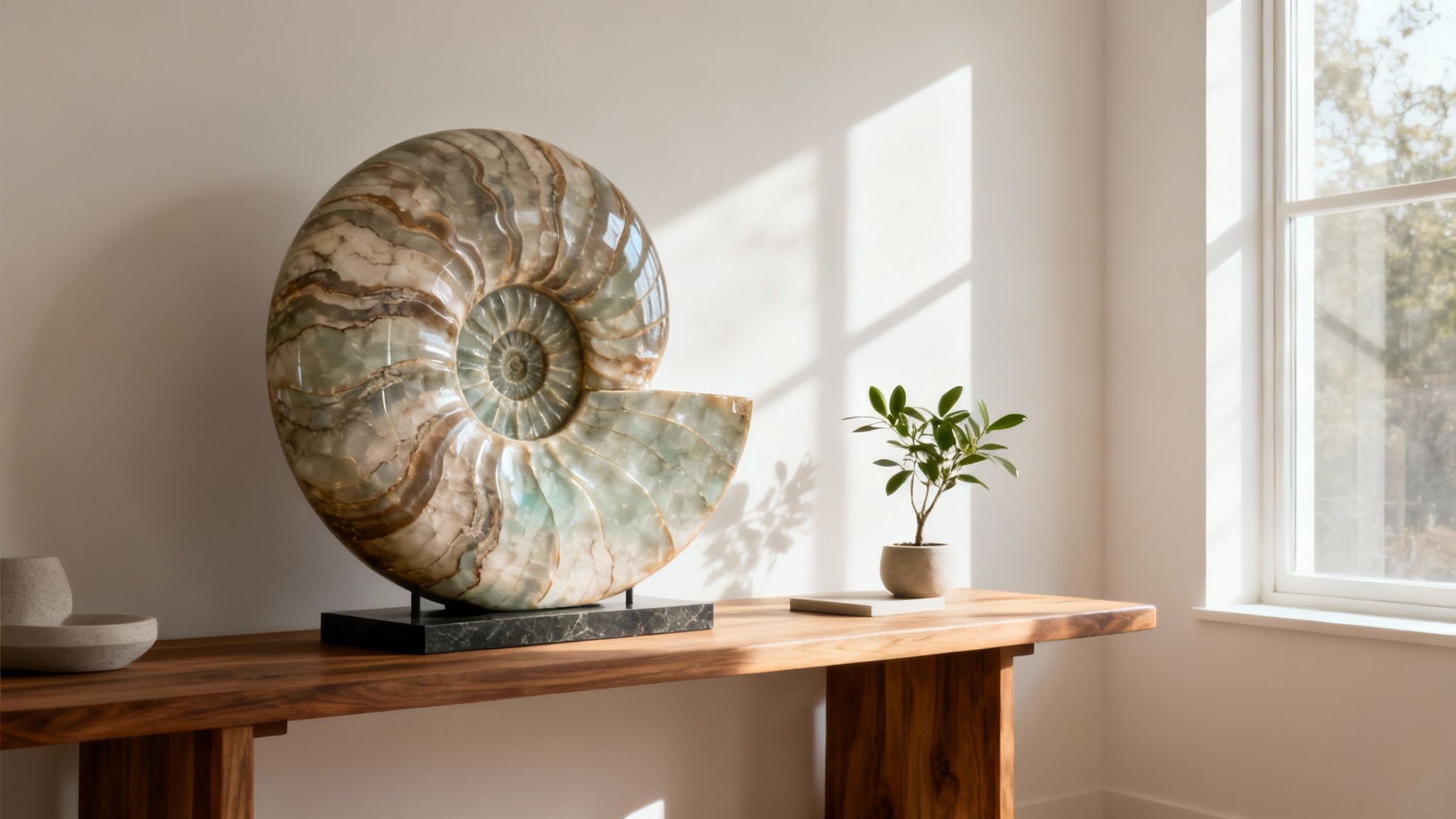
A Collector’s Guide to Ammonite Fossils: From Ancient Ocean to Investment Art
An ammonite is the fossilized, spiral-shaped shell of an extinct marine mollusk, an ancient relative of modern octopuses and squids. Today, these stunning fossils are treasured by collectors, interior designers, and investors alike for their mesmerizing geometric beauty and profound connection to Earth’s deep history. They are not merely stones; they are sculptures carved by time, representing a unique intersection of natural history, luxury décor, and tangible investment.
The Timeless Allure of Ammonite Fossils
When you hold an ammonite, you’re holding a direct link to a world that existed long before us. These captivating fossils are the preserved remains of ammonoids, a group of predatory cephalopods that flourished in our planet’s oceans for over 300 million years. Their story is one of incredible endurance and diversity, making each fossil a unique piece of natural art, sculpted by geological forces.
Imagine a creature with a coiled shell gracefully navigating ancient seas—that’s the magic of these extinct marvels. They first appeared in the Devonian period, around 400 million years ago, and came to dominate the oceans until their dramatic exit alongside the dinosaurs, roughly 66 million years ago.
During their long reign, ammonites evolved into an astonishing 10,000+ distinct species. They shared a lineage with the modern nautilus but often sported far more elaborate and ornate shell patterns, making them a fascinating subject for collectors.
Understanding Ammonite Biology
That iconic spiral shell wasn't just for protection; it was a sophisticated buoyancy device. Much like a modern submarine, the shell was divided into a series of chambers. The ammonite lived only in the final, outermost chamber. The others, known collectively as the phragmocone, were filled with gas.
By carefully regulating the gas and fluid within these chambers, the ammonite could control its depth in the water column. This allowed it to rise to hunt or sink to escape danger—an evolutionary masterstroke that was key to its long-term success.
From Ancient Oceans to Modern Art
Today, these fossils have found a new life beyond scientific study. They are celebrated in luxury décor and interior design for their perfect geometric form—the logarithmic spiral. This natural elegance connects our modern spaces to the ancient world, offering a story that is both scientific and deeply aesthetic.
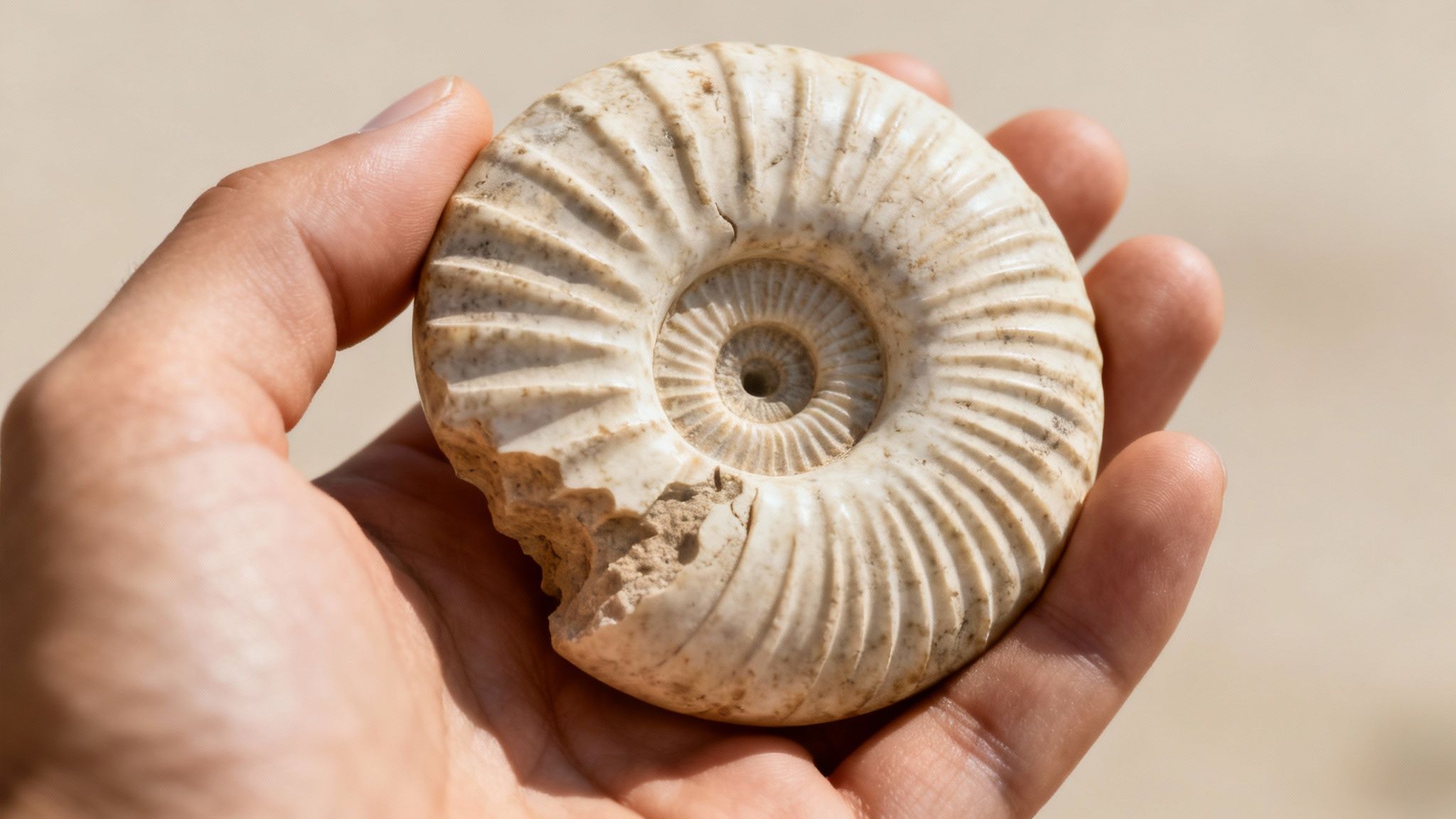
The beauty of a well-preserved ammonite lies in its distinct ribbed structure and spiral form, features that make these fossils so instantly recognizable. Each ridge, or costae, represents a stage of the creature's growth, telling the life story of an individual animal from millions of years ago.
Whether you are a seasoned collector looking for a prized specimen or an interior designer seeking a unique statement piece, the architectural beauty of an ammonite fossil is unmatched. You can explore a curated selection of these stunning natural sculptures in the Astro West ammonite collection.
The Journey From Seafloor To Stone
The transformation from a living, breathing creature into a solid stone masterpiece is one of nature’s most incredible stories. For an ammonite, this journey began the moment it died and sank to the ancient seafloor. Here, a precise sequence of events had to unfold perfectly, turning fragile organic remains into a fossil that would endure for ages.
This process, called fossilization, is like a perfect natural casting, and the secret ingredient was rapid burial. If the ammonite shell was quickly covered by fine sediment like mud or sand, it was shielded from scavengers, destructive currents, and the oxygen that would have otherwise caused it to decay and vanish.
This low-oxygen environment was absolutely critical. It essentially hit pause on decomposition, preserving the shell’s intricate structure and delicate details just long enough for the next, most magical stage to begin. Over millions of years, as more layers of sediment piled on, the pressure mounted and mineral-rich water started to seep through.
How Minerals Create Natural Art
As this mineral-laced water flowed through the buried ammonite, a remarkable exchange began. The original shell material—mostly aragonite, a form of calcium carbonate—was slowly dissolved and replaced, molecule by molecule, with more stable minerals from the groundwater. This is a process known as permineralization.
The specific minerals involved are what give each ammonite fossil its unique character and stunning good looks. The local geology really dictates the final masterpiece, turning every specimen into a one-of-a-kind sculpture.
Calcite: Often, the original aragonite simply recrystallizes into calcite, its more stable cousin. This can fill the internal chambers with a sparkling, crystalline druzy that creates a beautiful contrast between the fossil's earthy exterior and its glittering interior.
Pyrite: In marine environments rich in iron and sulfur, pyrite (or "fool's gold") can replace the shell. The result is a breathtaking, metallic ammonite fossil with a brilliant golden luster, as if the organic form was dipped in solid metal.
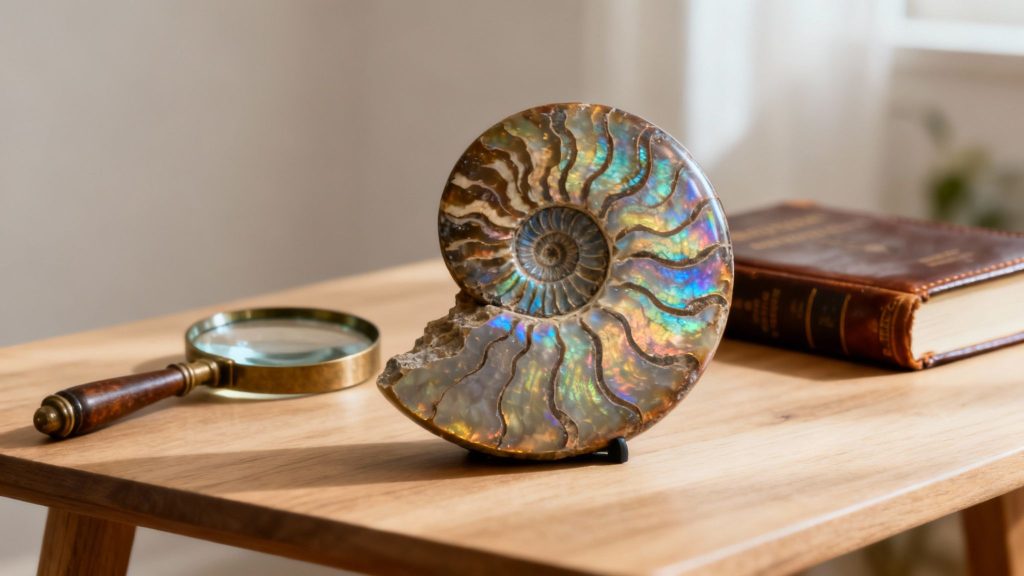
Agate & Opal: Sometimes, silica-rich solutions permeate the shell, depositing microcrystalline quartz like agate or even precious opal. These fossils can display vibrant bands of color or an iridescent fire, making them exceptionally rare and sought-after.
This mineral replacement is the very reason why no two ammonite fossils are ever identical. Each one is a direct reflection of its unique geological journey—a snapshot of the specific chemistry of its environment over millions of years.
Revealing The Hidden Beauty
Once fossilization is complete, the ammonite lies encased in solid rock, waiting patiently to be discovered. The final part of its journey involves careful extraction and preparation by expert fossil hunters and technicians. They meticulously chip away the surrounding rock, or matrix, to reveal the fossil within, often cutting and polishing the specimen to showcase the incredible internal crystal structures.
This whole process—from the ocean floor to a collector’s shelf—underscores just how rare a perfectly preserved ammonite truly is. It required the perfect conditions at the moment of death, followed by millions of years of stable geology. To see just how beautifully these minerals can encrust and enhance a specimen, take a look at this remarkable ammonite with calcite incrustation from the Astro West collection.
How To Identify And Value Ammonite Fossils
Stepping into the world of ammonite collecting is a bit like becoming a detective of deep time. Each fossil holds subtle clues about its long history, its quality, and ultimately, its value. Learning to read these clues is the key to building a collection that’s not only beautiful but truly significant. It’s a process that moves from simple observation to appreciating the fine details that separate a common fossil from a geological masterpiece.
Discerning collectors learn to look beyond the initial wow factor and assess a specific set of characteristics. These factors work together to tell a complete story about the ammonite's life, its death, and its incredible journey through geologic time. Once you know what to look for, you can make confident, informed decisions, whether you're acquiring your first piece or seeking a new centerpiece for your collection.
Core Factors In Ammonite Valuation
Your initial assessment of an ammonite fossil should start with three fundamental attributes: size, species, and the quality of its preservation. While a large, dramatic fossil is always impressive, size alone doesn't guarantee high value. It’s all about how these elements come together.
Size: As with many collectibles, bigger is often better. Larger ammonites are generally rarer and more desirable simply because it's much harder for a massive shell to survive the fossilization process intact. A specimen measuring over a foot in diameter is significantly harder to come by than one just a few inches across, which is why large, well-preserved examples often become statement pieces in luxury design.
Species Rarity: With over 10,000 known species discovered so far, not all ammonites are created equal. Common varieties from prolific fossil beds, like those in Madagascar, are quite accessible and make great starter pieces. But the real prizes are the rare species, especially those with unusual ornamentation like pronounced spines or sharp keels. These are highly sought after by serious collectors.
Preservation Quality: This is arguably the most critical factor of all. A top-tier ammonite should be as complete as possible, with a well-defined shell, minimal cracking or restoration, and a clear, undamaged center (the protoconch). The sharpness of the ribs, or costae, is another key indicator of just how well it was preserved.
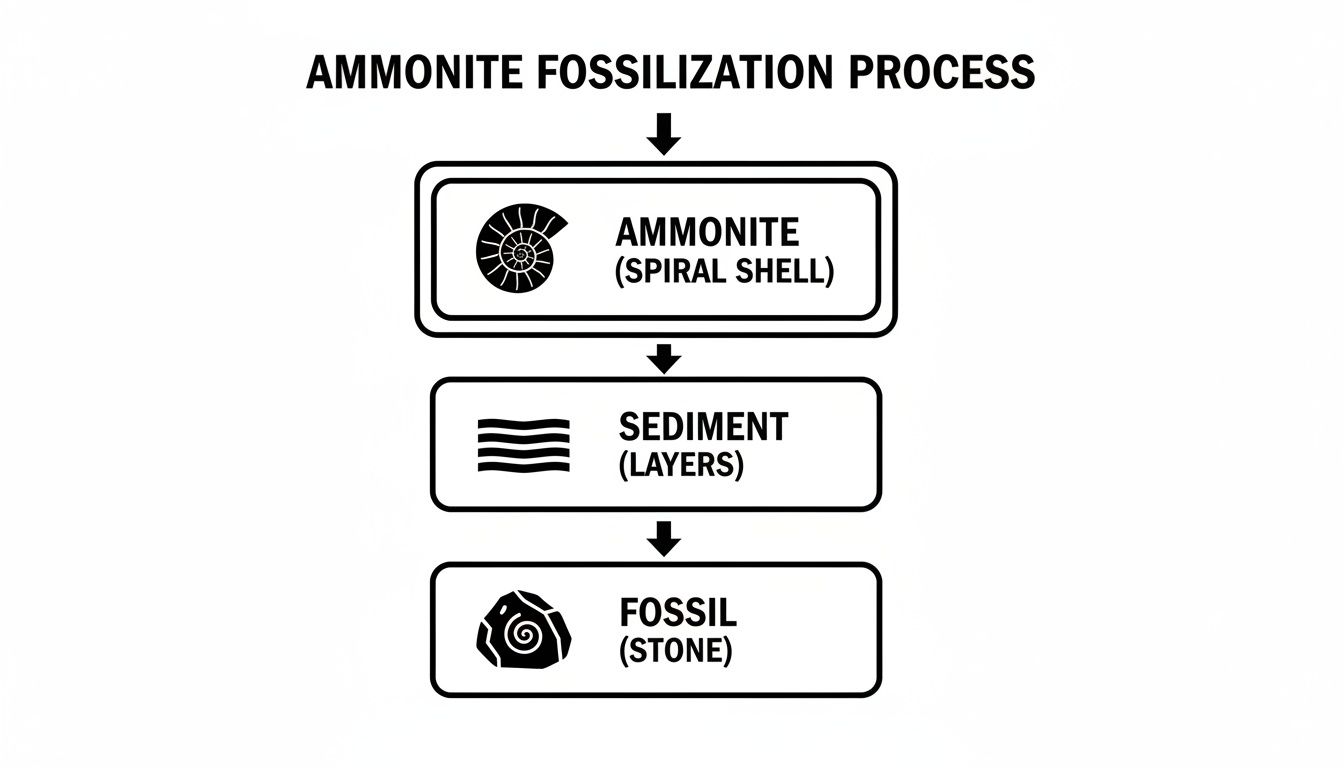
The image below shows the basic journey an ammonite takes to become the stone fossil we can hold in our hands today.
It’s a simple visual, but it captures the critical role sediment played in protecting the shell and allowing it to survive for millions of years.
The Decisive Detail Suture Patterns
While the physical shape and size are important, the true signature of an ammonite’s identity lies in its suture patterns. These are the intricate, almost fractal-like lines you can see on the shell's surface where the internal chamber walls, called septa, met the inside of the outer shell. You often can only see them once the outermost layer of the shell has been carefully removed.
Suture patterns are like an ammonite’s fingerprint. Their complexity increased dramatically over millions of years of evolution, making them a reliable tool for paleontologists to date the fossil and identify the species.
The most ancient ammonoids had simple, gently waving suture lines. But as they evolved through the Mesozoic Era, these patterns became incredibly complex and ornate, developing into elaborate, fern-like designs. A fossil with a highly intricate, well-defined suture pattern is often more valuable because it represents a more evolutionarily advanced species and showcases a stunning example of natural geometry.
When you're evaluating a piece, look for the clarity and beauty of these hidden lines. For a fantastic example of a specimen with clearly visible features, take a look at this expertly prepped ammonite from Madagascar in our collection.
Aesthetics and Preparation
Finally, the overall aesthetic appeal and the skill of the fossil preparator play a huge role in determining an ammonite's value. The color, which comes from the specific minerals that replaced the original shell material, can add significant desirability. Specimens with a striking golden shine from pyritization or those filled with vibrant agate are particularly prized.
The preparation itself is a true art form. A skilled technician can expertly remove the surrounding rock—the matrix—without damaging the delicate fossil, exposing its finest features. A well-prepared ammonite, free of tool marks and with its natural details perfectly intact, will always command a higher price than a poorly excavated or overly restored piece.
To help you put it all together, here’s a quick guide to the key indicators of quality and value.
Key Indicators of Ammonite Quality And Value
Quality Factor
Description of High-Value Trait
Example from Astro West Collection
Completeness
The entire spiral is present, including the aperture (opening) and protoconch (center). Minimal missing pieces.
Many of our ammonites are chosen for their near-perfect, unbroken spiral forms.
Suture Definition
Suture patterns are sharp, intricate, and clearly visible, indicating advanced evolution and excellent preservation.
The Madagascar ammonite shows off its complex, fern-like suture patterns.
Surface Detail
Ribs (costae), spines, and other ornamentation are crisp and well-defined, not worn down or obscured.
Pieces with pronounced ribbing and texture that you can see and feel.
Mineralization
Presence of desirable minerals like iridescent ammolite, golden pyrite, or colorful agate fills the chambers.
Look for specimens that flash with color or have a beautiful metallic luster.
Preparation Quality
The fossil has been skillfully cleaned from the matrix with no tool marks, glue, or excessive restoration.
Our preparators ensure the natural beauty of the fossil is the main focus.
Lack of Distortion
The fossil has not been crushed or deformed by geological pressure over time, retaining its natural shape.
We select pieces that have maintained their three-dimensional, symmetrical structure.
Ultimately, a truly exceptional ammonite is one where preservation, rarity, and artistry all come together to tell a remarkable story of ancient life.
Discovering Ammolite: The Gemstone Within
In the vast world of ammonite fossils, a treasure of breathtaking rarity exists. While most ammonites are preserved as stone sculptures, a tiny fraction undergoes a miraculous transformation. This is where paleontology and gemology collide.
These exceptional fossils preserve the iridescent mother-of-pearl layer of their original shells, creating an organic gemstone celebrated for its vivid, opal-like fire: ammolite. It's not a mineral in the traditional sense, but the actual fossilized shell of specific ammonite species—primarily Placenticeras meeki and Placenticeras intercalare. This distinction places it in the elite company of other organic gems like pearls and amber, treasures born from life itself.
The story of ammolite is tied to a single location on Earth, a testament to a precise series of geological events that unfolded over tens of millions of years.
The Science Behind The Spectacle
So, what creates that mesmerizing play of color? It’s not pigment. The magic comes from an optical effect called interference.
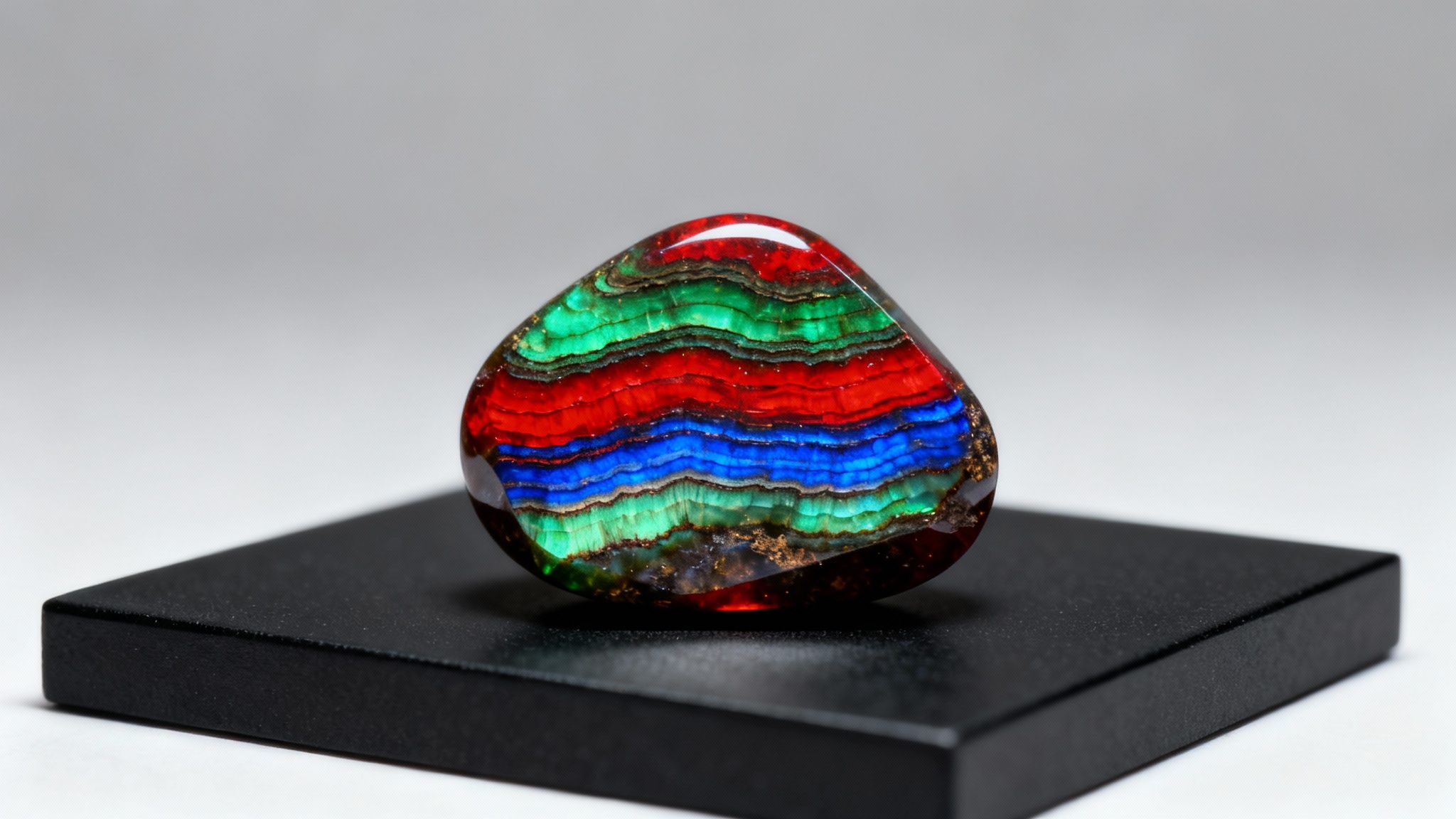
The fossilized shell is made of microscopic layers of aragonite, the same mineral that forms pearls. As light passes through these incredibly thin, stacked platelets, it diffracts and splits into a rainbow of colors. The thickness of these layers determines which colors we see. Thicker layers produce the more common reds and greens, while thinner layers create the much rarer—and more valuable—blues and purples. It's this unique structure that gives ammolite its dynamic brilliance, a fiery dance that shifts with every change in viewing angle.
The discovery of ammolite is a story of serendipity. For centuries, the Blackfoot tribes of Alberta, Canada, knew of these colorful stones, calling them "iniskim" or buffalo stones, and revered them for their perceived spiritual power. It wasn't until the 1970s that they entered the global gemstone market.
From Bearpaw Shale To Global Icon
The world's only significant commercial source for gem-quality ammolite is a specific geological unit in Canada. Mined almost exclusively from the 70-million-year-old Bearpaw Formation in southwestern Alberta, this incredible material finally earned official gemstone status from the World Jewelry Confederation in 1981.
In just the last 25 years, Canadian ammonites with gem-quality ammolite have seen their values triple. This surge is fueled by collectors and investors who view premier fossils as alternative assets, much like rare art. Yet only a tiny percentage of ammonites from this formation preserve the stunning nacreous luster that becomes ammolite.
Grading And Valuing Ammolite
Just like diamonds or emeralds, ammolite is graded on a specific set of criteria. Its quality and value come down to a few key factors that create its overall visual impact.
Color Brilliance and Range: The most valuable specimens flash multiple bright, vibrant colors. Stones showcasing the rare blues, violets, or purples are exceptionally prized.
Iridescence and Chromatic Shift: High-quality ammolite has a strong chromatic shift, meaning the colors change dramatically as you rotate the stone.
Pattern and Texture: The colors can form unique patterns, sometimes described as "stained glass," "ribbon," or "dragon skin." Clean, well-defined patterns are always more desirable.
Completeness: Many ammolite pieces are assembled from fragments. A complete, unbroken ammonite fossil displaying full ammolite coverage is the absolute pinnacle of rarity and value—a true museum-quality centerpiece.
Astro West is proud to offer exceptional specimens like this vibrant ammolite from Madagascar, which showcases the incredible natural artistry that makes this gemstone so captivating. Ammolite is more than just a beautiful stone; it is a direct link to the ancient oceans, a dazzling piece of natural history preserved in a flash of impossible color.
Styling Your Space With Ammonite Fossils
Ammonite fossils are where natural history and sophisticated interior design meet. These aren't just objects; they're conversations with deep time. Their perfect logarithmic spirals offer a touch of organic geometry that feels both ancient and strikingly modern.
Bringing an ammonite into your home or office is more than just decorating. It's a chance to anchor your design with an artifact of profound significance, bridging an immense gap between the prehistoric world and your personal space.
A large, dramatic ammonite can instantly become the focal point of a room. Place one on a console table in your entryway, and it delivers a powerful first impression. Set it on a mantelpiece, and it anchors the entire living area. Its spiraling form naturally draws the eye, adding a layer of historical depth that no manufactured art can replicate.
Creating Textural and Conceptual Contrast
One of the best ways to style an ammonite is by playing with contrast. The raw, earthy texture of an unprepared fossil creates a stunning juxtaposition against the clean lines and smooth surfaces of minimalist or contemporary décor.
This kind of pairing highlights the fossil's wild origins, reminding you of the ancient oceans it came from. It introduces a natural, untamed element that keeps a modern space from feeling cold or sterile.
Think about these dynamic pairings:
A Raw Ammonite on a Glass Table: The rough, stony surface of the fossil against the sleek transparency of glass creates a powerful dialogue between the elemental and the man-made.
A Polished Fossil on a Wooden Surface: The smooth, glossy finish of a polished ammonite contrasts beautifully with the warm, natural grain of a walnut or oak bookshelf, linking two different expressions of nature.
The goal is to let the ammonite tell its story. By placing it in a modern context, you are not just decorating a room; you are curating a personal museum, blending millions of years of natural artistry with your own contemporary aesthetic.
Symmetry and Harmony With Split Pairs
If you're after a more formal or balanced look, consider a split pair of ammonites. These are specimens that have been cut perfectly in half and polished to reveal the stunning, crystallized chambers inside.
Mounted as symmetrical wall art, they create an elegant, mirrored effect that’s both visually captivating and intellectually stimulating. This approach works especially well in spaces that benefit from symmetry, like flanking a doorway, hanging above a headboard, or positioned on either side of a fireplace. The intricate internal structures—often sparkling with calcite or agate—become a form of geological art, offering endless details to discover.
For those looking to artfully arrange smaller pieces, practical display strategies are key. You can learn how to decorate shelves to highlight your collectibles and create stunning visual arrangements. Whether displayed individually in a cabinet of curiosities or grouped together for impact, smaller ammonites add subtle layers of history and intrigue throughout your home. Every single specimen, regardless of size, carries the same incredible legacy.
Why Ammonites Are A Smart Investment
There's more to a high-quality ammonite than just its stunning beauty and ancient history. For the discerning collector, it represents a solid tangible asset, an investment in one of the Earth’s rarest natural treasures. Think of the market for premier fossils like the fine art world—a finite supply, growing global demand, and a powerful dynamic for value appreciation.
An investment-grade ammonite's value is tied directly to the same factors that define its quality: exceptional preservation, the rarity of its species, impressive size, and unique aesthetic features like iridescent ammolite. As the best specimens are unearthed and find their way into private or public collections, the pool of available top-tier fossils shrinks. It's this simple scarcity that drives their long-term value.
Market Dynamics and Appreciation
The world of fine fossils is increasingly attracting savvy investors who see the power in tangible assets. Unlike stocks or bonds, a world-class ammonite possesses an intrinsic value rooted in its irreplaceability and natural artistry. Its worth isn't dictated by market volatility but by the timeless human fascination with our planet’s story.
We're seeing this play out in the remarkable performance of certain fossils. For example, premier Canadian ammonites have reportedly tripled in value over the last 25 years, a trend that mirrors the dramatic rise seen in the dinosaur bone market. This growth is fueled by a perfect storm of rarity, size, and the incredible amount of skilled labor needed for their preparation. You can learn more about the rising prices in the fossil market.
Owning a premier ammonite fossil is like owning a piece of geological real estate. The supply is limited to what the Earth has already created and preserved, ensuring that the finest examples will always be in high demand.
Building a Legacy Collection
Investing in ammonites is really about building a legacy. Each one is a non-renewable resource, a snapshot from a lost world that can never be repeated. For collectors and interior designers alike, this adds a profound layer of meaning that goes far beyond simple aesthetics. An ammonite in a home isn't just a statement piece; it's an heirloom that carries the story of our planet's deep past.
As you begin to build your own collection, focus on pieces that are truly extraordinary. Look for specimens with:
Museum-Quality Preservation: Complete spirals, crisp details, and minimal restoration work.
Exceptional Rarity: Fossils from uncommon species or those with unique features like spines or vibrant ammolite.
Documented Provenance: Knowing exactly where a fossil was discovered adds to its story, authenticity, and value.
Choosing to invest in a high-caliber ammonite means you're acquiring an asset that is both visually breathtaking and financially sound. It’s a strategic decision to own something truly timeless—an object of beauty that has already proven its ability to endure for millions of years. At Astro West, we specialize in sourcing these investment-grade fossils, helping you build a collection that is as much a wise financial legacy as it is a source of daily wonder.
Got Questions About Ammonite Fossils? We've Got Answers.
As you get deeper into the incredible world of ammonites, a few questions are bound to pop up. It's only natural. Whether you’re just starting your collection or have been an enthusiast for years, getting a handle on the practical side of things can make you appreciate these ancient treasures even more. Here are our expert takes on the most common questions we hear, so you can buy, care for, and display your pieces with total confidence.
How Can I Tell If An Ammonite Fossil Is Real?
You can often feel the difference right away. An authentic ammonite has a certain heft to it—it feels dense and substantial, like a real stone, because that’s what it has become through mineralization over millions of years.
But the most telling sign is the suture lines. These are the beautifully complex, almost psychedelic patterns where the internal chamber walls once met the outer shell. On a genuine fossil, these lines will be intricate, organic, and naturally irregular, like a fingerprint from nature. Fakes often have patterns that are too simple, look painted on, or repeat perfectly, lacking that wild, natural complexity.
Real fossils also have a story to tell through their imperfections, like small, honest cracks or subtle color variations from their long journey through geological time. At Astro West, every single ammonite we offer has been meticulously vetted for authenticity by our in-house experts.
How Should I Care For My Ammonite Fossil?
Good news: caring for your ammonite is refreshingly simple. For most pieces, a gentle dusting with a soft, dry brush is all you’ll ever need to keep them looking fantastic.
The most important rule? Avoid water and all chemical cleaners. Moisture can easily damage the fossil's surface, and this is especially true for the more delicate pyritized or iridescent ammolite specimens.
To keep the colors vibrant, try to display your ammonite away from direct, prolonged sunlight, which can cause fading over time. And, of course, find a stable spot for it where it won’t get accidentally bumped or knocked over. If your piece features gem-quality ammolite, just treat it with the same gentle care you would a fine opal or pearl.
Are All Ammonite Fossils Rare And Valuable?
The rarity and value of ammonites are all over the map, which is great for collectors. Smaller, more common species—especially those from prolific fossil beds in places like Madagascar—are wonderfully accessible. They make a fantastic entry point for anyone looking to start a collection.
On the other hand, truly large, perfectly preserved specimens of uncommon species are exceptionally scarce. When you find a fossil with unique features, like gem-quality ammolite, you're looking at something even rarer—and often a significant investment.
Think of it like the fine art market. The value of premier ammonite fossils has shown consistent appreciation over time. This is driven by a simple reality: their supply is finite, but global demand from collectors, interior designers, and investors who prize these stunning artifacts of natural history just keeps growing.
At Astro West, we believe every fossil tells a story millions of years in the making. Explore our curated collection of authentic, high-quality ammonites and find a timeless piece of natural art for your home or collection.