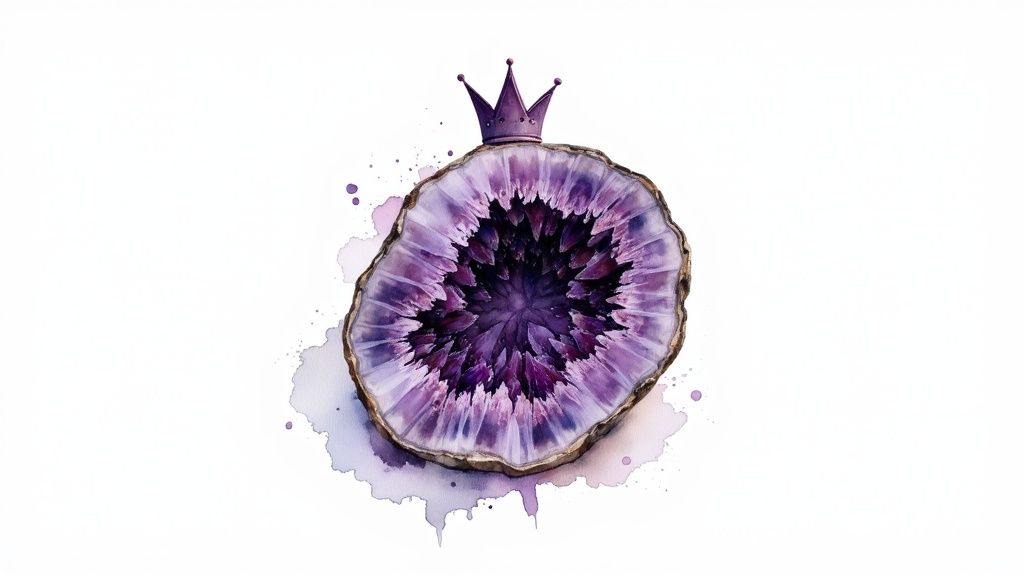
When you think of quartz, you probably picture a clear, glassy crystal. But what happens when nature adds a couple of surprise ingredients? You get amethyst—the stunning purple version of one of the most common minerals on Earth.
It’s not a separate mineral, but rather a special coloration. Think of it like a secret recipe: quartz is the base ingredient, but a little bit of iron and a long, slow bake of natural radiation from the Earth's crust create amethyst’s celebrated purple expression.
Unveiling the Royal Purple Gemstone
From ancient royal crowns to the modern jewelry we wear today, the deep allure of amethyst has captivated people for thousands of years. Its incredible color, which can range from a soft lilac to a rich, velvety purple, has always been tied to royalty, power, and mental clarity.
So, what is this mesmerizing stone, really? And how in the world does it get that majestic color?
At its heart, amethyst is simply silicon dioxide (SiO₂). That's the exact same chemical formula as clear quartz, rose quartz, and even citrine. The real magic happens deep underground, where two key ingredients come together during the crystal’s formation:
Trace Iron Impurities: As the quartz crystal grows, tiny amounts of iron get trapped inside its lattice structure.
Natural Gamma Radiation: Over millions of years, the surrounding rock emits low levels of radiation, which zaps the iron-laced quartz.
This natural one-two punch alters the iron's electrons, causing the crystal to absorb certain colors of light and reflect back those beautiful shades of purple. The final color often depends on just how much iron was present and how long the crystal was exposed to radiation.
A Stone Steeped in History
Amethyst's story is just as rich as its color. The name itself comes from the Greek word amethystos, which translates to "not intoxicated." The ancient Greeks genuinely believed the stone could prevent drunkenness, so they would wear amethyst amulets or even carve their wine goblets from it.
This belief in its sobering, clarifying power stuck around. In the Middle Ages, amethyst became a symbol of piety and divine wisdom, often worn by bishops and other clergy. Of course, its regal purple hue also made it a must-have for monarchs, who studded their crowns and scepters with it as a symbol of their divine right to rule. Even Leonardo da Vinci wrote that amethyst could sharpen intelligence and chase away evil thoughts.
Amethyst stands as a bridge between geology and culture. Its formation tells a story of volcanic origins and slow transformation, while its history reflects centuries of human admiration for its beauty and perceived power.
Understanding what amethyst is means looking at both its science and its story. It’s a perfect example of how a simple geological process can create something of profound beauty, which in turn inspires deep meaning for us. Before we dive into exactly how these crystals form, getting the basics down is key. For anyone looking to sharpen their identification skills, our comprehensive crystal identification guide is a fantastic place to start building that foundational knowledge.
The Geological Journey of Amethyst Formation
The story of how amethyst comes to be is a dramatic one, a tale of fire, water, and immense stretches of time. It all begins deep within the Earth, often over a billion years ago, during periods of intense volcanic activity. Picture molten lava, superheated and full of gases and steam, just like the bubbles in a can of soda.
As this lava cooled and solidified into rock like basalt, those gas bubbles became trapped, forming hollow, spherical, or almond-shaped cavities within the hardening stone. These natural voids became the perfect, protected nurseries for crystals to grow.
The Hydrothermal Beginning
Once the volcanic rock cooled down, the next phase of the journey began. This process, called hydrothermal activity, is the real secret to crystal creation. Groundwater, heated by the still-warm volcanic rock deep underground, started to circulate through the cracks and fissures of the newly formed stone.
This superheated water acted like a natural solvent, dissolving minerals from the surrounding rock. It became a rich, silica-infused soup, carrying all the necessary building blocks for quartz. As this mineral-rich water seeped into those hollow cavities, it found the ideal environment to begin its slow, meticulous work. You can learn more about these incredible hollow rocks in our detailed guide on what is a geode.
The formation of amethyst is a testament to nature's patience. Each crystal is built molecule by molecule over millions of years as mineral-rich fluids deposit microscopic layers of silica within a protected geological cavity.
Inside these pockets, the conditions were just right. The temperature and pressure slowly dropped, causing the dissolved silica to precipitate out of the water and begin crystallizing onto the inner walls. This process repeated itself over countless millennia, with each new layer adding imperceptibly to the growing crystals.
From Clear Quartz to Purple Gem
For a very long time, the crystals growing inside these pockets were just ordinary clear quartz. The magical transformation into amethyst required two final, crucial ingredients that were floating around in that mineral-rich water:
Trace Amounts of Iron: Tiny iron impurities (Fe³⁺) were incorporated right into the quartz crystal's lattice structure as it grew. At this stage, the iron didn't produce any color at all.
Natural Gamma Radiation: The surrounding host rock, especially granite, naturally emits low levels of gamma radiation over millions of years.
This faint but persistent radiation was the final trigger. When the gamma rays zapped the iron atoms trapped inside the quartz, they knocked an electron out of place, creating what scientists call a "color center." This tiny change fundamentally altered how the crystal absorbed light.
Instead of light passing through cleanly, these new color centers began to absorb light in the yellow and green parts of the spectrum. The light that is reflected back to our eyes is what we see as those stunning shades of purple.
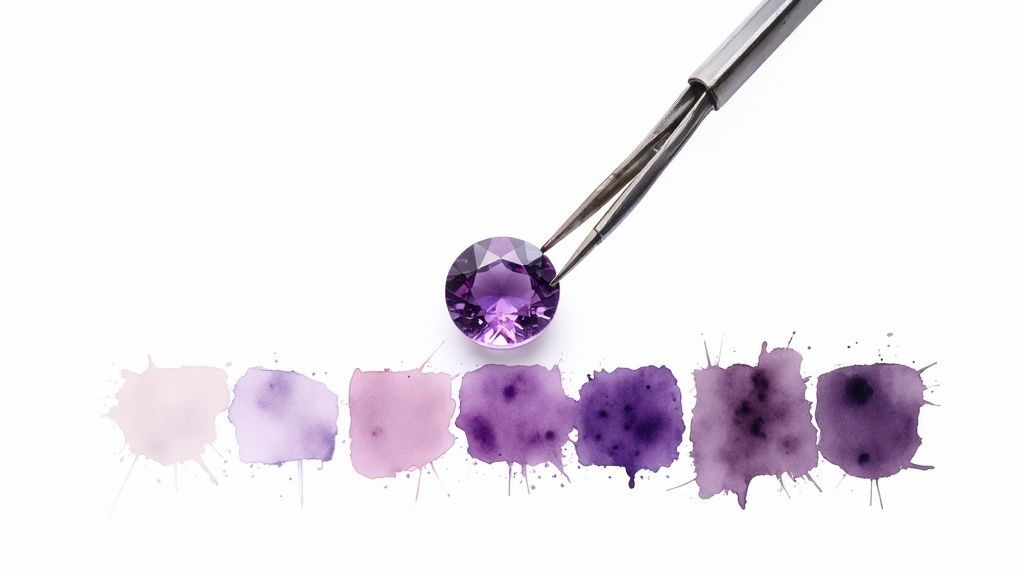
The intensity of the final color really depends on the concentration of iron and how long—and how strong—the radiation exposure was. A little bit of iron might result in a pale lilac, while higher concentrations and longer exposure can create the deep, velvety purples prized in the finest amethyst specimens. It's this slow, patient geological dance of heat, pressure, minerals, and radiation that gives us the beloved purple gemstone we all admire today.
Exploring the Spectrum of Amethyst Varieties
When you think of amethyst, that classic rich purple probably comes to mind. But the world of amethyst quartz is so much more than a single color. "Amethyst" is really the family name for a whole range of related varieties, each with its own personality, color depth, and geological story.
It’s a bit like apples. A Granny Smith and a Red Delicious are both apples, but they look and taste completely different. In the same way, amethyst varieties show off a stunning range of possibilities. Some are prized for their deep, velvety purple, while others are loved for their soft pastel tones or mind-bending patterns. Digging into these variations lets you see the subtle, beautiful ways geology can turn a common mineral into a spectrum of natural art.
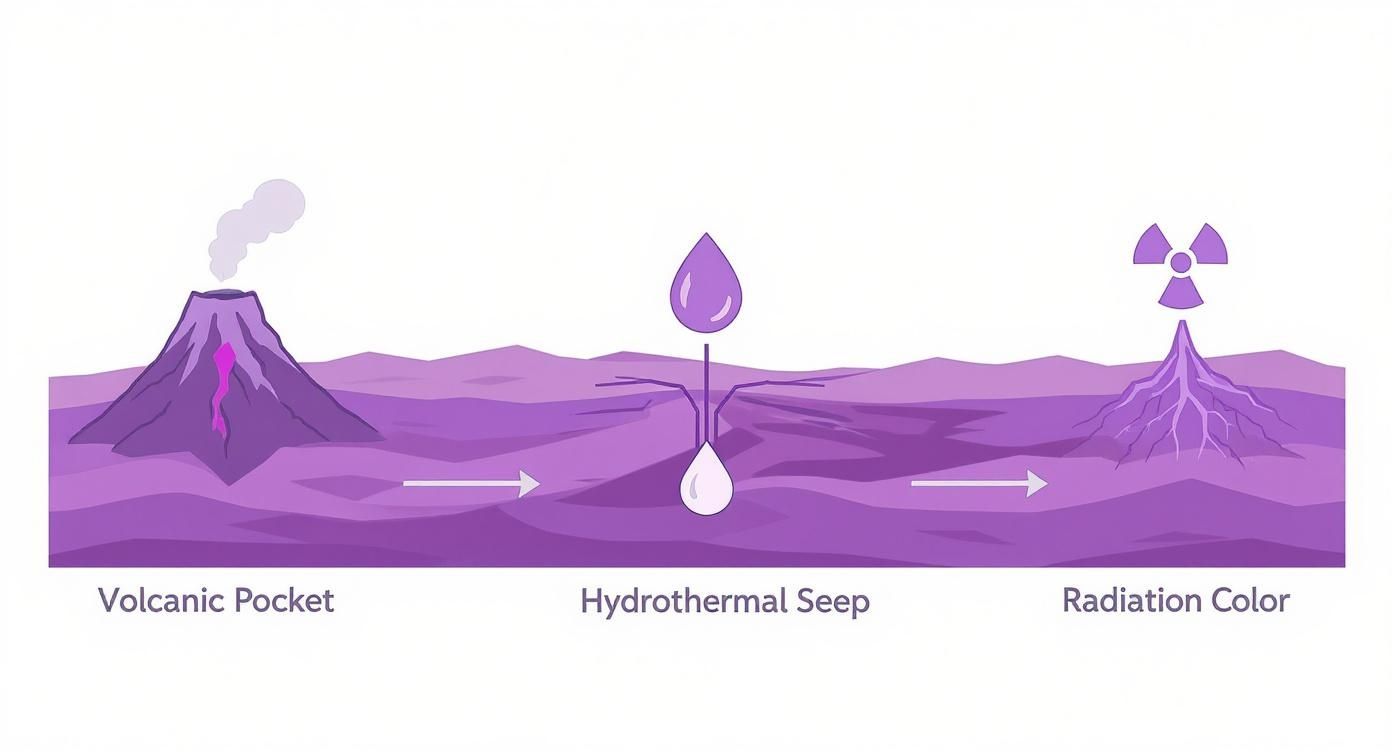
This whole process, from a volcanic pocket forming to the final coloration, is what gives each type its unique look. The infographic below breaks down how it all happens.
It’s pretty amazing to think that a simple chain of events—a cavity, some mineral-rich water, and a bit of natural radiation—can produce such a wide array of beautiful crystals.
The Most Sought-After Amethyst Types
Certain types of amethyst are a huge hit with collectors and jewelry designers, either for their incredible color or unique formations. Each one tells a slightly different chapter of the amethyst story.
Siberian Amethyst: This is the gold standard, the benchmark for what top-quality amethyst should look like. It’s known for an incredibly deep purple saturation that flashes with hints of red and blue. True Siberian amethyst is extremely rare today since the original mines are played out, but the name is now used to describe any amethyst with this top-tier coloring.
Rose de France Amethyst: On the complete opposite end of the spectrum, Rose de France is all about its delicate, light pastel shades of lilac or a soft pinkish-purple. Its subtle, romantic vibe makes it a go-to for elegant and understated jewelry.
Ametrine: This one is a true natural wonder. Ametrine is a single crystal that is part amethyst and part citrine, creating a wild bi-color effect. This happens because of different temperatures during the crystal’s formation, which changes the iron impurities and results in distinct zones of purple and yellow.
The love for these different stones isn't just anecdotal—it shows up in the numbers. The global amethyst jewelry market was valued at around USD 4.2 billion in 2023 and is only expected to climb, with projections hitting USD 7.8 billion by 2033. That’s a clear sign of a strong, lasting appreciation for this gem.
Comparing Popular Amethyst Quartz Varieties
To make sense of the major players, it helps to see them side-by-side. This table breaks down the key differences between some of the most popular amethyst varieties you'll encounter.
Variety
Primary Color
Distinguishing Features
Common Origin
Siberian Amethyst
Deep, rich purple
Strong red and blue secondary flashes
Historically Russia; now a grade
Rose de France
Light lilac/pinkish-purple
Delicate, pale, and transparent
Brazil, Uruguay
Ametrine
Purple and yellow/orange
Distinct bi-color zones in one crystal
Bolivia (Anahi Mine)
Chevron Amethyst
Purple and white
V-shaped bands of amethyst and quartz
Brazil, India, South Africa
Cactus (Spirit) Quartz
Varies (often lilac)
Large crystal covered in smaller druzy points
South Africa
Each of these tells a unique geological story, offering something different for collectors and designers alike.
Unique Formations and Patterns
Beyond just color, some amethyst is defined by its wild crystal habits and patterns, which are a direct result of the specific environment it grew in.
Chevron Amethyst is a fantastic example. It shows off these striking V-shaped bands of milky white quartz layered with deep purple amethyst. This mesmerizing pattern is caused by growth interference while it was forming, creating a graphic-looking stone that’s perfect for cabochons and decorative pieces.
Then you have Cactus Quartz, also called Spirit Quartz. This variety features a main amethyst crystal that’s completely crusted over with a second growth of smaller, glittery druzy crystals all pointing outwards. It’s found mostly in South Africa, and its unique spiky texture gives it a sparkle unlike anything else. If you're curious about other gems in this color family, you can check out our guide on other purple crystal stones.
From the uniform depth of Siberian amethyst to the striped beauty of Chevron, each variety is a geological snapshot. These differences in color, pattern, and form offer collectors a rich and diverse world to explore within a single gemstone family.
Getting to know these different types helps you appreciate the full breadth of what amethyst can be. Whether you’re drawn to deep royal purples, soft pastels, or funky natural patterns, there’s an amethyst out there with your name on it—each with an incredible story written over millions of years.
What Makes Amethyst So Special? A Look at Its Properties and Meanings
There's more to amethyst than meets the eye. Beyond its gorgeous purple color and fascinating geology, this gem really has a dual identity. On one hand, it's a durable, practical gemstone with physical qualities you can measure. On the other, it’s a powerful symbol that’s been wrapped up in human belief for thousands of years.
To really get what makes amethyst so compelling, you have to look at both sides of the coin. It speaks just as much to the pragmatic gemologist who appreciates its toughness as it does to the spiritual seeker drawn to its famously calming energy. Let's bridge that gap and connect the hard science to the deep significance that makes it so beloved.
The Physical Nature of Amethyst
From a practical standpoint, amethyst is a seriously robust and reliable gemstone—a huge reason why it’s been a jewelry staple for so long. The most important thing to know about it is its hardness.
Amethyst clocks in at a 7 on the Mohs hardness scale, putting it right in line with other types of quartz. What does that mean in the real world? It's much tougher than stones like fluorite (a 4) or apatite (a 5), but not quite as hard as a topaz (8) or, of course, a diamond (10). That 7 is a real sweet spot for jewelry. It’s durable enough to stand up to the bumps and scrapes of daily life, making it perfect for rings, bracelets, and necklaces you want to wear all the time.
An amethyst’s hardness isn’t just a random number; it comes directly from its crystal structure. The powerful bonds between its silicon and oxygen atoms create a super stable and resilient framework. That’s what makes it both beautiful and practical enough for everyday wear.
This resilience, coupled with the fact that it's widely available, gives amethyst a major role in the gemstone world. It's a significant player in the colored gemstones market, which was valued at around USD 6.8 billion globally in 2023. And that market is only growing—it's expected to hit about USD 12.4 billion by 2032, which tells you there's a strong and steady demand for beautiful, tough stones just like amethyst.
Meanings Woven Through History
While its physical traits make it useful, its symbolic meanings are what make it a legend. Jump across any culture or century, and you’ll find amethyst consistently linked with clarity, peace, and a connection to the spiritual.
It all started with the ancient Greeks, who gave the stone its name from their word amethystos, which means "not intoxicated." They genuinely believed it could ward off drunkenness and keep the wearer's mind sharp and clear. This idea of mental sobriety has stuck with the gem ever since.
A Sign of Royalty: For centuries, purple dye was incredibly difficult and expensive to make, so the color naturally became a symbol of wealth and power. Kings, queens, and pharaohs decked themselves out in amethyst to show off their noble status.
A Link to the Divine: In the Middle Ages, Catholic bishops wore amethyst rings as a symbol of piety, heavenly wisdom, and their vows of celibacy. The stone was seen as a direct line to a higher power.
The Ultimate Chill Stone: Across countless traditions, amethyst has been seen as a natural tranquilizer. People believed it could soothe irritability, balance out mood swings, and chase away anger, fear, and anxiety.
Amethyst in Modern Spiritual Practices
That long-standing reputation for promoting peace and insight is alive and well today. In modern wellness and spiritual circles, amethyst is easily one of the most recognized and popular crystals out there. It’s most often connected to the higher chakras—specifically the Third Eye and Crown Chakras. These are seen as our centers for intuition, wisdom, and our connection to the universe.
Many people believe that just having an amethyst in a room can help clear out negative vibes and create a more serene, peaceful atmosphere. If you want to better understand how different energies connect to your inner self, you might want to explore the chakra system and its colors to see where stones like amethyst fit into the bigger picture.
Whether you're drawn to the science behind the quartz or the deep cultural stories it tells, amethyst is a perfect blend of both. It's a stone that's physically tough enough for an engagement ring yet symbolically gentle enough to be called a stone of peace—a rare combination that cements its place as one of the world's favorite gems.
A Buyer's Guide to Selecting Quality Amethyst
So, you're ready to pick out your own amethyst. Stepping into the gem market can feel a little overwhelming at first, but knowing what to look for makes all the difference. With a few expert tips, you can confidently choose a stone that's not just gorgeous, but a smart buy, too.
Gem experts have a system for this, and it's a lot like the famous '4 Cs' used for diamonds: color, clarity, cut, and carat weight. While they all matter, for amethyst, one of these stands head and shoulders above the rest.
Judging Amethyst by Its Color
Color is the single most important factor in determining an amethyst's value. Unlike diamonds where a lack of color is the goal, with amethyst, it’s all about the richness and depth of that signature purple. The perfect amethyst has a strong, reddish-purple to deep purple hue with no weird patches of uneven color, a phenomenon known as color zoning.
When you're looking at a stone, you want to see vibrant, even saturation. The absolute best-of-the-best specimens are often called "Siberian" grade. These have a deep purple body with mesmerizing secondary flashes of red and blue. They're rare, but knowing this gold standard helps you size up any amethyst you come across.
Your goal is to find a stone that’s not too dark—so dark it looks black in anything but the brightest light—and not too light, which can look washed out. That sweet spot is a lively, rich purple that really pops and sparkles.
A stone’s price is tied directly to the quality of its color. If you want to see how this plays out in the real world, our detailed guide on the price of amethyst per carat breaks down how much premium colors are really worth.
Understanding Clarity and Cut
Right after color, clarity and cut have a huge impact on a gem’s beauty. The good news is that most faceted amethyst you’ll find on the market is eye-clean, which just means you won't see any inclusions with your naked eye. Minor inclusions are totally natural, but they shouldn't get in the way of the stone's overall sparkle.
The cut is what really brings an amethyst to life. It’s the artistry that unlocks its brilliance. A great cut will:
Make the color and light return as dramatic as possible.
Skillfully minimize any color zoning.
Be symmetrical and well-proportioned.
Look for facets that meet at crisp, clean points and a surface that throws light back at you evenly. A dull or funky-shaped stone is usually a red flag for a sloppy cut.
The Role of Treatments and Sourcing
It’s also smart to know about common treatments. A lot of amethyst is heat-treated to either lighten its color or get rid of any brownish tones. This is a completely stable and accepted practice in the industry, but it's something a seller should always tell you about.
Finally, think about where the gem came from. Ethical sourcing is a big deal for a lot of buyers these days. People want to know that their gems are responsibly mined. For instance, demand for sustainably sourced amethyst star stones—a cool variety with a star-like effect—is expected to jump by around 30% worldwide. This is part of a bigger shift toward transparency in the whole gemstone supply chain.
When you're shopping, never be afraid to ask about a stone's history. A reputable dealer will be happy to tell you where a gem is from and any treatments it has had. That transparency gives you the confidence you need to make a purchase you'll love for years to come.
How to Care for Your Amethyst Gemstone
Owning a gorgeous piece of amethyst is a real joy, but keeping that vibrant color and brilliant sparkle means knowing how to look after it. Just like any treasured possession, a little bit of proper care ensures your gemstone stays as stunning as the day you got it.
The good news is that amethyst is a pretty durable stone. Keeping it in perfect condition is actually quite straightforward once you know the basics. The key is a gentle approach—harsh chemicals, extreme temperatures, and rough handling are its main enemies.
The Right Way to Clean Amethyst
When it comes to cleaning your amethyst, simple is always better. You really only need a few common household items to get the job done right.
Warm Soapy Water: Grab a mild soap (like basic dish soap) and mix it with some warm water. You'll want to avoid any harsh chemical cleaners, especially anything with acids or ammonia, as they can slowly damage the stone.
A Soft Brush: A soft-bristled toothbrush is your best friend here. It’s perfect for gently scrubbing away any built-up oils or grime, especially in the nooks and crannies of a jewelry setting.
Thorough Rinsing: Make sure you rinse the amethyst completely under clean water. Any soap residue left behind will create a dull film on the surface, which is exactly what we're trying to avoid.
Gentle Drying: Pat the stone dry with a soft, lint-free cloth. Letting it air dry can leave water spots, so giving it a final gentle polish with a cloth is the best way to finish.
One big thing to remember: avoid ultrasonic and steam cleaners. While these are great for super-hard gems like diamonds, the intense heat and vibrations can cause tiny fractures in amethyst. This is especially true if the stone has any internal inclusions that you can't even see.
The golden rule for amethyst care is gentleness. The same properties that give it that beautiful purple color also make it a bit sensitive to harsh treatments. A simple bath in soapy water is all it needs to bring back its natural shine.
Avoiding Color Fading and Scratches
Protecting that magnificent purple color is probably the most critical part of caring for your amethyst. That vibrant hue is what makes it so special, but it can fade if you're not careful.
The biggest threat to its color is prolonged exposure to direct sunlight or intense heat. The sun's UV rays can actually break down the color centers inside the crystal, causing that deep purple to wash out over time. And once it's gone, that color is gone for good. So, a word to the wise: never leave your amethyst jewelry or crystals sitting on a sunny windowsill.
Proper storage is also a must. Amethyst sits at a 7 on the Mohs scale of hardness. That’s pretty tough, but it means it can be scratched by harder gemstones like topaz (8), sapphires (9), and diamonds (10). To keep it from getting nicked and scuffed, store your amethyst pieces separately. A soft pouch, a fabric-lined jewelry box, or even its own little compartment will keep it safe from getting banged up by harder items in your collection.
Amethyst FAQs: Your Questions Answered
To wrap things up, let's tackle a few of the most common questions people ask about this gorgeous purple quartz. Think of this as a quick-reference guide to satisfy your final points of curiosity.
Is Amethyst a Precious Stone?
It used to be! For centuries, amethyst was right up there with diamonds, rubies, and sapphires as one of the five "cardinal" precious gems. That all changed in the 19th century when enormous deposits were unearthed in Brazil, making it much more available.
Today, it’s officially classified as a semi-precious gemstone. But let's be honest—its royal reputation and stunning beauty haven't faded one bit.
Can Amethyst Go in Water?
Yes, for a quick clean, water is perfectly safe. Amethyst is a type of quartz, so it won’t dissolve or get damaged from a little rinse with mild soap. It's how we recommend cleaning it.
However, don't leave it soaking for hours on end, especially in salt water. Over time, prolonged exposure can start to dull the stone's natural luster or even mess with certain types of jewelry settings. A quick wash is fine; a long bath is not.
What Is the Difference Between Amethyst and Quartz?
This one trips a lot of people up, but the answer is surprisingly simple: amethyst is quartz.
Think of "quartz" as the big family name for a huge group of minerals made of silicon dioxide. When you add in different trace elements and unique geological conditions, you get all the different family members—like clear quartz, citrine, rose quartz, and of course, our purple hero, amethyst.
The only real difference is that amethyst has a secret recipe: tiny amounts of iron impurities that have been naturally irradiated over millions of years. That magical combination is what gives it that signature purple hue. Without it, you’d just have plain old clear quartz.
So, remember: all amethyst is quartz, but not all quartz gets to be amethyst. It's a very special, beautifully colored member of a massive mineral family, and that's what makes it so prized.
Discover your own piece of natural history at Astro West. Explore our curated collection of ethically sourced amethyst, fine minerals, and unique jewelry at https://astrowest.com.