Your Guide to Graves Mountain Georgia Rockhounding
Picture this: a place where the earth itself offers up fiery red rutile crystals and chunks of deep blue lazulite, a spot known and revered by serious collectors all over the globe. That place is Graves Mountain, Georgia, a truly legendary rockhounding site that produces some of the finest mineral specimens on the planet. This guide is your map to uncovering everything it has to offer.
Welcome to Georgia's Premier Mineral Treasure
Tucked away in Lincoln County, Graves Mountain isn't just the tallest peak in the Central Savannah River Area—it's a world-renowned destination for anyone with a passion for minerals. Think of it less as a mountain and more as a natural treasure chest, one that has been pried open time and again for decades, always revealing something incredible.
We're going to dig deeper than just the basic facts. This guide tells the stories etched into its ancient rocks, from its violent geological birth to its long history as a mining powerhouse. The mountain’s reputation is built on the sheer quality of its minerals—especially its rutile, which is in a class of its own.
What Makes Graves Mountain So Special?
So, what exactly elevates this Georgian peak from a local curiosity to a site with international fame? It comes down to a one-of-a-kind geological history that cooked up an incredible variety of minerals. It's the kind of place where a seasoned collector and a first-time digger can both feel that same thrill of discovery.
What sets Graves Mountain apart?
World-Class Rutile: This is one of the very few places on Earth where you can find large, beautifully formed, blood-red rutile crystals. They are the gold standard.
A Mineralogical Buffet: It's not just about rutile. Collectors flock here for stunning blue lazulite, shimmering iridescent hematite, and over 40 other mineral species.
Public Access: While it's private property, the mountain opens to the public during its biannual "Rock Swap and Dig" events, giving everyone a chance to get their hands dirty.
A Rich History: From hopeful gold prospectors before the Civil War to large-scale kyanite mining in the 20th century, the ground here is soaked in history.
Graves Mountain isn't just a place; it's an event. The biannual digs are a massive affair, drawing over 1,500 people from around the world and turning this quiet corner of Georgia into a bustling hub for the entire mineral community.
For a quick overview of what you need to know before you go, this table breaks down the essentials.
Fee-based digging during scheduled events. No public access outside these times.
What to Bring
Safety glasses, rock hammer, chisels, gloves, sturdy boots, buckets, and wrapping material for specimens.
On-Site Amenities
Primitive camping, food vendors, and portable restrooms are available during events.
Geological Formation
A pyrophyllite-kyanite-lazulite-rutile-quartz sericite schist, formed by intense metamorphism.
This table should give you a solid starting point for planning your adventure.
Whether your goal is to unearth a museum-quality specimen or you're just looking for a unique weekend adventure, this guide will walk you through everything you need for an unforgettable trip to Graves Mountain.
The Geological Story Forged in Fire and Pressure
So, what makes Graves Mountain a paradise for mineral collectors? The answer isn't just lying on the surface. It's a story that starts hundreds of millions of years ago, deep inside the Earth's crust. This isn't just any old mountain—it's the incredible result of immense geological forces that turned ordinary rock into a treasure chest of rare and beautiful specimens.
Think of it like a giant, natural pressure cooker. That’s the easiest way to picture metamorphism, the geological event that created the unique conditions at Graves Mountain. Ages ago, this area was a basin where sediments like sand and clay slowly piled up. Over time, those layers got buried miles deep, and that’s where the real magic started to happen.
A Recipe for Rare Minerals
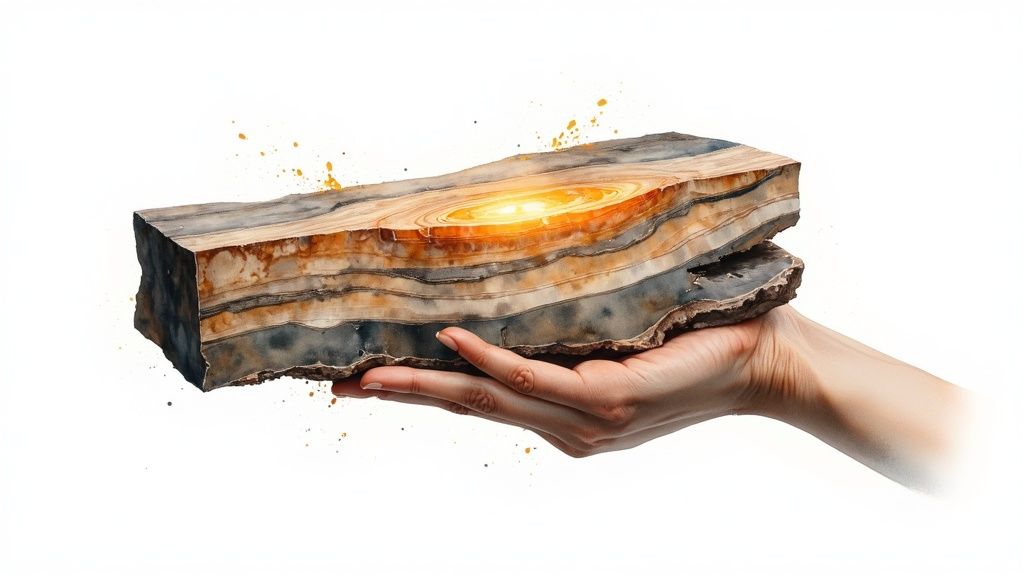
Deep underground, the intense heat and crushing pressure began to cook and squeeze these sedimentary rocks. This wasn't a gentle warming; it was a violent transformation that broke down the original minerals and re-formed them into something entirely new. The once-soft shales and sandstones were baked into a tough, crystalline rock called schist.
This metamorphic process is the key to understanding why Graves Mountain is so special. It created the perfect host rock—rich in quartz, sericite, and most importantly, kyanite—for the incredible crystals that would form later. To get a better feel for this fascinating transformation, you can explore our detailed guide on what is metamorphic rock.
This whole geological drama played out during the Pennsylvanian Period, around 310 to 280 million years ago. Later, folding and heating of the Earth’s crust kept changing these rocks, creating a truly unique mineral profile. Eventually, commercial mining operations zeroed in on the abundant kyanite, which was prized for its heat-resistant properties. At one point, this single location produced about 50% of all kyanite in the United States.
The geology of Graves Mountain is a perfect example of how the right combination of "ingredients"—the original rock type, immense pressure, and intense heat—can create a mineralogical masterpiece unlike anywhere else on Earth.
The Final Touch: Hydrothermal Activity
The last chapter in this story involved superheated, mineral-rich fluids. Long after the initial metamorphism, hot water coursed through cracks and fractures in the rock. This hydrothermal activity was like a delivery service, carrying elements like titanium and aluminum and dropping them off in open pockets and veins within the schist.
As these fluids cooled, the elements crystallized, forming the stunning minerals that collectors hunt for today. This is the process that gave us:
Rutile: The world-famous blood-red crystals formed from titanium.
Lazulite: Deep blue crystals created from a complex mix of magnesium, iron, and aluminum.
Pyrite: "Fools Gold" that adds that classic metallic glint to so many specimens.
This incredible sequence of events—sedimentation, intense metamorphism, and finally, hydrothermal crystallization—is why a trip to Graves Mountain feels like stepping back in time. Every crystal you find is a tangible piece of an ancient and powerful story forged in fire and pressure.
From Gold Rush Dreams to Modern Mining
The story of Graves Mountain isn't just about geology; it's a very human tale of discovery, ambition, and industry. Long before it became a rockhound's paradise, the area whispered promises of a different kind of treasure: gold. The mountain's first chapter with people was written by prospectors during the pre-Civil War gold rush, all of them chasing fortunes in its winding streams.
These early treasure hunters weren't looking for kyanite or rutile. They were part of a much bigger movement sweeping across the South, panning for placer gold that had washed down from the mountain's slopes. This era laid the groundwork for the more intense mining operations that would come later, changing the face of the mountain forever.
The Magruder Gold Mine Era
The hunt for gold got serious with the establishment of the Magruder Gold Mine. Historically, this spot was a well-known center for gold mining even before 1850, with Mine Branch Creek being the first source of placer deposits. Major operations kicked off in 1852 and ran off and on until the Civil War brought everything to a standstill in 1861.
Mining picked back up around 1874 under new ownership, which led to the digging of a 125-foot shaft and extensive tunnels to tap into the mineralized veins. For a deep dive into these early operations, you can check out this detailed historical account in a Southeastern Geological Society guidebook.
Of course, not everything that glitters is gold. Prospectors constantly stumbled upon shiny, metallic minerals that looked just like the real deal but were actually pyrite—famously known as "fool's gold." Learning the difference was a crucial, and often disappointing, lesson. If you're curious about this classic geological mix-up, our guide on how to tell gold from pyrite has some great tips.
A Shift to Industrial Minerals
The gold rush eventually fizzled out, but the mountain’s real value hadn't even been discovered yet. In the 20th century, industrial giants realized the true treasure wasn't gold at all, but kyanite—a mineral prized for its incredible ability to withstand extreme heat. This marked a huge shift from small-time gold prospecting to large-scale industrial mining.
The transition from gold mining to kyanite extraction fundamentally reshaped Graves Mountain's landscape. The massive open-pit operations of the 20th century are directly responsible for exposing the rich mineral veins that rockhounds explore today.
This new era of mining started in the 1960s and continued for decades. Heavy machinery carved away entire sections of the mountain, creating the terraced pits and exposed rock faces you see today. While this industrial work was focused on a single commodity, it accidentally unearthed an incredible variety of other minerals.
Every blast and excavation revealed pockets of world-class rutile, lazulite, and iridescent hematite, turning a commercial mine into an unintentional paradise for collectors. The history of ambition and industry at Graves Mountain is what makes every find there a piece of a much larger story.
A Collector's Guide to World-Class Minerals
This is where the real fun at Graves Mountain begins. You stop being just a visitor and become a genuine rockhound. The mountain isn't just a pile of dirt to dig in; it's a living field guide to some of the world's most incredible mineral specimens. The first step to building a killer collection is learning how to spot these treasures in the rough.
The ground here tells a dramatic story of heat and pressure, and the minerals are the story's main characters. You’ll find everything from world-famous rutile to brilliant lazulite and jaw-dropping hematite. Each piece you pick up is a tangible piece of that ancient history. With a little practice, you can learn to read the landscape and uncover its hidden gems.
Identifying the Stars of the Show
While Graves Mountain is home to dozens of minerals, a few key players have put this place on the global map. These are the specimens that draw collectors from all over, and they should be right at the top of your "must-find" list. Recognizing them in the field is the skill that turns a good day of digging into a truly unforgettable one.
Your primary targets should be:
Rutile: This is the undisputed king of Graves Mountain. You're looking for deep, blood-red to almost black crystals that have a killer metallic shine, which makes them pop against the host rock. The absolute best finds are "twinned" crystals, where two or more have grown together at perfect angles, creating incredible geometric shapes.
Lazulite: Nothing beats the brilliant pop of deep azure blue from a lazulite crystal. They're often found stuck in the lighter-colored pyrophyllite or quartz matrix. They typically form sharp, wedge-shaped crystals and are highly prized for that intense, saturated color.
Iridescent Hematite: People often call this "rainbow hematite," and it's a real showstopper. It forms a thin, shimmering coat on other rocks, flashing an oily sheen of metallic rainbow colors. A good piece will light up with vibrant blues, purples, greens, and golds as you turn it in your hand.
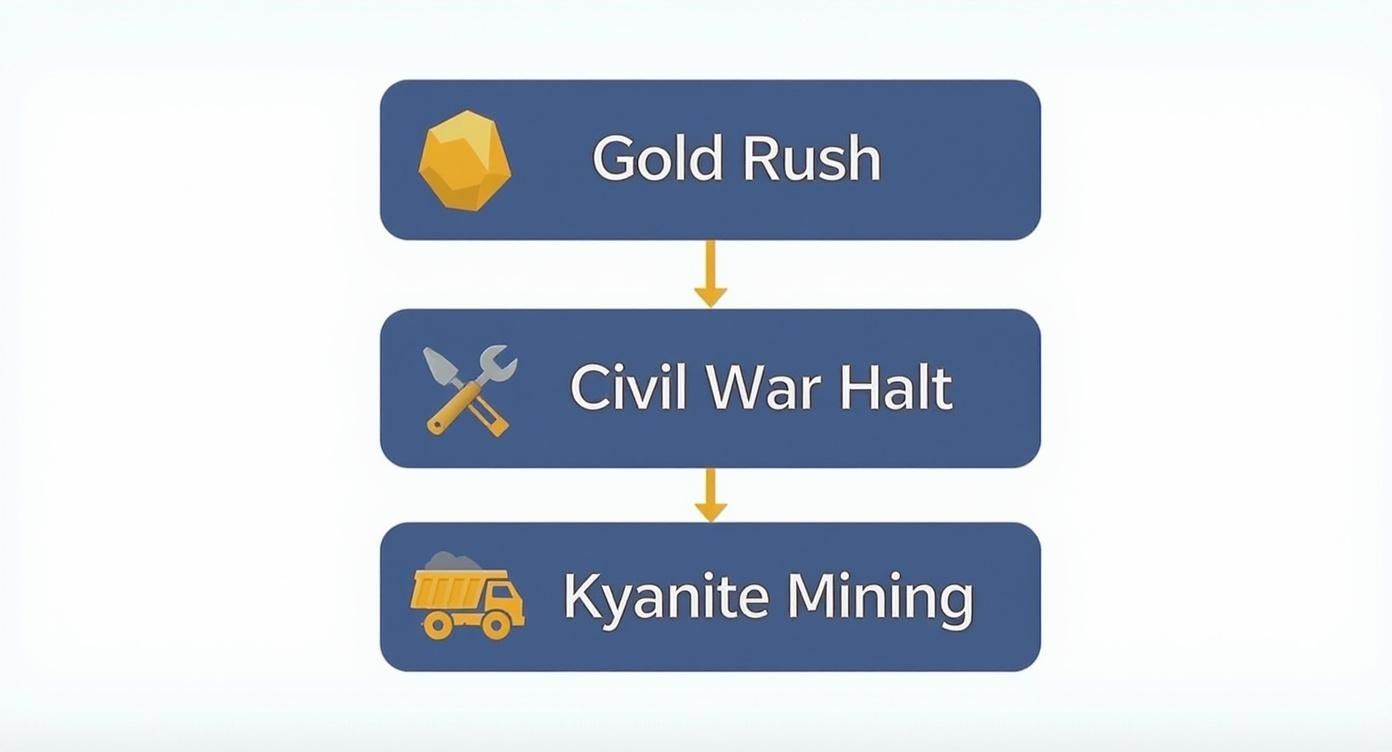
This infographic breaks down the major historical moments that shaped the mountain, from the early gold rush days to the industrial mining that first unearthed these world-class minerals.
This timeline really shows how each era of digging peeled back another layer, revealing the mineral treasures we get to hunt for today.
What Makes a Specimen High-Quality
Let's be real: not every find is going to be a museum piece. A huge part of the hobby is learning to evaluate the quality of what you find, and that's a skill you'll hone over time. A small but perfect crystal is almost always more desirable than a big, busted-up one.
For anyone just starting out, it helps to know what serious collectors look for. If you're hoping to turn your finds into a serious display, check out our guide on how to start a collection of rare rocks and minerals.
Graves Mountain is globally renowned for its mineral specimens, particularly its large, multiple twinned rutile crystals, which are considered some of the finest worldwide. Since the 1920s, notable companies like Tiffany and Company mined rutile here, which was historically used for polishing diamonds.
The site is also famous for minerals like lazulite, iridescent hematite, pyrophyllite, barite, and quartz. Specimens from Graves Mountain are so important they're held in collections across the globe, including the Smithsonian Museum of Natural History. That alone tells you just how significant this place is. You can learn more about this history from the Georgia Mineral Society.
Ultimately, collecting at Graves Mountain is all about the thrill of discovery. Every rock you turn over could be the one holding a perfect crystal—a little piece of Earth's art that's been waiting millions of years for you to find it.
How to Plan Your Rockhounding Trip
So, you're ready to get your hands dirty and find some treasure at Graves Mountain? Good. Planning a successful trip here is all about strategy, especially since the mountain isn't open to the public whenever you feel like showing up.
Your entire adventure hinges on timing your visit with one of the biannual Rock Swap and Dig events. These gatherings, usually held in the spring and fall, are your golden ticket. The property owners host them to provide safe, organized access for collectors like us. During these weekends, the mountain transforms into a bustling hub for the mineral community, drawing enthusiasts from all corners of the globe.
For the official dates, digging fees, and any last-minute news, your best bet is to keep an eye on the official Graves Mountain Community page.
Gearing Up for the Dig
Showing up with the right equipment can be the difference between a fantastic day and a frustrating one. You don’t need a pro-level setup, but a few key items are absolutely essential for both your success and your safety. The terrain is rugged, so being prepared is non-negotiable.
Here’s a look at a basic rockhounding toolkit:
A sturdy rock hammer or crack hammer is a must for breaking apart larger rocks.
Chisels are perfect for carefully extracting those delicate specimens from their matrix.
A shovel or garden trowel will help you clear away loose dirt and debris.
Durable buckets are necessary for carrying your finds without them getting banged up.
Wrapping material, like old newspaper or bubble wrap, is crucial for protecting fragile crystals on the way home.
Safety is your absolute top priority on the mountain. You'll be working on exposed rock faces and loose slopes, which makes proper protective gear a must. Never put finding the next great specimen ahead of your own well-being.
What to Wear and Important Site Rules
Comfort and safety are two sides of the same coin out here. You’ll be exposed to the elements for hours, so dress for the occasion. Georgia weather can be a wild card, but you can always count on two things: plenty of sun and a whole lot of dirt.
Here’s a quick checklist for what to wear and what to know:
Safety Glasses or Goggles: This is mandatory. Protect your eyes from flying rock chips at all times.
Sturdy, Closed-Toe Boots: Good ankle support is critical for navigating the uneven, rocky ground.
Durable Gloves: A solid pair of work gloves will save your hands from countless cuts and scrapes.
Sun Protection: Wear a wide-brimmed hat, slather on the sunscreen, and bring extra to reapply. Shade is practically nonexistent.
Stay Hydrated: Pack way more water than you think you'll need. Bring some snacks to keep your energy levels up, too.
When you arrive, you'll need to sign a liability waiver. It’s absolutely critical to stay within the designated collecting areas and follow any instructions from the event staff. Under no circumstances should you ever undermine rock walls—this creates dangerously unstable conditions for everyone.
And remember the golden rule of rockhounding: pack out everything you pack in. Leave the site just as you found it. After a long, successful day of digging, a good crystal identification guide will be your best friend for sorting through all your amazing new finds.
Your Graves Mountain Questions Answered
So, you're planning a trip to Graves Mountain. Smart move to do your research first. Having the right info before you go is just as critical as having the right hammer in your bucket.
To make sure you're fully prepared for your adventure, I've put together answers to the most common questions people ask about visiting and collecting here. Let's dig in and clear up any confusion so you can make the most of your trip.
When Is the Best Time to Visit Graves Mountain?
This is the single most important thing to know: Graves Mountain is private property. It isn't open to the public year-round.
The best—and really, the only—times for collectors to visit are during the biannual Rock Swap and Dig events. These are fantastic, organized weekends that give you safe access to the prime collecting areas.
These events are usually held in the spring (think April or May) and fall (October). Trying to visit outside of these designated weekends is trespassing. Always plan your trip around an official dig.
For the most accurate and current dates, you absolutely must check the official Graves Mountain Facebook page or the websites of associated mineral clubs. Dates can shift from year to year, so don't just rely on old information.
What Tools Should I Bring for Mineral Collecting?
For a successful (and safe) day of digging at Graves Mountain, you'll want a basic rockhounding toolkit. The terrain out there is rugged, so showing up prepared makes all the difference.
Here are the essentials for your kit:
A sturdy rock hammer or crack hammer for breaking down larger rocks.
Chisels are a huge help for carefully extracting delicate specimens from their host rock.
A shovel or trowel will save your back when clearing away loose dirt and debris.
Buckets are a must for carrying your finds without banging them up.
Wrapping material like newspaper or bubble wrap is crucial for protecting fragile crystals on the ride home.
Safety gear is non-negotiable. I can't stress this enough. Always bring safety glasses or goggles, durable work gloves, and sturdy, closed-toe boots with good ankle support. You should also pack plenty of water, snacks, sunscreen, and a hat—there is very little shade in the main collecting areas.
Are There Any Specific Rules I Need to Follow On Site?
Yes, absolutely. To keep everyone safe and preserve the site for future collectors, the property owners have a clear set of rules. The first thing you'll do upon entry is sign a liability waiver.
A few key rules to live by: stay within the clearly marked collecting areas, pack out everything you bring in (leave it cleaner than you found it!), and never undermine rock faces. Trying to dig under an overhang is incredibly dangerous and can easily cause a rockslide.
Always listen to and follow the instructions from the event organizers on the day of your visit. They're there to help and keep things running smoothly.
Can I Find Valuable Minerals at Graves Mountain?
You certainly can. Graves Mountain is world-famous for producing museum-quality specimens that are highly prized by collectors. Finding a large, perfect rutile crystal takes a lot of hard work and a bit of luck, but it’s definitely possible.
Beyond rutile, you can find other valuable minerals like deep blue lazulite crystals, iridescent "rainbow" hematite, and beautifully formed kyanite blades. The value of any specimen comes down to its size, color, crystal quality, and overall rarity.
Even if you don't find a six-figure piece, the experience of digging there and the beautiful minerals you're guaranteed to find make the trip worthwhile for any rockhound.
At Astro West, we believe every rock tells a story. Whether you're searching for your first crystal or adding a museum-quality piece to your collection, we offer a curated selection of ethically sourced minerals, fossils, and meteorites from around the world. Explore our collection and discover a treasure of your own at https://astrowest.com.