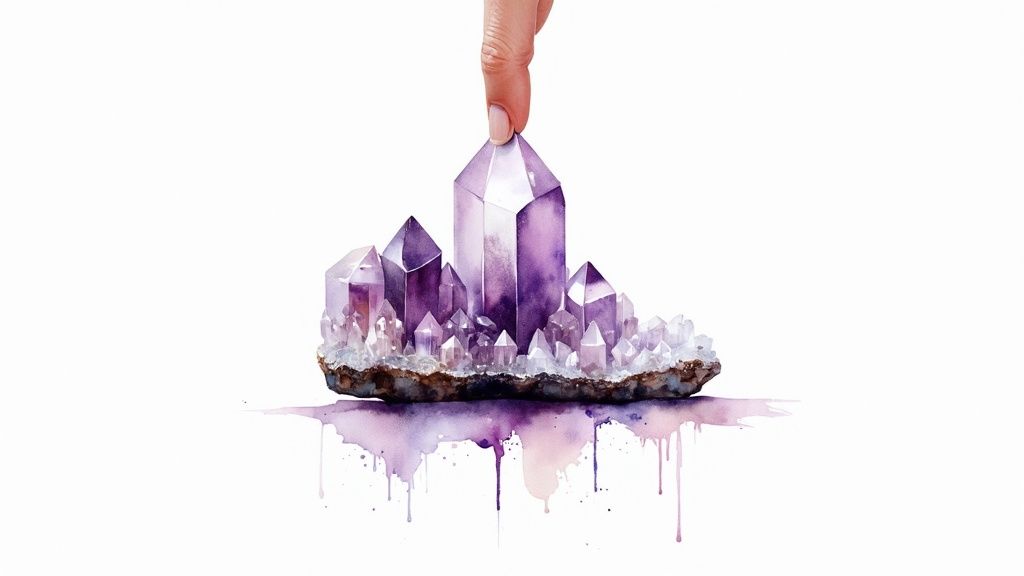
So, what exactly is this captivating purple gemstone we call amethyst?
At its heart, amethyst is simply a violet variety of quartz, which happens to be one of the most common minerals scattered across the planet. But if quartz is so abundant, what makes the purple version so special compared to its clear or smoky siblings?
The secret is a fascinating bit of natural alchemy. It all begins when tiny amounts of iron work their way into the quartz's crystal structure as it forms. That alone isn’t enough. Over millions of years, natural radiation from the surrounding rock zaps these iron impurities, causing them to absorb certain kinds of light and reflect back the stunning purples we see.
Think of it like a clear canvas that gets a permanent, natural violet stain. The more iron and radiation involved, the deeper the color—ranging from a delicate lilac to a rich, royal purple.
This remarkable transformation from everyday quartz to precious amethyst has captivated everyone from ancient civilizations to modern-day collectors.
From the Earth to the Market
An amethyst quartz crystal's journey doesn't stop once it's formed. These gems are typically found tucked away inside geodes—those unassuming, hollow rocks that hide a sparkling crystal treasure—within volcanic formations all over the world. While you can find them in places like Zambia, Uruguay, and even parts of the United States, one country truly dominates the scene.
Brazil is the undisputed heavyweight, supplying a significant portion of the world's natural amethyst. The mines in its southern states, especially Rio Grande do Sul, are situated in areas with perfect geological conditions left over from ancient volcanic activity. This has created massive deposits of incredibly clear and vividly colored amethyst. You can get a deeper dive into Brazil's role in the global market over at farmonaut.com. This wide-reaching supply chain is why amethyst is both accessible and highly coveted.
Why Amethyst Still Fascinates Us
Beyond its fiery origins, the enduring allure of amethyst comes from its perfect blend of beauty, toughness, and history. It’s so much more than just a pretty stone; it holds a special place in culture, royalty, and spiritual practices.
Here’s what really makes it stand out:
Hardness and Durability: Amethyst scores a solid 7 on the Mohs scale of hardness. That means it’s sturdy enough for everyday jewelry, whether it’s set in a ring you wear daily or a favorite pendant.
A Spectrum of Color: It comes in a whole range of shades, from pale lavender to deep violet with flashes of red. This variety means there’s an amethyst for just about every taste and budget.
Cultural Significance: For centuries, people have associated it with powerful qualities like sobriety, mental clarity, and spiritual protection.
This guide will pull back the curtain on its full story, from its birth deep inside the Earth to its celebrated place in human history and our collections today.
The Birth of Amethyst Inside the Earth
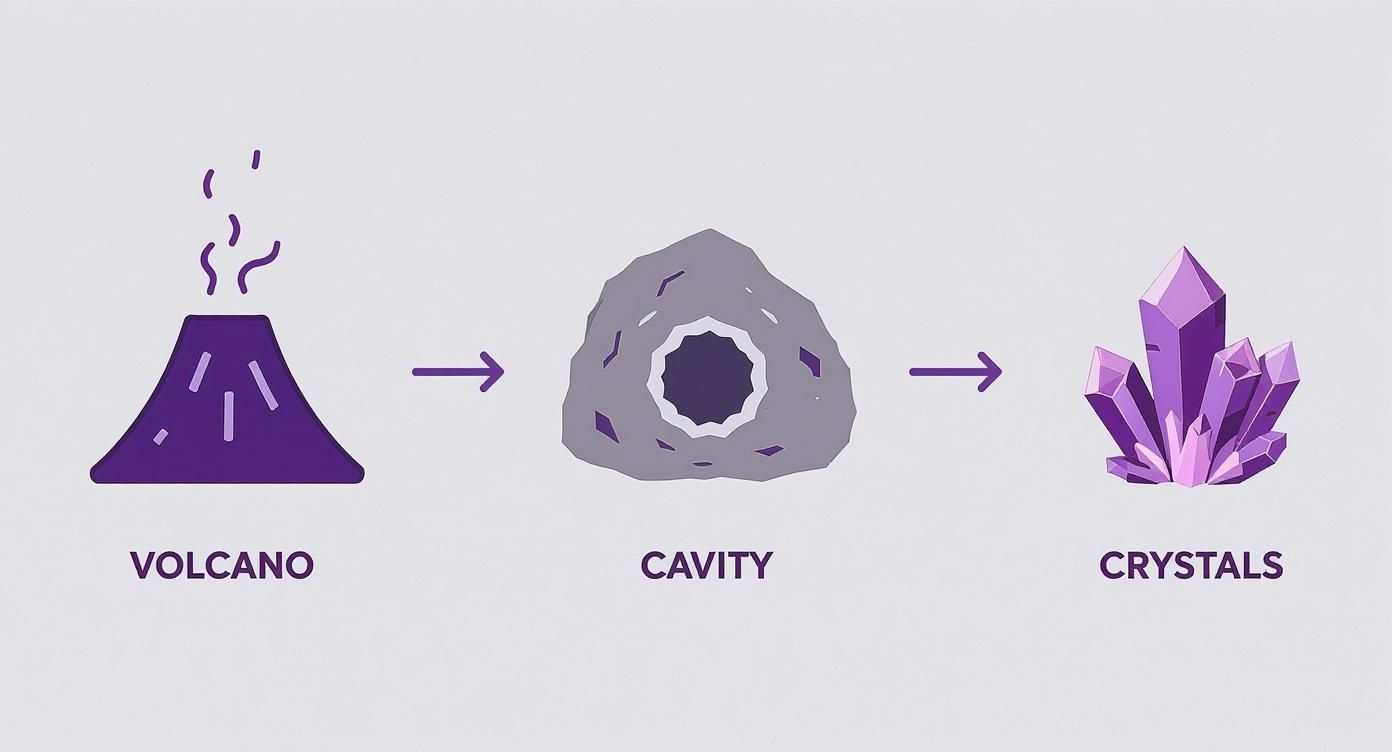
Every single amethyst crystal begins its journey deep within the Earth’s crust, born from fire and pressure. Picture a landscape of ancient volcanic fury, where molten lava bubbles and flows. As this lava eventually cools and hardens over staggering amounts of time, gas bubbles get trapped inside, creating hollow, rock-hard cavities.
These empty pockets, perfectly protected by a shell of solidified volcanic rock, become the ideal nurseries for crystals to grow. They’re like tiny, sealed-off geological wombs, just waiting for the right ingredients to show up.
The Crystal-Making Recipe
The next key ingredient is water—but not just any water. We're talking about a hot, mineral-rich solution that has worked its way through the Earth's crust, picking up all sorts of dissolved goodies along the way. Most importantly, this geothermal water is saturated with silicon dioxide, the fundamental building block for every type of quartz crystal.
This silica-packed water seeps through microscopic cracks in the cooled volcanic rock, eventually filling up those hollow cavities. When the conditions inside the pocket shift—maybe a slight drop in temperature or pressure—the water can’t hold onto all of its dissolved minerals anymore. This is the trigger that kicks off the crystallization process.
Slowly, atom by atom, the silica starts to drop out of the water and cling to the inner walls of the cavity. It's a bit like making rock candy on a string, except this show unfolds over millions of years. This first layer sets the foundation for the individual crystal points that will grow inward toward the open center.
This slow, steady growth is what gives the crystals their distinct six-sided, or hexagonal, structure. The final size and clarity of the amethyst points depend completely on how stable the environment is and how pure that mineral solution was.
This entire process is what creates what we know as a geode. If you want to dive deeper into these incredible formations, you can learn more about what is a geode and see how such plain-looking rocks can hide a breathtaking crystalline world inside.
From Clear Quartz to Purple Amethyst
At this point in the process, the growing crystals are basically just clear quartz. So where does that famous purple color come from? The magic happens when trace amounts of a specific element—iron—are mixed into the silica-rich water. As the quartz crystals form, they trap these tiny iron impurities within their molecular structure.
But having iron isn't enough to turn the crystal purple. The final, critical step is a long, slow bath in natural gamma radiation. This low-level radiation, given off by other radioactive elements in the surrounding host rock over millions of years, zaps the iron impurities locked inside the crystal lattice.
This irradiation process changes the iron atoms, causing them to absorb certain wavelengths of light while reflecting others. The light that gets reflected is what our eyes see as the color purple. The exact shade and intensity of that purple come down to two main things:
Iron Concentration: The amount of iron that was present in the crystal.
Radiation Exposure: How long and how intense the natural radiation was.
It’s a delicate balance. A little bit of iron and a short dose of radiation might create a pale lilac stone, while a higher concentration and longer exposure can result in that coveted deep, royal purple. This intricate geological dance of heat, water, minerals, and radiation is the natural artistry behind every single amethyst specimen.
Decoding the Colors and Qualities of Amethyst
Not all amethyst is created equal. The jaw-dropping specimen you see in a museum display is judged by a totally different standard than a small tumbled stone you might find in a gift shop. The true value and beauty of an amethyst quartz crystal come down to a combination of its color, clarity, and cut—and understanding these qualities is the key to appreciating what makes this gemstone so incredible.
The single most important factor is, without a doubt, its color. Amethyst’s purple hue exists on a stunning spectrum, running from a delicate, pale lilac that’s almost pink to the deep, royal purple that collectors covet. To dive deeper into the symbolism tied to its unique color, you can explore the meaning behind birthstone colors, which adds a whole new layer of appreciation for this beloved gem.
This infographic shows the simple, elegant process of how an amethyst quartz crystal is formed deep inside the Earth.
As the visualization shows, the journey from a fiery volcanic event to a sparkling, crystal-filled cavity is a multi-step geological marvel.
Understanding the Color Spectrum
When gemologists evaluate an amethyst's color, they're looking at three main things: its hue (the pure color), its tone (how light or dark it is), and its saturation (the intensity of the color).
The most prized amethysts show off a strong, reddish-purple to deep purple hue, but not so dark that they look black in low light. These premium stones are often called ‘Siberian’ amethyst—a trade name that now refers to this top-tier quality standard, not necessarily its origin.
Just as important is how consistent that color is. An even distribution of purple throughout the stone, with no visible color zoning (patches of lighter or darker color), seriously bumps up its value. Stones that flash hints of red or blue when you turn them in the light are also highly desirable.
Grading Amethyst Quality
To make sense of it all, the jewelry industry often uses a grading system, typically from A to AAA. While there's no single universal standard, this scale gives you a pretty good feel for a stone's overall quality.
Here’s a quick guide to help you understand what those grades really mean when you're looking at amethyst.
Amethyst Quality Grading Guide
Grade
Color Characteristics
Clarity
Typical Use
A
Light to medium purple with visible color zoning.
Moderately included (visible internal flaws).
Beads and mass-market jewelry.
AA
Medium to dark purple with slight zoning.
Slightly included (minor flaws visible).
Good quality commercial jewelry.
AAA
Rich, vibrant purple with no visible zoning.
Eye-clean (no flaws visible to the naked eye).
High-end and fine designer jewelry.
Naturally, this grading has a direct impact on the stone’s price tag. If you want a clearer picture of how these factors translate into cost, check out our detailed guide on the amethyst price per carat.
Physical Properties That Matter
Beyond its gorgeous looks, an amethyst's physical structure plays a huge role in how it's used and how well it holds up. At its core, it's a type of quartz, and that gives it some key advantages, especially for jewelry.
Amethyst’s resilience is one of its most practical traits. It scores a solid 7 on the Mohs scale of hardness, making it durable enough for everyday wear in rings, pendants, and bracelets without getting easily scratched.
This toughness comes from its trigonal crystal system, which is the blueprint for how its atoms are bonded together. This internal structure is also why raw amethyst crystals naturally grow into those classic six-sided prisms with pyramid-like points, creating the beautiful clusters we love to see in geodes. This inherent strength and iconic shape are just as much a part of its identity as its famous purple color.
Amethyst’s Journey Through Human History
Long before geologists could explain how it was made, amethyst captivated ancient civilizations with its intoxicating purple glow. Its story isn't just one of mineral science; it's a story of human culture, power, and belief. For thousands of years, this gemstone has been far more than just a pretty rock—it has been a symbol, a tool, and a treasure woven right into the fabric of our history.
The journey starts with its name. The ancient Greeks, who adored the stone, called it amethystos, which literally translates to "not drunk." They were convinced the crystal could ward off the intoxicating effects of wine, and it wasn't uncommon for them to stud their drinking goblets with amethysts or wear them as amulets to keep a clear head.
A Symbol of Power and Protection
This belief in amethyst's protective qualities traveled far and wide. In ancient Egypt, the stone was a go-to for amulets, talismans, and decorative carvings. Pharaohs and nobility often used it in their personal signets, trusting it to offer spiritual protection in both this life and the next.
The Romans were also fans. Soldiers would wear amethyst into battle, believing it would grant them courage and keep them safe from harm. They saw its deep purple as a direct representation of divine power, a sentiment that only grew stronger over the centuries.
Throughout history, the rich violet hue of amethyst has been tied to royalty and nobility. Before the discovery of massive deposits in Brazil, amethyst was as rare and pricey as a ruby or emerald, making it a status symbol only the elite could afford.
You can see this connection to power in the regalia of kings and queens. Empress Catherine the Great of Russia, for example, had a particular obsession with the stone, filling her personal collection and court with its majestic color. To this day, the British Crown Jewels feature breathtaking amethysts, cementing their legacy as gems fit for a monarch.
Cultural and Spiritual Significance
Beyond its ties to earthly power, amethyst has long held a place of spiritual importance. In medieval Europe, the Catholic Church saw amethyst as a symbol of piety, humility, and celibacy. Bishops began wearing amethyst rings to signify their rank and, in a nod to its Greek origins, to protect them from "mystical intoxication."
This deep spiritual connection has helped fuel its modern relevance. Amethyst is a premium variety in the global quartz market, which has seen significant growth. In 2022, the market was valued at USD 8.52 billion and is projected to hit USD 18.66 billion by 2031. You can get more insights into this trend by checking out the full quartz market research. This boom reflects a timeless human fascination with these natural treasures, driven by both a love for their beauty and a search for something more.
From Ancient Belief to Modern Adoration
When you trace amethyst's path through human history, a clear pattern emerges. Different cultures, separated by entire continents and centuries, all seemed to land on similar ideas about what this stone meant.
Ancient Greeks and Romans: Valued for sobriety, clarity, and courage.
Egyptian Royalty: Used as a powerful protective amulet.
Medieval Clergy: Symbolized piety and spiritual authority.
European Monarchs: Prized as a rare gem representing wealth and power.
From preventing drunkenness at a rowdy Greek symposium to gracing a monarch’s crown, amethyst’s story is a testament to the power of a single gemstone to capture the human imagination. Its physical beauty may have been the initial hook, but its rich, symbolic legacy is what has made it a cultural touchstone that still resonates today.
Caring for Your Amethyst Crystal
So you've brought home a beautiful piece of amethyst—now what? Whether it's a delicate piece of jewelry or a massive, sparkling geode, a little bit of care will keep it looking vibrant for years. Amethyst is a pretty sturdy stone, ranking a 7 on the Mohs hardness scale, which makes it great for regular wear. Still, it needs mindful handling to protect its incredible purple color and prevent damage.
The good news is that keeping this gemstone looking its best is surprisingly simple. You don't need any fancy equipment or expensive cleaners. It really just comes down to gentle cleaning and knowing what to avoid.
Simple and Safe Cleaning Methods
The best way to clean your amethyst is with warm water, a bit of mild soap, and a soft brush. Think of it like a gentle bath; nothing harsh is required. A soft-bristled toothbrush is perfect for getting into all the tiny nooks and crannies of a raw cluster or around the setting of a ring.
Just mix up some warm, soapy water and give the stone a light scrub. When you're done, rinse it well with clean water to get rid of any soap film and pat it dry with a soft cloth. This easy routine is all you need to remove dust, oils, and daily grime without harming the crystal's surface.
What's more important is knowing what not to do. Never use harsh chemicals like bleach or ammonia, as they can ruin the stone. It’s also best to skip the ultrasonic cleaners. While they work wonders on some gems, the intense vibrations can sometimes cause fractures in amethyst, especially if it has natural inclusions.
The single most important rule for keeping your amethyst's color rich and deep? Keep it out of direct, prolonged sunlight. UV rays are the enemy here, causing the beautiful purple to fade over time in a process known as photobleaching.
Proper Storage and Display
How you store your amethyst is just as important as how you clean it. Because quartz is a relatively hard mineral, an amethyst can easily scratch softer gemstones like opals or turquoise. On the flip side, harder stones like diamonds and sapphires can leave a nasty scratch on your amethyst.
The easiest solution is to store your amethyst jewelry in a separate pouch or a lined jewelry box with different compartments. This stops your pieces from knocking against each other. For larger specimens like geodes and clusters, picking the right spot is key. You can find some great ideas on how to display crystals to make them a stunning—and safe—part of your home.
Amethyst's popularity for both jewelry and home décor has helped fuel a massive market for ornamental stones and crystals. This widespread appreciation highlights why proper care is so essential for preserving these beautiful natural objects.
By following these straightforward tips, you can easily protect the natural beauty of your amethyst quartz crystal and ensure it remains a treasured piece for a lifetime.
How to Buy Amethyst and Avoid Fakes
So, you're ready to bring an amethyst into your collection? That's great! Shopping for this gorgeous gem should be an exciting experience, not a stressful one. With a bit of know-how, you can walk into any shop or browse online feeling confident you can tell a genuine stone from a clever imitation.
The market is filled with incredible options, but it definitely has its share of fakes, like dyed glass or synthetic quartz. The good news is that real amethyst has specific traits that are tough to replicate perfectly. Learning these signs is your best tool for making a smart purchase.
Spotting a Genuine Amethyst
Nature rarely creates anything perfectly uniform. That’s a good thing for collectors, because genuine amethyst almost always has subtle inconsistencies that serve as proof of its authenticity. When you’re looking at a piece, keep an eye out for these tell-tale signs of a natural stone.
One of the most common giveaways is color zoning. This is just an uneven spread of color within the crystal, where you might see stripes or patches of lighter and darker purple. A big piece with an unnaturally perfect, super-vibrant color all the way through can sometimes be a red flag for a dyed stone.
Also, most natural crystals have minor internal imperfections, often called inclusions. These can look like tiny specks, feathery lines, or small cracks inside the stone. While a completely flawless amethyst is possible, it's incredibly rare and carries a hefty price tag. Seeing a few minor inclusions is usually a good sign you’re holding a real piece of the Earth.
When you're shopping in person, trust your sense of touch. A real amethyst quartz crystal will feel cool and solid against your skin. Imitations made of glass or plastic often feel warmer and lighter in comparison.
Natural, Heat-Treated, and Lab-Grown Varieties
Understanding the different "types" of amethyst you'll run into will help you know what you're buying and why the prices can vary so much. The market really breaks down into three main categories, and each has its own place and value.
Natural Amethyst: This is the stone just as it came out of the ground, simply cut and polished. For collectors who value its geological origin and untouched beauty, this is the most desirable form.
Heat-Treated Amethyst: A lot of the citrine you see for sale is actually amethyst that has been heated to very high temperatures. This process permanently changes the stone’s color from purple to yellow or orange. A good seller will always disclose this treatment.
Lab-Grown Amethyst: This is synthetic quartz grown in a lab. It has the same chemical and physical properties as natural amethyst and can be visually identical. But, it lacks the rarity and geological story of a natural stone, making it much more affordable.
Knowing the difference is the first step to becoming a savvy buyer. For more tips on what to look for, our comprehensive crystal identification guide offers even more valuable insights. At the end of the day, finding a reputable dealer who is transparent about their stones’ origins and treatments is the best way to ensure you bring home a high-quality amethyst you’ll love for years to come.
Got Questions About Amethyst? We’ve Got Answers.
To round out your understanding of this incredible gemstone, we've gathered answers to a few of the most common questions people ask. This is the quick-and-dirty guide to the practical side of amethyst.
Can Amethyst Fade in the Sun?
Yes, and this is probably the most important care tip to remember. That beautiful purple color in amethyst comes from iron impurities that were naturally irradiated over millions of years deep inside the Earth. Prolonged exposure to UV light—especially direct sunlight—can actually reverse that process, causing its vibrant hue to fade.
To protect your crystal, it’s best to display it away from a window or any spot that gets constant, intense sunlight. This simple step will help preserve its deep, royal color for years to come.
What Is the Difference Between Amethyst and Clear Quartz?
Chemically, they are nearly identical. Both are just different flavors of quartz, which is silicon dioxide (SiO₂). The key difference is the tiny amount of iron that snuck into the crystal lattice of amethyst as it was forming.
Think of clear quartz as the blank canvas. When that quartz forms with just the right pinch of iron and is then exposed to natural gamma radiation from the surrounding rock, those iron impurities are transformed, creating that signature purple color. In short, amethyst is simply a naturally colored version of clear quartz.
The only thing separating these two crystals is a dash of iron and a long, slow bath in natural radiation deep within the Earth.
How Can You Tell If Amethyst Is Real?
Genuine amethyst has several tell-tale signs that give away its natural origin. Real stones often display color zoning, which means the color isn't perfectly uniform throughout the crystal—you might see lighter or darker patches. Minor internal imperfections, sometimes called inclusions, are also completely normal.
Another simple check is hardness. Since amethyst is a 7 on the Mohs scale, it can easily scratch glass. Fakes made from glass often have tiny, perfectly round air bubbles trapped inside and will usually feel warmer to the touch than a real crystal. A suspiciously uniform, super-intense purple can also be a red flag for a dyed stone.
Is Citrine Just Heated Amethyst?
A huge portion of the citrine on the market today is, in fact, heat-treated amethyst. When amethyst is heated to high temperatures, typically around 878°F (470°C), its iron impurities are altered in a way that shifts the stone's color from purple to a warm yellow, orange, or brownish hue.
Natural citrine is much rarer and usually has a paler, sometimes smokier yellow color. Any reputable seller will always be upfront about whether their citrine is heat-treated amethyst.
Ready to find the perfect amethyst for your collection? Discover ethically sourced, expert-vetted minerals and gemstones at Astro West. Explore our hand-picked selection at https://astrowest.com.