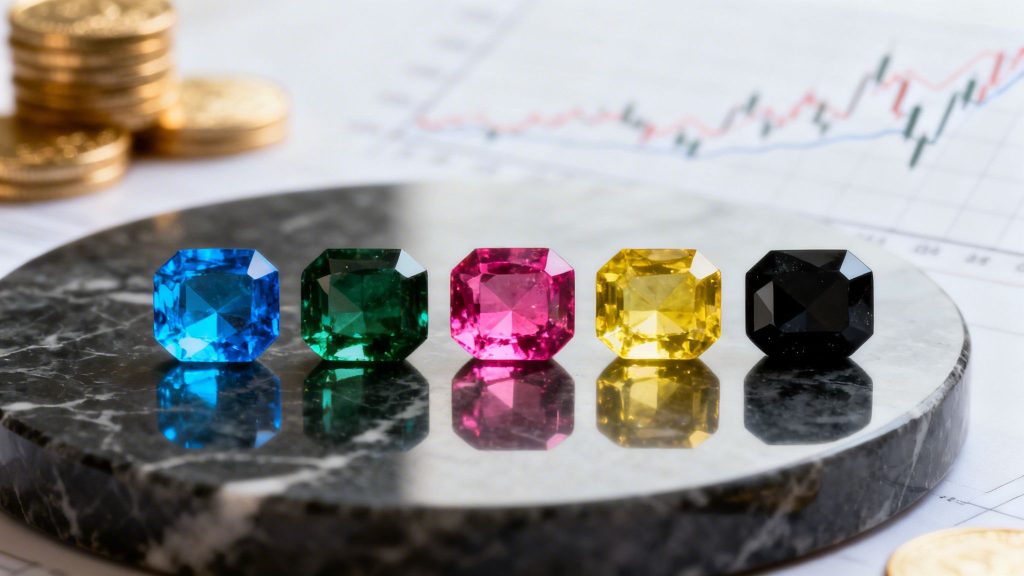
A Guide to Tourmaline Rarity, Value, and Investment
With its breathtaking spectrum of colors, tourmaline is one of the most versatile minerals in the world. However, for astute collectors, top-tier specimens are tangible assets with proven investment potential. Museums and private collectors seek these pieces for their beauty, rarity, and scientific importance.
Understanding Tourmaline as a Collectible Asset
Tourmaline transcends its role as a gemstone, entering the realm of hard assets and curated collectibles. While most people appreciate its vibrant colors, seasoned collectors recognize its capacity to store and grow value over time. Therefore, acquiring a fine tourmaline requires the same discernment used for fine art or a luxury timepiece, where quality, rarity, and provenance are paramount.
This mineral’s journey from a raw specimen to a prized gallery piece is a story of geology, artistry, and market dynamics. The value of a specific tourmaline is not arbitrary. Instead, a clear set of factors separates an ordinary stone from an investment-grade asset.
The Foundation of Tourmaline's Value
A tourmaline's price is driven by its specific color variety, the intensity of that color, its clarity, and its origin. For example, the vivid, copper-fueled glow of a Paraíba tourmaline from Brazil places it in a different asset class than a common black Schorl specimen. Its market value is directly tied to its verifiable rarity.
In fact, several key attributes contribute to a specimen's long-term worth:
Exceptional Color and Saturation: The most prized tourmalines exhibit deep, intense, and evenly distributed color.
Verifiable Rarity: Varieties like Paraíba or gem-quality Rubellite are exceptionally scarce, which directly fuels market demand and price appreciation.
Prestigious Origin: Specimens from historically significant or depleted localities, like the original mines in Brazil's Paraíba state, carry a significant premium.
Crystal Formation and Aesthetics: For natural mineral specimens, the quality of the crystal's shape, its termination, and its overall aesthetic are critical valuation points.
The market for high-quality natural specimens operates on a simple principle: true rarity, backed by undeniable beauty, commands a premium. A tourmaline with documented provenance from a famed locality is not just a stone; it is a piece of geological history with a verifiable narrative that enhances its value.
This focus on objective quality is why the old distinction between precious vs. semi-precious stones is often less important than a specimen's individual merits. At Astro West, our direct relationships with miners and field experts ensure every tourmaline we acquire is vetted for these critical attributes. This process guarantees authenticity and secures the specimen’s standing as a lasting, valuable asset.
Decoding Tourmaline Varieties and Market Value
The world of tourmaline is a dazzling matrix of color, where a stone’s hue and history directly correlate to its market value. Not all tourmaline is created equal. While some are common, others are treated as serious assets, prized for their staggering beauty and profound rarity. Learning to spot this difference is the first step toward a strategic acquisition.
For instance, the deep red of Rubellite and the rich blue of Indicolite are highly prized by collectors. They are stunning gems and serve as excellent entry points into serious collecting. However, they occupy a different tier from their ultra-rare cousins—the kinds of stones that headline major auctions. The market’s top shelf is reserved for specimens with unique optical properties and legendary origins.
The Elite Tiers of Tourmaline
At the absolute peak of the tourmaline market sit two undisputed champions: Paraíba and Chrome tourmaline. These are not just stones; they are market benchmarks. Their value is driven by extreme scarcity and a visual impact that no other mineral can replicate.
Paraíba tourmaline, with its iconic, electric neon-blue to green glow, is the undisputed king. This vibrant glow comes from trace amounts of copper, an element not found in other tourmalines. Its rarity is best compared to a vintage supercar—only a handful of the best were ever produced, and their value climbs accordingly.
Right alongside it is Chrome tourmaline. This variety delivers a vivid, pure green that can stand toe-to-toe with the finest emeralds. It represents a savvy acquisition for collectors due to its blend of top-tier color and relative value. As a result, it provides the visual impact of a more expensive gemstone, making it a strategic choice for those seeking both beauty and market advantage.
How Origin Defines Value
A tourmaline’s geographic origin is a critical part of its identity and price. A specimen’s source can add a massive premium, much like the provenance of a fine wine or a work of art from a famous studio. This premium is rooted in rarity, historical significance, and the superior quality often associated with a legendary deposit.
Brazil: As the original home of Paraíba tourmaline, Brazilian specimens command the highest prices. Their historical significance and unmatched color saturation make them true investment-grade gems.
Afghanistan: Known for producing breathtaking Indicolite and verdelite (green) crystals, often with exceptional clarity and ideal crystal forms.
Nigeria: An increasingly vital source for fine Rubellite and even copper-bearing tourmalines that rival Paraíba, offering compelling value in today's market.
A tourmaline's birthplace is inseparable from its story and, therefore, its worth. A certificate of origin from a famed locality like Brazil's original Paraíba mines acts as both a seal of authenticity and a driver of long-term value.
This chart breaks down the key factors that drive tourmaline's value. It shows how color, rarity, and origin combine to determine a stone's market price.
As you can see, a specimen's value increases dramatically when world-class color, extreme rarity, and a prestigious origin converge. A collector’s ability to recognize this powerful trifecta is fundamental to building a strong portfolio. Among the many fascinating varieties, the unique bi-color and tri-color specimens known as Watermelon Tourmaline hold a special place for their striking natural artistry.
The table below offers a closer look at how some of the most popular tourmaline varieties stack up in the market. It highlights the price differences driven by color and scarcity.
Market Valuation of Key Tourmaline Varieties
This table provides a comparative overview of popular tourmaline varieties, their defining characteristics, and typical price ranges, illustrating how color and rarity drive market value.
Variety
Defining Color
Key Localities
Relative Rarity & Value
Paraíba
Electric neon-blue to green
Brazil, Nigeria, Mozambique
Very High: The market's pinnacle. Extreme rarity and unique copper-driven color create exponential value.
Rubellite
Vivid purplish-red to red
Brazil, Nigeria, Madagascar
High: Prized for its rich, saturated color. Top-quality, clean stones command strong prices.
Chrome
Intense, pure green
Tanzania, Kenya
High: Offers top-tier green color rivaling emerald, often with better clarity, at a more accessible price point.
Indicolite
Deep blue to bluish-green
Afghanistan, Brazil, Namibia
Medium to High: The finest, pure blue specimens are rare and highly valued by collectors.
Verdelite
All shades of green
Brazil, Afghanistan, Namibia
Medium: Wide range of quality. Vibrant, well-saturated greens are always in demand.
Schorl
Opaque black
Worldwide
Low: Very common. Primarily valued by mineral specimen collectors, not the gem trade.
This comparison clarifies that the market places the highest premiums on stones delivering a rare and spectacular visual experience. Whether drawn to the electric glow of a Paraíba or the rich red of a Rubellite, understanding these distinctions is key to appreciating their true worth.
The Four Pillars of Tourmaline Valuation
Like the fine art market, the world of collectible tourmaline has a clear set of valuation principles. To move from appreciation to strategic acquisition, any serious collector must master these pillars: color, clarity, cut, and carat weight. These four factors work together, telling a story about a specimen’s quality, rarity, and ultimately, its price. They explain why two seemingly similar stones can have vastly different values and are key to building a collection with long-term potential.
The Decisive Power of Color
For tourmaline, color is the single most important value factor. Grading color, however, goes beyond simply identifying a stone as "green" or "pink." A tourmaline’s color grade is a combination of three distinct components.
Hue: This is the stone’s primary color—red, blue, or green. The purest, most distinct hues command the highest prices.
Tone: This describes the color's lightness or darkness. The ideal for most top-tier tourmalines is a medium tone, which avoids looking too dark or washed out.
Saturation: This is the color's intensity. A stone with high saturation appears to buzz with a vivid, electric quality. In contrast, low saturation can make a stone appear brownish or grayish.
A world-class Rubellite, for instance, is not just red. It is a pure, highly saturated red with a medium tone that allows its vibrant color to radiate. Stones with such exceptional saturation and pure hue are exponentially rarer and far more valuable.
Clarity and the Nature of Inclusions
Clarity refers to the presence or absence of internal features called inclusions. For most faceted tourmalines, the goal is simple: the fewer inclusions visible to the naked eye, the better. A crystal-clear stone lets light pass through unobstructed, unleashing its brilliance and color.
However, certain inclusions can actually make a tourmaline specimen more desirable. For example, fine, needle-like crystals of rutile shimmering within a tourmaline create a stunning visual effect. Collectors prize these "rutilated" specimens for their unique character.
While the standard for faceted gems is 'eye-clean' clarity, some inclusions tell a story of a crystal's geological journey. In the right context, these features add character and narrative, transforming a potential flaw into a mark of distinction that collectors actively seek.
This duality means clarity must be assessed with context. For a faceted Paraíba, clarity is critical to showcase its famous neon glow. For a display specimen prized for its aesthetic form, however, unique inclusions might be the main attraction.
The Art and Science of the Cut
The cut is where human artistry meets the raw potential of nature. An expert cut does far more than just shape the stone; it strategically unlocks a tourmaline's maximum beauty and value. A master lapidary will study a rough crystal, plotting the perfect angles to bring it to life.
A superior cut is designed to maximize brilliance by controlling how light behaves inside the stone. A skilled cutter can also minimize the appearance of inclusions or orient the stone to concentrate its color. This makes it appear richer and more vibrant.
One of tourmaline’s most famous traits is pleochroism, where it shows different colors when viewed from different angles. A strategic cut is therefore essential. The cutter must orient the crystal to show its most desirable hue face-up, a decision that adds significant visual impact and value.
Carat Weight and Exponential Rarity
Finally, carat weight is a measure of a stone's mass. While it may seem obvious that a bigger stone is more valuable, the relationship between size and price is not linear. It is exponential.
Large, high-quality tourmaline crystals are a geological anomaly. Finding a multi-carat specimen that also boasts top-tier color and excellent clarity is exceptionally rare. As a result, a single five-carat Indicolite is worth significantly more than five individual one-carat stones of the same quality. This principle of exponential value is a cornerstone of investing in high-end minerals, mirroring the dynamics of markets for large diamonds or important artworks.
Provenance: The Unseen Driver of Value
While a tourmaline's physical beauty captures attention, another invisible quality elevates a stone into a secure asset: its provenance. This is the stone’s pedigree—its verifiable history from a specific mine, through various hands, to its current owner. Think of it as the stone’s official biography.
Solid provenance acts as an unbreakable guarantee of authenticity. Additionally, it adds a compelling story that can dramatically increase its value. A tourmaline without a story is just a stone. A tourmaline with a documented history is a piece of geological heritage.
Historical Significance and Value Appreciation
The link between a famous locality and long-term value is undeniable. Certain mines become legendary for producing tourmaline of a specific, unmatched quality. Once these sources are depleted, the specimens in circulation become finite, historical artifacts. Their market value often behaves like fine art, climbing steadily as supply dwindles and demand from collectors grows.
For example, the famed deposits at Mount Mica in Maine were discovered in the 19th century. This site produced extraordinary gem-quality tourmalines that helped establish America's gemological reputation. Today, a specimen with verified provenance from this classic locality is prized not just for its beauty but for its role in history, commanding a premium from discerning collectors.
A tourmaline without a story is simply a stone. A tourmaline with documented provenance from a historically significant mine is a piece of geological heritage, a tangible connection to a specific time and place that can never be replicated.
This historical context is a powerful value driver. The narrative transforms a mineral into an artifact, and its market behavior often mirrors that of fine art, where origin and history are everything.
The Paraíba Benchmark for Provenance
Nowhere is the power of provenance clearer than with Paraíba tourmaline. The first discovery in Brazil's Paraíba state in 1989 completely reset the market. These initial stones, glowing with a unique copper-bearing fire, commanded high prices from the start. Today, their value appreciation shows a strong historical trend. You can discover more about recent tourmaline market performance and production highlights to see its market dominance.
This history makes origin absolutely critical. A gem-quality tourmaline certified from the original Brazilian mines carries an immense premium over those from newer deposits in Africa. Even if chemically similar, the Brazilian material holds the historical prestige that top-tier investors demand. This is why our direct relationships with miners are so crucial. They allow Astro West to secure specimens with unimpeachable origins, giving our clients assurance they are acquiring an asset with a sound foundation for long-term value.
How to Identify Quality and Authenticity
Acquiring an exceptional tourmaline requires knowing how to separate a genuine, high-quality natural stone from a treated or synthetic one. This knowledge is the most important tool a collector has to protect their investment. The market contains tourmaline that has been artificially enhanced. These treatments are common but must be disclosed, as they directly impact a specimen’s rarity and value.
Understanding Common Tourmaline Treatments
The two most common treatments for tourmaline are heating and irradiation. Both are designed to alter a stone’s color, often to mimic a more valuable variety. While they can produce beautiful results, a treated stone is no longer a pure product of nature, which drastically lowers its status as a collectible.
Heating: This process is often used to lighten tourmalines that are too dark, especially green and blue varieties. For example, a muddy green stone can be heated to a brighter shade. The process, however, permanently changes the crystal's natural state.
Irradiation: This technique is used to create or intensify color. A pale pink tourmaline can be irradiated to achieve a deep, Rubellite-like red. This is precisely why a natural, untreated Rubellite with rich color is exponentially more valuable than its treated counterpart.
An untreated specimen, with color born directly from geological processes, is always the rarer and more valuable stone. This is why untreated tourmalines in top-tier colors—like Paraíba blue or a vivid Rubellite red—command such a significant premium. Their natural state is the very definition of rarity.
Key Identification Techniques for Natural Tourmaline
Verifying a tourmaline's authenticity takes a trained eye and specialized tools, but several key indicators are available. Spotting these signs is a core skill for any serious collector. A great place to start is with a comprehensive crystal identification guide, which provides the foundational knowledge for any visual inspection.
One of tourmaline’s most definitive characteristics is its pleochroism. This is an optical effect where the crystal shows different colors or shades when viewed from different angles. Synthetic materials and common imitations do not exhibit this, making it a reliable indicator of a natural stone.
Another crucial window into a stone's history is its natural inclusions. While perfectly "eye-clean" stones are highly prized, the type of inclusions can be your best friend when confirming authenticity.
Natural tourmaline often contains characteristic inclusions like fine, needle-like tubes or liquid-filled "trichites." These microscopic fingerprints of geological history are nearly impossible to replicate in a synthetic stone, serving as a vital seal of authenticity for an expert examiner.
The Role of Gemological Certification
For any significant tourmaline purchase, third-party verification is essential. A grading report from a respected gemological lab like the Gemological Institute of America (GIA) is the gold standard for protecting your investment. It offers an unbiased, scientific assessment of a stone's identity, origin, and any detectable treatments. This official documentation confirms that a stone is natural and details any enhancements. As a result, a tourmaline with a GIA certificate carries more weight in the market, securing its value and giving the collector ultimate peace of mind.
Building Your Tourmaline Collection with Confidence
Building a world-class tourmaline collection is a journey into the world of tangible assets. This is where a deep appreciation for mineralogy meets a savvy understanding of market dynamics. This process transforms a beautiful stone into a store of long-term value. It is about having a clear strategy for acquiring specimens, from foundational pieces to museum-level investments, built on quality, rarity, and provenance.
Before you acquire your first stone, you need a strategy. Are you hoping to build a representative suite of tourmaline’s colors, or are you focused on acquiring a single, world-class asset? Answering that question is the first step toward making confident, strategic moves.
A Tiered Approach to Acquisition
Navigating the tourmaline market becomes much easier with clear budget tiers in mind. Each level opens up unique opportunities to acquire specimens that align with specific collecting goals. This structure demystifies pricing and focuses your efforts on acquiring the best possible piece within your reach. A collector can build a beautiful and educational collection across a wide range of price points. To explore this topic in more depth, you might want to read our guide on how to start a collection of rare rocks and minerals.
Novice Tier ($150 – $1,000 per carat): This is the perfect entry point for acquiring fine examples of Indicolite, Verdelite, or high-quality Pink Tourmaline. The focus here is on securing excellent color saturation and good clarity, building a foundational understanding of quality.
Fine Tier ($800 – $5,000 per carat): Here, collectors can acquire top-grade Rubellite or exceptional Chrome Tourmaline. Specimens in this bracket possess superior color, are often eye-clean, and may come from highly regarded localities. These pieces represent a significant step up in both quality and investment potential.
Museum Tier ($5,000 – $50,000+ per carat): This is the realm of world-class assets, dominated by the legendary copper-bearing Paraíba tourmaline. At this level, investment is driven by extreme rarity, impeccable provenance, and unequaled color. Acquiring a fine Paraíba is like purchasing a masterpiece; it is a globally recognized store of value with a proven history of appreciation.
Tourmaline's market performance has proven its stability as a long-term asset. Much like vintage luxury watches or blue-chip equities, the finest specimens have consistently appreciated, driven by a finite supply from depleted mines and growing demand from a global collector base.
Your Partner in Acquisition
Ultimately, building a collection with confidence comes down to expertise and trust. Every tourmaline tells a unique geological story, and its value is locked within its color, clarity, origin, and authenticity. As expert advisors, our role at Astro West is to translate that story for you. We ensure that every specimen, whether a vibrant Rubellite or a legendary Paraíba, meets the highest standards of quality and provenance. Our direct access to the world’s most important sources allows us to help clients acquire pieces that perfectly align with their collecting ambitions, securing assets of both exceptional beauty and enduring worth.
A Few More Things You Might Be Wondering
To conclude, let's address some of the most common questions about collecting tourmaline. This is the practical advice that helps you make smart decisions and truly appreciate your acquisitions.
Is Tourmaline a Good Investment?
Yes, for the right pieces, exceptional tourmaline has a strong history as a solid store of value. Like fine art, its worth is built on measurable quality, proven rarity, and reputable history. For example, top-tier specimens of Paraíba or untreated Rubellite have consistently appreciated, making them a savvy addition to a diversified asset portfolio. As the global pool of sophisticated collectors grows, demand for these finite natural treasures only increases.
What Is the Rarest Color of Tourmaline?
The electric, neon-blue to green Paraíba tourmaline is, by a significant margin, the rarest and most valuable variety. Its intense, otherworldly glow—caused by traces of copper—is unlike anything else in the mineral kingdom. First discovered in the 1980s, fine examples can command prices that surpass high-quality diamonds, reshaping the colored gemstone market.
How Can I Tell if a Tourmaline Is Real?
An authentic tourmaline displays distinct pleochroism, a noticeable shift in color when viewed from different angles. It also tends to contain characteristic natural inclusions that are nearly impossible for forgers to replicate.
However, the only surefire way to verify a significant specimen is with a gemological report from a trusted lab like the GIA. That report confirms authenticity, discloses any treatments, and locks in the stone’s provenance and market value, giving you ultimate confidence as a collector.
This is why buying from a reputable dealer who guarantees authenticity and provides documentation is critical. A true expert will have already vetted the specimen for these exact qualities.
At Astro West, we provide the expertise and access you need to acquire tourmaline specimens of exceptional quality and unquestionable provenance. Explore our curated collection of fine minerals and begin your own investment journey.