Meteor vs. Meteorite: A Guide to Valuation and Investment
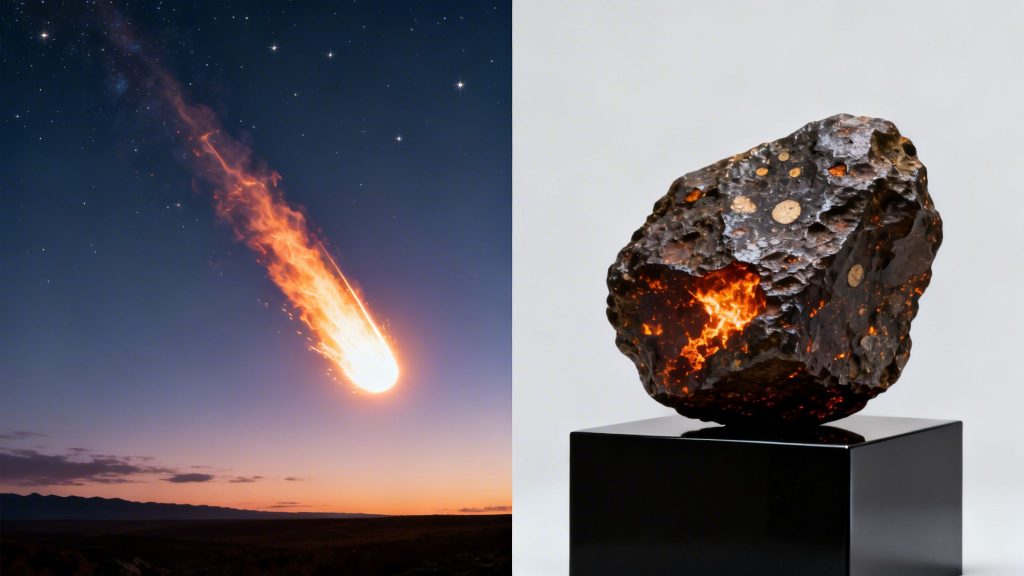
The fundamental difference between a meteor and a meteorite is critical. A meteor is the fleeting streak of light seen in the night sky. However, a meteorite is the rare physical object that survives a fiery descent to land on Earth.
One is a momentary event. The other is a tangible, collectible asset. For serious collectors and investors, this distinction defines its value.
From Fleeting Light to Tangible Asset
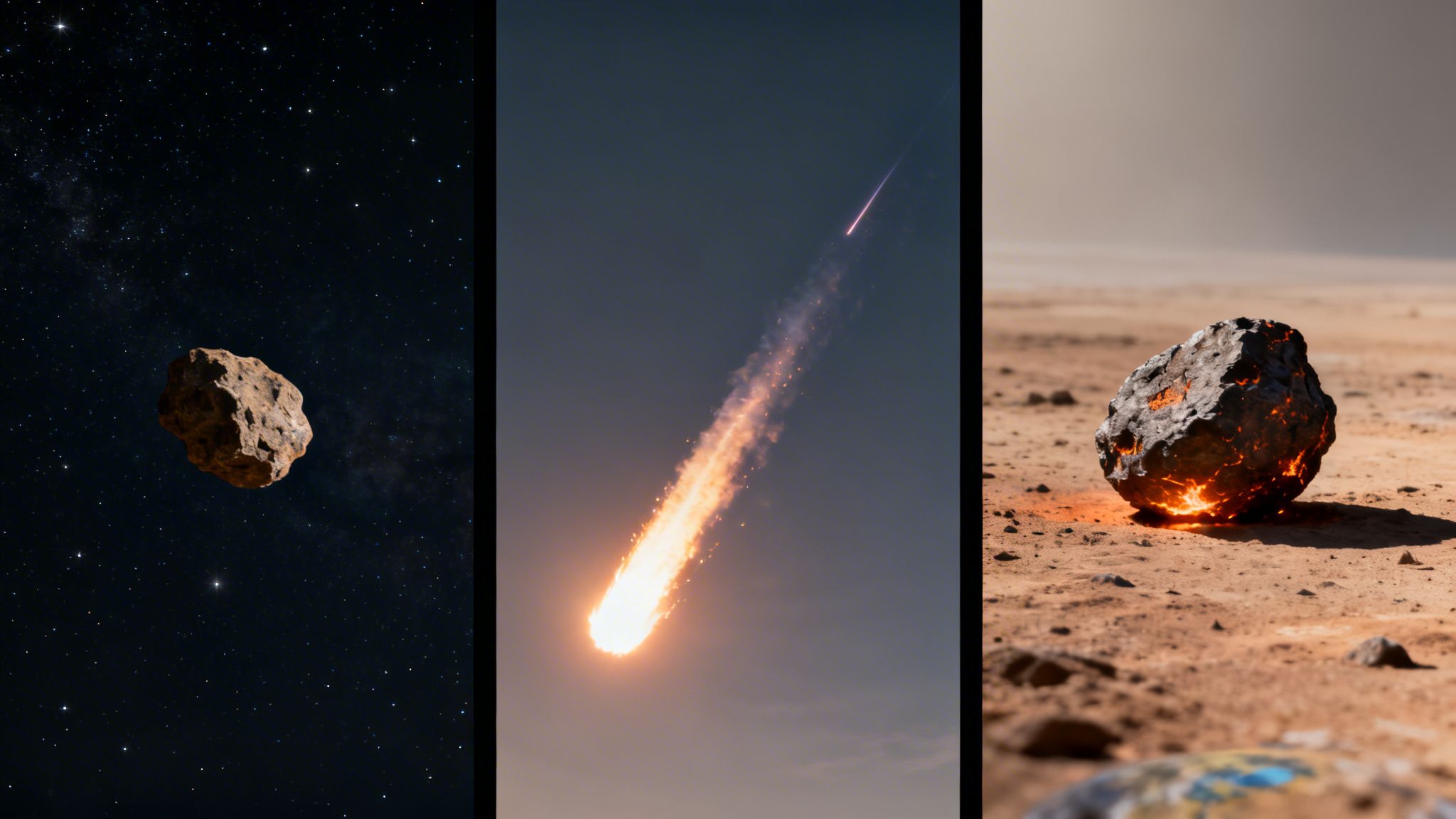
To appreciate a meteorite’s profound worth, one must understand its journey. It begins as a meteoroid, a piece of rock or iron drifting through space. This object is a silent time capsule from the early solar system.
The moment a meteoroid enters our atmosphere, it becomes a meteor. The brilliant light show, often called a "shooting star," is the result of extreme friction and heat as the rock vaporizes at hypersonic speeds. Consequently, most meteoroids burn up completely.
These objects travel at speeds between 5 km/s and 70 km/s. While scientists have documented over 50,000 meteorites on Earth, the vast majority of cosmic material never survives the journey. Top institutions like the Australian Museum provide further details on their composition.
This chart clarifies the core distinction between the momentary meteor event and the physical meteorite asset.
This contrast highlights why one is a brief spectacle and the other is a physical asset with inherent, lasting value.
Meteor vs. Meteorite: An Investor's Quick Reference
For a discerning collector, only the final stage of this journey truly matters. The meteorite is the survivor and, therefore, the prize. Its violent atmospheric passage gives it a unique story, identifiable characteristics, and ultimately, its investment value.
This table clarifies these distinctions from an asset-focused perspective.
Characteristic
Meteor (The Event)
Meteorite (The Asset)
Nature
A phenomenon of light and heat in the atmosphere.
A solid, physical object recovered from Earth's surface.
Tangibility
Intangible; it cannot be held or owned.
Tangible; it can be collected, displayed, and traded.
Duration
Lasts for only a few seconds.
Permanent; exists for billions of years.
Value
Experiential and observational value only.
Holds scientific, aesthetic, and monetary value as a rare collectible.
Astro West's expertise lies in curating these rare survivors. Each specimen, such as those in our Canyon Diablo meteorite collection, is valued for its unique journey, verified provenance, and rarity. As a result, we transform cosmic history into a tangible store of value.
The Three States of a Cosmic Traveler
Understanding a meteorite's journey reveals why it is so valuable. This cosmic filter separates the common from the truly rare. Moreover, it establishes a specimen’s story and, ultimately, its market price.
The Meteoroid in Space
A meteoroid is a solid object drifting through the vacuum of space. It ranges from a tiny dust particle to a large boulder. At this stage, it is a silent traveler, its history locked within its composition.
These objects carry clues about the early solar system. This is a primary reason for their scientific importance. You can learn more about the fascinating materials these objects contain in our guide on what meteorites are made of.
The Meteor in the Atmosphere
When a meteoroid intersects Earth's atmosphere, its identity changes instantly. Extreme friction and air compression create a streak of light called a meteor. This is a temporary, fiery event, not an object one can hold.
Atmospheric entry is nature’s most extreme filtration system. Intense heat and pressure obliterate most meteoroids, ensuring only the most substantial objects reach the ground.
These light shows often occur in groups during annual events. Understanding what causes meteor showers helps one appreciate their fleeting beauty. For collectors, however, this celestial display is merely a prelude.
The Meteorite on Earth
Finally, if a piece of the meteoroid survives its violent descent, it earns its final name: a meteorite. This is the tangible artifact, a rare survivor of a cosmic gauntlet. It is a physical record of our solar system's history and a finite, collectible asset.
This transformation is the source of its value. The journey from an anonymous rock in space to a verified specimen is a story of survival. Consequently, every meteorite is a trophy from the cosmos.
How to Identify a Genuine Meteorite
For any serious collector, distinguishing a real meteorite from a terrestrial rock is a foundational skill. Genuine meteorites have unique features forged during their fiery plunge through our atmosphere. Recognizing these signs is the first step toward confident acquisition.
While the meteor meteorite difference is simple, telling a meteorite from an Earth rock requires a trained eye. Fortunately, a few field tests provide strong clues about a specimen's cosmic origin.
Key Visual and Physical Indicators
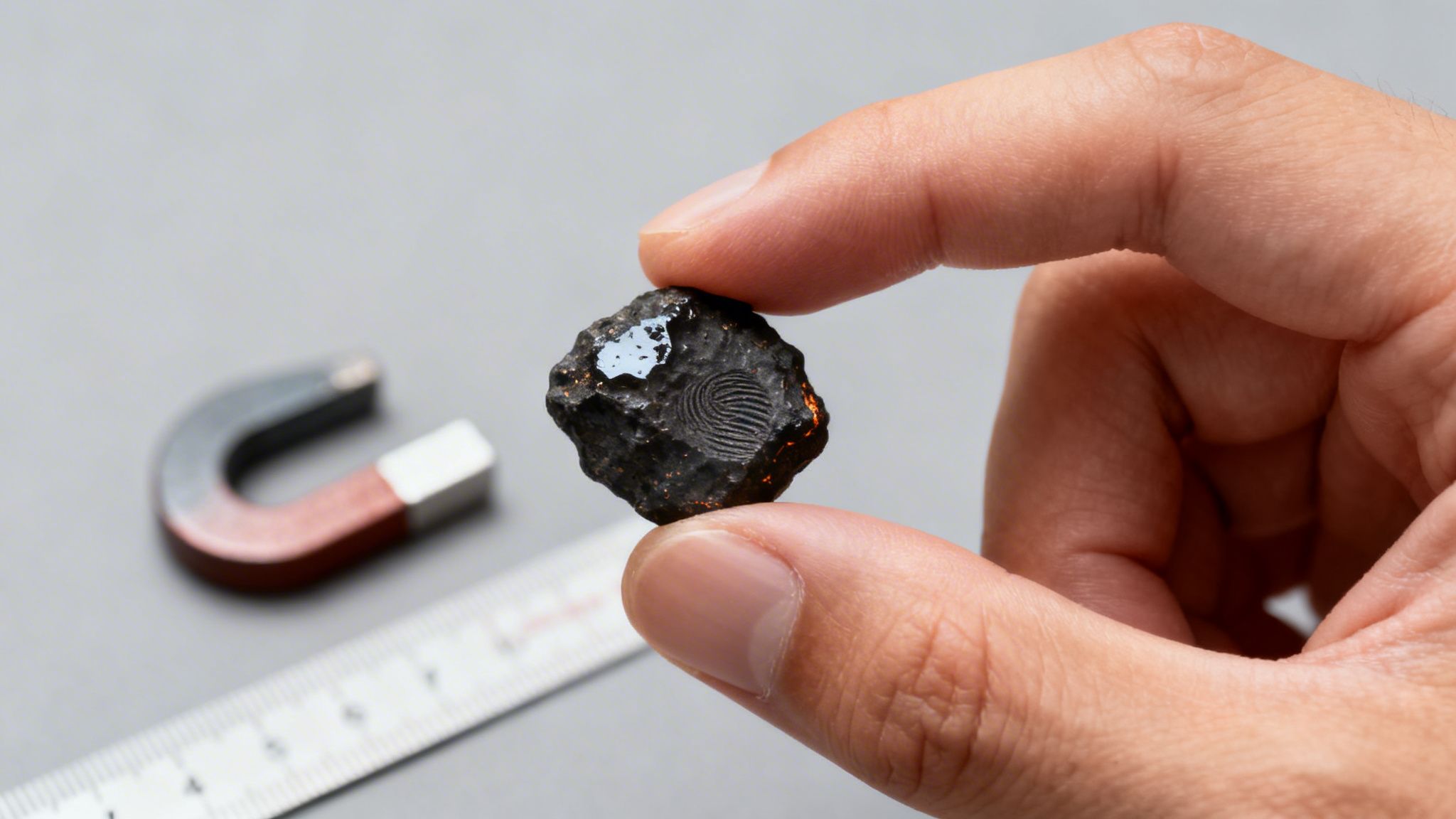
The most immediate feature is often the fusion crust. This is the thin, dark, glassy rind formed when the meteorite’s surface melts during descent. It is typically black or brownish, appearing smooth or cracked.
Another key identifier is the presence of regmaglypts. These are distinctive, thumbprint-like indentations covering the surface. They are created as outer layers of the rock ablate, or burn away, unevenly during flight.
A genuine meteorite will almost never have vesicles, or small bubbles. These are common in volcanic rocks but absent in meteorites, which formed in a vacuum, not from gassy, molten rock on Earth.
Meteorites are also much denser than Earth rocks due to high iron and nickel content. A meteorite will feel unusually heavy for its size. Therefore, most meteorites will attract a magnet.
Reliable Tests for Authenticity
While visual inspection is a good start, confirming a meteorite's identity requires further investigation. These simple, non-destructive tests build a stronger case for a cosmic origin.
Magnetism Test: Most meteorites contain iron-nickel metal, so they will adhere to a strong magnet. While some terrestrial rocks are magnetic, this test quickly rules out most common stones.
Density Check: A meteorite's high metal content gives it a specific gravity higher than most Earth rocks. For example, an iron meteorite is about three times denser than a typical terrestrial stone.
Streak Test: If you scrape a suspected meteorite on unglazed ceramic, it typically leaves a faint, brownish streak or none at all. Common iron-rich Earth rocks like hematite leave a prominent red or black streak.
However, even these tests are not definitive. Certain terrestrial rocks can mimic these properties, and rare meteorite types may not be magnetic. That is why professional verification is essential for any significant acquisition.
Decoding Meteorite Value: Rarity, Type, and Aesthetics
Not all cosmic survivors hold equal value. Like fine art, a meteorite's worth is determined by specific factors. Its market value hinges on rarity, scientific classification, and aesthetic appeal.
For any collector, understanding these value drivers is key to building a collection with lasting worth.
The journey from a meteor to a meteorite is a cosmic filter. For an investor, that journey ends with an object whose price reflects its scarcity and unique character.
The Critical Role of Rarity and Type
Rarity is the most important driver of a meteorite’s price. The vast majority of meteorites are Stony meteorites, specifically a type called Chondrites. Their relative abundance makes them an accessible entry point for new collectors.
At the other end of the spectrum are specimens from the Moon or Mars. These are exceptionally rare and, as a result, command premium prices. A meteorite's classification is directly tied to its rarity and market value.
Stony Meteorites: These are the most common finds, including abundant Chondrites and rarer Achondrites. Their value increases when they have a known origin, such as the asteroid Vesta.
Iron Meteorites: Composed almost entirely of an iron-nickel alloy, these are far less common. Collectors value them for their density, sculptural shapes, and stunning internal patterns.
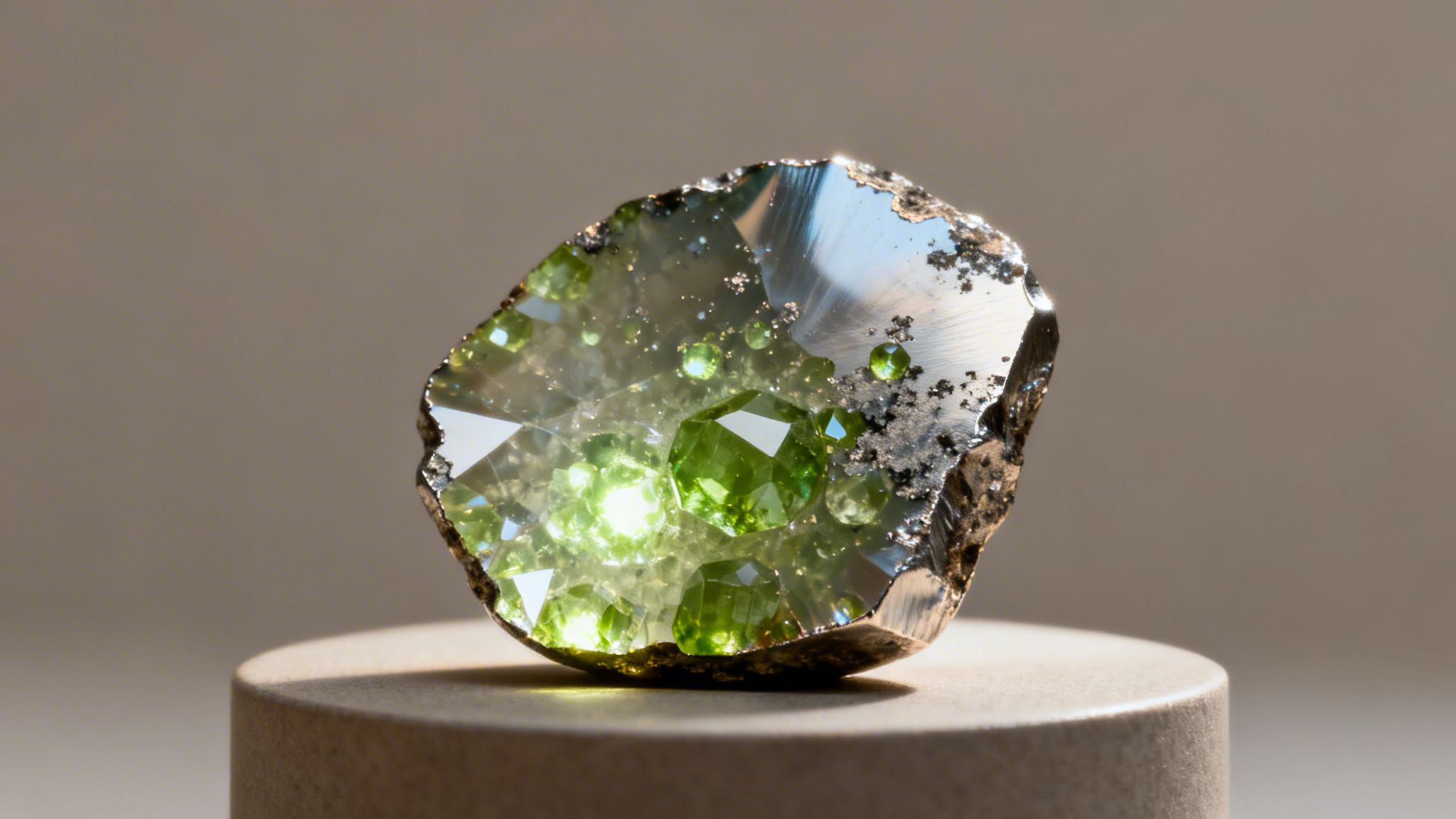
Stony-Iron Meteorites: This is the rarest main group. This class includes Pallasites, which feature olivine crystals in a metallic matrix, and equally scarce Mesosiderites.
Chondrites make up over 85% of all meteorite falls. However, iron meteorites represent 89.3% of the total mass that has landed on Earth despite accounting for just 5.7% of falls. This disparity explains why massive irons like the Canyon Diablo are legendary.
Pallasites represent less than 2% of known meteorites. They are the undisputed darlings of the aesthetic market. Sliced and polished, their translucent, gem-like crystals create an unparalleled natural mosaic.
Aesthetics and the Intangible Value
Beyond classification, a meteorite’s aesthetic appeal is a major value driver. This relates to its size, shape, preservation, and unique visual features. For example, a complete iron meteorite with distinct regmaglypts is highly valued.
The internal beauty can be even more compelling. The intricate Widmanstätten patterns found only in certain iron meteorites are a perfect example. This crystalline structure, formed over millions of years of slow cooling, is impossible to create on Earth.
This matrix breaks down the key drivers behind a meteorite's market price.
Complete individuals with regmaglypts, large oriented specimens
Internal Pattern
Medium-High
Strong Widmanstätten patterns in irons, high crystal density in Pallasites
Size & Mass
Medium
Large, intact specimens are rarer and more valuable than fragments
Provenance & History
Medium
Witnessed falls, specimens with a documented discovery story
Preparation Quality
Low-Medium
Professional cutting and polishing that enhances natural beauty
A meteorite's worth is never determined by a single factor. A common classification may be offset by an extraordinary shape. For example, the vibrant green olivine crystals inside a Pallasite transform it into natural art.
As a result, a beautifully prepared Pallasite slice often commands a higher price than a common chondrite of the same size. To better understand how these factors translate into prices, learn more about what a meteorite is worth in our detailed guide.
Acquiring and Preserving Your Cosmic Collection
Acquiring a genuine meteorite is a commitment to authenticity, ethical sourcing, and traceable history. These are principles upon which we have built our gallery. This field demands trust.
We have spent years building direct relationships with field collectors and scientific experts. By removing intermediaries, we ensure every piece has a clear, verifiable story. You acquire more than a rock; you acquire a verified piece of the cosmos.
The Importance of Ethical Sourcing and Provenance
In the world of high-value collectibles, ethical sourcing is non-negotiable. It guarantees a specimen was recovered legally and with scientific respect. For example, the world's ten largest iron meteorites, including giants like Mundrabilla, comprise 56% of the total cataloged meteorite mass.
The same applies to extremely rare finds, like the 80 lunar and 60 Martian meteorites known to science. These offer priceless insights into other worlds. You can dig into more meteorite statistics on Wikipedia.
At Astro West, provenance is the core of a specimen’s value. Our verification process uses microscopy and chemical analysis to confirm a meteorite's origin, ensuring its long-term integrity as a collectible asset.
This commitment to traceability is why serious collectors work with established galleries. It transforms a purchase into a secure investment. For more guidance, explore our article on where to buy meteorites.
Preserving a Meteorite’s Long-Term Value
Proper preservation is critical to maintaining a meteorite's condition and value. The primary threat to most meteorites, especially iron-rich ones, is terrestrial rust caused by humidity. Fortunately, the right care is straightforward.
Create a Controlled Environment: Store your specimen in a dry place, ideally a display case with desiccant packs to absorb moisture. This simple step can prevent oxidation for decades.
Handle with Care: Minimize handling. When necessary, wear gloves to prevent oils and moisture from your skin from causing corrosion.
Display It Properly: Use archival-quality stands and materials. Additionally, keep it out of direct sunlight to prevent fading and mineral damage over time.
Following these guidelines ensures your cosmic artifact remains a stable, appreciating asset. You become a custodian, safeguarding a rare piece of natural history.
Meteorites as a Modern Asset Class
The distinction between a meteor and a meteorite has given rise to a modern investment vehicle. Meteorites have shifted from scientific curiosities to a genuine alternative asset class. This market now parallels those for fine art and luxury watches, where scarcity, provenance, and aesthetic demand dictate value.
This is a market reality, not speculation. Demand has expanded beyond scientific circles. Architects and interior designers now seek unique specimens as statement pieces. A sculptural iron meteorite is natural art that cannot be duplicated, creating stable and growing value.
The Intersection of Art and Investment
This intersection of natural history and high design solidifies a meteorite’s potential as a long-term store of value. Unlike stocks, a museum-quality meteorite is a finite physical asset. Its value is anchored in the fact that it is irreplaceable.
A meteorite’s valuation extends beyond its material composition. It embodies cosmic survival, verifiable history, and a distinct aesthetic signature—the same attributes defining value in any high-end collectible market.
New forms of ownership are also emerging. The world of NFT utility for real-world assets is creating new models for managing unique collectibles. As these digital markets mature, the ability to digitally verify and trade ownership of such treasures will likely boost their liquidity.
This convergence of natural history, art, and investment is central to our mission at Astro West. We curate specimens for their scientific importance and their potential as lasting assets. We ensure every piece meets the highest standards of authenticity, beauty, and long-term worth.
A Few Final Questions
Here we address some of the most common questions from new collectors. This practical advice clarifies confusion and helps you appreciate your acquisitions.
Can I Own a Piece of a Meteor?
Technically, no. A meteor is a phenomenon of light, not a physical object. However, you can own a meteorite: the cosmic rock that survives its journey and lands on Earth.
Are All Meteorites Inherently Valuable?
While every meteorite is a scientific treasure, market values vary dramatically. Factors include type, size, aesthetics, and provenance. For example, common stony chondrites are relatively affordable, making them perfect for new collectors. In contrast, large pallasites with gem-like olivine crystals command museum-level prices due to their extreme rarity and beauty.
How Can I Guarantee a Meteorite Is Authentic?
Authenticity is a matter of science. A real meteorite has unique properties earth rocks lack, such as a fusion crust, high density, and specific nickel content. For any serious collector, however, the most reliable method is to purchase from a trusted expert who provides verifiable provenance. That guarantee is the foundation of a sound investment.
At Astro West, providing that assurance is our purpose. Our direct relationships with field experts and rigorous verification process ensure every specimen is an authentic, valuable asset for your collection. Explore our curated selection of verified cosmic artifacts at astrowest.com.