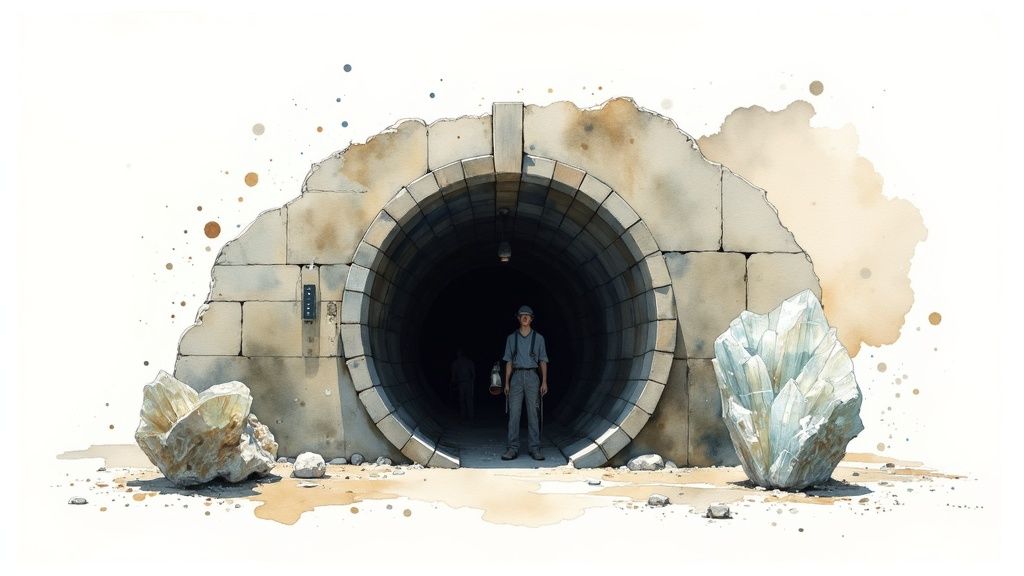
Step into the story of the Elmwood Mine, a name that sends a ripple of excitement through the mineral collecting world. Tucked away near Carthage, Tennessee, this zinc mine unexpectedly became legendary, not for its industrial output, but for the absolutely breathtaking mineral specimens pulled from its depths.
Exploring the Legendary Elmwood Mine
Think of the Elmwood Mine as a geological treasure chest that was briefly cracked open for the world to see. It’s one of those rare locations that, much like the famed Sweet Home Mine in Colorado, produced minerals so exceptional they literally set the global standard for quality.
Even though its tunnels have fallen silent, the story of this remarkable mine continues to fascinate collectors and geologists alike.
We're going to take a journey through the mine's history, explore the unique geology that allowed such incredible crystals to form, and look at the iconic minerals that made Elmwood a benchmark for perfection.
A Landmark in American Mining History
Running from its discovery in 1969 until it finally closed at the end of 2023, the Elmwood Mine carved out a major place in American mining history. It was never just another industrial site; it was a source for some of the most coveted mineral specimens ever found on the continent.
The conditions there were just right. Ore formed at relatively low temperatures—between 85 and 130 °C—which gave massive, flawless crystals the time they needed to grow slowly over millennia.
The real magic of the Elmwood Mine wasn't what it was designed to produce. Its primary job was industrial, but its accidental gift to the world was a collection of natural art that remains almost unmatched.
What Made Elmwood Minerals So Special?
The minerals from this Tennessee spot are prized for a combination of traits you rarely see all in one place. The mine consistently produced specimens with unbelievable quality.
Color Saturation: We're talking deep, rich purples in the Fluorite and vibrant "ruby jack" reds in the Sphalerite that almost glow.
Crystal Size and Form: Many crystals grew to astonishing sizes while keeping their perfect, textbook geometric shapes.
Clarity and Luster: These crystals often have a glassy, almost gem-like quality that is incredibly desirable to collectors.
Aesthetic Association: You'd often find different minerals growing together on the same piece, creating stunningly beautiful and perfectly balanced compositions. It's like nature's own sculpture.
The History of the Elmwood Mine
The story of the Elmwood Mine is a classic American tale of discovery, boom, and eventually, silence. Its history isn't just a list of dates; it’s a direct reflection of geology meeting economic reality. It all kicked off in the late 1960s, when the Jersey Minière Zinc Company struck promising zinc deposits near Carthage, Tennessee.
That discovery was the spark that lit the fuse for a massive industrial operation. After years of groundwork and heavy construction, the mine officially roared to life in 1975. For the next few decades, it was a titan of the Middle Tennessee mining complex, cranking out a huge portion of the domestic zinc supply and providing good jobs for the local community.
A History of Starts and Stops
But the mine's life wasn't a straight, upward climb. It was more like a rollercoaster, with periods of intense, around-the-clock activity followed by sudden shutdowns. What was pulling the levers? Simple economics: the global price of zinc.
When prices were high, Elmwood was a hive of activity. When they tanked, operations would grind to a halt. For collectors, this is a crucial piece of the puzzle. It means that fantastic new specimens weren't constantly flowing onto the market. Each time the mine fired back up, it opened a brief, precious window for new geological treasures to be found, making every piece that much rarer. This on-again, off-again dynamic is quite different from other famous American mining localities, and for those interested in a comparison, you can explore the unique history of gemstone mining in Colorado in another of our guides.
The mine’s intermittent operation created a finite, unpredictable supply of its famous minerals. This scarcity is a huge reason why authentic, high-quality Elmwood specimens are so prized today.
The Final Chapter
After changing hands a few times over the years, the mine entered its final act. Despite holding some of the most incredible mineral specimens on the planet, the numbers just had to work. Ultimately, the decision was made to shut it down for good. The pumps that battled back the groundwater deep in the earth were switched off one last time.
That closure marked the end of an era. It’s a guarantee that no new specimens will ever be pulled from the Elmwood Mine. This simple fact transforms every authentic piece from a rock into an artifact—a finite and irreplaceable slice of both geological and industrial history. Each crystal doesn't just tell a story of how it was formed, but also of the ambition and grit that brought it into the light.
Decoding the Geology of the Elmwood Mine
The secret behind the Elmwood Mine's legendary status is written in its rocks. What exactly made this one spot in Tennessee a world-class mineral factory? It all comes down to a perfect storm of geological circumstances that created an underground laboratory for growing enormous, flawless crystals over millions of years.
Geologists classify the Elmwood Mine as a Mississippi Valley-Type (MVT) deposit. This isn't just technical jargon; it's a specific recipe for incredible mineral formation. Think of the ancient host rock—the Ordovician-era Knox Dolomite—as a gigantic stone sponge. Over immense spans of time, geological activity carved out huge voids, pockets, and cavities within this rock.
These empty spaces set the stage for a slow, patient act of creation.
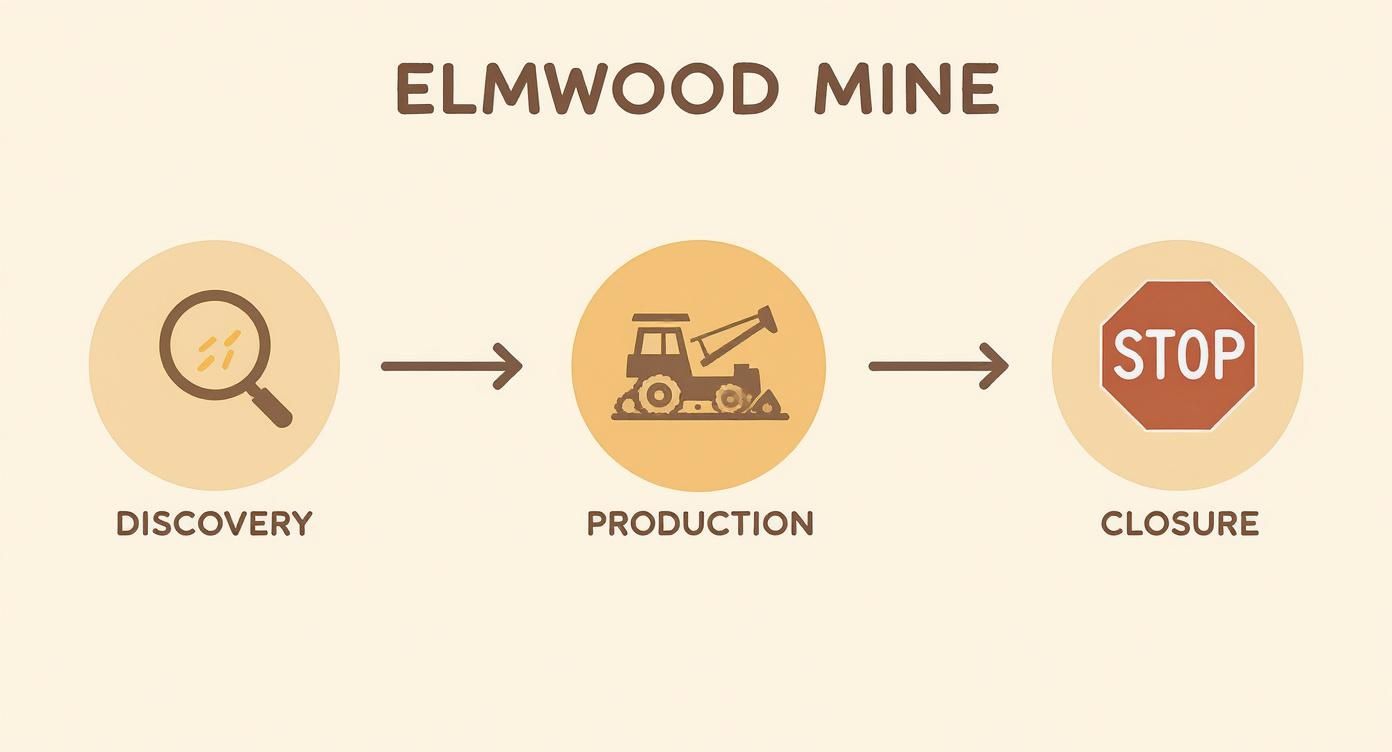
The diagram below maps out the mine's journey from a geological wonder to a sealed piece of history.
This visual timeline captures its life cycle, from the initial discovery and years of active production to its final, permanent closure, which cemented its legacy in the mineral world.
The Crystal-Growing Incubator
For countless millennia, warm, mineral-rich brines—basically salty, super-concentrated water—crept through the porous dolomite. The process was strikingly similar to making rock candy. Just as sugar crystallizes out of a supersaturated syrup onto a string, these brines gradually deposited their dissolved minerals onto the walls of the rock cavities.
This was anything but a rapid or violent event. The flow was slow and steady, and the conditions were stable and low-temperature, often below 150°C. This geological patience allowed minerals to form atom by atom, building up layer by layer into the large, perfectly formed crystals that collectors prize today. This natural incubator is the entire secret to Elmwood’s fame.
The key takeaway is simple: Elmwood’s remarkable specimens are the product of three perfect ingredients. You need a porous host rock, vast open spaces inside it, and a slow, steady flow of mineral-rich fluids over an incredibly long time.
Understanding the Host Rock
The Knox Dolomite itself is a type of sedimentary rock, but the heat and pressure from the mineralizing fluids can sometimes alter the surrounding geology. While not a classic example of large-scale change, these processes share principles with other geological transformations. If you're curious about how rocks can change under different conditions, our guide that explains what metamorphic rock is is a great place to start.
Ultimately, this unique geological setting provided everything needed for world-class specimens to form:
Space to Grow: The large voids meant crystals could grow unconstrained, allowing them to reach their impressive sizes.
Rich Ingredients: The brines were loaded with zinc, sulfur, fluorine, and barium—the essential building blocks for Sphalerite, Fluorite, and Barite.
Time and Stability: The slow deposition process is the reason for the high clarity and near-perfect crystal structures found in Elmwood minerals.
Showcasing The Crown Jewels Of Elmwood
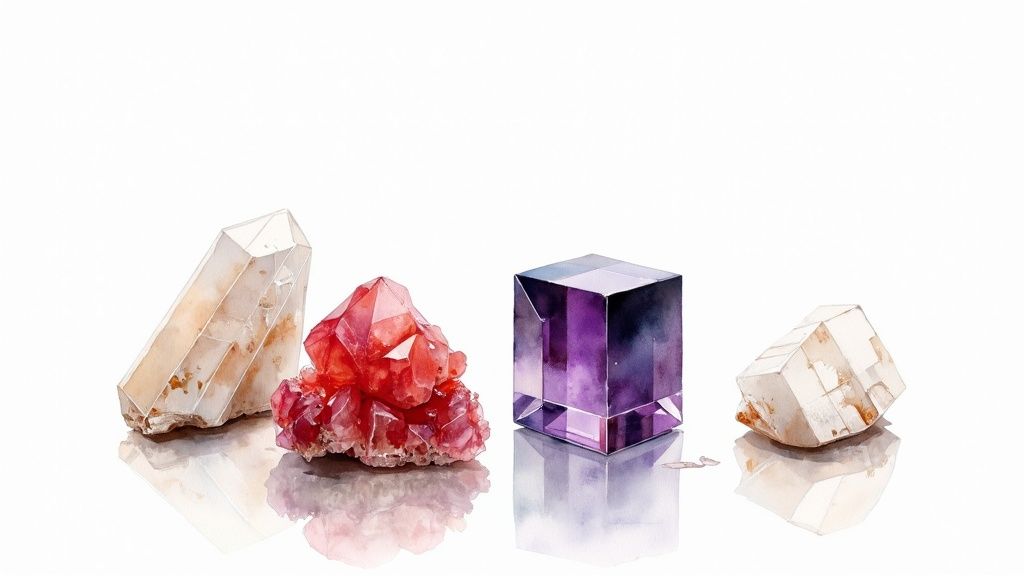
While the Elmwood Mine was an industrial workhorse for zinc production, its real legacy—the thing that gets collectors and curators excited—lies in the jaw-dropping mineral specimens it brought to the surface. These aren't just rocks; they're geological masterpieces that set a global benchmark for quality. When you hear experts talk about Elmwood, they're almost always referring to the mine's iconic "big four" minerals, each with a personality so distinct they're instantly recognizable.
These four—Sphalerite, Fluorite, Calcite, and Barite—are the undisputed stars of the show. Their sheer size, clarity, and the way they grew together are why the Elmwood Mine's name is spoken with such reverence. Let's get properly introduced to these crown jewels.
The Fiery Heart of Elmwood Sphalerite
When collectors talk about Elmwood Sphalerite, they don’t just say "Sphalerite." They use its affectionate nickname: "ruby jack." That name says it all, perfectly capturing the mineral's most famous trait—a deep, gemmy reddish-brown to cherry-red color.
This isn't your typical opaque, black Sphalerite found elsewhere. Elmwood's version is often highly translucent. When you backlight these crystals, they ignite with a fiery internal glow that shows off their incredible clarity and rich color. They formed in complex, multi-faceted crystal groups that are as beautiful as they are geologically interesting.
The Regal Purple Fluorite
If Elmwood had to be known for just one mineral, it would probably be its unbelievable purple Fluorite. These specimens are the very definition of "museum quality." They're celebrated for their classic, razor-sharp cubic crystal shape and a deep, royal purple that is simply second to none.
But what really pushes them into legendary status are the stories they tell from the inside. Many Elmwood Fluorite cubes contain phantoms—faint, ghost-like outlines of earlier crystal growth stages trapped within. These phantoms chronicle the crystal's life, with darker purple zones often marking distinct periods of formation. It’s like looking into a geological time capsule, perfectly preserved.
The combination of deep color, perfect cubic form, and the presence of phantoms makes Elmwood Fluorite a benchmark against which all other purple Fluorites are measured.
This level of quality cemented the mine's reputation. Beyond specimens, the mine was a huge economic driver. By 1988, Tennessee's zinc industry was pulling in over $159 million in revenue, ranking third among the state's mineral industries, and Elmwood was a major reason for that success. You can dig deeper into the numbers on Tennessee's mining economy to see the regional impact.
Gleaming Towers of Calcite
While Sphalerite and Fluorite steal the show with their color, Elmwood Calcite is all about breathtaking form and luster. These crystals often grew into large, elongated, and sharply terminated points, earning them the perfect nickname: "stellar beam" Calcite.
They range from a soft golden-honey color to completely colorless, with a glassy luster that makes them sparkle in any light. Some of the most coveted pieces are the massive "dogtooth" spars that can reach mind-boggling sizes while remaining perfectly water-clear. Often found growing right alongside deep purple Fluorite, these Calcite crystals create a brilliant, gleaming contrast.
Delicate Blades of Barite
Rounding out the "big four" is Barite, which often plays a crucial supporting role in the very best Elmwood specimens. It usually forms as delicate, bladed crystals in shades of white or light blue, frequently arranged in beautiful rosette or fan-like clusters.
Barite's true beauty shines when it acts as a backdrop. Just picture it: brilliant red Sphalerite or deep purple Fluorite perched on a contrasting matrix of snow-white Barite blades. These combination pieces are highly prized because they showcase multiple Elmwood classics in a single, stunning natural sculpture. The Barite adds texture, contrast, and another layer of beauty, turning these specimens into true geological works of art.
To pull it all together, here’s a quick look at what defines each of these legendary minerals.
Signature Minerals of the Elmwood Mine
Mineral
Common Color(s)
Distinctive Features
Common Associations
Sphalerite
Deep red to reddish-brown
High translucency, fiery internal glow when backlit, nicknamed "ruby jack"
Calcite, Barite
Fluorite
Deep purple
Sharp cubic form, often contains internal "phantoms" from growth stages
Sphalerite, Calcite
Calcite
Colorless, honey-gold
Large, elongated "dogtooth" or "stellar beam" crystals with glassy luster
Fluorite, Sphalerite
Barite
White, light blue
Bladed crystals forming rosette or fan-like clusters, often as a matrix
Sphalerite, Fluorite
These four minerals, whether found alone or in stunning combinations, are the reason the Elmwood Mine holds such a special place in the hearts of collectors worldwide. Each one tells a small part of the incredible geological story of this unique location.
A Collector's Guide to Elmwood Minerals
For anyone hoping to own a piece of geological history, getting your hands on a specimen from the Elmwood Mine is a special kind of prize. Now that the mine is permanently closed, the market for its minerals has become its own specialized field—one where knowing what you're looking at is everything.
Understanding what makes a piece valuable is the first step toward making a purchase you’ll be happy with for years to come. Think of it like evaluating a diamond. There are specific qualities that separate a good piece from a truly exceptional one. The big ones are crystal size, clarity, color saturation, and the overall look and feel of the specimen.
Sure, a large, perfectly formed Fluorite cube is impressive on its own. But find one with that classic deep purple color and glassy clarity? That’s something else entirely. A specimen that features multiple minerals in a balanced, visually pleasing arrangement—like a sharp Calcite crystal perched on a bed of "ruby jack" Sphalerite—is almost always more valuable than a piece with just a single mineral.
Identifying Authentic Elmwood Specimens
Navigating the market requires a keen eye for the signature traits that scream "Elmwood." Learning to spot these characteristics is a crucial skill for any collector wanting to add these Tennessee classics to their cabinet.
Signature Color Palettes: Keep an eye out for that classic deep, royal purple in Fluorite and the fiery, translucent red of "ruby jack" Sphalerite. These colors are pure Elmwood.
Distinct Crystal Habits: Elmwood is famous for its razor-sharp cubic Fluorite and the long, glassy "stellar beam" Calcite crystals. These shapes are highly characteristic of the location.
Iconic Mineral Associations: The most sought-after specimens often feature a beautiful combination of the "big four" minerals. Fluorite with Sphalerite, or Calcite sitting on a bed of Barite, are classic pairings you'll see again and again.
Sticking to reputable sources is non-negotiable. Established mineral dealers, well-known online shops, and major mineral shows are your safest bets. Don't be shy about asking for provenance—any information about the specimen's history—as it helps confirm you're getting the real deal. If you're just starting out, our guide to building a mineral and rock collection has some great foundational advice on sourcing and curating.
An authentic Elmwood specimen is more than just a mineral; it's a finite artifact from a legendary American locality. The value lies not just in its beauty, but in its irreplaceability.
Appreciating How Crystals Form
The perfect geometry and stunning clarity of Elmwood crystals are enough to inspire awe. For those who get curious about the science behind how these natural wonders form, a hands-on approach can be incredibly insightful.
If you're interested in the science and want to deepen your appreciation for their beauty, this guide to growing your own crystals is a fantastic starting point. It gives you a new level of respect for the slow, perfect conditions that created these Tennessee treasures. By understanding what to look for and where to buy, you can confidently add a true piece of American mining history to your collection.
The Enduring Legacy of the Elmwood Mine
So, why does the Elmwood Mine still get collectors and geologists talking, decades after its prime? The answer goes far beyond tons of ore. Its impact is permanently etched into mineralogical history, a perfect story of American industry meeting breathtaking natural art.
More than just pretty rocks, the mine produced specimens of such textbook perfection that they are now the gold standard for mineralogy students worldwide. These crystals are the ideal examples used to teach specific mineral habits and formations.
A Permanent Place in History
The sheer scale of the operation was staggering. At its peak, the Middle Tennessee mining complex, with the Elmwood Mine at its heart, could crank out around 39,000 metric tons of zinc-in-concentrate in a single year (like it did in 2018). For a deeper dive into its industrial might, you can check out the production details over at The Diggings.
But Elmwood's true legacy isn't found in production logs—it's preserved in every flawless crystal it yielded. Each specimen is a time capsule from a legendary locale that we can never return to.
Today, these incredible minerals are the centerpieces in prestigious museum displays and cherished private collections all over the globe, making sure their story is never forgotten.
Got Questions About the Elmwood Mine?
When you’re talking about a mineral locality as legendary as Elmwood, a lot of questions come up. It's a spot that holds a special place in the hearts of collectors, and for good reason. Let's dig into some of the most common things people want to know about the mine, its minerals, and what it all means for collectors today.
Getting these basics down will give you a much deeper appreciation for why this Tennessee treasure is so revered worldwide.
Can You Still Visit or Collect at the Elmwood Mine?
In a word: no. The Elmwood Mine is completely closed to all mining operations and is off-limits for any kind of public or private collecting. The site is totally inaccessible.
Every genuine Elmwood specimen on the market today comes from old stock—minerals that were brought out of the ground back when the mine was still active. This means there's a finite supply, which is a huge part of what makes these pieces so valuable and sought-after.
What Makes Elmwood Mine Fluorite So Special?
Elmwood Fluorite is the stuff of legends, mostly famous for its stunning, deep purple color, fantastic clarity, and textbook cubic crystal shape. What really sends collectors over the edge are the internal "phantoms" you'll find in many specimens, which beautifully map out the crystal's growth history in distinct, darker zones.
These incredible crystals are often found sitting right alongside brilliant Sphalerite, creating mineral combinations that are just jaw-dropping. Their quality really set the global standard for what top-tier Fluorite should look like.
The trifecta of intense color, perfect cubic form, and dramatic phantoms makes Elmwood Fluorite the benchmark. When collectors talk about great purple fluorite, this is the material all others are measured against.
How Do I Know if a Mineral Is Really from Elmwood?
Authenticating an Elmwood specimen is all about knowing its signature look and mineral pairings. There are a few dead giveaways:
Sphalerite: Look for that classic "ruby jack" luster and a deep, gemmy red color. It’s unmistakable.
Fluorite: The deep purple hue and sharp cubic form are trademarks of the locality.
Associations: The best pieces often feature Fluorite and Sphalerite together on the same matrix, sometimes accompanied by Barite or Calcite.
Honestly, the surest way to guarantee you're getting the real deal is to buy from a reputable mineral dealer. Someone who knows their stuff can provide clear provenance, confirming the specimen's origin and history.
At Astro West, we take immense pride in offering ethically sourced, fully authenticated minerals from iconic localities like the Elmwood Mine. We invite you to explore our curated collection and take home a true piece of geological history.