Neptunite: A Collector’s Guide to the Rare Gemstone
Neptunite is one of those minerals that just stops you in your tracks. Prized by collectors for its razor-sharp, jet-black crystals, it often bursts through a matrix of pure white natrolite, creating a natural sculpture of breathtaking contrast. Its sheer rarity means any new find is a big deal in the mineral world, making it a true geological treasure.
What Makes Neptunite So Special?
Imagine a gemstone born from crushing pressure deep within the Earth, pushed to the surface as a perfectly formed, inky-black crystal. That’s the story of neptunite. For collectors, its appeal is about so much more than a simple black rock—it’s a tangible piece of a very specific, and very rare, geological event.
The real showstopper is its dramatic visual flair. Dark, glossy neptunite crystals piercing a bed of delicate white natrolite look like a masterpiece sculpted by nature itself. This striking combination is exactly what collectors hunt for, turning a mineral specimen into a genuine piece of natural art.
A Mineral of Distinction
What really sets neptunite apart is its scarcity. This isn't a mineral you stumble upon often. It’s an exceptionally rare silicate found in only a handful of places worldwide, known for its deep black or, less commonly, reddish-brown hues.
It has a complex chemical formula—KNa₂Li(Fe²⁺,Mn)²⁺Ti₂Si₈O₂₄—which points to the unique cocktail of elements required for it to form. By far, the most famous and productive source for fine neptunite is the Dallas Gem Mine in San Benito County, California, which has unearthed the world's best examples.
Finding a high-quality neptunite specimen is a major moment for any collector. Its appearance, especially alongside other rarities like blue benitoite, signals a very specific and uncommon geological history. It elevates the stone from a mere mineral to a coveted geological artifact.
So, what’s the big picture? Neptunite is a mineral defined by its incredible story and standout features:
Extreme Rarity: Discovered in very few locations across the globe.
Striking Aesthetics: Deep black crystals set against a bright white matrix.
Geological Significance: Forms under very specific, high-pressure metamorphic conditions.
Collector's Value: Highly sought-after for its beauty, scarcity, and unique associations.
Neptunite at a Glance
For those who love the technical details, here’s a quick rundown of neptunite's key properties. This table gives you a snapshot of what defines this mineral from a scientific perspective.
Property
Description
Chemical Formula
KNa₂Li(Fe²⁺,Mn)²⁺Ti₂Si₈O₂₄
Crystal System
Monoclinic
Color
Black to reddish-black
Luster
Vitreous to sub-metallic
Hardness
5 to 6 on the Mohs scale
Specific Gravity
3.19 to 3.23
Cleavage
Perfect on {110}
Fracture
Conchoidal
Streak
Reddish-brown
Associated Minerals
Benitoite, Natrolite, Serpentine, Joaquinite
Understanding these characteristics helps you appreciate the fine details that make each neptunite specimen unique, from its crystal structure to the way it breaks and reflects light.
The Story of Neptunite's Formation
Every mineral has an origin story, but neptunite’s is particularly dramatic. It begins deep within the Earth's crust, in a geological pressure cooker where intense force and relatively low temperatures conspire to create something extraordinary. This isn't a story of volcanic fire; it's a tale of immense tectonic power.
This unique environment is most often found where oceanic plates grind beneath continental plates—a process geologists call subduction. The rocks get squeezed under unimaginable pressure but never get hot enough to completely melt, creating a special type of rock known as blueschist metamorphic rock. It’s this high-pressure, low-temperature "cooking" that sets the stage for neptunite's birth. To learn more about this fascinating process, check out our guide on what is metamorphic rock.
The Perfect Geological Recipe
Even within these specialized zones, neptunite doesn't just appear anywhere. It grows inside hydrothermal veins—fractures filled with superheated, mineral-rich fluids—that slice through a dark, greenish-black rock called serpentine. Think of these veins as geological arteries.
As these fluids cool under just the right conditions, the necessary ingredients—potassium, sodium, lithium, iron, titanium, and silicon—finally arrange themselves into neptunite's iconic crystal structure.
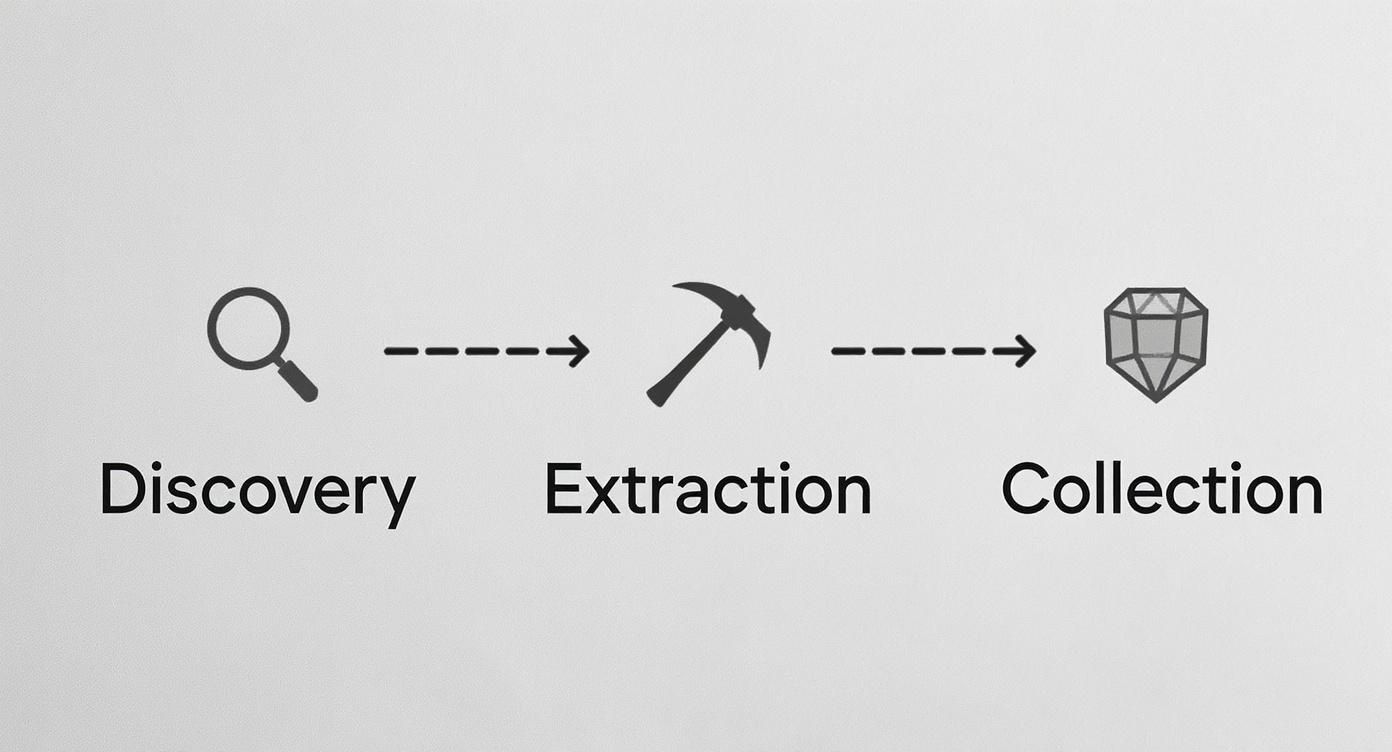
This infographic breaks down the journey of a neptunite specimen, from its violent birth deep underground to its final place on a collector's shelf.
As you can see, the path involves discovery within the host rock, careful extraction, and meticulous preparation to reveal its natural beauty.
The final product is a cluster of sharp, jet-black prismatic crystals. What makes these specimens truly spectacular is that they often grow alongside a soft, snow-white mineral called natrolite. This stark, natural contrast between the glossy black neptunite and its bright white matrix is what collectors go wild for. It's a perfect pairing, forged by a very specific and violent geological event.
A Tale Told by Mineral Companions
Neptunite is rarely a solo act; its presence often points to an even bigger geological story. Its most famous sidekicks are the electric-blue benitoite and the rare, orange-to-brown joaquinite, especially in the world-class specimens from San Benito County, California.
Because of this, finding neptunite is often a happy accident while searching for other prized minerals. Its formation is so interconnected with its neighbors that their presence tells geologists and collectors everything they need to know about the specimen's dramatic history.
How to Identify and Grade Neptunite
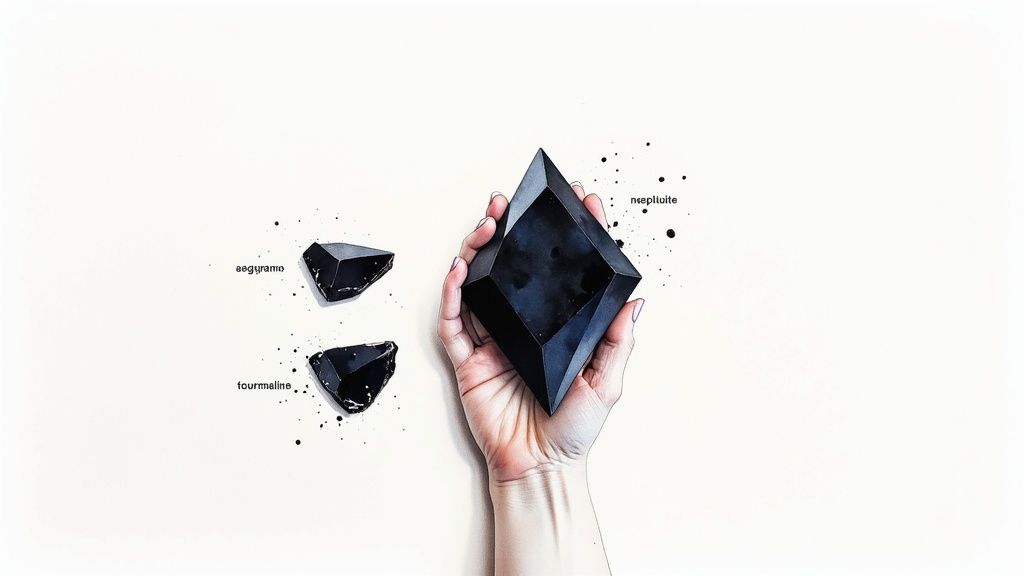
Telling a genuine neptunite from its look-alikes is a fundamental skill for any serious collector. At a quick glance, its deep black, prismatic crystals can easily be mistaken for minerals like aegirine or even black tourmaline (schorl). But when you take a closer look, its unique physical traits give it away every time.
The most telling feature is its crystal shape. Neptunite crystals are monoclinic, which means they form these sharp, well-defined prisms that often have a square or rectangular cross-section. This is a world away from the rounded-triangular, often striated look of black tourmaline. Neptunite also has a distinctive vitreous (glassy) to slightly greasy luster, giving it a special sheen under the light.
Key Physical Characteristics
Beyond its signature crystal habit, a few other properties will help you lock in an identification. One of the most reliable clues is its hardness and density—these are the numbers that don’t lie. Neptunite has a hardness of 5-6 on the Mohs scale and a density of about 3.23 g/cm³, making it sturdy enough for careful handling and display.
Here are a few other key identifiers to keep in mind:
Cleavage: It has perfect cleavage in two directions, meaning it will break along smooth, flat planes if it takes a hit.
Streak: When you scratch it on an unglazed porcelain plate, neptunite leaves a very distinct reddish-brown streak. This is a dead giveaway.
Fracture: On surfaces where it doesn’t break along a cleavage plane, it shows a conchoidal fracture—a curved, shell-like pattern.
Getting these details down is a game-changer for any collector. If you want to dive deeper into these techniques for other minerals, our crystal identification guide is packed with useful insights for enthusiasts at every level.
This image shows neptunite crystals nestled in their classic white natrolite matrix, a signature look from the San Benito County locality.
You can see the sharp, jet-black prisms and the stunning color contrast that makes these specimens so sought-after by collectors worldwide.
A Framework for Grading Neptunite
Once you know you have a real neptunite, the next step is figuring out its quality. Grading isn’t just about ticking boxes on a checklist; it’s about looking at the specimen as a whole and judging its overall aesthetic impact.
The ultimate value of a neptunite specimen lies in its visual harmony. A perfect, razor-sharp crystal on a pristine, contrasting matrix will always command more attention than a larger, but damaged or poorly presented, crystal.
When you're evaluating a piece, here are the main criteria to consider:
Crystal Size and Definition: Bigger is often better, but sharp, well-formed, and perfectly terminated crystals are what truly set a specimen apart.
Luster and Color: The best pieces have a high, glossy luster and a deep, consistent black color. You want it to pop.
Condition: Look for chips, fractures, and any other damage. A pristine, untouched crystal is always the goal.
Matrix Quality: The matrix—usually that bright white natrolite—is critical. A clean, undamaged matrix that makes the black neptunite stand out is ideal.
Association with Benitoite: If a neptunite specimen features the incredibly rare blue gem benitoite, its value and desirability skyrocket. This is the ultimate combination.
For a truly precise analysis, especially with high-value specimens, you’d rely on specialized equipment and the kind of sturdy casework for mineral labs professionals use. Taking all these factors into account gives you a complete picture, empowering you to make smart, confident additions to your collection.
Where in the World Is Neptunite Found?
When you think of world-class neptunite, one place immediately comes to mind: San Benito County, California. It rightfully holds the crown for producing the finest specimens the world has ever seen. But this incredibly rare mineral isn't a California exclusive.
Unearthing neptunite requires a very specific and unusual geological recipe, which is why it only pops up in a handful of special pockets around the globe. Each locality offers its own unique twist on the mineral's appearance, showcasing subtle but fascinating variations that get collectors excited.
The story starts at the historic Dallas Gem Mine in San Benito County, the undisputed king of neptunite localities. The specimens unearthed here set the global standard for quality. They're famous for their razor-sharp, intensely lustrous black crystals jutting out from a pristine white natrolite matrix. That dramatic black-on-white contrast is the mine’s signature, making its pieces instantly recognizable and highly sought-after.
A Global Tour of Neptunite Hotspots
Beyond the golden state, our search for neptunite takes us to some remote and geologically rich regions. Each of these locations adds its own chapter to the neptunite story, offering distinct characteristics that appeal to different collecting tastes.
The Kola Peninsula in Russia is another major player. Neptunite from this arctic region is often found in a different geological setting, typically within alkaline pegmatites. These specimens might not always have the stark white matrix of their Californian cousins, but they are known for forming complex, interesting crystal groups. The associated minerals are different, too, painting a completely new geological picture.
For collectors, the origin of a neptunite specimen is a key part of its identity. A piece from Russia tells a different geological story than one from California, adding a layer of scientific and historical richness to a collection.
Crossing the Atlantic, we land in another important spot: Mont Saint-Hilaire, Quebec, Canada. This area is a true mineralogical paradise, famous for an incredible diversity of rare species. Neptunite here is found within nepheline syenites and is often noted for its slightly different crystal habits and associations, giving it a unique Canadian flavor. These subtle variations really highlight just how sensitive neptunite's formation is to its local environment.
Limited Use But High Value
Despite its striking looks and unique chemistry, neptunite has no real industrial or commercial applications. Its value is purely for aesthetics and science, with production limited to small-scale operations that cater to the mineral collecting community. You can dig deeper into its specifics with resources like neptunite's properties on Webmineral.com, a reliable database for mineralogical data.
This exclusivity only makes it more appealing. Each key location contributes something unique to the global supply, offering a little something for every type of collector:
San Benito County, USA: The benchmark for quality. Known for that iconic black-on-white aesthetic and its famous association with benitoite.
Kola Peninsula, Russia: Offers neptunite from alkaline pegmatites, often with unique crystal habits and mineral pairings you won't see elsewhere.
Mont Saint-Hilaire, Canada: A source for neptunite found in nepheline syenites, adding to the location's famed mineral diversity.
This worldwide perspective really drives home the mineral's profound rarity. It’s not just a beautiful crystal; it’s a geological artifact from a handful of very special places on Earth.
Understanding the Value of Neptunite
Figuring out what a neptunite specimen is worth is part art, part science. Unlike gemstones faceted for jewelry, neptunite's value is all about its raw, natural form as a mineral specimen. Collectors aren't just looking at one single quality; they're captivated by the entire visual story the piece tells.
Several key factors come together to determine a specimen's market price. While size is often where people start, it’s rarely the most important detail. A small, perfect neptunite crystal sitting just right on a clean white natrolite matrix can easily be worth more than a larger crystal that's damaged or poorly presented.
Key Drivers of Market Value
The true worth of a neptunite specimen boils down to a mix of rarity, condition, and sheer visual impact. The pieces that collectors hunt for are those that strike a perfect balance, creating a natural sculpture that truly stands out in a display cabinet.
Here’s a breakdown of what collectors and appraisers are looking for:
Crystal Perfection: Are the crystals sharp and well-defined? Are they complete? Specimens with terminated, razor-sharp prisms are infinitely more desirable than those showing any signs of damage.
Aesthetic Association: The classic combination is jet-black neptunite on snow-white natrolite. But the ultimate prize? That's neptunite associated with the electric-blue benitoite, creating a trifecta of rare minerals that sends the value soaring.
Matrix Quality: The host rock, or matrix, is the stage for the main event. A clean, balanced, and undamaged matrix that shows off the neptunite crystals is absolutely crucial.
Specimen Origin: Pieces from the legendary San Benito County, California, carry a serious premium. It's not just about geography; it's about the historical significance and consistently superior quality found there.
From Entry-Level to Museum-Grade
The good news is that collecting neptunite is accessible at almost any level. An entry-level piece might have a smaller, less prominent crystal, giving you an affordable way to own this incredible mineral. Mid-tier specimens usually boast larger crystals or better contrast with the matrix, making them fantastic centerpieces for a growing collection.
At the very top end, you have museum-grade neptunite. These specimens are defined by their extraordinary crystal quality, unbelievable aesthetics, and often, that legendary association with benitoite. These pieces aren't just minerals; they're sound investments in natural art.
Neptunite's rarity is directly tied to its market value. High-quality specimens can command prices from several hundred to many thousands of dollars, all depending on those grading factors. This is where understanding the nuances between a precious and semi-precious stone classification becomes important. You can learn more about these distinctions in our detailed guide on precious vs. semi-precious stones.
For serious collectors, acquiring a top-tier neptunite specimen is more than a purchase—it's an acquisition of a rare geological artifact. Its value is tied to its scarcity, beauty, and the specific story it tells about its formation deep within the Earth.
For businesses or serious collectors, it's also smart to think about the financial risks of owning and trading rare gemstones like neptunite. Specialized insurance policies offer vital protection, and understanding specialized insurance for valuable gemstone inventory can be a critical step in safeguarding these incredible assets.
Caring for Your Neptunite Specimen
Bringing a rare mineral like neptunite into your collection is a real treat, but it also comes with the responsibility of proper care. A little bit of thoughtful maintenance goes a long way, ensuring those sharp, glossy crystals and their dramatic matrix stay pristine for years to come. Thankfully, caring for neptunite is pretty straightforward once you know the basics.
This mineral sits between a 5 and a 6 on the Mohs hardness scale. That makes it relatively durable but still vulnerable to scratches from harder everyday materials like quartz or even a steel knife. It’s always best to handle your specimen with care, holding it by the matrix to keep your fingers off the delicate crystals.
Cleaning and Displaying Neptunite Safely
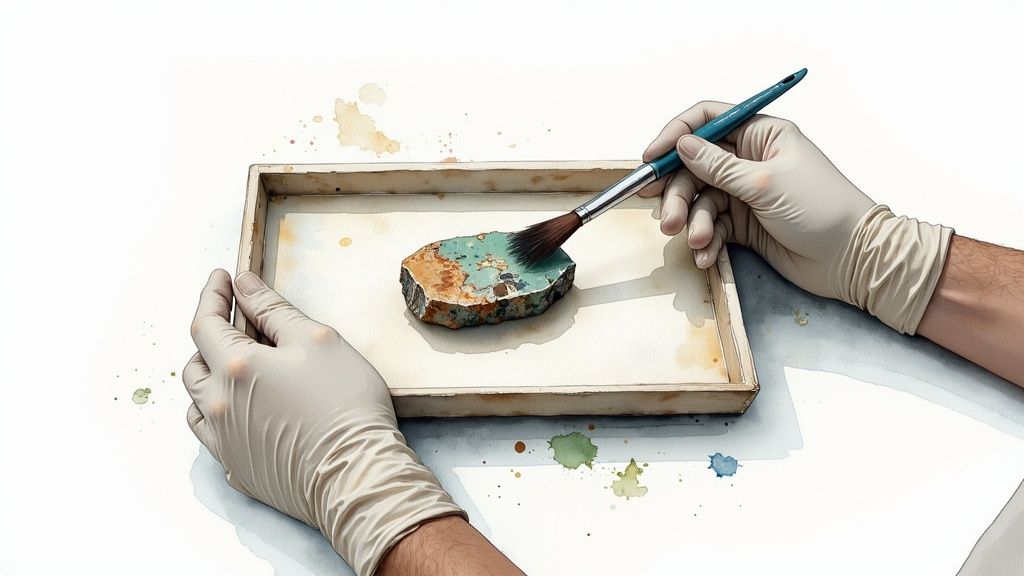
When it comes to cleaning, less is always more. For simple dusting, a soft, dry brush or a gentle puff of compressed air (from a distance!) will do the trick. If you’re dealing with more stubborn grime, a quick rinse with room-temperature distilled water is usually all it needs.
Never use ultrasonic cleaners or harsh chemical solvents on your neptunite. These aggressive methods can easily damage the delicate crystals and potentially harm the underlying natrolite matrix, which would permanently dull the specimen's natural beauty.
To keep your neptunite looking its absolute best, just follow these simple guidelines for display and cleaning:
Avoid Sunlight: Keep it out of direct sunlight. Prolonged exposure can cause subtle color changes over time, so a spot with indirect or artificial light is ideal.
A Stable Environment: Place it somewhere free from vibrations or the risk of being bumped—think a sturdy shelf or, even better, a closed display case.
Gentle Cleaning Only: Stick to the basics: compressed air or distilled water. Stay away from soaps, detergents, or any abrasive materials that could scratch those beautiful crystal surfaces.
Proper care is really the final, crucial step in being a good steward of your mineral collection. For more great advice on building a collection you can cherish for a lifetime, check out our tips on how to start a collection of rare rocks and minerals. By following these simple practices, you'll preserve both the value and the incredible aesthetic appeal of your magnificent neptunite.
Your Neptunite Questions Answered
To wrap up our deep dive into this incredible mineral, let's tackle some of the most common questions collectors ask. Think of this as a quick-reference guide to solidify what makes neptunite such a standout piece in any collection.
Is Neptunite a Good Investment?
Absolutely. Within the mineral collecting community, high-quality neptunite is considered a solid, stable investment that often appreciates over time. Its sheer rarity, combined with the legendary status of the San Benito County locality, keeps demand consistently high.
Specimens with sharp, well-formed crystals are always in demand, but the real prizes are those with desirable associations—especially the iconic blue benitoite. These top-tier pieces are the ones that tend to hold or increase their value, making them a smart addition for any serious collector.
How Can I Tell Neptunite from Black Tourmaline?
This is a great question, as they can look similar at a glance. While both can form black, prismatic crystals, the giveaways are in the details. Neptunite crystals are monoclinic, which gives them a distinct square or rectangular cross-section and a glassy, almost greasy luster.
Black Tourmaline (also known as Schorl), on the other hand, is trigonal. Its crystals often have a tell-tale rounded triangular cross-section, usually with fine vertical lines running down their length, called striations.
But the easiest way to tell them apart? The hardness test. Tourmaline is a tough 7-7.5 on the Mohs scale, while neptunite is a much softer 5-6. This simple difference will clear up any confusion right away.
Can You Make Jewelry Out of Neptunite?
Technically, yes, you could facet neptunite, but it’s almost never done for a few very good reasons. Its moderate hardness and perfect cleavage in two directions make it incredibly fragile and a nightmare for lapidaries to work with.
Ultimately, a natural, uncut neptunite specimen is far more valuable and appreciated just as it is, particularly when it’s still sitting on its original matrix. Turning it into jewelry would not only be a huge challenge but would almost certainly diminish the unique value it holds as a pristine geological wonder.
At Astro West, we take pride in sourcing exceptional neptunite specimens for collectors at every level. We invite you to explore our curated collection of fine minerals and find a piece of natural history to treasure for a lifetime.