What Is Metamorphic Rock? Learn Key Facts & Examples
So, what exactly is a metamorphic rock?
At its heart, a metamorphic rock is any rock that has been fundamentally transformed by intense heat, immense pressure, or chemical reactions happening deep within the Earth. It's not a new rock, but rather a recycled version of something that already existed—whether that was an igneous, sedimentary, or even another metamorphic rock.
Think of it like baking. You start with individual ingredients like flour, eggs, and sugar. But once they go into the oven, heat transforms them into something completely different: a cake. The original ingredients are still there, but their form has changed entirely. The same thing happens to rocks under the Earth's surface.
The Story of Rock Transformation
Picture a simple piece of shale—a soft sedimentary rock formed from ancient mud—getting buried miles deep during the slow, powerful collision of tectonic plates.
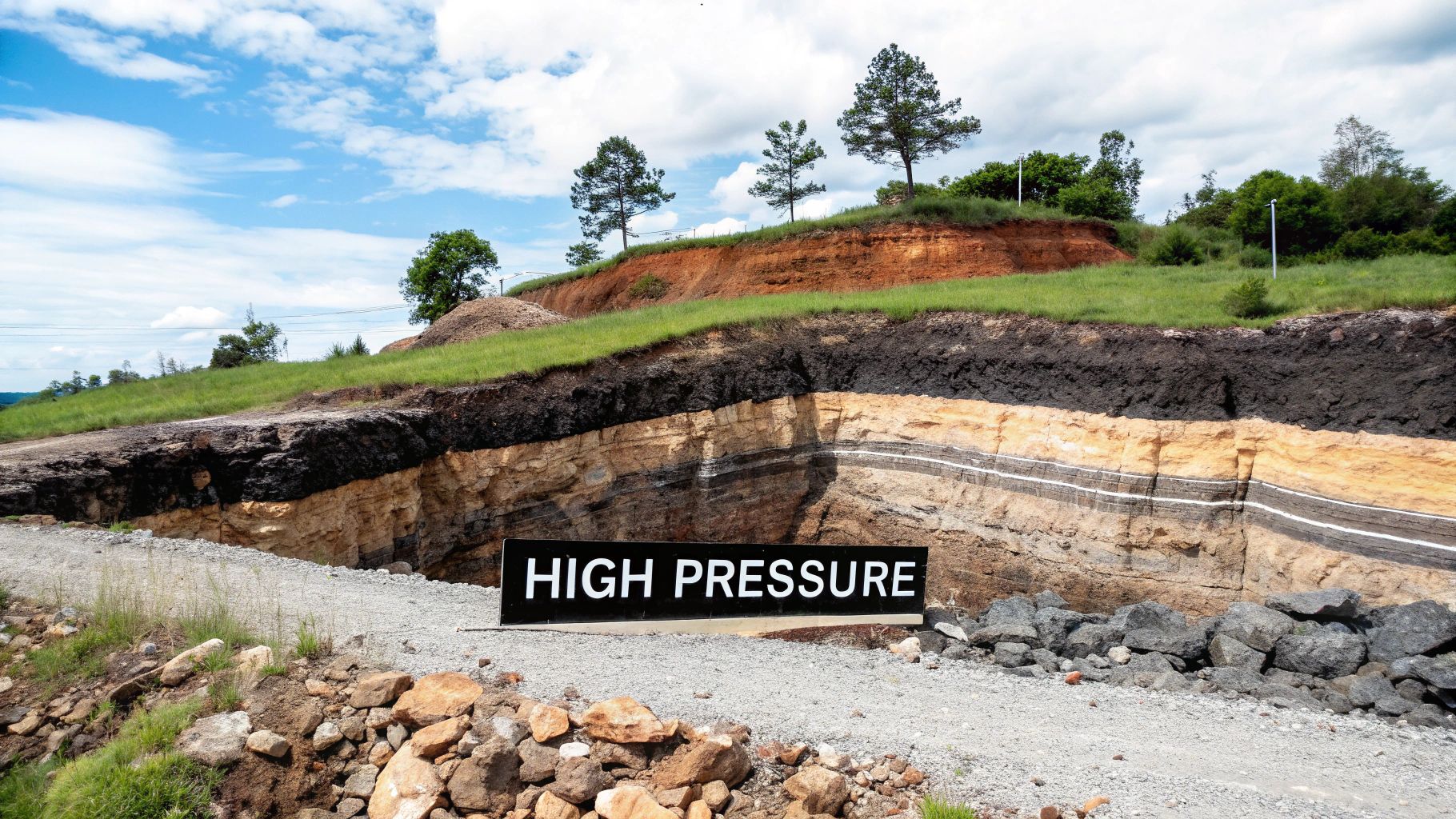
Down there, it's subjected to crushing pressure from the weight of the mountains above and baked by temperatures hot enough to cook it, but not quite hot enough to melt it back into magma. The original clay minerals inside the shale become unstable under these new conditions. They start to rearrange themselves, growing into new, stronger minerals like mica.
The rock's entire structure shifts, turning it from crumbly shale into hard, layered slate. This is the essence of metamorphism: a story of transformation written in stone.
This process, aptly named metamorphism, literally means "change in form." It's crucial to remember this change happens while the rock remains completely solid. If it got hot enough to melt, it would become magma, and upon cooling, it would form a brand new igneous rock, resetting its journey in the rock cycle.
A Quick Comparison of Rock Types
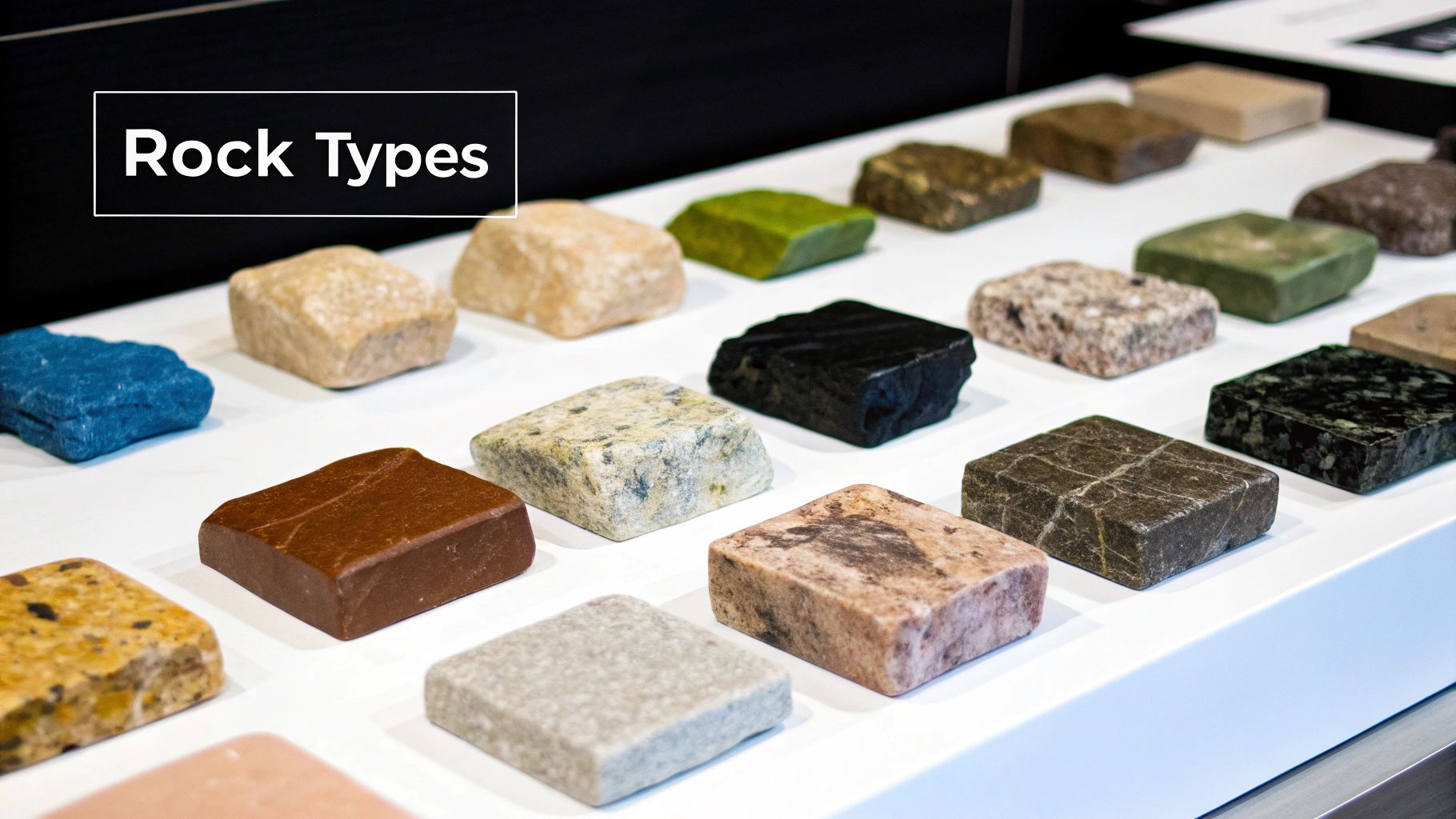
To really get a feel for metamorphic rocks, it helps to see how they stack up against their counterparts. Each rock type tells a unique geological story, and for anyone learning how to start a collection of rare rocks and minerals, telling them apart is a foundational skill.
The key takeaway is this: metamorphism reworks existing material. It doesn't create rock from scratch like a volcano does, nor does it form from loose sediment like a sandstone. It takes what's already there and forges it into something new.
Here’s a simple breakdown of the three main rock families:
Rock Type
How It Forms
Key Characteristics
Common Examples
Igneous
Cooling and solidifying of molten magma or lava.
Can be glassy or have visible, interlocking crystals.
Granite, Basalt, Obsidian
Sedimentary
Compacting and cementing of sediments (sand, shells, pebbles).
Often layered, may contain fossils, can feel grainy or crumbly.
Sandstone, Limestone, Shale
Metamorphic
Transformation of existing rocks by heat and pressure.
Often has bands or layers (foliation), visible crystals, can be very dense and hard.
Marble, Slate, Gneiss
The Recipe for Rock Transformation
To really get what a metamorphic rock is, you have to understand how it’s made. Think of it like a recipe. Just as a chef needs the right ingredients and methods, the Earth uses a powerful combination of two main agents of change: intense heat and immense pressure. Deep within the crust, these forces work together to transform an existing rock into something entirely new.
This incredible transformation happens while the rock is still solid—it never actually melts. If it did, it would just become magma and cool into an igneous rock. Instead, the minerals inside the original rock, called the protolith, get squeezed and cooked until they become unstable. They then rearrange their entire crystalline structure to adapt to the harsh new environment.
The Power of Heat
One of the biggest drivers of metamorphism is temperature. When rocks get shoved deeper into the Earth or end up next to molten magma, they get "cooked." This process is known as contact metamorphism, and it usually happens on a smaller, more localized scale.
It’s a bit like placing a piece of bread next to a hot toaster element. The side closest to the heat gets toasted and changes its texture, while the rest stays pretty much the same. In a similar way, the rock surrounding a magma chamber gets baked, causing its minerals to recrystallize without melting. This is how limestone, a simple sedimentary rock, transforms into the beautiful, crystalline marble we see in statues and countertops.
Squeezing Under Pressure
The second crucial ingredient is pressure. And we're talking about enormous pressure. This kind of force is usually applied during massive geological events, especially when tectonic plates collide to form mountain ranges like the Himalayas. Geologists call this regional metamorphism.
Imagine squeezing a ball of multicolored clay in your hands. As you apply pressure, the colors flatten and stretch out into distinct layers and bands. The same thing happens deep inside the Earth. The directional pressure forces the minerals in a rock to align in parallel planes, creating that signature layered or banded texture you see in many metamorphic rocks.
The Role of Chemically Active Fluids
There's a third, often overlooked, agent of change: superheated, chemically rich fluids. These hot waters can seep through a rock’s cracks and pores, acting as a catalyst that speeds up the transformation.
These fluids can do a couple of things:
Introduce new minerals: They carry dissolved elements that react with the existing rock to form completely new minerals.
Remove existing minerals: They can also dissolve certain minerals and carry them away, changing the rock's overall chemical makeup.
This chemical alteration often works right alongside heat and pressure, accelerating the whole metamorphic process. Sometimes, these fluids deposit minerals into empty pockets, which is one of the key processes behind formations you can learn about in our guide on what is a geode.
Together, these three forces—heat, pressure, and fluids—are the master chefs in Earth’s high-pressure kitchen, forging the incredible diversity of metamorphic rocks we see today.
Understanding Foliation: A Rock's Hidden Story
Many metamorphic rocks hold a secret history, and the key to unlocking it is foliation—that layered or banded look you often see. It's the result of immense, one-directional pressure deep within the Earth.
Think of it like this: if you take a ball of multicolored play-doh and squash it flat with your hand, the colors will stretch out and form parallel stripes. The same thing happens to the minerals inside a rock under geological stress. They flatten and align, creating those distinct sheets or wavy bands.
This simple visual is exactly why some rocks, when you look at them through a hand lens, show off these beautiful, organized textures.
How Pressure Shapes Texture
The intensity of foliation tells a story about how much pressure the rock endured. You can actually see the progression through three common rock types.
Slate: This is the first stage. Under relatively mild pressure, the microscopic clay minerals align perfectly, creating the flat, thin sheets that slate is famous for.
Schist: Turn up the pressure a bit, and you get schist. The mineral grains grow larger—you can actually see them sparkle—and the foliation becomes more wavy and pronounced.
Gneiss: At the highest pressures, the minerals segregate into bold, zebra-like stripes of light and dark colors. This is the signature look of gneiss.
"Foliation is a window into a rock's metamorphic journey, revealing the forces it experienced."
So, by learning to read the foliation, you can get a pretty good idea of the rock's "metamorphic grade"—essentially, how much it's been cooked and squeezed. This is a huge part of answering the question, "what is metamorphic rock?" when you're out in the field.
When Rocks Don't Show Their Layers
Now, not all metamorphic rocks play by these rules. Some, like the classic marble, are non-foliated. They have a uniform, crystalline structure without any layers.
This happens when the parent rock recrystallizes without that intense, directional squeeze. The minerals grow, but they do so in a random, interlocking pattern instead of aligning in bands.
Here’s what sets them apart:
Uniform Grain Size: The crystals in marble, for instance, are all roughly the same size and grow in random directions.
No Preferred Alignment: There's no force pushing the minerals to flatten or stretch in one direction.
Smooth, Consistent Texture: Without layers, these rocks don't have cleavage planes and tend to break in a more granular way.
Feature
Foliated Rocks
Non-Foliated Rocks
Layering
Present (banded or sheet-like)
Absent (homogenous)
Formation Clue
Directional pressure
Uniform recrystallization
Identification Tip
Look for splitting planes
Check for interlocking crystals
Using Foliation for Rock Identification
Once you know what to look for, recognizing foliation becomes a powerful tool.
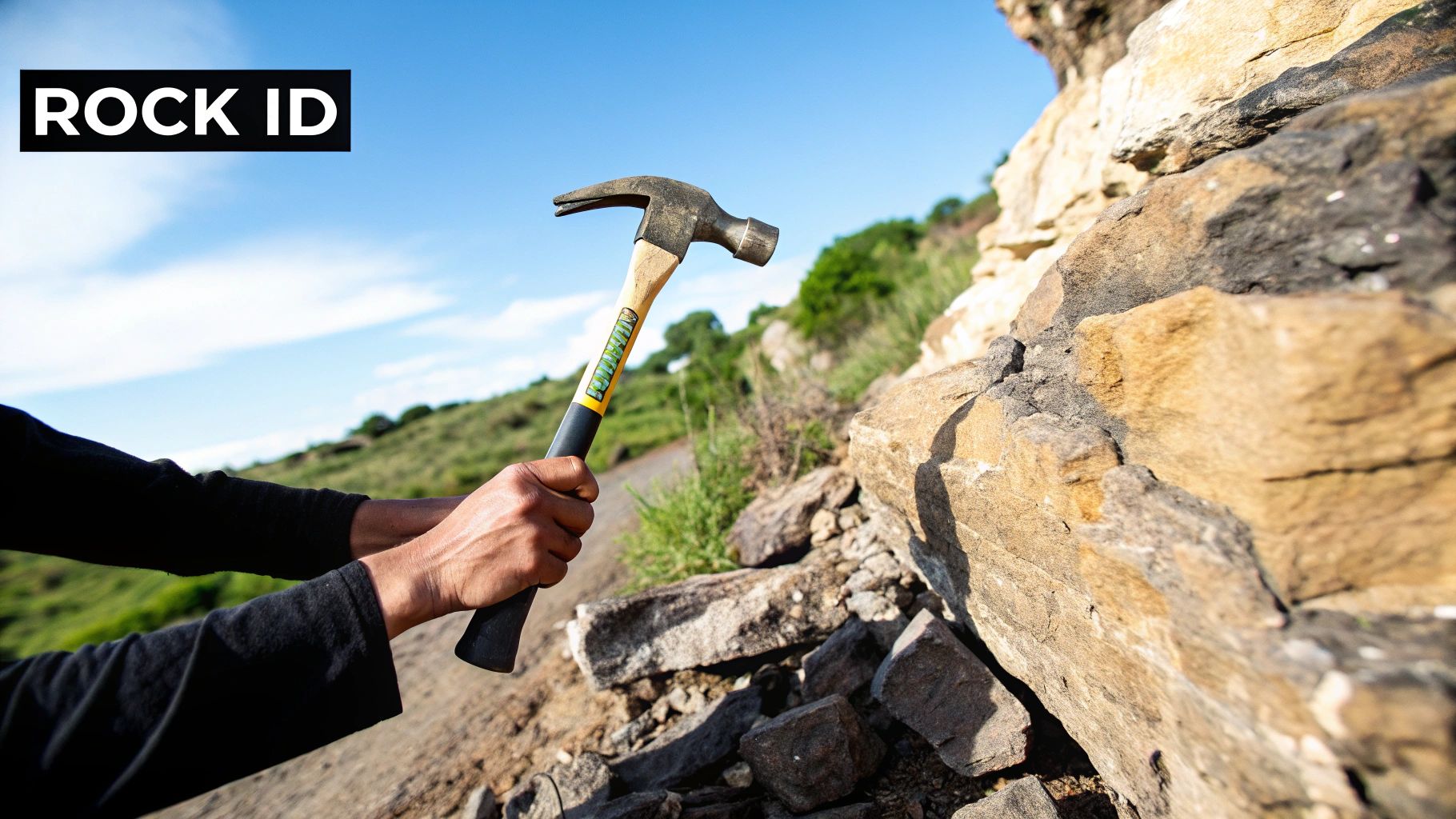
Start by looking for any kind of shine or sheen, which often comes from aligned mica minerals. Then, check if the rock wants to split into flat pieces. Slate’s perfect cleavage is so distinct that a gentle tap with a rock hammer (or even a knife, carefully!) can split it effortlessly.
Next, if you see bands, look closer. Are they thin and wavy like in schist, or are they bold and segregated like in gneiss? These visual cues are your best friend.
Combine these observations with basic hardness and color tests, and you'll be identifying rocks like a pro.
Tip 1: Always carry a hand lens. It makes seeing the mineral alignment so much easier.
Tip 2: Gently tap the rock. A foliated rock might sound "flaky" or "thinner" than a solid, non-foliated one.
Tip 3: Keep a field guide or reference photos handy to compare your finds.
Following these steps turns you into a rock detective. You're not just guessing; you're piecing together clues from the rock's foliation and other properties to tell its story.
For collectors, a rock's foliation can be a major factor in its quality and appeal. A specimen with perfectly defined bands or a beautiful schistose glimmer can be a real centerpiece.
Here are a few practical tips for documenting foliated rocks in your collection:
Photograph your specimens from multiple angles to capture the layers and texture.
In your field notes, jot down any indicators of the pressure direction if you can tell.
Store fragile, flaky pieces flat to protect their delicate cleavage surfaces from chipping.
By mastering the art of reading foliation, you're not just identifying rocks—you're getting a glimpse into the immense power of the planet.
How Geologists Classify Metamorphic Rocks
Every metamorphic rock tells a story. Think of it like a family tree—geologists act as detectives, tracing a rock's lineage back to its origins. To do this, they focus on two main clues: the rock's texture and, most importantly, its original parent rock.
This parent rock is called the protolith, and it’s the single most critical factor in determining what a metamorphic rock becomes.
The protolith sets the stage because it dictates the rock's starting chemistry. While the intense heat and pressure of metamorphism can rearrange minerals and completely change a rock's structure, it rarely adds or removes the fundamental ingredients. A rock that starts out rich in quartz will end up rich in quartz.
It's a story of transformation, not one of creation from scratch.
From Parent Rock to Metamorphic Descendant
The journey from a protolith to its final metamorphic form is often quite predictable. A humble, grainy sandstone, which is made almost entirely of quartz sand, won't magically become a banded gneiss. Instead, under immense heat and pressure, its quartz grains fuse together, creating an incredibly hard and durable rock called quartzite.
In the same way, a limestone formed from ancient marine shells—rich in the mineral calcite—transforms into elegant marble. The original calcite crystals just recrystallize, growing larger and interlocking to give marble its classic crystalline shine.
The identity of the protolith is the blueprint for the final metamorphic rock. By identifying the parent, geologists can reconstruct the rock's entire geological journey through Earth's crust.
Knowing the protolith is so crucial that geologists have specific classifications based on it. In fact, about 44% of metamorphic rock samples in global databases have a recorded rock origin classification, a high figure that underscores its importance. Rocks of sedimentary origin (called metasedimentary) are slightly more common than those from igneous parents (meta-igneous). You can find more fascinating insights on these classifications in journals like Copernicus Publications ESSD.
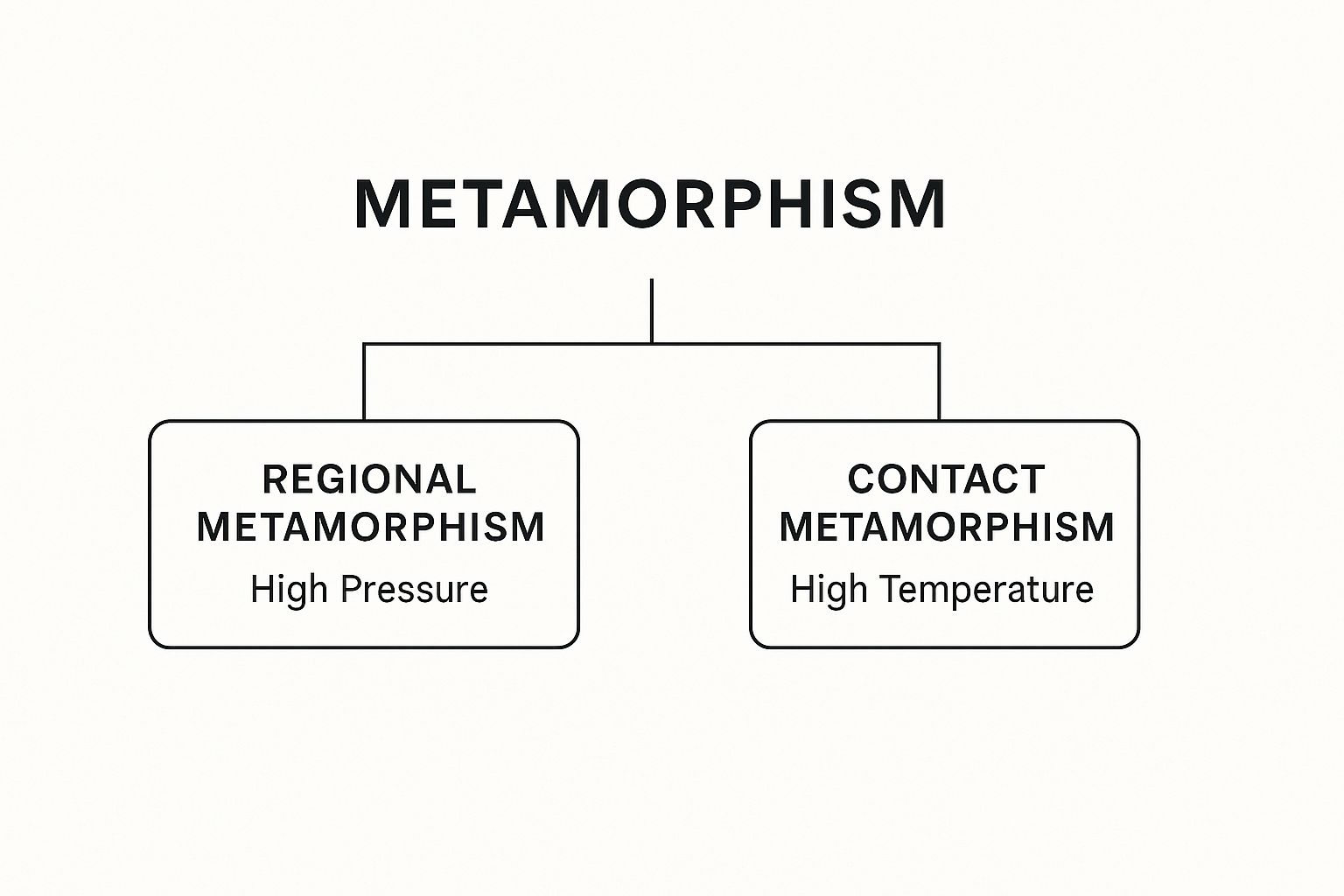
This diagram illustrates the two main pathways—one driven by pressure, the other by temperature—that a protolith can follow on its transformative journey.
As you can see, regional metamorphism is associated with high pressure, while contact metamorphism is all about high temperatures, both acting on that original parent rock.
Common Transformations at a Glance
To make these connections even clearer, it helps to see some of the most common parent rocks and what they typically become. The table below really demystifies how geologists connect the dots between a rock’s past and its present form.
Common Protoliths and Their Metamorphic Rock Transformations
Protolith (Parent Rock)
Protolith Type
Resulting Metamorphic Rock
Key Characteristic
Shale
Sedimentary
Slate, Schist, or Gneiss
Foliated texture that increases with metamorphic grade.
Sandstone
Sedimentary
Quartzite
Non-foliated, extremely hard, and crystalline.
Limestone
Sedimentary
Marble
Non-foliated, crystalline, reacts with acid.
Granite
Igneous
Gneiss
Foliated with distinct bands of light and dark minerals.
Basalt
Igneous
Greenschist or Amphibolite
Typically foliated and contains characteristic green minerals.
Looking at these examples, you can really start to see the patterns. Sedimentary rocks like shale and sandstone become entirely new stones, while igneous rocks like granite and basalt undergo their own dramatic makeovers.
Common Metamorphic Rocks in Your World
Metamorphic rocks are everywhere, and I mean everywhere. They're the literal foundation of our buildings, monuments, and even the countertops in our kitchens. Once you know what to look for, you’ll start spotting these incredible materials all over the place, from historic city centers to your own backyard.
This guide will walk you through five of the most common examples, turning a walk down the street into a mini geology lesson. By understanding where they come from and what makes them unique, you'll start to see the world in a whole new way. When you're out exploring the planet's diverse landscapes, you'll encounter these and many other rock types, often on display in breathtaking natural wonders of the world.
Slate: From Rooftops to Chalkboards
Slate is a fine-grained, low-grade metamorphic rock that started its life as shale. Under intense compression, its microscopic clay and mica minerals line up perfectly, giving it a defining characteristic: perfect cleavage.
This simply means it splits easily into thin, flat sheets. It’s this property that has made slate the go-to material for roofing tiles for centuries. You'll also find it used for classic chalkboards and elegant flooring, all thanks to its durability and clean-splitting nature.
Schist: The Glittery Rock
When you take slate and expose it to even more heat and pressure, it can transform into schist. This rock is a real head-turner, easily identified by its visible, glittery crystals of mica that are all aligned in wavy, parallel layers. This texture has its own name: schistosity.
You’ll often see schist used in decorative landscaping or as a building stone. That shimmering appearance comes from the large, flattened mica grains catching the light. It's also common for other minerals like garnet and kyanite to grow within schist, making some pieces extra special. For collectors, a sample of bright blue kyanite with quartz found in a schist host rock is a fantastic find.
The key difference between slate and schist really comes down to crystal size. In slate, the mica crystals are too small to see with the naked eye. In schist, they're large enough to give the rock its signature sparkle.
Gneiss: The Striped Rock
At the highest levels of metamorphism, schist can turn into gneiss (pronounced "nice," and it is!). This rock is all about drama. It's defined by its bold, zebra-like bands of light and dark minerals, a texture we call gneissic banding.
During this intense transformation, minerals sort themselves out. Lighter-colored minerals like quartz and feldspar separate from darker minerals like biotite and amphibole, creating those distinct stripes. You can find gneiss used as a building stone—for example, it forms the base of the iconic Chrysler Building in New York City—and in paving and curbing. Its striking pattern makes it both beautiful and incredibly strong.
Marble: The Classic Crystalline Stone
Marble is what’s known as a non-foliated metamorphic rock, which means it lacks the layers or bands you see in slate or gneiss. It begins its life as limestone, a sedimentary rock packed with calcite. The intense heat and pressure of metamorphism cause these tiny calcite crystals to recrystallize and grow, interlocking to form a dense, crystalline stone.
This process completely erases any fossils or sedimentary layers the original limestone had, replacing them with a uniform, often sugary texture. Renowned for its timeless beauty, marble has been the favorite material of sculptors and architects for thousands of years, used in everything from the Taj Mahal to modern kitchen countertops.
Quartzite: The Unbreakable Rock
Last but not least, we have quartzite. This is another non-foliated rock, formed when a quartz-rich sandstone gets put under the metamorphic microscope. The intense pressure fuses the individual sand grains together so tightly that the rock becomes unbelievably hard and durable.
Unlike sandstone, which can feel grainy to the touch, quartzite has a smooth, almost glassy luster. When it breaks, it fractures right through the quartz grains, not around them. This exceptional toughness makes it the perfect material for railroad ballast, road construction, and decorative architectural stone. It's built to last.
Tips for Identifying Metamorphic Rocks in the Field
There's nothing quite like putting your knowledge to the test in the real world. Heading out on a hike and spotting these transformed stones for yourself is the best way to get a feel for what metamorphic rocks are all about. Once you know what to look for, it's easier than you might think.
The number one clue, the dead giveaway for a metamorphic rock, is foliation. You'll want to get up close and look for any signs of parallel layers, bands, or even just a subtle sheen running in one direction. This alignment of minerals is the classic signature left by intense pressure. Think of slate, which often has a dull sheen and splits into perfect flat sheets, or gneiss with its distinct, zebra-like stripes of light and dark minerals.
Simple Field Tests to Try
Beyond just looking, a few simple hands-on tests can help you zero in on an ID. Hardness is a great place to start. Quartzite, for example, is ridiculously hard because the original sandstone grains were essentially welded together under heat and pressure. It’ll scratch glass with ease, which immediately sets it apart from softer rocks like marble.
Don't forget to examine the mineral crystals themselves. Are they large and glittery, like the mica flakes you'd see in schist? Or are they more uniform and sugary-looking, like the calcite in marble? Our https://astrowest.com/crystal-identification-guide/ is a great resource if you want to get better at spotting key minerals on the fly.
The goal is to become a rock detective, combining multiple clues—foliation, hardness, and crystal texture—to piece together the stone's geological story and history.
Context and Other Clues
Finally, pay attention to the rock's "heft" and where you found it. Metamorphic rocks often feel surprisingly dense for their size, a direct result of all that compression. Their mean densities typically fall between 2.70 to 3.0 g/cm³, depending on what minerals they're made of.
Thinking about the bigger picture helps, too. Having some general geological awareness, like the kind needed when identifying different rock formations for outdoor sports, gives you valuable context for what kinds of rock you can even expect to find in a certain region. It all adds to the story.
Your Metamorphic Rock Questions, Answered
As you dive into the world of metamorphic rocks, a few common questions always seem to pop up. Let's clear up some of the finer points that often leave new collectors scratching their heads.
Can Metamorphic Rocks Change Again?
They absolutely can. A metamorphic rock isn't a final destination. If you take a rock like slate and expose it to even more intense heat and pressure, it’ll keep changing—first into schist, and then maybe even into gneiss.
Geologists call this process increasing metamorphic grade. Think of it as a rock climbing the ladder of transformation, with each new form representing a higher level of heat and pressure.
Metamorphism vs. Melting: What's the Difference?
This is a big one. The key is that metamorphism is a solid-state transformation. The minerals inside the rock rearrange and recrystallize, but the rock itself never actually melts.
If things get hot enough for the rock to liquefy completely, it becomes magma. Once that magma cools and hardens, you’ve got a brand-new igneous rock on your hands, kicking off a whole different part of the rock cycle.
Metamorphism is like taking flour, sugar, and eggs and baking them into a cake—the ingredients change form but never turn back into a liquid. Melting is like tossing all those ingredients into a pot and heating them until they dissolve into a soup.
Are There Fossils in Metamorphic Rocks?
Finding a fossil in a metamorphic rock is incredibly rare. The same crushing pressure and searing heat that forge a new rock are more than enough to obliterate any delicate fossils that might have been in the original sedimentary rock.
Any ancient shell or bone that was once there typically gets warped, crushed, or completely erased during the transformation. It’s simply too violent a process for most fossils to survive.