Where Can You Find Fossils? A Guide to Provenance and Investment Value
For a serious collector, asking "where can you find fossils?" is less about a map and more about provenance. The specific geological formation a fossil is unearthed from dictates its rarity, scientific story, and, therefore, its investment-grade potential. The location is the foundation of its value.
Premier formations like Wyoming's Green River Formation or Montana's Hell Creek Formation are not merely dig sites. They are the paleontological equivalent of grand cru vineyards. Therefore, their origin serves as a mark of exceptional quality and a key driver of asset appreciation.
A Collector's Introduction to Fossil Provenance
First, not all fossil sites are created equal. The planet’s surface is a patchwork of geological formations, each a time capsule from a different chapter of Earth’s history. A select few are known as lagerstätten—a German term for "storage place"—and they are renowned for exceptional preservation conditions.
These are the locations that produce fossils with breathtaking detail, perfect articulation, and stunning aesthetic appeal. As a result, fossils unearthed from a lagerstätte command a significant premium on the market. For any serious collector, the first step is learning the names and signatures of these legendary formations.
Premier US Fossil Formations And Their Signature Finds
The United States is home to several globally significant fossil beds. Each offers a unique window into our planet's deep past and produces fossils highly sought after by collectors and institutions. These can be considered the blue-chip assets of the fossil world.
This table highlights some of the most prestigious fossil-bearing formations in the US. It provides a snapshot of what makes each a prime source for investment-grade specimens.
Formation
Location
Geological Era
Signature Fossil Type
Investment Potential
Green River Formation
WY, UT, CO
Eocene (50 Mya)
Exceptionally preserved fish (Knightia, Diplomystus)
High
Hell Creek Formation
MT, ND, SD, WY
Late Cretaceous (66 Mya)
Dinosaurs (Tyrannosaurus rex, Triceratops)
Very High
Morrison Formation
Western US
Late Jurassic (150 Mya)
Giant Dinosaurs (Allosaurus, Stegosaurus)
Exceptional
Niobrara Formation
KS, NE
Late Cretaceous (85 Mya)
Marine Reptiles (Mosasaurus, Pteranodon)
High
Wheeler Shale
Utah
Cambrian (507 Mya)
Trilobites (Elrathia kingii)
Moderate to High
Each formation tells a different story, from ancient seas teeming with predators to the final days of the dinosaurs. Consequently, understanding their unique offerings is key to building a collection with both historical significance and appreciating value.
A Closer Look at American Giants
Some of these sites have become legends in the collecting world due to their iconic status.
Green River Formation (Wyoming): This 50-million-year-old system of ancient lakebeds is the undisputed source for world-class fossil fish. The fine-grained limestone sediment here captured every last detail, from scales to soft tissues. It therefore created natural art plates prized by collectors and designers.
Hell Creek Formation (Montana): This is where the dinosaurs made their last stand. Formed roughly 66 million years ago, this geological layer has yielded some of the world's most famous Tyrannosaurus rex and Triceratops skeletons. Fossils from this region are cornerstone assets in any serious collection. You can get a sense of these incredible finds over at Discover Magazine.
Other Notable Sites: Beyond these titans, one can find world-class Trilobites in New York and valuable Megalodon teeth on the coastal plains and river beds of North Carolina and New Jersey. You can even find Ice Age mammal bones in the ancient river beds of Texas. Each location offers fossils with a unique story and a distinct value proposition.
For a collector, a fossil’s geographic and geological origin is the foundation of its entire story. This provenance is the most critical factor influencing its rarity, preservation quality, and, consequently, its long-term investment potential. An authenticated fossil from a world-class formation is not merely an object; it is a curated piece of natural history.
The Global Geography Of Fossil Value
While the United States has incredible fossil sites, truly legendary specimens often come from a handful of world-renowned international locations. These places are famous for producing fossils of such astounding quality and scientific importance that they set the global standard for value.
Their value is not just about age; it is about the miraculous circumstances of their preservation. A select few are even recognized as UNESCO World Heritage sites, a status reserved for places of universal human value. For a collector, a fossil from one of these localities carries a tangible piece of a globally significant story, which dramatically elevates its status and value.
UNESCO World Heritage Fossil Sites
You can find fossils on every continent. However, only a few special places offer a perfect window into key moments in life's history. UNESCO has spotlighted 16 global hotspots for their extraordinary fossil records, which preserve entire ancient ecosystems with breathtaking clarity.
For example, Canada's Burgess Shale is home to over 65,000 specimens from 508 million years ago. Here, ancient underwater landslides instantly buried soft-bodied creatures in mud devoid of oxygen. This event preserved bizarre animals from the Cambrian Explosion in impossible detail, making Burgess Shale fossils a benchmark for quality and scientific worth.
Additionally, Germany's Messel Pit is an oil shale deposit dating back 47 million years. It has yielded more than one thousand primate fossils, including the famous Darwinius ("Ida"), which offered a revolutionary glimpse into early primate evolution. The fine-grained sediment preserved everything from fur to last meals, providing a complete snapshot of life and creating immense value.
Provenance from a world-renowned site like the Messel Pit fundamentally changes a fossil's market standing. A specimen from such a location carries an inherent validation of its rarity and scientific importance, which directly translates to higher and more stable long-term value.
What Makes International Fossils Investment-Grade
The value of fossils from these premier global sites is driven by a unique blend of factors. Rarity is always important. However, the quality of preservation truly separates an average fossil from an investment-grade masterpiece.
Take the Holzmaden Shale in Germany, a site famous for its Jurassic marine life. An Ichthyosaur fossil from Germany from this location can show not just a complete skeleton but also the carbonized outline of its body shape. These features transform a specimen from a simple collection of bones into a dynamic narrative frozen in stone, justifying its position as a high-value asset.
These are the attributes that define a true gallery-quality fossil:
Exceptional Preservation: Includes soft tissues, skin impressions, or even traces of original color patterns.
Scientific Importance: Represents a key species or a major evolutionary transition.
Aesthetic Appeal: Possesses a natural composition, balance, and visual impact that feels like art.
Completeness and Articulation: Skeletons that are mostly complete and arranged in a lifelike posture will always command the highest prices.
Ultimately, collectors are acquiring a piece of irreplaceable natural heritage. The direct relationships Astro West has cultivated over decades with paleontologists and field experts give us access to these top-tier international specimens. Our role is to verify their provenance and quality, ensuring every piece meets the rigorous standards of a fine collectible and a sound long-term store of value.
The secret to finding a world-class, investment-grade fossil is not knowing where to look, but understanding the geology of a location. The specific conditions at the moment of an organism's death determine the difference between scattered fragments and a breathtaking, museum-quality specimen. For a collector seeking assets with real, lasting value, understanding these geological processes is critical.
Exceptional preservation is a geological lottery, requiring a very specific sequence of events. The most important step is rapid burial. When a creature is quickly covered by sediment, like fine mud on an oxygen-free lakebed, it is immediately shielded from scavengers and decay. This swift entombment is the first critical step in creating a fossil worth collecting.
The Science of Superior Preservation
Once the organism is safely buried, a slow process called permineralization can begin. This is where the geological magic happens. Over millions of years, groundwater loaded with dissolved minerals like silica or calcite seeps into the porous parts of the bone, shell, or wood.
Slowly, these minerals crystallize inside the original organic structure, effectively turning it to stone. The more complete this process, the more durable and detailed the final fossil will be. As a result, a specimen that has undergone perfect permineralization will be denser, more stable, and command a much higher price.
The most valuable fossils are geological miracles. They represent a perfect storm of conditions—rapid burial, an oxygen-poor environment, and stable, mineral-rich groundwater. These factors must work in concert to create a specimen with fine detail, structural integrity, and breathtaking beauty—the hallmarks of an investment-grade asset.
This infographic shows just a few of the world-class fossil sites, including Canada, Egypt, and Germany, and the iconic specimens they're known for, like ancient whales and the ever-popular trilobites.
The map drives home how specific geological histories, like the ancient seas that once covered Canada or the Eocene lakes of Germany, create these localized pockets of extraordinary preservation that produce some of the most sought-after fossils on the planet.
From Famous Formations to Local Finds
When people think of valuable fossils, legendary sites like Wyoming’s Green River Formation often come to mind. It is famous for producing pristine fish plates that can be worth tens of thousands of dollars. The Green River's incredible value comes from its ancient lake system, where layer after layer of fine limestone sediment perfectly captured entire ecosystems.
However, valuable fossils are not just found in these iconic spots. The same principles of preservation apply everywhere. For instance, ancient river beds can be found across the globe, and sharp collectors can find incredible specimens in less famous but geologically similar areas. River beds in Texas are well-known for producing Ice Age mammal bones, and the coastal plains of North Carolina are premier hunting grounds for valuable Megalodon teeth.
Even a state like New York, which you might not associate with dinosaurs, yields world-class Trilobite fossils from its Devonian-era seabeds. These more accessible finds are fantastic entry points for new collectors. They teach the core principles of paleontological value—scarcity, condition, and provenance—on a more manageable scale. Understanding a specimen's geological journey is the key to appreciating its true worth. You can explore the qualities of a petrified wood plate from Indonesia to see how its specific formation created its beauty and value.
Ultimately, connecting a specimen back to its geological origins separates a casual enthusiast from a serious collector. This is where Astro West’s expertise is essential. Our direct relationships with paleontologists and field experts ensure that every single fossil we acquire has a verified provenance, guaranteeing its authenticity and securing its place as a long-term store of value.
Navigating The Legal Landscape Of Fossil Collecting
Knowing where to find a fossil is just the first step. The next question is critical for any collector: can you legally keep what you find? The rules around fossil collecting can be complex and directly impact a specimen's authenticity, marketability, and long-term value as an investment.
An illegally collected fossil is a liability, not an asset. Its story is tainted, its market value is nonexistent, and it can never be part of a legitimate collection. Therefore, legal provenance is the absolute bedrock of any serious acquisition, a principle we uphold at Astro West.
Public Land Versus Private Land
In the United States, the laws hinge on a single question: was the fossil found on public or private land? The rules are worlds apart. Knowing the difference is critical for collecting ethically and legally, protecting both the collector and our paleontological heritage.
On private land, the situation is generally straightforward. If you have clear, explicit permission from the landowner, any fossils you unearth are typically yours. You can keep, excavate, and sell them. This is how many of the world's most incredible specimens legally enter the market and, eventually, museums and private collections.
Public lands, however, are a completely different matter. These are areas managed by federal agencies like the Bureau of Land Management (BLM) or the National Park Service. They have much stricter rules designed to protect the nation's natural treasures for science and the public.
The Paleontological Resources Preservation Act
The primary law for public lands is the Paleontological Resources Preservation Act. This federal law draws a clear line between different types of fossils.
Invertebrate and Plant Fossils: You can generally collect "reasonable amounts" of common invertebrate fossils (like ammonites or trilobites) and plant fossils for personal use without a permit. The key condition is that these specimens cannot be sold or traded.
Vertebrate Fossils: The collection of any vertebrate fossils—including dinosaurs, mammals, fish, and reptiles—by a private individual on federal land is strictly prohibited. These fossils are considered scientifically vital and are protected by law. Only credentialed researchers with a federal permit may excavate them.
This tight protection of vertebrate fossils is logical. It ensures that major discoveries are properly documented, studied by scientists, and preserved for public benefit, rather than being lost to an improper dig or sold without scientific context.
A fossil’s legal provenance is as vital as its geological origin. Just as in the fine art market, a clear and traceable history of ownership is paramount. It verifies authenticity and secures the specimen’s future value, protecting the collector’s investment from legal and ethical complications.
Navigating International Laws
When considering fossils from outside the U.S., the legal framework becomes even more complex. Many countries have passed national patrimony laws, which declare all fossils found within their borders to be state property. For example, nations like China, Brazil, and Mongolia have near-total bans on the private export of their fossils.
Attempting to export a fossil from one of these nations without explicit government authorization is illegal and carries serious consequences. This is where a gallery’s direct relationships with international experts become critical. These connections ensure an imported specimen has been acquired and exported in full compliance with all local and international laws.
At Astro West, our authority is built on decades of trust and direct collaboration with paleontologists, legal landowners, and field experts around the globe. We perform the complex work of navigating these legal frameworks for our clients. This commitment is the foundation that secures the value and integrity of every piece we offer.
How to Acquire Your Own Piece of Natural History
Understanding how a fossil travels from an ancient seabed in North Carolina to a modern display case is the final, crucial part of your journey as a collector. This is where a natural wonder becomes a verified, curated piece of your own collection. To get it right, you need to know what drives a fossil’s market value and how to buy with the confidence of an expert.
Figuring out a fossil's price isn't some kind of dark art. It’s a logical process based on real, tangible qualities, not just guesswork. These factors are what make one specimen an affordable starting point and another a major investment, right on par with fine art.
What Makes a Fossil Valuable?
A fossil’s price tag is a direct reflection of its story—its geological history and its physical condition. Think of it like a puzzle. Several key pieces have to come together to determine its market value, each adding to its rarity and appeal as a collectible.
For instance, a small, common invertebrate fossil is a fantastic educational piece, but its value will be modest. On the other hand, a huge, perfectly preserved Megalodon tooth with flawless enamel from a rare location is in a completely different league. You can see how these factors create a world-class specimen by checking out this collector's grade Megalodon tooth.
Here are the core factors that tell you what a fossil is really worth:
Rarity: This is the most fundamental driver. Specimens from species that are incredibly scarce in the fossil record, or finds that are unusually complete, will always command a premium.
Preservation Quality: A fossil with sharp, fine details, little to no distortion, and natural articulation is far more valuable. Any hint of soft tissue preservation or original color patterns can send its price soaring.
Size: Within a single species, bigger is almost always rarer and more desirable. A large, beautifully preserved fossil has an undeniable visual impact that boosts its aesthetic and market value.
Preparation: This is the unsung hero of fossil value. The skill it takes to free a fossil from its surrounding rock (the matrix) is a critical art form. Expert preparation can take hundreds of hours and dramatically enhances a fossil’s beauty and price.
These qualities all work together, creating a clear and understandable hierarchy of value in the world of fossils.
Fossil Valuation Drivers
Understanding what drives a fossil's price is key to building a collection with purpose. The table below breaks down the major factors that separate a common find from a true investment piece.
Valuation Factor
Description
Impact on Price
Rarity & Completeness
How scarce the species is and how much of the original organism is present.
High Impact: A complete skeleton or a rare species can be exponentially more valuable than a common fragment.
Preservation Quality
The level of detail preserved, from bone texture to soft tissue imprints.
High Impact: Exceptional detail and lack of distortion are the hallmarks of a top-tier, high-value specimen.
Size
The physical dimensions of the fossil, especially in relation to the average for its species.
Medium-High Impact: Larger specimens are generally rarer and more visually impressive, driving up the price.
Scientific Significance
Whether the fossil provides new information, represents a new species, or is a "type specimen."
High Impact: Fossils of major scientific importance command premium prices in both academic and private markets.
Preparation & Aesthetics
The skill used to clean and present the fossil, and its overall visual appeal.
Medium-High Impact: Expert preparation and a striking appearance can significantly increase a fossil's desirability and cost.
Ultimately, a fossil's value is a combination of these elements. A specimen that scores high in several categories isn’t just a beautiful object—it’s a tangible asset with lasting worth.
A fossil’s value is not arbitrary. It is a direct calculation of rarity, preservation, size, and scientific significance. A premier gallery provides the expertise to authenticate these qualities, ensuring an acquisition is not just a purchase, but a sound investment in a tangible piece of Earth’s history.
Why Work With a Curated Gallery?
Buying a significant fossil requires more than a simple transaction. It demands trust, deep market knowledge, and an expert eye. This is where a reputable gallery like Astro West becomes your most important partner, bridging the gap between the field and your collection.
We connect serious collectors with incredible specimens sourced directly from paleontologists, expert excavators, and trusted international contacts. Moreover, we handle the complex verification of authenticity, documentation of provenance, and assurance of legal and ethical sourcing.
Our gallery is not a mass-market retailer; it is a carefully curated space. Here, every piece is chosen for its scientific importance, aesthetic power, and potential as an investment. We provide access to artifacts that are both profoundly beautiful and a lasting store of value, guiding you toward an exceptional piece of natural history.
Frequently Asked Questions About Fossil Collecting
As you move from casual buyer to informed collector, practical questions naturally arise. Understanding legality, value, and authenticity transforms a beautiful object into a sound, long-term asset. This knowledge is essential for building a collection of true significance.
Let's address some of the most common questions we hear from collectors. The answers provide the confidence needed to acquire truly remarkable specimens.
Can I Legally Find and Keep Fossils on My Own?
Yes, you can, but the legality depends entirely on where you are. In the United States, if you’re on private land with the owner’s permission, any fossils you find are generally yours to keep. This is how many incredible specimens legally enter the market.
However, the situation is completely different on public lands, such as those managed by the Bureau of Land Management (BLM) or in National Parks. The Paleontological Resources Preservation Act strictly protects all vertebrate fossils (dinosaur bones, mammal skulls, etc.). On these lands, collecting them is exclusively for permitted scientists. This is precisely why working with a gallery that guarantees legal provenance is crucial; it secures your investment and ensures legal compliance.
Why Do Some Fossils Cost Thousands While Others Are Inexpensive?
A fossil's price is a direct reflection of its rarity, preservation quality, size, scientific importance, and aesthetic appeal. For example, a common Trilobite from New York may sell for under a hundred dollars because they are relatively abundant.
Conversely, a complete Megalodon tooth from a North Carolina riverbed with perfect enamel can easily cost thousands. The value climbs even higher for a perfectly preserved fish plate from the Green River Formation. Such pieces are incredibly scarce, requiring a perfect storm of geological conditions to form. A gallery-grade fossil's price is therefore justified by its unique story of survival.
A fossil’s price isn't arbitrary; it's a calculated assessment based on a hierarchy of value. Rarity and preservation quality are the two biggest drivers, creating a market where a common specimen is accessible to all, while a top-tier piece stands as a significant investment-grade asset, just like fine art.
How Do I Know if a Fossil Is Authentic and Not a Replica?
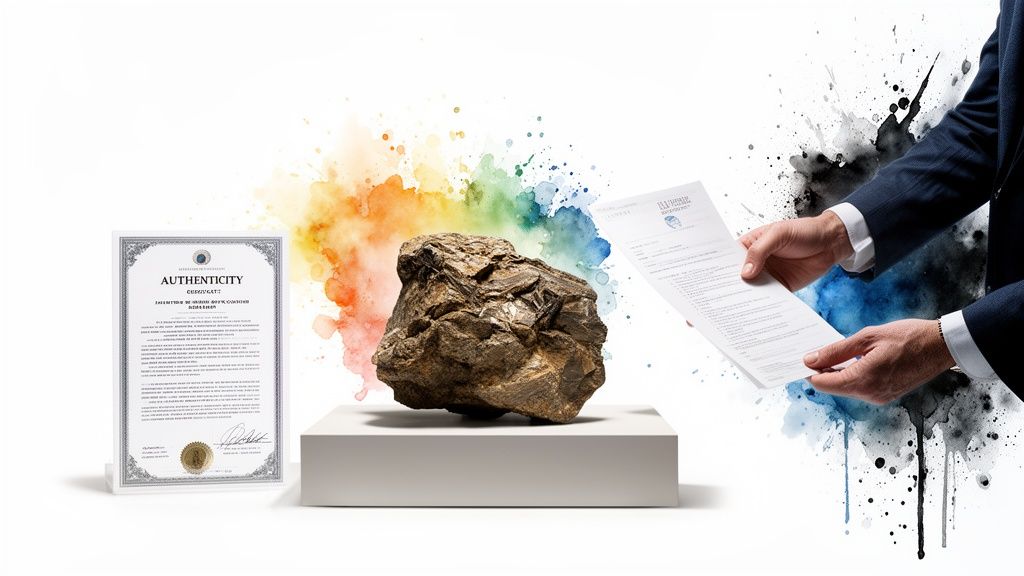
Authenticity is the absolute cornerstone of a fossil's value. While a trained eye can often spot the red flags of a cast—such as unnatural textures, uniform color, or unusually light weight—the real secrets are in the details. Subtle marks from preparation, the texture of the surrounding rock matrix, and microscopic features often elude the untrained observer.
Therefore, the most reliable method is to buy from a reputable source. At Astro West, specialists meticulously inspect every fossil we handle, working directly with paleontologists and field experts. We provide detailed documentation verifying its origin and guaranteeing its authenticity, giving you total confidence in your acquisition. This documentation protects the fossil's long-term value and your investment.
Are Fossils a Good Long-Term Store of Value?
High-quality, rare fossils with solid provenance have a strong track record of appreciating in value, much like fine art or luxury watches. As public fascination with natural history grows and the supply of top-tier specimens remains finite, demand naturally increases. We see this trend confirmed by record-setting auction sales and major museum acquisitions, which continue to cement fossils as tangible assets.
While no investment is guaranteed, a well-preserved, legally sourced fossil is a uniquely powerful store of value. It combines profound scientific, historical, and aesthetic worth into a single tangible object. This makes it a compelling addition to a diversified portfolio, offering a solid hedge against the volatility of traditional markets.
At Astro West, we do more than just sell fossils. We provide the expertise and assurance you need to build a collection of true significance and lasting worth. Explore our curated selection of authenticated specimens and acquire your own piece of Earth's incredible history today at astrowest.com.