How to Value a Trilobite Fossil: A Collector’s Guide
A trilobite fossil is the preserved record of an ancient sea creature. These arthropods dominated Paleozoic oceans for nearly 300 million years. Today, they are tangible pieces of history and premier collectible assets. Therefore, understanding their scientific and market context is the first step toward appreciating their true value.
From Ancient Oceans to Modern Assets
To properly value a trilobite fossil, one must look beyond its simple definition. Trilobites were among the first complex animals with hard exoskeletons and sophisticated compound eyes. As a result, they represent a true landmark in evolutionary history. Holding a trilobite connects you directly to the dawn of complex life.
This immense scientific importance directly elevates their status as collectibles. During their incredible 270-million-year reign, over 22,000 species evolved. These species ranged from small, fingernail-sized specimens to giants weighing up to 4.5 kg. This diversity provides a rich landscape for collectors.
Understanding the Fossil as an Asset
The journey from an ancient seabed to a modern gallery transforms a trilobite into a unique physical asset. The fossilization process itself is a rare geological event. After death, minerals gradually replaced the trilobite’s tough exoskeleton as it was buried in sediment. This process dictates the fossil's final appearance, detail, and preservation quality.
The term "fossil" includes more than just preserved remains. It also covers molds, casts, and trace fossils like tracks. These different preservation types are a key factor in a specimen's rarity and market value.
The finest trilobite fossils are natural sculptures. Each one possesses a unique story of survival written in stone. Appreciating a trilobite’s scientific history is the first step toward understanding its market value. For example, this is similar to knowing a fine watch's movement or a diamond's clarity grade. To learn more about this transformation, review our guide on the different types of fossils.
The Foundation of Value
This deep connection between geological history and market appeal is fundamental. A specimen's journey through deep time directly contributes to the factors that determine its price. Consequently, everything from its age to the way it was preserved plays a role.
Here are the key drivers:
Geological Age: Fossils from certain periods, like the Cambrian Explosion, are highly sought after for their incredible age and scientific significance.
Formation Conditions: The specific rock matrix and minerals involved in fossilization determine the specimen's color, contrast, and level of detail.
Preservation Quality: The completeness and articulation of the fossil are paramount. A perfectly preserved, three-dimensional trilobite is far more valuable than a partial or flattened one.
Ultimately, a trilobite fossil is a piece of Earth's autobiography. Its value derives from its authenticity as a direct witness to an ancient world. This powerful combination of science and aesthetics positions the finest trilobites as objects of enduring desire.
The Key Factors That Determine a Trilobite Fossil's Value
Understanding what a trilobite is provides a foundation. However, knowing what it is worth requires a collector’s eye. The market for these ancient arthropods is surprisingly nuanced. Two fossils may appear identical, yet one might be worth under $100 while the other commands over $50,000.
This significant price gap is not random; it is driven by a clear set of factors. Much like the fine art or luxury watch markets, a trilobite's value depends on its rarity, condition, and aesthetic impact. By learning to assess these key traits, you can become an informed collector who can spot investment-grade specimens.
Species Rarity and Provenance
The primary driver of value is the rarity of the species. With over 22,000 described species, trilobite diversity is immense. However, some are far more common than others. For example, the famous Elrathia kingii from Utah is widely available and offers a fantastic entry point for new collectors.
At the other end of the spectrum are exceptionally scarce species. The dramatically spined Devonian trilobites from Morocco, such as a Walliserops or a Cyphaspis, are highly sought after. Their natural rarity and the skill needed for preparation give them a major market premium.
A trilobite’s provenance—its documented origin—is inseparable from its rarity and authenticity. A fossil with a clear history from a famed locality like the Wheeler Shale of Utah or the Zguid formation in Morocco carries more weight and value than one with an unknown background.
Preservation Quality and Completeness
Beyond rarity, the quality of preservation is paramount. This refers to the fossil’s condition, a direct result of its journey through geological time. You can learn more about how these ancient creatures become stone in our article covering the details of fossilization. An ideal specimen exhibits several key characteristics.
These critical factors include:
Completeness: A complete trilobite, with its cephalon (head), thorax (body), and pygidium (tail) intact, is always more desirable than a partial one. Missing sections or significant repair will dramatically lower its value.
Articulation: A fully articulated fossil, with segments connected as they were in life, is considered far superior. Disarticulated molts are much more common and therefore less valuable.
Lack of Distortion: Intense geological pressure can crush or flatten a fossil. A three-dimensional specimen that retains its lifelike shape signals exceptional preservation and will always command a higher price.
Size and Aesthetic Appeal
While size can be a factor, it affects value in complex ways. An unusually large example of a common species can be valuable for its impressive scale. Conversely, a tiny but perfectly preserved adult of a rare species might be prized for its delicate nature.
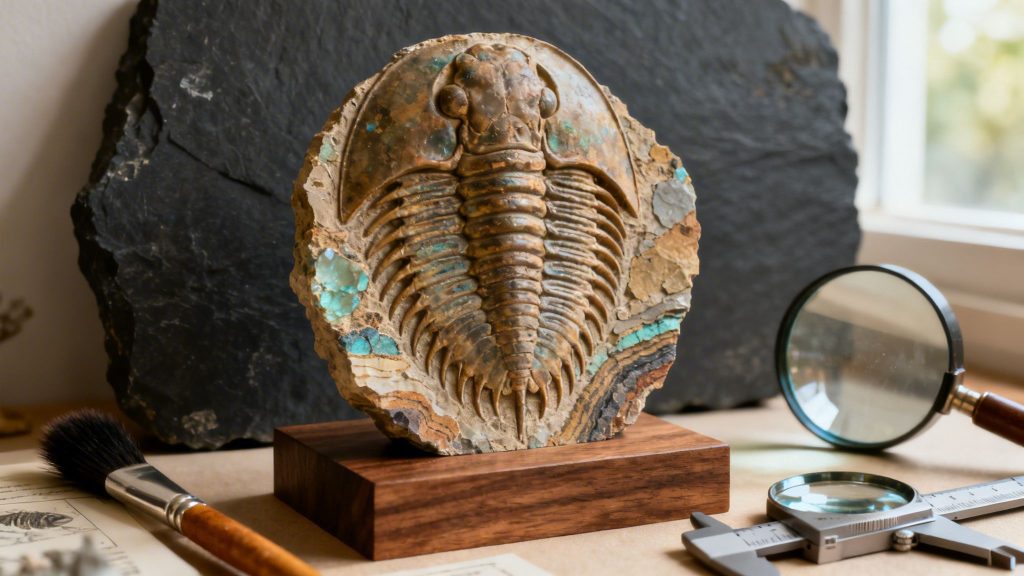
Ultimately, aesthetic appeal often becomes the deciding factor for premier pieces. A trilobite fossil is not just a scientific specimen; it is a natural sculpture. For example, a trilobite enrolled in a defensive posture creates a dynamic visual story that adds immense appeal.
The contrast between the fossil and its surrounding matrix also plays a crucial role. A dark fossil on a light matrix creates a natural frame that enhances visual impact. It is this inherent beauty that elevates a trilobite from a simple fossil to a true design object, justifying its place as a long-term store of value.
A Collector's Guide to Trilobite Species and Provenance
Connecting value factors to specific species and their origins is essential for serious collecting. The world of trilobites is incredibly diverse. Certain species from specific localities set the gold standard for rarity, beauty, and investment potential.
This is where provenance—a fossil's documented origin—becomes critical. Think of it like knowing the artist of a painting or the maker of a luxury watch. It provides a story, a stamp of authenticity, and anchors its value in a real-world context. Some fossil sites are famous for producing specimens with unique, highly desirable traits.
Iconic Species and World-Renowned Localities
Some of the most legendary trilobites are defined by their origin. For example, the rocky landscapes of Morocco are famous for spectacularly spiny Devonian trilobites. Species like Walliserops and Cyphaspis are prized for intricate, 3D spines that require hundreds of hours of painstaking preparation.
In contrast, the Cambrian shales of Utah, USA, produce classics like Elrathia kingii. While common, these are a cornerstone of many collections and offer an accessible entry point. Trilobite hotspots are scattered across the globe. New York's Devonian sites, for instance, offer over 300 species and are a focus of our Manhattan gallery. You can explore New York's rich trilobite history on museumoftheearth.org.
Then you have the Ordovician quarries near St. Petersburg, Russia. These sites offer another distinct style. Trilobites like the bizarre Asaphus kowalewskii with its long, periscopic eyes, are preserved in caramel-colored calcite. Their unique anatomy and preservation make them highly sought-after by advanced collectors.
The Impact of Preservation Type on Value
The geological conditions of a site directly shape a fossil's preservation. This, in turn, dramatically affects its appearance and market value. The specific fossilization process can completely change a trilobite’s aesthetic and durability.
Provenance is more than just a location; it is a direct reflection of the geological processes that created the fossil. Different conditions create different types of preservation, each with its own set of aesthetic qualities and market demands.
This variation leads to several distinct fossil types you will encounter:
Calcite-Replaced Fossils: Common in limestone, this process replaces the exoskeleton with calcite. This often results in fossils with excellent three-dimensional shape, like those from Russia.
Pyritized Fossils: In oxygen-poor environments, pyrite (fool's gold) can replace the exoskeleton, creating stunning metallic fossils. These "pyritized" trilobites, famously found in New York, are prized for their brilliant golden shine.
Molds and Casts: Sometimes, the original trilobite dissolves completely, leaving a perfect impression, or mold. If that mold later fills with other minerals, it creates a natural cast—a replica of the original animal.
Each preservation type tells a different chapter of the trilobite’s journey. A collector who understands these nuances can better appreciate the rarity of each piece. This knowledge is the hallmark of a discerning eye, essential for building a collection of lasting value.
How to Identify Authentic Trilobites and Avoid Fakes
As your eye for trilobites sharpens, so does the need to identify forgeries. The unfortunate truth is that fakes are common in the market. Spotting them is perhaps the most critical skill a collector can develop. Distinguishing a genuine, investment-grade specimen from a replica separates a great collection from an expensive mistake.
Composite or entirely fabricated fossils are out there, especially from certain international markets. These can range from a "Frankenstein" trilobite—pieced together from different fossils—to complete fakes molded from resin. Knowing what to look for is your best defense.
Telltale Signs of an Authentic Trilobite
A real trilobite fossil almost always has subtle imperfections from its geological journey. In fact, these natural flaws are often the best proof of authenticity. A genuine specimen will rarely be perfectly symmetrical; immense pressure nearly always causes minor distortion.
Under magnification, look for microscopic preparation marks. Skilled preparators use fine tools like air scribes, which leave faint marks on the matrix. A cast fake, on the other hand, often has a suspiciously smooth surface or contains tiny air bubbles—a dead giveaway it was made in a mold.
This quick visual guide breaks down some key indicators of provenance for popular trilobite localities.
As you can see, preservation style and matrix color are strong clues to a fossil's origin. This is a huge part of its authenticity and value.
Red Flags for Forgeries and Composites
The most common forgeries come from Morocco, where local artisans are skilled at both preparation and fabrication. A primary red flag is a suspicious color line or an unnatural crack around the trilobite's perimeter. This often means a real fossil was glued into a carved-out piece of matrix to look more dramatic.
Another major warning sign is mismatched body parts. In a composite piece, the cephalon (head) might be from one animal and the pygidium (tail) from another. An authentic fossil will show consistent preservation across its entire body. You can learn more about spotting fakes in our detailed fossil identification guide.
Here is a quick checklist for examining a potential new piece.
Authentic vs. Fabricated Trilobite Checklist
Characteristic
Authentic Specimen
Potential Forgery or Composite
Symmetry & Flaws
Natural asymmetry, minor compression, or healed bite marks are common.
Often too perfect, with flawless symmetry that looks unnatural.
Surface Texture
Under magnification, you might see fine tool marks on the matrix from preparation.
The surface can be too smooth, or you may find tiny air bubbles trapped in the "fossil."
Cracks & Glue Lines
Natural fracture lines in the matrix may run through the fossil.
Look for a distinct line or crack around the fossil, suggesting it was glued into place.
Color & Consistency
The color and texture are consistent across all parts of the trilobite's body.
Mismatched colors or textures between the head, body, and tail are a big red flag.
UV Light Reaction
Under a blacklight, natural fossil and matrix have a dull, uniform glow.
Glue and modern resins will often fluoresce brightly under UV light, revealing repairs or fabrication.
This checklist is a great starting point, but experience is the best teacher. Handling authenticated specimens will quickly train your eye to spot these critical differences.
A key takeaway for any collector is that authenticity is paramount. A fabricated trilobite has no scientific or long-term market value, making expert verification essential before any significant acquisition.
Ultimately, the best way to ensure you acquire a genuine piece is to work with a reputable gallery. At Astro West, our experts meticulously vet every trilobite. We leverage our direct relationships with paleontologists and field specialists to guarantee the provenance of every specimen, securing its value as both a piece of natural history and a sound investment.
Trilobites as Design Objects and Long-Term Assets
Beyond their scientific importance, premier trilobite fossils have carved out a modern identity. They exist as stunning objects of interior design and as tangible, long-term assets. This dual role elevates a top-tier trilobite from a simple collectible into a class of its own.
A beautifully preserved trilobite is now viewed through the same lens as fine art or a rare antique. It is an object with a deep history and an absolutely finite supply. This natural scarcity is the engine driving its long-term value, attracting both serious collectors and design-savvy buyers.
The Trilobite Fossil as a Tangible Asset
The market for the best trilobites has shown remarkably steady growth over decades. This is due to simple economics. The supply of high-quality, authentic fossils is fixed; nature is not making more. At the same time, global demand continues to climb as more people discover their power.
Museum acquisitions are a huge factor in this dynamic. When a major institution acquires a certain species, it validates its importance. This often sends a ripple through the private market, driving up prices for similar pieces. This pattern directly mirrors the fine art world, where a museum show can cement an artist’s legacy and market value.
A superior trilobite fossil is not merely a purchase; it is an acquisition. It represents a long-term store of value, secured by its irreplaceability and a documented history of appreciating demand from both scientific institutions and private collectors.
Looking back, market data shows that rare and exceptionally preserved specimens have often outperformed traditional collectibles. The logic is simple. A common Elrathia kingii will always be accessible. But a complete, spiny Walliserops with zero restoration is an object of extreme rarity, ensuring its value is protected and likely to grow.
A Natural Sculpture for Luxury Interiors
The aesthetic force of a trilobite fossil makes it a compelling element in luxury interior design. A well-chosen specimen acts as a natural sculpture. It brings a sense of deep time and organic elegance to any space. These are intricate forms sculpted by nature over hundreds of millions of years.
Designers and homeowners prize trilobites for their ability to serve as a singular focal point. A large, dramatic specimen on a custom stand can command a room. Meanwhile, smaller fossils can be arranged in a display case to create a personal museum. Our guide to integrating fossils into home decor explores these concepts in greater detail.
Consider these display applications:
The Centerpiece: A large trilobite, like a formidable Terataspis or an impressive Isotelus, makes a powerful statement on a console table or pedestal.
The Curated Shelf: A collection of smaller, diverse species from different localities tells a compelling story of evolution and geology.
The Wall-Mounted Feature: Some plate fossils are prepared for wall display, transforming them into natural bas-relief art that blends ancient history with modern design.
Trilobite fossils are critical geological timekeepers with a history spanning nearly 300 million years. Their importance as index fossils allows geologists to correlate rock layers worldwide. Whether you see it as an asset or a design object, a trilobite fossil offers a profound connection to Earth's deep past, making it a truly timeless acquisition.
Frequently Asked Collector Questions
When you are ready to acquire a piece of ancient history, practical questions often arise. Moving from "what is a trilobite?" to "how do I care for this asset?" signals a shift to serious collecting. This is the expert advice you would receive at our Manhattan gallery, providing confidence to choose, care for, and enjoy your fossil.
How Should I Care For and Display My Trilobite Fossil?
The good news is that these ancient survivors are very low-maintenance. They survived millions of years of geological processes. The key is providing a stable environment. Keep your trilobite away from direct sunlight and avoid areas with large temperature or humidity swings.
A glass display case or a custom stand is perfect for protection. For cleaning, less is more. A gentle dusting with a soft, dry brush is all that is ever needed. Never use water or chemical cleaners, as they can damage the delicate surface details that define the fossil's value.
Are Trilobite Fossils a Good Investment?
For the right pieces, yes. High-quality, rare, and exceptionally preserved trilobites have a strong history of appreciating in value. It all comes down to classic market dynamics: finite supply and growing global demand. Like fine art or a vintage watch, the investment potential is concentrated in top-tier specimens.
Common fossils are fantastic for their beauty but do not appreciate at the same rate. The best returns are found in trilobites with the ideal combination of rarity, preservation, and aesthetic appeal. Therefore, strategic acquisition is critical for building a collection that doubles as a tangible asset.
A key market indicator is museum acquisition. When an institution acquires a specific type of trilobite, it validates its significance. This often leads to increased demand and value appreciation in the private market for similar high-quality examples.
What Is the Most Important Factor for a Trilobite's Value?
While rarity and size are important, preservation quality is almost always the single biggest driver of value. A complete, fully articulated trilobite with crisp detail and no restoration will always be worth more than a larger, but damaged, specimen.
Why? Because preservation gives a fossil its lifelike presence. A three-dimensional, perfectly preserved trilobite that looks as if it could crawl off the rock is the pinnacle of collecting. It is this "wow" factor that collectors and designers prize above all else, making it the final word on market value.
At Astro West, we believe a deep understanding of what makes a trilobite fossil remarkable is the foundation of any great collection. Our gallery is built on decades of expertise. We ensure every specimen is authenticated, ethically sourced, and curated for its unique scientific and aesthetic merit. We invite you to explore our collection and discover a genuine piece of Earth's ancient history.
Discover our curated collection of authentic trilobite fossils at astrowest.com.