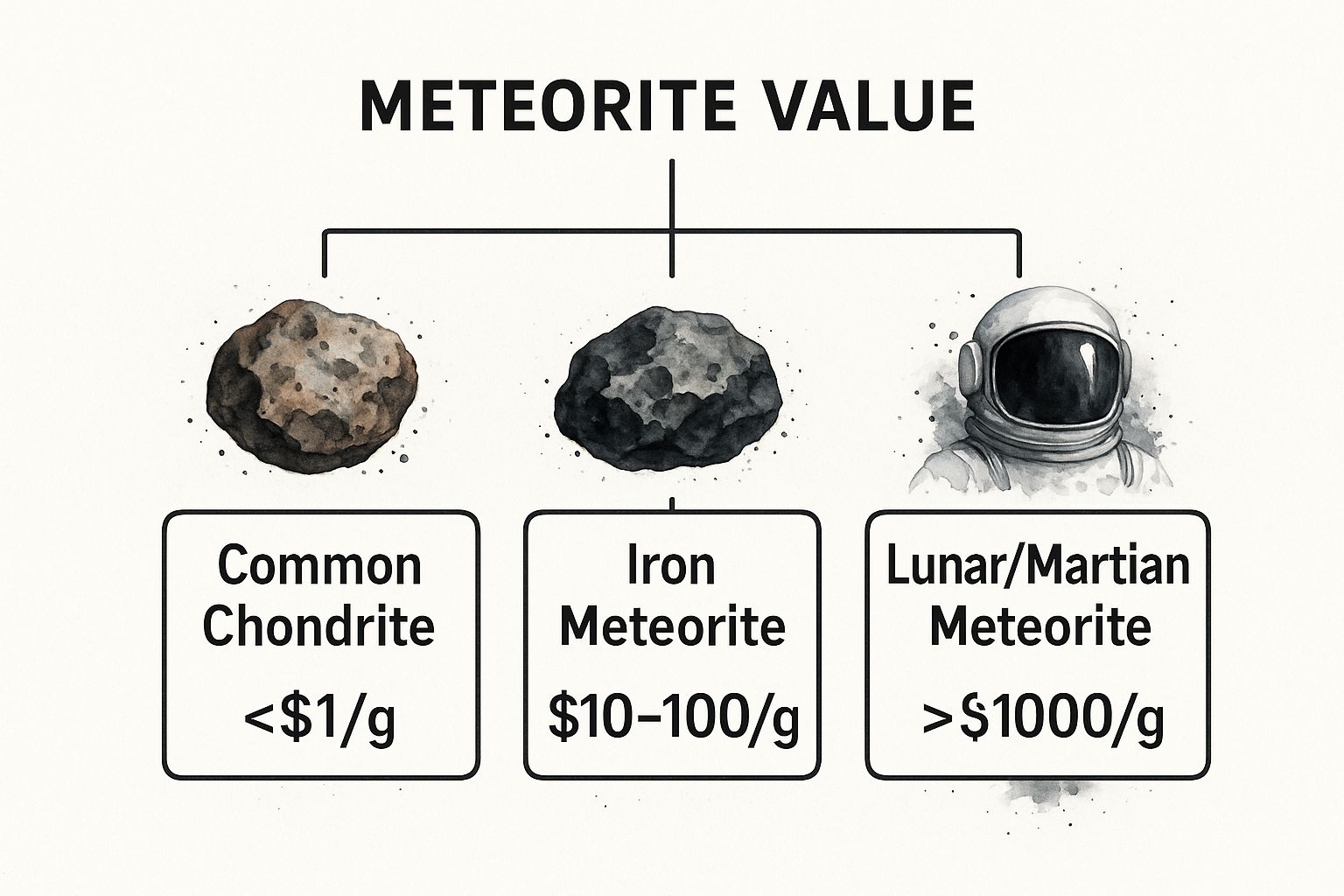
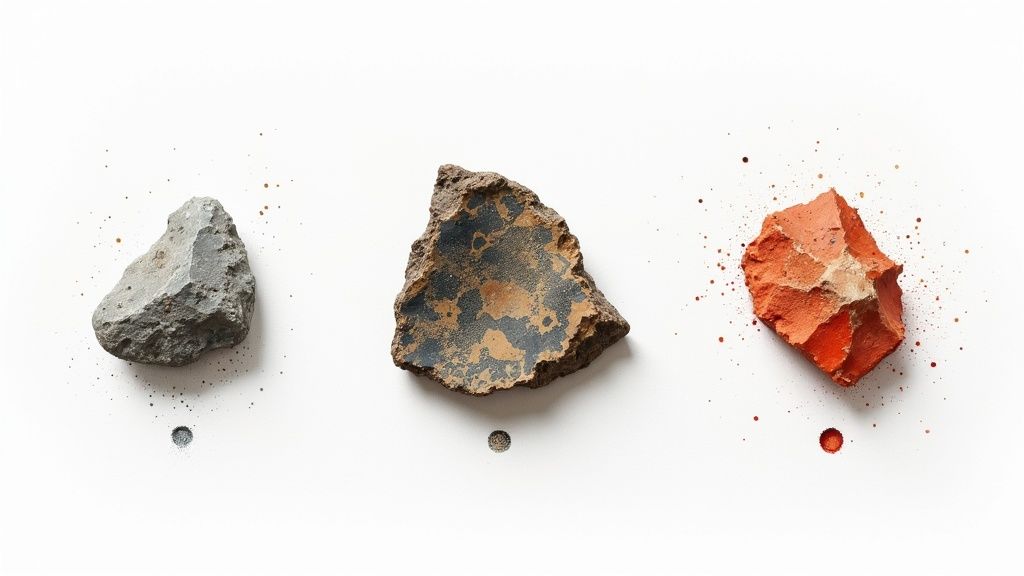
So, what’s a space rock actually worth? The answer isn’t simple, as the price spectrum is incredibly wide. You could be looking at less than a dollar per gram for a common, garden-variety find, or well over $1,000 per gram for an authenticated slice of the Moon or Mars.
That massive gap in value all boils down to a few key factors: its type, how rare it is, and where it came from.
Understanding the Value of a Space Rock
Think of meteorite valuation a bit like the market for precious gems. A common fieldstone is everywhere and easy to find, much like an ordinary chondrite meteorite that falls to Earth in abundance. A flawless diamond, on the other hand, is exceptionally rare and fiercely sought after—just like a lunar or Martian meteorite.
These extraterrestrial treasures aren’t just valued for what they’re made of. They’re prized for the incredible story they tell and the cosmic journey they’ve taken to get here.
To get a broader perspective, it helps to look at general expert valuation tips for collectibles, as the principles of rarity and provenance driving the market are surprisingly similar. This gives us a great starting point before we dive into the specific details appraisers use.
This chart gives you a clear visual of just how dramatic the price differences can be.
As you can see, specimens from the Moon or Mars sit in a completely different pricing universe. It’s a powerful reminder that in the eyes of a collector, not all space rocks are created equal.
Meteorite Value at a Glance
To give you a quick snapshot, here’s a breakdown of what you can generally expect to pay for different types of meteorites.
Meteorite Type
Typical Price Per Gram
Key Value Driver
Ordinary Chondrite
$0.50 – $5
Abundance – The most common type of meteorite.
Iron Meteorite
$1 – $10
Aesthetics – Often prized for beautiful patterns.
Pallasite
$20 – $100+
Beauty – Olivine crystals suspended in metal.
Lunar Meteorite
$500 – $1,000+
Extreme Rarity – A genuine piece of the Moon.
Martian Meteorite
$800 – $1,000+
Extreme Rarity – A verified piece of Mars.
This table makes it clear just how much rarity and origin dictate the final price tag.
The Core Drivers of Price
Ultimately, a meteorite’s worth hinges on its classification, scarcity, and history. The market makes a sharp distinction between a stone that’s one of millions and a specimen that’s truly one-of-a-kind.
An ordinary chondrite, for example, might sell for just $0.50 to $5 per gram. In stark contrast, an ultra-rare Martian meteorite can easily command prices exceeding $1,000 per gram. That value is a direct reflection of its profound rarity and immense scientific importance.
This huge spectrum is exactly why proper identification is so critical. Before you can even begin to talk about price, you have to know exactly what kind of cosmic visitor you’re holding.
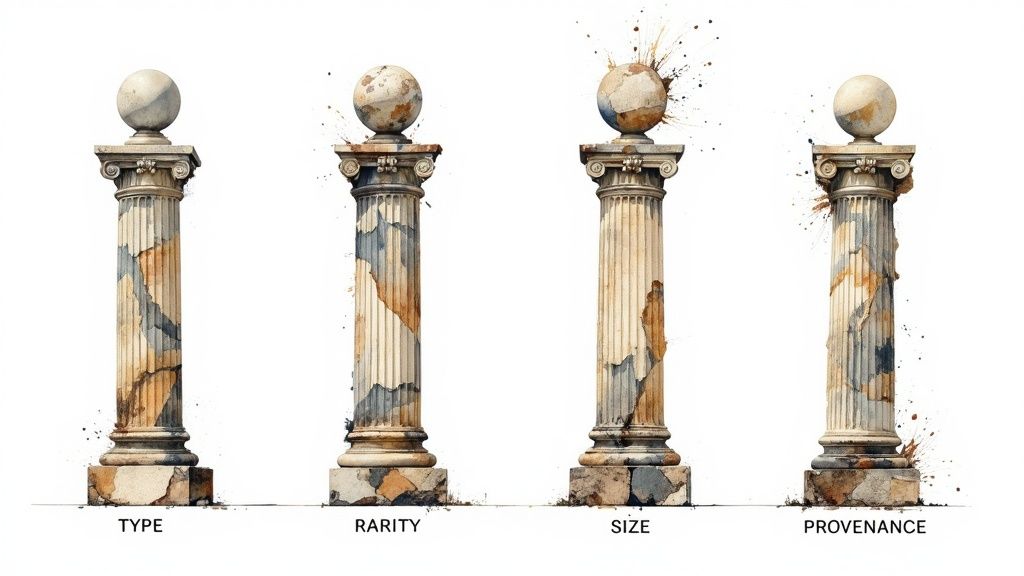
The Four Pillars of Meteorite Valuation
Figuring out what a meteorite is worth isn’t random guesswork; it’s a systematic process built on four foundational pillars. These factors—Type, Rarity, Size, and Provenance—all work together to determine a specimen’s final market value.
Getting a handle on these is the first step to seeing a meteorite not just as a cool space rock, but as a collectible with a real, quantifiable price.
The most fundamental factor is its type, or classification. Meteorites fall into three main families: stony, iron, and the much scarcer stony-iron. Each group has a unique makeup and origin story that directly shapes its value. For a deeper dive, our guide on what a meteorite is made of breaks down their composition in detail.
For instance, common chondrites (a type of stony meteorite) are the most abundant, making up over 85% of all known falls. As you’d expect, their value is relatively low. On the other hand, a Pallasite—a breathtaking stony-iron meteorite filled with olivine crystals suspended in a nickel-iron matrix—is far more scarce and visually spectacular, commanding a much higher price tag.
Rarity and Total Known Weight
This brings us right to the second pillar: rarity. In the meteorite world, rarity is often boiled down to a specific metric called Total Known Weight (TKW). This is simply the combined weight of every known specimen from a single meteorite fall. The lower the TKW, the more valuable each gram becomes.
Think of it like this: if a meteorite fall scatters thousands of kilograms of material across the desert, the supply is high, and prices stay accessible. But if a fall only produces a few hundred grams in total, every tiny fragment becomes an incredibly prized possession.
The concept is simple supply and demand. A meteorite with a low TKW is like a limited-edition print from a famous artist; its value is inherently tied to its scarcity.
The Influence of Size and Provenance
The third pillar is size. Now, you might assume bigger is always better, and often it is. Larger, intact specimens are usually more valuable than small fragments from the same fall. But this rule isn’t absolute.
A tiny sliver of a hyper-rare meteorite will always be worth more than a massive chunk of a common one. Still, for any given type, a larger, well-preserved individual stone will typically fetch a higher total price.
Finally, we have provenance—the meteorite’s backstory. This is easily the most romantic and, at times, most influential factor. A meteorite with a documented history adds a whole new layer of value.
Was the fall witnessed? Does it have a connection to a significant event? Was it recovered from a famous location like the Barringer Crater? This documented history transforms a specimen from a geological sample into a historical artifact, connecting it directly to a moment in human or planetary history. That story adds a premium that science alone can’t measure.
Comparing Market Prices For Different Meteorite Types
Now that we’ve covered the core principles of what makes a meteorite valuable, let’s get down to the fun part: talking numbers. The difference between meteorite types isn’t just a scientific detail; it creates a massive and fascinating price spectrum where some space rocks are worth exponentially more than others.
By putting some real-world prices to these concepts, you can start to get a feel for where a potential find—or a piece you’re looking to buy—might land in the collector’s market.
Common Stony Meteorites: The Entry Point
Your most common finds will almost always be ordinary chondrites. These stony meteorites are the workhorses of the collector world. Because they’re relatively abundant, their value is pretty modest, typically falling somewhere in the $0.50 to $5 per gram range.
What does that mean for a new collector? You could hold a genuine, hand-sized piece of an asteroid for less than $50. They’re the perfect gateway into the hobby, offering an authentic piece of the cosmos without a huge financial commitment. Their real value lies in their accessibility and their incredible scientific importance as the primordial building blocks of our solar system.
Iron Meteorites: The Sculptural Beauties
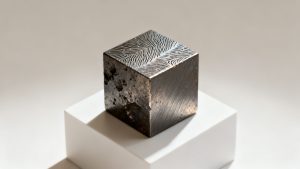
Iron meteorites carve out their own unique niche in the market. They’re valued as much for their stunning aesthetic appeal as their extraterrestrial origins. While their base price often starts between $1 to $10 per gram, their true value is unlocked when they’re sliced open and etched with a mild acid.
This process reveals the mesmerizing Widmanstätten patterns—an intricate, crystalline lattice of nickel-iron alloys that simply cannot be replicated on Earth. It’s this one-of-a-kind beauty that makes them so sought-after for display pieces and even high-end jewelry. A large, well-prepared specimen with a sharp, striking pattern will always command a premium.
The Widmanstätten pattern is more than just a cool visual. It’s the definitive, tell-tale signature of a meteorite’s cosmic origin. This unique look is a primary driver of its market value, turning what would otherwise be a chunk of iron into a piece of natural art.
Pallasites and Planetary Riches
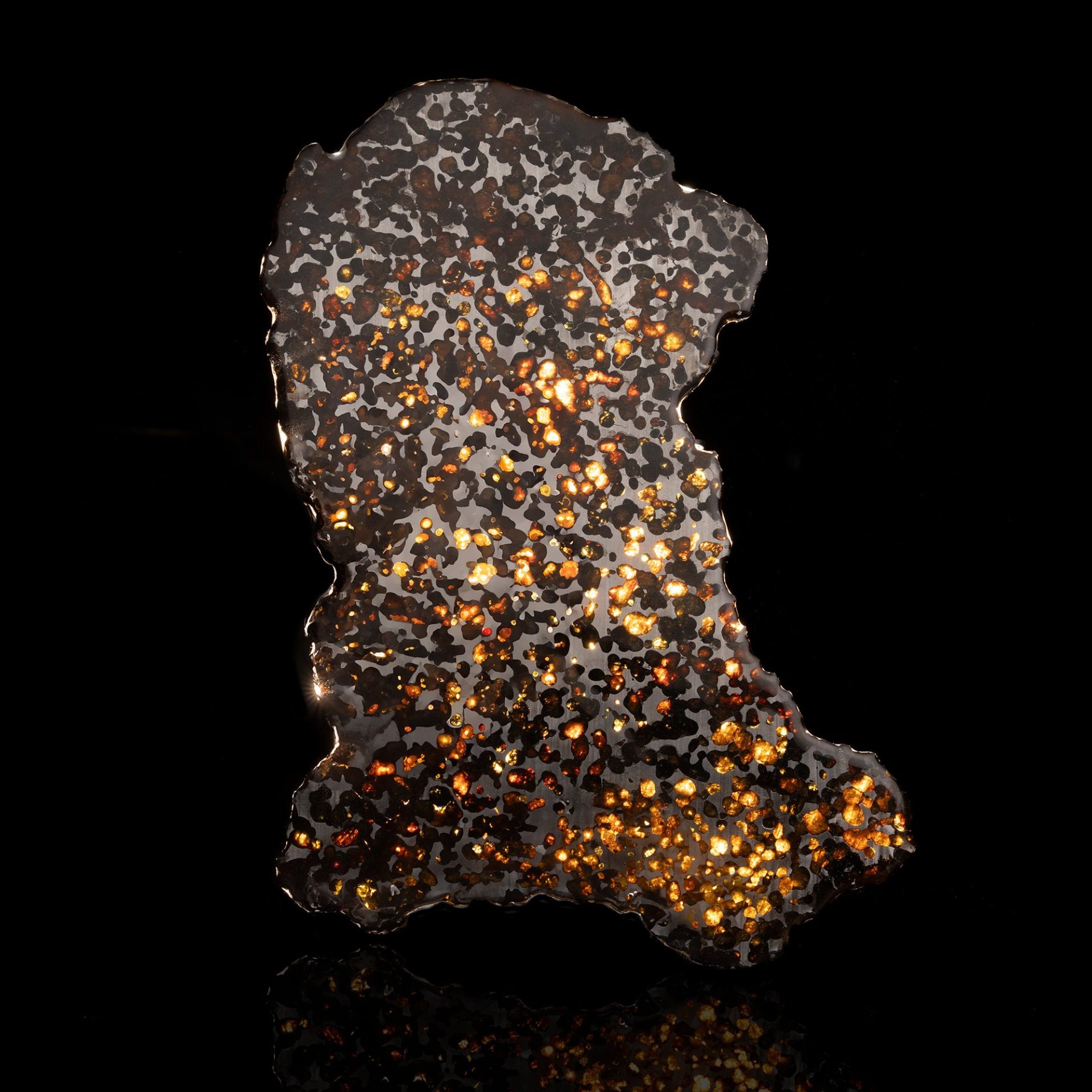
As we climb the ladder into the rarer categories, the prices jump dramatically. Pallasites, a type of stony-iron meteorite, are especially prized by collectors. These incredible specimens contain gem-like olivine crystals suspended in a nickel-iron matrix, creating a breathtaking stained-glass effect when sliced thin and backlit. The jaw-dropping beauty of a high-quality Sericho Pallasite meteorite slice instantly shows you why they are so valuable.
At the absolute peak of the market are the planetary meteorites. A tiny, gram-sized fragment from Mars (like a Shergottite) or the Moon (like a lunar anorthosite) can easily fetch over $1,000. Their immense value is a direct reflection of their unbelievable rarity and the profound connection they offer—a verifiable piece of another world, right here on Earth.
To put it all into perspective, here’s a side-by-side look at how these different classifications stack up in the market.
Detailed Price Comparison of Meteorite Types
Meteorite Classification
Subtype Example
Price Range (per gram)
Defining Characteristics
Stony Meteorite
Ordinary Chondrite
$0.50 – $5
Most common type; contains small, round grains called chondrules.
Iron Meteorite
Octahedrite
$1 – $10
Dense, metallic; reveals Widmanstätten pattern when cut and etched.
Stony-Iron Meteorite
Pallasite
$20 – $100+
A mix of nickel-iron and olivine crystals, creating a “stained-glass” look.
Planetary Meteorite
Martian (Shergottite)
$1,000+
Extremely rare; composition matches data from planetary missions.
Planetary Meteorite
Lunar (Anorthosite)
$1,000+
Blasted off the Moon’s surface; a direct piece of our closest celestial neighbor.
As you can see, the value isn’t just about the material—it’s about the story, the rarity, and the origin. From the affordable and abundant chondrites to the almost priceless fragments of Mars and the Moon, the meteorite market offers something for every level of collector and budget.
How Aesthetics and Story Shape a Meteorite’s Value
Beyond the hard science of classifications and mineral content, a meteorite’s worth is often decided by two powerful “intangibles”: its beauty and its story. These elements are what elevate an ordinary space rock into a prized collectible, proving that value is about much more than just data.
When it comes to aesthetics, certain features can send a specimen’s price soaring. Collectors hunt for meteorites that tell the visual story of their blazing journey through our atmosphere.
The Beauty of the Fall
Some of the most coveted aesthetic traits are direct results of a meteorite’s violent descent. These features don’t just look incredible; they’re also tangible proof of a genuine atmospheric entry.
Flight Orientation: When a meteorite holds a stable position as it falls, it can develop a stunning conical or shield-like shape. These specimens are exceptionally rare and highly sought after by collectors.
Regmaglypts: These are the shallow, thumbprint-like divots that cover the surface of many meteorites. Formed as the surface material burned away during flight, they add incredible texture and character.
Fusion Crust: This is the thin, dark, glassy coating that forms when a meteorite’s outer layer melts. A complete and well-preserved fusion crust is a hallmark of a fresh fall and adds significant value.
These features offer a direct, physical connection to the meteorite’s incredible journey from space to Earth.
Just as a painting is valued for the artist’s brushstrokes, a meteorite is valued for the marks left by its cosmic voyage. The shape and texture are not just random; they are the physical records of its arrival, making the specimen a unique piece of natural sculpture.
The Power of a Great Story
Just as important is the meteorite’s provenance—its unique history and story. A killer narrative can transform an otherwise common meteorite into a priceless artifact, giving it a human connection that collectors find irresistible.
A meteorite from a witnessed fall, like the 2013 Chelyabinsk event, isn’t just a rock; it’s a piece of a modern historical event that millions of people experienced firsthand. Likewise, fragments tied to famous impact sites carry a special weight. You can learn more about the legendary Canyon Diablo meteor that blasted out Arizona’s Meteor Crater to see how a powerful story can cement a meteorite’s place in history.
Ultimately, a well-documented discovery story—especially one tied to a famous location or a historic event—adds a layer of value that can easily eclipse its scientific classification. In the end, the most cherished meteorites are often the ones with the most captivating tales to tell.
Navigating the Fluctuating Meteorite Market
One of the first things you learn in this field is that the value of a meteorite isn’t set in stone. It’s a dynamic, ever-changing market driven by the classic forces of supply, demand, and—most importantly—new discoveries. Understanding this is key to grasping what a meteorite is worth, because today’s rare treasure could become more common tomorrow.
This interplay between passion and investment means prices can shift dramatically. A new, significant find can introduce a flood of material into the market, instantly changing the value of existing specimens. Collecting meteorites isn’t just about owning a piece of space; it’s about recognizing that its market value is in constant motion.
A perfect case study for this market behavior is the story of lunar meteorites. For years, these verified pieces of the Moon were among the most coveted and expensive specimens out there—the absolute pinnacle of meteorite collecting.
The Lunar Meteorite Case Study
When lunar meteorites first hit the market, their extreme rarity commanded exceptionally high prices. Collectors were willing to pay a massive premium for a genuine piece of another world, and the tiny supply kept the per-gram cost astronomical.
But then, things started to change. Expeditions to the deserts of Northwest Africa and Oman became more and more successful.
As more lunar samples were discovered, classified, and prepared for sale, the once-tiny supply began to grow. This influx had a direct and powerful effect on pricing. While prices held strong for years, the increasing availability eventually created an oversupply. By 2022, the average price for lunar meteorites had fallen significantly. You can dig deeper into this trend in this meteorite market analysis from Galactic Stone.
This is a powerful lesson in just how much timing and rarity influence a meteorite’s market value.
A meteorite’s price today is a snapshot in time. New discoveries and shifts in collector interest ensure that the market remains an exciting and fluid environment, where rarity is always being redefined.
Looking ahead, public fascination with space exploration, fueled by missions from organizations like NASA, keeps driving demand. As new planetary defense initiatives and asteroid-tracking systems teach us more about our cosmic neighborhood, the desire to own these celestial visitors will only grow, continuing to shape the future of their valuation.
A Practical Guide to Buying and Selling Meteorites
Jumping into the meteorite market is an exciting journey, but it’s one that calls for a healthy dose of caution. Whether you’re hoping to sell a piece you’ve found or you’re ready to buy your first specimen, understanding the rules of the road is the only way to protect your investment and make sure you’re dealing with the real deal.
For sellers, the entire process hinges on one critical step: authentication. A rock is just a rock until a reputable lab confirms it came from space. This isn’t just a friendly suggestion; it’s the absolute requirement for establishing any real market value. An unclassified stone has no provenance, which means it has no quantifiable worth to serious collectors. Getting that official classification from a university or a specialized lab is what turns a “possible meteorite” into a verifiable asset.
Smart Buying Strategies
For buyers, the biggest hurdle is dodging the fakes, often called “meteorwrongs.” These earth rocks can look surprisingly similar to genuine meteorites. The best way to protect yourself is to buy from dealers who are members of respected organizations like the International Meteorite Collectors Association (IMCA). Membership is a strong signal that a dealer is committed to authenticity and ethical dealing.
A trustworthy dealer will always provide documentation detailing a meteorite’s classification, where it came from, and any known history. This paperwork is just as important as the specimen itself—it’s the provenance that backs up its value.
When you’re making a purchase, especially a high-value one, don’t forget the logistics. Getting your new treasure home safely is paramount. It’s always a good idea to consider shipping insurance to cover any potential loss or damage in transit.
Tips for Safe and Successful Trading
Whether you’re on the buying or selling side, knowledge is your best defense. Here are a few final pointers to keep in mind:
Do Your Homework: Get familiar with the key traits of genuine meteorites. To learn more, check out our detailed guides on meteorite identification.
Ask for Guarantees: A reputable seller won’t hesitate to offer a certificate of authenticity and a clear return policy. If they do, that’s a red flag.
Start Small: If you’re just getting into collecting, begin with smaller, more affordable specimens from trusted sources. It’s a great way to build both your confidence and your eye for quality.
By following these practical steps, you can dive into the fascinating world of meteorite trading with confidence, ensuring your experience is both rewarding and secure.
Got Questions About Meteorite Value? We Have Answers.
Digging into the world of meteorite values can bring up a lot of questions. Here are a few of the most common ones we hear from new collectors and people who think they might have found a space rock.
I Found a Magnetic Rock. Is It a Valuable Meteorite?
It’s true that most meteorites will stick to a magnet, but so will most common Earth rocks, like magnetite. A real meteorite has other tell-tale signs that set it apart.
Look for a dark fusion crust, which is the glassy melted surface from its fiery trip through our atmosphere. You might also spot shallow, thumbprint-like indentations called regmaglypts. But the only way to be certain is to have an expert take a look. Authentication is the first, non-negotiable step before you can even begin to talk about value.
Does a Bigger Meteorite Always Mean a Higher Value?
Not even close. When it comes to meteorites, rarity and type are king, not size.
For example, a tiny one-gram slice of a Martian meteorite can easily fetch over $1,000. On the flip side, a much heavier 100-gram ordinary chondrite—the most common type—might only sell for around $50.
It all comes down to scarcity. A meteorite’s value is often tied to its Total Known Weight (TKW). If only a few kilograms of a certain type have ever been found on Earth, even the smallest fragments become incredibly sought-after.
Where Can I Get a Potential Meteorite Officially Tested?
For a formal, scientific classification, your best bet is to reach out to a university with a solid meteoritics or geology department. Places like Arizona State University or the University of New Mexico have labs specifically equipped for this kind of work.
These experts can run the analyses needed to confirm if your rock is from space and figure out exactly what kind it is. This official classification is crucial—it gives the meteorite its identity and is the foundation for its value in both the scientific and collecting communities.
At Astro West, we provide authenticated, ethically sourced meteorites for every type of collector. Explore our curated collection of genuine space rocks and own a piece of the cosmos today. Find your perfect specimen at astrowest.com.