Index fossils are the rock stars of the geological world. These aren't just any fossilized remains; they are special time markers embedded in the Earth's crust that help scientists pinpoint the age of rock layers with incredible accuracy.
Think of them as unique, time-stamped bookmarks tucked into the pages of Earth's massive history book.
Your Guide to Geological Timekeepers
Imagine trying to piece together a massive, ancient puzzle without a picture on the box. That’s essentially what geologists face with the Earth’s crust, which is made up of countless rock layers, or strata, stacked one on top of the other. Each layer tells a story from a different chapter in our planet’s immense history. But how do we know which chapter came when?
This is where index fossils come into play. They act as reliable signposts.
When a geologist finds a specific type of index fossil—say, a particular trilobite—in a rock layer in North America, they can be confident that the layer is the same age as another one containing the same fossil in Australia. This powerful ability to match, or correlate, rock ages across continents is the foundation of a field called biostratigraphy.
Why Not All Fossils Are Created Equal
While countless organisms have left their mark in the fossil record, only a select few have the right combination of traits to serve as these crucial timekeepers. Not every fossil makes the cut. You can dive deeper into the different types of fossils and what makes each one unique in our other guides.
To be considered a true index fossil, the organism it came from had to be distinctive, globally widespread, and alive for a very specific—and geologically short—period of time. This unique combination is what gives index fossils their power. Their presence provides a timestamp, allowing scientists to assemble the scattered pages of Earth's timeline into a coherent story.
For a fossil to earn this special status, it must meet five strict criteria:
It must be easily recognizable and distinct from other species.
It must have a broad geographical distribution across the globe.
It must be abundant, making it likely to be found by researchers.
It must have existed for a short, well-defined period of geologic time.
Its remains must be durable enough to fossilize well.
This rigorous checklist ensures that when an index fossil is identified, it provides an accurate and reliable point of reference for dating the rock in which it was found. Reputable geology sites like GeologyIn.com offer further information on these key characteristics.
The Five Qualities of a Perfect Geological Clock
Not just any fossil can act as a reliable time marker for geologists. To earn the title of "index fossil," a species has to meet five strict, non-negotiable criteria. Think of it as a rigorous checklist; if a fossil fails even one of these tests, it can’t be trusted to accurately date rock layers.
Each quality ensures that when scientists uncover one of these special fossils, they’re looking at a clear and consistent snapshot in geological time. This reliability is what allows them to confidently connect rock layers across vast distances, piecing together Earth's complex history one fossil at a time.
To be a truly useful index fossil, a species must have five key traits. We've laid them out below to show what geologists look for when they're trying to read the story written in the rocks.
The Five Essential Criteria for an Index Fossil
Characteristic
Description
Why It's Important
Easily Recognizable
The fossil has unique, distinctive features that make it easy to identify and hard to confuse with other species.
This ensures that geologists around the world can confidently identify the same species, confirming they're looking at rocks from the same time period.
Widespread
The organism lived across a vast geographical area, ideally on multiple continents or across entire oceans.
A global distribution allows scientists to correlate rock layers in different parts of the world, building a comprehensive geological timeline.
Abundant
The species was extremely common when it was alive, leaving behind a large number of fossilized remains.
High abundance increases the chances of finding the fossil, providing more data points for dating and correlation. Rare fossils are too hard to find.
Short-Lived
The species existed for a geologically brief period of time, typically less than a few million years.
A short lifespan provides a very precise time marker. A fossil from a long-lived species would only narrow down the age to a huge, vague window.
Durable
The organism had hard parts (like shells or bones) that were likely to survive the fossilization process.
Durability ensures the remains can withstand burial, pressure, and time, leaving a clear and well-preserved record for scientists to find millions of years later.
These five rules work together to create the gold standard for dating rocks. Without them, we'd have a much fuzzier picture of Earth's ancient past. Let's dig a little deeper into why each one is so critical.
1. Easily Recognizable Appearance
First and foremost, an index fossil must be distinctive. Its features need to be unique and easy to spot, leaving no room for confusion with other species. A fossil that looks too much like others from different eras would be like trying to tell time with a clock that has blurry numbers—completely unreliable.
This clarity ensures a geologist in Morocco and another in Canada can identify the same species with total confidence. It’s the first step in confirming they are looking at rocks from the exact same geological moment.
The best index fossils often have intricate structures, like the detailed sutures on an ammonite's shell or the complex body segments of a trilobite. Their unmistakable forms make them perfect geological signposts.
2. Widespread Geographical Distribution
Next, the organism must have lived all over the world. A fossil found only in a single, small region is of limited use for connecting rock layers globally. The ideal index fossil comes from a creature that was a true globetrotter, spreading across ancient oceans or continents.
This widespread distribution allows scientists to connect the dots between rock formations separated by thousands of miles. Finding the same species of graptolite—tiny colonial animals that floated in ancient seas—in both Scotland and the Andes proves those rock layers were formed at the exact same time.
3. Abundant and Plentiful
It’s not enough for a species to have lived everywhere; it also needed to be incredibly common. If an organism was rare, the chances of its remains turning into fossils would be slim, making it an impractical marker.
The best index fossils come from species that existed in huge numbers. Their abundance means their fossils show up frequently in the geological record, giving scientists plenty of data points to work with.
4. Short Geological Lifespan
Perhaps the most crucial criterion is that the species existed for a geologically short period of time. Think of it like a limited-edition sneaker that was only sold for a single year; finding a pair instantly dates the context to that specific time.
If a species lived for tens of millions of years, its fossil would only narrow down a rock layer’s age to a massive, vague window. In contrast, a species that was around for only a million years or less provides a sharp, precise time marker. This is what gives an index fossil its power as a high-resolution "clock."
5. Durable and Well-Preserved
Finally, the organism's remains must be durable enough to survive the fossilization process. Creatures with hard parts like shells, skeletons, or teeth are far more likely to leave a lasting record than soft-bodied organisms.
The intense heat and pressure that can transform rock can easily destroy delicate remains. That's why durability is key. For more on how rocks change, check out our guide on what metamorphic rock is. Good preservation potential is the final piece of the puzzle, ensuring these ancient timekeepers survive for millions of years to tell their story.
Famous Index Fossils Through Geologic Time
To really wrap your head around index fossils, it helps to meet some of the most famous examples from Earth’s deep past. Think of them as the "rock stars" of the fossil world—each one capable of perfectly pinpointing a moment in geologic time.
These fossils aren't just cool relics; they're living proof of the five key criteria for a perfect index fossil. They were distinctive, globally widespread, and plentiful, but they only existed for a fleeting moment. Let's dig into a few of the all-stars.
Trilobites: The Rulers of the Paleozoic Seas
If there's one fossil that screams "ancient," it's the trilobite. These marine arthropods are distant cousins of today's insects and crabs, and they absolutely dominated the oceans of the Paleozoic Era. They first showed up over 520 million years ago and stuck around for an incredible stretch before vanishing in the great extinction at the end of the Permian Period.
But here's the key: while the group lasted a long time, individual trilobite species were quick bursts of evolution. They’d appear, spread across the globe, and then disappear in a geologic blink of an eye. Their complex, segmented bodies and funky eye structures also make them incredibly easy to spot and identify.
Take the genus Paradoxides, for instance. If a geologist finds one of these, they know without a doubt they're looking at rocks from the Cambrian Period, about 500 million years ago. Because their hard exoskeletons fossilized so well and are found on nearly every continent, they're a textbook example of what makes an index fossil so useful. You can even find stunning specimens like this 510-million-year-old Paradoxides trilobite fossil available for collectors.
Ammonites: The Spiral Timekeepers of the Mesozoic Era
Let’s jump forward a few hundred million years to the Mesozoic Era—the age of dinosaurs. Here, a different fossil superstar takes the stage: the ammonite. These extinct marine mollusks, related to modern squid and octopuses, are famous for their beautiful, coiled shells. They were so common that their fossils are found in marine rocks worldwide from this period.
Just like trilobites, the larger ammonite group had a long run. Their real value for geologists, however, comes from how quickly individual species evolved and changed.
Ammonite shells have intricate, wavy patterns called suture lines where the internal chamber walls met the outer shell. These patterns grew more complex over time, allowing paleontologists to identify specific species with stunning precision. It's often possible to narrow down a rock layer's age to a window of less than a million years just based on these lines.
The evolution of ammonites was so rapid and distinct that different species are used to define the official boundaries of geologic stages within the Jurassic and Cretaceous periods. The species Baculites, for example, is a dead giveaway for the Late Cretaceous Period thanks to its nearly straight shell.
When a geologist uncovers a Baculites fossil, they know exactly which chapter of Earth's history they're reading. Their widespread distribution and fantastic preservation make them an indispensable tool for dating rocks from the time of the dinosaurs.
How Scientists Use Index Fossils in the Field
Knowing what index fossils are is one thing, but how geologists actually use them out in the real world is where their true power shines. This isn't just some dusty academic exercise; it’s a practical toolkit for solving complex puzzles about Earth's history, from dating ancient seabeds to finding valuable natural resources.
The main application is a field called biostratigraphy—the science of dating rock layers (or strata) using the fossils trapped inside them.
Think of it like this: Imagine you have a huge, scattered pile of old books from different publishers and years. If you find several books with the exact same, unique publisher's mark from a limited print run, you can confidently group them together, knowing they came from the same time frame.
Index fossils are that unique publisher's mark. When a geologist unearths a specific trilobite species in a rock layer in Wales, and another scientist finds that exact same species in Morocco, they can prove both rock formations were laid down at the same time. This simple but powerful method allows them to line up the ages of rock layers across entire continents.
From Ancient Seabeds to Modern Industries
The practical use of index fossils goes far beyond just mapping out Earth’s timeline. It plays a huge role in modern industries, especially in the hunt for petroleum. Oil and natural gas are often trapped in specific rock layers deep underground, and to find them, energy companies need to know the precise age of the rock they're drilling through.
This is where microscopic index fossils, or microfossils, become indispensable. Today, these tiny fossils are central to dating rock layers with incredible precision. Microfossils from planktonic organisms are particularly useful in oil exploration, a topic well-covered by educational resources like earthsci.org.
Take foraminifera, for example. These were tiny, single-celled organisms with calcified shells that floated in ancient oceans. When they died, they sank in unimaginable numbers, accumulating in sediments all over the globe.
Because these microfossils are so tiny and abundant, drilling crews can analyze them right in the small rock chips brought up by the drill bit. Different foraminifera species define very narrow windows of time, acting like signposts that tell geologists if they're getting close to oil-bearing strata. It’s a fantastic example of how studying ancient life directly impacts our modern world. Of course, knowing what to look for when collecting fossils is a key skill, whether you're a professional or just starting a collection.
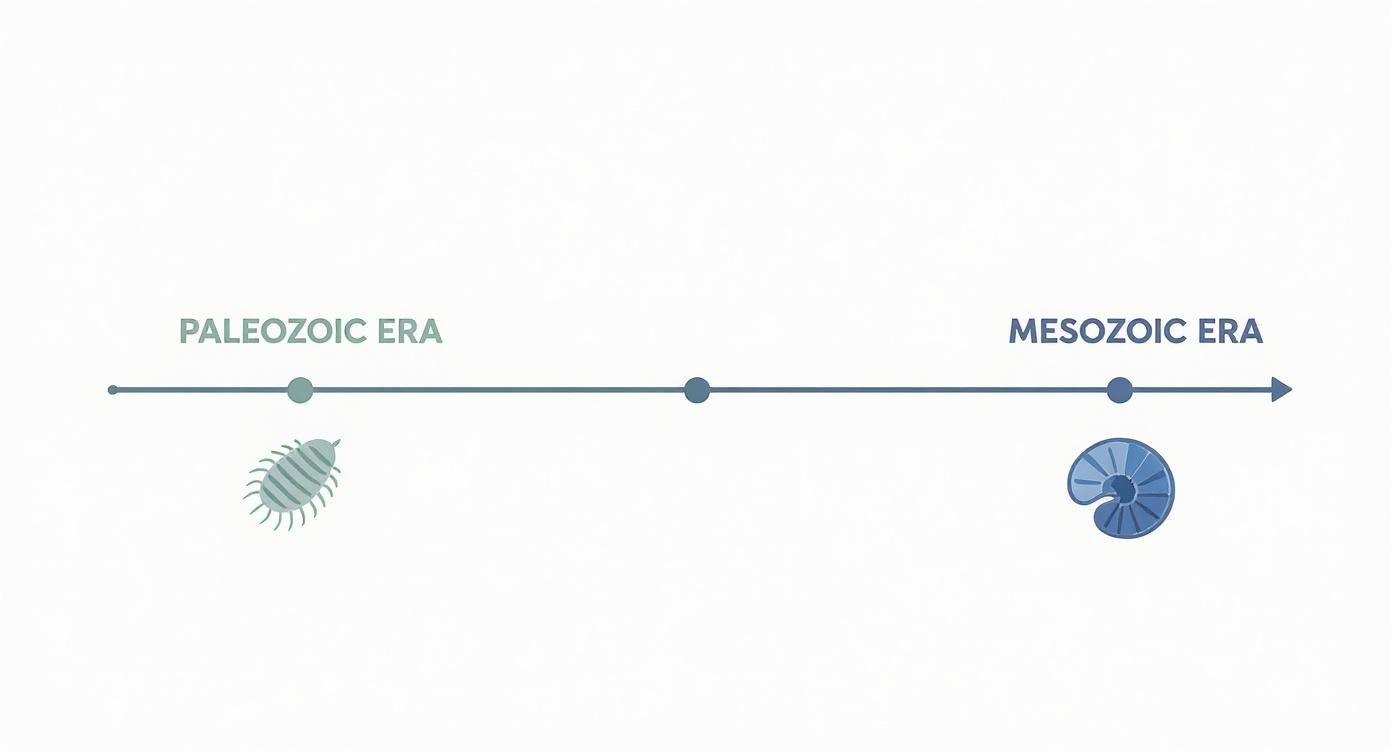
This timeline zeros in on two of the most famous index fossils, the trilobite and the ammonite, and the geologic eras they perfectly define.
As you can see, these creatures dominated very specific and separate periods, which is exactly what makes them such ideal markers for the Paleozoic and Mesozoic Eras.
Building the Geologic Timescale
Ultimately, the most significant use for index fossils is building and fine-tuning the Geologic Timescale. This is the official calendar of Earth's history, and its major divisions—eons, eras, periods, and epochs—are largely defined by the appearance and disappearance of specific life forms in the fossil record.
The boundaries between many geologic periods are marked by mass extinction events. Index fossils are crucial for identifying these boundaries, as they show the sudden disappearance of many species and the subsequent appearance of new ones.
For instance, the boundary between the Paleozoic and Mesozoic Eras is defined by the Permian-Triassic extinction event, where trilobites vanished forever. In the same way, the end of the Mesozoic Era is marked by the extinction that wiped out the dinosaurs and the very last of the ammonites.
By piecing together these fossil appearances and disappearances from rock layers all over the planet, geologists have constructed the incredibly detailed history of our world that we study today.
Comparing Index Fossils to Other Fossil Types
In the world of geology, not all fossils are created equal. To really get a feel for what makes index fossils so important, it helps to see how they stack up against the other types you might come across. A massive T-Rex skeleton is undeniably cool, but its main job is to teach us about biology and behavior, not to pinpoint an exact moment in time.
The key difference really boils down to purpose. Most fossils tell us what lived in the past. An index fossil's unique job is to tell us when a rock layer was formed. That distinction is everything when it comes to piecing together Earth's incredibly complex history.
A Tale of Two Fossils
Imagine you're out in the field and find two different fossils. The first is a trace fossil—say, a set of dinosaur footprints perfectly preserved in what was once mud. This is an incredible find! It tells you about the dinosaur's stride, how fast it was moving, and maybe even hints at group behavior. It tells a story about that animal's life.
A few feet away, you find a tiny ammonite, just one of thousands you might see in the same rock layer. It’s far less dramatic than a giant footprint, but its presence tells a completely different, and arguably more powerful, story. It’s a geological timestamp, instantly dating that rock layer to a precise window within the Mesozoic Era. This is the unique power of an index fossil.
While a trace fossil captures a moment in an animal's life, an index fossil captures a moment in geological time. One reveals behavior, the other reveals age.
To make these roles even clearer, let's break down the key differences between index fossils and other common types.
Index Fossils vs Other Fossil Types
The table below really highlights the distinct jobs that different fossils have in helping us understand the past.
Fossil Type
Primary Purpose
Key Characteristics
Example
Index Fossil
Dating Rock Layers: Serves as a time marker to correlate the age of rock formations across vast distances.
Short-lived, widespread, abundant, and easily recognizable. Its value is in its time-specificity.
A specific species of trilobite or ammonite.
Trace Fossil
Recording Behavior: Shows evidence of an organism's activities, such as movement, feeding, or burrowing.
Preserves actions, not the organism itself. Examples include footprints, nests, and bite marks.
A Tyrannosaurus rex footprint or a worm burrow.
Body Fossil
Revealing Anatomy: Preserves the physical remains of an organism, providing insights into its biology.
Can be complete skeletons or isolated parts like bones, teeth, or shells. Shows what an animal looked like.
A mammoth's tusk or the complete skeleton of a saber-toothed cat.
Living Fossil
Illustrating Evolution: A modern species that appears remarkably similar to its ancient fossilized ancestors.
Shows a very slow rate of evolutionary change over millions of years. Connects the past to the present.
The coelacanth fish or the Ginkgo biloba tree.
This comparison makes it obvious that while every fossil gives us valuable clues, only index fossils have that specific cocktail of traits needed to act as geological clocks. They are the essential "page numbers" in Earth's history book, allowing scientists to put all the other amazing stories—told by trace, body, and living fossils—into the correct chronological order. Their function isn't just important; it’s fundamental to the entire science of geology.
Common Questions About Index Fossils
Even after getting the basics down, a few questions always seem to pop up about index fossils. These curiosities usually get right to the heart of the matter—like why some of the most famous fossils don't make the cut, and how this whole dating method fits into the bigger picture of geology.
Let’s tackle some of the most common questions to clear up any lingering uncertainties.
Why Aren't Dinosaurs Good Index Fossils?
It seems a little strange, right? Dinosaurs like Tyrannosaurus rex or Triceratops are the most famous fossils on the planet, yet they are rarely used as index fossils. While they’re definitely distinctive, they fail several of the key tests needed for a fossil to be a truly useful geological clock.
For starters, most dinosaur species had a pretty limited geographic range. You won’t be finding T. rex fossils scattered across every single continent. More importantly, complete dinosaur skeletons are incredibly rare finds, so they don’t pass the "abundant" test either.
But the biggest problem is their geologic lifespan. The Mesozoic Era—the age of dinosaurs—lasted for over 180 million years. Even though individual dinosaur species had shorter runs, they were still around for millions of years at a time. That’s just not precise enough to date a specific rock layer with the kind of high resolution we need from a true index fossil.
How Do Index Fossils Work with Radiometric Dating?
This is a great question because the two methods are a perfect partnership. Index fossils give us what’s known as relative dating. They can tell you that a rock layer in North America is the same age as one in Europe, or that one layer is definitively older than the one above it. But they can't give you a specific age in years.
That’s where absolute dating methods like radiometric dating come into play. Scientists can analyze radioactive isotopes in layers of volcanic ash found above or below strata containing index fossils. This process gives them a precise numerical age for that ash layer.
When you put the two together, you get a powerful synergy. The index fossils provide the global sequence and correlation, while radiometric dating anchors that sequence to specific points in time. It’s the best of both worlds.
Are New Index Fossils Still Being Discovered?
Absolutely. Paleontology isn’t a static field—it's constantly evolving as new discoveries refine our understanding of Earth's history. As researchers explore new regions or even re-examine old museum collections, they regularly identify new species that perfectly fit the criteria of an excellent index fossil.
Many of these new finds are actually microfossils, the tiny remains of plankton and other microorganisms. Because these organisms were incredibly widespread, abundant, and evolved rapidly, they allow geologists to subdivide geologic time with even greater detail.
New finds are constantly being shared in paleontological communities and online hubs like The Fossil Forum, where both amateurs and experts post their latest discoveries. Every single one helps sharpen the resolution of our planet’s geological timeline.
At Astro West, we believe every fossil tells a unique story about our planet's incredible past. From the intricate patterns on a trilobite to the stunning spiral of an ammonite, these natural treasures connect us to deep time. Explore our curated collection of ethically sourced, museum-quality fossils and bring a piece of Earth's history into your home. Visit us online at https://astrowest.com to discover your own geological timekeeper.