Upper West Side of NYC: Your 2026 Guide to Explore & Dine
You're probably looking at the Upper West Side because it offers something rare in Manhattan. It feels cultivated without feeling staged. A morning can start with coffee on a brownstone block, shift into a museum visit, and end with a concert, a park walk, or a serious browse through objects that reward close looking.
That mix is what makes the Upper West Side of NYC stand apart. It isn't just convenient. It has intellectual weight, architectural memory, and a lived-in rhythm that many neighborhood guides flatten into a simple list of attractions. In practice, the area works best when you approach it as a place for connoisseurs, not just tourists.
Introduction Discovering Manhattan's Cultural Soul
The Upper West Side rewards people who like substance. You notice it in the pre-war facades, the bookstore energy, the museum traffic, and the calmer residential blocks that sit only minutes from major cultural institutions. Few Manhattan neighborhoods balance daily life and destination appeal this well.
This is also a neighborhood with real scale. The NYU Furman Center ranked the Upper West Side as the city's 3rd largest neighborhood by population out of 59 in 2024, which matters because it explains why the area feels like a serious residential market, not a curated backdrop for visitors alone, according to the NYU Furman Center neighborhood profile.
Why the neighborhood feels so complete
The appeal comes from layers working together:
Culture within walking distance: You can move from natural history to archival New York history to world-class performance without crossing half the city.
Residential calm: Tree-lined streets and apartment houses create a steadier pace than many downtown districts.
Green space on both sides: Central Park and Riverside Park shape the neighborhood's daily life, not just its views.
Specialty retail: The area still supports shops built around expertise and passion, including natural history collecting.
That last point matters more than it gets credit for. A strong Upper West Side day often includes one destination that feels specific to your interests. For some people, that's a smoked fish counter or a concert hall. For others, it's a gallery where natural specimens are presented with the seriousness usually reserved for art and design.
The Upper West Side works best when you leave time between stops. Its charm comes from sequence, not speed.
How to experience it well
First-time visitors often overpack the day. That usually backfires here. The neighborhood isn't about racing between landmarks. It's about pairing institutions with street life.
A better plan is simple. Choose one anchor visit in the morning, one outdoor stretch in the afternoon, and one food or shopping stop that feels character-rich rather than purely convenient. That's how the Upper West Side becomes memorable instead of merely efficient.
The Museum Mile and Performing Arts Hub
The cultural case for the Upper West Side starts with concentration. Few parts of Manhattan give you this much range within a compact walk. Science, music, opera, ballet, and city history all sit close enough to shape a single day.
For a first visit, start with the institution that defines the neighborhood for many travelers. The American Museum of Natural History gives the area global recognition, but it also sets the tone. The museum asks you to look carefully, compare scale, and think across time. That habit of attention carries well into the rest of the neighborhood.
American Museum of Natural History
Families gravitate here naturally, but the museum also rewards adults who care about collecting, display, and scientific context. If you're interested in how natural objects move from field discovery to public interpretation, the museum provides the intellectual framework. Nearby specialists can then make that interest tangible. For example, a specimen such as museum-quality dioptase with calcite from the DRC shows how mineral beauty, rarity, and presentation converge outside an institutional setting.
That same bridge between education and object appreciation appears in smaller collectible forms. The Dinosaur Agate Fossil Box contains agatized dinosaur bones found in Utah, USA, from the Cretaceous period. It's a useful reminder that natural history on the Upper West Side doesn't stop at museum vitrines.
Lincoln Center after dark
Lincoln Center shifts the neighborhood from scientific wonder to formal performance. The setting itself matters. Even before the curtain rises, the plaza and surrounding architecture create a sense of occasion that many travel guides underplay.
If you're choosing among venues, use interest rather than prestige as your filter:
Opera: Best for visitors who want scale, costume, and ceremony.
Philharmonic performance: Best for listeners who want precision and acoustic depth.
Ballet: Best for those who value line, movement, and visual composition.
Practical rule: If you only have one evening on the Upper West Side, build dinner around Lincoln Center rather than treating the performance as an add-on.
New-York Historical Society
The New-York Historical Society complements the museum and Lincoln Center because it narrows the lens. Instead of universal natural history or grand performance, it turns your attention to the city itself. That smaller scale is useful. It helps visitors understand that the Upper West Side isn't culturally important by accident. It sits inside a larger New York story shaped by institutions, archives, preservation, and public life.
For first-time visitors, this trio works especially well in sequence. Start broad with natural history, refine your perspective with city history, and end with performance. That progression feels distinctly Upper West Side Manhattan.
Legendary Parks and Waterfront Vistas
The Upper West Side's green spaces aren't interchangeable. Central Park gives you drama, density, and famous compositions. Riverside Park gives you openness, horizon, and relief from the city's inward pressure. If you try both on the same day, the contrast becomes one of the neighborhood's strongest pleasures.
Central Park from the west side
The west-side entrances lead into some of the park's most rewarding scenes. Strawberry Fields draws visitors for obvious reasons, yet it also works as a pause point before a longer walk. From there, The Lake, Bow Bridge, and the Ramble offer a sequence that feels cinematic without becoming crowded at every step.
A practical route works better than a wandering approach if your time is limited:
Begin at Strawberry Fields for a quick orientation.
Continue toward The Lake for changing sightlines and calmer water views.
Cross near Bow Bridge if you want one of the park's most photogenic moments.
Finish in the Ramble if you prefer shade, texture, and a less formal setting.
Photography is strongest early or late in the day, when the light catches stone, foliage, and water with more depth. Midday can flatten everything.
Riverside Park for breathing room
Riverside Park offers a different kind of value. It feels less performative and more local. The bike paths, benches, and Hudson views make it one of the best places to reset after a museum-heavy morning or a dense food crawl.
The atmosphere also changes your pace. You walk farther without noticing, which is part of the appeal. For visitors traveling with children, it can be the easier choice because there's less pressure to hit named landmarks in sequence.
One object lesson in scale comes from natural history itself. The neighborhood's fascination with deep time and large forms makes a specimen like this Authentic Phacops rana rana Devonian Trilobite Fossil from New York feel like a great representation of the deep history felt when visiting.
Riverside Park is where the neighborhood stops presenting itself and simply lets you live in it for an hour.
How to choose between the two
Use this simple test:
Choose Central Park if you want iconic views, classic New York imagery, and a fuller sightseeing loop.
Choose Riverside Park if you want waterfront air, a quieter walk, and more local rhythm.
Choose both if you're spending a full day on the Upper West Side and want the neighborhood's complete outdoor range.
Architectural Grandeur and Historic Streets
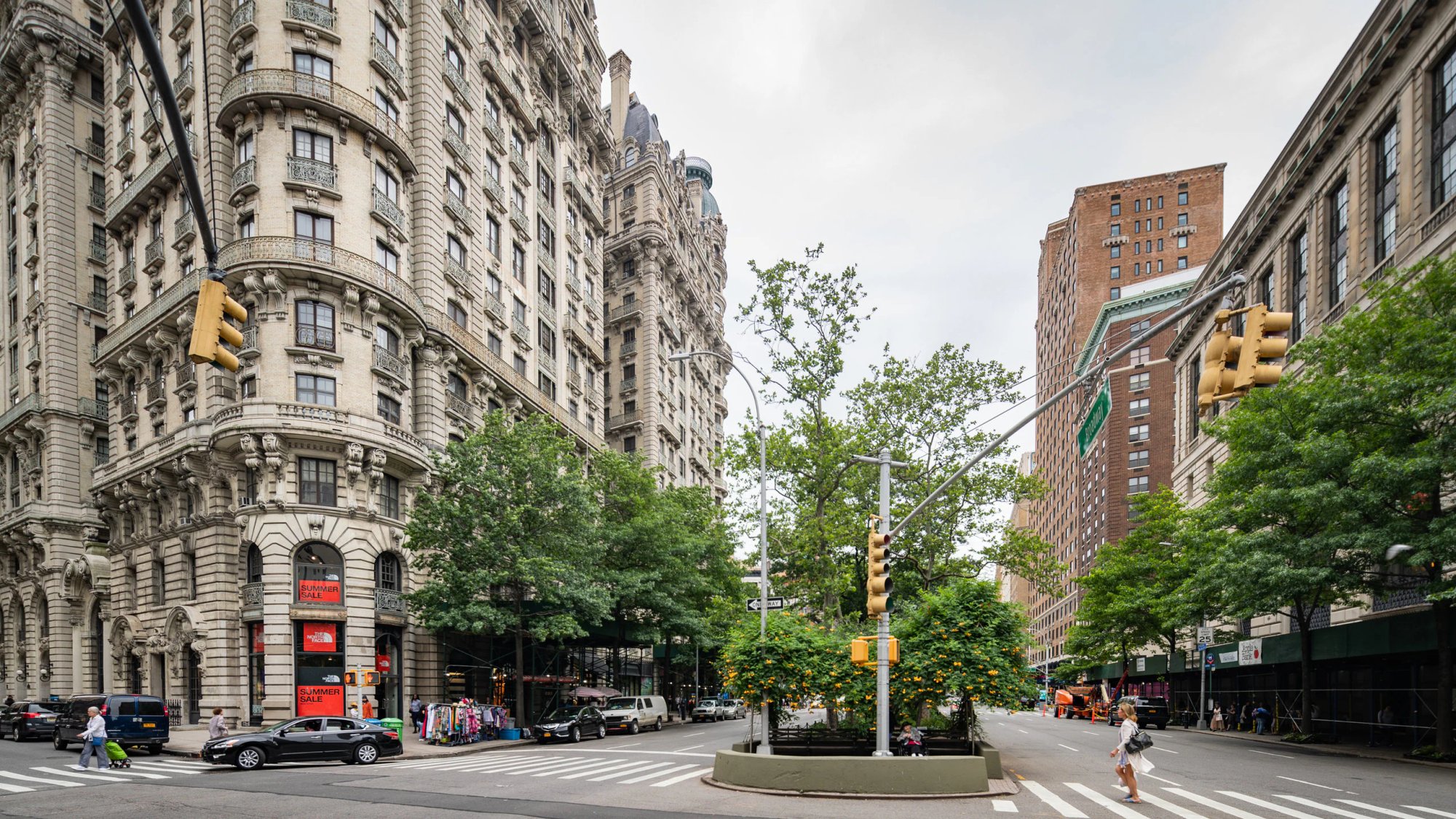
Start on a quiet side street off West End Avenue or Central Park West, look up, and the Upper West Side explains itself. The neighborhood rewards slow observation. Bay windows, carved stone, ornamental cornices, and dignified entrances create the kind of visual continuity collectors recognize at once. Individual pieces matter, but its true value sits in the ensemble.
Its character grew out of timing and infrastructure. The extension of the Manhattan grid, the creation of Central Park, and later rapid transit gave developers a framework for ambitious residential building. By the late 19th and early 20th centuries, the area had become one of New York's great apartment-house districts, with blocks that still read as a coherent record of changing taste, status, and urban confidence.
The buildings that define the skyline
The Dakota and the Ansonia draw attention for good reason. Each is dramatic, highly legible, and loaded with New York identity. The trade-off is predictable. Visitors often stop at the famous facades and miss the neighborhood's deeper appeal.
That appeal lives in repetition with variation. Rows of brownstones, pre-war apartment houses, stoops, lintels, and recessed entryways create a visual rhythm that holds up over long walks. One block may feel restrained, the next more ornate, but the standards of materials and proportion stay high. For anyone interested in design as a form of connoisseurship, that consistency is what makes the district satisfying.
Why preservation still matters
The Upper West Side remains unusually readable because so much of its historic building stock survived to be protected. The Landmarks Preservation Commission's Upper West Side/Central Park West Historic District designation report documents the scale and architectural range of the district, from rowhouses to large apartment buildings. That protection preserves more than facades. It preserves the experience of moving through streets that still hold their original proportions and intent.
Element
What you notice on foot
Why it matters
Brownstone blocks
Rhythm, stoops, smaller-scale detail
Creates a residential cadence that slows you down
Grand apartment houses
Ornament, massing, formal entrances
Shows how prestige was built into everyday city living
Historic district continuity
Consistent materials and streetwall
Makes the neighborhood feel collected rather than accidental
Park-edge buildings
More light, longer views, open frontage
Ties architecture to the park and the river air
How to walk it like a curator
A better route pairs one celebrated building with one ordinary residential block. That method sharpens your eye. You start noticing what is rare, what is repeated, and what gives the Upper West Side its collectible quality.
Walk north or south without rushing. Pause at entry canopies, window surrounds, ironwork, and lobby thresholds. The neighborhood does not rely on a single masterpiece. It offers a series of well-composed streets where details accumulate value block after block.
Iconic Tastes of the Upper West Side
The food culture here isn't about novelty for its own sake. The Upper West Side does its best eating through institutions, habits, and places that became part of neighborhood memory. That makes it ideal for visitors who want meals with context.
Start with the classics
Zabar's is the obvious first stop because it functions as more than a store. It's part pantry, part ritual, part New York shorthand. Even if you don't buy much, the experience teaches you something about Upper West Side appetite. People here value quality, repetition, and confidence over trend-chasing.
Then there are the staples that anchor shorter visits. Levain Bakery draws people in for good reason. The cookies are part of the neighborhood's informal itinerary now. Barney Greengrass adds a different note. It's old-school, direct, and firmly tied to the city's appetizing tradition.
Build a food day with range
A practical sequence works better than trying to sample everything.
Morning pick: Start with coffee and a bakery stop if you're heading toward the park or museum corridor.
Midday institution: Use Zabar's or a classic appetizing destination when you want something that feels rooted in the neighborhood.
Good Upper West Side eating isn't only about the plate. It's about whether the place feels inseparable from the block around it.
What works and what doesn't
What works is choosing places with history and clear identity. What doesn't is treating the neighborhood like a generic reservation zone. The Upper West Side has enough chain convenience that you don't need another anonymous meal.
For visitors, the strongest approach is selective. Pick fewer places. Make each one count. You'll remember the neighborhood more clearly that way.
A Premier Gallery for Natural History Collectors
One of the most distinctive stops on the Upper West Side isn't a museum, park, or performance hall. It's a natural history gallery that turns abstract interest into physical encounter. For visitors who leave the American Museum of Natural History wanting something more tangible, the neighborhood offers an unusually specific experience.
Why this stop belongs on a serious Upper West Side itinerary
Astro West Natural History Gallery sits naturally within the local cultural ecosystem because the area already teaches visitors how to look closely. Museum collections establish scientific context. A gallery setting then lets collectors, families, and design-minded visitors see how minerals, fossils, and meteorites function as real objects in private hands and interiors.
That matters because natural history isn't only educational. It also has aesthetic and market logic. Preservation quality, rarity, provenance, scale, and visual balance all influence why one specimen commands more attention than another. Those are the same value drivers collectors use in fields like fine art and decorative objects.
For readers who want to preview the broader range, the gallery's online categories for minerals, fossils, meteorites, and gemstone décor show how wide the collecting spectrum can be.
Collecting as culture, not clutter
A strong natural history collection has to do more than impress. It has to hold its interest over time. That's why museum-quality pieces tend to stand apart from novelty purchases. The strongest specimens combine scientific integrity with visual clarity. They read well in a case, on a pedestal, or in a refined interior.
A compact example of collector appeal appears in an object like this authentic T. rex fossil in collectors box. The point isn't spectacle alone. It's the controlled presentation of rarity, narrative, and authenticity.
A short visual look helps here:
Who should make time for this
This stop makes the most sense for three kinds of visitors:
Families leaving the museum: Children often respond strongly to the idea that natural history can be held, displayed, and studied outside an institution.
Collectors: The Upper West Side is one of the few neighborhoods where a museum visit and an acquisition-minded gallery stop feel like part of the same conversation.
Interior designers and gift buyers: Natural specimens can function as design objects with stronger provenance and individuality than mass-market décor.
That combination makes this destination unusually aligned with the Upper West Side itself. It's thoughtful, visual, and selective.
Practical Guide for Visitors and Residents
The Upper West Side is easy to admire from the outside. Living in it or even spending several full days here requires a more practical lens. The questions people ask tend to be straightforward. Can you move around easily? Is it manageable for a family? Does the neighborhood justify its costs?
The cost question deserves a direct answer
The Upper West Side is often described as uniformly affluent, but that shorthand hides real variation. According to Lena Simpson's neighborhood guide, the area is one of NYC's wealthiest, with year-to-date median home prices of $860,000 for a one-bedroom and $1,850,000 for a two-bedroom, while studios start around $2,400 to $3,500 and one-bedrooms around $3,200 to $4,900, as detailed in this Upper West Side market snapshot.
That tells you two things. First, the neighborhood is expensive in a very real way. Second, the market is segmented enough that “luxury” doesn't explain everything. Building type, unit size, and exact location change the lived experience fast.
What daily life feels like
Transit is one of the neighborhood's practical strengths. You can walk a lot of it comfortably, and that reduces friction for both visitors and residents. The trade-off is that parking can be frustrating, especially if you expect convenience rather than patience.
Quality of life depends heavily on where you land. Some blocks feel lively and plugged into the city's rhythm. Others become notably quiet, especially at certain hours. For families, that can be a strength. For people who want nonstop energy, it can feel subdued.
Resident lens: The Upper West Side is often easier to live in than to explain. Two apartments a short walk apart can produce very different routines.
Planning before you commit
If you're considering a move, it helps to model the space before you sign anything. Tools for Designing NYC living spaces can be useful when you're deciding how far a smaller footprint can really stretch.
Use a simple checklist before you commit to a block or building:
Test the walk: Do the grocery, park, and transit routes feel easy at your pace?
Check the noise pattern: Visit once in the afternoon and again later in the evening.
Map your routine: A beautiful apartment can feel less appealing if your daily errands pull in awkward directions.
Know your reason for choosing the area: If culture, parks, and residential calm matter most, the Upper West Side often delivers.
Who tends to like it most
The neighborhood suits people who want Manhattan with a little more composure. Families often value the parks and institutional density. Visitors enjoy how much fits into a walkable day. Collectors and design-oriented shoppers benefit from the area's unusual concentration of cultural and specialty destinations.
What doesn't work is expecting the same mood on every block. The Upper West Side is broad, layered, and mature. That's part of its strength, but it does mean you should choose your exact pocket carefully.
Shop Natural History Treasures at Astro West
A day on the Upper West Side often ends with a familiar question. What belongs in the bag home. In a neighborhood shaped by museums, performance, and collecting culture, the strongest answer is usually an object with staying power.
Astro West works well as a final stop because the shopping is more focused than impulse-driven. Buyers can narrow the field fast by deciding what they want the piece to do. A shelf specimen asks for color and silhouette. A desk piece needs durability and scale. A gift benefits from a clear story and an easy display format. That practical filter keeps the visit aligned with both budget and space.
For a modest first acquisition, this authentic Triceratops tooth fossil in collectors display box is a sensible example. It has enough presence to read as a real collection piece, but it does not demand a pedestal, custom mount, or a complete redesign of the room around it.
Shopping in person has clear advantages. Surface detail, polish, weight, crystal structure, and true scale are easier to judge under natural sightlines than on a product page. Online browsing still has its place. It helps compare categories, set expectations, and identify whether your taste runs toward fossils, meteorites, or minerals before you arrive.
Collectors tend to make better choices when they buy for context, not just rarity. A dramatic statement specimen can be right for an entry, library, or office. A smaller fossil or mineral often works better for an apartment where every object has to earn its footprint. The Upper West Side rewards that kind of editing. Its cultural life has always favored discernment over accumulation.
That is what makes a purchase here feel connected to the neighborhood rather than separate from it. You are not just picking up a souvenir. You are choosing an object that fits the Upper West Side habit of living closely with culture, history, and things worth studying over time.